The Youth’s Instructor, Vol. 29, No. 44.

TROPICAL FRUITS

The Youth’s Instructor

Nov 2, 1881

S. D. A. Publishing Association · Battle Creek, Mich. · Nov 2, 1881

TROPICAL FRUITS.

THE goodness of God is seen in the abundance of fine fruits which are found in the tropical, or warm, regions of the world. Most abundant of all is the banana, a splendid fruit which we need not describe, as most of our readers have not only seen but also eaten it. Resembling the banana tree, is the plantain, which bears fruit of a similar kind, of a cucumber form, and which is alike pleasant to the taste and nourishing to the body.
Then there is the golden-fruited mango, accounted one of the most delicious of fruits. The tree is large, and the fruit is about the size of a goose’s egg; it emits a fragrant odor, and melts in the mouth with a cooling sweetness. In India, the fruit is considered so precious that guards are placed over it as it approaches perfection. Another delightful fruit is the mangostan, a native of Sumatra and the Spice Islands. The fruit is of the size and shape of an orange, and of the flavor of the strawberry, pineapple, and grape combined.
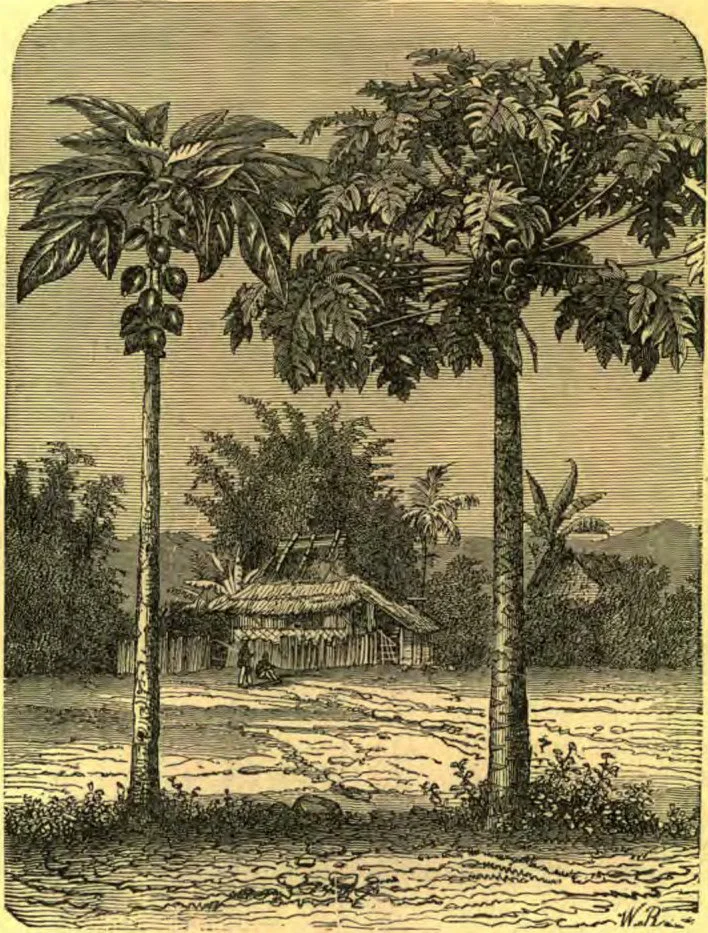
The pawpaw tree, as seen at the right of our picture, is a native of South America. It is said that its growth is so rapid that a seed, when planted, will produce in three years a tree whose trunk is twenty feet high, with its upper part laden with ripe fruit. It is for the sake of this fruit that the tree is cultivated. If gathered before it is ripe, it is soaked in water, boiled, and then eaten as turnips, or baked as apples. The juice of the ripe pulp is a powerful medicine; and the natives employ the leaves instead of soap in washing their linen.
An Oriental fruit of renown is the durion, reckoned next to the mangostan, or even superior to it, for richness of flavor, although it is not of so agreeable an odor. It is so highly esteemed in the Eastern Archipelago that one durion is worth more than a dozen choice pine-apples.
Then there is the West Indian guava, with its yellow, egg-shaped fruit, of a very agreeable taste in its raw state, and also as a jelly; also, the cream fruit, a native of Western Africa, esteemed for its delicious qualities.
Better known to us is the tamarind. The pulp in which the seeds are inclosed is of a sharp taste, but it is a cooling article of food, possessing medicinal properties. The tree, adorned with feathery, pale green foliage, and prettily streaked flowers, presents a handsome appearance.
Lastly, we turn to the forbidden fruit, which is commonly classed in the same family as the orange and lemon. Its name is derived from a legend that it is the tree which grew in Paradise. Indeed, the Mohammedans assign the site of the garden of Eden to the island of Ceylon, where this tree is extensively found. They say that the fruit may be known by the fragrance of its flower and the tempting beauty of its color. It presents the singular appearance of having had a piece bitten out of it, leaving, they say, the marks of the teeth of Eve; and as it now possesses a poisonous quality, it is said that this change from a delicious fruit passed over it as a judgment for the disobedience of our first parents.
Certain it is that the tree is held in high veneration by the Cingalese, though its curious fruit is avoided alike for its bad taste and the superstitious feelings associated with it. But, however singular and unfounded the Eastern story, the solemn fact in our world’s history remains: “When the woman saw that the tree” in the midst of the garden “was good for food, and that it was pleasant to the eyes, and a tree to be desired to make one wise, she took of the fruit thereof, and did eat, and gave also unto her husband with her; and he did eat.” Thus Eve was betrayed into the snare by her great desire to have her senses gratified. She saw; she took; and she did eat; and then became a tempter to her husband. And thus sorrow and sin entered into the world, and death by sin; and so death passed upon all men. But it is our happiness that, as we know of man’s fall in Adam, we know of his salvation through the Son of God.
GUAVA AND PAWPAW TREES.

SUE'S CUP OF COLD WATER.

“FIVE and five is ten, and ten is twenty, and three is twenty-three, and two is twenty-five! Three and two is five, and five is ten, and five is fifteen, and ten is twenty-five—” There was no use. You could not make one more cent of it, no matter how you counted it, and Sue gave it up finally with a little sigh. “It's awful to be poor! If I was only rich like Lena Rivers, I would do lots of good,” she said, as she put the money back into her purse.
To-morrow was the Sabbath-school picnic that Sue had been looking forward to ever since the snow went off. Was she not going to have a whole long holiday out of the hot, noisy mill, and going on the boat to the nice cool woods—how she had looked forward to it! There was one drawback, however, to Sue's happiness. All the rest of the girls in her class were to have new pretty dresses, and she had nothing but her old white one that she had almost outgrown; and, besides, it was darned—well, I do not dare to say how many times. The brightness all faded out of Sue's face when she thought of that, but then she could not have another possibly; and perhaps with fresh ribbons it would not look so very bad. So she had been saving up her pennies. Slow, tedious work it was, but at last there was a quarter, enough for two yards and a half. To-morrow was the picnic, and to-night she was going down the street to buy the ribbons. She felt so happy that she almost ran on her way home from the mill, until she came to Mrs. Mellen's.
Mrs. Mellen went out working by the day, anywhere she could get work. And Jimmy, her little crippled boy, was sitting in the door, watching for her to come home. He had been very sick a long time, and was just getting about again. He looked so sad and pitiful that Sue stopped to speak with him,—
“Isn't it nice out of doors, Jimmy?” she said.
“I guess it would be, if I could get out where there is green grass and trees; but it is so dusty here.”
“I know it,” replied Sue, looking up and down the narrow, dingy street. “How I wish you could go to our picnic. We are going on the river and then to the grove. There'll be music, and good things to eat, and swings, and I don't know what else.”
“I wish I could,” said Jimmy, with a queer little quiver in his voice, and something like tears in his eyes—only boys never cry, you know. But mother couldn't spare the money for my ticket, for I've cost a lot lately.”
“Oh!” exclaimed Sue, with an odd little start. “I must be going. Good night.”
There were two things that popped into Sue's mind all at once. One was the verse that Miss Benton gave her only last Sabbath: “And whosoever shall give to drink unto one of these little ones a cup of cold water only, in the name of a disciple, verily, I say unto you, he shall in no wise lose his reward”—and added: “There's a chance for every one, isn't there, Sue? for the dear Saviour promises to reward even a cup of cold water; and any one can give that much.”
The second thought was of her treasured quarter at home—the tickets were just a quarter! The conclusion she arrived at instantly was: Is not this an opportunity for me to give a cup of cold water to Jimmy Mellen? But then, there were the ribbons! What would become of them? She really did need them so badly. Oh dear, what should she do?
There was no more running. Instead, she walked very slowly; and once home she went directly to her room. To be sure, she knew exactly how much she had, and yet perhaps there was a little more. But not a cent more could she make of it, and now the question was, What could she do? Go without her ribbons, and give Jimmy a day's pleasure? or—Oh dear, how could she give up the ribbons?
Seven—eight—the clock struck. And still Sue sat by the window, her treasure in hand, pondering. A bit of a song floated through her mind:—
“I gave Myself for thee— What hast thou given for me?”
She sprang up quickly. “I won't be so awfully selfish. I will give this little bit,” she cried aloud. And she went flying down stairs, out of the yard, toward Mrs. Mellen's. “O Jimmy,” she cried, almost out of breath, you can go, after all. Here's a quarter for your ticket, and we'll have lots of fun!”
You should have seen Jimmy. He tried to say, “Thank you.” But he could not—do his very best. And, boy as he was, he buried his face in the pillows, and sobbed as though his heart would break. “O Sue, I wanted to go so bad—you don't know.”
As for Sue's ribbons—well, perhaps you won't believe me, but she never thought of them all day long. They had such a pleasant time, you see, and everybody was so good to her and Jimmy.
“It isn't so much what folks have, after all, is it, mother,” she said that night, “as the way they feel inside? I was so glad I let Jimmy go, that I had every bit as good a time as Lena Rivers, I know, if my dress was old, and hers new.”—Selected.

AN AUTUMN DAY.

To-day is a perfect poem, As fair as a dream of June; And the heart of the dying summer Seems ebbing away in tune,—
A tune that is tenderly dreamy, Tender and soft and low, Telling of just such poems In summers of long ago.
And down in the wide green valley, Over the beautiful bay, Rests a veil of shimmering splendor, Of gossamer soft and gray.
And the south wind breaking softly, In whispers across the sea, Is telling the same old story, Over and over to me;
Telling it over and over, In language that's passing sweet, Of rivers of pure water, Of rest for the weary feet;
Of green and shadowy pastures, Of flowers that never die; Of a perfect, eternal summer, A cloudless, unchanging sky;
Of a fair and shining city, Which needs not the light of day, Nor stars, nor the moon's pale glory; For Christ is the light alway.
Oh! this is that perfect poem, Oh! this is that dream most fair, Where the vanished and golden splendor Of summers shall all be there.
Coming from God out of Heaven, The beautiful city will seem Fairer than bride in adorning, Fairer than aught we can dream.
Make me but worthy to enter; Give me, my Father, a place; Lead me up into thy Summer, Into the light of thy face.
—M. R. H.

CANUTE, KING OF ENGLAND.

As the result of a long-continued contest, the Danes settled in many parts of England. In the person of Canute they had conquered the Anglo-Saxon people, and for a time they extinguished the Anglo-Saxon sovereignty. He was king of Denmark and Norway as well as England, and all the historians call him a very wise and good king. William of Malmesbury says of him, “By his piety, justice, and moderation he gained the affection of his subjects, and a universal esteem among foreigners.”
When Canute saw how cruelly the Danes treated the English, he made laws to prevent the Danes from doing any more mischief in England, and to help the English to make themselves comfortable again. He inquired of the judges and wise men concerning King Alfred’s good laws, and having found them, he made the people use them. He restored many of the schools which had been destroyed in the wars, and sent young men to the English college at Rome to study. He acknowledged no difference between conqueror and conquered, between Dane and Englishman. Although he raised up four Earldoms,—Mercia, Northumberland, Wessex, and East Anglia,—and recognized their provincial independence, yet he drew close the ties that bound these rulers to his throne.
One great cause of animosity between the Danes and Anglo-Saxons had been their religion. Canute sought above all things to favor the Church and secure its friendship. His love for the monks of Ely is shown in the verses he wrote while hearing them sing, as he was being rowed over the fen-waters that surrounded their abbey.
“Merrily sung the monks of Ely when Canute king rowed by, Row, boatmen, near the land, and hear we these monks sing.”
His course of action, his ideas of right rule, and his grandeur of character are well expressed in a letter he wrote from Rome to his English subjects: “I have vowed to God to lead a right life in all things, to rule justly and piously my realm and subjects, and to administer just judgment to all. If heretofore I have done aught beyond what was just, through headiness or negligence of youth, I am ready, with God’s help, to amend it utterly. Never have I spared, nor will I spare, to spend myself and my toil in what is needful and good for my people.”
Southampton was one of the places where Canute held court, at the old Roman Clausentum. One day while holding his court here, he was walking with his lords by the side of the Southampton waters. Some of them, thinking to please him, began to praise him very much indeed. They called him great, and wise, and good, and said they were sure he was so powerful he could do anything he chose, that even the waves would do as he bade them. When they had talked this way for some time, he said, “I am tired, bring me a chair.” When they had brought it, he had them place it close by the water’s edge. As he sat in the chair, he said to the sea, “I command you not to let your waves wet my feet.” The flattering lords looked at one another in surprise. Canute sat still until the waves came up so that the water wet him and all the lords who had flattered him so foolishly. Then he rose up and said, “Learn from what you see now, that there is no being really great and powerful but God! He only who made the sea can tell it where and when to stop.” The flatterers saw with shame that the king was too wise to believe their false praise. J. N. LOUGHBOROUGH.

“WE WANTED TO COME.”

Last Sabbath morning dawned chill and rainy, and by Sabbath-school time the rain was falling heavily. Well protected with water-proof, rubbers, and umbrella, I hurried down the street, thinking the while of what a small school we should be likely to have on account of the disagreeable weather. “The older classes,” thought I, “will be likely to be quite well represented, for the young men and women will not mind the rain; but the children’s classes will be rather thin, as it will be too bad for the little ones to get out much.” Thus I mused, as I walked rapidly up the church steps, and laying off my wraps in the vestry, went first into the room where the older classes met. It was yet early, but many of the teachers were there, and a few scholars. Others soon came in, but still the classes were small, and some were without teachers. “The school will be pretty thin to-day,” said one of the superintendents to me, just as the last bell was tolling, and all should have been in their places.
Starting to go into the children’s room, I passed through the vestry, where I noticed a row of small umbrellas along one side. Several little girls were hurrying up the steps, most of them with an umbrella or parasol of some kind; but a number of small boys were running along with nothing to protect them. Perhaps they came “between the drops!” Still I was hardly prepared for the full classes that met my eyes as I passed into the children’s room; and the fifty or more bright faces that looked up with a pleasant “good morning” written there, seemed to say, “We don’t care for the rain!”
Going up to a class of the smallest, I said, “What made you come to-day? It was so bad and rainy!” “Why, ’cause we wanted to come!” piped out several eager little voices. And I needed not to be told that these brave little ones who “wanted to come” had good lessons.
“Ah, yes,” thought I, as I passed on, “That is just the secret of it, and that is the very reason why the older ones stayed away—because they did not want to come. And this same childish answer is the expression of the motive which underlies all earnest work, whether in the Sabbath-school or elsewhere. In one way or another we usually find time and opportunity to do what we really want to do.” **

AUTUMN

Thou standest, like imperial Charlemagne, Upon thy bridge of gold; thy royal hand Outstretched with benedictions o’er the land, Blessing the farms through all thy vast domain. Thy shield is the red harvest moon, suspended So long beneath the heaven’s o’erhanging eaves; Thy steps are by the farmer’s prayers attended; Like flames upon an altar-shrine, the sheaves; And, following thee, in thine ovation splendid, Thine almoner, the wind, scatters the golden leaves! —Longfellow.

DOING GOOD.

A few years since, a wealthy gentleman of Paris, who lived in idleness, at length became weary of life, and left his house one evening, with the intention of drowning himself in the river Seine. It being yet twilight when he arrived at its bank, he concluded to walk about a short time, till it was darker, so that he should not be discovered. While thus engaged, he put his hand in his pocket, and felt a purse, which was filled with gold; he concluded to go and find some poor family, and give it to them, as it would do no one any good, if he cast himself into the river with the money. He soon found a dwelling that bespoke poverty within; he entered it, and there he beheld the mother of the family stretched on a bed of sickness, and six children in rags, and crying for bread. He gave them his purse of gold, and immediately their tears of sorrow were transformed to tears of joy; and their gratitude to their benefactor was so ardent and simple as to fill his heart with joy and peace; and he exclaimed, “I did not know that there was so much happiness in doing good. I abandon the idea of killing myself, and will devote the remnant of my life to doing good.” He did so, and was much distinguished for his deeds of benevolence.

The Blessing of a Good Conscience

A good conscience is better than two witnesses. It melts sorrow as the sun does the ice. It is a spring when we are thirsty, a staff when we are faint, a shelter when the sun strikes us, a pillow in the hour of death.

NEW-TESTAMENT HISTORY.

LESSON 54.—AT THE FEAST OF TABERNACLES.

As Jesus was journeying through Galilee and Samaria, on his way to Jerusalem, he entered into a certain village, where he was met by ten men who were lepers. Standing at a distance, these men cried out, “Jesus, Master, have mercy on us. And when he saw them, he said unto them, Go show yourselves unto the priests. And it came to pass that, as they went, they were cleansed. And one of them, when he saw that he was healed, turned back, and with a loud voice glorified God.” And he fell down at the feet of Jesus, and gave him thanks. And this man was a Samaritan. And Jesus said, “Were there not ten cleansed? but where are the nine? There are not found that returned to give glory to God, save this stranger.” And Jesus said unto him, “Arise, go thy way; thy faith hath made thee whole.”
While Jesus was thus leisurely making his way toward Jerusalem, there was much talk about him at the feast. Some said, “He is a good man,” while others said, “Nay, but he deceiveth the people.” The interest at length became so great that they sought after him, saying, “Where is he?”
Jesus, however, did not show himself openly until about the middle of the feast, when he went up into the temple and began to teach. When the Jews heard him, they marveled, saying, “How knoweth this man letters, having never learned?”
“Jesus answered them, and said, My doctrine is not mine, but his that sent me. If any man will do his will, he shall know of the doctrine, whether it be of God, or whether I speak of myself. He that speaketh of himself seeketh his own glory; but he that seeketh his glory that sent him, the same is true, and no unrighteousness is in him.”
“Did not Moses give you the law, and yet none of you keepeth the law? Why go ye about to kill me? The people answered and said, Thou hast a devil: who goeth about to kill thee? Jesus answered and said unto them, I have done one work, and ye all marvel. Moses therefore gave unto you circumcision (not because it is of Moses, but of the fathers); and ye on the Sabbath day circumcise a man. If a man on the Sabbath day receive circumcision, that the law of Moses should not be broken, are ye angry at me because I have made a man every whit whole on the Sabbath day? Judge not according to the appearance, but judge righteous judgment.”
“Then said some of them of Jerusalem, Is not this he whom they seek to kill? But, lo, he speaketh boldly, and they say nothing unto him. Do the rulers know indeed that this is the very Christ? Howbeit, we know this man whence he is; but when Christ cometh, no man knoweth whence he is.”
“Then cried Jesus in the temple, as he taught, saying, Ye both know me, and ye know whence I am; and I am not come of myself, but he that sent me is true, whom ye know not. But I know him; for I am from him, and he hath sent me.”
“Then they sought to take him; but no man laid hands on him, because his hour was not yet come. And many of the people believed on him, and said, When Christ cometh, will he do more miracles than these which this man hath done?”

QUESTIONS.

1. While Jesus was on his way to the feast of tabernacles, who met him, as he was entering a certain village? Luke 17:11, 12.
2. What did they cry out, as they stood afar off?
3. What did Jesus say to them?
4. What happened to them, as they went on their way?
5. When they discovered that they were healed, what did one of them do?
6. What did Jesus say about the ingratitude of the others?
7. What did he say to this Samaritan, who had returned to give thanks?
8. What interest was manifested in Jesus at the feast, before he arrived?
9. At what time did he show himself there? John 7:14.
10. What did he at once begin to do?
11. How did his preaching affect some of the Jews? Verse 15.
12. What did they say?
13. What did Jesus say of his doctrine?
14. How may any one know that the doctrine taught by Jesus is of God?
15. What does he seek who speaks of himself?
16. What may be said of him who seeks the glory of him who sent him?
17. What did Jesus say to the Jews about the law of Moses? Verse 19.
18. What did the Jews say when Jesus asked them why they were plotting to kill him?
19. To what did Jesus probably refer when he said, I have done one work?—He probably referred to the healing of the impotent man at the pool of Bethesda, a year and a half before. John 5:1–18.
20. Had he attended any Passover since that time?
21. Why not? John 7:1.
22. To what conclusion do we come, from the facts stated?—That they still made the healing of the paralytic on the Sabbath day a pretext for seeking the life of Jesus.
23. What were the Jews accustomed to do on the Sabbath day, in order that the law of Moses should not be broken?
24. What did this law require?—That every male child should be circumcised on the eighth day after his birth.
25. How did Jesus show the inconsistency of their accusation against him?—If, rather than delay the circumcision of a child until the ninth day, it was proper to perform the ceremony on the Sabbath, how much more proper it was for Jesus to make a man every whit whole on the Sabbath day.
26. What caution did Jesus give them about judging?
27. What words of surprise were uttered by some who dwelt at Jerusalem, and knew that the rulers had planned to kill Jesus if he came to this feast? Verses 25, 26.
28. How did some deceive themselves, that otherwise might have believed? Verse 27.
29. What did they mean by this?—They probably thought that the parentage of the Messiah would be a mystery, and since the humble birth of Jesus was, as they supposed, well known to them, they decided that he could not be the Christ.
30. What reply did Jesus make? Verses 28, 29.
31. What did his enemies then attempt to do?
32. Why were they not able to arrest him?
33. How did his words affect the people?
34. What did they say?

NOTES

JEWISH FEASTS.

“God appointed several festivals, or days of rest and worship, among the Jews, to perpetuate the memory of great events wrought in favor of them: the Sabbath commemorated the creation of the world; the Passover, the departure out of Egypt; the Pentecost, the law given at Sinai, etc. At the three great feasts of the year, the Passover, the Pentecost, and that of Tabernacles, all the males of the nation were required to visit the temple. Ex. 23:14-17; Deut. 16:16, 17; and to protect their borders from invasion during their absence, the shield of a special providence was always interposed. Ex. 34:23, 24. The other festivals were the feasts of Trumpets, or New Moon, Purim, Dedication, the Sabbath year, and the year of Jubilee. The observance of these sacred festivals was adapted not merely to freshen the remembrance of their early history as a nation, but to keep alive the influence of religion and the expectation of the Messiah, to deepen their joy in God, to dispel animosities and jealousies, and to form new associations between the different tribes and families.”
The feast of the Passover was held in the first month of the Jewish year, answering for the most part to our April. The lamb was killed on the fourteenth day of the month, and the feast continued from the fifteenth to the twenty-first inclusive. The feast of Pentecost was held fifty days later than the feast of the Passover.

The Feast of Tabernacles.—

“This festival derives its name from the booths in which the people dwelt during its continuance, which were constructed of the branches and leaves of trees, on the roofs of their houses, in the courts, and also in the streets. Nehemiah describes the gathering of palm-branches, olive-branches, myrtle-branches, etc., for this occasion, from the mount of Olives. It was one of the three great festivals of the year, at which all the men of Israel were required to be present. Deut. 16:16. It was celebrated during eight days, commencing on the fifteenth day of the month Tishri, that is, fifteen days after the new moon in October; and the first and last days were particularly distinguished. Lev. 23:34-43; Neh. 8:14-18. This festival was instituted in memory of the forty years’ wanderings of the Israelites in the desert, Lev. 23:42, 43, and also as a season of gratitude and thanksgiving for the gathering in of the harvest, whence it is also called the Feast of the Harvest. Ex. 23:16; 34:22. This season was an occasion of rejoicing and feasting. The public sacrifices consisted of two rams and fourteen lambs on each of the first seven days, together with thirteen bullocks on the first day, twelve on the second, eleven on the third, ten on the fourth, nine on the fifth, eight on the sixth, and seven on the seventh; while on the eighth day one bullock, one ram, and seven lambs were offered. Num. 29:12-39. On every seventh year, the law of Moses was also read in public, in the presence of all the people. Deut. 31:10-13; Neh. 8:18.”
“These leafy structures [the booths] were sometimes erected on the tops of the houses, and in the streets, but oftener outside the walls of the city, in the valleys and along the hill-sides. Scattered about in every direction, these green camps presented a very picturesque appearance.
“The feast lasted one week, and during all that time the temple was a festal scene of great rejoicing. There was the pomp of the sacrificial ceremonies; and the sound of music, mingled with hosannas, made the place jubilant. At the first dawn of day, the priests sounded a long, shrill blast upon their silver trumpets; and the answering trumpets, and the glad shouts of the people from their booths, echoing over hill and valley, welcomed the festal day. Then the priest dipped from the flowing waters of the Kedron a flagon of water, and, lifting it on high, while the trumpets were sounding, he ascended the broad steps of the temple, keeping time with the music with slow and measured tread, chanting meanwhile: ‘Our feet shall stand within thy gates, O Jerusalem!’”
“He bore the flagon to the altar, which occupied a central position in the temple court. Here were two silver basins, with a priest standing at each one. The flagon of water was poured into one basin, and a flagon of wine into the other; and the contents of both flowed into a pipe which communicated with the Kedron, and was conducted to the Dead Sea. This display of the consecrated water represented the fountain that flowed from the rock to refresh the Hebrews in the wilderness. Then the jubilant strains rang forth:— “ ‘The Lord Jehovah is my strength and song:’ ‘therefore with joy shall we draw water out of the wells of salvation!’ All the vast assembly joined in triumphant chorus with musical instruments and deep-toned trumpets, while competent choristers conducted the grand harmonious concert of praise.
“The festivities were carried on with an unparalleled splendor. At night the temple and its court blazed so with artificial light that the whole city was illuminated. The music, the waving of palm-branches, the glad hosannas, the great concourse of people, over which the light streamed from the hanging lamps, the dazzling array of the priests, and the majesty of the ceremonies, all combined to make a scene that deeply impressed all beholders.”

SCENES IN THE LIFE OF CHRIST.

LESSON 41.—REVIEW.

  1. What was our Lord’s first noted miracle after the Sermon on the Mount? Matt. 8:5-13; Luke 7:1-10.
  2. What was the next? Luke 7:11-17.
  3. While Jesus was at meat in the house of a Pharisee, what was done for him by a woman that was a sinner? Luke 7:36.
  4. What complaint did the Pharisee make?
  5. What way did Jesus take to show him that he was wrong?
  6. On what round of preaching did Jesus then go? Luke 8:1-3.
  7. Who went with him?
  8. Tell how the people crowded upon him to hear him. Mark 3:19-21.
  9. What noted miracle attracted special attention? Matt. 12:22, 23.
  10. How did the people regard this miracle?
  11. What did the Pharisees say of it?
  12. How did Jesus show that what the Pharisees said could not be true?
  13. What is it that makes our conversation good or bad? Matt. 12:34, 35.
  14. What did Jesus say about the importance of our words?
  15. What was the only sign that Jesus would give the scribes and Pharisees?
  16. What did Jesus say was more honorable than to be his natural brother, or even to be his mother? Luke 11:28; Matt. 12:46-50.
  17. Relate the parable of the sower. Matt. 13; Mark 4; Luke 8.
  18. Give the explanation of it that Jesus gave his disciples.
  19. Repeat the parable of the wheat and the tares.
  20. What is represented by the wheat, and what by the tares?
  21. How long were the wheat and the tares to be left to grow together?
  22. To what does the harvest correspond?
  23. What was to be done with the wheat, and what with the tares, at the time of harvest?
  24. What is to be done with the wicked, and what with the righteous, at the end of the world?
  25. Tell the parable of the treasure in the field.
  26. What other parable was given to show how we ought to regard the kingdom of heaven?

DO YOU LOVE YOUR SCHOLARS?

WITHOUT love you cannot teach. And you must love, not the gentle only, but the forward also—not Jennie, because Jennie’s mother is your best friend, or Nellie because she is beautiful, or Willie because he has winning ways, but love the rudest, and the most insubordinate as well. Love the children for their own sakes; love them for Christ’s sake.
Love begets love, inspires confidence, banishes coldness, softens harshness into tenderness, puts new light into the teacher’s eye, and a new melody in his voice. Love quickens thought, and gives the teacher full control of the child. It prevents favoritism, and gives all classes of your pupils faith in the religion of Him who is “no respecter of persons.”—Teacher’s Cabinet.
Continue reading: CLEANING HOUSE