The Youth’s Instructor, Vol. 28, No. 41.

THE CROCODILE OF OLD

The Youth’s Instructor

Oct 6, 1880

S. D. A. Publishing Association · Battle Creek, Mich. · Oct 6, 1880

THE CROCODILE OF OLD.
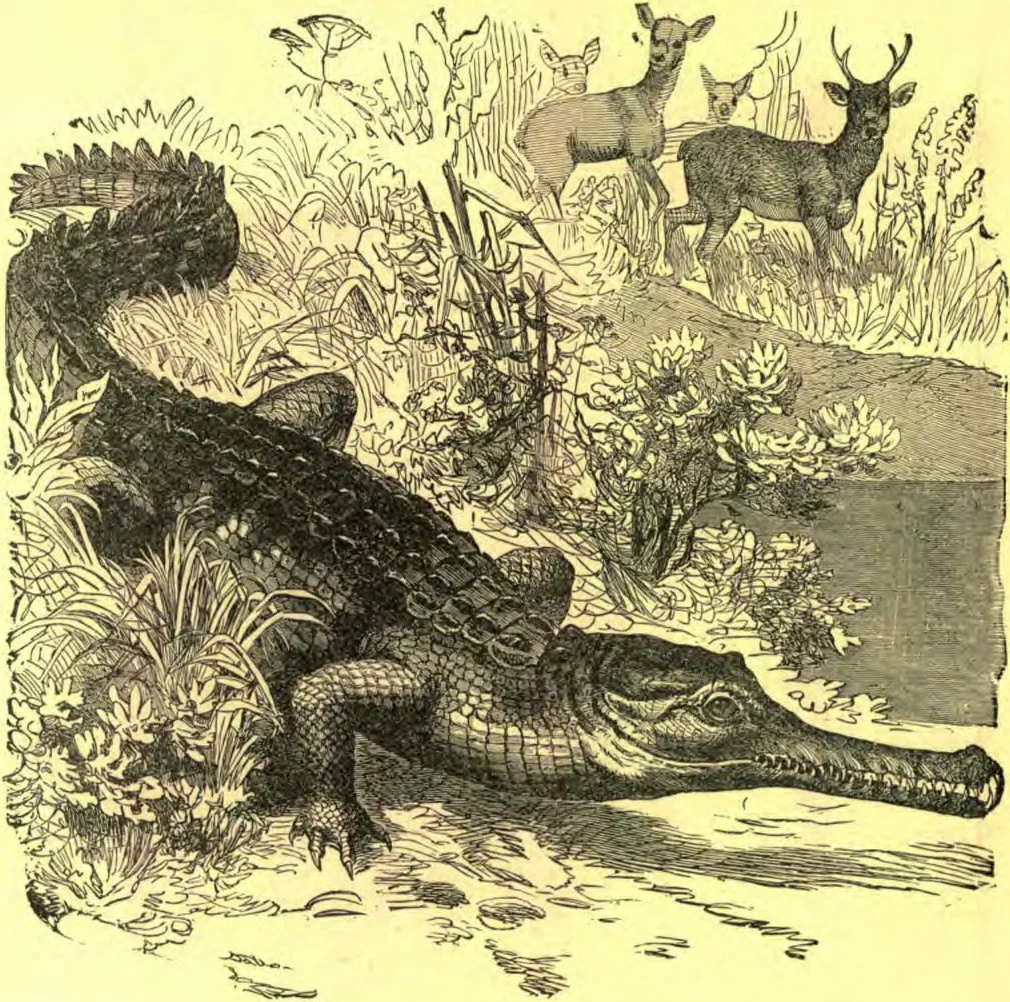
Of all the strange creatures worshiped as gods by the ancient Egyptians, perhaps none were so favored as the crocodiles inhabiting the sacred river. The banks of the Nile were dotted with the low huts of keepers, whose only care was to decorate the scaly heads of the monsters with gold and precious stones, and feed them with costly viands served on vessels splendidly wrought in silver. Daily, at noon, the king came in state with his household to view them as they lay warming their great ugly backs in the sun, and at night and early morn, the priests, offering incense, implored them to hear the prayers of the people. And it was not enough that homage should be paid them while living, but after death their bodies were carefully embalmed, wrapped in fold upon fold of perfumed cloths, and buried with magnificent pomp in a sepulcher sacredly consecrated as their final resting-place.
This now famous Crocodile Cave extends underground for several miles, and is a curious object of interest to travelers in the East. Its entrance is a small, square aperture, eight by twelve feet, in the flat summit of a low range of hills crossing the desert in upper Egypt, and the succession of narrow chambers is exceedingly difficult to explore on account of the quantities of dust and half-fallen rocks which choke up the winding passage-way.
Here lie the defunct gods of all sizes; some of them huge, shapeless masses eighteen to twenty feet in length; others, tiny objects but a few inches long, packed in layers with palm leaves between. Think of embalming, not to say worshiping, a crocodile just out of the egg! Such heathen idolatry seems impossible in these days of light and progress, and we cannot be too thankful that, long ago, the crocodile descended to his proper level.—Classmate.

The Language of the Swearer

ORDINARILY we know from what country people come by the language they use; but in the case of the swearer it is different,—he uses the language of the country to which he is going.

WRITE THEM A LETTER TO-NIGHT.

DON’T go to the theater, concert, or ball, But stay in your room to-night; Deny yourself to the friends that call, And a good long letter write;—
Write to the sad old folks at home, Who sit when the day is done, With folded hands and downcast eyes, And think of the absent one.
Don’t selfishly scribble, “Excuse my haste, I’ve scarcely the time to write;” Lest their brooding thoughts go wandering back To many a by-gone night, When they lost their needed sleep and rest, And every breath was a prayer That God would leave their delicate babe To their tender love and care.
Don’t let them feel that you’ve no more need Of their love or counsel wise, For the heart grows strangely sensitive When age has dimmed the eyes. It might be well to let them believe You never forget them quite; That you deem it a pleasure when far away, Long letters home to write.
Don’t think that the young and giddy friends Who make your pastime gay, Have half the anxious thoughts for you That the old folks have to-day. The duty of writing do not put off; Let sleep or pleasure wait, Lest the letter for which they looked Be a day or an hour too late.
Be sure the sad old folks at home, With locks fast turning white, Are longing to hear from the absent one,— Write them a letter to-night.—Sel.

LORD YARBOROUGH'S DOGS.

Lord Yarborough, who has a splendid estate in the Isle of Wight, keeps a great many dogs,—eighty in number. They all live in one house, or “kennel,” and sleep in one bed,—a good big one it must be.
Over the bed hangs a bell, and if the keeper, who lives near by, hears any snarling or quarreling, he just rings the bell, and down they lie, still as mice; for they know the whip will very soon follow the bell, and so they wisely hush up their little disputes and go to sleep.
All this large family of dogs have names, and when the keeper calls the roll, they each walk out as orderly and as quietly as boys and girls in school.
Think what a quantity of food is needed for their breakfast and supper. In their store-room may be seen two or three quarters of horse beef hanging up, and great bins or sacks of nice oatmeal and barley meal. For their soup, two old horses are killed weekly. The oatmeal and barley meal are scalded and made into a kind of porridge; and everything about their house and cookery is perfectly nice and clean.—Sel.

COD-FISHERIES

The morning of the fourth day of our voyage finds us nearly over the New Foundland Banks. These great banks, on the south-east of the island, are the most extensive submarine elevation known to exist in any ocean, being six hundred miles long by two hundred miles wide. The whole bank appears to be a mass of solid rock with abrupt descents, which deepen suddenly from one hundred and fifty to five hundred and seventy feet below the level of the sea. There is, also, what is called the outer bank, which seems to be a continuation of the great bank at a lower elevation. This outer bank is one of the greatest fishing places in the world, and the catching and curing of cod-fish is the principal employment of the inhabitants of New Foundland.
As our steamer is out of sight of land, we have no opportunity to see the arrangements for catching and curing the cod. In the spring of 1863, I witnessed this interesting process on Block Island, thirty miles from Newport, Rhode Island. Thirty small sail-boats, called fishing-smacks, left the harbor at 3 A. M., and by sunrise they were out twelve miles east of the island, and over one of these fishing banks. From each boat they let down a large stone or piece of iron for an anchor, to which was attached a rope about one hundred and fifty feet in length. When the stone touched the bottom, the rope was made fast, and thus the boat was held in position. A fishing line was then let down by a reel placed over the bow of the boat. Near the end of this were attached five or six short lines with hooks baited with pieces of fresh herring. As the fish feed on a sea growth upon these banks, they soon discover this bait near them, and “bite.” The hooks are then drawn up, and very seldom without a fish upon each hook.
Generally, two hours is long enough to secure a full load. The men then return to the harbor and unload their fish, which are immediately cleaned near the sea-side. They are then taken into small huts near by, and salted down in casks. They are allowed to remain in these casks some three or four weeks, after which they are taken out, dried in the sun, and packed in boxes for the market.
By 4 o’clock P. M. the fish were all out of sight, the little “smacks” made fast, and the fishermen gone to bed to secure their sleep so as to be off the next morning early to the fishing grounds. Cod-fish feed early in the morning, and seldom “bite” at a hook after noon.
But while we have been conversing on cod-fishing and fishing banks, the captain and mate have made the noon observation and calculation. Since yesterday we have sailed three hundred miles. This is good, and we do not expect to exceed this any day. We are now eleven hundred and forty-six miles from New York, and just leaving the Banks. Our ship’s course is a little more easterly, and we are rapidly nearing the deepest waters of the Atlantic.
J. N. L.

SOLOMON'S TEMPLE.

The building commonly called Solomon's Temple was one of the most beautiful ever constructed. It was Solomon's only in the sense that he ordered the work of building,—the plans and specifications were nearly all revealed from Heaven.
A most interesting and significant fact in the construction of this building is that the material was all prepared and fitted before it was brought on the ground, so that everything went to its place without the sound of chisel or hammer.
The temple was erected on the summit of Mount Moriah, one of the two mountains upon which Jerusalem stood. The walls were built of beautiful white stone, ornamented with plates of gold. These walls arose perpendicularly from the bottom of the valley over four hundred and fifty feet. From a distance, the temple is said to have resembled the snow cap of a mountain; and when the sun shone upon it, the golden ornaments reflected the rays with wonderful beauty.
The site of this temple had been made sacred by at least two extraordinary events. Nearly nine hundred years before, on the same spot, Isaac was bound upon the altar of sacrifice, Abraham thus manifesting that faith in God's word and promises which has given him the title “The Father of the Faithful.” In David's time the place was occupied by Ornan the Jebusite, as a threshing-floor. On account of the wickedness of the people, God sent a terrible plague upon them. About seventy thousand of the people had already died, when the angel of the Lord commanded David to buy the threshing-floor and there make an offering, which he did, and the work of destruction was stayed.
Jesus promises, “Him that overcometh will I make a pillar in the temple of my God.” It is of such material as we are that God proposes to build his temple. The preparation must be made now. Our carnal natures must be subdued, and our characters molded after Christ's character. If at last we are found meet for the Master's use, there will be a place for us in our Father's “house.” The work must be done now, because there will be no fitting and finishing there. The building will go together without sound of hammer or ax.
G. C. TENNEY.

PERSEVERANCE

Perseverance wins the day, Either in thy work or play, Reaching forward to the end, Steadfast to thy purpose bend Every muscle, every nerve; Vanquish self, nor ever swerve. Earnestness in anything, Rich reward is sure to bring; And who play in earnest learn Noble work to do in turn. Child, if thou wouldst prosper here, Early learn to persevere.

An Earthly Story With a Heavenly Meaning

A LITTLE girl described a parable as “an earthly story with a heavenly meaning.”

AUTUMN

As we look abroad over the face of nature, we can see that summer is gone, and, step by step, autumn is coming with all her brightness and beauty. True, the leaves are yet green upon the trees, the flowers are still blooming in the gardens, the grass, like a soft, green, velvet carpet, covers the meadows and pastures; but yet there are signs that summer has gone,—there are withered leaves, the sun is marching southward, and occasionally an icy breath comes from the North.
Oh, these glorious autumn days, upon which we have entered, of which September has brought us the first installment! They are simply delicious. Why, the very name, autumn, suggests ripeness and fullness; for while it means that the freshness of summer is gone, it also means that the time for the harvest has come.
Not an idle day has nature spent during the summer; night and day the mysterious growth has been going on, and now the summer’s work is done, and well done. The harvest is gathered in, the granaries are full to overflowing, for the harvest has been abundant.
Autumn speaks to us all. Like it our lives at their close should be rich with golden sheaves. But to have a good harvest, care must be taken with the sowing; for as we sow, we shall garner in. The autumn time of our lives is not far off. The day of Judgment will reveal what the sowing has been, for it will show a harvest of good or bad fruit.
V. A. M.

LESSONS FOR CHILDREN.

LESSON XCIII.—DANIEL PROTECTED AMONG LIONS.

“It pleased Darius to set over the kingdom a hundred and twenty princes, which should be over the whole kingdom; and over these, three presidents, of whom Daniel was first; that the princes might give accounts unto them, and the king should have no damage. Then this Daniel was preferred above the presidents and princes, because an excellent spirit was in him; and the king sought to set him over the whole realm.” This made the presidents and princes envious of Daniel, and even angry at him, so much so that they laid plans to put him out of the way. They tried to find something wrong in his management of the affairs of the kingdom, but could find nothing. “Then said these men, We shall not find any occasion against this Daniel, except we find it against him concerning the law of his God.” Then they counseled together and made a decree that whosoever should ask any petition of any god or man for thirty days save of the king should be cast into a den of lions. This decree they brought to the king and asked him to sign it, in order that it might become a statute that could not be changed. The king did not suspect their evil designs, and so signed the decree very cheerfully.
Daniel paid no attention to the decree, but three times a day kneeled before his open window and prayed to his God. This was just what his enemies had expected, and they went immediately to the king and entered a complaint against him, demanding that he should be cast into the lions’ den, according to the decree that had just been made. When the king heard this, he was “sore displeased with himself, and set his heart on Daniel to deliver him; and he labored till the going down of the sun to deliver him.” But these wicked men said unto him, “Know, O king, that the law of the Medes and Persians is, That no decree nor statute which the king establisheth may be changed. Then the king commanded, and they brought Daniel, and cast him into the den of lions.” But the king did not think Daniel would be destroyed; for he said to him, “Thy God, whom thou servest continually, he will deliver thee.”
After a stone had been laid upon the mouth of the cave, the king sealed it with his own signet, and then went to his own palace, where he spent the night fasting; for he loved Daniel, and besides, he knew him to be the most valuable man in his kingdom, and was very anxious for his safety.
Very early in the morning, Darius went to the den, and cried out, “O Daniel, servant of the living God, is thy God, whom thou servest continually, able to deliver thee from the lions?” And Daniel said, “My God hath sent his angel, and hath shut the lions’ mouths, that they have not hurt me.” Then the king was glad, and had Daniel taken up out of the lions’ den. When Daniel was brought out, it was seen that the lions had not hurt him at all.
Then the king ordered that the men who had accused Daniel should be brought, and cast into the lions’ den. This order was obeyed, and when the men were cast in, the lions broke all their bones in pieces before they reached the bottom of the cave.
Then King Darius made a decree and put it in writing, and sent it unto all the people, nations, and languages that dwell in all the earth, saying, “I make a decree, That in every dominion of my kingdom men tremble and fear before the God of Daniel; for he is the living God, and steadfast forever, and his kingdom that which shall not be destroyed, and his dominion shall be even unto the end.”

QUESTIONS.

  1. How many princes did Darius set over his kingdom? Dan. 6.
  2. Whom did he set over the princes?
  3. Who was first, or chief of these presidents?
  4. Why was Daniel preferred above the presidents and princes?
  5. What high position of honor and authority did the king think to give him?
  6. How did this cause the presidents and princes to feel toward Daniel?
  7. What plans did they lay?
  8. How did they first try to find something of which to accuse him?
  9. When they failed in this, what did they say?
  10. After counseling together, what decree did they draw up?
  11. What did they ask the king to do?
  12. Why were they so anxious to have him sign the decree?
  13. Why did he sign it so willingly?
  14. How did Daniel regard the decree?
  15. Had his enemies expected him to obey it?
  16. What did they do as soon as they found that Daniel still prayed to his God three times a day?
  17. What did they demand?
  18. How did the king feel when he heard this?
  19. What did he set his heart to do?
  20. How long did he labor to save Daniel from such a terrible fate?
  21. What did these wicked men say to the king?
  22. What did the king command when he found that they would show no mercy?
  23. Did he think that Daniel would be destroyed?
  24. What did he say to him?
  25. After a stone had been laid upon the mouth of the cave, what did the king do?
  26. How did he spend the night?
  27. Why did he feel so anxious for Daniel?
  28. What did he do very early in the morning?
  29. What did he cry out when he came to the den in which Daniel had been put?
  30. What did Daniel say in answer to the king’s question?
  31. What did the king have done?
  32. Had Daniel been hurt by the lions?
  33. What command did the king give in regard to the men that had accused Daniel?
  34. When these men were cast into the den, how did the lions serve them?
  35. What decree did the king then make?
  36. Where did he send the decree?
  37. What did he say about the God of Daniel?

BIBLE LESSONS FOR YOUTH.

LESSON CXIX.—CHRIST’S FIRST MIRACLES.

The next day after Andrew and Peter joined him, Jesus went to Galilee, where he saw Philip, and said unto him, “Follow me.” “Now Philip was of Bethsaida, the city of Andrew and Peter. Philip findeth Nathanael, and saith unto him, We have found Him, of whom Moses in the law, and the prophets, did write, Jesus of Nazareth, the son of Joseph. And Nathanael said unto him, Can there any good thing come out of Nazareth? Philip saith unto him, Come and see.” It would seem from this that Nazareth had a bad reputation, for Nathanael was a good man, as will be seen from the Saviour’s words, who when he saw him coming, said, “Behold an Israelite indeed, in whom is no guile! Nathanael saith unto him, Whence knowest thou me? Jesus answered and said unto him, Before that Philip called thee, when thou wast under the fig-tree, I saw thee. Nathanael answered and saith unto him, Rabbi, thou art the Son of God; thou art the King of Israel. Jesus answered and said unto him, Because I said unto thee, I saw thee under the fig-tree, believest thou? Thou shalt see greater things than these. And he saith unto him, Verily, verily, I say unto you, Hereafter ye shall see heaven open, and the angels of God ascending and descending upon the Son of man.”
“And the third day there was a marriage in Cana of Galilee; and the mother of Jesus was there. And both Jesus was called, and his disciples, to the marriage. And when they wanted wine, the mother of Jesus saith unto him, They have no wine. Jesus saith unto her, Woman, what have I to do with thee? Mine hour is not yet come. His mother saith unto the servants, Whatsoever he saith unto you, do it. And there were set there six waterpots of stone, after the manner of the purifying of the Jews, containing two or three firkins apiece. Jesus saith unto them, Fill the waterpots with water. And they filled them up to the brim. And he saith unto them, Draw out now, and bear unto the governor of the feast. And they bare it. When the ruler of the feast had tasted the water that was made wine, and knew not whence it was (but the servants which drew the water knew), the governor of the feast called the bridegroom, and saith unto him, Every man at the beginning doth set forth good wine; and when men have well drunk, then that which is worse; but thou hast kept the good wine until now. This beginning of miracles did Jesus in Cana of Galilee, and manifested forth his glory; and his disciples believed on him. After this he went down to Capernaum, he, and his mother, and his brethren, and his disciples; and they continued there not many days.
“And the Jews’ passover was at hand, and Jesus went up to Jerusalem, and found in the temple those that sold oxen and sheep and doves, and the changers of money sitting; and when he had made a scourge of small cords, he drove them all out of the temple, and the sheep, and the oxen; and poured out the changers’ money, and overthrew the tables; and said unto them that sold doves, Take these things hence; make not my Father’s house a house of merchandise. And his disciples remembered that it was written, The zeal of thine house hath eaten me up.
“Then answered the Jews and said unto him, What sign showest thou unto us, seeing that thou doest these things? Jesus answered, and said unto them, Destroy this temple, and in three days I will raise it up. Then said the Jews, Forty and six years was this temple in building, and wilt thou rear it up in three days? But he spake of the temple of his body. When therefore he was risen from the dead, his disciples remembered that he had said this unto them; and they believed the scripture, and the word which Jesus had said.”

QUESTIONS.

1. Where did Jesus go the next day after he was joined by Andrew and Peter? John 1:43.
2. Whom did he see there?
3. To what city did Philip belong?
4. What other two of Christ’s disciples belonged to the same city?
5. What did Christ say to Philip?
6. When Philip found out that Jesus was the Christ, to whom did he carry the glad news?
7. Relate the conversation between Philip and Nathanael.
8. Judging from Nathanael’s remark, “Can there any good thing come out of Nazareth?” what would we naturally think of that place?
9. What kind of man was Nathanael?
10. What reason have we for thinking so?
11. What testimony did our Lord bear to the purity of his character?
12. How did he show his surprise at the words of Jesus?
13. What reply did Jesus make?
14. What did Nathanael then say?
15. How did Jesus answer him?
16. What wonders did he say Nathanael should afterward behold?
17. What occasion called Jesus and his disciples to Cana on the third day? John 2:1.
18. Describe the miracle which Jesus performed at the marriage feast.
19. When the water had been changed to wine, what did he tell the servants to do?
20. What may be said of the quality of the wine?
21. What proof have we of this?
22. What was the effect produced by this miracle?
23. Where did Christ go after this?
24. Who accompanied him?
25. How long did they remain there?
26. Where did he next go?
27. Why did he go to Jerusalem?
28. In what condition did he find the temple?
29. What did he do?
30. What did he say to those who sold doves?
31. What scripture did this incident bring to the minds of the disciples?
32. What did the Jews then say to Jesus?
33. How did Jesus answer them?
34. How did the Jews show their astonishment at what he said?
35. To what temple did he have reference?
36. After he was risen from the dead, what effect did the remembrance of these words have upon his disciples?

RAISING MISSIONARY TOMATOES.

At a Sabbath-school convention in Murphy’s, California, a lad about fourteen years of age came to the superintendent and said,
“I’ve got some missionary money for you.”
“Who gave it to you?”
“Oh, I earned it all myself,” was his reply, and his bright eyes shone with joy.
“How did you earn it?”
“Last spring my mother had more tomato plants than she wanted, and I asked her to give me some. I planted them, and when the tomatoes were ripe I peddled them. At first I received three cents, then two cents, and, by-and-by, one cent, a pound. Here is one dollar and a half; I want it all to go to missions.”
“But, Herbert, who told you to do this?”
“I told myself.”
“Didn’t your mother ask you to do this?”
“No; but she encouraged me.”
“Are you perfectly willing that all this money should go to missions, and none of it for marbles, toys, candies, etc.?”
“Yes, sir.”
“How long are you going to keep this up?”
“I guess as long as I live.”
“One question more. Do you love Jesus? Have you given your heart to him?”
With a modest and serious expression on his face, he replied, “Yes, I have.”
Ah, here was the secret: The boy turning aside from just so much play-time, from games and fun with the other boys, to work in the corner of the garden, carefully watching and tending the vines till they yielded the bright red fruit, then peddling it from house to house, because he loved Christ, his Saviour.

NOTES ON BIBLE LESSONS FOR YOUTH.

THE THIRD DAY.—It is a little uncertain whether this means the third day from the time when Peter and Andrew joined the Saviour, or the third day after he arrived in Galilee; for either could be true, since it could not have been more than about fifty miles from the place where John was baptizing to the place in Galilee to which our Lord probably went.
CANA.—Be sure to read the article on Cana, found below; and also the one on Nazareth, found in a previous number.
G. H. BELL.

CANA OF GALILEE.

THE province of Galilee comprises all that part of Palestine lying north of Samaria, including the great plain of Esdraelon. It is hemmed in on the south by the mountains of Samaria; on the east it extends as far as the Jordan; on the north it is bounded by the southern end of the mountains of Lebanon; and on the west it is skirted by the Phoenician plain and the waters of the Great Sea.
The upper portion of this region is quite mountainous, but the lower part forms an undulating plain. Nature has here spread out her beauties in rich profusion. The earth is covered with bright green grass, scattered over with flaming wild-flowers, while the low hills are dotted with groves of evergreen oak. Birds, familiar in our own land, people the trees and inhabit the ledges and rocky caverns.
To the Bible student, Galilee has many places of deep interest. Prominent among these is Cana, located about half-way between the sea of Galilee and the northern extremity of the Carmel range.
There are, at the present time, two places where ancient Cana may have been situated. One, about nine miles north of Nazareth, Kona el-Jelil, is, Dr. Robinson thinks, in all probability the one mentioned in the Scriptures. He says that this place is “on the southern declivity of a tell [hill], and overlooking the plain. The situation is fine. It was once a considerable village of well-built houses, now all deserted. Many of the dwellings are in ruins. There are also several arches belonging to modern houses, but we could discover no traces of antiquity.”
The other place, Kefr Kenna, is but about three and a half miles north of Nazareth. This is a modern village, consisting of from thirty to forty houses and a little synagogue. As yet, no one seems prepared to state just where the site of Cana was; excellent authorities prefer one place, and others, equally good, find reasons for choosing the other.
This little village was the birthplace of the apostle Nathanael. It will also be remembered as the place where our Lord first made manifest to the sons of men his divine power, when “the conscious water saw its Lord and blushed.” Dr. Fish in speaking of this miracle says: “The church edifice (at Kefr Kenna) is said to stand over the site of the miracle; and on the floor (simply smooth and level ground) I was shown the reputed big earthen jars that held the wine.”
At another time, the tender mercy of Jesus was shown, when, by the might of his word, he made well and strong the son of the heart-sick ruler whose faith was so great that he came over fourteen long miles to hear the Saviour speak the words of healing.
Many, many are the places around Cana, which, had they tongues, would volumes tell of the words of compassion, the deeds of mercy, and the mighty miracles, that Christ has done.
O Galilee! thrice hallowed spot, where He who came man's life to save did first his wondrous works perform! WINNIE LOUGHBOROUGH.

“BE PATIENT, MY DEAR.”

“MOTHER,” said Mary, “I can’t make Henry put his figures as I tell him.”
“Be patient, my dear, and do not speak harshly.”
“But he won’t let me show him how to put the figures,” said Mary, very pettishly.
“Well, my dear, if Henry won’t learn a lesson in figures, suppose you try to teach him one in patience. Perhaps when you have learned this the others will be easier to both.”
Mary hung her head, for she felt that it was a shame to any little girl to be fretted by such a little thing, and she began to think that perhaps she deserved to be blamed as well as Henry.—Canada Presbyterian.

LETTER BUDGET.

Alice A. Floyd, of Southampton, England, writes us a nice little letter. She is not a Sabbath-keeper, but takes the INSTRUCTOR and attends Sabbath-school. She is ten years old.
Now we will read this letter from Christian P. Hanson, of Artichoke, Minnesota: “I have been taking the monthly INSTRUCTOR the past two years, but now I am taking the weekly. I read it with great interest. I am keeping the Sabbath. I was baptized May, 1878. We have no Sabbath-school, but I read my Bible and try to live for the coming kingdom. Pray for me.”
Ida E. Potter, of West Hallock, Illinois, says that she has taken the INSTRUCTOR two months, and likes it better than anything else she has to read, excepting her Bible. She is so glad that so many of the INSTRUCTOR family love Jesus. She desires the prayers of all.
Annie A. Whitlock, of Bonaparte, Iowa, writes: “I attend Sabbath-school, where I get the INSTRUCTOR. I learn the lessons in it, and think that they are very good. My youngest sister, Ida, died this month. We miss her very much, but hope to see her again when Jesus comes.”
Carrie Neill, of Southampton, England, writes a nice little letter, in which she says that she is keeping the Sabbath with her father and mother, and is trying to so live that she may be ready when Jesus comes. She is eight years old.

LITTLE HOME-BODY.

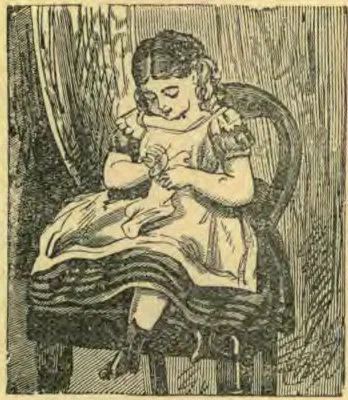
LITTLE Home-body is mother's wee pet, Fairest and sweetest of house-keepers yet; Up when the roses in golden light peep, Helping her mother to sew and to sweep; Tidy and prim in her apron and gown; Brightest of eyes of the bonniest brown; Tiniest fingers, and needle so fleet, Pattern of womanhood, down at my feet.
Little Home-body is grave and demure, Weeps when you speak of the wretched and poor, Though she can laugh in the merriest way While you are telling a tale that is gay. Lily that blooms in some lone leafy nook, Sly little hide-away, moss-sided brook; Fairies are fine where the silver dews fall; Home-fairies,—these are the best of them all. —Sel.

You have reached the end of this edition.

The Youth’s Instructor · Oct 6, 1880