The Youth’s Instructor, Vol. 37, No. 43.

TO A SEA-SHELL

The Youth’s Instructor

Oct 23, 1889

S. D. A. Publishing Association · Battle Creek, Mich. · Oct 23, 1889

TO A SEA-SHELL.

WHAT is the song thou singest to me, Shell of the beautiful, bright, blue sea? Thou hast ridden the crest of the dancing foam, Where the bark was joyfully speeding home; Thou hast felt the warmth of the sun's bright beam Where waters glisten, and sail-tops gleam; Thou hast been fanned by the gladsome breeze That scattered the sprays; dost thou sing of these?
What is the song thou singest to me, Shell of the beautiful, boundless sea? Is thy voice a sigh for a distant land, For a fairer clime and a summer strand? For the winds that steal through the groves of palm, With the odor of spice and the breath of balm? For tropical isles, with their rich perfume Of orange flower and citron bloom?
What is the song thou singest to me, Shell of the wild and stormy sea? Thou hast been where the waves like thunders crashed, And the whirlwind roared, and the lightnings flashed; Thou hast bounded high with the ocean's shock, When the ship was tossed on the piercing rock: Tellest thou of the mariner's cry, borne past, And lost in the sound of the rushing blast?
What is the song thou singest to me, Shell of the fathomless, deep-rolled sea? Thou knowest the wealth of the ocean's caves, Where the pearls are hid by the lapping waves; Wouldst thou tell of the grottoes, all treasure-lined, And safe from the diver's power to find? Of the coral branch, with its spiral stems, Of the lucent amber and sparkling gems?
What is the song thou singest to me, Shell of the strange, mysterious sea? Dost thou mourn for the ruins beneath the flood And the waves, where the pillars of thrones hath stood? For the arch swept o'er, and the walls erased, The might brought low, and the strength laid waste? Or for fleets gone down in the seething tide, The merchant's hope, and the prince's pride?
What is the song thou singest to me, Shell of the mournful, restless sea? A dirge for the young and the brave who sleep In the silent halls of the mighty deep? For the true of heart and the fair of face, Who are locked in its secret burial place? Or a wail for the watchers upon the shore Who wait for the loved who return no more?
Not these the song thou singest to me, Shell of the mournful, sounding sea, Though sweet, and plaintive, and weird thy tone, The music thou breathest is not thine own. Fragile and light is thy tiny form, The toy of the wave, the sport of the storm; Yet thou, in thy low and murmuring strain, Dost echo the infinite sea's refrain.
So may my heart be, like unto thee, Shell of the infinite, sounding sea; As frail as thou, and as light of wing, The disdain of fortune, the plaything of change, Tossed for a day on the shores of time, Yet may it echo a song sublime; True to its sea may its murmurings prove, And give back the voice of God's infinite love.
—Christian Weekly.

LITTLE CHARLIE'S MESSAGE: OR, THE ANGEL'S WHISPER.

A TRUE STORY.
It was one of those chill winter afternoons, when the ground was white all over, and the air came up crisp and keen into people's faces, that two little boys stood leaning against the wall of a house in a narrow street in New York.
They were very little fellows, the elder of them not above seven or eight years of age. They had been to a skating match on a pond at some distance, and now they had stopped a moment to rest on their way home. They talked and laughed over the fun they had had, the tumbles they had got, or had seen others get, which was quite as good; and being, like most boys, rather fond of making a noise, they rattled their skates, which they carried in their hands, and clashed them together till the steel rang again.
Presently a gentleman—he was evidently a clergyman—came out of the house; his face was kind, but very sad.
“Little men,” he said, addressing the children, and pointing to a window close by, which was partly open at the bottom, “there is a poor sick woman in that room; I fear she is dying, and the noise you are making disturbs her; will you not, like good boys, go farther away?”
The little fellows stopped at once, and without a word resumed their walk towards home.
They had gone some distance in silence, when Charlie, the younger of the two, suddenly stopped and looked up into his brother's face.
“Willie,” he asked, “do you think that woman knows anything about the Lord Jesus Christ?”
“I don't know,” replied Willie, in a puzzled tone; “the gentleman didn't say that.”
“But he said she might die,” broke in Charlie; “O Willie, wouldn't it be an awful thing if she died without knowing about him? We ought to go back, and say something to her.”
They hesitated for a moment, then turning, retraced their steps to the house they had so lately quitted. There was no pretty garden in front of it, or even an area railing to separate it from the street, while the window to which the gentleman had pointed, came close down upon the footway. Stealing softly to the spot, Charlie put his mouth to the opening, and said, in his clear, childish voice, “Poor sick woman, believe on the Lord Jesus Christ, and you shall be saved.” Then, half frightened at what they had done, the children darted away, and were quickly out of sight.
Nobody had seen them; nobody either in the house or on the street knew they had been there—nobody but God, whose Holy Spirit had put it into little Charlie's heart to carry that message of mercy and love to one who was in sad need of comfort.
It was late on the following afternoon that the same clergyman, Mr. S—, once more entered the room of the woman he believed to be dying. The snow still lay white and thick on the streets, and the frost was unthawed upon the window panes; yet within that sick room was something which told of a wonderful change since the day before.
“You seem better to-day,” said Mr. S—, as he seated himself beside the bed on which his poor friend lay, her thin, pale face looking very calm and peaceful.
“Yes,” was the reply, “a thousand times better; better both in body and soul. O sir! I have such a strange thing to tell you. You know how bad I was yesterday, and how afraid to die, because I had been such a sinner; and all you said about God's sending his own Son from heaven to save me did not seem to do me any good. Do you remember?”
Yes, Mr. S— remembered well the poor woman's distress, as she told him it was of no use talking to her; for there was no mercy for her, no hope either in this world or the next; and he remembered, too, his own deep sorrow as he turned away, feeling that his words had failed to shed one ray of peace or comfort round that dying bed.
“Well,” continued the woman, “I know you will not believe it when I tell you; most likely you will think it was my poor head which was a bit astray; yet it is as true as that you are sitting in that chair. After you left me yesterday, there came an angel to that window, and said to me, ‘Poor sick woman, believe on the Lord Jesus Christ, and you shall be saved.’ Those were his very words, and they went right down to my heart; for they were just what I wanted; it must have been the Lord himself who sent him; and now I do believe in him; for I know he has saved me, and taken away all my sins.”
What could the good minister say? He did not know who had spoken those words. Of course he did not for a moment suppose that a real angel had come down from heaven; nor did he find out till long afterwards that it was little Charlie's voice which had come through the open window, bringing such light and joy to the poor sufferer inside; but he saw that the once hard, proud-spirited woman had been led a humble believer to the feet of the Lord Jesus; and he knew that, whoever had been the bearer of that message, God alone had been the sender of it. What could he do, then, but go down upon his knees by that sick bedside, and pour out his heart in thankfulness to the gracious heavenly Father for his mercy to one who had long refused to believe his gospel?
Such is the story. Dear children, as you read it, will not each of you ask God to make you, like little Charlie, his messenger of peace and comfort to somebody in want and sorrow?—English Tract.

HONORABLE LABOR.

There are some people who seem to regard labor as dishonorable and beneath their proper dignity. They are mistaken in their estimate; for God has ordered that men should labor. A Puritan minister named Carter, coming upon a Christian brother who was busily employed in his work as a tanner, clad in the begrimed and filthy garments appropriate to his calling, gave him with his salutation a friendly slap upon the shoulder. The tanner looked back, and said to the minister: “O sir, I am ashamed that you should find me employed in this way.”
“My friend,” said the minister, “may the Saviour, when he comes, find me doing just so.”
“What!” said the tanner, “doing such dirty work?”
“Yes,” said the minister, “faithfully performing the duties of my calling.” Dirty work sometimes makes clean money, and no man has a right to be ashamed of faithfully following an honest calling.
Years ago a student from one of the Southern States came to attend the theological seminary at Andover. When winter set in, he purchased a cord of wood for his stove. But how to prepare it for his fire was the difficulty. He could find no extra hand to chop it for him, and there were no circular saws and steam wood-splitting works going then. In his perplexity he went to Professor Stuart for advice. The learned professor, who knew how to use his hands as well as his head, made short work of the matter.
“Young man,” said he, “I am in want of a job myself, and if you have no objections, I will saw the wood for you and split it.” The student concluded that he would not trouble Professor Stuart to saw the wood for him, but preferred to do it himself.
A story is told of a young gentleman who purchased some provisions in a Boston market, and when looking around for some one to carry home his purchase, at last found a quiet man who was willing to do it, and he was so pleased with his conversation and appearance, that, thinking he might be glad to employ him again, he asked him his name. After some questioning, he found out that the man who had served him so faithfully was “Billy Gray,” the merchant prince of Boston, the sails of whose ships whitened every sea, and who perhaps could have bought out a hundred such men as the one whom he had consented to serve.
Are there other examples?—Yes; for “the Son of man came not to be ministered unto, but to minister, and to give his life a ransom for many.” Let him be our pattern and example.—J. L. Hastings.

THE UPPER SPRING.

In one of the sweetest of children’s books, one written nearly forty years ago, “Karl Krinken and his Christmas Stocking,” a little boy asks his mother why God, who is so rich, lets people be poor; why doesn’t he give everybody a plenty. And she answers by telling him a little parable of the king whose people had two springs of water. One spring was near their city, but it was small, its waters were not wholesome, it did not fully satisfy thirst, and sooner or later it was sure to go dry. The other spring was far away, up among the hills, but it was abundantly full enough for all their wants; its waters were pure and sweet and life-giving, and it could never fail. Now the king wanted his people to depend upon the upper spring, only using the lower for common purposes, and he was very sorry when he found that they neglected the better water, using chiefly the lower spring, not seeming, many of them, to know of or care anything about the other. So the good king cut off the waters of the lower spring, and that drove his people to use the higher one.
Then the mother in “Karl Krinken” had to explain to her little boy that earthly riches are like the lower waters, and that our dear heavenly Father sometimes cuts off the poor, insufficient, temporary supply, to make us trust entirely to the riches of his grace, that abundant, unfailing, life-giving upper spring.—Sel.

KEEPING ENGAGEMENTS.

A boy should not make an engagement unless it is a proper one; but having made it, he should keep it. If an hour has been named, he should be there on time, or if not, he should have some valid reason to offer for his failure to do so. He may have the liberty to waste his own time, but he has no right to waste the time of another.
The sacredness with which Sir William Napier regarded an engagement, even of a seemingly trivial character, is shown by an incident. One day he met a little girl who was sobbing violently over a bowl which she had broken.
“You can mend it, can’t you?” she appealingly said to him.
The bowl was past mending, and on putting his hand into his pocket, he found that he had left his purse at home.
“Meet me here at this hour to-morrow, my dear,” he said. “I’ll give you a sixpence with which to buy another bowl.”
When he reached home, he found on his desk an invitation to dine with some distinguished gentlemen at Bath the next day. He had to forego the great pleasure because of the engagement which he made with the little girl, and so he notified the host that a previous appointment would prevent him from accepting the invitation. His integrity would not allow him to break an engagement that involved but a sixpence, which he might have paid at some other time.
President Lincoln had been trained from boyhood to honor every promise that he made. After he was married and had a family of his own, he was visited by a gentleman of some distinction, who, unfortunately, made promises more freely than he kept them.
In order to induce one of Mr. Lincoln’s boys to sit on his lap, the gentleman offered to give him a charm which he wore on his watch-chain. The boy clambered upon his lap, and finally the gentleman rose to go.
“Are you not going to keep your promise with my boy?” Mr. Lincoln asked.
“What promise?” inquired the other.
“You said you would give him that charm,” reminded Mr. Lincoln.
“Oh, I couldn’t,” laughed the visitor. “It is not only valuable, but I prize it highly as an heirloom.”
“Give it to him,” Mr. Lincoln sternly said. “I would not want him to know that I entertained one who had no regard for his word.”
The gentleman colored, and then undid the charm and handed it to the boy. We do not know whether the gentleman received the charm again afterward, but he certainly was taught a lesson.—Youth’s Companion.

Flowers in the Window.

Flowers in the window Cheer me as I pass, Geranium and rosebud Peering through the glass, Pretty baby faces O’er the casement lean, Sweeter than the fairest Flowers that bloom, I ween,
Flowers in the window Sometimes bring the tears, Sometimes bring the shadows From the by-gone years, When beneath my window Blossomed, sweet and fair, Eyes of violet’s blueness Under golden hair, Cheeks of rose-leaf color, Lips geranium hue. Breath as sweet as pansies Under morning dew.
Gone, one day, my Blossom! Pale as lily bloom, Wrapped about by shadows From the dreary tomb; Lips, smile, set and silent, Closed the deep blue eyes, And the window vacant Only showed the skies.
Was there something in it?— The vacant window-seat, Missing baby’s blue eyes ’Mid the blossoms sweet,— That my eyes should follow Past the vacant place, Till the light of heaven Filled the desolate space?
Faces in the window Bring me smiles and tears; But the vacant window Gives no startling fears; For uncertain future Nevermore can leave Sin or stain on Blossom, And I cannot grieve.
On the grave of baby, Underneath the cross Flowers of hope and patience Bloom amid the moss: Blest is He who gave her, Blest the vacant place; Looking after Blossom, I saw my Saviour’s face.
FANNIE BOLTON.

WHEELBARROW FOLKS.

THERE are a good many children and some grown people, who go like a wheelbarrow; that is, they go just as far as you push them, and when you stop, they stop. You tell them to do a thing, and they do it, and that is all they will do. If you want a thing done again, you must tell them to do it again. If you want it done forty times, you must tell them forty times to do it.
There are other people, who, when you set them going, can keep on themselves. They have some “go” in them. If you tell them to-day that you want a thing done, to-morrow you will find that same thing done without telling them. If you complain that a thing has been neglected this week, next week they will see that it is not neglected.
There is a great deal of difference in the value of these two kinds of people, because the wheelbarrow kind of folks need somebody to run them, just as much as a machine needs somebody to attend it. They only go while you watch them and push them; so if you have one such person at work, you must employ another to watch him and keep him going. But if you have one of the other kind at work, he will watch himself, do his work, and make you no trouble about it.
It is very important for all boys and girls to decide which class they will belong to; whether they will be wheelbarrow folks, that go as far as they are pushed, and then stop, or whether they can be depended upon to keep in motion after they are once started. Boys and girls who must be told what to do, and watched while they do it, are not worth their salt; but if a person can do a thing with once telling, and continue doing it without further care, such a person is worth more than gold.—The Little Christian.

THE OFFICE OF WIT.

THIS is for the sterling, sensible boy, who wishes he could ever make a joke. It is from Mr. Beecher:—
“The mere Wit is only a human bauble. He is to life what bells are to horses, not expected to draw the load, but only to jingle while the horses draw.
“Let every one beware of the insensible effect of witty men upon him. They gild lies, so that base coin may pass for true; that which is grossly wrong, wit may make fascinating; when no argument could persuade you, the coruscations of wit may dazzle and blind you; when duty presses you, the threatenings of this human lightning may make you afraid to do right. Remember that the very best office of wit is only to lighten the serious labors of life; that it is only a torch by which men may cheer the gloom of a dark way. When it sets up to be your counselor or your guide, it is the fool’s fire, flitting irregularly, and leading you into the quag or morass. The great Dramatist represents a witty sprite to have put an ass’s head upon a man’s shoulders; beware that you do not let this mischievous sprite put an ape’s head upon yours.
“If God has not given you this quicksilver, no art can make it; nor need you regret it. The stone, the wood, and the iron are a thousand times more valuable to society than pearls and diamonds and rare gems; and sterling sense, and industry, and integrity are better a thousand times in the hard work of living than the brightest flashes of wit.”—The Well-Spring.

THE INFLUENCE OF TREES ON HEALTH.

The value of trees from a sanitary point of view in large and overcrowded cities can scarcely be overestimated. Apart from the sense of relief and coolness which they impart, their value as purifiers of the atmosphere is almost incredible. It has been calculated that a good-sized elm, plane, or lime-tree will produce seven million leaves, having a united area of two hundred thousand square feet. The influence of such a large surface in the absorption of deleterious gases and the exhalation of oxygen must therefore be of immense benefit in overcrowded and unhealthy districts. In all large cities there exist a great number of waste spots in which one or more trees could be planted to advantage in every way. In this respect, at all events, they manage things well in France, and indeed in most continental cities, where the boulevards are kept cool in summer and warm in winter, owing to the influence which trees have in modifying temperature; in addition, they tend by absorption to purify the soil below as well as the atmosphere above them. A society for planting trees in the wide streets and waste places of large cities might accomplish as beneficial results as the excellent institution which supplies drinking fountains for the refreshment of man and beast.

THE VOICE WITHIN.

A LITTLE Quaker girl one day Paused in her busy round of play, As her dear mother came that way.
“May I?” she said, as, soft and clear, She whispered in her mother’s ear, So low that no one else could hear.
Her mother answered, as she smiled, “By nothing wrong be thou beguiled: What says the voice within thee, child?”
The little Quaker went her way; Soon back she came. I heard her say, “The little voice within says, ‘Nay.’”
O children, heed the voice within; The little voice your hearts would win, And keep your feet from paths of sin.
—Selected.

WHAT AILED TOMMY.

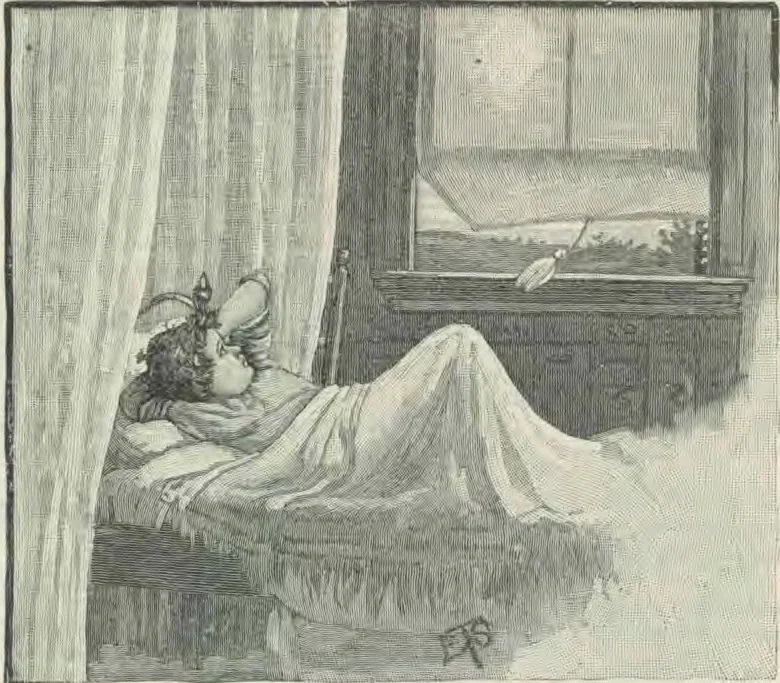
“Tommy! Tommy! It is time to get up,” came sounding in Tommy’s ears one crisp autumn morning.
Tommy turned over, and snuggled the clothes closer about his head.
“Tommy! do you hear?”
“Yes’m,” came from a voice under blanket and spread.
“Get right up; it is six o’clock,” his mother added as she left him.
Tommy knew his father would be displeased if he was not out to morning prayers. But the bed was so comfortable! He stretched, and yawned, and shut his eyes again. Fifteen, twenty minutes, half an hour passed.
“Tommy!” This time it was his father’s voice, and Tommy bounded out of bed. He dashed some water into his face, and hurried the comb through the front of his hair. One shoe-string was gone, and he couldn’t find his collar button. He rumpled the clean linen trying to fasten it with a pin. Then he rushed out to the sitting-room.
Tommy’s father looked him over from head to foot. He noted the half-combed hair, the crumpled collar, and the unfastened shoe, but he did not say anything. Tommy tried to look unconcerned. It was the third time he had been late that week.
As no remarks were made, Tommy began to breathe easier. Perhaps his father did not mind it so much, after all. But when breakfast was over, Tommy’s heart failed him, as he saw a peculiar smile on his father’s face, and heard him say, “It’s too bad a boy can’t sleep all he wants to, isn’t it, Tommy?”
Tommy made no reply, and his father added, “Your mother and I think so, and so you may undress now, and go back to bed.”
“O, I don’t want to, sir!” begged Tommy, in distress; “the boys are going nutting, and I promised to go too.”
“Indeed!” said his father, in surprise, “I should suppose you would be too tired to go; in fact, I can’t think of allowing it.”
Tommy knew that it was useless to beg off, so he turned slowly toward the bed-room. His mamma stayed with him while he crept out of his clothes, hung them in order on the chair, and disappeared between the sheets. Then she went out, leaving the door open.
He heard her clear off the table, and wash the dishes. Then the broom was whisked rapidly over the carpet. By and by he heard the clatter of tins, and the rolling-pin clap, clap, on the molding-board. It was baking day. Oh, dear! what was mamma making?
He twisted and turned in bed. It wasn’t the nice, warm place he had left. It wasn’t even soft; there were lumps in the mattress and wrinkles in the sheets; the clothes had pulled out at the foot, and all the feathers would crawl up into one end of the pillow, and that wasn’t the end under Tommy’s head.
Nine—ten—eleven—whirred the little clock on the mantle-shelf. Was there ever such a long day?
Presently there came a scraping of shoes and a tug at the window-sill. A torn straw hat and a brown face appeared at the opening.
“Say, Tom, ye’ sick?” queried the new-comer.
Tom turned over, and did not answer.
“Say, Tom,”—then a pause, and a chuckle as Tom’s friend took in the situation,—“say, Tom, did yer mother put ye’ to bed?”
“Shut up!” said Tom, growing cross.
“O my! a’n’t we a baby! have to take a nap in the daylight!” said the mocking voice.
The hot blood was tingling to the end of Tommy’s toes. He sprang out of bed, and hurled a shoe at the intruder.
“O see us in our new clothes!” continued the voice.
A dipper of water sent by Tom brought his tormentor to the ground, and silenced further remarks. Just then Tom’s mother came in.
“Tom,” said she sternly, “go straight back to bed.”
Tom did not dare to disobey her when she spoke like that.
“Now what is the matter?” she asked, as Tom lay down again.
“He called me a baby!” said Tom, punching up the pillow with his brown fists as if he wished it were Dick Smith himself.
Tom’s mother smiled.
“Say, mother,” said Tom coaxingly, noticing the smile, “how long have I got to stay here? You don’t want the boys to call me baby, do you?”
But Tom’s mother was not to be coaxed. “You will have to stay there until your father says you may get up.”
Tom groaned. It would be two o’clock before father started from his uptown office, and three o’clock before he reached home!
How hard the bed grew as the hours rolled by! Every bone in Tom’s active body ached with the enforced quiet. What did the sun want to shine so bright for? What delicious air blew in through the open window! And the nuts—how they must rattle down after such a frost as this?
Twelve o’clock! One o’clock! Two o’clock! Oh, dear!
By three o’clock Tom had fully made up his mind he could get up in the morning; and it did not take him long to tell his father so, and get permission to dress. The remembrance of that day, and the teasing the boys once in a while give him, has so far been enough to get him up bright and early on the coldest morning.
W. E. L.

DOLLIES THAT CAN TALK.

Mr. Thomas A. Edison, who has invented many wonderful machines, has not forgotten the little folks. A “talking doll” is his latest invention. “Doll-phones,” he calls them. They are not like the old-fashioned kind that say “Mamma” when they are squeezed, but they can repeat long sentences.
A reporter who visited the inventor says Mr. Edison picked up one of the dolls, with golden curls and rosy cheeks, and winding her up by inserting a clock-key into the small of her back, handed her to the reporter. He then pressed a spring, and the doll said in a plaintive tone:— “I love you, mamma; I love you dearly, mamma; but I am tired and sleepy now. Please put me in my little bed.”
She did not look a bit sleepy, but she spoke so plainly the reporter was sure she spoke the truth, and laid her down at once. Then Mr. Edison wound up a black-haired, brown-eyed little lady, who started off at a quick rate with,—
“Twinkle, twinkle, little star, How I wonder what you are, Up above the world so high, Like a diamond in the sky!”
Another doll sang a sweet little song. Will not the little girls be happy when the doll-phones become common?
There is another machine upon which Mr. Edison is at work, called a “phonograph,” which will repeat all the words spoken into it. If you should talk into it, and then send it, no matter how far away, the one who received it would simply have to set it in motion and hold a tube to his ear, and he would hear the words you said in your very own voice.
Some day—who knows?—there may be dolls made to repeat all the words they hear spoken. All the cross and peevish and grumbling and quarreling and unkind words! How dreadful that would be! But no more dreadful, not nearly as dreadful, as what really happens now, only we do not stop to think that all our words are written down in God’s great record-book; and somewhere in the future, unless we ask Jesus to wipe them out, we must hear them all again. And then, there are the wee brothers and sisters taking in every word, good or bad, which we speak before them, and sure to repeat them all.
Look out what these dear little live “phonographs” hear you say. Try to speak only sweet, pleasant, helpful words.—The Child’s Hour.
Continue reading: THE BLACKBERRY TART