The Youth’s Instructor, Vol. 32, No. 37.

DANGER OF READING FICTITIOUS AND INFIDEL BOOKS

The Youth’s Instructor

Sep 10, 1884

S. D. A. Publishing Association · Battle Creek, Mich. · Sep 10, 1884

DANGER OF READING FICTITIOUS AND INFIDEL BOOKS.
Every Christian, whether old or young, will be assailed by temptations; and our only safety is in carefully studying our duty, and then doing it at any cost to ourselves. Everything has been done for us to secure our salvation, and we must be not only willing but anxious to learn the will of God, and do all things to his glory. This is the Christian’s life-work. He will not try to see how far he can venture in the path of indifference and unbelief, and yet be called a child of God; but he will study to see how closely he can imitate the life and character of Christ.
Young friends, a knowledge of the Bible will help you to resist temptation. If you have been in the habit of reading story books, will you consider whether it is right to spend your time with these books, which merely occupy your time and amuse you, but give you no mental or moral strength? If you are reading them, and find that they create a morbid craving for exciting novels, if they lead you to dislike the Bible, and cast it aside, if they involve you in darkness and backsliding from God,—if this is the influence they have over you, stop right where you are. Do not pursue this course of reading until your imagination is fired, and you become unfitted for the study of the Bible, and the practical duties of real life.
Cheap works of fiction do not profit. They impart no real knowledge; they inspire no great and good purpose; they kindle in the heart no earnest desires for purity; they excite no soul hunger for righteousness. On the contrary, they take time which should be given to the practical duties of life and to the service of God,—time which should be devoted to prayer, to visiting the sick, caring for the needy, and educating yourself for a useful life. When you commence reading a story book, how frequently the imagination is so excited that you are betrayed into sin. You disobey your parents, and bring confusion into the domestic circle by neglecting the simple duties devolving upon you. And worse than this, prayer is forgotten, and the Bible is read with indifference or entirely neglected.
There is another class of books that you should avoid,—the productions of such infidel writers as Paine and Ingersoll. These are often urged upon you with the taunt that you are a coward, and afraid to read them. Frankly tell these enemies who would tempt you—for enemies they are, however much they may profess to be your friends—that you will obey God, and take the Bible as your guide. Tell them that you are afraid to read these books; that your faith in the word of God is now altogether too weak, and you want it increased and strengthened instead of diminished; and that you do not want to come in such close contact with the father of lies.
I warn you to stand firm, and never do a wrong action rather than be called a coward. Allow no taunts, no threats, no sneering remarks, to induce you to violate your conscience in the least particular, and thus open a door whereby Satan can come in and control the mind.
Suffer not yourselves to open the lids of a book that is questionable. There is a hellish fascination in the literature of Satan. It is the powerful battery by which he tears down a simple religious faith. Never feel that you are strong enough to read infidel books; for they contain a poison like that of asps. They can do you no good, and will assuredly do you harm. In reading them, you are inhaling the miasmas of hell. They will be to your soul like a corrupt stream of water, defiling the mind, keeping it in the mazes of skepticism, and making it earthly and sensual. These books are written by men whom Satan employs as his agents; and by this means he designs to confuse the mind, withdraw the affections from God, and rob your Creator of the reverence and gratitude which his works demand.
The mind needs to be trained, and its desires controlled and brought into subjection to the will of God.
Instead of being dwarfed and deformed by feeding on the vile trash which Satan provides, it should have wholesome food, which will give strength and vigor.
Young Christian, you have everything to learn. You must be an interested student of the Bible; you must search it, comparing scripture with scripture. If you would do your Master good and acceptable service, you must know what he requires. His word is a sure guide; if it is carefully studied, there is no danger of falling under the power of the temptations that surround the youth, and crowd in upon them.
MRS. E. G. WHITE.

THE RUINED NEST

Written for the INSTRUCTOR.

THE RUINED NEST.

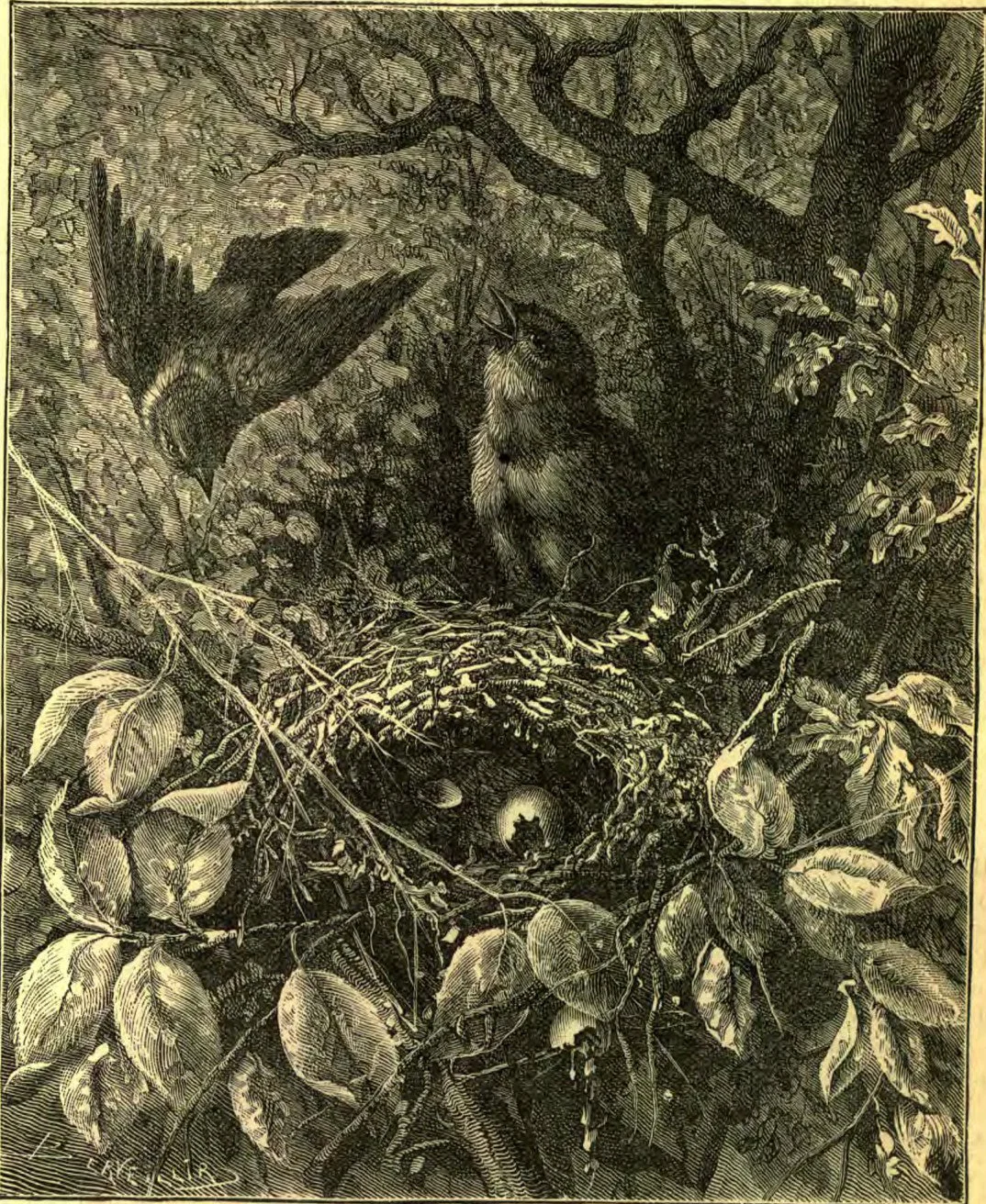
mamma, do come here, I beg! See what some naughty boys have done; They’ve found the sparrows’ nest of eggs, And they have broken every one.
They built right in this shady nook, Close by my window-ledge, you see; And every morning, when I’d look, The father-bird would sing for me.
I saw them when they first began To build the nest, one warm, bright day; And when I to the window ran, At first it frightened them away.
But afterward, I came so still It scarcely frightened them a bit; I’d lean across the window-sill, And they would hop right on to it.
And when the twigs and moss were laid, I threw them down a lock of hair; See what a pretty stripe it made, Just like a sunbeam lying there.
When next I looked into the nest, Five cunning little eggs I found. Here’s one still in it, and the rest, You see, are scattered on the ground.
She sat upon them hour by hour, While he sat swinging on a bough. This climbing rose-bush formed her bower, But that is also broken now.
I used to feed them from my hand, But now they look with frightened eyes, As if they could not understand; Just hear, how pitiful their cries!
What sorrow fills each tiny breast! What terror trembles in each wing! Who could have spoiled their pretty nest, And done this cruel, wicked thing?
I know that God will not be pleased To have them rob a poor bird’s nest, Because he made them, and I’m sure That he who made them loves them best.
The Bible says that from above He looks, and notes each sparrow’s fall; Then if he thus his creatures loves, We should not harm them, great or small.
S. ISADORE SUTHERLAND.

Essential Oil.

HARRY and Eva Morse were on the floor one day, playing with their blocks, while their mother sat near, sewing.
Presently Harry stopped his play, and looking earnestly into the grate, said: “Mamma, you promised to pop some corn next time the fire looked just so. See, there’s no black coal and no blaze. Will you, mamma?”
“Please, mamma, do pop some corn,” said little Eva, dropping her blocks.
“Well,” answered Mrs. Morse, “you may go and ask Bridget for the popper and an ear of corn.”
The children came quickly back, Eva bringing the popper, and Harry the corn and a dish to put it in.
“May n’t I shake it just a little?” asked Eva.
“No, dear,” replied the mother; “you would n’t do it fast enough, and the corn would scorch.”
In a few minutes, it began to snap, snap, snap, in a most delightful manner. Eva clapped her hands merrily: “See, mamma,” she cried, “they are turning wrong side out. Hear them laugh! See them jump!”
But Harry was in a brown study. Soon he asked,— “Mamma, what makes the corn pop?”
“The heat causes it to swell until its skin cracks open,” answered Mrs. Morse.
The little boy was silent a moment, evidently not satisfied, as he was quite a thinker for an eight-year-old.
“Mamma,” he said slowly, “there must be something more, or else peas and beans would do the same; and they won’t.”
“How do you know?” questioned the mother, laughingly.
“I’ve tried it. I put two beans on the stove, and kept stirring them with the poker; but they just burned up—did n’t pop a bit.”
“Well,” said Mrs. Morse, as she shook the second batch, “there is more than I said; but I did n’t know as you would understand. Scientists—that is, men who study into the ‘hows and whys’ of things—have found that in every perfect kernel of pop-corn there is a tiny drop of an essential oil that is highly explosive. This oil is distributed through every particle inside the shining yellow coat. When the corn becomes hot enough, the oil explodes; and, as by shaking the popper the kernel is heated all over alike, every bit of oil explodes at the same instant, cooking the corn as well as changing its shape. You see the result,—these delicious, beautiful things; we might call them snowflakes, they are so light and white and fairy-like.”
As the corn was emptied into the dish, Harry noticed two or three unparched kernels.
“Why did n’t they pop?” he asked.
“I suppose they are not quite perfect,” was the reply.
“Did n’t they have enough essential oil?”
“Probably not,” answered the mother, musingly. Harry’s questions had set her to thinking. Soon she called him to come and sit near her. “Do you understand what I said about the corn?” she asked.
“Yes,” was the positive answer. “I understand all about it, and I won’t forget.”
“Well, I have been thinking of something else a little like it. Perhaps we can talk it over, and both get some good. You remember visiting Aunt Hester Wakefield?”
“I guess I do! Is n’t she jolly, though? She likes boys; and she told me stories, and gave me cookies.”
“Yes, she likes boys; but that is n’t all. She loves everybody, and has as kind words and sweet smiles for the poorest as for her nearest friends. But there is old Mrs. Cole, who was here yesterday. What do you think of her?”
“I hope she’ll never come again!” exclaimed Harry. “If she does, I’ll go and stay in the barn. She’s crosser ’n a bear.”
“Did she speak crossly to you?”
“Not exactly to me, but she talked real mean about boys; and her eyes looked as though they’d snap my head off. I do n’t like her one bit.”
“Aunt Hester and Mrs. Cole were girls together,” continued Mrs. Morse. “They went to the same school and church, and I have heard it said that Mrs. Cole was a livelier girl than Aunt Hester. But they have both had a great deal of trouble. Their husbands and children have died. Aunt Hester is feeble and poor, and Mrs. Cole is very lame. How differently has sorrow affected them! The Bible compares sorrow to a furnace, and speaks of those who have suffered as having been tried by fire. That reminds us of the pop-corn. The heat of sorrow has made Aunt Hester more and more lovely, while poor Mrs. Cole has only grown hard and bitter. Can you tell me why?”
“I guess,” said Harry, thoughtfully, “that Aunt Hester has had more essential oil.”
“I guess so, too. And what shall we name it?”
“Goodness!” suggested Harry.
“Let us call it Christliness; for that means love, joy, peace, long-suffering, and much more. Aunt Hester loved Jesus when a little girl, that was the starting point.”
“And does n’t Mrs. Cole love Jesus?”
“I am afraid not. She feels hard toward God for taking away her husband and children.”
Harry’s eyes filled with tears, as he said, “I am sorry for her. I wish she loved Jesus.”
“The love of Christ will help every one to bear trouble, little children as well as grown people,” continued Mrs. Morse. “And if we really have that love, all the trials of life will only increase it, and make us more like him. We cannot all be beautiful in face, but we can be beautiful in heart and life.”
“Mamma,” said Harry, solemnly, “I’ll pray every day for God to put essential oil into my heart.”—The Well-Spring.

EDITOR'S CORNER.

BEFORE the Lord could come down upon Mt. Sinai to give his people his law, the ten commandments, they were told, through Moses, that they must get ready for the event. The Lord gave the people two days’ time in which to sanctify themselves, and to wash their clothes. He is a holy being, a God of order and of purity; and before he could approach as near to them as he must upon that occasion, they had to put away their sins, and bring their minds into a holy frame; even their garments had to be cleansed. Please read the nineteenth and twentieth chapters of Exodus, and see how very particular he was in this matter.
This happened thousands of years ago; but the Lord says, “I change not!” He requires of us the same carefulness when we draw near to him that he did of his ancient people. But it is a fact which we wish to bring before the minds of the young, that the Holy Spirit is many times grieved away from the congregation, for lack of reverence for God’s house and his service. The fault is not alone with the children and youth, but it would please God to have a reform begin with them. Their example would teach a powerful lesson, one which would have greater influence than many sermons upon the subject. Will it be said of you that you have done what you could, if your example is not correct here? Take time to think about it.
Perhaps if we tell you who the offenders are, it may help you to shun their mistakes. They are those who go into the house of the Lord carelessly, the same as though entering a common building, and who, to all appearances, have not a thought of God. If they are seated before service begins, it is to whisper and laugh, even upon the holy Sabbath. In time of prayer, they remain sitting; and if not whispering, their thoughts are gadding just as they please. All through the further exercises of the meeting, no attention or respect is shown the God whom we should fear and worship.
Dear readers, will you not each ask yourself, “Am I guilty of irreverence?” You may have sinned thoughtlessly; but he who keeps the record in heaven is not careless nor thoughtless; and although punishment may not be inflicted suddenly, as in the days of Moses, yet this sin will be a swift witness against those who do not truly repent of it.
A house dedicated to the service of God is sacred to him, and we should enter it with reverence, and “give unto him the honor due unto his name.” “Serve the Lord with fear, because he is holy; let us rejoice with trembling, lest he be angry, and we perish from the way.”
M. J. C.

NEW-VIEWING IN REVIEWING.

In addition to all the gain which comes from the work of reviewing, in the teaching-process, as a means of testing the measure of knowledge already attained by the scholar, and, again, as a means of fastening in the scholar’s mind the truth already taught to him, there is a farther gain, as a means of securing a new view of the truth which has been taught.
The main points of a series of statements may be recapitulated, after their first consecutive mention, without any new view of them being gained, or being aimed at. But a review of a series of words or statements, of facts or truths, which were before taken up singly, and were looked at only in their separateness, may give an utterly new view of the whole—a view of them in their relation to each other, and to a common whole—which would not have been possible except from this latter standpoint of observation. This new-viewing of the whole, in a review of the teaching work of a month, or of a quarter, or of a year, is a phase of reviewing which cannot be ignored or neglected by any teacher, without a loss to his scholar of that view of the truth taught which would be likely to prove of more value to him than all which he has gained thus far from his teacher’s teachings.
A man might handle every brick which entered into the building of a house, and even have a part in laying each successive course of bricks in that house, from foundation to coping, and yet have no real knowledge of the form and appearance of that house as a whole. Only as he obtained a new view of those bricks in their final relation to each other in that building, by standing off from it, when it was completed, and reviewing all the work on it in which he had had a part, can he intelligently understand the outline and the dimensions, or have any just sense of the general effect of that structure in its entirety. So it is in all attainments of knowledge; there is no true view of all that which has been learned in separate details, until a review of the whole gives a new view of the whole.
All related truths have their perspective, in which they can be seen to an advantage not otherwise obtainable. All Bible truths are related. To fail of bringing any series of Bible truths into its proper perspective, is to fail of seeing the truths of that series in their best light, and in such a way as to gain the fullest and most important understanding of them, in their relations to each other, and to the great central truths of the Bible as a whole. A “perspective,” it may be well to consider just here, is a view of a scene, or of a landscape, as gained from a single point of observation; or, more literally, as seen through some favorable opening. The perspective of a series of truths, therefore, can best be obtained at the close of the examination of those truths in detail; after the main features of the field of observation have been made known to the observer by his special study, so that they can be recognized by him, as he now looks back upon them through the opening of a review exercise.
Reviewing a lesson to see it in perspective is quite a different matter from reviewing it for the purpose of testing the scholar’s knowledge of it; or, again, from reviewing it for the purpose of fastening it in the scholar’s mind. A perspective reviewing of the lesson is a new-viewing of the lesson. This distinction should always be borne in mind by the teacher, in his work of reviewing. Whether the lesson be a simple narrative, a seemingly involved doctrinal teaching, or a few apparently unconnected practical injunctions, it has its true perspective, and it ought to be looked at in perspective.
Although this method of reviewing a series of lessons so as to find one new lesson in the several lessons of the series, brings all of the lessons of the series into an utterly new light before the scholars, it is not as if the material out of which the new lesson is constructed were before unknown to the scholars. The new lesson is still a review, while it is also a new view. Its very construction, indeed, is by the scholars themselves, although under the skilled direction of their teacher. The teacher asks the scholars to look back over the lessons they have learned, and to tell him what they see in the direction of his pointing. As they go on in this work of re-examination, under their teacher’s guidance, they see for themselves the progress of the new lesson which their answers are constructing, and they have an interest in it, and an understanding of it, accordingly. It is as if the teacher were to take the irregularly formed bits of a dissected picture, each of which bits is known by itself to the scholars, but not understood in its relations to the other bits, and should question the scholars as to the correspondence of certain outlines of one of these bits to the outlines of another bit; and so should go on, in the way of such suggestions, until the scholars were all alive to the completion of the one picture of which those several bits were but the portions. It would not, indeed, be the drawing of the picture anew; but it would be the showing anew a picture which otherwise might never have been perceived by those who had in their possession all the material for its correct exhibit.
It need hardly be added, that to secure the teaching of such a new-view lesson in a review of a series of lessons, the teacher must be well prepared with his plan of the lesson, and with his outline of questioning in order to bring that plan before the minds of his scholars; or, rather, in order to bring the minds of his scholars to recognize that plan as of their own finding in the series of lessons reviewed by them. But without such a new view of a series of lessons in its review, the best study of a series of Bible lessons, under the best teacher, would be incomplete, and one with which no teacher has a right to be satisfied.—S. S. Times.

The Heart Is a Garden

THE heart is a garden; our thoughts the flowers That spring into fruitful life; Have care that in sowing there fall no seed From the weed of cruel strife. Oh! loving words are not hard to say, If the heart be loving too; And the kinder the thoughts you give to others, The kinder their thoughts of you.

THE OPPORTUNITY IMPROVED

Written for the INSTRUCTOR.

THE OPPORTUNITY IMPROVED.

A YOUNG boy was once asked how long he had known his Saviour, and if he felt certain that all his sins were forgiven.
“Oh, yes,” he replied; “I am quite sure that they are forgiven.”
“When did you first come to know and understand that?” asked the minister.
“When the bee stung mother,” said the boy quickly.
“When the bee stung mother! Tell me what you mean, my boy.”
“Sir,” said the boy, “my mother had for some years told me what Jesus had done for me; but I never really understood how he had taken my place, and died in my stead, until one summer afternoon.
“I was playing around the door of our house. Mother was ironing in the kitchen at the window, with her sleeves turned up. Suddenly, while I was playing about the door, a large bee came buzzing around and around my head. For some cause, it seemed determined to sting. I tried to drive it off; but the more I tried, the closer he flew to my head. At last, in despair, I ran inside to get rid of my enemy. The bee followed me up, as I ran to my mother, who had for the last half minute been watching my efforts to get rid of the bee. With a cry of despair, I hid myself under her long, white apron.
“Surprised at my fear, with motherly care she immediately put her iron down, and with a smile covered me up with her apron, putting her arms outside, as if to assure me that I had full protection. She had hardly covered me up, before the bee lit upon her bare arm, and thrust his sting in so far that he could not pull it out; so he left it, and crawled away. My mother felt the sting very sharply, and was a little surprised; but, looking at the bee on her arm, a thought struck her which was the means of my salvation.
“Said she, ‘There, you may come out now; the bee has stung me instead of you; come out, and look at it on my arm.’”
“Out of curiosity, I lifted the apron, and put my head out to see if it was really so. Sure enough, there was the bee still on her arm; and mother, pointing to the sting, said, ‘There it is; you may play with it now, for it cannot sting any more. It had but one sting, and that it left in my arm.’ Astonished, as well as not a little sorrowful for my mother, I looked at the sting.
“Mother then explained it to me, and well applied the lesson, showing me that it was a picture of what for a long time she had been trying to make me understand,—that Jesus had taken my place, and been punished in my stead.” R. S.

IMPORTANT BIBLE SUBJECTS.

LESSON 11.—REVIEW.

[NOTE TO THE STUDENT.—Do not consider the lesson learned until you can give at least the substance of every text, with the correct reference for each. The references in black letters indicate those texts that should be committed to memory. A little diligent application each day will enable you to do this.]
1. For what purpose does Christ come the second time?
2. Are any taken besides those then living? Give proof.
3. Quote a text concerning the righteous dead, which shows that they will not be rewarded before those who live until the Lord comes.
4. Can you prove that no one will be rewarded before the coming of the Lord?
5. Relate in order the events connected with the coming of Christ. Give authority for each statement.
6. To what event did Christ teach the people to look for a recompense for their good actions? Quote proof.
7. Prove that the resurrection takes place at the coming of the Lord.
8. Can you show that the doctrine of the resurrection of the dead was known to those who lived before the birth of Christ?
9. Give three references in the Old Testament that speak of the coming of the Lord. State the substance of each.
10. Prove from the New Testament that the dead are not now happy in heaven.
11. Prove the same from the Old Testament.
12. Who has the power of death? Quote proof.
13. By whose power are men raised from the dead?
14. When the Lord comes, what change takes place in the righteous?
15. Do both the living and the dead alike share in this change?
16. Before this change comes, where are the dead kept in waiting?
17. In what condition are they?
18. Can you quote a verse from Paul’s writings that proves that they are unconscious?

The Joy of Performing Neglected Duty

Do you wish to feel the highest joy which God has given as a reward of work well done? Just go and perform that neglected task which you know you ought to perform, and which you can perform, but for which you have an apparently unconquerable aversion. It is pleasant to do work which one delights in doing; but that pleasure pales into insignificance before the greater joy which comes to a person who has manfully taken up a work which he does not like, but which he has carried out faithfully in spite of his dislike for it.

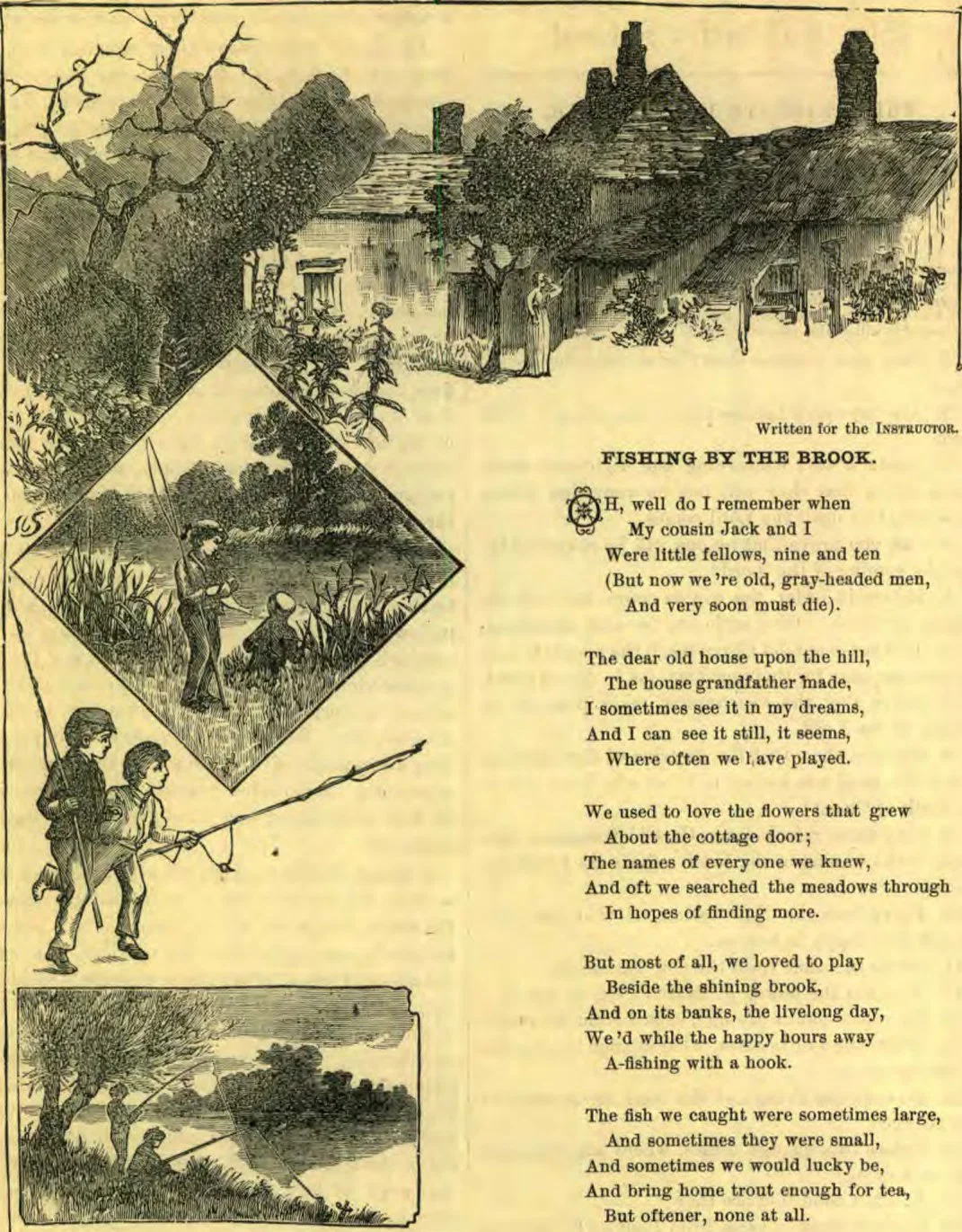
FISHING BY THE BROOK.

O, well do I remember when My cousin Jack and I Were little fellows, nine and ten (But now we’re old, gray-headed men, And very soon must die).
The dear old house upon the hill, The house grandfather made, I sometimes see it in my dreams, And I can see it still, it seems, Where often we have played.
We used to love the flowers that grew About the cottage door; The names of every one we knew, And oft we searched the meadows through In hopes of finding more.
But most of all, we loved to play Beside the shining brook, And on its banks, the livelong day, We’d while the happy hours away A-fishing with a hook.
The fish we caught were sometimes large, And sometimes they were small, And sometimes we would lucky be, And bring home trout enough for tea, But oftener, none at all.
Dear Jack and I, in early life, The narrow pathway took. Our Master cares for us, I know, The same as when we used to go A-fishing by the brook.
MRS. L. D. A. STUTTLE.

“GOOD NEWS FROM A FAR COUNTRY.”

[Here is a letter from Mrs. E. H. Whitney, wife of Eld. B. L. Whitney, missionary to Bâle, Switzerland. It will be read with interest by all, and will awaken a desire to hear more from our friends over the sea.]
DEAR INSTRUCTOR FAMILY: As I sat listening to the exercises in one of our Sabbath-schools in the mountains of French Switzerland, last Sabbath, my thoughts took a long journey to the Sabbath-schools of our dear America, and I thought you might like to hear something of our schools here. We have very many children in Switzerland, and in Germany also. Most of the children one sees on the streets are clean and intelligent, much more attractive than in some other countries of Europe; and I have learned to love dearly their bright, happy faces.
I wish you could have been with me yesterday, to hear them recite in their own pleasant tongue. You could not have understood what they said, and even the Bible names would have sounded strange to you; but the prompt answers would have pleased you; and I assure you they had thoroughly learned their lessons.
The older pupils learn the lessons in Les Signes des Temps, which are now on the life of Paul; but the little ones have no such lessons prepared for them as yet. They are learning chapters of Old-Testament history, and they seem to have quite a thorough understanding of their lessons.
We are trying to translate and print the good lessons for children that Prof. Bell has prepared for you in your American Sabbath-schools; for we need them very, very much, both in French and German. We hope to have No. 1 out in a few weeks.
Would you like to know something of the lives of these French-Swiss children? Some of them are very poor, and their clothes are very coarse, but they are always tidy and whole, and their sun-browned faces are always clean, and generally have a happy look. Many of them have to work as soon as they are large enough to do anything. I often see the little ones out with their parents in the fields, or taking care of still smaller children. The parents often have to work very hard. In country places, where the people work on farms or in vineyards, the church bell rings, during the summer, at three in the morning, to call the villagers from their sleep to go into the fields, where they work till nine in the evening or even later. Eld. D. T. Bourdeau, who is now in France, speaks of beginning his meetings at nine o’clock in the evening, to give these hard-working people a chance to attend his lectures. The watch-makers often sit at their tables at work from early morning till midnight, and even at that they live very plainly and simply indeed; for their pay is small.
All the children are obliged by law to attend school from six till fourteen years of age. If they are compelled to work through the day, they spend from five o’clock to seven o’clock in the morning in school, or the same hours in the evening. Those who can spend the day at their studies, go to school at seven or eight o’clock. They spend about six hours in school, usually, and learn how to sew, knit, etc., besides their lessons from books. All the girls knit; and one often sees them sitting in the parks at Bale, or walking on the streets, bareheaded, knitting stockings.
You see that many of our Sabbath-school scholars have very little time to prepare their lessons. Sometimes they study very late Friday evening to learn them; for they do not like to fail. We do not have as many helps in the Sabbath-school work in French as in English. We have no nice INSTRUCTOR or “Sabbath Readings” for our little Sabbath-keepers, and very few books on present truth, compared to what you have in English. Some of our young people are studying English, so they can read our good books in that language, and help to translate them into French for others.
We hope you will think often of your many little friends on this side the water; for though they speak many different languages, in all these countries, you are all children of the same heavenly Father. Pray God for them, and for those who are trying to help them in the good way. Perhaps there may be some other way, also, in which some of you can help. E. H. Whitney.

Letter Budget.

HERE is a letter from ANNA B. HUNTLEY, Grant Co., Dakota. She says: “I have never written a letter before, but I take the INSTRUCTOR, and love to read the “Letter Budget” very much. My papa and mamma keep the Sabbath, and I try to keep it with them. We attend Sabbath-school every Sabbath. I study in Bible Lessons No. 1. I love the Saviour, and am trying to be a good girl. We live near school, and so I attend every day. I am ten years old. I have two brothers and two sisters who attend Sabbath-school with me.”
FREDDIE REED, of Litchfield Co., Ct., writes: “My brothers and I have taken the INSTRUCTOR for a number of years, and like it very much. I have never written a letter for it before. We have no Sabbath-school, as we are the only Sabbath-keepers in the place. I learn a lesson every Sabbath in Book No. 3. I go to day school. I am trying to be a good boy. I send love to all the little boys and girls that read the INSTRUCTOR.”
CORA BELLE MOYERS writes from Cumberland Co., Tenn. She says: “I keep the Sabbath with my pa and ma and two brothers and two sisters. We have a family Sabbath-school. We use the INSTRUCTOR lessons each week. We like the INSTRUCTOR very much. My pa is a minister, and is away from home part of the time holding meetings and selling books. I am nine years old. I love the INSTRUCTOR family, and want to be a good girl, so I can meet them all in the near future, when the earth is made new.”
ELWIN, ETTA, and TRUMAN YOUNG, aged twelve, ten, and eight years, in writing from Crow Wing Co., Minn., say: “As we have seen no letter from this place, we thought we would write one. There are three girls and three boys in our family. We all go to Sabbath-school, and three of us to day school all the time. We are trying to live so we shall be accepted of the Lord when he comes. Our pa is a mason by trade, and has gone to Wisconsin to work this summer, and it is lonesome when he is gone. We send love to the INSTRUCTOR family.”

You have reached the end of this edition.

The Youth’s Instructor · Sep 10, 1884