THE Constitution of the United States was founded upon the self-evident truth that all men are created equal.
This government was not organized to grant rights to which its citizens previously were not entitled, but to protect each one in his individual rights. It sought to be a government such as all governments ought to be—one in which the individual shall enjoy to the fullest extent his natural rights.
To more effectually secure these rights church and state were separated; and Congress was forbidden to legislate in favor of, or against, religion, confining it to matters which are purely civil.
It is sometimes urged by those who are seeking to secure laws for the observance of Sunday as the Sabbath day that such a step would not be a union of church and state.
But murder will out, and it is being made more and more manifest that such statements, however honestly intended, are absolutely and unqualifiedly false.
If Sunday laws are all right, and no union of church and state would thereby be effected, why do they desire to have the Constitution changed?
As the Constitution was founded upon the self-evident truth that all men are created equal—that they have certain unalienable rights; and since to more effectually secure these rights to one and all church and state were kept separate, it is perfectly plain that to change the Constitution in this regard is to deny the doctrine that all men are created equal—that they have any inalienable rights at all.
It is therefore perfectly natural that those who plead for Sunday laws should come right out and thus deny this principle—this self-evident truth. Indeed, it could not be otherwise. Hence Dr. Burrell, at the Christian Endeavor convention held a few months ago, at Paterson, N. J., in pleading for Sunday laws, was perfectly logical when he declared that the doctrine of personal rights was a political heresy.
To fasten this teaching of Dr. Burrell upon the people of this country is to bring them into the worst kind of bondage. It is not only to make a slave of man’s actions, but also of his conscience. From being a king amongst kings, he is reduced to the awful condition of a serf—a mere automaton, a machine of the government, capable of action only as the government directs.
Doubtless Dr. Burrell and his associates would like to cover up this truth, if it were possible. But the matter of Sunday laws, striking as it does at the very root of personal liberty, brings its advocates face to face with this phase of the question, and the inexorable law of logic compels them to make this argument; they cannot dodge it if they would.
Sunday law advocates would have us believe that this Sunday-Sabbath is a true friend of all—especially of the laboring classes. But an institution that cannot be sustained except by denying truth that is self-evident, is an enemy, an implacable foe; and will destroy instead of save,—whether it be a nation or an individual. Consequently Sunday cannot be a part of the truth the knowledge of which shall make us free. John 8:32. Its source is not in the Author of freedom who said, “And if the Son shall make you free, ye shall be free indeed;” nor is it a part of that law concerning which the Psalmist said, “I will walk at liberty, for I seek thy precepts.” Ps. 119:45.
In the address of Dr. Burrell before referred to, he urged that Sunday is a seal. Yes, this is true; but not the seal of God as the speaker desired his hearers to believe.
The very fact that this Sunday institution cannot, as before stated, be sustained only as the self-evident truth that all men are created equal, is squarely denied, and a change of the Constitution called for, ought to convince every one, especially Christians, beyond the possibility of a doubt, that Sunday is not the Sabbath of the Bible, nor the seal of the living God. God’s Sabbath is not a sign of bondage, but of liberty—liberty that can be found only in the Lord Jesus Christ.
Patriotism Beyond the Fourth of July
THIS country does not need a kind of “patriotism” that is only good on the fourth of July, and derives its chief inspiration from fireworks and lemonade.
Calmness on the Side of Truth
IF you don’t agree with the sentiments expressed in this paper, don’t get excited over it; but if you do, remember that on the side of truth there is always calmness.
News Notes and Comment
By Editor
THERE was a great banquet given the other day in this city,—the largest, it is said, that was ever given at an American hotel, as well as “the richest and most resplendent.” It was a banquet given by the “National Association of Manufacturers.”
ABOUT a thousand diners were present—more than could be accommodated in the great dining-room of the ten-million-dollar hotel in which the banquet was spread. Nearly all of them were millionaires, the aggregate wealth represented reaching away into the billions, beyond the stretch of the human imagination to picture. It was not a banquet held for the purpose of eating and drinking, but for considering the situation of the country; for it was as representing the country that this great gathering of manufacturers had assembled. And it was evident that “the country” is prosperous; no one looking into the great dining room and taking even a momentary glance at the banquet as it was in progress, could have doubted for a moment that “the country” is very prosperous indeed.
THE President of the United States was there, and made a speech. He came expressly from Washington to be present, and he came in his official capacity. It was the only capacity in which he could have come. The conclave would not have cared a cent for his presence in his own individual capacity; for the President is not a great manufacturer, neither is he a millionaire. But why should the President, as such, come from Washington to do honor to this banquet of wealth? This is a query which we deem pertinent to a consideration of the event.
THE President of the United States is the representative of 70,000,000 people,—the inhabitants of all the States and Territories. As such he stands for the people. Persons who go to see the President on any mission go to the people. As chief executive of the nation, the President is the embodiment of the people. The people are the reality behind every act that is done in official capacity. They are the real movers, the real actors, in everything.
THE manufactures might have gone to Washington,—to the President; but instead, the President came to them. The people moved at the will of the millionaire manufacturers. Remembering that it is not the tail that wags the body, but the body the tail, it is evident that the millionaire manufacturers, and not the 70,000,000 or more citizens, are “the country.” It is in dollars that the millions count, not in mere human individuals. But things have changed in this respect since the days of Jackson and Lincoln.
THE “National League for the Protection of American Institutions” is getting ready to fight Sunday baseball, which the leading ball clubs have announced their intention of playing during the coming season. The object, of course, is to prevent the “desecration of the Sabbath.”
THE League should change its name. Baseball is distinctly an “American institution,” while the Sabbath is not; yet the League is going to oppose baseball in the interests of the “Sabbath.” It is going to oppose an American institution, in order to maintain something entirely foreign to such institutions.
ANY person who reads the Bible and history cannot help knowing that the Sabbath is not an American institution; it is a divine institution. And any one who believes the Bible ought to know that a divine institution does not need the protection of an earthly power.
NOT long ago Emperor William, of Germany, in swearing in some recruits for his army, took occasion to proclaim that a good soldier must necessarily be a good Christian. Appreciating the absurdity of this utterance, the editor of a Berlin journal published a cartoon in which the infidel armies of Frederick the Great and Napoleon, and the heathen armies of Alexander the Great and Leonidas, were represented as reading these words of the emperor’s speech; and for this the editor is to be punished for “lese-majesty.” It is said, by the way, that about a thousand prosecutions for “lese-majesty” take place in the German empire in the course of a year.
BUT the noteworthy point which appears in the present instance is that while “lese-majesty” sends the offender to prison for at least a term of several months, a man who almost at the same time was prosecuted for speaking against God, got a sentence of imprisonment for only eight days; which leads an exchange to remark that Emperor William “is probably the first to carry the impression that he believes in a God of less importance than himself.” But just such inconsistencies are always to be found under a system where church and state are united.74
IT is a fact that the union of church and state under any form of government tends not to beget reverence for God, but rather the opposite. Of course, under such a system, the state is bound to punish all such acts as constitute “offenses against God and religion.” But to punish an “offense against God” with anything less than death, is only to cast ridicule upon God. God, indeed, forgives the offense freely, and magnifies his name through his mercy and love. He forgives the offender, and the latter escapes the penalty of his transgression; but always the divine forgiveness discloses the awful scene of the Son of God hanging on the cross in the agonies of death, for the very offense which was forgiven. So that both justice and mercy, the attributes of God’s character, are magnified in his forgiveness of sin. But as human governments are not conducted upon the principle of forgiving the offenses of transgressors, it only remains for them to inflict punishment; and when the state assumes to deal with offenses against God, the only thing it can do is inflict what it deems a fitting punishment for them.
AN offense against God is a sin; and the only fitting punishment for sin is that which God himself, after the Judgment, will inflict upon all who have not obtained pardon and regeneration through Christ. When a government therefore undertakes to punish for an offense against God, by inflicting a penalty of fine or imprisonment, as is usually done, it only casts contempt upon God, and lowers him to the level of the earthly and human. An offense against him comes to be considered as on a par with an offense against an earthly ruler, or as even a thing of less consequence. It is simply impossible that the result should be otherwise.
The Ontario Sunday Bill Withdrawn.
By M. C. Guild
EDITOR SENTINEL: The bill introduced in the Ontario Parliament, at the request of the “Lord’s Day Alliance,” to amend the “Lord’s Day Act,” and make it more stringent than at present, has been withdrawn. This was largely brought about by Sunday keepers themselves, who viewed with alarm the prospective workings of the bill, and vigorously protested against it.
The law as it now stands leaves the way open for religious persecution, and it was shown that should the amendment pass, very many of the industries of the country would be seriously menaced, if not entirely destroyed.
It is proposed, however, in the future to take up the matter again in a form that it is hoped will meet with popular approval.
Those who favored the bill severely censure the government for its action in withdrawing it.
As the country is on the eve of an election, the present government is accused of yielding because of political expediency.
Thus it may be seen that Sunday laws abound in innumerable difficulties, both to those who make them and those on whom they are enforced.
How much trouble would be avoided in this world if the matter of the Sabbath and religion in general were left between God and man.
M. C. GUILD.
To Close Drug Stores on Sunday.
New York “World,” January 24.
THERE will be a meeting of the Executive Committee of St. Michael’s Chapter of the Church Association for the Advancement of the Interests of Labor to-morrow night at the Parish House of St. Michael’s Church, 225 West Ninety-ninth Street [New York City]. The object is to start a movement to close drug stores on Sundays. So far sixty-five trade, labor, reform, business, and church organizations and fifteen leading clergymen have indorsed the movement.
Decline in the Price of Titles.
It will be good news to some Americans, that there is a prospective decline in the price of titles of royalty. The Italian government, says the New York Sun, intends to submit to parliament a bill which provides “that any one desiring the title of prince shall pay $8,000 therefor. Five thousand dollars will be the sum necessary to obtain the title of marquis, while $4,000 will buy the title of count. Any one may become a baron who is willing to pay $1,000 for the honor.”
This is far below the price that American heiresses,—or their papas—have been in the habit of paying; and we know no reason too why these titles are not just as good as any.
Cardinal Vannutelli in Disgrace After Italian Dinner
A DISPATCH from Rome says that Cardinal Vannutelli is “in deep disgrace” at the Vatican, on account of having been present at a grand dinner given in honor of the American ambassador to the Quirinal, Mr. Draper. To thus openly seek the good will of the Italian government, is to violate a stringent rule of papal policy; but it seems that the cardinal, who is a prominent candidate for the tiara, thinks the good will of the Italian government worth more to him than the friendship of the Italian cardinals.
Washington's Birthday Observance in Ohio Public Schools
THE Bellefontaine (Ohio) Republican announces that Washington’s birthday will be celebrated in the public schools of that State, according to a program furnished by the “Women’s Relief Corps” ladies, which will include the “flag salute.”
Studies in French History.—7.
By Mrs. L. D. Avery-Stuttle
“WHOM were we talking about when our last week’s study closed?” questioned Professor Carman.
“That’s good; I see you are interested in these lessons,” he added, as he noted the dozen eager hands that were raised.
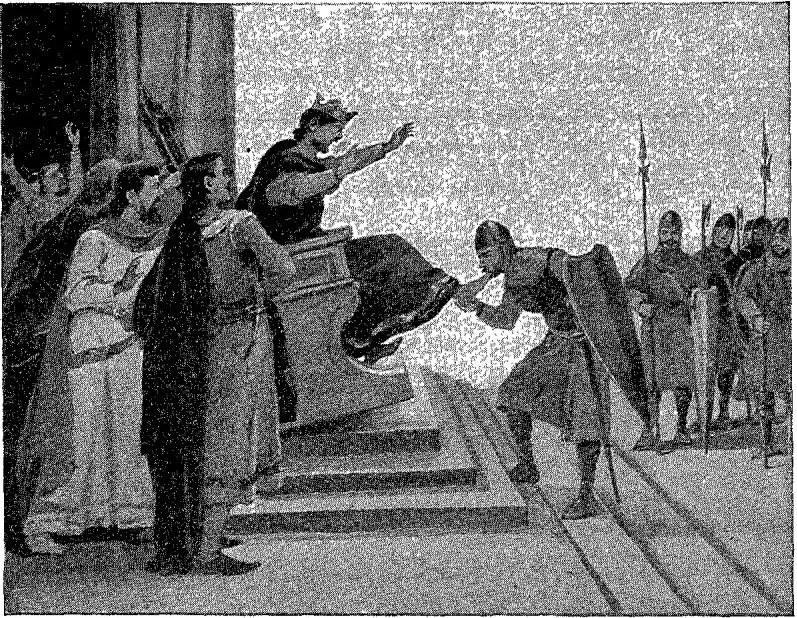
Rollo of Normandy showing allegiance by proxy to King Charles.
“It was about Rollo, the Norman,” answered Charlie White, in response to a nod from his teacher.
“Right. Well, Milly, what is on your mind? You may speak freely. In fact, I think we may as well devote the first of the half hour to questions, answers, and a familiar talk on the previous lesson.”
“Well,” said Milly, “aunt Mildred is at our house visiting, she is real good in history, and she told us a little story about Charles the Simple and Rollo. She said that when the king let Rollo have certain lands, it was necessary that he comply with the usual custom, and show his allegiance to his king by kissing Charles’ foot. But Rollo didn’t propose to do that kind of business, and so he sent a soldier to do it for him. But it was not at all agreeable even to him, and he was so indignant at being asked to do this, that he seized the king’s foot and raised it to his lips, instead of bowing down to perform the ceremony. As the king was sitting on a throne which was not stationery, it tipped him over, throne and all,” laughed Milly, “and then the Normans laughed at him; but the Frenchmen were quite angry, though the king wisely turned it off as a joke.”
“A very good story, Milly, and well told,” said Professor Carman, encouragingly.
“After Charles the Simple had been murdered,” continued the teacher, “which people supposed was done by one of his nobles, Hugh the Great, who was the son of the Count of Paris,—he who had been the real ruler instead of Charles the Simple, might easily have been king. But he did not choose so to aspire; so Louis IV. ascended the throne. He reigned eighteen years, and in 954 A. D. he left the kingdom to Lothaire, his son. He was succeeded by Louis V., called the Do-Nothing, because really his reign was so short that he could not have accomplished much, were he even so wise,—it was only a year. He was the last of the Carlovingian kings, the direct posterity of Pepin, and of Charles the Great.”
“Charles the Great and Charlemagne were the same, weren’t they, I believe?” asked Max Smith.
“Yes, the very same. Now, Hugh Capet, son of Hugh the Great, was made king by the nobles; and so you see that in less than two hundred years from the time when the great Charlemagne was placed in his tomb, the kingdom for which he fought so many battles and over which he reigned in such glory, had gone into stronger hands.”
“Don’t you think it would have been better for France if the descendants of Charlemagne had continued to reign?” asked Rob Billings.
“If they had been capable as their illustrious ancestor, yes; but they were not, so it was no doubt better to have a change. You see the nobles had almost unlimited power over those under them, and history says that the name of ‘king’ was almost a mockery.”
“How came the nobles to have so much power?” asked Joe Palmeter.
“I will try and explain how, Joseph, or rather, I will tell you about the Feudal System, then you can understand it.
“When a chief went to war, in very early times and was victorious, he used to give his principal men a certain share of the conquered territory, if they would promise to fight for him and work for his interests. This was called ‘owning allegiance,’ while the chief was called their liege lord and they his vassals. Then after a while these vassals themselves would do the same thing, and subdivide the land, among others, called ‘freeholders,’ and these freeholders had also others under them, called serfs, who were the very lowest class. So there were:—
“First, the king; second, the nobles; next, the freeholders: and lastly, the serfs.”76
“I should think such a way of doing things would make no end of bother and worry for the king,” said practical Jack Smith.
“It did, indeed, for after a while the poor king didn’t own as much land as the nobles and vassals, and so they did not like to acknowledge their allegiance to him.”
“Wasn’t that the way with Rollo?” asked Florence Ray.
“Yes, and poor Simple Charles did not dare to resent the insult of being tumbled off his throne.”
“I should have thought they would have changed the foot-kissing ceremony after they had such an experience as this,” said Maggie Palmeter, laughing.
“So they did; after a while they signified their allegiance to the one above them by placing the hand inside that of their superior, which was certainly a more pleasing custom.”
“Let me see, professor, I would like to make a note of the time when Hugh Capet took the throne.”
“Very well; write; Hugh Capet, first of the Capetian kings, reigned from 987 to 996 A. D.
“I have been very glad to see that you all made good use of your note books during this lesson. We will close this study by giving the names of each of the kings of France as far as we have studied. This you will also do well to write in your note books. Then we will repeat them in concert:—
“Clovis, later, and unimportant kings, Pepin the Short, Charlemagne, Louis the Good-natured, Charles I. the Bald, Louis II. the Stammerer, Louis III. and Carloman, Charles II. the Fat, Charles III. the Simple, Louis IV. Lothaire, Louis V. the Do-Nothing, and Hugh Capet.
Mrs. L. D. Avery-Stuttle.
Following the Majority.—No. 2.
By Elsie A. Brown
“Good evening, Tom!”
“Why, good evening, Will! Come in! Take a seat by the fire. You are just the boy I’ve been wanting to see. Where have you been keeping yourself of late?”
“At home, Tom. You know I told you I believed I would take my circus money and buy me one of those pocket Bibles like yours?”
“Yes, Will, I remember.”
“Well, I did it, and I have been putting in my spare time of late in studying it.”
“Good for you, Will! How are you getting on?”
“Well, that is just what I want to tell you. I need a little help.”
“What is the matter, Will? Is it hard for you to find the texts you want?”
“No, Tom. I tried your way. Learned the names of the different books, and the order in which they come, and when I know the reference now, I can find it easy enough.”
“Well, that is good! Now what is the matter?”
“Why, it’s these verses here in the fifth chapter of Matthew—the 17th and 18th: ‘Think not that I am come to destroy the law, or the prophets: I am not come to destroy, but to fulfil. For verily I say unto you, Till heaven and earth pass, one jot or one tittle shall in no wise pass from the law, till all be fulfilled.’”
“So you are studying of the law, are you, Will?”
“Yes, Tom. I wanted to see if there is any reason for people’s thinking it has been changed. Jim Drake says he heard his father say that there was no need of people getting their mind all confused in the study of the old law, because it had all been changed when the Saviour came, and all we had to do now was to believe in Christ.”
“But, Jim,” said I, “how are we to believe in Christ unless we are acquainted with him; and how are we to become acquainted with him except through his laws? Did you ask your father to explain the matter, Jim?”
“No, indeed,” said he. “He wouldn’t have done it if I had. He don’t think such things belong to children.”
“But they do, Jim,” said I, “for I remember reading a verse in my Bible the other day that said, ‘Those things that are revealed belong unto us and to our children,’ so if there was any change made, we boys have as good a right to know it as the older people.”
“Why, Jim,” said I, “your father is quite an active man in church work, isn’t he?”
“‘Well, yes,’ said he, ‘if talking politics and keeping people straight on Sunday can be called church work.’”
“‘But, Will,’ said he, ‘are you certain that the Saviour’s coming didn’t change the law?’”
“‘Yes, sir, Jim, I am,’ said I.”
“‘Well, now, look here, Will,’ said he, ‘it isn’t very likely that the majority of the people are in the wrong, and only now and then one right.’”
“But, Jim,” said I, “don’t you know that the way that the majority travel is called the broad way, and doesn’t lead to heaven at all, and but just a few find the road to eternal life? It doesn’t make any difference, Jim, if all the world says a thing is so, if God says it isn’t so, why, it isn’t!”
“‘Well, Will,’ said he, ‘just show me where He says it isn’t so.’”
“Well, Tom, do you know that I couldn’t do it? I had heard it talked of lots in the Sabbath-school, and thought I understood it real well, but I hadn’t realized how necessary it was that we know just where to find the proof of what we say, and I began to see why our teacher considered it so very essential that we boys learn the references for ourselves. I said, ‘Jim, I don’t know just where to find it, but I know it says so, and I’ll look the matter up.’”
“‘Well, yes,’ said he in his sarcastic way, ‘it strikes me, Will, that that will be about the thing for you to do, and may be when you find it it won’t read just as you thought it did.’”
“‘But I knew it did, so I said, ‘I mean to do it, Jim,’ and walked away, fearing he might aggravate me to say something to be sorry for. I went home and began at once. My father smiled and said, ‘If you keep on, my77son, I don’t know but you’ll be a preacher yet; but if you are,’ he added, ‘I hope you’ll stick to your profession and not try to be preacher and politician too, as some in these days seem endeavoring to do.’”
“Your father don’t belong to the church, does he, Will?”
“No, Tom; but do you know I believe he has got more good religion in him than some who do, and that isn’t saying that people shouldn’t belong to the church either. But now, Tom, I’m ready to begin. What does this jot and tittle mean in this text, that the Saviour says shall in no wise pass from the law?”
“Why, Will, ‘jot’ is the smallest letter of the Hebrew alphabet. The Saviour is speaking to the Jews here and says that there shall not even so much as the smallest letter of their alphabet ever pass from the law till all be fulfilled.”
“And the ‘tittle,’ Tom, what is that?”
“Why, that is just a little corner of a letter that makes it different from another that is very nearly like it. For instance, Will, you know how nearly alike our capital O and Q are? Just that little quirl taken from the Q would leave it an O; but the Saviour tells them that not even the smallest letter nor the tiniest part of a letter shall ever pass from the law while heaven and earth remain. Turn to the 111th Psalm and read the last clause of the seventh verse and the first clause of the eighth.”
“‘All his commandments are sure. They stand fast for ever and ever.’”
“For how long, Will?”
“For ever and ever.”
“How many of them?”
“All of them.”
“Now turn to Ecclesiastes, third chapter. Read the first two clauses of the fourteenth verse.”
“‘I know that, whatsoever God doeth, it shall be for ever; nothing can be put to it, nor anything taken from it.’”
“How does this text agree with the idea of the law’s having been changed, Will?”
“Not a bit of agreement about it, Tom.”
“So I say. You see the Saviour knew there would come a time when it would be taught that he changed the law, and he says, Think not that I have done such a thing. If you want to find what he did do, turn to Isaiah the forty-second chapter and twenty-first verse.”
“‘The Lord is well pleased for his righteousness’ sake; he will magnify the law, and make it honorable.’”
“He will do what to it?”
“Magnify it.”
“Now let me bring the magnifying glass, Will, and we will hold it over the page and see what it does.”
“It enlarges and brings out the parts more clearly! It makes it lots plainer, Tom!”
“Now Will, isn’t that just precisely what the Saviour did when he said that not even the corner of a letter should ever pass from the law?”
“Well, truly it is, Tom. I don’t know of any way by which he could better have done it.”
“Nor I. From what we have already gone over you wouldn’t judge the study of the law so very confusing to the mind, would you, Will?”
“No, indeed!”
“Well, it’s too late to study further to-night; but come over again, Will. I just enjoy an evening like this.”
“I too, Tom, and I am sure I thank you ever so much for helping me this time, and shall be only too glad to come again.”
ELSIE A. BROWN.
A Card.
To all interested in carrying the gospel of Jesus Christ to the inhabitants of other lands and who desire to assist in supporting missionaries already placed and others who may engage in the work, the opportunity is given to make an offering to the Foreign Mission Board of the Seventh-day Adventist denomination.
Such donations should be sent to W. H. Edwards, the Treasurer of the Board, 1730 North Fifteenth Street, Philadelphia, Pa.
THE EMPIRES OF THE BIBLE
By Alonzo T. Jones
Invaluable to Bible and History Students
THE EMPIRES OF THE BIBLE
FROM THE TIME OF THE FLOOD TO THE BABYLONIAN CAPTIVITY.
By ALONZO T. JONES.
Recent research in Babylon and Egypt has brought to light many valuable historical records that were inscribed in stone by the very men living in those ancient times. These records and the Bible history of the same time are woven together in one connected story. Another important feature of the book is the tracing in a series of twenty-one maps, the course of those empires. The design of the book is unique, and every student either of Bible or history will find it invaluable.
410 Pages. Cloth, Post-paid, $1.50.
PACIFIC PRESS PUBLISHING CO., 39 BOND STREET, NEW YORK.
SOMETHING NEW, NEAT, NICE,
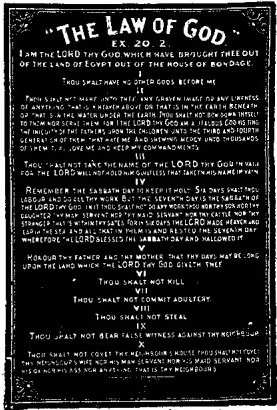
And necessary, if you would know, and have others know the COMPLETE DECALOGUE as God spake it from Sinai’s flaming summit.
A CHART 12x18 INCHES.
On thick paper, mounted at top and bottom with metal and ready to hang on the wall.
Postpaid, 25 Cents.
Postage stamps acceptable.
PACIFIC PRESS PUBLISHING COMPANY, 39 Bond Street, New York City, N. Y.