The Youth’s Instructor, Vol. 38, No. 13.

MARCH

The Youth’s Instructor

Mar 26, 1890

S. D. A. Publishing Association · Battle Creek, Mich. · Mar 26, 1890

MARCH

The pillared clouds against a sullen sky Shut in the day, Like frozen waves on Arctic seas they lie Stone-faced and gray; Against them are the gaunt trees penciled out, Bare and unclad. Low hills, flat meads—the landscape all about Is dark and sad.
There is a look of hopelessness, an air As of old age; Of ended life, too quiet for despair; Of the last page. And the last word written; the tired pen Laid down; the breath Of Nature coming slow and faint, and then The sleep of death.
Yet even now, unseen beneath the clod, The pulse is stirred To bring green freshness to the dry, brown sod, And bud and bird To naked woods; till from the heart of Death, Life, wakening, Opens soft eyes of laughter, as she saith, “I am the Spring.”
—Mary Martin.

THE YELLOW-CRESTED WREN.

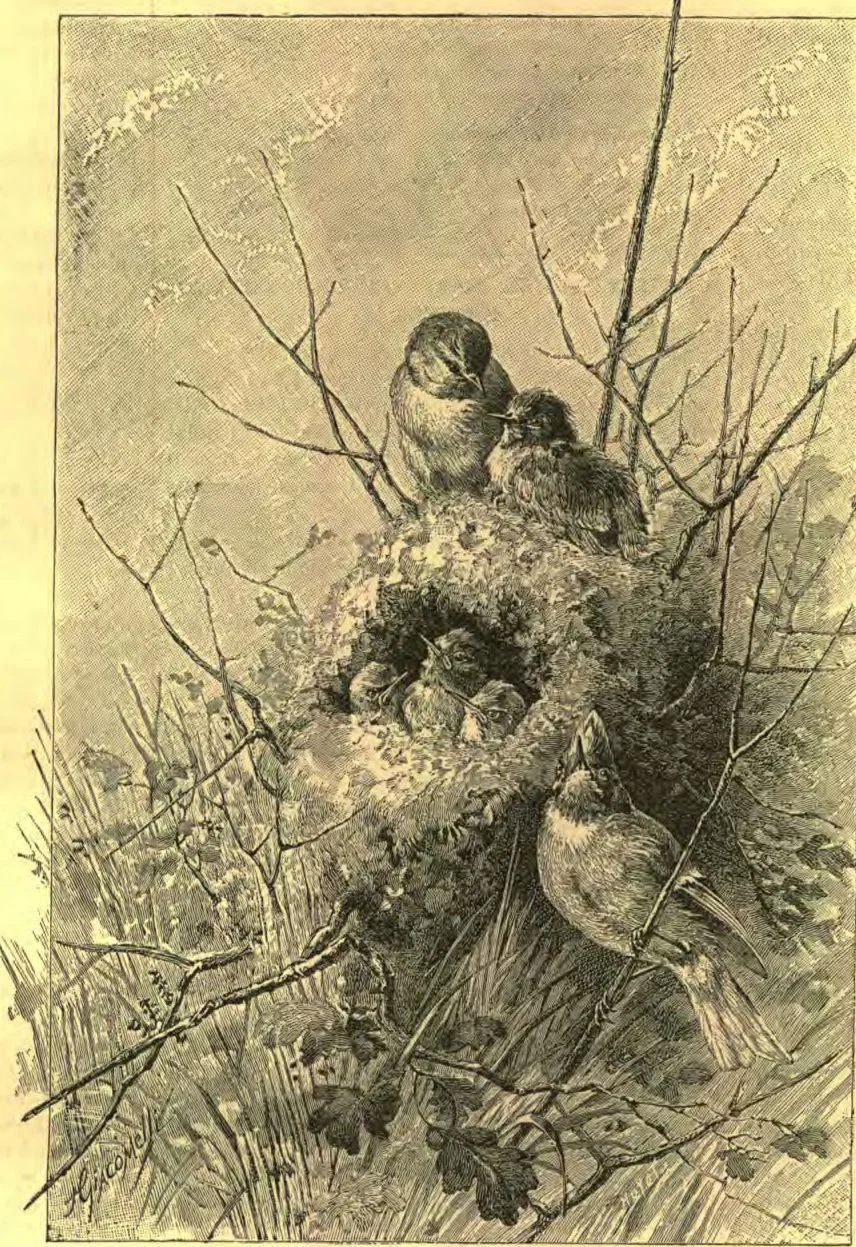
IN “Song Birds and Seasons,” André Theuriet gives an interesting description of the golden-crested wren, the smallest of the British birds. The accompanying engraving shows this little bird at home with his family. Mr. Theuriet thus describes this tiny bit of feathered royalty:—
“I found one day a marvelously constructed nest in the boughs of a larch tree. Imagine a large ball, delicately woven of moss and gossamer threads, wadded inside with the warmest and softest down, gathered from the catkins of poplars, the ripe tufts of thistles, and the cottony seed of the willow herb. This soft nest, into which one could only penetrate on one side by a narrow opening, was the work of the golden-crested wren, that Liliputian bird, the smallest of our European birds.
“The golden-crested wren scarcely ever warbles excepting at the time of brooding; at all other times it utters only a sort of single shrill cry, which is very much like that of the grasshopper. But if it does not shine by its song, it makes up for this imperfection by wearing on its forehead the badge of royalty. Its plain brown plumage is set off by a beautiful gold-colored crown. This crest consists of moveable feathers which the wren, by means of certain muscles in the head, can raise or lower at pleasure. The crest is edged with black; a white line at its base and a black trait on both sides of the eyes mark yet more the courageous and resolute mien of this miniature monarch.
“And indeed the golden-crowned wren is full of vivacity and energy; there is not a bird who undertakes more bravely the struggle for existence. In summer’s sun, in winter’s cold, it skips courageously from tree to bush, from bush to blade of grass, shelling the yellow grain of fennel seed, clearing the needles of the larch tree, picking in the crevices of the bark of willows, to find larvæ of insects or eggs of butterflies.”
“It is exceedingly fond of biting off young leaves from the boughs of the trees of the pine family,—pines, fir-trees, juniper-trees, which conceal a whole world of larvæ and eggs between their needles. The wren is a master in the art of destroying caterpillars. It has been calculated that a golden-crested wren can devour yearly three millions of eggs and of chrysalides.
“It pursues its occupations, followed by its whole family, with order and method. The whole band flies from one tuft or shoot to the other, in a certain direction determined by a special instinct of migration.”
“The golden-crested wren is fond of large trees. It suspends its nest beneath some forest pine-tree, in whose boughs the wind sings such melodious strains, or else beneath the majestic fir, all bordered with lichen. In this nest, rocked by the waves of the big forest, the female lays from seven to eleven yellowish brown eggs, about the size of green peas.
“In its small body, the golden-crested wren combines at the same time royal and plebeian blood. By its size, its industrious habits, and its good humor, it belongs to the people; but it wears a crown, and reigns in the forest in a fashion of its own. In the large, sleeping forest, the golden-crowned wren represents movement and life. When the frozen brooks are silent, when not one blade of grass is moving, when the wood-cutter warms his fingers by blowing on them before taking up the hatchet, he hears suddenly a light, merry cry, and sees a lovely, diminutive apparition, crowned with a crest of gold, gliding between the bare boughs. It is the familiar spirit of the great forest, the beautiful, golden-crowned wren, which laughs at the bleak north wind, and continues picking caterpillars from the juniper trees, almost buried in the snow.”

OTHER PEOPLE'S AFFAIRS.

“What makes everybody love to be with you?” the sweet, simple, unaffected, and lovely Princess Alice once asked her grandmother, the Duchess of Kent. “I am always so sorry to have to leave you, and so are the others who come here. Won’t you tell me, grandma?”
The old lady smiled, and for a moment that was all she did. The Duchess of Kent knew the secret of her influence over her friends, but how to explain it without vanity or egotism to the most natural and truthful little girl at her side was not altogether an easy task. Alice’s sweet directness could never be put off with a pooh-pooh or disclaimer, as the dear old lady knew from an intimate acquaintance with her character.
“I think, my child, that this is the reason,” the duchess replied at last. “I was early instructed that the way to make people happy was to appear interested in the things which interest them,—namely, their own affairs; and this could only be accomplished by burying one’s own grief, annoyance, satisfaction, or joy completely out of sight. Forgetfulness of one’s own concerns, my dear, a smiling face, a word of sympathy, and unselfish help, where it is possible to give it, will always make others happy, and the giver equally so.”
Such counsel as this took deep root in the heart and mind of the beautiful princess, and her brief but exceptional life proves the wonderful power of unselfish regard for others. Where could a better lesson for all our girls be found than this one, given so many years ago by the aged duchess? Other people’s affairs? Why, our own affairs are of infinitely more consequence to us, and yet, if we take the trouble to look about us, we are sure to find that the most agreeable and helpful persons are those who lend a ready ear to the sorrows of others, and keep a closed mouth concerning their own.
A most pathetic instance of the power of example and self-restraint came under the writer’s observation only a short time ago. A very bright and intelligent young lady had received a severe shock in the death of a pet Newfoundland dog. Those who love dogs know how bitter it is to lose a faithful friend of this kind, and this girl was passionately fond of her dumb companion. For days she was really ill, and utterly refused to be comforted. There happened to be illness in the family, which necessitated a certain amount of daily service that the unnerved girl felt entirely unable to perform. About this time a young lady came to the house to board, and, discovering the state of affairs, offered her aid as nurse and general helper. One day the girl, who had so grieved over the loss of her pet, came to the writer with a new kind of tears in her eyes—tears of shame and genuine sympathy.
“I have had a lesson,” she said, with quivering lips, “that will last me. Why did not some one tell me what a selfish and inconsiderate simpleton I was? For two weeks,” she continued, “I have done nothing but mope and cry and let Miss — do my work. Last night I began to feel that I ought to be ashamed of myself, and started to her room to tell her so. The door was ajar, and I was just going to rap and enter, when I found the poor child was praying. This is what I heard, and how do you think I felt? ‘And O dear Father,’ she said, ‘I am trying to do as my dear mamma told me,—forget my own grief, my own great loss, in work and care for others.’ I was grieving for a dog, and this sweet girl had just buried her mother! Do you think I can ever forgive myself?”
A bitter-sweet lesson, indeed, but as valuable for all girls as for this one,—Companion.

THE PULITZER BUILDING.

The tallest building in the great city of mammoth structures, New York, is now in process of erection, and is nearly finished. It is named after its owner, Pulitzer, and is to be occupied by the New York World, the paper having the greatest circulation of any in America. Before the erection of the Pulitzer, the roof of the Equitable Life Insurance Company's building or the tower of the Produce Exchange were the best places from which to obtain a bird's-eye view of the city. On Washington's birthday, a reporter of the World climbed to the top of the Pulitzer building, and the following is his description of the scene presented to him:—
“It was not as easy to reach the roof of this imposing structure as it would have been to get to the highest point on any of the other lofty structures of modern New York, but the view, when the top was gained, amply repaid the extra effort.
“The new Pulitzer building, when supplemented with the splendid tower and dome which are to cap it, will be higher than the topmost point of Trinity church spire.
“One can reach the summit of this great structure only by climbing ladders through small openings in the several fire-bricked floors. It is a dizzy and tiresome climb, meaning one hundred and ninety-two rungs to put one's hands and feet upon before the top is reached.
“The particular advantage of this outlook over any other lofty elevation in New York consists in the fact that from the roof of the Pulitzer building, one looks almost directly down upon the Brooklyn bridge. From many other tall buildings one can see the great bridge arching over the East River in a comparatively insignificant fashion, but from the top of the Pulitzer building alone, can a real bird's-eye view of that structure be obtained.
“And what a wonderful sight this bridge presented on the one hundred and fifty-eighth anniversary of George Washington's birth! The sky at eleven o'clock was almost cloudless; the mercury was low enough, yet not too low, to make walking attractive, and the famous roadway between the first and third greatest cities of the country for which Washington fought was in consequence lined with travelers. From the roof of the Pulitzer building, the bridge looks almost flat. Being on a level nearly with its towers, the spectator looks down upon what appears to be a level, narrow path, stretching from where the buildings on the west side of the East River end, to where they begin on the east side of that apparently narrow stream.
“Everything is dwarfed. Standing up there in mid-air, one feels as though he had left below him a race of pigmies, and smiles unconsciously when, as on the twenty-second of February, the spectacle is presented of their self-importance in celebrating a national event. Of course, here and there, some near-by flag on the summit of a lofty building seemed to have acquired dignified proportions, but the majority of the banners, floating from what would have been considered a few years ago reasonably high roofs, are little better than gaudy pocket handkerchiefs. The people themselves, the representatives of the great and mighty Republic, are no larger than mice. Out on the bay go steamboats, which seem to be the size of the canoes used by the aborigines in the days when Washington lived. It is like looking down from one's superior height of six feet upon a settlement of ants on some occasion when the ants are largely astir. It is like that, and yet it is not like it, for the splendid spectacle of color remains. One's roof is a bright blue sky, meeting the less azure blue of the Orange Mountains on the west and the green of the ocean on the south and southeast. To the north, the distance is abridged by the gray, indistinct, and smoke-hued atmosphere which at all times hangs like a curtain of dirty gauze over a large city. Brooklyn, on the east, has the appearance of being part of New York. The East River, so many hundred feet below the spectator's stand-point, is apparently too insignificant to be a division line between the two cities.
“Turning to an inspection of sights near by, the pleasant sensation of color is provided by a million flags. The air is rosy with these emblems of national independence. One wonders, as he gazes upon them, how it has happened that he has never before observed the great prevalence of flag-staffs that there must be throughout the city. The eye fails anywhere over the surface of the great panorama of roof-tops spread out before it, to discover a place (from this balloon-like perch) on which a coin so large as a silver dollar could be laid without touching the brilliant hue of some floating American flag. An independent company of paraders in uniform passes along Park Row, and the music of the drums and fifes comes up faintly after they are almost out of sight. City Hall Park is almost as crowded as the bridge. It is clearly a holiday, and one feels that the scene has been viewed to splendid advantage from this lofty perch.” W. S. C.

A SOCIETY FOR THE PREVENTION OF CRUELTY TO MOTHERS.

“Can you help me a few minutes, Marion?”
“I would like to, but I don't see how I can.” The tone was not impatient, but hurried. “I have this essay to finish for the society this evening. I must go to our French history class in an hour, then to a guild meeting, and get back to my German lesson at five o'clock.”
“No, you can't help me, dear. You look worn out yourself. Never mind. If I tie up my head, perhaps I can finish this.”
“Through at last,” said Marion, wearily, giving a finishing touch to the essay, at the same time glancing quickly at the clock. Her attention was arrested by a strange sight. Her tired mother had fallen asleep over her sewing. That was not surprising, but the startled girl saw bending over her mother's pale face two angels, each looking earnestly at the sleeper.
“What made that weary look on this woman's face?” asked the stern, strange-looking angel of the weaker, sadder one. “Has God given her no daughters?”
“Yes,” replied the other, “but they have no time to take care of their mother.”
“No time!” cried the other. “What do they do with all the time I am letting them have?”
“Well,” replied the Angel of Life, “I keep their hearts and hands full. They are affectionate daughters, much admired for their good works; but they do not know they are letting the one they love most slip from my arms into yours. Those gray hairs come from overwork and anxiety to save extra money for the music and French lessons. Those pale cheeks faded while the girls were painting roses and pansies on velvet or satin.”
The dark angel frowned.
“Young ladies must be accomplished now,” explained the other. “Those eyes grew dim sewing for the girls, to give them time to study ancient history and modern languages; those wrinkles came because the girls had not time to share the cares and worries of every-day life. That sigh comes because the mother feels neglected and lonely, while the girls are working for the women in India; that tired look comes from getting up so early, while the poor, exhausted girls are trying to sleep back the late hours they gave to study, or spent at the concert; those feet are so weary because of their ceaseless walk around the house all day.”
“Surely the girls help, too?”
“What they can. But their feet get weary enough going round begging for the charity hospital and the church, and hunting up the poor and sick.”
“No wonder,” said the Angel of Death, “so many mothers call me. This is indeed sad,—loving, industrious girls giving their mothers to my care as soon as the selfish, wicked ones!”
“Ah, the hours are so crowded,” said Life, wearily. “Girls who are cultured, or take an active part in life, have no time to take care of the mother who spent so much time in bringing them up.”
“Then I must place my seal on her brow,” said the Angel of Death, bending over the sleeping woman.
“No! no!” cried Marion, springing from her seat; “I will take care of her, if you will only let her stay!”
“Daughter, you must have the nightmare—wake up, dear. I fear you have missed your history class.”
“Never mind, mamma, I am not going to-day. I am rested now, and I will make those button-holes while you curl up on the sofa, and take a nap. I'll send word to the guild professor that I must be excused to-day; for I am going to see to supper myself, and make some of those muffins you like.”
“But, dear, I dislike to take your time.”
“Seeing you have never given me any time. Now go to sleep, mamma dear, as I did, and don't worry about me. You are of more consequence than all the languages or classes in the world.”
“So, after having been snugly tucked in a warm afghan, with a tender kiss from her daughter, usually too busy for such demonstrations, Mrs. Henson fell into a sweet, restful sleep.”
“I see we might have lost the best of mothers in our mad rush to be educated in this hurrying, restless day and generation,” Marion soliloquized, as she occasionally stole a glance at the sleeping mother. “After this, what time she does not need, I shall devote to outside work and study. Until she gets well restored, I will take charge of the house, and give up all the societies except one,—and that I'll have by myself, if the other girls won't join,—a Society for the Prevention of Cruelty to Mothers.”
And Marion kept her word. A few months later, an energetic worker remarked to her: “We miss your bright essays so much, Miss Marion. You seem to have lost all your ambition to be highly educated. You are letting your sisters get ahead of you, I fear. How young your mother looks to have grown daughters! I never saw her looking so well.”
Then Marion felt rewarded for being a member of what she calls the “S. P. C. M.”—Exchange.

SOMETHING FOR SOMEBODY.

SOMETHING for somebody! How or why— It makes no odds how small it may be; The little, sweet kindness just close by. The unprized duty that's next to thee.
Just giving a flower, a book, a tone, A cup of water to thirsty lip, Or helping the angel roll the stone Out of the path where a foot might slip.
Something for somebody! He prays best Whose deeds with a heaven-blest incense come; The breath of love in a human breast Can make the angels feel at home.
—Selected.

FISHING OTTERS.

Man has trained the falcon to hunt for him in the air, and the otter to fish for him in the sea. Bishop Heber saw in India a number of otters lying on the bank of a river, each one tethered by a long rope attached to a collar woven out of straw. They had been trained, by a simple process, to fish for their masters.
When young, the otter was fed on bread and milk, and not allowed to eat a morsel of fish. When old enough to be trained, it was taught to chase an artificial fish tied to a string, and bring it to the master. Then a real fish was substituted for the artificial one, and the otter was taught to bring that, being punished if he mangled the fish, and rewarded if he restored it uninjured.
The Rev. J. G. Wood, in his “Dominion of Man,” says that in the salmon rivers of Scotland the otters have favorite feeding-places, known to the shepherds, who visit them at daybreak. The visit is due to the fact that the otter is dainty, and, after it has brought a salmon to shore, eats only the choice meat of the shoulder, leaving the rest of the fish on the bank. The early shepherd—the otter fishes at night—is almost certain of finding enough fish to feed his family.
A Mr. Campbell, of Scotland, owned a tame otter, which used to catch eight or ten salmon daily for its master. When it caught a large fish, it always bit its prey just above the tail, so as to break the spine, and deprive the fish of the power of swimming.
Another trained otter, knowing that the largest fish of a stream inhabit certain nooks, called “holes,” in the banks, used to swim close to the shore, swishing its tail sharply against the bank, so as to drive out any fish that might be lurking there.
An otter belonging to an English gentleman showed no affection for its master, but a warm attachment to an Angora cat. One day a little terrier attacked the cat as she was lying before the fire. At that moment the otter entered the room; seeing what was going on, he flew at the dog, seized him by the face, and would have injured the terrier had not a gentleman separated them, and expelled the dog from the room. This otter would wander about the garden in search of grubs, worms, and snails, which it would eat with a relish. It would also catch and eat flies.

WHEN GRANDPA WAS A LITTLE BOY.

“WHEN grandpa was a little boy about your age,” said he, To the curly-headed youngster who had climbed upon his knee, “So studious was he at school he never failed to pass, And out of three he always stood the second in his class—” “But if no more were in it, you were next the foot, like me!” “Why, bless you, grandpa never thought of that before,” said he.
“When grandpa was a little boy about your age,” said he, “He very seldom spent his pretty pennies foolishly; No toy or candy store was there for miles and miles about. And with his books straight home he’d go the moment school was out—” “But if there had been one, you might have spent them all, like me!” “Why, bless you, grandpa never thought of that before,” said he.
“When grandpa was a little boy about your age,” said he, “He never stayed up later than an hour after tea; It wasn’t good for little boys at all, his mother said; And so when it was early, she’d march him off to bed—” “But if she hadn’t, may be you’d have stayed up late like me!” “Why, bless you, grandpa never thought of that before,” said he.
“When grandpa was a little boy about your age,” said he, “In summer he went barefoot, and was happy as could be; And all the neighbors round about agreed he was a lad Who was as good as he could be, except when he was bad—” “But ’ceptin’ going barefoot, you were very much like me!” “Why, bless you, grandpa’s often thought of that before,” said he.
—Malcolm Douglas.

THE BEST KIND OF DOLL.

“O MAMMA,” said little Hetty, “I wish I had a new doll.”
“I wish you had,” said mamma.
“Couldn’t you buy me one?”
“I’m afraid not,” said mamma. “I have no money to spare for dolls.”
Hetty knew that pretty well before, so she was not much disappointed.
“Susy Deane has such a be-yewtiful doll, mamma. It is so big—” Hetty held up her two little hands to show how big it was. “Did you ever see such a big one?”
“Yes,” said mamma, “I have seen one so big.”
She held her hands farther apart than Hetty had held hers.
“Dear me!” exclaimed Hetty. “But Susy’s doll can open and shut her eyes.”
“So could this one,” said mamma.
“And did it have beautiful soft, curly hair? Susy’s has.”
“Yes.”
“And pretty red cheeks?”
“Yes.”
“Oh, my! Could it cry? Susy’s cries when you push on it.”
“Yes, it cried when you pushed on it and sometimes when you didn’t.”
“Susy’s mamma told her there are dolls that can walk and some that can creep. Just think of it, mamma—a doll walking!”
“Oh, the doll I am telling you about could walk and creep too,” said mamma.
“What a splendid, beautiful doll it must have been!” cried Hetty. “Ever so much nicer than Susy’s, I know.”
“Yes, indeed,” said mamma, “ever so much nicer.”
“Oh!” Hetty danced up and down. “I wish you’d take me where I could see such a doll.”
“I will,” said mamma. “Look here.”
She led her to the door of a room, and pointed to a cradle. Hetty’s little baby brother was in it fast asleep.
“Oh, did you mean that?” said Hetty. “Why, I meant a real doll.”
“I think he is as nice a doll as you could have. Did you ever see a doll with prettier curling hair and red cheeks? And when he opens his eyes, you will see sweeter ones than any other kind of doll could show. And he can walk and creep and cry.”
“But if he was a real doll, I could do anything I liked with him. He won’t let me.”
“But if he was a real doll, he would never put his pretty arms around your neck and say, ‘I love ’ou, sissy.’”
Hetty stood and looked at the bonny baby face. The blue eyes opened and looked up at her. Then as baby laughed, and held up his dimpled arms, Hetty took him up with a very loving hug, saying,—
“Yes, I do think he is the nicest doll in the world.”—
Sydney Dayre.

A CURIOUS MONKEY.

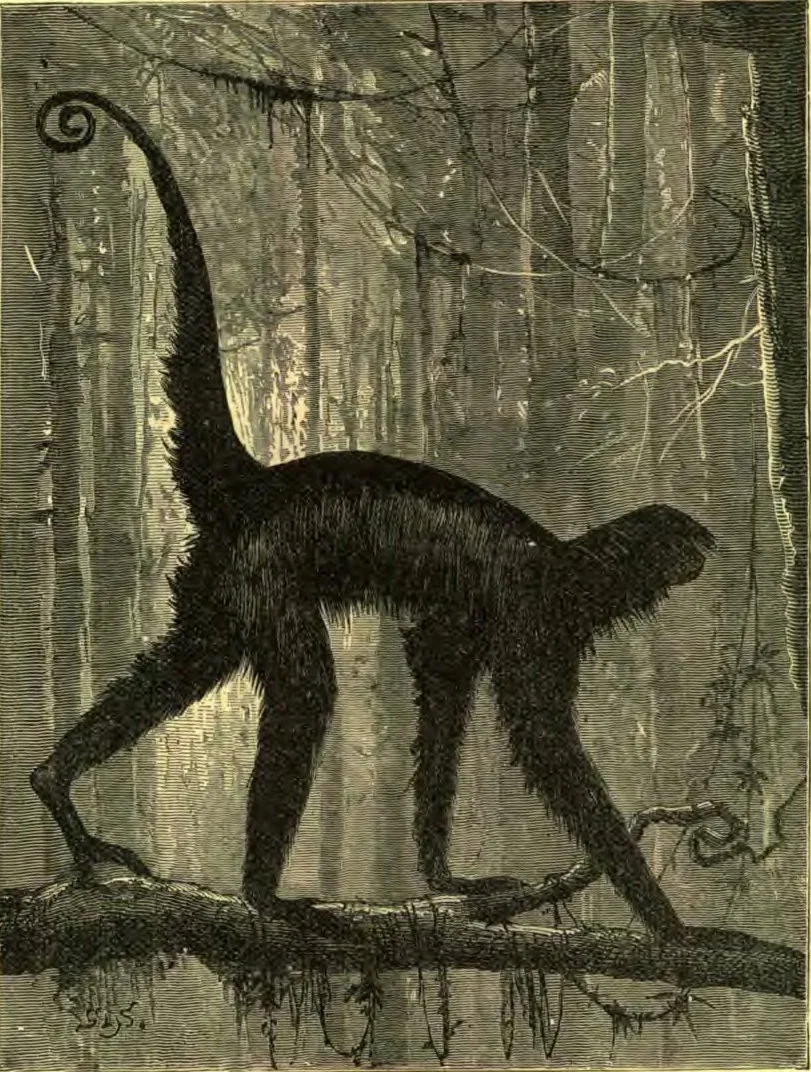
What a strange animal is this one in the picture. He looks for all the world like a gigantic spider walking along the limb. It is a spider monkey, so named because, when walking on all fours, its motions are so much like those of a spider.
The hair on his coat is straight and long and black. His body and head are smaller than those of most other monkeys. His legs are long. His hands and feet have only little stumps of thumbs. This makes it harder for the spider monkey to cling to branches than it is for other monkeys to do so.
But the spider monkey has a long tail. It is as useful as another hand. It sometimes seems as if there were an eye in the end of it, for the monkey uses it in such a handy way. The tip of the tail is bare on the underside. This enables the animal to grasp objects firmly. If he should see a bird's nest in an opening so small that he could not reach his hand in to take the dainty eggs, it would not trouble him in the least; for he could thrust in his tail, and hook out whatever he wanted.
The spider monkey can curl its tail so tightly around the limbs of the trees that even after it is dead, it will not lose its hold.
This monkey walks in the most awkward fashion. It rests its body on the outer edges of the hind feet, and the inner edges of the front ones. So it more than ever looks like a huge spider as it scuttles over the ground.
Spider monkeys are gentle and affectionate when tamed. They act especially fond of those persons who take their fancy, and will play all sorts of antics for them. Even when angry, they do not become savage and bite. They are not only amusing, but can be made useful as well. W. E. L.

WHAT TRANSFORMED TOMMY.

“Have you observed Master Tom lately?” said Duke, the tall greyhound. “How tyrannical he is growing! His selfishness is really something to be deplored; it makes him absolutely cruel.”
Duke was lying now on the soft rug before the open fire-place, with his good friend, the cat.
“Indeed I have,” returned Selina, as she rose and began stroking her beautiful Maltese fur with her pink tongue, “and to my sorrow! I want to leave a room when he enters it.”
“If only I were not shut in by these wires!” chirped the canary from his gilded cage by the window. “He frightens me almost to death, but here I must stay,” and the sweet bird voice dropped to a doleful little twitter.
Now I had been comfortably resting after a long, wearisome journey, and wakening in the late afternoon, had found my way into the library to wait for the dinner-bell. I am Tommy’s Aunt Meg from California, and at this time I had never seen my Eastern nephew, as he was away from home when I arrived that morning. I was sitting there, very quietly watching the firelight, more than half asleep,—but I should not have confessed that; you will be sure now that I only dreamed the conversation I have told you of,—and forgetting my presence, none of them were rude enough to purposely hurt my feelings by saying such dreadful things about the nephew I so longed to meet.
I had always pictured Tom as being all that was good and lovable; so now I comforted myself with the thought that Duke and the rest could not be fair in their judgment. “At any rate,” I decided, “I will not believe Tommy so bad a boy, just because of what I overheard them say.” Presently Mary came in to light the gas, and a few moments afterward the door opened, and there stood Tommy.
Such a handsome boy as he looked, with his broad white forehead, and short chestnut curls, and fine eyes; so graceful, too, and gentlemanly! My heart went out to him in a moment, as he came forward with a bright smile, and said in his manly fashion, “I am so glad to see you, Aunt Meg; you are very welcome.”
“He selfish and cruel,” said I to myself with indignation; “I don’t believe it!” And I turned a glance of intense disapproval toward the rug where Duke and Selina had been lying a moment before, but to my surprise it was empty. There was no sign anywhere of either dog or cat; and as I glanced toward the cage, I saw the little canary crouched on his perch against the opposite wires.
Tom and I had such a delightful talk. I told him of California, and he told me of New York, and the many things he meant to show me, until the dinner was called. As we rose to answer the summons, Tom’s bright eyes caught sight of Selina’s long tail, which was not quite hidden by the drapery of a table under which she had taken refuge, and he managed to step fairly upon it. Such a sharp cry of pain as the poor cat gave as she made a dash for the open door, and how Tommy laughed! I did not say anything about it then. I was not enough at home with my nephew yet, but I thought a great deal.
At dinner I could not help seeing how Tommy nearly made Mary drop some dishes which she was carrying, by a sly attempt to trip her, when he thought no one was observing him.
When we were comfortably settled in the library again, mother and father, Tom and I, everything seemed right for a delightful evening. Tom had a handsome new book to examine, and the rest of us were fairly engaged in talking over the old days, when a sudden commotion at the window made us all jump. Tommy had thrown up the shade with such a jerk that the bird-cage had been almost turned over, and was swaying violently on its spring, while the poor canary, asleep a moment before, was a palpitating little heap of feathers and misery. “O Tom,” said his mother, “why will you be so rough? You’ll frighten the bird to death sometime.” But Tommy laughed. “I only wanted to look out for a moment,” said he. “Silly thing!” he added in a lower tone, with a contemptuous glance at the occupant of the cage. Again I said nothing, but I thought more than ever.
There is no need of my telling you of all the cruel tricks Tom played on every dumb animal within reach, during the weeks of my visit. For one thing, he drove his handsome pony, Dick, unmercifully, one cold afternoon, and on bringing him home all wet and foam-flecked, did not take the trouble to drive him around to the warm stable. He said afterward that he was in too much of a hurry; one of the boys was waiting for him to go skating. So Dick stood for a long time in the wind, unblanketed, and besides his suffering, was ruined for life, his stiffened limbs never growing supple again. “Silly thing!” said Tom when they told him, “he is just making believe that he can’t travel. It was not cold enough to hurt him, I’m sure.”
When I heard that, I thought that the time had come for me to say something, and I spoke my mind. “Tom,” I began, “I had intended to take you back to California with me for a long visit. I wanted you to see the wonders of our beautiful State, and enjoy them all with me; but I have changed my mind. We have horses and dogs and cows and birds on our place, and many animals besides. Then we have servants about, men and women. They are not used to being treated with cruelty, and I do not intend they shall be. So, in place of having company on my long journey home, I shall go as I came, alone.”
Tom’s face was scarlet as he listened to me. “Why, Aunt Meg,” he said, “I am not cruel! Whatever makes you think so? To be sure, I have a little fun with Duke and the cat sometimes, but they’re used to it. What else are they good for?”
I gazed at Tom in wonder. Could it be that he really meant what he was saying, and did not realize that he was cruel? Was it partly thoughtlessness, after all?
“Tom,” I began again, “do you never think that God knows and cares when you hurt one of these dumb creatures, even in fun, as you call it?”
But my nephew looked incredulous. “Oh,” said he, “animals have no souls, Aunt Meg. What makes you think that God cares for them?”
I took my Bible then, and showed Tom how God placed all the animals in the care of man, when he made them, in the very beginning; and then I turned the leaves on to the song of David, which tells of God’s particular care for every living thing. How he sends streams of water in the wilderness for the thirsty wild beasts; how he makes the grass grow fresh and green for the cattle; and how, when he made the trees, he thought of the birds which would make their nests among the branches; how the hungry little lions cry to him for food; and how even the fishes in the seas are in his care every minute, while he never forgets even one of them. And then I turned the pages again to the life of Jesus, and showed Tom how he had said that not one little sparrow, worth only a half farthing, could perish without his knowing the how and the why.
Tom’s face was earnest and solemn as he looked up at me. “Aunt Meg, I never knew all this,” he said; “I never stopped to think that the animals and birds and fishes were of any account in God’s sight, nor that he expects us to care for them. I am glad you showed me those verses.”
I noticed a change in Tom after this. It was a long time before he could make friends with Duke and Selina, and especially with the canary, but he won them all at last, and learned to love them too; and poor, stiff-kneed Dick had a friend in Tom as long as he lived.
As I thought it all over afterward, there came into my mind the thought that no doubt Tom was not the only boy who was cruel mainly because he did not stop to think how his actions appeared in the eyes of others, and especially in God’s eyes. And so I decided to tell you all about him, with the hope that when you read his story, your eyes will be opened, and you will make haste to become manly and kind and thoughtful of every living thing, as God would have you be. If you would like to know what verses of the Bible I read to Tom, they are, Gen. 1:26, Psalms 104:10–29, and Matt. 10:29. Find them all, and read them for yourselves.—Maria James, in the Interior.

The Cultivation of a Kind Voice

THERE is nothing so hard to get and to keep as a kind voice. One must start in youth, and be on the watch night and day, to keep a voice that shall always speak the thought of a kind heart.
Continue reading: TAMING A PARTRIDGE