The people of the United States, who have recently become ambitious to acquire colonial, or outlying, possessions, may yet learn that such property is not as profitable as their “patriotic” enthusiasm leads them to suppose. It is not an uncommon thing for smart individuals, even Americans, to overreach themselves in enlarging their farms or commercial or manufacturing enterprises. It is admitted on all sides to be better policy to so till and fertilize a field as to double its product than to double the size of the field. A nation is but an aggregation of individuals. The experience of others in the colonial business may be worthy of note. Here is what Premier Sagasta recently said about the colonies which the United States are now trying to wrest from Spain:—
“Our colonies have cost us dearly. Within the last twenty-five years we have spent in them three billion francs in defensive works. Only the most important cities and points have been fortified, as we could not erect works everywhere. The cost would have been seven or eight billion francs.”
But it is said that the Spaniards do not know how to manage their colonies profitably; that their colonial officials systematically rob the government, and that the customs revenues are in many cases pawned to the European money-lenders. Taking all this for granted, let us turn to Germany. Here we find a sagacious business people, in whose capital is the headquarters of the greatest financial concern in the world. What about her colonies? The Boersen Courier, published at Berlin, than which there is probably no better authority on the subject, recently said:—
“A heavy burden has been laid upon Germany by her colonial policy. About eleven million marks is spent annually in this connection, and a further expenditure may be looked for in the future. The revenue derived from the colonies in no way offsets this expenditure.”
There is no doubt that it will cost the United States more to hold these outlying possessions than it would cost any of the European monarchies. By a kind of mutual understanding, and a dread of adverse complications, the nations of Europe have not interfered with the colonies of one another for many years. The policy of the United States has been not to acquire any of them excepting by purchase; and even these acquisitions (excepting Alaska) were natural adjuncts from a geographical standpoint. Therefore Spain has been enabled to hold what she now has for hundreds of years. What she has lost has been by revolution, and not by conquest of other nations.
But the sudden wide departure of the United States from their time-honored original policy, together with their well-known strength of resources and the aggressive energy of her people, will work a change in the attitude of European nations toward these colonies. The latent jealousy of these nations, for a long time but illy concealed, will naturally be aroused. Under suspicion of further designs in the way of conquest, they will be continually seeking pretexts for jeopardizing American claims to these possessions. Thus the United States will be compelled not only greatly to strengthen her long eastern and western coasts, but will be obliged to fortify her newly-acquired island possessions far more extensively than Spain has done in the past. Not only so, but an enormous navy will be required, and a standing army such as has not yet been thought of will be demanded in order to meet the never-ceasing menace of the ever-increasing enmity of rival powers. The financial burden that is gathering over us as a result of the present war is not appreciated as yet.
The “Christians” who have demanded this war will find before long that the increasing demand for money to maintain a foreign aggressive policy will more than ever absorb the funds that ought to be devoted to missionary purposes. They will find, too, that the war spirit which has been aroused in the hearts of the people will go far toward quenching the missionary spirit, which is none too ardent even when not diverted by the delusion that carnal warfare can in anywise advance the Gospel of peace. These last days are days of deception, and there can hardly be a worse delusion than to suppose that a call to arms is in any sense a Christian call, or that the armed conquest of territory, even in the name of Christianity, can be reckoned as a victory for the Gospel. Carnal warfare, like the carnal mind, is “enmity against God;” it has nothing in common with the work of salvation. W. N. G.
The Good Shepherd.
There was to be a children's meeting at the chapel at 3 o'clock, and the teacher was collecting different articles together, preparatory to going over to the large, light room that was to be used for the meeting. All the morning she had been thinking, praying, and studying. And now when she had her Bible, her pictures, crayons, pins, and blackboard cloth in her little satchel, she bowed again to ask the great, good Shepherd to speak through her to His own lambs. She said, “Thou knowest I am unworthy to speak to them, but I love them, and Thou lovest them, and I ask Thee for Thy little lambs’ sake, and for Thine own, to bless them, to soften their hearts, and to feed them in green pastures.” After this she started for the chapel, feeling a sense of rest and calm.
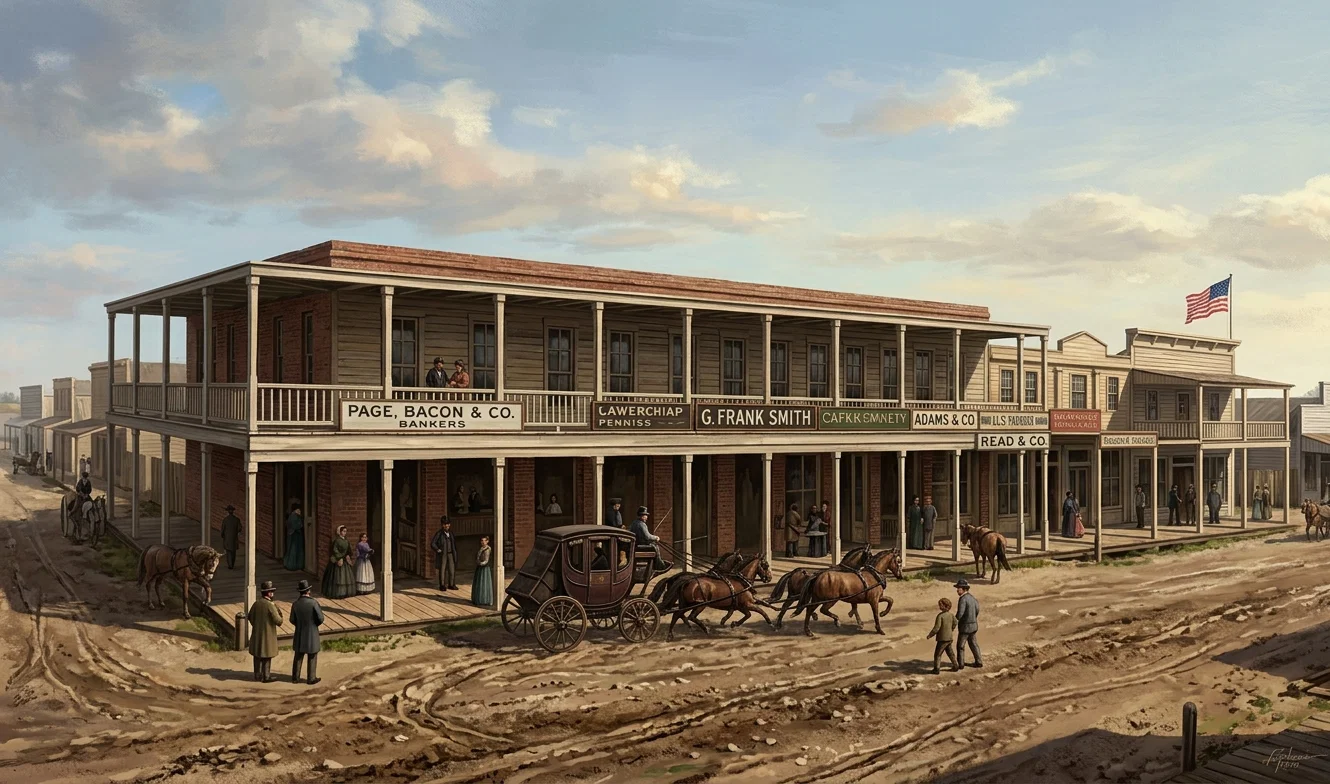
CALIFORNIA SCENERY, No. 21.—John A. Sutter, a Swiss, entered California in 1839. He built a fort, known as Sutter's Fort, on the present site of Sacramento, and formed a settlement, named by him New Helvetia. Sutter and Marshall built their sawmill in the foot-hills of the Sierras, about fifty miles northeast of the fort, in the autumn of 1847. It was finished in January, 1848, and the 19th of that month gold was discovered, which set California and the whole country wild. In the autumn Fort Sutter and vicinity were laid out as the town of Sacramento. A view of the town in 1849 was given last week. The above illustration is from an old engraving of the principal part of the city in 1850. This was the year California became a State.
It was an hour before the time appointed for the meeting, but there was an hour’s work to do. At a convention she had heard a primary worker say that we were impressed eighty times more through the eye than through the ear. “And so,” she said, “they shall have the benefit of both channels to the heart.” First she pinned on the blackboard a lovely picture of a shepherd and a flock of sheep. She had cut this out of a nicely colored picture in a child’s book, as she had a number of other pictures that were used. Then she drew a few mountain peaks in the distance with green chalk for a background, and made a green pasture for the sheep and shepherd in the foreground, and then pinned on a few lilies and other flower pictures, and made a very attractive pasture.
Behind the picture she drew a white cross; on one side of the cross, at the top, was the Saviour carrying a little child in one arm, while leading another by His hand. Over the top of the cross was written, “The good Shepherd;” round the smaller picture, “Carries the lambs in His bosom.” On the other side, over a wild, mountainous desert, where a lamb was caught in a thicket, “Seeketh the lost one.” At the lower right side, over a picture of a shepherd at a well with his sheep, was, “Watereth the flock.” On the left side, a picture of a green place beside a still river where the sheep were resting, and over this, “Leadeth them beside still waters.” On the cross was written, “Giveth His life for the sheep,” and underneath the cross over a picture where a lion was coming to devour the sheep, and where the man hired to care for them was running away, was written, “The hireling fleeth.”
Then she carefully cleared away all trace of litter, “For,” she said, “children are influenced to be orderly if the room is in order,” and placed a few cut pictures that were to be used on the desk.
Before 3 the children began to gather. The songs had been selected with reference to the lesson, and as the children looked at the picture yet unexplained, they sang with interest the first and third verses of the good hymn, “He Leadeth Me.” When the teacher rose to begin the lesson, a sense of her privilege took hold of her heart. There were the sweet, fresh, eager faces lifted to her, and something of a realization of how precious they were in the dew of their youth, how much they were to the great Shepherd, caused the tears to spring unbidden to her eyes. There was a little tremor in her voice as she said: “Children, I am so glad to be with you to-day, because I love you. You are the dear Lord’s children. I never see a child but I feel my heart reach out for him.” The direct gaze of the children read deeper than the words; it was no sham; they would have found that out in a minute. The teacher loved them, and made them feel so quickly that Jesus loved them too.
“Now can you tell me the name of the man who was a shepherd for forty years?”
“Jesus,” said a little fellow timidly.
“Yes,” said the teacher, “so He was, and much longer than that. But there was another man.”
“Moses,” said another boy.
“Who can tell the name of the shepherd boy who used to play on a harp while he kept his sheep, and sing beautiful songs of praise to God?”
The teacher held up a picture from the desk, of David on the hillside.
“David,” said the children.
“Let us repeat the words of one of his songs—now after me.”
Then together they repeated: “The Lord is my Shepherd; I shall not want. He maketh me to lie down in green pastures; He leadeth me beside the still waters. He restoreth my soul. . . . Surely goodness and mercy shall follow me all the days of my life.”
“Who was David’s shepherd?”
“Jesus.”
“Yes, and what kind of a shepherd is He?”
“The good Shepherd.”
“Now we have come around to our picture; for our lesson is on ‘The Good Shepherd.’”
“But if Jesus is a shepherd, who are the sheep and lambs?”
A little girl read, “‘And ye My flock, the flock of My pasture, are men, and I am your God, saith the Lord God.’”
“If grown people are the sheep, who are the lambs?”
“Children,” said some one.
“Then we are His lambs,” and, pointing to the first side picture, “What does our Shepherd do for the lambs?”
The children read, “‘Carries the lambs in His bosom.’”
“Children, Jesus was the Father’s pet Lamb, and the Bible says that ‘He was in the bosom of the Father.’ That means that God thought of Him always, planned for Him, loved Him, felt all His griefs, and it was as tho He was lying always on the Father’s heart. That is the way Jesus loves His lambs. You can have no grief, no trouble, temptation, or thought, that Jesus does not know. He carries you in His bosom.”
“But is it only when you are good?—No, always. I know how children feel when they do wrong. They feel that no one loves them. When mother reproves, they say, ‘She doesn’t love me.’ I knew a little girl who did wrong, and when her mother sent her upstairs alone, the little girl sobbed, and said to herself, ‘I won’t eat any dinner or supper, and I’ll starve to death, and then when I’m dead, mother will be sorry she didn’t love me more.’ But all this time the little girl’s mother was carrying her in her bosom and saying, ‘What can I do to help my darling child?’ That is the way Jesus feels for you when you do wrong. We are often like this little lamb who wandered away and got lost in the rocks. But Jesus, the good Shepherd, does what?”
“Seeketh the lost one,” read the children.
“He will never give us up. I knew a child who told her mother a lie. Her heart felt so heavy after she told it that she could not eat any supper, and when she went to bed, she was almost afraid to go to sleep. In the morning she kept following her mother around, and at last she threw her arms around her, and sobbed out her confession. Did her mother punish her?—No, she took her child in her arms, and said: ‘I knew you told me a lie last night, and I have been praying for you ever since, asking God to help you confess it. Of course I’ll forgive you, and so will Jesus.’ Then they knelt down and told our good Shepherd all about it. But He had been seeking the lost one, and how glad He was that He had found His own again! Never let the enemy tell you that Jesus does not love you when you do wrong. ‘He seeketh the lost one.’”
“How many have felt as tho you wanted something you did not have?—Why, all of you. I have felt that way, and I believe it is a soul-thirst for Jesus’ love. But our good Shepherd will satisfy that hungry, thirsty feeling. Just as a shepherd takes his flock to the well, and10pours water into the trough for them, so our good Shepherd does what?”},{
A NEW LEAF.
He came to my desk with a quivering lip—
The lesson was done—
“Dear teacher, I want a new leaf,” he said;
“I have spoiled this one.”
In place of the leaf so stained and blotted,
I gave him a new one, all unspotted,
And into his sad eyes smiled—
“Do better now, my child.”
I went to the throne with a quivering soul—
The old year was done—
“Dear Father, hast Thou a new leaf for me?
I have spoiled this one.”
He took the old leaf, stained and blotted,
And gave me a new one, all unspotted,
And into my sad heart smiled—
“Do better now, my child.”
—Western Christian Advocate.
SPANISH RULE IN THE PHILIPPINE ISLANDS.
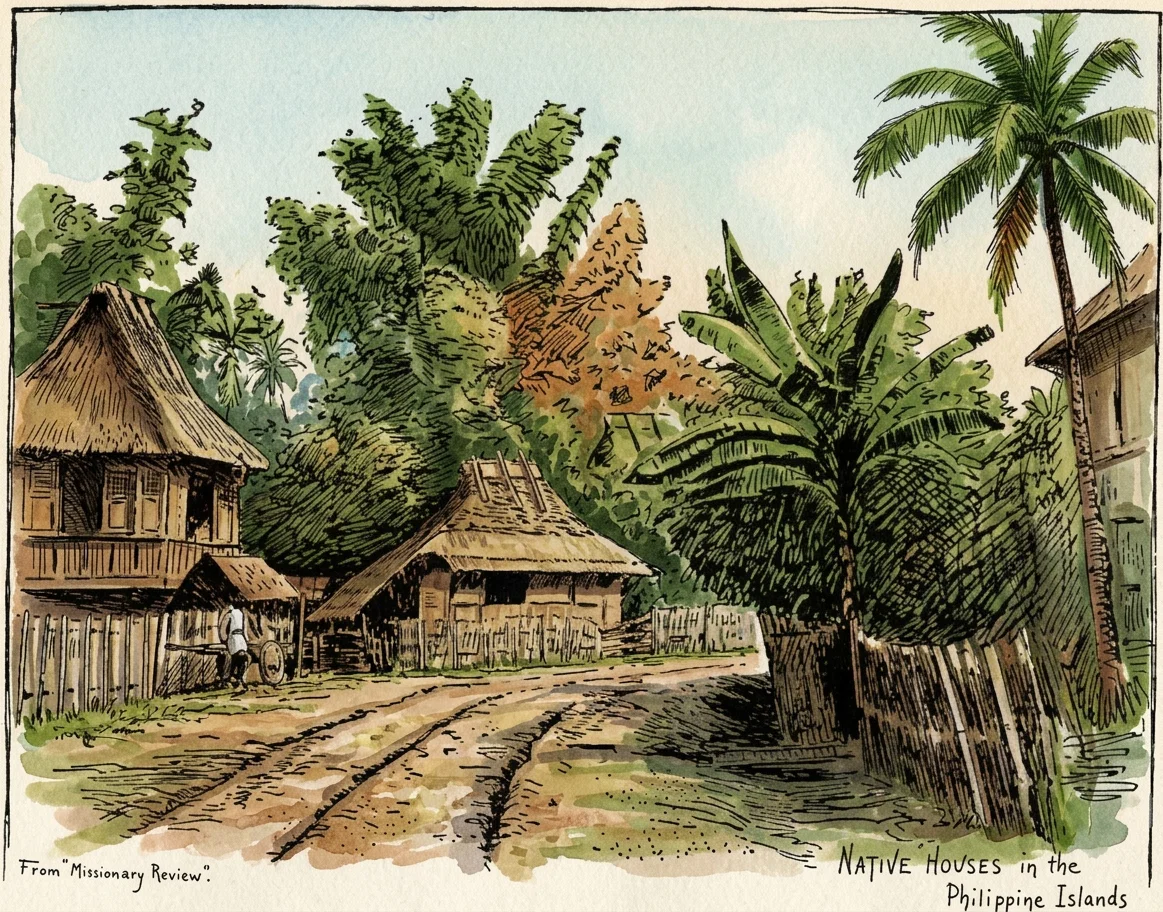
THE present war with Spain has an important religious and missionary bearing. The government of Spain has denied to her colonies religious as well as civil liberty, and has kept them in moral darkness, as well as in material depression. Missionary work in Cuba has been carried on under the utmost difficulties, and in the Philippines has been utterly discouraging. A few years ago the British and Foreign Bible Society sent there a colporter and a converted priest. The priest was killed, the Bibles confiscated, and the colporter was obliged to flee for his life. We trust that the time has now come for the emancipation of these islands, long oppressed and neglected. Professor Worcester, of the University of Michigan, in the Independent gives the following facts in regard to them:—
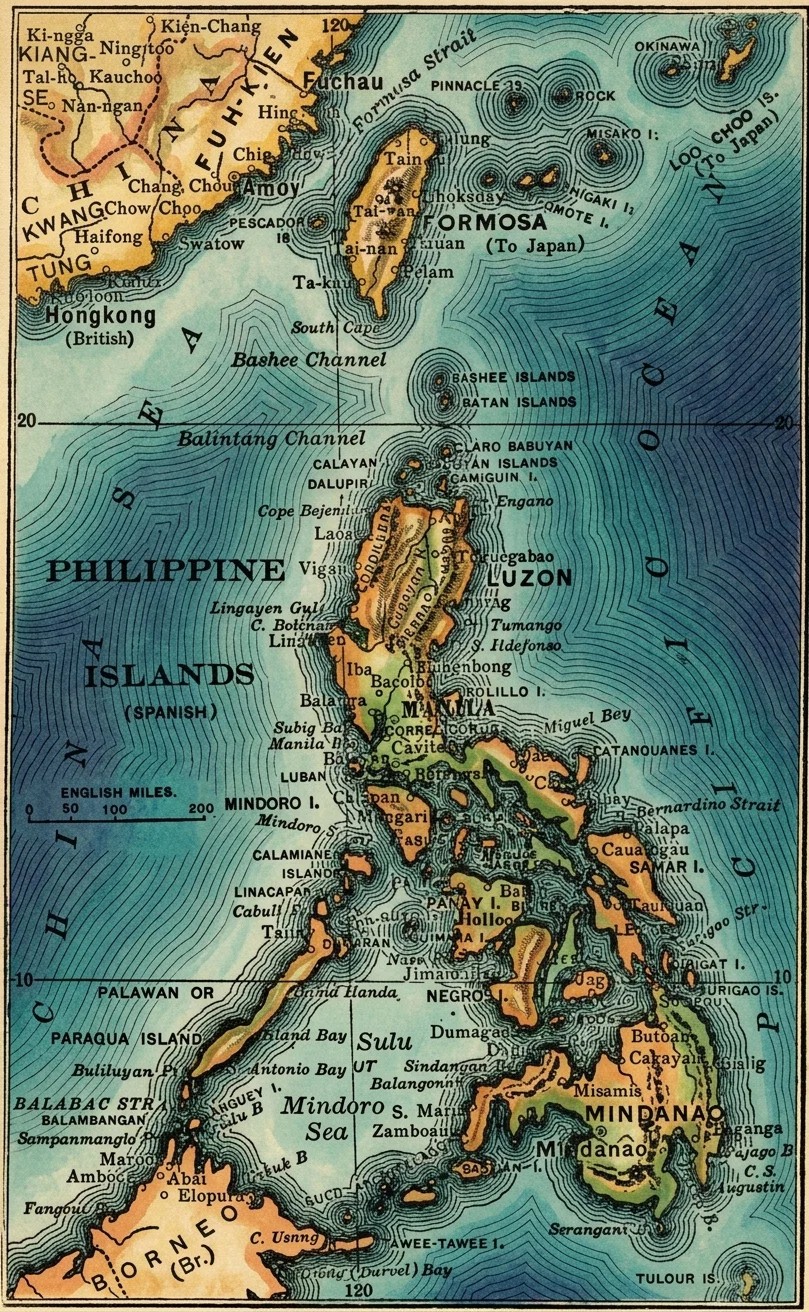
The Philippine Islands (see map) lie wholly within the tropics, reaching at the south to within four and a half degrees of the equator. Big and little, they number some six hundred, varying in size from Luzon, with its 40,000 square miles, to tiny islets hardly worthy of the name. The islands are in most instances of volcanic origin, and several fine volcanic peaks may still be seen in Luzon, Negros, and Mindanao. Destructive eruptions have occurred within recent times, while earthquakes are frequent and often of great violence.
The climate is intensely hot, and in many of the islands very unhealthy for Europeans. There are four months of rain, four of sun, with intense heat, and two months of variable weather at each change of the monsoons. Revolving storms of great magnitude and frightful violence occur at certain seasons, and frequently cause enormous damage to property, attended with heavy loss of life.
The tropical scenery in the forests of this archipelago is of unsurpassed splendor, the heat and moisture combining to produce vegetation of magnificence which beggars description. Gigantic trees, towering to a height of two or three hundred feet, are festooned with graceful rattans, beautiful ferns, and exquisite orchids, while underneath splendid tree-ferns rear their lovely heads thirty or forty feet into air. So dense is the vegetation in some of these forests that the fierce tropical sun hardly penetrates to the ground beneath them, and the dense undergrowth perpetually drips with moisture.
The population of the islands is estimated at from eight to ten millions. The natives are divided into11something like two hundred tribes, each with its peculiar dialect and customs. With the single exception of the Negritos, these tribes are of Malay extraction. The latter people are a race of dwarfish blacks, confined at present to a few of the loftiest mountain ranges. They are characterized not alone by their color, but by the possession of closely curling hair, which serves at once to distinguish them from the straight-haired Malay races. They are commonly believed to be the aborigines of the islands.—Missionary Review of the World.
LOVING SERVICE.
A LADY was walking homeward from a shopping excursion, carrying two or three packages in her hand, while by her side walked her little boy. The child was weary; the little feet began to lag, and soon the wailing cry arose:—
“I’m too tired. I want somebody to let me ride home.”
The mother looked about her, but there was no street-car going in her direction. She took one of her parcels and gave it to the child.
“Mama is tired, too, and Willie must help her to get home. She is glad she has such a brave little man to take care of her, and help her to carry the bundles.”
Instantly the little fellow straightened, his step quickened, and he reached for the offered parcel, saying stoutly:—
“I’ll carry ’em all, mama.”
It was only the old, old lesson that our Father is always teaching us,—“Is the homeward way weary? Try to lighten another’s burden, and the loving service shall smooth thine own path.”—Lutheran Observer.
The Devil’s Deceitful Demands
By C. L. Thurgood
THE devil is prince of this world, and he will make his deceitful demands, taking advantage of the weakness of humanity. As he approached Christ, so does he approach us to-day.—Rev. C. L. Thurgood.
TO-MORROW
By Rev. N. B. Ripley
I HEAR the trumpet of the morrow call;
I see her glittering summits proudly rise
Against the ever-glorious amber skies;
I idly sit, while shadows lengthen to their fall,
And dream, in listless mood, of all
The great and golden opportunities
I deem the pregnant future hour supplies,
Till night shuts round me with her somber pall.
Illusive dream! Let me the lesson learn,
And urge it on my feeble, fainting will,
That if to-morrow comes ’twill be to-day;
And, knowing this full well, O, let me yearn,
With honest, well-directed toil, to fill
Each hour along a straight and perfect way!
—Rev. N. B. Ripley, in The Voice.
THE FRIARS IN THE PHILIPPINES.
By F. de P. Castells
BY REV. F. DE P. CASTELLS, GUATEMALA, CENTRAL AMERICA.
The eight millions of souls in the Philippine Islands have been deprived by Spain of religious as well as political freedom, and have never yet heard the pure message of the Gospel. Since Admiral Dewey’s overwhelming victory there are indications that Spanish authority in those islands is at an end, and that at last the rays of the Sun of Righteousness will shine upon them, dispelling the darkness and purifying the rotten social and religious life which has dominated the people thus far.
From the reports that reach us from time to time from Manila it is time that that nursery of tyranny and religious fanaticism were sunk in the sea, or swept clear of the lazy and cruel drones that make every act of honest men, every opinion different from their own sluggish and bigoted spirits, an act punishable with all the horrors of a lingering imprisonment or speedy death. That such men (the priests) should be permitted to wield such an enormous power for evil, is a disgrace to the Spanish nation; and an indelible stain on the administration of the Spanish Government.
Thus spoke the Siam Free Press and the Singapore Daily Advertiser some five years since. But we, as Christians, only exclaimed, “O Lord, how long?”
Discovered by the celebrated Magellan in 1521, when on his voyage of circumnavigation, these islands were named in honor of the crown prince of Spain, the sanguinary monster that has become famous as King Philip II. No sooner had the friars heard of them than they flocked thither and began the work of baptizing the natives with great vigor, becoming from the first the virtual rulers of the new colonies.
The Spaniards wonder at times that the priests should have gained so much influence over the natives. How has this come about? It was simply through the king lending them his authority and military power, and allowing, what we find even now in Spain, a servile subordination of the civil to the spiritual power. The maxim underlying all their “mission work” was this: All the king’s subjects shall be Catholics. And no territory was considered altogether conquered until its inhabitants had been baptized. When once the friars had obtained control of the islands, they were careful not to let their power be lessened. Orders came, indeed, from the Spanish Government for the establishing of schools and the teaching of Spanish to the natives, but these laws were disobeyed. It was proposed that the Mohammedan populations of the south should be subjugated, but the friars invariably hindered this by turning the expeditions into a sort of religious crusade. In spite of all the precautions taken, however, some of the natives have learned to read Spanish, and have imbibed Western ideas. It is this class which started the revolution—a revolution which was more social than political—and their attitude to the Church of Rome is shown by the fact that whenever they capture convents, the inmates are ruthlessly butchered.
The revolution in the Philippines created more astonishment than indignation in Spain. The Philippine islanders were supposed to be most fervent Catholics, men who fairly worshiped the parish priests, and, therefore, no one could explain this uprising against the “holy fathers.” Foreseeing how detrimental all this would be to their prestige, the priests hastened to announce that the revolution was the work of the Free Masons and the Protestants. The people did not believe this, however, because they knew that the laws of those colonies made it impossible for any dissenting body, or for the Masonic order, to get a footing there. Accordingly, not very long since, the bishop of Oviedo (Spain) gave to the public a more plausible explanation:—
It would be difficult just now to point out the causes of the Separatist uprising in the Philippines, and still more to indicate the remedy. It was the idea that there was once of granting the colonization of Mindanao to a foreign syndicate that led the Jesuit fathers to occupy that island. On coming they were offered the parishes, which had been founded and administered by the Franciscans, and the latter, in compensation, received some livings in the archbishopric of Manila, which had been in the possession of native clergy ever since the extinction of the Jesuits’ order in the last century. The colonization of Mindanao did not take place, as it was not right that it should either. Then the transfer of the benefices in question has been effected, and is being effected very slowly. And it is in this wise that, from the sore that was opened there, has been flowing blood for the last thirty-six years. The native clergy, their relatives, and the friends of these, have formed a band of discontented people, whose well-known workings were abruptly brought to a standstill by the earthquake of 1863, when, it may be remembered, the leaders of the incipient filibustering party were buried in the ruins of the cathedral of Manila.
This throws the blame on the Jesuits, but as the bishop is a friar, it is probable that he only gives us part of the truth.
What makes all this of interest to Christians, however, is the high probability that the Lord is using recent and coming events to show the evil tendencies of papal priestcraft, and the necessity of religious as well as political freedom for the true development of those islands. In endeavoring to quell the revolution, the Spanish forces have been officered with priests and one bishop. It is not surprising, however, that the Spanish clergy should devote themselves to the work of subduing the rebellion, since they derive a revenue of nearly $24,000,000 in gold from the islands.
There is great need of united prayer for this portion of the Lord’s vineyard, that it may be opened to the Gospel, that God may raise up suitable workers for it, and that souls may be saved there.—Missionary Review of the World.
Our Work and Workers.
At Weeping Water, Neb., two candidates were recently baptized by Brother J. H. Rogers.
Five new churches were added to the Wisconsin Conference at its recent annual session.
Brother J. B. Scott recently baptized two candidates, a young brother and sister, at Stanley, Wis.
The addition of two members to the church at Oxford, Wis., on the 2d inst., is reported by Brother G. M. Brown.
In connection with meetings held by Brethren Fred Johnson and H. G. Burgeson at Swift, Minn., six candidates were baptized on the 3d inst.
From the Advance for June we learn that the New Zealand Conference officers were contemplating a camp-meeting at Wellington about the first of August.
Brother W. B. White, formerly president of Nebraska Conference, and later of Indiana, has located at Cañon City, Colo., on advice of physicians and on account of his wife’s health, which is now improving.
Soon after the recent California camp-meeting at St. Helena, eight persons were baptized at Napa, Cal., where Brother G. K. Owen and wife are laboring. Several other candidates were awaiting a subsequent opportunity.
Brother S. H. Lane, president of Illinois Conference, writes thus encouragingly: “Our work is coming on quite well here in Illinois. We have now seven tents in the field, the largest number ever before run in one season.”
Brother L. E. Johnson says in the Reporter that since the last of April five have been baptized at Hastings, Neb. The distribution of the Signs from week to week has created considerable interest, and opened the way for Bible work.
Brother James Cochran, secretary of Missouri Conference, writes again (11th inst.) concerning the work of the Signs in Kansas City, and says: “Since writing before, five more have come into the church and four more will next Sabbath. I don’t think we have a minister in the conference that has brought so many people into the truth as the Signs.”
The first half of the summer school at the St. Helena (Cal.) Sanitarium has given good results, and those in attendance have still greater expectations12for the rest of the term. The class numbers forty-five members. The studies include the Bible, the principles of healthful living, healthful dress, simple remedies, physiology, cooking, and practical missionary work.
The editor of the West Virginia Monitor, in reporting meetings with some of the churches in that conference, notes the fact that eight persons had agreed to secure five new yearly subscribers each for the Signs, thus obtaining a five-years subscription free. We are glad to see that this liberal offer is being appreciated by those who recognize a good opportunity when it is presented to them.
Brother E. W. Farnsworth, president of New Zealand Conference, tells of a family in Fortrose who were convinced of the truths we hold by reading the book “Thoughts on Daniel and the Revelation.” They studied it in connection with the Bible for two years before taking their stand on the Bible Sabbath. Brother Farnsworth says: “I went to visit this family, and on the Sabbath we had a baptism. Finding a convenient place not far from the home of the family mentioned, we went alone with them, and there the father, mother, four grown sons, two daughters who have grown to womanhood, and their daughter-in-law, all went forward and were buried with the Lord in baptism. The place where we had the baptism was a quiet retreat, and God blessed this family as with broken hearts they stepped out to obey God and followed their Lord.”
A recent report of Brother W. C. Grainger to the California Missionary, concerning his work in Japan, is quite encouraging. He says: “Altogether we now have about one hundred Bible students. Our daily attendance is now from thirty-five to sixty. Mrs. Grainger’s classes contain forty students. The prejudice against women teachers does not seem to count in her case. She has two of the most interesting classes in our school. Among those who are now taking lessons are a Baptist minister and his wife, a teacher in the Imperial High Normal School, a principal of one of the grammar schools, and several clerks in government departments. The greater number, however, are college and high school students. We have recently had printed a short series of Bible readings which we are putting into the hands of those who are professing Christians or who have some knowledge of the Bible. The few we have circulated have already aroused an interest which we hope will lead to good results. We feel the need of a paper in the native language very much. The attendance at our Sabbath-school and our Sunday-evening meetings has increased very much since I last wrote to you.”
The Upper Columbia Conference is operating two city missions, one in Spokane, and the other in Walla Walla, Washington. In Walla Walla they have obtained a lease of three years on a well-located building, at $10 per month. This mission has a capacity of forty beds, a chapel, bath-rooms, and all necessary accessories for operating a successful mission. This plant is taxed to its utmost capacity to accommodate the workmen who desire a comfortable home at very small expense. As high as 1,250 penny dishes of food are supplied to hungry men in a single day. The number of beds will not meet the demand, so that many of the applicants are compelled, for want of more room, to sleep on the floors. In connection with the Gospel work of this mission, street meetings are held, at which the attendance varies from 100 to 300 persons. Sometimes so many follow the workers from the street meetings to the mission, that not more than half of them can be seated in the chapel.
At the close of a recent meeting, when a call was made for those who realized that they were lost without Christ, to come forward, and give themselves to the Lord, seven responded. One of these said that up to that time he had been a Jew; another, that till that meeting he had been an infidel; another, that he had been raised a Quaker, but had never experienced a change of heart. Still another had been to that date a drunkard. And thus it is that the Lord is giving His people the privilege of going out into the streets and lanes of the cities, and so lifting up the Saviour before the lost that many are being gathered into the fold of Christ.