The Youth’s Instructor, Vol. 33, No. 46.

SIR WALTER RALEIGH

The Youth’s Instructor

Dec 2, 1885

S. D. A. Publishing Association · Battle Creek, Mich. · Dec 2, 1885

SIR WALTER RALEIGH.
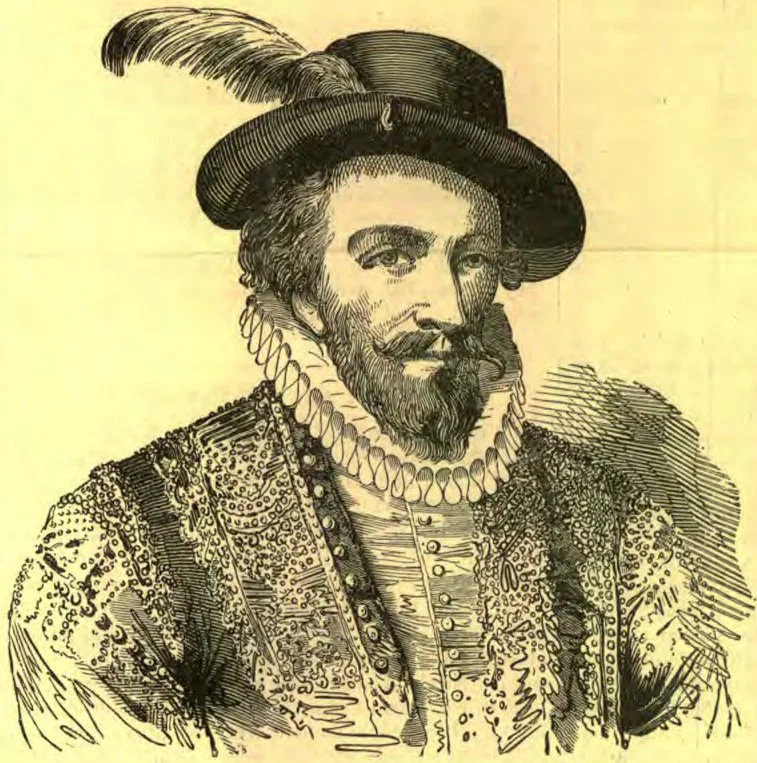
As soon as you read that name, no doubt you remember a piece that you have read over and over again in your school readers about a daring young cavalier, who, when good Queen Bess was one day walking in the park, gallantly threw his richly embroidered cloak over a muddy spot in her path, that she might not soil her jeweled shoes. You remember how pleased the queen was at this marked attention from so handsome and richly dressed a young man, and how from that time he stood high in her favor at court; for she found that he was as wise and witty as he was handsome and gallant.
Walter Raleigh’s boyhood home was in the south of England, in the county of Devon, close to the British Channel. The plain old farm-house in which he was born still stands amid the ancient oaks and orchard trees, where it has stood for at least four centuries. About thirty miles from Hayes—the name of Raleigh’s home—stood, in the midst of dense forests, the grim and hoary castle of Compton. To this castle, young Walter often galloped to see his two half-brothers, Humphrey and Adrian Gilbert. These young men had done some good military service, and were excellent navigators. Walter was a great favorite with them; and they never tired of telling, or he of listening to their tales of daring and adventure, and he longed for the time to come when he, too, could win renown. At other times he would dash over to the fisher’s huts on the Channel, and listen for hours with dilated eye and bated breath to the tales of wonderful voyages, and hair-breadth escapes, and the strange lands beyond the seas, till he came to love the ocean almost as well as the fishermen did.
At fifteen he went to college. Here, as at Devon, he was the leader in his classes and in the sports. His schoolmates all loved him, and his teachers were proud of him. But he did not stay long, for he had a chance to go to war with his cousin, to help the oppressed Huguenots of France,—a temptation that his ambitious spirit could not resist. We may believe he fought bravely in these wars, acquitting himself like a man. After six years he came home, no longer a slender youth, but a tall, broad-shouldered young soldier of twenty-four. Shortly after this he was made captain of a company to put down a rebellion in Ireland. He performed this duty with honor to himself and his country. The queen and all the great men of England were astonished that such a chivalrous youth could manifest such coolness and sound judgment.
From this time he rose rapidly in royal favor, no doubt owing as much to his courtly bearing, fine figure, and keen wit, as to any more manly qualities he might possess; for Elizabeth, although she ruled with as sound a head and firm a hand as ever came to the throne, was nevertheless a very vain woman, loving to have fine courtiers around her, who would flatter her beyond the bounds of truth. Raleigh was one of her principal favorites; yet at times I fancy he found it neither an easy nor a pleasant task to please his exacting and jealous mistress. One time he had the misfortune to fall in love with one of the queen’s maids of honor, whom he secretly married. When Elizabeth found out what had been going on behind her back, she was so angry with Raleigh for daring to fall in love with any woman but herself, that she put him in the Tower, where he was kept a prisoner for several months. She never quite forgave him.
But this court life was a very tame one for such an energetic man as Sir Walter to lead. So when he had endured it as long as he could, or when the queen frowned on him, and made it so disagreeable that he could not stay in the palace at London, he would either go to his beautiful country-seat at Sherborne, or else off to some war or sea voyage. Sir Walter never got over his passion for the sea. Just then the air was full of rumors of wonderful lands that lay on the other side of the world,—lands so rich that things grew without the trouble of cultivating them, and where gold could be picked up like stones in the streets. Sir Walter thought it would be a fine feather in his cap if he could find this land, and add it to the British crown. But of course he never could find such a country, because it did not exist.
He tried time after time to plant a colony in America, which was then an unsettled wilderness. I think it was his half-brother, Sir Humphrey Gilbert, who first put the idea into his head. But some misfortune attended every company that he sent over.
At last Queen Elizabeth died, and James, the son of Mary Queen of Scots, came to the throne. Then Raleigh’s happiest days were over. The new king hated him bitterly, and took every chance he could find to disgrace him before the court. Worst of all, he was, after a short time, accused of trying to dethrone the king, and place Arabella Stuart, a relative of James’s, on the English throne. This charge was false. The chief of the conspirators was an intimate friend of Sir Walter’s, but Raleigh had nothing to do with the plot. King James, however, chose to believe the false reports, and kept him in prison for twelve long years.
Finally he was granted his liberty on condition that he would go to Guiana, subdue the country, and annex it to the English crown. Raleigh, glad to obtain his freedom at any price, very eagerly accepted the proposal. He spent the last of his princely estate in fitting out this fleet, and his wife gave him all the money she had from her own property. It was with high hopes that Sir Walter set out on this last voyage, taking with him his oldest son, a fine young man of twenty-three.
But I dislike to tell you how this expedition turned out; how the Spaniards, who had been there before him, entangled him in constant broils, and how in one of these skirmishes, his noble son was killed! At last he had to go back without finding the country, with half his gallant followers killed, and his fleet in a disabled condition.
Of course James was very angry with him when he reached England, and immediately shut him up in prison. He was anxious to get rid of him, and at last hit upon the plan of trying him for his old offense that by this time most everybody had forgotten. In the trial, Raleigh was not allowed to defend himself, but was accused in the most abusive language, and finally sentenced to the block. You may be sure that by this time he had learned that “it is better to trust in the Lord than to put confidence in princes.” And that you may know how he felt about it, I shall give you a good part of the last letter he ever wrote on earth:—
“You shall receive, my dear wife, my last words in these my last lines; my love I send you, that you may keep it when I am dead, and my counsel, that you may remember it when I am no more. I would not with my will present you sorrows, dear Bess; let them go to the grave with me, and be buried in the dust. And seeing that it is not the will of God that I shall see you any more, bear my destruction patiently, and with an heart like yourself. . . . To what friend to direct you, I know not, for mine have left me in the true time of trial. Most sorry am I, that being thus surprised by death, I can leave you no better estate; God hath prevented all my determinations,—that great God which worketh all in all; and if you can live free from want, care for no more, for the rest is but a vanity; love God, and begin betimes—in him you shall find true, everlasting, and endless comfort; when you have travailed and wearied yourself with all sorts of worldly cogitations, you shall sit down by sorrow in the end. Teach your son, also, to love and fear God whilst he is young, that the fear of God may grow up in him; then God will be a husband to you, and a father to him,—a husband and a father that can never be taken from you.”
His remains lie in Westminster Abbey; and years after his burial, there was placed near the spot a brass tablet, with this inscription:—
“Within the chancel of this church was interred the body of the great Sir Walter Raleigh, on the day he was beheaded, in Old Palace Yard, Westminster, October 29th, 1618. Reader, should you reflect on his errors, remember his many virtues, and that he was mortal.” W. E. L.

THE WORTH OF A NAME.

“THREE groans for Chester Fay!”
This was what Mr. Hall heard from a group of boys as he left the school-room one afternoon.
“Not quite pleasant is it?” he said to a boy as he passed on, for he had seen the retreating figure of Chester, as the boys gave the dismal chorus.
“It is rather hard on him,” said Archer Blake, “but he was mean.”
“Are you sure of it?” said the teacher. “Better be certain before you speak so.”
“We boys think so. I am going to ask mother.”
“That is right,” said Mr. Hall, passing on, feeling quite safe about the opinion of that boy’s mother, though not acquainted with her. Boys often tell unconscious tales of home influence.
Archer rushed home and burst in upon his mother in the home room with the question: “Isn’t it mean to be disobliging? Can’t we have a talk?”
“When I have finished these letters.”
The boy watched the pen until it was put in the rack, and mother said, “Now, my son,” as she took up her knitting from the basket, mechanically moving her fingers while giving her whole thought to the boy.
He pushed a low seat to her side, and began: “You know about the excursion to Boston for Friday, when they go for half-price on the train and into the fair?”
“Yes; is that the mean thing?”
“No, but they got up a petition in our class at school for a holiday. Several of the boys wish to go. Mr. Banks won’t let his boys stay out of school, and Ned Trow wants to get the prize for constant attendance and good conduct, so it all depended on the success of the petition; and Chester Fay wouldn’t sign, though we teased and teased him; and I think it real mean of him. Don’t you?”
“Perhaps not. Why wouldn’t he?”
“He said it would be lying to put his name down, because he didn’t want it. He might have wanted to please the other fellows, I think.”
“If that is so, he did right to refuse. We must sometimes seem unkind when we do what we know to be right. Did he tell why he did not want a play-day as much as the others?”
“This is the week Professor Russell comes to drill us, and the last time he will be here before the committee examine for promotion. Chet says we ought to be at school. The professor promised to give an extra hour, so as to be critic for each of the class.”
“That is quite reason enough to keep any thoughtful boy from signing a petition to be away.”
“But I signed to oblige the others. Isn’t it right to be obliging?”
“You will have to learn that it is not possible always to be obliging and do right. Sometimes it is wrong to be obliging, and your name is one of the things to be very careful of, as of some treasure.”
“Simply a school-boy’s paper is not much.”
“Does it make much difference in a sum in compound interest if, in adding the interest the first year, you forget to add one to the dollar column?”
“Oh, yes, it makes hundreds of dollars’ difference sometimes, and it is the worst place for a mistake, because it spoils the whole, and you have to begin again to correct the mistake.”
“Remember, my boy, that habits increase as fast as the amount in compound interest. It is time now to learn how to act. A careless boy is not likely to be a reliable man. I suppose Chester Fay’s name is worth so much, because it is not easy for everybody to get it. Don’t cheapen your name by signing everything you are asked to sign.”—The Well-Spring.

EVENING BRINGS US HOME.

UPON the hills the wind is sharp and cold, The sweet young grasses wither on the wold: And we, O Lord, have wandered from thy fold; But evening brings us home.
Among the mists we stumbled, and the rocks Where the brown lichen whitens, and the fox Watches the straggler from the scattered flocks; But evening brings us home.
The sharp thorns prick us, and our tender feet Are cut and bleeding, and the lambs repeat Their pitiful complaints; oh, rest is sweet When evening brings us home.
We have been wounded by the hunter’s darts; Our eyes are heavy, and our hearts Search for Thy coming; when the light departs, At evening bring us home.
The darkness gathers. Through the gloom no star Rises to guide us. We have wandered far. Without Thy lamp we know not where we are; At evening, bring us home.
The clouds are round us, and the snow-drifts thicken. O thou, dear Shepherd, leave us not to sicken In the waste night; our tardy footsteps quicken; At evening bring us home.
—Anon.

A BALLOON JOURNEY

Written for the INSTRUCTOR.

A BALLOON JOURNEY.

WHILE reading, in a late INSTRUCTOR, an article upon balloons, the thought came to me to write a true incident of a swift journey in a balloon. In the year 1870, when Paris was besieged by the Prussians so that it was impossible to receive or send out any mail, two officers attempted to leave the city in a large balloon, with five mail sacks and five sand-bags as ballast. The Prussian bullets whistled round them, as they were quickly borne out of the city over sea and land, they knew not where.
One sand-bag after another was cast away, and at last, as the balloon came down to the waves of the sea, it became necessary to still further lighten it by casting away the mail sacks also, one of which was afterward picked up by a fisherman on the Norwegian coast. After seventeen and a half hours’ journey through the air, the ropes which hung from the basket of the balloon became entangled among some trees. The two Frenchmen immediately jumped out of the basket, and fell into the deep snow. After a few hours’ wandering in the cold, they caught sight of a narrow path, which, to their great delight, led them to a house. Here they found a man gathering fire-wood on a hand-sled.
They could not understand him any better than he could them; but they made signs, telling him that they had dropped down from the air. They could not imagine where they were, until one of them spied a match-box with the word “Christiania” upon it; then they knew that they were in Norway.
The first town they came to was Kongsberg; and from there they went to Christiania, where they found people who understood the French language.
With the French minister as interpreter, they made a speech to thousands of people, the writer among the rest. It was a very interesting address.
But what became of the balloon, you may ask? There was still a small quantity of gas in it, and when freed of its inmates, it rose and sailed several hundred miles farther north. At last it came down at a place called Hallingdal, in Norway. When first seen, it was rolling over and over on the earth. The people who saw it were very much frightened; many of them said, “It is the devil himself.” But at last some ventured to approach it, and found it was only a balloon, with two carrier doves in the basket. The balloon and doves were brought to Christiania, and placed on exhibition.
The balloon was made of thick silk, with a net around it. It had a basket attached to it by means of ropes that were fastened to the net surrounding the balloon. The ballast and all who go up with a balloon are in the basket.
This balloon was as large as a medium-sized house, and it was said that there was not enough gas in Christiania to fill it. The writer went in the basket while it was exhibited in the city. This journey was among the swiftest and longest which has ever been taken in a balloon.
P. L. HOEN.

WHY ARE YOU HONEST?

“Why am I honest?” said Will. “I have been educated that way. I can’t very well help it. I have heard about it morning, noon, and night.” You may be very thankful that you have had that home education. Habits have long roots. Honesty as a habit will be likely to send its roots all through your manhood, if the plant have a good start in youth.
“Why am I honest?” says Rob. “Well, it seems to be respectable. I don’t think that really nice people lie, cheat, or steal; and I want to go in that set.” Nice people do not lie, cheat, or steal, as I classify people. Sometimes, in so-called “good society,” you will find people who break the eighth commandment in a sly way, taking advantage of another’s ignorance, and keeping money that belongs to the latter. In society that is morally good, people scowl at such commandment-breakers, and I am glad the scowl is on your face.
“Why am I honest?” says Ned. “I think it pays. Isn’t there an old proverb that honesty is the best policy?” Yes, it is true in the long run. Policy says, “Be honest. It is good for your best interests to be honest.” If we take the business world, a certain measure of honesty is a necessity. People that buy and sell must trust one another; and such confidence rests on people’s honesty. It is not good policy for me, if making chairs, to put together poor work, and palm it off on a merchant as a good chair. He sells it to a man who comes to the ground while occupying it; he scolds the merchant, and refuses to trade with him; the merchant in turn comes to scold me, and will have none of my chairs. It does help one to build up among business men a reputation for integrity. There was a merchant in New York, (Arthur Tappan) of whom it was said that “his customers had the fullest confidence that when they made purchases at his store, they would not be cheated by false weights and measures, or fugitive colors.” A merchant made this remark about him: “If Arthur Tappan will allow his name to be put up on my store, and sit in an arm-chair in my counting-room, I will pay him three thousand dollars a year.” That man’s honesty became an ally to him. In political life, the man scorning everything dishonest will gain the respect and confidence of his fellow-citizens. In the end it will pay in politics, where things are so cheap.
Of what value is honesty in the home circle? You say your father would not stoop to any act of a doubtful character, and you can trust his honesty of purpose. He is repaid by the fact that you lean upon that father’s integrity as if it were a marble column.
And yet, for the present, honesty may not pay. Some poor fellows are pressed into tight corners for their integrity. A boy who cannot in a store cover up with a lie a poor place in the cloth, or by throwing in a lie make fifteen ounces weigh sixteen, may perhaps lose his place. Even then a sufferer through honesty will have a present peace of mind that certainly pays. That is the highest wages honesty can pay—a good conscience that would let us sleep the night through. And if any one may be a sufferer pecuniarily, even through life, on account of his honesty, in the next life there will be an evening-up of things. He has saved his character—himself. The big rascal who has gone on cheating his neighbors, and as a fraud and deceiver has met death, will wake up to find himself between the millstones of justice, and be sorry there that he did not in this life practice the honesty which in the end will always pay.
Would any one else like to answer that question, “Why am I honest?”
“Because it is right,” says a little fellow. Too young to reason whether it will pay or not, he falls back upon that which is undoubtedly the best and strongest reason,—honesty is right. Make honesty a principle. The boy that stops to ask whether it is respectable, whether it will pay, may consult a motive that is selfish; and the higher ground to take is that of right for right’s sake. Plant your guns on Mount Principle, and you can rake any enemy. That was a noble answer made by a young slave. Somebody offered to buy him if he would promise to be honest. “I’ll be honest,” he replied, “whether you buy me or not.” His body might be enslaved, but his soul walked in glorious liberty. He belonged to the same honor-family—all free-born and noble in God’s sight—of which an Irish boy was a member. In a linen-factory, working on a piece of cloth which was too short to be honest measure, the master thought by stretching he could make it long enough. He seized one end of the cloth, and told the boy, taking the other end, to pull. “Pull, Adam! pull!” he cried. The boy was motionless. “Pull, Adam! pull!” he said again. “I can’t,” said the boy. “Why not?” asked the man. “Because it is wrong,” was the answer. The master said he would not do for a linen manufacturer, but Adam did well enough in after-life to become the distinguished Dr. Adam Clarke.
“Because it is wrong;” let that be our great argument against dishonesty. We will not ask first whether anybody else does that way, whether those at home, or whether those in the better ranks of life have that fashion, and whether it will pay for any reason, but whether a thing be right; and if it be not right, we will put it out-of-doors, and not make room for it in our hearts. Sir Benjamin Rudyard was right when he said, “No man is bound to be rich or great—no, nor to be wise—but every man is bound to be honest.” Let us put it on our flag, “Honest always, because right always.” That flag was never yet taken by the enemy.
Honesty is not the only thing that pays in this world; brains pay. If the man on the other side of the bargain has more brains than you or I, our honesty will not be a match for his cunning. If you wish never to be disappointed, be honest because it is right, whether it pays or not; then you will be content, however the matter goes, whether for or against you. Still young, you can afford to wait and let the years tell you whether you have acted wisely or not.
I feel that this is a very important subject. I want to put into your hands at starting out in life the helm of a rudder strong enough to steer the ship. Ask God to help you. Think of him as near to see and strengthen you. Somebody at work in a shop was asked in the absence of his master to do something for a caller which was not strictly honest. “Your master is not in,” pleaded the caller; and the grand reply was, “My Master is always in.” The human master is not always in, but is God ever away? Think of him as present, and remember to obey him.—Edward A. Rand.

“ONE STEP AT A TIME.”

ONE step at a time, and that well placed, We reach the grandest height; One stroke at a time, earth’s hidden stores Will slowly come to light; One seed at a time, and the forest grows; One drop at a time, and the river flows Into the boundless sea.
One word at a time, and the greatest book Is written and is read; One stone at a time, a palace rears Aloft its stately head; One blow at a time, and the tree’s cleft through, And a city will stand where the forest grew A few short years before.
One foe at a time, and he subdued, And the conflict will be won; One grain at a time, and the sands of life Will slowly all be run. One minute, another, the hours fly; One day at a time, and our lives speed by Into eternity
One grain of knowledge, and that well stored; Another, and more on them; And, as time rolls on, your mind will shine With many a garnered gem Of thought and wisdom. And time will tell. “One thing at a time, and that done well,” Is wisdom’s proven rule.
—Golden Days.

BOYS, READ THIS.

THE other day I cut the following from the Boston Journal:—
“PHILADELPHIA, Sept. 6.—Oscar Parry, 11 years old, committed suicide this morning by shooting. The boy stood in front of a looking-glass, and guiding his arm by the reflection, shot himself in the head. He had just finished reading a sensational story, and it is believed that the story has affected his mind.”
A boy only eleven years old committing suicide! A young and hopeful life ruined and put out so early! How sad and wicked that was! What was the cause? It was story-reading. Of late I have read of several such cases. Some are led by novel reading to steal, others to break into stores, and some to attempt highway robbery, and even murder. Thousands who do not go as far as this are ruined in their education, and in their morals. They lose taste for good, sober, plain things. They must have something exciting; so they become dissatisfied with school books, with the Bible, with work, and with home. Then they fall into bad company, are led off, and ruined. Boys, be careful. Avoid sensational stories as you would a snake.
D. M. CANRIGHT.

There Are Gentlemen Present.

On a recent occasion we heard General Fiske relate this incident of General Grant. During the war, General Grant and several army officers were sitting together in a tent. One of the number, a major-general in rank, remarked that he had a good story to tell, adding, “There are no ladies present.” General Grant, looking up quickly, replied, “But there are several gentlemen present.” The conversation changed to another channel, and the officer’s story was not told. At the first opportunity the officer sought General Grant’s presence again, and with sincere apology he said, “General, you have taught me a lesson, and I shall never forget it.”
And here is a lesson for my young readers, and older ones as well. How many are the stories that are told among men and boys, that would be considered unfit to be told in the presence of ladies. The safe rule is never to tell anything that would be indelicate to relate in the presence of your mother, your sister, or the most refined lady you can think of. If all persons would follow this rule, how conversation would be relieved of all things impure and degrading, and be lifted up to a pure and ennobling plane! The greatest soldier of our country would not suffer low conversation in his presence. His example should be remembered, and scrupulously followed.—Selected.

IMPORTANT BIBLE SUBJECTS.

LESSON 13.—THE LITTLE HORN OF DANIEL 8.

[NOTE TO THE STUDENT.—Do not consider the lesson learned until you can give at least the substance of every text, with the correct reference for each. The references in black letters indicate those texts that should be committed to memory. A little diligent application each day will enable you to learn them, although this need not be considered a test of scholarship.]
1. Is the little horn of the eighth chapter of Daniel identical with the one brought to view in the seventh chapter?
2. What is symbolized by the little horn of the seventh chapter?
3. What does the little horn of the eighth chapter represent?
4. How many points may be stated in proof of this?
5. In the dream of Nebuchadnezzar, what universal empire is represented as coming next after the Grecian kingdom?
6. What in the vision of the seventh chapter?
7. Does the little horn of the eighth chapter represent a universal kingdom?
8. How may this be proved? Dan. 8: 4, 8, 9.
9. What is the only universal kingdom that has succeeded Grecia?
10. In the twenty-third verse of the eighth chapter, what is said of the kingdom represented by the little horn?
11. How was this prediction fulfilled by the Roman soldiery?
12. In Deut. 28: 49, 50, what does Moses say of the Romans?
13. Is it universally admitted that this passage refers to the Romans?
14. To whom, then, must Dan. 8: 23 refer?
15. Where did Rome extend her conquests?
16. What is said of the little horn in this respect?
17. In its tours of conquest, how did pagan Rome treat other nations?
18. What is said of the destructive character of the little horn? Verse 24.
19. What have the people of God suffered at the hands of the Roman power?
20. What was the little horn to do? Verse 24.
21. What power crucified the Saviour? Acts 4: 26, 27; Matt. 27: 2; Rev. 12: 4.
22. Against whom was the little horn to stand up? Verse 25.
23. How was this power to be destroyed? Verse 25.
24. How were the feet of the image to be destroyed?
25. What kingdom was represented by the feet of the image?
26. From all these considerations, what must we conclude with reference to the kingdom that is represented by the little horn of Dan. 8?

NOTES.

The horns not identical.—The little horn of Dan. 8 cannot be identical with that of Dan. 7; for the latter denotes the Papal power only, while the former represents the entire Roman kingdom, some of the acts attributed to it having reference to pagan Rome, and some to the Papacy.
The fourth kingdom represented in Dan. 8.—That Rome under both pagan and Papal rule is represented by the little horn of Daniel 8, is clearly shown by the following considerations:—
1. It represents a power that is to hold sway next after Grecia, and we have seen from both the other lines of prophecy, that Rome was to succeed Grecia in the dominion of the world.
2. It represents a kingdom greater than either of the kingdoms that preceded it, and this could not be true of any kingdom but Rome.
3. In verse 23, this kingdom is spoken of as a king of fierce countenance, and understanding dark sentences. The Roman soldiers were fierce in combat, and spoke a language that the Jews could not understand. Words similar to those of verse 23 are used by Moses when he is, as all agree, describing the Romans. Read Deut. 28: 49, 50.
4. It was to wax exceeding great toward the south, toward the east, and toward the pleasant land. This was true of Rome; for she extended her conquests into Africa on the south, and into Asia on the east; she also subdued Palestine, the pleasant land.
5. It was to destroy wonderfully. No power has ever destroyed the nations as did pagan Rome in its tours of conquest, in one of which eight hundred cities were taken, and a million of men were slain.
6. It was to destroy the mighty and holy people. Pagan Rome persecuted the people of God, but Papal Rome has destroyed millions upon millions of them, employing the most lingering torments and the most cruel tortures that were ever invented.
7. It was to stand up against the Prince of princes. It was the Roman power that crucified our Saviour. Acts 4: 26, 27; Matt. 27: 2; Rev. 12: 4.

THE ORIGIN AND PROGRESS OF RAILROADS.

Have you ever tried to consider the terrible consequences which would follow the sudden destruction of all the railroads in the country? And yet only about 250 years ago these lines of passage had not been thought of. They had their origin in a very simple contrivance; but lo, what has time wrought! It has been said of the railroad system as at present perfected:—
“The advantages afforded by it, and the speed we have attained to in this relation, afford such important facilities to our mail-transit that time and space have been almost shriveled to a span among us. In truth, the great network of our railroads has so ramified itself through all our vast borders, that notwithstanding our population of upwards of 50,000,000 is scattered from the Atlantic to the Pacific, from Florida to Alaska, we are all, so to speak, gathered together on one hearthstone. These great arteries so pulsate with the life-blood of the nation that every throb of the heart at Washington is felt to the remotest bounds of civilization.”
The origin of railroads is traced to the simple apparatus used in England about the middle of the 17th century for transferring coal in the collieries near Newcastle-upon-Tyne. As condensed from good authorities:—
“The invention consisted of a double parallel line of wooden beams or trams, fixed to the ground and furnished with flanges to prevent the wheels of the cars from slipping aside. The motive power was furnished by horses. The date at which these roads were first used is set down as between 1602 and 1649. In 1700, long slips of iron were placed on the wooden beams, in order to prevent the excessive wear and tear. This was far from satisfactory, and about 1740, cast-iron rails, fixed in parallel lines on cross wooden sleepers, were substituted, this species of railway becoming pretty general in mining districts between 1745 and 1775. The use of these rails led to an improved method of traction; for instead of drawing a single large wagon, the plan of linking together several smaller ones was now adopted; and here we see the germ of the train at the present day.
“The wagons were still drawn by horses; but many minds set about devising schemes to substitute for these some machine moved by steam. In 1808, wrought-iron rails were introduced, which were an improvement, as cast-iron rails could not be made straight in greater lengths than four or five feet.
“The first locomotive was the invention of Richard Trevethick, an eccentric but ingenious engineer; and it was run successfully on the Merthyr-Tydvil Railway in 1804, although it was far from perfect. George Stephenson, however, was the first to bring the locomotive within hailing distance of its present state of perfection.”

IT SHINES FOR ALL.

For though the sun a palace light, With glory gilding all, Yet never fails its golden woof On straw-thatched cot to fall. —L. M. Millard.

THE ALABAMA CLAIMS.

REFERENCE is frequently made in print to the “Alabama Claims,” a term perhaps not familiar to all of our young readers. In the war of the Rebellion, the British Government claimed to take a neutral position; that is, it would take no part with either the South or the North in the contest which was waging between them. But England failed in its duties as a neutral, in allowing the building and fitting out of Confederate cruisers in British ports. Hence, what is meant by the “Alabama Claims,” were claims entered by the United States Government against Great Britain for damages done American commerce from 1862 to 1864, by the privateer Alabama, which was built and fitted out in England. During Gen. Grant’s administration, these claims “were referred to five prominent men, who, on Sept. 14, 1872, awarded the claimants damages amounting to $15,500,000 in gold. The cruisers Florida and Shenandoah were also concerned in these depredations, having violated English neutrality at the period named.”

CARPETS AND CIVILIZATION.

Their manner of serving tables in the days of good Queen Bess was not in harmony with present ideas of etiquette, if we can credit what has been written of those times. It is said that—
“Joints of meat were brought to the table on the roasting-spits. The carver held the meat with one hand, while he cut it with the other; and the guests helped themselves with their fingers. After eating what they wished, they threw the remnants to the cats and dogs under the table. There were no forks with which to take up the meat, and no plates to hold it. Huge slices of bread served for plates, and were called trenchers. These became soaked with gravy, and were often eaten with relish, the fragments, if any, being gathered into baskets and given to the poor. The rooms were large and lofty, scantily furnished, and uncarpeted with anything better than rushes.”
“The above statements help to confirm what is said of “carpets and civilization” in the following paragraphs from a late exchange:—
“Carpets and civilization may be considered to have advanced together. There was a time when the floors of the royal palace were strewn with rushes, in which were only half hidden the odds and ends that were thrown from the table, mingled with the mire that was brought in by ill-shod feet from the unpaved roads. The rush-strewer was an important official of the royal household, and the rush-bearings, which are still familiar festivals in the country places, are but the remnant of the ancient usage connected with the days of rush-strewn floors. It is mentioned as a special feature of the luxurious style of living adopted by Thomas à Becket that his dining-room floor was daily covered with straw or hay in winter and with green branches in summer, that the guests for whom there was not room at the board might sit on the floor without fear of soiling their clothes.”
“Then came the first rude carpets of plaited rushes, after which the era of carpets was not long in following.”
“In the East these accompaniments of luxury were used for centuries before they found their way to the cold northern latitudes, where they were capable of being still better appreciated. From China and India they were carried forward to Egypt, and spread ‘beneath the ivory feet of purple-cushioned couches,’ as Plautus tells us; from Babylon to Greece, from Greece to Rome, the history of the carpet may be traced.”
“The Moors took them to Spain, and being seen there by the Venetians, their introduction into Italy and thence westward was soon afterward an accomplished fact.”
“It was not, however, until the revocation of the edict of Nantes sent to England large bodies of weavers, in 1685, that the manufacture of carpets came to be one of the recognized industries of that country; and to the fact that many of the foreign refugees settled in the Halifax district they owe the setting up in the carpet-making business.”

THE USES OF STEAM.

The dancing of the tea-kettle lid, as you know, suggested to James Watt that there was power in steam; and the result of that boy’s experiments with the old black kettle almost revolutionized the world in its manner of doing things; for see, in the following rhymes, the uses to which steam is put, and then think of past generations performing all their labor without its aid. This agency, which can so gently “push a pin, an inch long, through two ridges of soft paper, can drive a steamer, three hundred feet in length, through the great ocean waves, doing both duties with sure obedience to its master.”
The following rhymes are from St. Nicholas. As you read them, call to mind what you have seen done by steam:—
“It lifts, it lowers, it propels, it tows. It drains, it plows, it reaps, it mows. It pumps, it bores, it irrigates. It dredges, it digs, it excavates. It pulls, it pushes, it draws, it drives. It splits, it planes, it saws, it rives. It carries, it scatters, collects and brings. It blows, it puffs, it halts and springs. It bursts, condenses, opens and shuts. It pricks, it drills, it hammers and cuts. It shovels, it washes, it bolts and binds. It threshes, it winnows, it mixes and grinds. It crushes, it sifts, it punches, it kneads. It molds, it stamps, it presses, it feeds. It rakes, it scrapes, it sows, it shaves. It runs on land, it rides on waves. It mortises, forges, rolls and rasps. It polishes, rivets, files, and clasps. It brushes, scratches, cards, and spins. It puts out fires, and papers pins. It weaves, it winds, it twists, it throws. It stands, it lies, it comes and goes. It winds, it knits, it carves, it hews. It coins, it prints—aye—prints this news!”
Continue reading: ORIGIN OF THE BAYONET