Our Heavenly Father has in a few instances spoken to man directly. He has spoken to us directly through his Son and through the prophets. The sayings of these are preserved to us in his word. At the present time he works upon the hearts of all men through his Spirit, but notwithstanding all this he uses men and women, the printing-press, the telegraph, and the telephone as agents by which to disseminate light through the truth. These agencies are powerless without the living agent, man, behind them.
The distribution of literature by our people has done and is doing more for the spread of the truth for these times than any other one agency connected with it, and the truth would spread much more rapidly, and the good work close much sooner, if we all as Seventh-day Adventists would hasten the coming of the Lord by distributing our literature to earth’s remotest bounds.
We have in this State (Illinois) in a certain city, a soldier’s home. In that home is a pensioned soldier. He is constantly purchasing books and papers. He recently sent to all the soldiers’ homes in the United States “His Glorious Appearing,” and when the illustrated Sentinel of July 18 came out, he sent for a supply, and, armed with one of these, visited a city council-room, where the council was in session discussing the advisability of enforcing the Sunday law in that city. Let the following quotations from the city paper testify in regard to the results of reading that one paper:—
“A Great Discovery.
“The following is from the Quincy (Ill.) Whig of Aug. 23, and appeared under the above heading:—
“‘Ever since the last meeting of the city council, Mayor Steinbach and Alderman Swimmer have been in trouble. It is a well-known fact that neither the mayor nor the aldermen are in favor of closing saloons, and that they have stated that if saloons must close, every other branch of business must do likewise, as section 881 of chapter 16 of the Quincy code, provides that ‘whoever shall, on Sunday, disturb the peace and good order of society by work within said city, shall, on conviction, be fined not less than $10, nor more than $50; provided, that this section shall not apply in cases of necessity or of charity; nor to hotels, eating-houses, drug-stores, tobacco-stores, barber-shops, livery-stables, and street-cars. A law lately passed by the legislature closes the barber-shops.’”
“‘According to the above law, almost every business house should be closed on Sunday, and as the mayor and the aldermen interpret the law, even the ministers are forbidden to work on Sunday, as the labor they do on that day is paid for by their congregations.”
“‘These were the views of the mayor and the aldermen when they met in the former’s office yesterday afternoon to talk over the matter. They realized that they would have a hard fight on hand if the petitioners would insist on enforcing the law in relation to closing saloons on Sunday, and they weren’t happy a bit. Alderman Swimmer had been telling how he lies awake all night studying how to prevent action on the petition, and the mayor was in very deep thought, when the door of the office opened, and a man entered with copies of the American Sentinel, published in New York, and placed them on the mayor’s table. The mayor picked up one and looked at the picture on the first page, and then turned to the next page. He was silent a short time, and then said: “Harry, do you know that Miss Irene Smith was wrong when she said it was God’s law to close business on Sunday?””
“‘Alderman Swimmer.—No; is that so?”
“‘The Mayor.—Yes, she was. Listen to this. The New Orleans Times-Democrat of July 5, in speaking of the persecution of the Seventh-day Adventists at Dayton, Tenn., for resting on the Sabbath and working on Sunday, says:—
“‘On the one side is the express command of Jehovah to keep the seventh day holy, and opposed to it is the injunction of secular legislators to keep the first day holy. That is the difficulty in which Seventh-day Adventists find themselves, and, as we said, they obey the voice of God rather than the voice of man.’
“‘The Mayor.—Harry, how is this? Is the Sabbath the seventh day?”
“‘Alderman Swimmer.—Of course it is. Our people have their services on Saturday.”
“‘The Mayor.—Harry, listen to this. It proves that you are right.’
“(Here follows the statement made by Father Enright, in a sermon at Harlan, Ia., and reported in the Harlan American. The quotation may be seen in full in the Sentinel of July 18.) After reading this to Alderman Swimmer, the mayor adds:—
“‘That settles it. Sunday is not the seventh day, and if the saloons must be closed one day, it will be Saturday.”
Seventh-day Adventists are emphatically a temperance people, and favor the closing of saloons not only one day in the week but every day in the week. When the saloon is closed on Sunday only, and allowed to carry on its hellish business untrammeled six days in the week, the act which closes it on Sunday is a religious act and not a temperance movement. If it were a pure temperance act, it would demand the closing of the saloons all the time; but if an act closes them because of the religious character given to Sunday, then the act is a religious act and becomes religious legislation, which is un-American, and in principle positively wrong.
THE EVOLUTION OF THE HOME—2.
LOVING COMPANIONSHIP.
We reiterate our text of last week—the development of the home has ever kept pace with the advancement of civilization and Christian principles. In those lands where domestic ties are weakest, homes are rudest. It is natural for us to adorn and beautify the objects upon which the heart dwells; consequently, where there is no beauty, there is no heart, and a true home is the heart’s dwelling-place.
Starting with the most primitive people, as the Australian natives, or the Ute Indians, whose frail structures scarcely afford any shelter from storm or heat or protection for privacy, we find the lowest ideas of home life. Parental or filial ties are scarcely known beyond the natural instincts of brute beasts. Womanhood is trodden under foot, and motherhood is despised. Ascending the scale, we have the teepees, or wigwams, of the Indians, the huts of the African natives, and similar abodes, which, as they bear more of the characteristics of the home, represent more of domestic life. But here womankind are but bond-servants, performing the drudgery for men, who hunt and fish or follow the war-path, but regard themselves altogether above the menialities of household care. Their movable dwellings are built by the women alone.
Many times we have seen the Indian walking proudly in front, carrying his rifle, and wrapped in his blanket, while his squaw followed behind laden like a donkey with a papoose and the whole camp outfit. This is only a manifestation of brutal selfishness that is entirely natural to human nature. We often see it cropping out very plainly in more civilized communities. A man swaggers about with a cane and a cigar, while his delicate and tender wife is left to tug and struggle with a baby in her arms, and another hanging to her skirts. He is ready to scold if the children cry, or if his wife does not keep up with his pace; but to load himself down with such truck!—never. He acts as though she had no business to have babies. Shame on such poor excuses for men! they are estrays. They belong with the Sioux Indians.
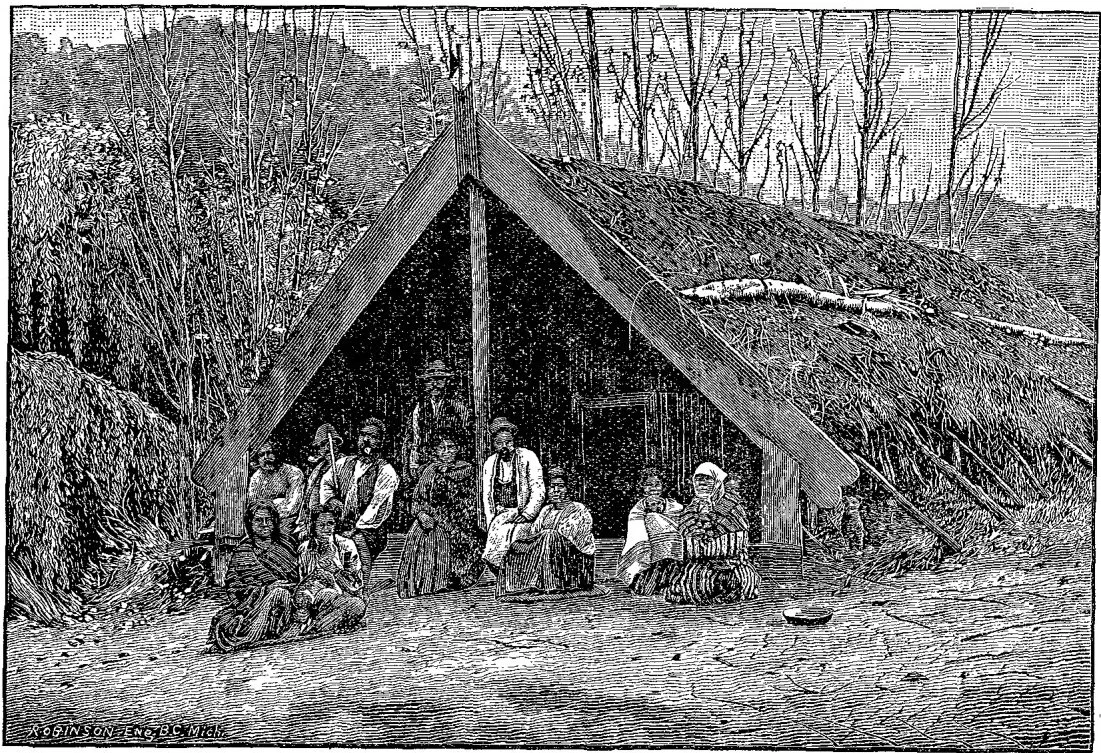
There are many steps to the ladder of civilization; and every one is represented by a home corresponding thereto. In the semi-barbarous tribes we have dwellings that approach more nearly to our ideal. To such belong the adobe homes of the Mexicans and the often elaborately carved dwellings of the Maories of New Zealand. The one shown in the engraving, though true to life, is inferior to many of its class. In the domestic relation of this people we find that the principle stated holds good.
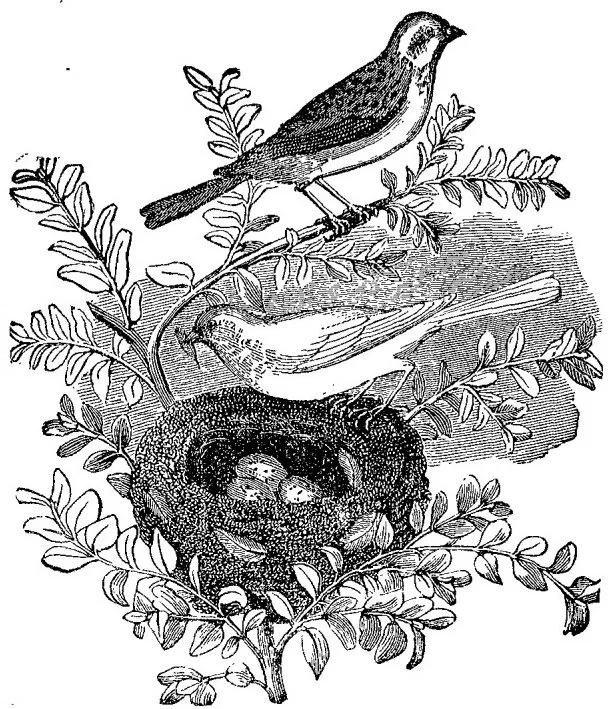
To the construction and equipment of these permanent abodes, both husband and wife contribute. And it is easily perceived that where their interests and labors are combined in establishing the domicile in a permanent locality, a great step is gained in the evolution of a home where family ties may be created and cultivated. We learn this same lesson from the loving companionship of many birds, whose mates consort and toil together for an abode, where in peaceful security the family may be reared. It is the ambition of their little hearts to make them secure, comfortable, and attractive, and we have all witnessed how well they succeed.
GLIMPSES AT THE TURKS.
By E. S. Popoff
BY E. S. POPOFF.
(Amsterdam, N. Y.)
The oriental nations in general and the Turks in particular are proverbially great story-tellers. Their stories are so elaborate and well devised that even the authors themselves will begin to believe them to be true, and assert their verification with many an oath. In Turkey and Bulgaria, where Mussulmans are found in great numbers, it is a common thing to see half a dozen or more Turks, sitting Turkish fashion on their mattings, upon a circular or semi-circular divan, drinking their caves or sherbet, mingled with a stifling cloud of nicotine smoke, and feasting for hours on some enchanting story. While it would take an educated author in America to produce a “Dream Child” or “Looking Backward,” in Turkey an old, tattered-garment Turk can tell the same in a cafene, without asking any compensation. And the plot of the story is so well constructed, the characters so nicely selected, and the language used so fluent and captivating, that in spite of its being a deliberate lie, the hearers are so charmed with it that they would thrice forego their dinner, in order to hear its end. The author, with his copious imagination, will transport his listeners, now to the sun, then to the moon; again back he takes his beloved to this earth in some palace of fabulous riches; then, perhaps, the whole story ends in a bloody combat between the king and an assailant of prodigious strength, who proves to be the lover of his spouse, who recaptures his beloved, and finally both of them are ushered by the angelic host into the heavenly paradise.
A MAORI HOME.
Speak about Spiritualism as being a new doctrine! The Turks have believed and practiced it for ages. Once I heard a Turk tell of an Imam (Turkish priest) who had an argument with a skeptic who seemed to doubt this wonderful doctrine. The Imam had told him that he would materialize his spirit the next night, and send it to some of his friends in India, and the next day the skeptic should write a letter, asking if they had seen him there that night. This was done, and the unbeliever was surprised to receive an answer, asking the reason of his sudden and mysterious disappearance. Think of it! a man’s spirit materialized, transported thousands of miles away, in one night, and by morning brought back again!
This spiritualistic doctrine has no little effect upon the moral and social as well as the temporal condition of the Turks. What is the cause of so much disinterestedness in civilization and dilapidation and ruin which is to be seen everywhere in the Mohammedan world? What are the causes of so many atrocities of which we now read almost every day committed by the Turks?—Why, simply an unbalanced mind caused by a devilish doctrine. A Turk exists in an ethereal state. To him there is nothing real in this world, living and yet simply as a specter. And the Koran, instead of correcting these visionary ideas in its believers, rather encourages them by the teaching that as soon as a Mussulman dies, he is transported by angels into the heavenly Eden, there to enter upon his realistic endless bliss, surrounded with all the voluptuousness human fancy can conceive, makes its votaries both brutish and sensual, without a spark of ambition for good.
PHYSICAL PREPARATION FOR WINTER.
By David Paulson
BY DAVID PAULSON, M. D.
(Sanitarium.)
Winter is really the healthiest season of the year; but to the majority of invalids it is a time of dread and continued fear lest something happen which will hurry them off to an untimely grave. Just now, at the beginning of the cold weather, is the time when those severe colds are usually contracted which sometimes linger all winter; and so a few words of advice upon how to become prepared for the winter may not be amiss.
The first suggestion of cold weather leads many at once to bundle up with scarfs, cloaks; and other superfluous wraps; in this way some parts of the body, as the neck, for instance, become very sensitive to cold, and some moment742when the usual additional wraps are not at hand, a cold draught happens to strike the body, and a severe cold will then be contracted, when otherwise, if the parts had not been rendered so sensitive, it would scarcely have been felt.
The proper way for weak and sickly persons to prepare for the winter, is to dress uniformly with warm underwear, and accustom themselves to the cold wind by taking vigorous exercise out-of-doors every day for a short time, being careful not to sit down and cool off too rapidly afterward, as it is when persons are perspiring that they are the most apt to catch cold.
Then such parts of the body as the throat and chest, which in some persons are so very susceptible, can be hardened by daily sponging in cold water, followed by brisk rubbing. Those who are not accustomed to this treatment should begin by using water near the temperature of the body and let it gradually become colder day by day. This is a far more valuable way of protecting the body than by putting additional wraps on these parts.
Above all things, invalids should not shut themselves in overheated and poorly ventilated rooms; for no matter how careful they may be to maintain this condition, there will be changes in the temperature of the room at some time or other, and then they will be sure to catch a severe cold, and perhaps sow the seeds of early death.
DIET FOR THE SICK.
By A. B. Olsen, M. D.
BY A. B. OLSEN, M. D.
(Sanitarium.)
In a state of health the question of diet is of the greatest importance, since the body is built up from the food which it receives. Every tissue and part of our being is made up from that which we eat, though in the broadest sense of the term, food may be made to include drinks as well as the more solid aliments.
But to the sick the matter of diet becomes of much greater importance, because in that critical situation the welfare of the individual depends more intimately upon the quality of the food that is taken into the system than when he is in a state of robust health.
Only a very few simple conditions relating to this subject can be alluded to here. The primary consideration in the preparation of food for the sick is simplicity,—simplicity in material, simplicity in preparation, and simplicity in combination. By the former term I mean food that is easily digested and assimilated, and which will not impose too great a tax upon the weakened system; by the second term is meant that the preparation of the food should be done in a manner that will not complicate and retard the work of digestion; and by the last term I mean that there should not be too wide a variety of articles. Food may be easy of digestion, but wanting in nutritious elements. On the other hand, it may be very nutritious, but difficult of digestion. Care should be taken to combine both qualities,—ease of digestion and abundance of nutrition. This will give to the patient the greatest amount of good for the least exertion. Sterilized milk, simple gruels, and other simple foods, perhaps meet this demand.
Food should not be prepared in an elaborate manner, highly seasoned, and rendered indigestible with condiments and spices, by frying, or any other process by which the digestion of the food is rendered difficult. We all remember the case of the old gentleman who, on going to the cupboard late in the evening, could not find any pie, and exclaimed to his wife, “Why, mother, there’s no pie in the house; what would we do if anybody should be taken sick?” Many other things that we regard as delicacies, such as pastries, cakes, preserves, and other articles which might be mentioned, are very poorly suited to the use of the sick.
When a large variety of food is prepared, even though it be of a proper character, it is not gratefully received by a sick person; the very sight of it oftentimes discourages the appetite, and the use of a large and varied amount of food would retard the progress of the patient toward recovery.
Food for the sick should be of a character to encourage the appetite. It should be received with a relish, otherwise it will not impart the good that it might. Food eaten by the sick against their will is of but little good to them.
It is better not to torment the patient by asking him what he wants, and what he would like, but rather exercise your own good sense, and prepare some simple dish in an attractive manner that will create a pleasant surprise, and thus be received with gratitude; whereas, if the mind has already been troubled and perplexed over it, there often comes a feeling of revulsion which absolutely refuses the food that has been prepared with much care.
THE ART OF CANNING.
By T.
It is said that canning fruit was one of the “lost arts” restored to us by the discovery and excavations of Pompeii. Wherever it originated, it is a blessing, and should be more and more utilized. It is generally supposed that when the fruit season closes—when grapes, peaches, tomatoes, etc., are “done,” that then the canning season for the household is done. But that does not follow. In our northern climates we are in the habit of storing away quantities of pumpkins, squashes, apples, and other perishable articles; and later on they become decayed. They not only perish to our loss, but they become a source of dangerous contamination, because they are usually in our cellars, under our dwellings, and their effluvium arises to the living-rooms.
It is the best kind of policy, therefore, to anticipate their decay by canning them. If we have no cans to put them in, we shall soon have when we begin to use our summer store. And empty cans should be filled with those things that are most liable to decay. The three articles we have mentioned are readily put up in the same way in which fruits are canned. They will then be ready for use just when wanted, and always as good as fresh.
Now right here a word about the use of apples. Here is a family having, say, three or four barrels of this fruit, all good. They are keeping well the first part of the winter, so they are not disturbed, for it would be too bad to eat good sound apples(?). Finally, one barrel begins to show signs of decay. They are “sorted,” and the decayed apples are put in a pan for use, while the sound ones are put back in the barrel. Next week the same process is gone through, and only the fruit that is unsound, diseased, and from a quarter to two thirds perished, is used. This course is persevered in until spring, when the fruit is gone. Perhaps one third or one half was decayed and lost, and the family has eaten rotten apples all winter.
Such a policy is at best but a very dubious kind of economy. It is the legitimate consequence of being always just a little too late. Why not move forward a week and eat sound apples and save them from decay? If I have four apples, I would rather eat three of them sound, and throw the other away, than to eat the four when they were one-fourth to one-half rotten. Wouldn’t you? T.
PERFECT THROUGH SUFFERING.
By Fannie Bolton
BY FANNIE BOLTON.
(Avondale, N. S. W., Australia.)
The things the most valued by men, are they not
Things tested by trial severe?
Gold brought from a furnace made seven times hot
With dross removed, polished, and clear?
The stones men prize most are not stones by the way.
The marble submitted to test,
That is chiseled and hewn and brought forth to the day
With its beauty perfected, is blest.
Not the song that comes lightly, not the poem of words
Lip deep, with no blood of the soul,
But the music of heart-life full of passion-born chords
That lives while the centuries roll.
And shall we who behold take no lesson from this?
We who look for eternity's years,
Who strain toward God-likeness, and hoping for bliss
That will never know dimming of tears?
In the sight of Christ's cross upon Calvary's hill,
In the view of Gethsemane's sward,
Shall we say, “No pain in perfecting God's will,”
When he agonized so—our great Lord?
The Captain of hope was made perfect by grief,
And shall he bear the pain, and we not?
Shall he bear the cross, and we find but relief?
O away with the unworthy thought!
Gird up, gird ye up! Buckle on for the fight!
He fought through the ranks of the foe.
Only those shall march up in the garments of white
Who through tribulation shall go.
But O exaltation! What joy shall be thine
Who have suffered with Christ; for thine hand
Shall seek unto his, and thy soul know the sign
Of fraternity, love-sealed and grand.
THE FAIRY AND THE GEMS.
By F. H.
BY F. H.
(Battle Creek, Mich.)
O DREAM of fame, which, in the tenderer years of man’s experience, ever besets the brain,—how rosy-hued, how strong and shapely, how fair to look upon! Yet, like the delusive ignis fatuus to the lonely wanderer in the darkness, how long and hard the journey, how utterly hopeless to the many, how utterly useless to the few! Ever bright, ever flaunting its beauty before the victims’ enraptured gaze, it lures them on, step by step, leaving some heart-broken wrecks by the way, and a few, more favored than the rest, or perhaps more successful, grasp for a time a thing devoid of principle, a phantom of man’s imagination only.
A few who were left by the wayside, seemingly in deep despair, are aroused by the touch of a gentle hand, which causes a sweet thrill of hope to pass deliciously through their beings; and a still, small voice says gently, “Come.” They follow, and are pointed to a room filled with rubbish and objects having no form nor beauty for the prevalence of dirt and decay on every hand. The command comes, “Work . . . while it is day; the night cometh, when no man can work.” How doubtingly and reluctantly they begin! What pleasure can there be in this? They seem afraid of becoming contaminated with the dust and decay. After a severe mental struggle, with many wavering thoughts of the fairy who had treated them so shabbily, they begin their undesirable task. Soon the repulsive feeling wears away and is forgotten. They all seem absorbed in their work. Soon one who has been working industriously, with occasional unseen assistance from the one who set them at work, springs up, his face beaming, and a cry of joy upon his lips. He has found a rare white gem, a pearl. In his rapture he forgets his surroundings, and when at last he looks at his hands and garments, to his surprise, they are clean and unspotted. There are many other gems in this place more or less valuable, beautiful pictures and works of art.
One is surprised at the happy look on each face, in strange contrast to the cold, sinister look of those who are following or have captured the fickle fairy, Fame. We inquire into the secret, and learn that these are looking over and beyond their surroundings to another time when this dust in which they have toiled so hard will be all cleared away, leaving nothing but the rare gems and the beautiful pictures and the happy remembrance of their part in accomplishing such glorious results.
“WARS AND RUMORS OF WAR.”
By Uriah Smith
The following from the Catholic Mirror of Nov. 2, emphasizes two very important prophetic declarations, as the reader will notice on perusal:—
“According to some authorities, war in Europe seems inevitable, but it can hardly be considered so, notwithstanding the gravity of the situation at present, remembering how many times it has been threatened within the last dozen years, and how easily in each instance the trouble was adjusted.
“Of all the great powers, Russia is the fondest of intrigue, and is, perhaps, the cleverest at it. Her diplomatists are famous for their skill at this intricate game, and there appears to be in the national character a special liking and aptitude for it. As soon as the war ended between China and Japan, Russia saw her opportunity, and began to play for the possession of Corea. Her first step was to entrap the Chinese, which she accomplished by lending them money, and the rest was easy. As the London Times phrases it, China has now been annexed, and Japan has been notified to vacate Corea as soon as possible.
“Japan feels the sting of the insult; and ships of both powers are moving,—a Russian fleet to Fusan, whither British war vessels have also sailed, and the Japanese fleet, which had gone to Formosa, homeward recalled. Other countries are looking on expectantly, the sympathies of France naturally with Russia, and Germany thinking particularly of herself.
“Japan, flushed with her recent success, is plucky and confident, and, it is clear, would not mind engaging even so great a power as Russia. A war, however, would not be merely between these two; all Europe would engage, and the colossal struggle, so often talked of, and so often postponed, would occur at last.
“Such a vast conflict would be deplorable, but it would settle many things. The modern inventions of battle, upon which so much labor and ingenuity have been expended, would come into play, and their value be tested as it can never be tested in the experiments of peace. The internal troubles of the great nations would be, for the time, forgotten, as they engaged in the bloody and frightful struggle for mastery and conquest.”
The foregoing gives a good idea of the belligerent outlook in Europe and the East, and the appalling results of the war should it occur. But the reader cannot have failed to notice its bearing upon the prophecy of Rev. 7:1, concerning the holding of the winds. Prophetic winds denote war, strife, and commotion; and it could be evident that such winds were “held,” that is, restrained from breaking forth, only when there was continual prospect of national contentions and repeated threatenings of armed conflict, which after all did not actually occur. And so marked has been this condition of things for nearly the last half century, and especially during the closing years of this period, that this writer does not fail to notice it. Mark his words: “How many times it has been threatened within the last dozen years, and how easily in each instance the trouble was adjusted.” And again: “All Europe would engage, and the colossal struggle, so often talked of, and so often postponed [all italics ours], would occur at last.”
It may seem to men that these threatened troubles were “easily adjusted” and “postponed” without difficulty; but it has been because there were angelic beings behind the scenes holding back the winds of war and strife, till the servants of God are sealed.
Another noteworthy point is that this very delay of the great struggle is leading men to flatter themselves that it will never come. So this writer, while acknowledging that some deem the threatened war “inevitable,” declares that “it can hardly be considered so, notwithstanding the gravity of the situation at present,” because it has been threatened so many times, and been so often adjusted. He who rests upon such an argument, is giving way to an operation of the human mind, very natural indeed, but no less dangerous. He is deceiving himself, and preparing to be taken in the snare. This is one of the grounds upon which the last-day cry of “Peace and Safety” is raised, just before the coming of sudden and unescapable destruction. 1 Thess. 5:3. U. S.
PASSING EVENTS AND COMMENTS.
By G. O. T.
To the Student of Prophecy.—Then, to the student of prophecy, these things have even a more thrilling significance. When the Turk is expelled from Europe, and establishes the remnant of his government in the “glorious holy mountain,” it will be but the step that leads to his utter destruction. For while the Turkish government apparently holds possession of Jerusalem, it does so only in the same manner in which it holds its European dominion—by the sufferance of other powers. Russia already has vast interests in and about Jerusalem. The Russian Church owns a great portion of the Mount of Olives, of the valuable territory north of the city; indeed, that church stands far in advance of any other power in points of vantage in and around Jerusalem. They are assiduously adding to their strength and possessions. On the slope of the Mount of Olives stands the yet unconsecrated mausoleum of Alexander II., of Russia, waiting for the presence of a Russian army and the pomp of official dignity from St. Petersburg, which at present the Turks forbid. But that tomb and those sacred remains were placed there with no idle purpose. Every Russian awaits impatiently the word to rush to the rescue of that tomb; and before such an onslaught, “he shall come to his end, and none shall help him.”
Then shall the time of trouble come. Then shall “Michael stand up, the great Prince which standeth for the children of thy people.” Then will the people of God be delivered, “every one that shall be found written in the book.” Truly we are in solemn times. It is true that the present crisis may be averted, but it is surely coming, and nothing now delays except that divine mercy lingers for us. O shall we not awake?
The Eastern Question.—At no time in the past has the state of affairs of which the Turkish empire is the center been in what appears to be a more critical condition than they now are. From every standpoint of human probability the days of the Sick Man are numbered and few. The sultan is entirely unable to give satisfaction to the powers that demand the restoration of order in Armenia and the cessation of the brutal massacres that are continually taking place. Anarchy prevails throughout the whole of Asia Minor, and riots extend to Jerusalem, in the neighborhood of which a mob threatened the British mission. Throughout all that region the bloodthirsty ferocity of the Mohammedans is ready to break forth in the ruthless destruction of all other faiths. At home disaffection and suspicion rend the affairs of State. The treaty powers are wholly displeased and disgusted with the pusillanimity and treachery of the Turk. It is credibly reported that England has suggested to the other powers that the limit of endurance has been reached, and the time has fully come for the breaking up of the Ottoman power. But then the serious question as to the disposition of the plunder comes up. This is a question upon which every European nation is very sensitive. Russia stands ready for the lion’s share, and every other nation is intensely jealous of Russia. Immense armies and fleets stand ready to rush into action rather than that one nation should obtain more than belongs to it.
Old-fashioned Tyranny.—The emperor of Germany is thoroughly indoctrinated with the “divine right of kings,” and with his own personal superiority as compared with the rest of mankind. He gloats in self-glorification, and anything like a personal affront arouses his deepest anger. His vanity shows itself in the manner in which he parades himself before the world. In his own realm he takes particular pains to form with his own person the focal point of every spectacle or exhibition. A recent freak was to collect his army, and exact from them another oath of allegiance to him. A young Mennonite, who, by some means, was in the ranks, could not conscientiously make this oath, and he was, by the order of the great Kaiser with a little soul, thrown into prison. Surely the world ought to tell Mr. William Hohenzollern, who happens to be emperor, that rulers are for the people, not people for the rulers.
G. O. T.
READY FOR ACTION.
By Allen Moon
At its regular quarterly meeting held Nov. 4, 1895, the Churchman’s League of the District of Columbia received and adopted the report of the committee on legislation, which was appointed last spring. The committee was appointed to search the statutes of the District for a law to prevent certain social entertainments where secular music was used on Sunday; and in case no law was found that could be enforced, the committee was instructed to draft a bill to be presented to Congress at its next session. The committee failed to find any law that was up to the standard, so it proceeded to draft the following bill, which was submitted with its report:—
“It shall not be lawful for any person to keep open any place of business, or maintain a stand for the sale of any article or articles of profit during Sunday, except apothecaries for the dispensing of medicines, and undertakers for the purpose of providing for the dead, or others for the purposes of charity or necessity. Nor shall any public playing at foot-ball or base-ball or any other kind of playing sports, pastimes, or diversions disturbing the peace and quiet of the day, be practiced by any person or persons within the District of Columbia on Sunday. And for any violation of this act any person offending shall for each offense be liable to a fine of not less than $5 nor more than $50.”
The Churchman’s League is an organization composed of religionists of all classes that favor the enforcement of Sunday observance by law. The Catholics of the District have been invited to join the league, and engage in the crusade against all who do not religiously regard the Sunday institution. At some of the meetings in the District of Columbia the clergy of that church have made themselves conspicuous by their presence on the platform. But of the Catholic people be it said that some of their clergy of other places have declined the invitation to attend such meetings. Reverend Father O’Keefe, pastor of St. Francis Catholic church of Baltimore, Md., was invited to attend a meeting of the crusaders, composed of ministers, a short time since. He replied by letter that “he was not in sympathy with the meetings of ministers who undertook to manage civil affairs, as civil officers were selected for that purpose. And he believed that more good could be accomplished by attending to their spiritual duties.”