I want to tell you a true story about a little boy who ran away to a neighbor’s to see the men thresh wheat.
He stayed so long that some one told him he would get a whipping when he should go home, and that frightened him so that he was afraid to go. But he soon grew tired of seeing the men work, and, too, he began to be hungry; so near the middle of the afternoon he started homeward. As he neared the house, he remembered that he had run away, and he could almost imagine that he felt his trousers smarting from the whipping which he expected. Before he reached the gate, his courage failed him—no I do not mean that. If he had been brave, he would have gone straight to his mother, confessed his fault, and asked her to forgive him. But he was too cowardly to meet her; so he turned aside; and it would take you a long time to guess what he did.
Well, over in the next yard was a poplar tree. You have seen them,—very tall and slim and straight, with the limbs all pointing upward. Up this tree he climbed about thirty feet, and hid himself among the branches.
Now I have been trying to think what object the boy could have had in climbing that tree; and I must say I am puzzled. He could not have expected to stay up there until his mother should forget that he had run away; and he ought to have known that the longer he stayed the more anxious she would be. Maybe that was it; and he intended to hide so long that in her joy at finding him, she would forget the whipping. I think, however, his motive was one which we older people know something about,—that is, to put off an unpleasant duty, such as confessing a fault, just as long as we can. But this is not the right way. Just as soon as we know we have done wrong, it is best to confess our fault, and ask forgiveness.
I am very certain that this little boy did not intend to do what he really did, and that is what you are all anxious to hear about.
He had not been long in the tree before he fell asleep, and then his grasp began to loosen until he lost his balance and came tumbling from limb to limb, heels over head, down to the ground.
When they picked him up, he was unconscious; and for some time they were afraid he would die; but fortunately the limbs had so broken his fall that he was not hurt very badly, and in a few days he recovered.
His mother was very glad when she saw her little boy recovering, and thought his punishment had been great enough; so he escaped the whipping; but he paid pretty dearly for his runaway; and I thought as I stood under the tree, and saw the branches broken off by his fall, that the wrong way is the hardest way, after all.
I am sure my little friends will learn a lesson from this boy’s sad experience.
THE CHILDREN’S FRIEND.
WHAT IT IS TO BE TESTED.
When a new engine is made, it is customary to test it to see how it works. Great care has been taken to make every part perfect, and to put all the parts together properly; yet, after all this, it is possible that when the engine is tried there will be some defect discovered which was not seen before, and which never would have been seen but for the test.
It is so with character. Care is taken by parents and teachers in order that the children under their charge may have a good character. This is right; yet sometimes when character is tested it is found weak.
A boy once yielded to a temptation to steal when he saw a bank-note lying on the store-counter near him. Conscience said: “Give it to the gentleman standing near you. He dropped it from his pocket-book a moment ago, and you saw him.” But instead of that he slyly slipped it into his pocket.
This boy had never been taught to steal. On the contrary, he had often been told that he must be honest. When he went into that store it was not with the intention of stealing; he went on an errand for his father. But for him temptation came in this way, and he yielded. It was a test of his character, and his character could not bear the strain.
Quite different was the result in the case of Frank Jones, who one day saw a gold watch and chain slip to the ground from a lady who was walking in front of him. The lady passed on unconscious of her loss, and Frank could easily have put the watch and chain into his pocket without her knowledge. But such a thought never entered his mind. As soon as possible he picked up the valuable articles and gave them to the owner. He did not stop to say, “She will advertise and offer a reward, and I will keep them until I see the advertisement.” No; his first and only impulse was to restore the property to the one who had lost it, whether he received a reward or not.
Frank's character stood the strain, and this incident showed that he could be trusted. He had been tested, and was found to be right.—Children's Friend.
A LOW VOICE.
A good Quaker, eighty-five years of age, whom no one ever heard speak a cross word, was asked by a young man how he had been able, through the trials and perplexities of a long life, to keep always so pleasant.
He replied, “Dayton, if thee never allows thy voice to rise, thee won’t ever be likely to get very angry.”
Remember this, children, and try to keep your voices “soft and low.”
Cultivating Generosity and Kindness in Youth
If you value your own happiness, and desire to make others happy, be generous, helpful, and willing to aid those who need help. The measure that you mete unto others will be measured to you again. Youth is the time to cultivate kindness, gentleness, and love. The tender heart of the little child may grow more lovely as the years roll on.
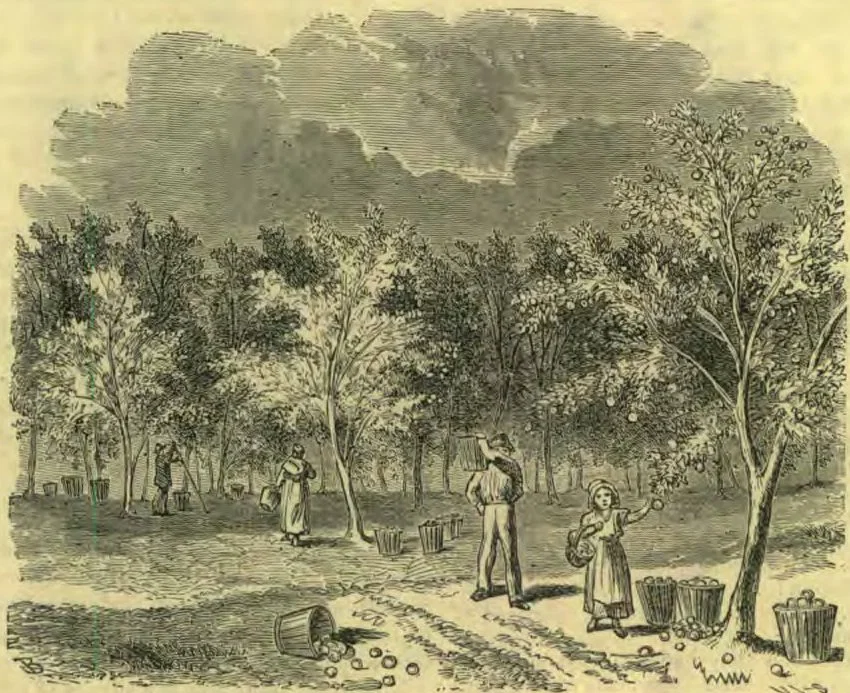
APPLE-TIME
By George Cooper
SHOWER-TIME, flower-time,
Earth is new and fair;
May-time, hay-time,
Blossoms everywhere;
Nest-time, best time;
Days have longer grown;
Leaf-time, brief time,
Make it all your own;
Berry-time and cherry-time,
Songs of bird and bee;
But, of all the gay times,
Apple-time for me!
Wheat-time, sweet time,
In the closing year;
Sheaf-time, leaf-time,
Now will disappear;
Ice-time, nice time,
For a merry lad;
Snow-time, blow-time,
Earth is lone and sad;
Yellow ones and mellow ones
Dripping from the tree;
Rusty coats and pippins:
Apple-time for me.
—George Cooper, in Nursery.
Never Speak Disrespectfully of Your Neighbors
NEVER speak disrespectfully of your neighbors. If you cannot speak well of them, please do not injure them.
A CURIOSITY.
The following letter from Rye, New Hampshire, under date of May 19, 1881, will, we think, be of interest to the children. It was originally published in the Haverhill Bulletin.
My Dear Nephew:—I must tell you what a curiosity we have on Rye Beach. You know we have had a long, hard storm this week. Well, Monday night the sea was very rough, and the great waves washed on to the beach a whale sixty-seven feet long and fifteen feet wide. His mouth is large enough for a good many boys to stand in, and his tongue is as large as you are, and three times as long as you are tall. He is ribbed on the under side something like a seamed stocking, black and white, in stripes about six inches wide. His back is nearly black.
One hundred and seventy-five teams, loaded with people, have passed our house to-day on the way to pay his whaleship a visit; and more than that number passed yesterday, besides hundreds of people from Portsmouth, who did not take this road.
A four-horse team, from Exeter, full of boys, visited him to-day, and two young men who had driven twenty-two miles to pay their respects to him, called here for grain for their horses. I believe a steam tug is to tow him away toward the place where the Sagamore House formerly stood, and he is to be cut up for dressing the land.
More than a hundred years ago a whale was washed ashore on Wallis Sands, but no one is now living who saw it, and probably nothing like it will occur again for a great many years.
I wish you could see him, as you cannot realize his size from my description. *
LETTER BUDGET.
Sarah Troxal, who wrote to us once before, says: “I love the INSTRUCTOR better every week. Some one sends it to me, but I do not know who. My father thinks his fever-sore grows worse. I have one brother fourteen, and a sister seven.”
Phebe Irwin writes from Onondaga, Mich.: “I go to Sabbath-school almost every Sabbath. We did not go last Sabbath, because it rained. I have a baby sister one year old. I go to day school. My teacher is Miss Lottie Campbell. I like her very much. I am trying to be a good girl.”
Frankie writes from Clarion, Kansas: “I am seven years old, and thought I would send you a letter for the Budget. I live with my grandpa and grandma, who keep the Sabbath. I like to hear my grandpa read the nice little letters in the INSTRUCTOR. I go to Sabbath-school almost every Sabbath, and learn a lesson. I never wrote a letter for the INSTRUCTOR before, and hope this will be printed.”
Childhood Stories That Are Never Forgotten
Stories first heard at the mother's knee are never wholly forgotten—a little spring that never quite dries up in our journey through scorching years.