The Youth’s Instructor, Vol. 27, No. 14.

RANSOMS

The Youth’s Instructor

Apr 2, 1879

S. D. A. Publishing Association · Battle Creek, Mich. · Apr 2, 1879

RANSOMS

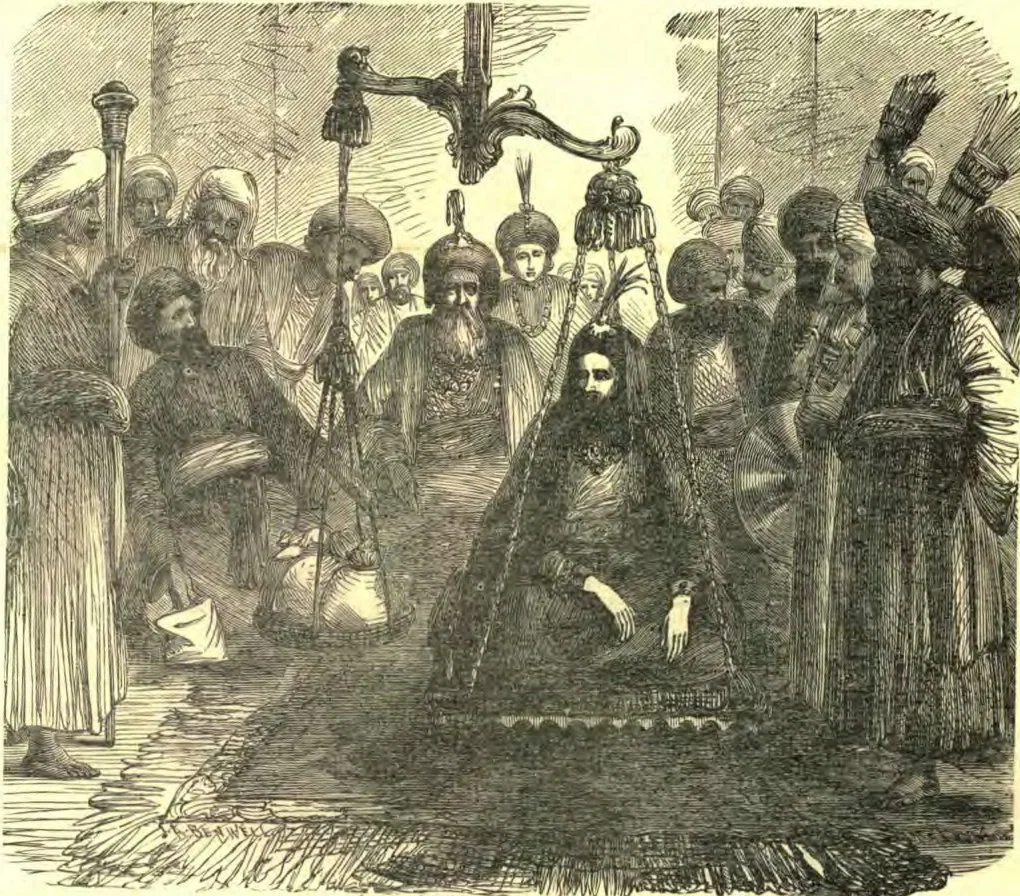
Here is a man who is being weighed; but if you look close, you will see that the weights which are being put in the scale do not seem to be the ordinary iron ones. No; it looks as if they were bags of gold. I can count four; and you see that, as the balance is almost reached, loose coins are being put in from an open bag. What does it all mean? You say, “It is a strange sight, truly; such a one as is not often witnessed.” You know what a ransom is?—a thing of value given to secure the release of a prisoner. In former times, when war was carried on differently from the way it is now, captives were often given a choice between being put to death, and getting a ransom paid to the conqueror in order to secure their being set at liberty. Even in more modern times this has been done in countries where there were brigands. These bold robbers would sometimes make prisoners of travelers, carry them off to hiding-places, and then send word to their friends that unless a certain amount of money was paid for their ransom they would be killed.
You may imagine how anxious such a prisoner would be to have the ransom paid, how he would beg and plead with his captors to give him and his friends time to arrange it, and how glad he would be when the ransom was paid and he set free.
Then there is another sort of ransom. In war times, men are often drafted into the army who do not want to serve as soldiers and risk their lives. If they cannot give a good reason why the government should let them off, there is only one way to get out of it—that is, by furnishing a substitute. So they hunt up men, who, for a certain sum of money, are willing to take their places, and it is looked upon as all right by the government.
In China this way of getting substitutes is used by rich criminals, who hire men to bear the punishment to which they have been condemned. Yes; sometimes a poor man will even, for a sum of money, suffer death in the place of one who can afford to pay him well for it.
In India it used to be believed that substitutes could be hired to bear a man’s sins and suffer punishment for them in his stead. Thus it has come about that this very thing was done, and the picture shows one of the steps in such a transaction which actually occurred more than twenty years ago in India. The rajah of Mysore—a native Hindoo prince—was told by an astrologer that in two years he must die. When he heard this, he began to think he had better prepare for death. He thought of his great sins, and, knowing they would prevent his reaching Heaven unless they were taken away, he offered to pay liberally for substitutes. There came to him then a number of heathen priests, who declared that they would bear his sins and their punishment, but he must pay them his weight in gold. As the rajah was very rich and powerful, he agreed to their terms, and got into one side of a large scale, with all his robes and his sword, while the other side was filled with gold until it overbalanced him. This the substitutes took as their pay, and the rajah believed he was freed from all future responsibility for his sins.
It seems strange to us that any one should believe such a thing as this, for see how unfair it would be! Only a rich and powerful person could ever secure a substitute in this way. The poor and weak would all fail. Quite different is it with the salvation which Christ offers. This is free. He was not paid, and cannot be paid, for enduring punishment in our stead; and so he offers us all—poor and rich, low and high, ignorant and learned—salvation freely. All we have to do is to believe what he has said, trust ourselves to him, and, asking his help, begin to live as we believe he would have us live. This is a God-like gift to men, and if we will only accept it with our whole hearts, we have the promise that God will carry on the good work in us; for it is written: “God commendeth his love toward us, in that, while we were yet sinners [that is, while we sinned and did not care], Christ died for us. Much more then, being now justified by his blood, we shall be saved from wrath through him. For if, when we were enemies, we were reconciled to God by the death of his Son, much more, being reconciled, we shall be saved by his life.”—S. S. Visitor.

WINTER'S FAREWELL.

THEY are growing tired of the poor old man; I have known it long; and it first began When Spring sent messengers one day To herald her coming along this way. Ah! a fickle set are these girls and boys, For they welcomed me with the wildest noise.
And I went to work with a right good will, To make them happy; on dale and hill I rallied my forces, snow and ice, To fashion new roads all smooth and nice, Where they could coast or bound away O'er the frozen ground in the dashing sleigh.
I caught the stream as it tried to pass, And floored it o'er with the finest glass, That they on the keen-edged skate might glide, Or chase each other a-down the slide. And I rather think were it not for me They never old Santa Claus would see.
When Autumn left the earth so bare, I came with beautiful things, and rare; The landscape glistened in crystal gems, And forests in pearly diadems; And all that perished beneath her feet I wrapt around in a winding-sheet.
The rain, young Spring, I've heard it said, Has no respect for my hoary head; No glory of mine is ever seen Whene'er she dons her suit of green; And if I turn but a moment back, She pushes the old man off the track.
But, as Autumn yielded her golden crown, And I am robbed of my robes of down; E'er I wish good-bye, I would like to say, It will be her turn to step out some day. Ah! here she comes; I'll hurry and go, I'm off to the land of the Esquimaux. —S. S. Classmate.

THE ISLE OF CYPRUS.

FAR away over the broad Atlantic, and in the extreme eastern portion of the great Mediterranean Sea, within a day’s sail of the Holy Land, lies the celebrated and historic island of Cyprus. This well-known sea-girt spot of land is 140 miles long, and varies in width from five to fifty miles. It lies east and west, and contains about 4500 square miles, being by comparison about as large as the State of Connecticut. The present population is upwards of one hundred thousand, and is composed of Greeks, Turks, Armenians, and Jews, with a liberal sprinkling of other nationalities. But under the prosperous rule of the Venetians, in the sixteenth century, its population was about one million.
As a country, Cyprus is traversed by an extensive mountain range, near the center of which is a celebrated peak called Mount Olympus, which is upwards of 7000 feet high. From its summit may be seen the entire island; also the beautiful hills of Lebanon in Palestine, and the Taurus Mountains in Asia Minor. There are several other peaks of lesser altitude, upon one of which, Mount Croce, anciently stood a heathen temple dedicated to Jupiter. This temple was in ruins in the fourth century, when the Empress Helen, mother of Constantine the Great, visited it, and caused to be erected on the mount a Christian chapel, in which, if we may credit tradition, she deposited a piece of the holy cross of our Saviour.
Cyprus was famous in antiquity for its uncommon fertility, and for its remarkably mild climate. At present it is noted for its silks, fruits, flowers, and wines, its natural productions being of the richest character. It has been several times visited with severe earthquakes, and is occasionally subject to the desolating ravages of locusts.
The oldest history of Cyprus is somewhat involved in obscurity, yet it occupies a prominent place in both sacred and profane writings. It has been successively controlled by the Phœnicians, Egyptians, Assyrians, Persians, Greeks, Romans, Arabians, Crusaders, English, Venetians, Turks, and now again, within a few months, amid the complications of the Eastern Question, it has reverted back to the British power, having been out of its control since the beginning of the twelfth century. The barbarism and tyranny of Turkish rulers have greatly interfered with the splendor and world-wide celebrity which Cyprus enjoyed under its Venetian masters; but travelers and authors generally agree in saying that under a proper government it is one of the most delightful countries on the globe.
Among the mineral products of Cyprus may be mentioned silver, diamonds, emeralds, precious stones, alum, and asbestos; besides iron, lead, and zinc, and above all, an almost unlimited supply of superior copper, called the æs Cyprium. Our word copper, is from the Latin, Cyprium, which means Cyprus.
It is said that Alexander the Great had a copper, or bronze, sword, given him by one of the kings of Cyprus, which was much praised for its lightness, as well as for its good quality. Pliny, the Roman naturalist, ascribes the discovery of brass to the ingenious metal-workers of Cyprus. It appears also from modern excavations and researches, among the ruins of this island, that the Cypriotes were as clever in the arts of pottery and sculpture, in clay or terra-cotta, as in the manipulation of metals.
Cyprus was also especially celebrated for its ligneous productions. Some affirm that its cedars surpassed even those of Lebanon. It was the boast of its ancient inhabitants that they could create a fleet of ships without any recourse to foreign countries. It was in consequence of its large forest supplies that the Egyptian monarchs conquered the island, in order to get timber to create navies. It is recorded of Demetrius Poliocites, the noted admiral in the days of the Ptolemies, that he had a war galley built of cedar wood, in Cyprus, one hundred and thirty feet long. Cyprus, also, was noted for its having thirty seaports, which made a convenient rendezvous for the numerous Egyptian war ships. G. W. A.

A STRANGE AMBITION.

We want to call the especial attention of our young readers to the good instruction contained in the following article from the S. S. Classmate. After reading it, we think you will choose for a motto, “Not how much; but how well.” Study the article thoroughly, and learn to read understandingly, for therein lies a mine of knowledge.
Some young people have a strange ambition to be considered “great readers.” They do not use the word “great” in reference to what they learn by reading, but in regard to the number of books and pages that they read. They are not careful as to the quality. Usually this class of readers select the poorest quality, because they can get through with it quicker. Indeed, they will sometimes boast of the rapidity with which they can read books, as though it were an occasion of honest pride to read a whole volume at one sitting. They forget that it is not the amount of reading which benefits one, but the quality and the manner in which the book is used. Some get more good from a page than others from a volume.
What would be thought of one who should boast of eating everything set before him without any reference to the wholesomeness of the food? To eat large quantities of even wholesome food would be very unwise; to eat all sorts of food is a still greater folly.
Be select in your reading; read only what will do you good, and try to get all the good out of it you can. Have an ambition to be a thorough reader rather than a rapid one. M. J. C.

WHOM CAN YOU TRUST?

A SHIP'S captain in New York wanted a trusty man to take care of his ship. The captain had sent away his sailors, and was going into the country himself.
Somebody said, “John will do; he is a trusty sailor.”
But the captain dared not trust him. He thought every sailor would steal if he could. But as he could do no better, he locked up everything on board the ship, and brought John to stay there.
Next morning, before he left the city, he thought he would take an early peep at his ship. So he quietly stepped on board, and softly opened the cabin door. There was John on his knees, with his Bible open before him. The captain shut the door carefully, and waited. By-and-by John came out.
“John,” said the captain, handing him all the ship’s keys, “you may open all the drawers and trunks, and air those things. Keep a sharp lookout, John, for these thieves along the wharves. Have everything snug, and I’ll be back next week.”

BIBLE LESSONS FOR YOUTH.

LESSON XL.—THE VESSELS OF THE SANCTUARY.

  1. What was the first apartment of the sanctuary called?
  2. How large was it?
  3. What did it contain?
  1. What was the second apartment called?
  2. What did it contain?
  3. What is this ark sometimes called?
  4. For what purpose was it made?
  5. Describe it.
  6. Describe the mercy-seat.
  7. What other vessel was kept in the most holy place?
  8. How was the golden censer used?
  9. Where was the altar of incense placed?
  10. How was it made?
  11. How was it used?
  12. Where did the table of show-bread stand?
  13. Describe it.
  14. What was kept on it?
  15. Describe the golden candlestick.
  16. Where did it stand?
  17. What purpose did it serve?
  18. Where was the brazen altar?
  19. How was it made?
  20. How was it used?
  21. What stood between the brazen altar and the door of the tabernacle?
  22. What was its use?
  23. What was the only kind of wood used in making the sanctuary and its vessels?
  24. How was it overlaid?
  25. Give the dimensions of the vessels of the sanctuary.

SYNOPSIS.

The first apartment of the sanctuary was called the holy place. It was twenty cubits long, and contained the altar of incense, the table of show-bread, and the golden candlestick. The second apartment was called the most holy place. It was ten cubits every way, and contained the ark of the covenant.
This ark is sometimes called the ark of the testimony, sometimes the ark of the testament, and frequently the ark of God. It was made to contain the tables of the law,—the ten commandments, written by the finger of God. It was a chest, made of boards, overlaid with gold within and without, and covered with the mercy-seat. The mercy-seat was made out of one piece of gold, each end of it being wrought into the form of a cherub looking inward toward the mercy-seat, and extending its wings forward above the mercy-seat.
The golden censer, in which the priest burned incense, was also kept in the most holy place.
In the holy place, just before the ark, and separated from it only by the second vail, stood the golden altar of incense. Like the ark, it was made of boards of shittim wood overlaid with gold. It had a horn of gold at each corner, and on the top of it the priest burned incense every morning and evening.
The table of show-bread stood on the north side of the holy place. It was overlaid with gold, and ornamented by a crown and border wrought in gold. On it was kept a continual supply of bread, which the priests renewed every week.
The golden candlestick stood on the south side, opposite the table of show-bread. It was wrought out of one piece of gold, and had a shaft and six branches, so as to hold seven lamps, which were trimmed and kept burning by the priests.
The brazen altar stood in the court, between the gate of the court and the door of the tabernacle. It was made of boards overlaid with brass, and on it were burned the animals presented as burnt-offerings to the Lord.
Between the brazen altar and the door of the tabernacle stood the laver. It was made of brass, and contained water for the priests to wash in.
All the wood used in making the sanctuary and its vessels, was overlaid with gold, no wood but shittim wood being used.
The ark was 2½ cubits in length, by 1½ in breadth and height; the altar of incense, a cubit in length and breadth, and 2 cubits high; the table of show-bread, a cubit broad, 1½ cubits high, and 2 cubits long. The altar of burnt-offering was 5 cubits in length and breadth, by 3 cubits in height.
G. H. BELL.

THE SABBATH-SCHOOL.

SECOND Sabbath in April.

LESSONS FOR CHILDREN.

LESSON XIV.—DEBORAH AND BARAK.

“And the children of Israel again did evil in the sight of the Lord, when Ehud was dead.” On account of their wickedness, God let Jabin, king of Hazor, oppress them twenty years. He was so cruel to them that they cried unto God for help. And the Lord raised up Deborah, a woman of the tribe of Ephraim, to be a judge in Israel.
Now Deborah was a prophetess, and the Lord showed her what should come to pass, and what she should do. “And she dwelt under the palm tree of Deborah between Ramah and Bethel in mount Ephraim; and the children of Israel came up to her for judgment.”
When the time had come to deliver Israel from the wicked king of Hazor, Deborah sent word to Barak, the son of Abinoam, to gather ten thousand men and go up to Mount Tabor; for the Lord had promised to bring Jabin’s army unto this place, and deliver it into the hand of Barak. Barak refused to go unless Deborah would go with him. She consented to go, but told him plainly that the honor of the victory would not be given to him, but to a woman.
Then Barak gathered ten thousand men to Mount Tabor, and Sisera, the captain of Jabin’s army, came down with a great host, and nine hundred chariots of iron. Then Barak and his army came down from the mountain, and fought with Sisera; and Jabin’s army was beaten, and fled before the children of Israel, and Barak pursued them until every man was slain.
Sisera leaped down from his chariot, and fled on foot to the tent of Heber the Kenite. Here he lay down to rest, and fell asleep. Then Jael, the wife of Heber, drove a nail through his head, and killed him. Thus the Lord delivered his people from the king of Hazor.

QUESTIONS

  1. What course did the people take after the death of Ehud?
  2. What did God let come upon them on account of their wickedness?
  3. How long did the king of Hazor oppress them?
  4. When they cried unto God, who was raised up to deliver them?
  5. Why was Deborah called a prophetess?
  6. Where did she live?
  7. For what did the children of Israel come to her?
  8. How did she know what to say to them, and what to do?
  9. When the time had come to deliver Israel, what did Deborah do?
  10. Why was Barak to raise an army, and go up to Mount Tabor?
  11. What did Barak want Deborah to do?
  12. Did she consent?
  13. What did she tell him about the victory?
  14. Who was king of Hazor at this time?
  15. Who was captain of Jabin's army?
  16. How many men had Barak?
  17. Describe Jabin's army.
  18. Which army was beaten?
  19. How long did the children of Israel pursue them?
  20. How did Sisera try to escape?
  21. Into whose house did he go?
  22. What did Heber's wife do, while Sisera was sleeping?

DUTIES OF S. S. SECRETARIES.

The Secretary, as his title of office implies, should keep the records of the school.

MINUTES.

Minutes should be kept, not only of business meetings, but of each session of the Sabbath-school. From Sabbath to Sabbath the Secretary should note the most interesting features of the school, and these notes, together with the Membership, Attendance, Number of Visitors, etc., should be embodied in a Report to be read at the opening of the school on the Sabbath following, and afterward recorded in a book provided for that purpose.
The membership and attendance of the entire school can be made out from the teachers’ class records, and should be verified by the personal observation of the Secretary.
If class records are neglected, the Secretary should make out the membership and attendance just as he would if the whole school were a class under his instruction. These items should be entered in the School Record Book on the pages ruled and headed for that purpose.

REGISTERS.

First the names of officers should be registered, together with the date of their election, and such other items as may be deemed important.
This should be followed by a register containing the names of teachers, the date of their appointment, etc.
After this, there should be a register containing the names of all the members of the school who are not officers or teachers, the date of their entering school, and the time and cause of their leaving, whenever they do so.

RECORD OF THE ATTENDANCE OF OFFICERS AND TEACHERS.

The Secretary should keep a record of the attendance of officers and teachers, just as the teacher keeps a record for his class. An ordinary Class Record Book will be convenient for this purpose.

AS TREASURER.

Unless some one is elected for that especial purpose, the Secretary is expected to act as Treasurer, receiving and accounting for all moneys belonging to the school, and paying out the same on the order of the Superintendent.

GENERAL DUTIES.

The Secretary should not have a class, except in cases of necessity. He should be free to aid the Superintendent in looking after the minor interests of the school. He can assist in welcoming and seating new scholars, and visitors, as they come in. He can see that everything is in readiness; that the bell is struck at the proper time; that there is a timely distribution of the lesson sheets and papers; that cards are provided bearing, one on each, the names of all the members of the school, and that these cards are distributed to the teachers at the beginning of the class-recitations, and collected again in time for use in the General Exercises. Whenever the Superintendent desires it, the Secretary can assist him in the General Exercises by calling names, or by asking questions. Thus there are countless little things which a watchful, willing Secretary may find to do. He should be the “Vigilant Committee” of the school, especially at times when the Superintendent’s attention is so taken up by some matter as to cause other things to be neglected. Indeed, it is scarcely less important to have a good Secretary than to have a good Superintendent.
All members of the school should be prompt, but the Secretary must be prompt. He should be energetic and active, yet cool-headed and accurate. Such Secretaries must be found or made, if we would have the business of the school properly done. G. H. BELL.

PAUL'S LESSON.

“Go and get it! Go and get it, I say!”
Poor little Dash crept close to his young master's feet, looking up in his face with earnest, pleading eyes, as if he would say,—
“Please, please don't! I cannot do what you want.”
Paul was trying to make Dash swim after a stick which he had just thrown into the river. Now Dash was not a water-dog, having no more love for it than a cat, and foolish Paul was bent on making him one. He kicked the poor little animal away, and repeated his order; then, angry that it was not obeyed, seized him, and threw him into the water. The dog was sorely frightened, but by hard struggling reached the bank, and wet, panting, and trembling, crawled to his master's feet with a pitiful whine. The cruel boy caught him up with rough words, and was just going to throw him in again, when a pair of strong arms seized him, and a man's voice said,—
“Here, young man! Now we'll see how you like to swim!”
It was Paul's turn to be frightened. He turned pale, trembled, and caught his breath, as the stranger lifted him in his stout arms as easily as he had poor Dash. He began to beg,—
“Oh, sir, pray don't! I cannot swim, indeed, I cannot! Oh, don't throw me into the water! I will never, never do so again.”
The man paused, but did not let go his hold.
“Neither can your dog swim,” said he; “but you meant to make him do it, just to amuse yourself. Why can I not make you do it to amuse me? I am as much larger and stronger than you as you are larger and stronger than that poor, panting, trembling dog.”
Paul still begged and promised, and the stranger at last released him, saying,—
“Now, my boy, let me give you a kind word of advice. Never treat another, whether human being or dumb animal, as you would not like to be treated yourself. Never try to make anybody or anything do what God, when he created it, did not make it to do, or to be what he did not mean it to be. If you keep these rules, you will be a better, wiser, happier boy. Good-bye.”
Paul knew in his heart that the man was right, and the lesson was never forgotten.

NOTICE TO S. S. OFFICERS.

As the present quarter is just closing, every Sabbath-school in the land, that has not already done so, should report immediately to the Secretary of its State Association. Those schools outside of any Association may report directly to the Secretary of the General Association, Miss Eva Perkins, Battle Creek, Mich.
In connection with the General Conference and Dedication to be held in this place, April 17-21, there will be a general Sabbath-school meeting which we hope will be fully attended by the Sabbath-school workers from every State.
COM. OF GEN. S. S. ASSOCIATION.

THE ORPHAN BOY.

The readers of the INSTRUCTOR will remember that a few weeks since Eld. S. N. Haskell told them a story of a little sick boy named Eugene. I now have something more to tell you about him.
The poor little sufferer has fallen asleep in Jesus. Much of the time during the last ten days of his life, he could not speak, neither could he be moved. The last words he spoke were on Sabbath morning, in reply to the question, “How do you do?” He said, faintly, “Pretty well.” On Monday morning, Feb. 10, he closed his eyes in death, being eleven years and one month old.
No kind father or tender mother bent over his wasted form, and wept as he passed away; for his mother died when he was only five years old, and his father three years after. But the Lord remembered the prayers of that dying mother, who said to the writer, “I believe the Lord will care for him.” Dear children, think you the Lord forgot him? No, no; many were the kind friends that tenderly watched over him, and administered to his wants.
Eugene loved the Sabbath-school; his lessons were well learned. He loved good reading. Pilgrim’s Progress, Sabbath Readings, and the INSTRUCTOR were his choice. When left alone, he spent much of the time in singing. Never did we witness such patience under as trying circumstances.
We have laid him beside his parents, to rest until the trump of God shall wake the righteous dead. Dear readers, how many of you will strive to meet him in the earth made new? M. L. PRIEST.

SINGULAR COMBINATION OF FIGURES.

A very curious number, 142,857, which multiplied by 1, 2, 3, 4, 5, or 6 gives the same figures in the same order, beginning at a different point, but if multiplied by 7 gives all nines:—
142,857 × 1 = 142,857 142,857 × 2 = 285,714 142,857 × 3 = 428,571 142,857 × 4 = 571,428 142,857 × 5 = 714,285 142,857 × 6 = 857,142 142,857 × 7 = 999,999

“IF I WERE A SUNBEAM.”

IF I were a sunbeam, I know what I'd do: I would seek white lilies Rainy woodlands through; I would steal among them, Softest light I'd shed, Until every lily Raised its drooping head.
“If I were a sunbeam, I know where I'd go: Into lowliest hovels, Dark with want and woe; Till sad hearts looked upward, I would shine and shine; Then they'd think of Heaven,— Their sweet home and mine.”
“Art thou not a sunbeam, Child, whose life is glad With an inner radiance Sunshine never had? Oh! as God hath blessed thee, Scatter rays divine; For there is no sunbeam But must die, or shine.”

SPRING

SPRING is coming, coming, coming, With her sunshine and her showers; Heaven is ringing with the singing Of the birds in brake and bowers.

LETTER BUDGET.

Sheridan, Mich.
Dear Editors: I take the Instructor. I go to Sabbath-school, and like to get my lessons. I am eleven years old. I keep the Sabbath with my father; my mother is dead. I hope we will meet her in the first resurrection. Charlie Knolty.

FLUSHING, MICH

DEAR EDITORS: I am a little orphan, seven years old. I have been living with a family of Sabbath-keepers about three years, and I call them pa and ma. I keep the Sabbath with my brother and sister, and attend church and Sabbath-school. Although I cannot do much, I like to get a verse to say with the rest. I am so glad the INSTRUCTOR comes every week. I cannot read it much myself, but I like to look at the pictures and hear the stories. The paper which has the picture of the dove returning to the ark, I call mine. I want to be a good girl, so that when Jesus comes I may be his little dove.
Yours truly, JENNIE HARLE.

Letter from a Young French Girl

St. Anne, Ill.
Dear Instructor: I am a little French girl, but I am learning the English. I am eight years old. I keep the commandments with my father and mother. I love the Instructor.
Yours, Alexine Gros.

Modesty Best Sets Off Intelligence

If you have intelligence, modesty best sets it off; if not, it best hides your want of it.

You have reached the end of this edition.

The Youth’s Instructor · Apr 2, 1879