The Youth’s Instructor, Vol. 38, No. 48.

ROUND THE WORLD.—37

The Youth’s Instructor

Nov 26, 1890

S. D. A. Publishing Association · Battle Creek, Mich. · Nov 26, 1890

ROUND THE WORLD.—37.

THE JAPS OF TO-DAY.
Much obscurity still hangs over the origin of the Japanese people. Various writers have attempted to identify them with the Malays, Chinese, Tartars, and even the ten lost tribes of Israel. There can be no doubt that they are an entirely and utterly distinct race from the Chinese; their initial language and traditions conclusively declare this. With the Coreans they would seem to have more affinity, but even here the resemblance is not striking. But that they are related to all these nations through being members of the great Turanian family seems undoubted.
The Japs are a race of manikins. The hight of the average man is only about four feet eleven inches, and that of the woman considerably less. The Mongolian cast of countenance is prevalent. The Japanese face is oval, the cheek-bones prominent, the eyes dark, often oblique, and always narrow. The nose is flat, and the lips usually somewhat heavy. The hair is dark and generally straight, and the complexion in most cases sallow. The eyes often look as if the owner had been born blind, and two narrow slits had been afterwards cut to admit the light, an impression caused by their narrowness and by the disappearance of the eyebrows within the folds of the eyelid. The complexion extends to almost Caucasian fairness in some of the more beautiful ladies.
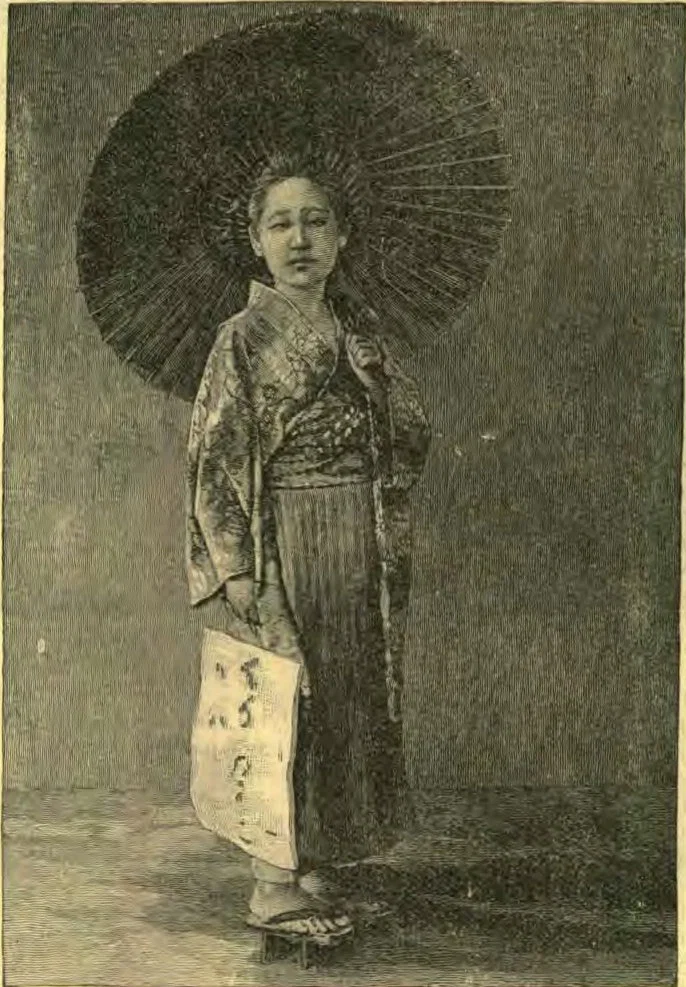
JAPANESE SCHOOL GIRL.
To commence at the youngest—we do not say the lowest—stages of Japanese life: The children are very attractive. They have happy, sparkling eyes; are quick, intelligent, and frank, with a politeness that is unequaled by even a Frenchman.
Nothing is more apparent among these people generally, than their air of good humor. Young and old, high and low, plain and good-looking alike, win the heart with their matchless courtesy and intense kindliness.
We cannot say that these young olive branches are brought up on flowery beds of ease. It seemed to us that whether the parents were poor or rich, the youngsters were slung on the back of a father, mother, elder sister, or brother. There they sleep, and there they laugh and cry, and it would seem to the eye of the casual observer that there they spend nine tenths of their younger days.
Their hair is generally shaven off around the base of the skull, and again from a patch about the size of two silver dollars on the crown, leaving nothing but a round circlet about three inches wide. They are devoid of head-gear of any kind, even in summer, when the rays of the sun are hottest. They remain slung in position on the back of the father while he hoes in the garden, or on that of the mother while she washes her dishes.
Among young men and women one fact is apparent,—there is a universal air of good humor. The cares of the world evidently press lightly upon them. They seem less alive than Europeans to the stern realities of life. None wear that intensely distracted look so common in a Western city. They form a smiling, contented throng, from the shaven-headed old grand-dame to the crowing baby. To look at them, man, woman, boy, and girl alike, one might suppose that there was no such thing as sorrow in the world. True, the clothing of some of the poorer sort seems thin and scant, but if one does not look too closely, the brilliant sunshine glosses and idealizes all that, not to speak of the sunny temperament which from within lights up even the plainest face. We would not contend that the Japanese never look miserable, for we have seen them the picture of despair. But the fact remains that among this people there is nothing that so strikes and wins the stranger as this aspect of geniality.
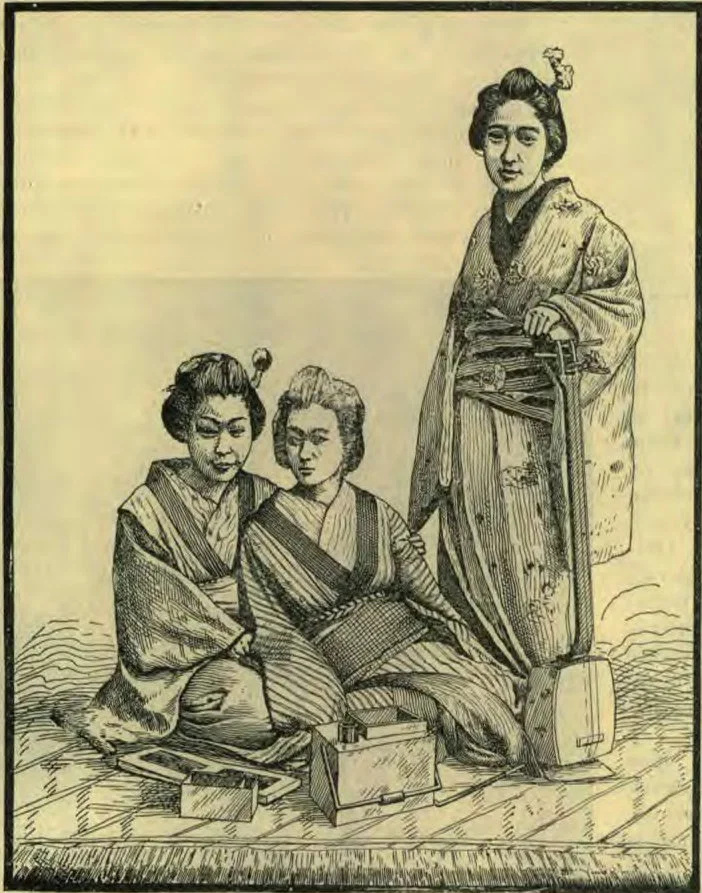
The young girls as a rule are very good looking. The complexion is pink and white, the eyes dark and sparkling, with an abundance of black tresses which they take great pains in dressing. We would not know so much about this toilet arrangement were it not for the fact that the place they generally chose to carry it on is the door-step in front of the house. Women of all ages and classes use the rich oil from the seeds of the camellia or tea-shrub to make beautiful their raven black but stiff hair, which often reaches down to their heels. Their coiffures are so artistic and tasteful that no European lady need be ashamed of them. A chignon forms the main feature, and is held together by one or more long needles of tortoise-shell, or a cheaper material, as well as by wooden combs, and is further ornamented by twisting into it strips of a peculiar red or blue crape-like fabric. They are always laughing, and even at the funeral of a parent, merriment does not seem to cease.
As for the matrons, what shall I say? They have lost all their maiden freshness, and their very features look as if they had been planted on their faces by a cyclone. It is their custom to blacken their teeth and cut off their eyebrows, to make themselves if possible more hideous than before.
In olden days the men wore their hair gathered up in a queue. But now the majority have adopted the European mode. Their dress and shoes as a rule are Japanese, although they wear European hats.
“Apparel oft proclaims the man,” wrote Shakespeare. This is a truth for the West, but we doubt whether it will hold good for all Eastern climes, where the robe of both sexes is the same. In Japan the universal garment is the kimono. It is a long dress, open in front, and fastened at the waist by a broader or narrower girdle called the obi. Her obi is the pride of a Japanese girl. Sometimes it is black, and then again of the most gaudy colors, tied behind in a huge butterfly bow, and hanging down in two long streamers. They are magnificent stiff fabrics, often a foot broad. Among the better class the kimono consists in summer of a light cotton fabric, and in winter of heavy silk stuff. The wide-flowing sleeves form under the elbows two hanging bags, which serve as pockets. In these every Jap carries among other things soft paper, which he uses as a substitute for a pocket handkerchief.
The foot covering of both sexes consists of blue or white cotton stockings called tabi. In these the big toe has a special compartment to itself, as in mittens, in order to pass between it and the other toes the strap by which the sandal is fastened on. The sandals are made of plaited rice straw. A cord is fastened in front, which comes up between the great and second toe, and then divides so that a strand goes across each side of the foot, fastening on either side, in front of the instep. In rainy weather they wear huge, clumsy wooden clogs. These have two uprights underneath, about three and a half inches high, and a quarter of an inch thick. The print left in the mud by these resembles that of a hen more than of a human being.
All this is very nice to look upon, and it is fashionable to praise Japan and admire the Japanese, but we would rather be clad as we are than robed in a thing like a pillow-slip and shod with juvenile stilts.
P. T. M.

HOW A BOY BECAME A COMMANDER.

THERE lived in a Scotch village a little boy, Jamie by name, who set his heart on being a sailor. His mother loved him very dearly, and the thought of giving him up grieved her exceedingly; but she finally consented.
As the boy left home, she said to him, “Wherever you are, Jamie, whether on sea or on land, never forget to acknowledge your God. Promise me that you will kneel down every night and morning, and say your prayers, no matter whether the sailors laugh at you or not.”
“Mother, I promise you I will,” said Jamie, and soon he was on a ship bound for India.
They had a good captain, and as some of the sailors were religious men, no one laughed at the boy when he kneeled down to pray.
But on the return voyage, some of the sailors having run away, their places were supplied by others, one of whom proved to be a very bad fellow. When he saw little Jamie kneeling down to say his prayers, he went up to him, and giving him a sound box on the ear, said, in a very decided tone, “None of that here, sir!”
Another seaman who saw this, although he swore sometimes, was indignant to see the child so cruelly treated, and told the bully to come up on deck, and he would give him a thrashing. The challenge was accepted, and the well-deserved chastisement was duly bestowed. Both then returned to the cabin, and the swearing man said, “Now, Jamie, say your prayers, and if he dares to touch you, I will give him another dressing.”
The next night the Devil put it into the little boy’s mind that it was quite unnecessary for him to create such a disturbance in the ship, when it could easily be avoided if he would only say his prayers quietly in his hammock, so that nobody would observe it. But the moment that the friendly sailor saw Jamie get into the hammock without first kneeling down to pray, he hurried to the spot, and dragging him out by the neck, he said, “Kneel down at once, sir! Do you think I am going to fight for you, and you not say your prayers, you young rascal?”
During the whole voyage back to London, this profane sailor watched over the boy as if he had been his father, and every night saw that he knelt down and said his prayers. Jamie soon began to be industrious, and during his spare time studied his books. He learned all about ropes and rigging, and when he became old enough, about taking latitude and longitude.
Several years ago, the largest steamer ever built, called the Great Eastern, was launched on the ocean, and carried the famous cable across the Atlantic. A very reliable, experienced captain was chosen for this important undertaking, and who should it be but little Jamie. When the Great Eastern returned to England after this successful voyage, Queen Victoria bestowed on him the honor of knighthood, and the world knows him as Sir James Anderson.—Band of Hope Review.

NOVEMBER

THE color and the warmth are gone, The beauty and the glow are fled; And we, who love the summer, mourn Her warblers mute, her flowers dead.
But, ere she left us sorrowing, she A future wealth of beauty planned, Fashioned her buds on every tree, Scattered her seeds with generous hand.
Then patience! They will safely sleep Through winter's cold; the April rain Awaking them from slumbers deep Will bring the bloom to earth again.
—Selected.

CULTIVATION OF RICE.

Since it is said that rice furnishes to three-quarters of our race their chief article of food, the history of its cultivation must be of general interest. The plant is a native of the East Indies, and it is in India and China that it is most largely cultivated and consumed. In those countries its use is well-nigh universal. So closely does the consumption of it keep pace with the production that other countries have to cultivate it in order to have a supply. It is now grown in every quarter of the globe where the conditions of heat and moisture are favorable.
In this country, rice is said to have been first planted in Virginia by Sir William Berkeley, as early as 1647. Other authorities say that it was first brought to Charleston, South Carolina, from Madagascar, about the end of the seventeenth century. Whichever of these two accounts may be correct, it is certain that the attention of the English who were interested in the settlement of the New World was directed to the lowlands of South Carolina as suited to the growth of rice. In the report of the agents for 1666, it is stated that “the meadows are very proper for rice, rape-seed, linseed, and many of them be made to overflow at pleasure with a small charge.”
Since the introduction of rice into this country, its cultivation has extended through most of the South. Its habits of growth have been so far modified by cultivation that a variety is now grown on uplands and without irrigation. The upland variety yields from twenty-five to forty bushels to the acre, and the lowland, where irrigation is practiced, yields from fifty to seventy-five bushels. The lowland cultivation has this in its favor, that where the rice is grown, no other crop could be raised. The upland can be devoted to other crops.
The Carolina rice-fields are subjected to extreme irrigation. Swamp lands used to be considered the best for rice, but lands that are subject to tidal overflow of fresh water have been found to give better results. In Louisiana the rice planter occupies ground that has a slope from the river. The water is let on by flumes cut in the levee, and closed by gates. The fields are divided into sections by ditches and laterals. Some of the ditches are made deep and broad enough to form canals for the transportation of crops to the barns.
The rice is flooded at different stages of its growth. First, it is kept under water from four to six days when it is sprouting. Ten days later, what is called the “long water” is let on for about two weeks. This is kept at a considerable depth for four days, and then is made to diminish slowly. When a joint appears on the plant, what is called the “joint water” is put on. This remains until the grain ripens, about two months. The water has to be renewed frequently. Salt or even brackish water is fatal to the crop. In places where the water used in irrigation is likely to be mixed with salt water by the incoming tides from the ocean, men are stationed at the flumes to taste the water as it comes through, and to shut the gates as soon as salt is detected.—Selected.

SPARE MOMENTS.

A LEAN, awkward boy came to the door of a principal of a celebrated school one morning, and asked to see him. The servant eyed his mean clothes, and thinking he looked more like a beggar than anything else, told him to go around to the kitchen. The boy did as he was bidden, and soon appeared at the back door.
“I should like to see Mr. Slade,” said he.
“You want a breakfast, more like,” said the servant girl, “and I can give you that without troubling him.”
JAPANESE GIRLS.
JAPANESE GIRLS.
“Thank you,” said the boy, “I should like to see Mr. Slade if he can see me.”
“Some old clothes, may be you want,” remarked the servant, again eyeing the boy’s patched clothes. “I guess he has none to spare; he gives away a sight.” And without minding the boy’s request, she went about her work.
“Can I see Mr. Slade?” again asked the boy, after finishing his bread and butter.
“Well, he is in the library; if he must be disturbed, he must. He does like to be alone sometimes,” said the girl in a peevish tone.
She seemed to think it very foolish to admit such a fellow into her master’s presence; however, she wiped her hands, and bade him follow. Opening the library door, she said:—
“Here’s somebody, sir, who is dreadful anxious to see you, and so I let him in.”
I don’t know how the boy introduced himself, or how he opened the business; but I know that, after talking awhile, the principal put aside the volume that he was studying, and took up some Greek books and began to examine the new-comer. The examination lasted for some time. Every question the principal asked the boy was answered as promptly as could be.
“Upon my word,” exclaimed the principal, “you do well,” looking at the boy from head to foot over his spectacles.
“Why, my boy, where did you pick up so much?”
“In my spare moments,” answered the boy.
Here was a poor, hard-working boy, with few opportunities for schooling, yet almost fitted for college by simply improving his spare moments. Truly are spare moments the “gold-dust of time.” How precious they should be! What account can you give for your spare moments? What can you show for them? Look and see. This boy can tell you how very much can be laid up by improving them; and there are many, very many other boys, I am afraid, in jail and in the house of correction, in the forecastle of a whaleship, in the gambling-house, in the tippling-shop, who, if you should ask them when they began their sinful course, might answer, “In my spare moments.” “In my spare moments I gambled for marbles.” “In my spare moments I began to swear and drink.” “It was in my spare moments that I began to steal chestnuts from the old woman’s stand.” “It was in my spare moments that I gathered with wicked associates.”
Oh, be very careful how you spend your spare moments! The tempter always hunts you out in small seasons like these; when you are not busy, he gets into your hearts, if he possibly can, in just such gaps. There he hides himself, planning all sorts of mischief. Take care of your spare moments!—Selected.

BUT TWELVE HOURS LONG.

The great Indian, Rajah Montia, it is said, had but one son, to whose education he gave much time and thought, in order that the boy might be fitted for his high place.
Among his devices for the wise training of his son was the placing near him of an old man, whose duty it was to say to the young prince, whenever he was enjoying any pleasure keenly, “The day hath but twelve hours.”
When the lad, on the other hand, was sick or in trouble, he changed the warning to, “The night is but twelve hours long.”
The poor lad struggling through college in a crowd of wealthy classmates, fancies the mortifications and humiliations which he endures will last as long as life itself. He forgets how swiftly in this country social conditions change. In twenty years not a man in his class will probably stand where he does to-day. Each man will have found his place for himself.
There are among our readers, too, many plain, unattractive girls, who find themselves neglected while their prettier companions are admired. Their suffering is not a thing to smile at; it is real and sharp. They are at the age to which beauty and grace are fitting, and they have neither wisdom nor experience to bear disappointment coolly.
But they should remember that there are other and more potent charms than pink cheeks and bright eyes, which tell in the long run.
The night, however dark, is but twelve hours long; with each morning come fresh chances and possibilities for all of us.—Youth’s Companion.

“TOO MUCHEE BY AND BY.”

“WHAT is your complaint against this young man, John?” said the magistrate to the Chinese laundryman, who had summoned a young gentleman whose laundry bill was in arrears.
“He too muchee by and by,” was the answer of the aggrieved Celestial, who evidently knew what ailed the young man, even though he could not express his views in the most classical English.
There are other youngsters who are troubled with the same complaint—“too muchee by and by.” The boy who has to be called four times in the morning, and then is too late for breakfast; the boy who says “in a minute” when his mother calls him to run errands; the young gentleman who forgets his promises; the young lady who always “meant to” do things and have them in order, but who never, never carries out her intentions; the legion of folk who always have to be waited for—all these have “too muchee by and by.”
People are likely to sing themselves into perdition with “the sweet by and by.” What they need is the sweet now, which is the accepted time and day of salvation.—Little Christian.

Silence Is Golden: On Letting Trifles Pass

Do not speak of every trifle that annoys you. If you pass such a thing over in silence, it is most likely that you will soon forget it. If you speak of it, you fix it not only in your own mind, but in that of some other person. It is much the better way to let the matter pass, and turn your attention to something else. In this case, as in many others, silence is golden.

TWO TINY TWINS.

To-morrow there will be a pair of little twins at your house. You have never seen them; but the rest of your family have, for they have been there before. They are bright little things, and you will be sure to have a much better time with them than you possibly could have without them.
You will be sure to love them, and will want them to stay with you always; but I am sorry to know that they have one serious fault. I will tell you what it is, in order that you may help them to overcome it. Your mamma has so much to do that she will not be able to watch them all the time, and keep them from being naughty; but as you will be with them, you can help them to be good; for they will do almost anything you wish them to.
Now I will tell you what the naughty thing is that these twins do: They sometimes run away! They never go very far; but at Sabbath-school they often leave their class, and go right over to another one; and sometimes they wander all around the room at prayer-time! I am so sorry, and hope you will persuade them not to do so any more. If you really dislike to have them do it, I am sure they will stop.
Another time that these little twins go where they ought not, is when there is something which they ought not to see—which mamma would not like to have them see. Then they should turn right away, and not look in that direction; but I have known them to hurry to where other children were acting rudely or foolishly, although it is not good for us to see such things.
But now I will tell you some good things about the twins: They will find many things to please you, which you never would have thought of except for them; and they will help you to draw pictures, and to do almost everything you have to do. They will also find things which were lost, and help you to keep your playthings where they belong, instead of leaving them on the floor in mamma's way.
They will help the older people, too, in many ways, and I am sure you will want them to stay with you always; but if you find them running away ever, do call them back, quick.
I have not yet told you who these little twins are, have I? Do you want to know?
They are just your two eyes!
MRS. ADA D. WELLMAN.

TREE-TOADS

Did you ever hear an odd little chirp from some tree or vine near the house? When you caught the musician, you found that it was a lively little green toad. He is not much like the great brown fellow who hops about the garden at dusk, catching the bugs and spiders which would soon spoil your pretty plants. Those of this country are, as I said, small, and very near the color of the leaves or bark of the tree to which they cling. They have some curious relatives in other parts of the world. The mother-toads in tropical Africa put their eggs on leaves by the side of small streams. When the rain comes, it washes them into the water, which will furnish them food after they are hatched. A good old lady toad's family in Martinique rides about upon her back. In the Andes, Mamma Toadie carries her baby in a sort of bag on her back.
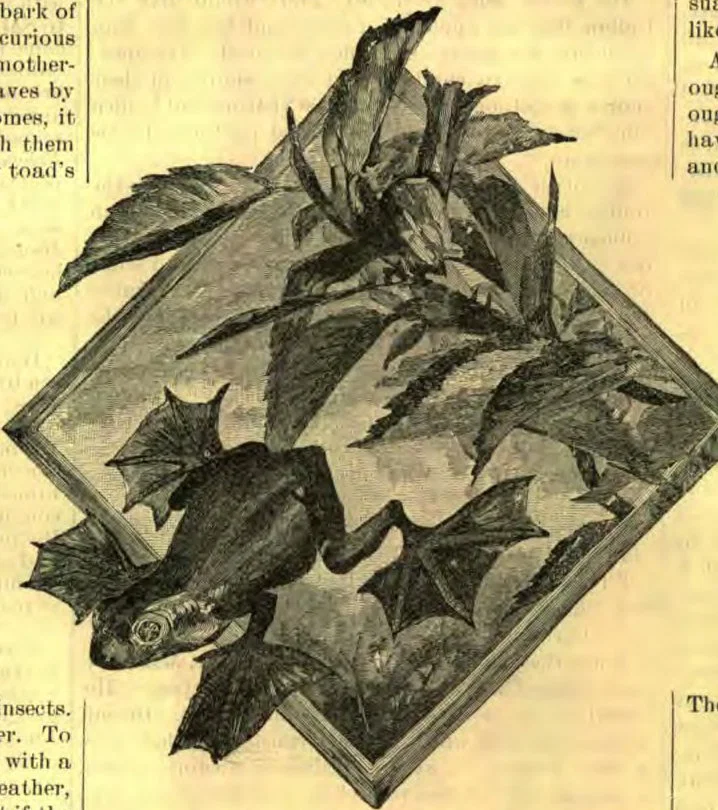
In New Guinea there is a curious little fellow, which flies almost like a flying squirrel. His toes and fingers are webbed, and look like great fans outspread, as he springs from limb to limb. They are only four inches in length, and the web of their hind foot expands to four square inches. You see that their feet are their most prominent feature.
Nearly all tree-toads are green or brown in color. A kind Creator gives them this color in order that they may protect themselves from their enemies, as it makes it more difficult to find them. One species frightens its foes by a luminous secretion; another gives forth a very strong, pungent odor when attacked. Like their neighbor of the garden, the common toad, they destroy many poisonous insects.
One bright little fellow is a natural barometer. To make him useful, he must be placed in a bottle, with a small ladder. Up this he climbs in pleasant weather, to enjoy the scene, as any one else would. But if the clouds are gathering, or a storm threatens, down to the bottom of the bottle he goes till the weather improves again.—Our Little Ones.

A BUNCH OF DRY APPLE.

Grandpa Gay was going to market, and Grandma Gay was flying around, putting the golden “pats” of butter into the round, red box, bringing out the sage and the tansy spotted cheeses that would melt in the mouth, weighing again the five bunches of dry apple that had cost little Pete so many hours of misery.
But the thought that he was to have one bunch for himself consoled him somewhat, and eased the pain of cut thumbs and the vicious stabs from the long, sharp stringing-needle fashioned from an old umbrella “brace.” He had made a great many bright plans with that bunch of dry apple.
Then the dear old lady put up bundles of sage, summer savory, and other sweet herbs wherewith to savor the Thanksgiving turkeys of her town friends. Oh, it was a busy morning, and in the hurry the eggs were almost forgotten—those precious eggs that were worth their weight in—coppers, at least. Pete was hurried to the barn, and in a minute he ran into the kitchen again in breathless haste.
“There’s three dozen an’ ’leven, an’ a hen on!” he shouted. “And oh, grandma, there’s an awful pretty buzzing bird flying around down there! It makes a noise like thunder!”
“I believe my heart it’s a pa’tridge!” grandma said. “Go down and see, father. If it is, be sure and get it for ’Lizy Jones. She’s wanted an’ wanted a pa’tridge stew or some kind o’ wild meat a good spell.”
Instantly there was “war” in little Pete’s heart. That beautiful, fluttering bird made into a stew! He followed grandpa with shuffling steps. Grandpa got a long pole, and in a minute was limping over the barn in pursuit of the partridge.
“Bum-m-m-m! Whirr-r-r-r!” back and forth, high and low. They frightened off the “hen on.” The barn was filled with the roar of its whirring wings. At last grandpa hit it with the end of his pole, and knocked it into Pete’s outstretched hands.
“Hold fast! Don’t let it get away!” shouted grandpa, climbing over the calf-pen gate.
How the feathers flew! For a moment little Pete stood irresolute; then, with the panting, trembling bird held close under his rough jacket, he turned and fled across the fields to the woods, and when grandpa had got over the gate, and rubbed the chaff and cobwebs out of his eyes, there was no Pete and no partridge.
Grandpa could not wait any longer for the forty-eighth egg, and started for town. Pete hung around in the woods half the forenoon, shuffling through the brown, dry leaves and thinking very hard.
The partridge had rumbled off into the deep woods, glad of its freedom. And Pete was glad, too, yet he could not quite get over disobeying grandpa. “Lizy Jones wouldn’t have any “wild meat” either, and she was poor and sick besides.
Just then an idea popped into his mind,—and idea so hopeful and yet so grievous to him that he sat down on a log, clapped his chubby, brown hands over his face, and wept uproariously, as boys ought to weep.
Pretty soon he felt better, but there was still a sore spot in his heart, and he couldn’t eat any dinner, although grandma had a luscious “pandowdy.”
Pete’s bunch of dry apple brought seventy-eight cents, and, although it cost him some heartaches, he carried out his “idea” that came to him in the woods, and bought with the money a plump turkey, ready for market, out of Deacon Brown’s lot, for ’Lizy Jones. He took grandma into his confidence, and she added some cranberries and a big slice of sage cheese.
Alas for Pete’s bright plans! They were swept away like cobwebs; but he thought that more apples would grow the next year; and he looked ruefully at and rubbed his stabbed and black-stained thumbs which had scarcely got healed over, and tried to whistle bravely.—Selected.

FIVE KINDS OF PENNIES.

A boy who had a pocketful of coppers dropped one into a missionary box, laughing as he did so. He had no thought in his heart about Jesus or the heathen. Was his penny not as light as tin?
Another boy put in a penny, and looked around to see if anybody was praising him. His was the brass penny; not the gift of a lowly heart, but of a proud spirit.
A third boy gave a penny, saying to himself, “I suppose I must, because others do.” That was an iron penny. It was the gift of a cold, selfish heart.
As a fourth boy dropped his penny into the box, his heart said: “Poor heathen! I am sorry they are so poor, so ignorant, and so miserable.” This was a silver penny, the gift of a heart full of pity.
But there was one scholar gave his, saying: “For thy sake, Lord Jesus. O let the heathen hear of thee, the Saviour of mankind!” That was a golden penny, because it was the gift of faith and love.—Christian Advocate.

THE KING OF BIRDS.

Now, you think I am going to tell you about the eagle. You confess that you do! “Of course!” you say. “Everybody knows that the eagle is the king of birds. Do you think we are dunces?”
No, I don’t think you are dunces; but perhaps there may still be a few things that you do not know, though, of course, it is only because you have not had time to learn them. And one of these few things is that, according to ancient story, the king of all birds is not the mighty eagle, but the wren!—the tiny, chattering, brown wren, who builds his pretty, little, round nest in hedge-rows and hay-ricks. I will tell you the story as it was told by a famous writer many hundreds of years ago, and then you may believe it or not, just as you like.
Once upon a time, then, all the birds met together to choose a king, and they decided that the one who could soar the highest should be ruler over all the feathered tribes. Up they all sprang into the air, hawk and heron, swallow and sky-lark, and every bird that flies; up, up, up, till their wings were weary and their hearts faint. But far above all the rest flew the mighty eagle, his broad wings bearing him up like sails. When the other birds paused, exhausted, he alone soared onward and upward; till at length, resting on his outspread wings, at a dizzy height above the earth, he screamed in triumph, “O birds! behold your king!”
“Behold him, indeed!” cried a tiny voice at his ear. “But not in you, clumsy fellow!” And the wren, who had been perched all the while, unseen and unnoticed, on the eagle’s shoulder, now boldly took flight, and twittered and chirped from a still greater height; while the weary eagle, unable to soar higher, beat his broad wings in anger and disappointment. So the wren was proclaimed the king of all birds, and remains so to this day; and it is a very pretty story, whether you believe it or not.
Now, let us look at this saucy little king, and see what he is like. He is about four inches long, of a rich, reddish-brown color; and he has a saucy little cocked-up tail, and knowing black eyes, and a very sweet voice, which says very impudent things. He is always gay and cheery, and sings as merrily on a cold day as on a warm one; this is a good point in any king. He builds his own palace, and a very fine one it is for its size, being made very neatly of leaves, moss, and grass, and having always a dome, which covers it completely, the opening of the nest being always at the side. King Wren prefers this domed nest to any other; first, because it is more lofty, and, second, because it protects the royal eggs from cold and rain. But sometimes he chooses the strangest places for his nest. A wren’s nest has been found in the body of a dead hawk, which had been killed, and nailed to the side of a barn, to frighten other hawks.
Once a farmer had killed a calf, and hung its body on a tree. (It seems a singular thing to hang a calf on a tree, as if he were a horse-thief, but that is the way I heard the story.) Some days after, when the farmer cut the calf down in order to cut it up, he found a wren’s nest in its throat. Again, I have heard of a little Queen Wren, who made her nest inside a pump, and went in and out through the spout to attend to her natural duties. “What did she do when they were pumping water?” Why, I suppose she waited until they stopped, don’t you? At least that is what I should have done in her case.
When winter comes, the little wrens are put to all sorts of shifts to keep themselves warm. Sometimes, in very cold weather, they may be found all huddled together in heaps, six or seven of them united, looking like masses of soft brown feathers. Sometimes they get into their summer nests, the whole family, parents and children, crowding into the little hollow under the dome.
Once a kind lady, who was very fond of birds, and used to scatter crumbs for them in her garden every day in cold weather, happened to see a party of wrens go to bed; and this is how they did it. They gathered together on a large branch of a tree, about four inches above which grew another branch. On the lower branch the wrens packed themselves comfortably together three and four deep, the topmost bird always having his little brown back pressed against the upper branch, as if to keep the whole pile steady. The lady pitied the poor, shivering little creatures, and the next day she nailed to the branch a square box, lined with flannel, with a very small round hole by way of door. When the wrens came to go to bed, they examined the box, and soon seemed to understand all about it; for they crowded in eagerly, jostling each other in their hurry to get into the fine new bed room. The next night there were more of them, and more and more, till at last more than forty wrens would crowd into the box, which did not seem big enough to hold more than half that number. Just think! Forty kings and queens, all in one palace! What a proud lady she must have been!—Laura E. Richards.

LULLABY

SLEEP, darling baby; like soft thistle-down Blows the darkness to earth from the fields darkness sown; And the bright stars bloom out like sweet flowers of white, They seem falling down through the softness of night; But earth's flowers are asleep, all their brightness to keep Till the morn comes with sunshine; my pretty one, sleep.
O sleep, darling baby; you're my flower and my bird, For the sweetness you are there is no mortal word, But the angels have whispered it soft and complete, And it perfumes my heart like a rose's breath sweet; And no song that I know is too tender and low To sing as I rock you, my babe, to and fro.
FANNIE BOLTON.
Continue reading: THE INDIAN BIBLE