The Youth’s Instructor, Vol. LIII, No. 34

Riga to Northern Caucasus—II

The Youth’s Instructor

August 22, 1905

Review and Herald Publishing Assn. · Washington, D. C. · August 22, 1905

Riga to Northern Caucasus—II
RELIEVED and happy indeed were we to quietly purchase our railway ticket, and without any difficulty take leave of Riga, the city which has caused us no little anxiety. Our ticket was for a journey of nearly a thousand miles, and cost us only seven dollars. In our company were several of our friends who had been present at the meeting in Riga. They were from various parts of the North Russian Mission field, and were now returning to their homes, where they would take up anew their toil in shop, factory, or farming community. About eighty per cent of the adult laborers in Russia belong to the agricultural class, and twelve per cent more are employed in other rural pursuits; it is therefore not strange that the larger number of believers in the third angel's message here are farmers.
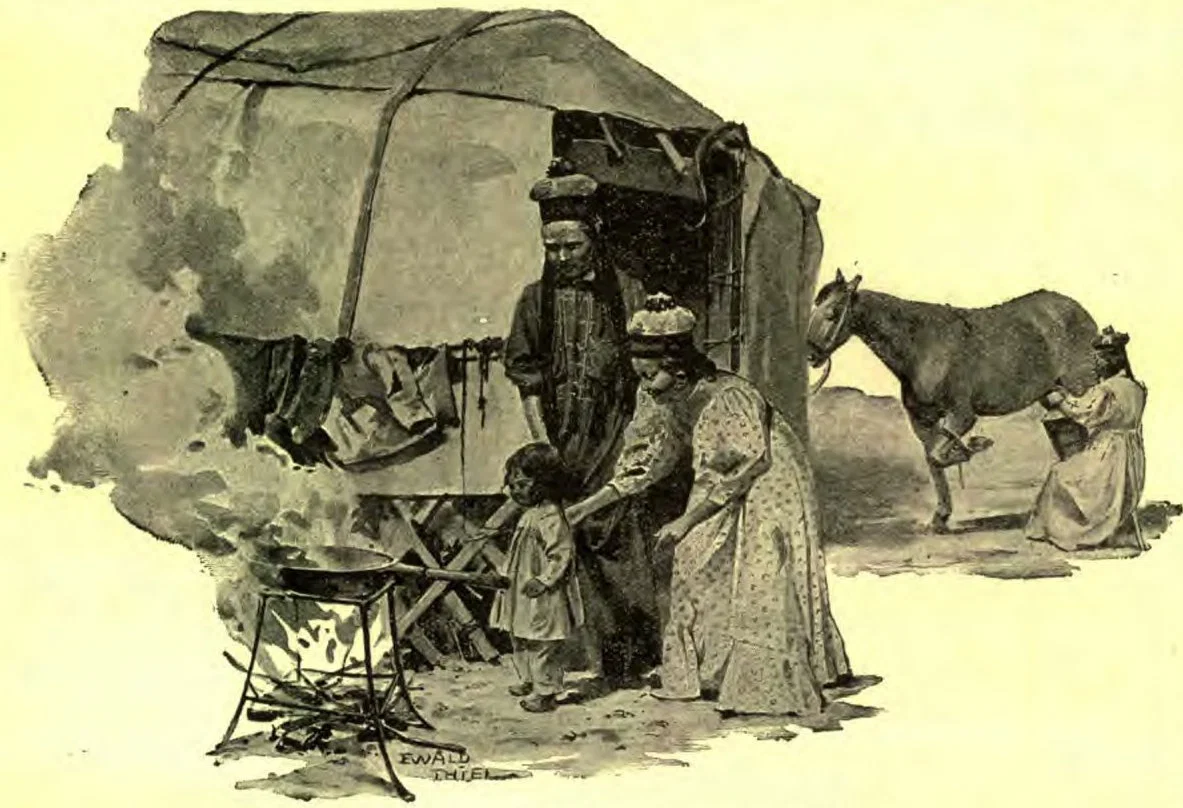
AMONG THE KOLMUCKS, OR WESTERN RUSSIANS
As we would not have an opportunity to see and counsel with the brethren for a long time, the greater part of the night was spent without sleep, for Brother Conradi wished to improve every moment in assisting our fellow workers to better understand the best way of spreading the message, and in encouraging them to rely wholly on God in attempting the accomplishment of the great task before them. We sat in the midst of the fumes of that cheap Russian tobacco, which is so largely used by the common people, with windows closed, in the dim lights afforded by the low, flickering candles, as the train slowly moved up the Duna River. But our hearts were filled with thanksgiving, because we saw the eagerness with which our brethren listened to the truth of God, and seemed to receive every ray of light that came to them. Thus the night passed, and the hours of the morning dawned, and as one by one the brethren left us, we found ourselves alone, in the midst of the ever-changing crowd of Poles, Jews, Esthonians, Lettonians, Germans, and Russians, each one bent on his own special mission, whether it was in search of work in the factories, or as small tradesmen and salesmen, or as mere unemployed country peasants, with their stupid-looking faces, which showed no marked signs of ambition or independence. It must be remembered that the Russian serfs were not freed until 1861, and that to this day most of the peasants manifest the traits of a serf. They are fatalists. They accept good or ill as coming from God; and it never occurs to them that they have any right to ask for the good, or to try to surmount the evil. To submit is their lot, hard though that lot may be. This is a cardinal principle of their crude philosophy.
The next morning we reached Dvinsk, or Dunaburg, a city of about seventy-two thousand two hundred inhabitants. It is the chief strategic city for the defense of the Duna. Here have occurred some of the great battles between the Swedes, Russians, and Poles, and the city has several times in the past changed masters.
One hundred eighty-three miles farther to the southeast is the city of Vitebsk, capital of the Great Russian government of the same name. Here are a large number of Jews (a race one frequently meets in his travels in Russia), and they are among the most highly educated and progressive of the smaller merchants in the cities. From this, however, it is not to be understood that there is no ignorance, and suffering, and poverty among them, for their lot as a nation is a hard one. White Russians are in the predominance; then come Letts, Jews, Great Russians, and Poles.
We next came to the city of Smolensk, which is the capital and largest city of a second of the Great Russian provinces through which we were to pass, that is, the government of Smolensk. This city is on the Dnieper, and it has been called the “key and the door” to Russia. It has therefore been a city much desired by contending armies, and in the early part of the sixteenth century, which has been called the time of blood for this city, it was taken by the Muscovites; in 1610 it was seized by the Poles; and finally in 1686 was turned over to Russia. The larger part of the city was burned in 1812, when the French under Napoleon advanced on the place; on his return from Moscow, Napoleon spent four days here, trying to reorganize his troops. The government of Smolensk has an area of 21,638 square miles, and a population of over one and a half millions. It is stated that forty per cent of the children of school age receive no schooling. However, there are some things which are helpful to the poorer classes, for example, there is a mutual fire insurance society among all the peasants. A little more than one third of the land is in forests; almost one and a third million acres are unfit for cultivation; thirty per cent of the land is under cultivation, and twenty per cent is meadow land. Many of the peasants leave home in the winter months in search of work. We have met quite a number thus going about. Often they steal their ride on the cars. Frequently a poor mother with two or three children appeals to the passengers for a few copeks, which she will use in bribing the train officials for her passage. There is, indeed, in all parts of the country a great deal of begging. Many go about begging for money with which to erect cathedrals and monasteries, as well as asking alms for private purposes.
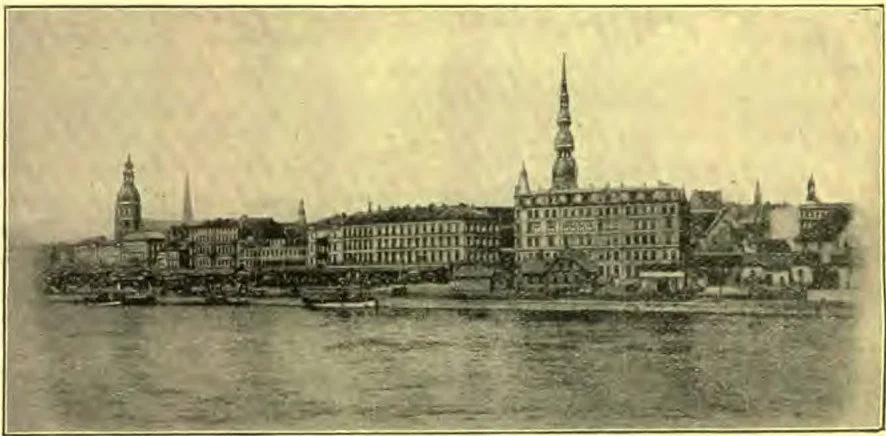
CITY OF RIGA
CITY OF RIGA
Manufacturing is not very well developed. The country as yet does not yield enough grain to supply the wants of the inhabitants; it must be imported from other provinces.
We changed cars in Smolensk, for Orel, which we reached at seven o'clock Monday morning. Very little sleep did we have. The cars were more crowded, and the disturbance caused by the shuffle of the peasants' feet as they entered and left the car with their great bundles, and the fleas, and the ever-present tobacco fumes, kept us awake most of the night.
Orel, which has about seventy thousand inhabitants, is the capital of the government of Orel, a government containing about eighteen thousand square miles, and over two million inhabitants. In the eastern part of the province, where the famous black earth of South Russia begins, enough grain is raised for home consumption, but in the other parts some must still be imported. About sixty-two per cent of the land is under cultivation.
We changed cars again, this time for Charkov, but we had it still more uncomfortable and crowded than before, and the cars were very dirty. The bad air in the car was stifling. Our fellow passengers were of a rougher and more rowdyish class.
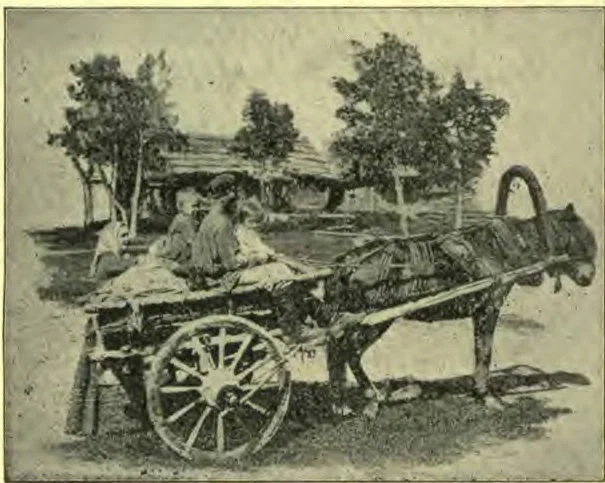
NORTH RUSSIAN PEASANTRY
We passed through the city of Kursk, the chief city of the government by that name, and it is in this government that we first met with the real black earth region—a region that is so very fruitful that it does not need to be fertilized; and yet it is said that the strength of the land is fast being used up by this crude method of agriculture. Here the peasants raise enough and to spare. The government contains nearly eighteen thousand square miles, and about two and a half millions of people, seventy-six per cent of Great Russians, and twenty-four per cent of Little Russians. Here two thirds of the land is under cultivation. Large villages are found in this neighborhood. There is much emigration from the province, as the small allotments of land which the peasants have received do not permit them to make a living for such large families as they must often provide for. Most of the emigrants go to Siberia. One finds a great many bees here. Rye is a heavy crop, and grain is exported. Domestic and petty trades are on the increase. Flouring mills and sugar works are also to be found. In this province over one million pairs of boots are made annually, and six hundred thousand icons and shrines (worth ninety-five thousand dollars), while toys, caps, and pottery are also manufactured. The country and district councils (zemstvos) have helped forward education some, so that ten per cent of the people can read and write. There is quite an active trade in grain, hemp, hempseed oil, sheepskins, hides, tallow, felt goods, wax, honey, and leather goods.
We will in our next paper write of our stay in Charkov, where it was our privilege to have a little rest, and see one of the Russian Church feast-day processions. Guy Dahl.

One Out of Five

“One fifth of all the women of the world are found in the homes of China. One baby girl out of every five is cradled in a Chinese mother’s arms, unwelcomed and unloved, except by that poor mother’s heart. One little maiden out of every five grows up in ignorance and neglect, drudging in the daily toil of some poor Chinese family, or crying over the pain of her crippled feet in the seclusion of a wealthier home. Among all the youthful brides who day by day pass from the shelter of their childhood’s home, one out of every five goes weeping in China to the tyranny of the mother-in-law she dreads, and the indifference of a husband she has never seen. . . . One out of every five, at the close of earthly life, passes into the shadow and terror that surrounds a Chinese grave, never having heard of Him who alone can rob death of its sting. One fifth of all the women are waiting, waiting in China, for the Saviour who so long has waited for them. What a burden of responsibility does this lay upon us—the women of Christendom!”
This expression, “one out of five,” will give our readers some idea about the homes in populous China, but I believe they will be interested to hear something more about the children of China. I will therefore translate some from a pamphlet written by a Swedish friend and missionary in China:—
All our readers have heard something about China, the “Middle Kingdom,” with its immense population, but few have a clear idea of the strange life and customs of the people of this kingdom. A short biography of one of the dark-haired girls of this ancient land, as told by herself, may interest those who are waiting for the prophecy to be fulfilled: And these from the land of Sinim.
Chen po po is now an old widow, who about three years ago joined the Swedish Mission church in the great city of Wu-chang. Chen is her name, and po po a common title for old women among the common people. The place where she was born, nearly sixty years ago, is Uin-kin-ngan. Her father’s name was Niu-ien-long. The grandfather was, according to Chinese custom, the head of the house. Ien-long included, he had four sons who were married, and these, with their wives and children, lived in his family.
The subject of this story was the first daughter in the house, and she was given a place in the family circle. It was decided that she for the present should be educated in the home. Had she happened to be the second, third, fourth, or fifth child, she would undoubtedly have been sold or put to death. By this time she was called “kuniang,” daughter. At the age of three she was betrothed, and at the age of nine her mother-in-law came to take her to her home. According to Chinese custom, she was carried in a sedan-chair to the home of her mother-in-law. It was the first time she ever had a ride, and it was much more enjoyable than walking the distance on her tiny bound feet. Although she enjoyed the pleasant ride, she could not keep the tears back as she had to leave the old home and go to live with strangers. She said that she wept constantly for the first three days, and could not eat, and drank only a little tea.
Her new home was situated in a village called Ma-ko-teng, seven miles from her parents’ home. At the arrival she was met by two older sisters-in-law, who as soon as the chair stopped, asked her to step out. She had been carefully taught not to obey before the call had been thrice repeated, and she followed her mother’s teaching concerning this point of etiquette. Her sisters-in-law led her into the house directly to the idol’s “Kuan-in.” She made a bow and prostrated herself upon the floor, and knocked her head four times, and then repeated the bow, and then the religious ceremonies were over. Now the neighbors came in to see her. They urged her to be of good courage and not weep, but her head sank heavier, and the tears constantly rolled down her cheeks. They asked her to eat, but she had no appetite. O, how far she was from home! How strange and cold the new home appeared! only strange people on every side. With anxious mind she thought of the ill treatment she might meet, for she had heard much about how severely mothers-in-law treated their daughters-in-law. If she only had known the children’s best friend, Jesus! But how could she know him whose name and loving-kindness she had never heard about?
After three days she must begin to work. Her work was to spin cotton, braid trimmings, carry water, gather fuel, and plant and harvest rice, besides various other duties. When half a year was gone, her mother came to take her home to stay two months, according to the Chinese custom. Even at home she had to work hard because her mother was a poor widow; but nevertheless she felt very happy those two months she was with her mother at home again, and all her surroundings, though poor and simple, were familiar and loving to her. No place was like home.
The time went fast, and soon she had to depart for her new home.
The mother-in-law treated her fairly well, and did neither beat nor scold her. In this respect she was fortunate compared with many of her native sisters, and especially so when she compared her lot with that of a cousin, Hong-uin. They were brought up together, and had to move from home at the same time. Hong-uin was two years younger, and had to leave home at seven to come under the control of her mother-in-law. Her food was very poor, and mixed with chaff. Although she was so young and weakened from poor and scanty nourishment, she had to work very hard, and endure scolding and whipping. If the boy to whom she was betrothed, and his brothers, wished to scratch, pinch, and beat her, she dared not complain. Neither to satisfy her hunger did she dare ask for some of the same food her torturers ate. No wonder that the poor ill-treated child was nearly brought to despair. Several times she fled home to her mother, but was soon brought back and punished. At last she grew worse, and the neighbors pitied her misfortune. Was there any consolation for her little heart? Had not the Saviour of love offered his life even for her? Yes, indeed, if she only had known the peace and rest he is so willing to give the weary and heavy laden!
But how do you think her own mother felt when she saw her little girl’s suffering? The mother’s heart bled in sympathy, and in an hour of unspeakable despair, she hanged her child in a tree, because she would rather see her die than to have her live such a miserable life. But her cousin observed the awful deed, and hurried after a knife and cut the rope. She fell unconscious to the ground as if she were dead, and her mother and cousin wept bitterly. By and by she regained consciousness. After this she was allowed to remain two years with her own mother.
As stated before, the cousin was comparatively well treated, and the time passed away in peace. She had never seen her father-in-law nor her future husband. They lived in another province, and worked at a trade. First, when she was eighteen years old, the father-in-law came home. He had been away from home thirteen years, and did not even remember his own small cottage. During his stay at home, he also treated his daughter-in-law very well. After a year he went back to Honan, the province he visited before.
IDA PILQUIST.
(To be concluded)

The Viper, or Adder

How closely certain words are connected with certain ideas! Just repeat to yourself the word dove. How soothing, how sweet, how fully blended with lovely attributes! Now try the word viper. Do you not feel a shivery sensation creeping down your spine, and does it not seem instantly as if every tender feeling went out of your heart? And yet, as a word, viper is just as innocent as dove. It is the association, don’t you see? Names suggest the qualities of the people or things that bear the names. From the innocent letters that make up the word viper we get an impression of all that is repulsive and deadly. And this impression is well carried out by the family of serpents that bear the name.
The Old World vipers are somewhat like the New World rattlesnakes, only they lack the pits on the side of the face and the rattles. But in deadly venom they are much alike. There are about twenty varieties variously distributed over the world, but the greater number are found in tropical countries. In Africa they are particularly numerous and deadly. The vipers have robust bodies, short tails, a triangular-shaped head. The eye is of medium size, with a pupil set vertically. One of the African vipers that is almost as deadly as the cobra is the horned viper. It is a most repulsive-looking creature, of a pale, brownish color above, with blotches of a darker shade. Above each eye is erected a spine, or horn, that helps to give this animal its ferocious aspect. The natives of the country impute to these horns wonderful curative virtues. Sometimes this serpent has been kept in confinement over two years without taking a particle of nourishment, and yet has seemed to be in a healthy condition.
Another deadly member of the viper family is that called Vipera aspis, or asp. The bite of this serpent is most painful, and often fatal.
Another variety is found in England, and is the only venomous reptile that inhabits the island. Its bite is very poisonous. This snake is also called the adder. Horses and dogs are often bitten by it; and the bite, though always causing intense suffering, is not always fatal.
The viper remains torpid in holes during the winter months, often great numbers of them twining together in a repulsive ball. But, though torpid in winter, it is alert and ready to attack in warm weather, and faces a suspected enemy with body closely coiled, head and neck raised and ready to strike as soon as it comes within reach.
In Africa there is a viper called the puff-adder, which distends itself when angry. It must be related to our Southern blowing-viper, with which most plantation children are familiar. From this puff-adder the bushmen of India obtain the virus with which they tip their poisoned arrows, of which we hear so much in accounts of Indian warfare.—Eva Williams Malone.

Good for Evil

WHEN Madame Sontag first began her musical career in Vienna, she was hissed off the stage by her rival, Amelia Steinenger. Years went by; and one day, in her glory, Madame Sontag was riding through the streets of Berlin, when she noticed a little girl leading a blind woman along the walk. She called to her and said: “Who is that you are leading?”
“Why,” said the little girl, “don’t you know? That is my mother, Amelia Steinenger. She used to be the great singer once, but she lost her voice; and then she cried so much about it that her eyes went blind.”
“Give her my love,” said Madame Sontag, and tell her that in a few days an old acquaintance will call upon her.”
The next week in the city of Berlin, a vast multitude gathered at a benefit for the poor blind woman, and it is said that Madame Sontag sang that night as she never sang before, and to the day of her death she took care of Amelia Steinenger, and then she took care of her child after her.—Exchange.

The Coming of the Lord

1 CAN see the Saviour coming, Floating downward from on high; And the angels all are with him, And they shout the victory cry. For the saints on earth have gathered At the trumpet’s note of doom, And the Lord has come to take them To their everlasting home.
I can hear the sinners calling, “Rocks and mountains, on us fall; Hide us from the face of Jesus, He has seen and knoweth all.” And from his righteous judgment Sinners can make no appeal; They have broke the law of Jesus, And that law shall with them deal.
Let the wicked now take warning Awhile the Saviour gently pleads; Happy is the soul that listens, And the angel’s message heeds; For the prize is life eternal, Ages with the Lord to be, And to sing and shout his praises Throughout all eternity.
MORRIS E. GRESS.

A Peculiar Fish

THERE is a kind of fish that swims in the deep seas which is very rare, and a great curiosity. Its common name is the torch fish, but very learned people call it linophryne lucifer. It is a queer creature, with triangular jaws, filled with long, slender teeth, a cartridge-shaped tongue, and body very much like a worn-out old shoe that has become so limp it can not hold itself up in shape any more.
The most remarkable thing about this strange fish is that on the tip of its long pipe-stem nose there is an egg-shaped object that the fish can light up like a bull’s-eye lantern whenever he wants to, and put it out again when he so pleases. This lantern does not serve as a guide to him in his wanderings, but is used as a trap to entice unwary and innocent little fool fishes. When this deep-sea lucifer is hungry, he just lights his lamp, which is a peculiar kind of lip with phosphorus on it, opens his mouth, and waves before it a slender cord-like appendage that grows from beneath his lower jaw. The small fishes mistake the light for a certain kind of toothsome firefly that is down in the sea, and in their scramble for this dainty they sail right into lucifer’s mouth, which is gaping wide open to receive them. When he has had all the dinner he wants, he turns off the light, and goes away about other business.—Selected.

What to Say and What not to Say

Don't Say:—
Say:—
He died with pneumonia.
He died of pneumonia.
He donated five dollars to the society.
He gave five dollars to the society.
NOTE.—“Give” is preferable to “donate,” unless the gift is important and special.
He don't like to do it; The bell don't ring.
He doesn't like to do it; The bell doesn't ring.
I don't hardly know.
I hardly know.
NOTE.—“I hardly know,” is correct. “I don't hardly know,” conveys the meaning that I do know.
I don't doubt in my mind that he will come.
I don't doubt that he will come.
NOTE.—“In my mind” is superfluous.
This is different to that; This is different than that.
This is different from that.
NOTE.—A thing differs from another when it is unlike it, but it does not differ to it, nor is it different than it.
I fear that I shall discommode you.
I fear that I shall incommode you.
Each one of the students have their own room.
Each one of the students has his (or her) own room.
I wish each one present would express their opinion.
I wish each one present would express his (or her, or his or her) opinion.
Either he or she are going; Neither he nor she are going.
Either he or she is going; Neither he nor she is going.
NOTE.—When singular subjects are connected by “or” or “nor,” the singular verb is required.
His hands were in position before him, ready either to attack or defend.
His hands were in position before him, ready either to attack or to defend.
He attempted to follow up, but wisely forbore, and contented himself with blocking and covering up the whirlwind his blow had raised.
He attempted to follow up, but wisely forbore, and contented himself with blocking and covering up the whirlwind that his blow had raised.
In so far as disappointment was his, she shared it with him, but that was all.
So far as disappointment was his, she shared it with him, but that was all.
NOTE.—“In” is superfluous in the phrase “in so far as.”
My wife made this announcement, tragically sinking into a chair as if its import was too great to be borne standing up.
My wife made this announcement, tragically sinking into a chair as if its import were too great to be borne standing up.
NOTE.—The subjunctive, and not the indicative form, is always required after “as if.”
On the night of his mysterious advent, the Prophet had found his people in a condition of mental chaos—as liable to repudiate as to accept the seeker for their confidence.
On the night of his mysterious advent, the Prophet had found his people in a condition of mental chaos—as likely to repudiate as to accept the seeker for their confidence.
NOTE.—“Likely,” and not “liable” is the correct word, for the reason that it is used with reference to “accept” as well as to “repudiate.” “Liable” is properly used only in reference to a possibility of exposure to evil, to danger, to censure, and the like. Note that while “likely” refers to a contingent event usually regarded as favorable, it may be used to express mere external probability.—Correct English.

Arrival at Home

OPENING EXERCISES.
SCRIPTURE LESSON: Acts 28:1-16.
REFERENCE STUDY: “Sketches from the Life of Paul,” pages 272-279.
TOPICS FOR STUDY:—
  • Name of island.
  • Condition of the people.
  • Great miracle.
  • Publius healed.
  • Others healed.
  • Sailed.
  • Arrival at Rhegium.
  • Arrival at Puteoli.
  • Met by brethren.
  • Paul’s courage.
  • Enter Rome.

Notes

Instead of “Castor and Pollux” the American Revised Version gives the name of the vessel as “The Twin Brothers.”
Notice how the Lord wrought through the apostle in healing Publius and others on the island. Compare with the gospel commission in Matt. 28:18-20; Mark 16:15-17.
Look up the geographical location of all the places mentioned in this lesson.
“On the arrival of the party at Appii Forum, which was a town where the mules were unfastened at the other end of the canal, and is described by the satirist as full of low tavern-keepers and barge men,—at that meeting place, where travelers from all parts of the empire had often crossed one another’s path,—on that day, in the motley and vulgar crowd, some of the few Christians who were then in the world suddenly recognized one another, and emotions of holy joy and thanksgiving sanctified the place of coarse vice and vulgar traffic.”—Conybeare and Howson.
“The travelers reach Appii Forum, forty miles from Rome. As they make their way through the crowds that throng the great thoroughfare, the gray-haired old man, chained with a group of hardened-looking criminals, receives many a glance of scorn, and is made the subject of many a rude, mocking jest. Not one of all he meets bestows upon him a look of pity or sympathy. He meekly wears his chain, and silently, slowly pursues his way. Suddenly a cry of joy is heard, and a man springs out from the passing throng, and falls upon the prisoner’s neck, embracing him with tears and rejoicing, as a son would welcome a long-absent father. Again and again is the scene repeated.”
“At Rome the charge of the centurion Julius ended. Here he delivered up his prisoners to the captain of the emperor’s guard. The good account which he gave of Paul, however, together with the letter of Festus, the procurator of Judea, caused the apostle to be favorably regarded by the chief captain, and instead of being thrown into prison, he was permitted to live in his own hired house. The trial of having constantly to be chained to a soldier was continued; but he was at liberty to receive his friends, and to labor for the advancement of the cause of Christ.” G. B. T.

The Relative Importance of Meetings and Work

  • (Concluded)*
In addition to the definition quoted, which Webster gives for meetings, is another in which there is a deep meaning; connected with the thoughts expressed in the prayer of Christ as recorded by John, it is freighted with eternal consequences. It is defined thus: A coming together, confluent—the running of one into the other. Jesus prayed: “And for their sakes I sanctify myself, that they also might be sanctified through the truth. . . . That they all may be one, as thou, Father, art in me, and I in thee, that they also may be one in us: . . . I in them, and thou in me, that they may be made perfect in one.” What is needed more? What could be more important in this stage of the message than the fulfilment of this definition and the answering of this prayer? Without it what will all our efforts avail? Then as young people let us make this the aim of all our meetings, the burden of every prayer, and the melody of every song; for in it is the accomplishment of our work. Jesus prayed for this oneness, “that the world may know that thou hast sent me, and hast loved them, as thou hast loved me.”
Work is the outgrowth of union; activity is the very condition of life. Christ says, “My Father worketh hitherto, and I work.” If Christ be in us, we shall work; for again he says, “I will work, and who can hinder it?” As soon as one comes to Christ, there is born in the heart a desire to make known to others the saving, sanctifying power of truth found in Jesus. And our abiding in him, our growth in the Christian graces, depend upon our activities for others. It is useless to endeavor to maintain a Christian life by passively accepting the blessings of heaven. Doing nothing for Christ is like trying to live by eating without working—weakness, decay, and death are the results.
Strength comes by exercise; the more vigorous the exercise, the stronger the muscle. So if we desire spiritual muscle, we must be engaged to the extent of our ability in blessing and helping those who need the help we can give them.
We have the assurance that “he that has begun a good work in you will perform it until the day of Jesus Christ.” There is no release from the Christian warfare until that day. Then let us sing and do, as expressed, by William Miller:— “We’ll work till Jesus comes, We’ll work till Jesus comes, We’ll work till Jesus comes, And we’ll be gathered home,”— to see our motto ratified, our committee justified, our members sanctified, our hearers edified, our numbers multiplied, our leader satisfied, and the Lord glorified. ANNA HIBBEN.

Our Conversation

1. What is the ninth commandment?
“Thou shalt not bear false witness against thy neighbor.” Ex. 20:16.
2. How may we see good days?
“For he that will love life, and see good days, let him refrain his tongue from evil, and his lips that they speak no guile.” I Peter 3:10.
3. How do we speak?
“For out of the abundance of the heart the mouth speaketh.” Matt. 12:34.
4. Can man control his tongue?
“But the tongue can no man tame; it is an unruly evil, full of deadly poison.” James 3:8.
5. Then how only can the tongue be controlled?
“I can do all things through Christ which strengtheneth me.” Phil. 4:13.
6. How will our words stand in the Judgment?
“But I say unto you, That every idle word that men shall speak, they shall give account thereof in the day of judgment. For by thy words thou shalt be justified, and by thy words thou shalt be condemned.” Matt. 12:36, 37.
EMMA S. NEWCOMER.

The Berkeley (Cal.) Society

OUR Berkeley Society of young people is still in its infancy. We date our birth one year and a half ago. We owe our existence to the faithful labors of our pastor and his wife and daughter, as there are but few in our Society who have not received the truth through their personal labors.
As a Society of young people we earnestly desire to meet the mind of God in doing the work he would have us do in that important center of learning,—Berkeley, the university town.
In this center are to be found not only young men and women from all parts of the great State of California, but from almost every country and nation in the world. Thus our responsibility is greatly increased.
In view of this important center in which we find ourselves, and the great message now due to the world, we are earnestly endeavoring to qualify ourselves, by prayerful study of the Word, to become “laborers together with Him,” that in “the meekness and gentleness of Christ” we may present these great themes in their original simplicity and clearness.
Our regular study, at present, is the Acts of the Apostles. Another very interesting and beneficial feature of our meeting is the brief Bible readings which every member is expected to prepare and give from memory before the Society. By thus hiding the Word of God in our hearts, we shall be able to give a reason of the hope that is within us, with meekness and fear.
We are glad to report some of the personal work done by the Society. This includes the purchase and distribution of literature, canvassing for our publications, and considerable Bible work from house to house. The sick have been visited, the needy helped, and the naked clothed.
What has been done seems as nothing when we see what is yet to be done. We sincerely hope that from this convention there will go forth a band of workers whose hearts the Lord has touched by a fresh baptism from above.
RETA BAILEY.

The Stream of Life

I SEEM to float, I seem to glide, Softly along life’s solemn tide; On either hand, bold headlands gleam, And valleys open as a dream. The mountains lift their brows of flame, Solemn and awful, e’er the same, While past the isles of joys and fears, Glides on the ripple of the years.
Within my bark, I lie and dream, Floating adown life’s wondrous stream, By sheltered nooks, and vistas grand, And loved ones waiting on the strand, I can not stop, but e’er must go On with the river’s restless flow, On, ’neath the shine, or rain, or tears, ’Adown the ripple of the years.
Above me are the bending skies, Where storms are born, whence clouds arise, And shadows vast, or sunny gleam, Change oft the landscape of my dream, And higher still, my home above, Where Jesus reigns, and all is love, And brightly paradise appears, Beyond the ripple of the years.
O mystic stream! O deeps profound! Thy billows never line can sound, What passions thrill the human heart, Whence joys arise, whence sorrows start, While o’er life’s wave the human soul Drifts ever to some unseen goal, But hope discerneth brighter spheres Beyond the ripple of the years.
L. D. SANTEE.
Continue reading: “Unto Me”—A Dream