Among the various schemes and ideas which have of late been sprung upon the public in the name of reform by law, is that of the establishment by Congress of a “bureau of matrimony,” to rest upon a law to be passed making marriage compulsory upon all persons of marriageable age. As yet, this innovation has not a very strong backing, the visible power behind it consisting of one determined woman, by name Mrs. Charlotte Smith. Just what reasons the latter is able to set out in support of her proposition, we have not yet learned; but doubtless they are as numerous and quite as weighty as those urged in behalf of other proposed reforms with which the public have long been familiar.
It might be said in its support, for instance, that man was not created to live by himself, and that the married state is the one ordained for him by the Creator: and this is certainly true. Therefore it might be argued that, as a general rule, it is the duty of all persons of marriageable age to get married; and this being so, that there ought to be a law to make them do it. Statistics might be invoked to show—as they unquestionably do show—that criminals are proportionately more numerous among the unmarried part of the population than among the married; and hence it would be clear that by increasing the proportion of married people there would be secured a diminution in the amount of crime. And it will not be questioned that the prevention of crime is one of the chief ends of civil government.
That is the way people argue in support of some other and quite popular reforms, and the argument holds just as good in the one case as in the other. It is upon just this line of argument that the great movement for “Sabbath reform” rests. It was ordained that man should keep the Sabbath; and if all men would do this, the benefit to society would be incalculable. Crime and the evils which spring from human depravity would disappear as if by magic. Therefore, say the promoters of the movement, let us have laws which will oblige all people to keep the Sabbath. Their “logic” involves the same mistake that is involved in the idea of a compulsory marriage law,—a mistake which is fatal to the success of the scheme as a means of promoting the welfare of mankind.
The mistake turns upon the point of compulsion. Marriage was not ordained as a state to be entered into by compulsion; and neither was the Sabbath so ordained. A person who marries under compulsion makes the poorest kind of a marriage partner, and the poorest exhibition of Sabbath keeping is furnished by the one who observes the day against his own free will. Unless his heart and soul are in it, the individual himself is not in it; and then the thing itself, whether marriage or Sabbath keeping, becomes only hypocrisy and sham.
The trouble with Mrs. Smith’s scheme of reform by enforced matrimony is not in the scheme itself, but in the principle on which it is based. It would be all right to compel people to get married, if the principle of reform by the force of law were a sound one. But it is not; and whenever this principle is embodied in a scheme of reform, things are made worse than they were before. This is the only result that can ever follow in such a case.
But although this is as plain as a b c, the efforts made to reform the city, state, and nation by law still keep up, and are becoming more widespread than ever. Morally, the world is moving backward, not forward.
The state of Ohio has just passed through an acute attack of politics, which, while it has not furnished the rest of the country with a very edifying spectacle, has given the observer a fair idea of what politics can become under the developing influence of nineteenth century civilization.
The most conspicuous thing in this contest was the open and specific charge of bribery made by the leaders of one political faction against the successful candidate for the office of United States senator. The latter having escaped defeat by a single vote, the President says that in his victory “all right-minded people will rejoice;” whereupon a prominent politician of the state makes reply to the President that his words are an “insult to every honest man in the United States.” This is bad enough, certainly; but what would it have been if all the preachers in the state had been involved in the contest, imparting to it a distinctly religious character? Certainly it would have been worse, in such a case, than it was.
There is news just now of a rather strange and startling character from Italy. The pope, it is said, has made a pronouncement in favor of republics. This is contrary to the traditional policy of the papacy, which has always favored monarchical government. This pronouncement is made in the Civilta Cattolica, the official organ of the41papacy in Italy, in an article which is referred to as “evidently inspired.”
The article says that the co-existence in Rome of the Vatican and the Italian monarchy is not possible, and that one or the other of them must go. Which means, of course, that the monarchy must go, since the pope has no intention of going himself. The article says that there are many examples to prove that national unity may exist in other forms, and cites the republics of Switzerland and the United States as illustrations. There is in this no flattering significance as regards this “land of the free.”
At this date, looking back at events which have transpired within recent years, it is not very difficult to see why the papacy has come to look with favor upon a republic. Traditionally, as stated, the policy of the papacy has been in favor of monarchy. The republics which are upon the earth to-day are of comparatively recent origin. They represented, at the time of their rise, a movement of the people away from long standing despotisms which had come down from the Middle Ages, in the direction of popular liberty. A republic—a “government of the people, by the people and for the people”—contained the promise of liberty for the people, both civil and religious. For this reason the papacy feared such a form of government, and stood against it.
But the papacy has discovered that things were not really so bad as it feared. It has discovered that even a republic may be “run” upon papal principles; that indeed the greatest republic of modern times is conducted upon lines which afford no real guaranty of that religious freedom to which she stands opposed. She has discovered that the United States Constitution, as now interpreted, is not the formidable document she thought it was; so that she has instructed her adherents to go forth to the spread of papal principles, bearing a copy of this Constitution in their hands. The pope was not long since assured by Mr. Burke Cochrane, a Catholic and one of the most prominent of American politicians, that church and state are not really divorced in this country, but are in fact firm supporters of each other. He sees too that an untiring effort is being made in this republic to secure as close a union of church and state as was ever known in the papacy’s palmiest days. What wonder then that Rome has lost her fear of republican government. But how will the suggestion of an Italian republic be received by the crowned heads of Europe? This remains to be seen; though we may be sure that the papacy always feels her ground before she treads on it.
Our Citizenship Is in Heaven
“OUR citizenship is in heaven.”
Items from Washington.
UNDER date of January 15, our Washington correspondent sends us the following:—
“The prospect is good for the defeat of the Sunday bill in the Congressional Committee.”
“The three daily papers in this city have declared themselves in favor of opening the National Library on Sunday.”
“No bill for the ‘God-in-the-Constitution’ amendment has yet been offered. Such a bill would have no chance of passing.”
“Sabbath Reform” in the Transvaal.
The Cradock Register (South Africa), in a recent issue printed the following item of “reform” news:—
“THE SABBATH.—The Rev. Mr. Murray, Moderator of the Dutch Reformed Church, in Natal, has addressed a letter to Afrikanders, expressing his sympathy with those who have suffered great losses through rinderpest. He considers the plague as a punishment for sins; the main transgression of the country being the violation of the Sabbath. ‘Not only is the Sabbath considered as a “visiting” day by many, but even inoculation of cattle is being performed on that day.’ The Transvaal Volksraad has decreed that officials shall in future be compelled to attend divine service on Sundays.”
The Transvaal legislature is noted for its “whole-souled” way of doing things, and the present instance is no exception. Having set out to reform the community by law on the point of Sunday observance, the members of this body do not stop with any half-way measures, but decree that “officials shall in future be compelled to attend divine service on Sundays.” They see that attendance at the churches is the ultimate step in this reform, and this is just what is seen by the promoters of the Sunday-observance movement here; but the latter are governed less by logic and more by policy.
But the logic of the Sunday law movement is the same here that it is in South Africa. The logic does not stop short of a decree compelling the people “to attend divine service on Sundays.”
Civic Federation Organized in Lincoln to Enforce Sunday Laws
A “CIVIC FEDERATION” has been organized in Lincoln, Ill., the chief purpose of which is given as “the enforcement of Sunday laws.”
Tuskegee Negro Conference and Workers' Conference Announced
THE usual annual session of the Tuskegee Negro Conference will take place in Tuskegee, Ala., Wednesday, February 23rd. The Workers’ Conference, composed of officers and teachers of the various colored schools in the South, takes place February 24th, at Tuskegee, Ala. These conferences present an opportunity to study the condition and progress of the negro that is afforded nowhere else. Further information can be had from Booker T. Washington, Tuskegee, Ala.
Your Conscience.
I WONDER how many of the youthful readers of the SENTINEL can really tell for what reason the Creator gave them a conscience.
And how many can tell what a person ought to do with his conscience?
Ought you to be master of your conscience? or should your conscience be master of you?
Some people try to quiet their conscience when it reproves them for a thing they have done, instead of correcting the wrong as conscience tells them. They seem to think they will be better off with a sleeping or a dead conscience than with one that is alive and wide-awake. But what is the right condition for every conscience to be in?
Of how much value do you think conscience is to you? Did you ever see a person who had no conscience at all, or almost none? And if so, did you envy him? Try to imagine what this world would be like if the people in it possessed no consciences.
Like every other thing that is of great value, conscience ought to be carefully cherished. And being a faculty of the mind, it must grow and become educated as the mind develops. But how ought it to be educated? Should it be by what men say; by the maxims of the world and the traditions that have come down to us from the past? Or is there some other and better way for it than this? and what is it?
When you go contrary to your conscience, because some person tells you to do so, what are you really giving up? If a law should be passed telling you to do a certain way, and your conscience should tell you differently, how much would you really surrender if you should yield your conscience?
How much do you think any person could serve the Lord without the aid of his conscience? Could any one who should surrender his conscience exercise faith?
The Bible tells us that whatsoever we do, we should do it not merely unto men, but unto the Lord. Now if you should surrender the conscience which God gave you, could you do anything unto the Lord? What do you say to this?
But is your conscience, or anybody’s conscience, the standard of right and wrong? Could you say that your conscience told you to do a thing that interfered with some one’s rights? Some people have said this, but it did not justify them. It was really not their conscience, but something else, that led them to do such things. God is the author of both conscience and rights, and he never made two things that conflict with each other. When conscience and law come in conflict, an appeal must be made to an authority which is higher than either, and that is the Word of the Creator.
The principle of the Golden Rule will always settle any seeming conflict between conscience and individual rights.
Studies in French History.—5.
By Mrs. L. D. Avery-Stuttle
“WHAT became of King Childeric III?” asked Florence Ray at the next study. “The time to go home came so soon last week that we did not find out, and I have been worrying about him ever since.”
“Poor fellow,” answered Professor Carman, “they shaved his head again, and sent him back to his cloister.”
“Then I suppose Short Pepin had his way,” snapped Joe Palmeter, spitefully.
“Pepin the Short,” corrected Edna Phillips, whose memory of names and events never deserted her.
“Yes; Pepin the Short had his way, and now became the first of the Carlovingian kings, so-called from the word ‘Carolus,’ the Latin name for Charles.”
“Now to renew: Our last study took us over a period of 241 years, bringing us to the year 572 A. D. Who was the first French king?”
“Clovis,” answered a dozen voices.
“When did he rule France?”
“From 471 to 511 A. D.”
“After him came the later kings, hardly worthy the mention. But Pepin the Short was the first real king worth speaking about after Clovis. You will remember that his father was the great Charles, called the Hammer, but he was not really a king—only a mayor. This Pepin the Short was also the father of Charles the Great, or Charlemagne; he, Pepin, fought and conquered the Saracens and Bretons, went down into Italy and reduced the Lombards to submission, then gave their territory to the pope. This ‘Pepin’s Donation,’ as it was called, was the beginning of the wonderful friendship which existed many years between the popes and the French kings.
“Pepin was a very strong and courageous man. Once when he with many of his people were witnessing an exciting fight between a lion and a bull, as was the cruel custom, he asked, ‘Who dares separate them?’ No one caring to distinguish himself by running so fearful a risk, the king himself leaped between them, and finally cut off both their heads, saying as he did so, ‘Now am I not worthy to be called your king?’”
“When he died, he left the kingdom to his two sons, Charles and Carloman. But Carloman soon died, leaving to his brother, Charles the Great, or Charlemagne, as he is more commonly called, the entire kingdom. This was43about the year 768 A. D. You should make a note of this date in your books, for now there was at last what the world calls a great man seated upon the throne of France. He was a man of great energy, military genius, and wonderful achievements. He was also a great friend of learning. But in those days, people did not have such books to read as we do now, for you must not forget that the art of printing had not yet been invented.”
“I don’t see,” said Jennie Jacobs, “how in the world they could learn anything without books, I have a hard time nowadays to learn even with them.”
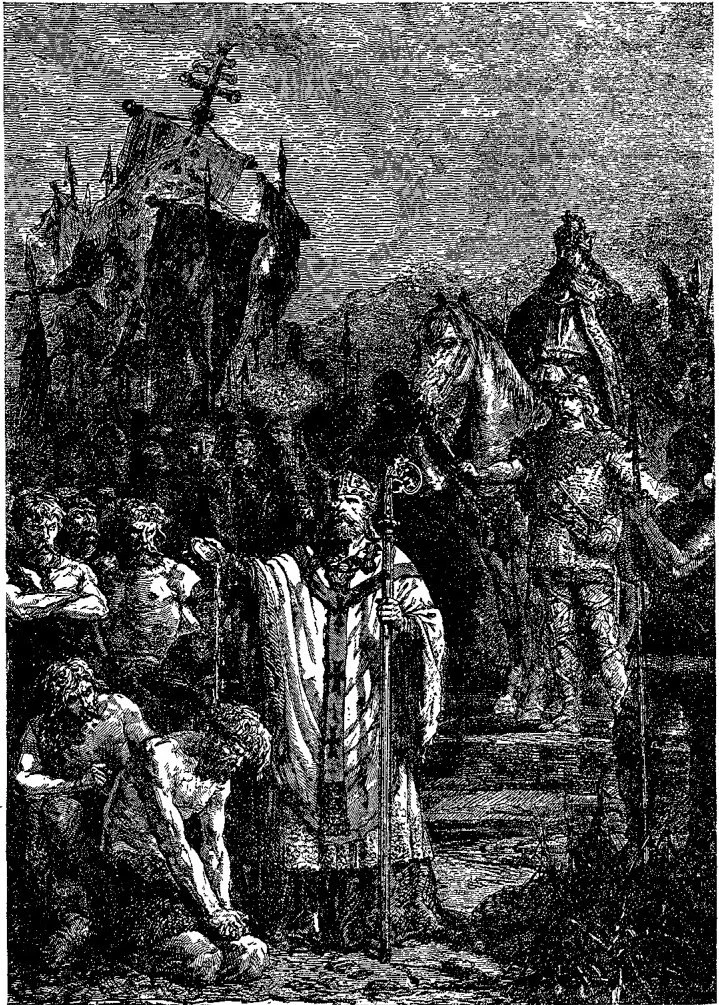
CHARLEMAGNE BAPTIZING THE SAXONS.
“Well, you see,” replied Professor Carman, with a smile, “they had a few books, but they were very expensive, and were all copied with pen and ink; so you may imagine the labor they involved.
“It is said that Charlemagne made fifty-three warlike expeditions, and was always a victor, except in those against the Moors, who lived in Spain. Once when he was coming back home from one of these, he had to pass through the country of the Basques, and when he was crossing the Pyrenees with his army, these Basques, who were friendly with the Saracens, threw down great rocks, stones, and tree trunks upon them. This killed many and so frightened the others, that they became an easy prey to the fierce Basques, who killed them without mercy.”
“O I don’t see how any one could have been so cruel,” said Florence Ray, “it seems as if people were not half so bad as they were then.”
“But, Florence, human nature, without the renewing influence of the grace of God is pretty much the same in all ages.”
“It is from this battle that the romantic legend of Roland and Oliver sprang.”
“I’ve heard of them,” said Harry Ray, who was a great reader.
“O, please tell us about them,” pleaded Milly Brown, who was very romantically inclined.
“But, you see, I’m teaching truth now, and not fiction,” said Professor Carman, with a smile, “so you’ll have to get some one else to tell you the improbable stories.”
Milly looked quite disappointed, but the professor proceeded: “Charlemagne had a war with the Saxons, which lasted over thirty years; but they were finally forced to submit to the mightiest warrior of the age. But this war was another of those carried on in the name of religion. The zealous king wanted the Saxons to believe as he did. But I think he would have better succeeded if he had shown a more Christlike disposition toward his enemies. Only think of his ordering the wholesale slaughter of four thousand helpless prisoners at once, and then declaring that the war was carried on for the purpose of converting his enemies!”
Julia March raised her hand quickly. “I think he did not follow the teachings of Christ very closely, for he said, ‘Love your enemies, do good to them that hate you, and pray for them which despitefully use you and persecute you;’ he didn’t say to kill them.”
“No, indeed. Well, when Charlemagne had reigned thirty-two years as king of the Franks and Lombards, Pope Leo III crowned him also emperor of the Romans in the year 800 A. D.”
Professor Carman paused a moment, as nearly all seemed to be very busy with their note books. When the eager eyes were again raised to his, he continued:—“Foreign princes and kings were all anxious to form a friendship with this wonderful man. The Caliph Haroun Al Raschid, the famous hero of the ‘Arabian Nights,’ sent him a clock that struck, an elephant, and a monkey,—wonderful curiosities then.
“He created what was called the ‘School of the Palace.’ There Charlemagne would sit in great dignity, surrounded by his children, and some of the favored nobles, while Alcúm, a wise monk, brought on purpose from England, lectured to them about grammar, astronomy, and theology.
“The emperor tried to learn to write. But his hands were so stiff and accustomed to the sword, that he made sad work of it. But so anxious was he to improve every12moment that he used to have some one to read to him even while he ate. He built a beautiful cathedral at La Chapelle, in Germany, which you can still see; therein is the very chair in which he was buried for near two hundred years, till Otho III removed the remains. Please write: Charlemagne died in the year 814, when he was seventy years old, having reigned nearly fifty years.
“Now you may all be dismissed, and see how much you can tell your parents to-night about Charles the Great or Charlemagne.”
MRS. L. D. AVERY-STUTTLE.
He “Shall Wear Out the Saints of the Most High.”
By F. B.
“Well, Charlie, what is the next specification in the prophecy concerning the papal power?”
“He . . . shall wear out the saints of the Most High,” read Charlie.
“What does it mean to wear out anything, Charlie?”
“Why, mama, I should think you would know when you have a boy like me. See here, my knees are almost coming through my pants, and they will soon need another patch.”
“Well, how did you wear them out?”
“Why, just by wearing them out, by giving them a knock here, and a scuff there, by tumbling, climbing, and scuffling at school, by straining and tearing, you know, mama.”
“Then you did not do it all in a minute?”
“No. I did it by slow processes, as it were.”
“All right. How did the papacy wear out the saints of the Most High?”
“By keeping at them. By all sorts of persecutions. I’ll show you,” said Charlie, taking “Foxe’s Book of Martyrs” from the shelf. “Look at these pictures, and you’ll see. Here is a man on the rack. They would rack him for awhile, and then if he would not recant, and be a hypocrite, they would put him in a cell for a few days and rack him again. They hung heretics up by the thumbs, burned them at the stake, baked them in slow ovens, sealed them up in the walls of buildings, flayed them and rubbed them with salt, pulled out their tongues, and seared out their eyes. O mama, it is dreadful to think of the way in which men used to be tortured. The martyrs must have had a living connection with God, and have known real help, or they never could have stood true to truth. How glad I am it’s all over.”
Mrs. Ross sighed and looked troubled. “All you have described is wonderfully real and vivid to me; for I have visited places in London, and in other parts of the world, where men were burned at the stake, and where these very tortures were enacted. I stood on the very spot at Smithfield, London, where some of the most godly men were burned at the stake for their faith, and entered the old Norman cathedral opposite the spot, at the door of which the priest stood holding up the crucifix, and urging the martyr to recant ere the flame touched him.”
“I should think the sight of Christ dying on the cross would have helped the martyr to die for him. How very inconsistent it was to hold up the crucifix for such a purpose!”
“After visiting Smithfield I went to Madame Tussaud’s wax-work exhibition, and there in ‘the chamber of horrors’ saw a very realistic representation of the Inquisition.”
“For weeks after seeing that horrible sight, I felt nervous and frightened when alone; but now I am glad that I visited the chamber of horrors. There are many places in the world where you may still see frightful instruments of torture. At Nuremburg is a building given up to a diabolical display of torture instruments. Even in this generation buildings have been torn down in Spain, whose double walls were found packed with the skeletons of martyrs. The whole earth is sprinkled with the graves of those who died because they chose Christ for their heart’s king, and would not permit self in any form to wield the scepter.”
“Mama, how many martyrs do you suppose there were?”
“The very lowest estimate given by history is fifty millions. But I think with others that it is more than likely that they never will be numbered till the earth discloses her dead. Now I want you to read a few scriptures just to see by what figures the prophet describes the blotting out of the saints of God. What is to cover the earth? Read Isa. 62:2.”
Charlie read: “For, behold, darkness shall cover the earth, and gross darkness the people.”
“When darkness covers the earth, what do we call the time?”
“Night time,” said Charlie.
“The darkness spoken of here is spiritual darkness, or spiritual night.”
“What appears in the sky at night?”
“The moon and stars,” said Charlie.
“Why do the moon and stars give light?”
“The moon and the planets reflect the sun’s light; the stars are suns in themselves.”
“For carrying out the figure, we will call the moon and the stars or planets that reflect light, the people of God. Our Saviour is the Sun of Righteousness, and the moon and stars of God are those who shed his light into earth’s spiritual night.”
“What does the prophet declare shall be seen upon God’s people?”
“The glory of God.”
“What is God’s glory?”
“You told me once,” said Charlie, “that it was his love. Moses prayed, Show me thy glory, and God said he would let his goodness pass before him.”
“Then what is to appear on the people of God?”
“The goodness or character of God.”
“What did Jesus say his people were to be in the world’s darkness?”
“The light of the world.”45
“But if the spiritual condition is one that may be compared to darkness or night, what may God’s people be compared to?”
“To the moon and stars.”
“Now, Charlie, you may read in the eighth chapter of Daniel another prophecy that brings out the manner in which the horn was to war against God’s light-bearers.”
Charlie read the 10th verse: “And it waxed great even to the hosts of heaven; and it cast down some of the host and of the stars to the ground. Yea, he magnified himself even to the prince of the host.”
“You can see how the horn warred against the stars of God, and gather from the violence of the figure that there was a deep-set malignity back of its action. What does the name ‘Lucifer’ mean?”
“Light bearer,” said Charlie.
“Yes. You remember in one of our first talks how Lucifer shed the light of God’s glory throughout heaven, and that through self exaltation he lost his light and his position, and was cast out. You can see by the scriptures we have read that God has chosen us, who have been the captives of Satan, to become his light bearers, and take the place of the great angel who lost his first estate. O how Lucifer hates us when we shed abroad the glory of love, of which he is now incapable,—when we believe God’s Word and follow the footsteps of Him who is meek and lowly in heart. It is this malignant spirit of jealousy that is behind all persecution, that bids the horn tear down the stars of God, and stamp them out.”
“But persecution did not blot out the people of God,” said Charlie. “I read somewhere that the fagot was like a taper that lit up other stars, and that when a martyr died, his ashes were like seed that sprang up in a great harvest of souls.”
“That is true, Charlie, praise God. No one can do anything against the truth. But the object of the persecution was the blotting out of God’s people. The privilege of becoming God’s light bearers is too sacred, too dear, too full of heavenly joy, to be lightly given up. Once let a soul catch a glimpse of the glory of God, and realize that that glory may be seen upon him, and death itself loses its terrors. Besides the promise is sure that we shall never perish, neither shall any man pluck us out of the hand of omnipotent Love.”
“But, mama, how was it that the papacy had power to persecute the people of God? It doesn’t have that power to-day. Why, there’s liberty everywhere. You know our Constitution says that Congress shall make no law respecting religion, or to hinder the free exercise thereof. What could any church do in the way of open persecution in the world to-day?”
“It certainly does not look as if it could do anything; but in the Dark Ages the Catholic Church could command the power of the state. God’s plan is to keep the state and church separate; but Satan’s plan is to put into the hands of the church the power of the state, so that he, through a perverted church, can control the faith of men, or at least make them conform to certain outward standards. Satan would like to run the world through one mold,—the self-mold. Whenever the world consents to his scheme of government, and he is always alert to push it on the world, then persecution can be carried on under the sacred name of law, and then God’s saints are treated as was their Master, who was known as one of the malefactors.”
“But, mama, why is it that the people of the past had to endure all this, while to-day we have things so pleasant? It doesn’t seem quite fair.”
“Every generation has its own test. But we will answer this question more fully at another time. I will give you one text, however, to think about. The apostle says, ‘Yea, and all who will live godly in Christ Jesus, shall suffer persecution.’ The image of Christ is too faintly traced in those who profess his name to provoke enmity from him who was the murderer of the Son of God. When the image is clear, your question will receive the answer of ages. But we have talked a long time; let us close with prayer.”
Mrs. Ross prayed fervently that they might reflect the glory of God, and be strengthened to bear all the consequences. Then they sang together—
“Be Thou my pattern, let me bear,
More of Thy gracious image here;
Then God the Judge shall own my name,
Among the followers of the Lamb.”
“There is just one thought more, Charlie. The great day of vindication is at hand. Very soon the martyred hosts will hear the voice of the Life-giver. John saw these hosts of God, and said, ‘These are they who have come up through great tribulation, and have washed their robes and made them white in the blood of the Lamb.’”
“Let us wash our robes, my boy, and be made white; then we shall be tried, and after the cross will come the crown.”
F. B.
TO OUR PATRONS:
By Editor
Write names plainly.
Remit by P. O. Money Order, or Express Order, or by Bank Draft on New York. Personal checks are not desired.
Make all Orders and Drafts payable to Pacific Press Publishing Co., not to the editor or any other individual.
We will receive Postage Stamps in small quantities and any kind of good money. Defaced coins will not be taken. If paper money or coin is sent, register the letter.
SOMETHING NEW, NEAT, NICE,
And necessary, if you would know, and have others know the COMPLETE DECALOGUE as God spake it from Sinai’s flaming summit.
A CHART 12x18 INCHES.
On thick paper, mounted at top and bottom with metal and ready to hang on the wall.
Postpaid, 25 Cents.
Postage stamps acceptable.
PACIFIC PRESS PUBLISHING COMPANY, 39 Bond Street, New York City, N. Y.
Sunbeams of Health and Temperance.
This is a unique work in which the author has undertaken to present a vast amount of interesting information in such a manner as to be not only instructive but entertaining.
The following are the titles of the principal sections of the work: The House We Live In; The Habitations of Men; Some Strange People and Their Strange Manners; The Bills of Fare of all Nations; Dame Fashion and Her Slaves; Health and Temperance Miscellany; Hygiene for Young Folks.
Over 224 quarto pages.
Illustrated by hundreds of engravings.
One of the most interesting volumes ever published.
Regular price. We will send postpaid.
Cloth, plain edges, $2.25. $1.25.
Cloth, gilt edges, 2.50. 1.50.
Pacific Press Publishing Co., 39 Bond Street, New York.
Christ Our Saviour: Book Review and Ordering Information
“It is the Grandest Book I Ever Read,” Says a lady who has read the book entitled,
“Christ Our Saviour,”
By Mrs. E. G. WHITE.
WE have in this book the life of “Christ Our Saviour” from his birth to ascension, given in simple and direct language. It is printed in large, clear type, and is finely illustrated by engravings made especially for it. The simplicity with which this “Old, Old Story” is told, the aptness of the illustrations, and the general appearance of the better bound styles will attract and hold the reader’s attention to the very close. It makes an excellent birthday or holiday gift to a friend, either young or old. 160 large octavo pages, bound as follows, and will be sent postpaid at prices given.
Presentation edition, two colors, vellum cloth, embossed in jet, green and gold, beveled edges, gilt top... $1.25
Fine English cloth, embellished aluminum cover... .75
Cloth back, board covers, in colors... .50
Heavy tag-board covers. Bible Students’ Library, No. 141... .35
Also published in board and cloth at 50c and 75c in German, Swedish, Danish, and Spanish languages.