The Youth’s Instructor, Vol. 28, No. 49.

THE PEACOCK

The Youth’s Instructor

Dec 1, 1880

S. D. A. Publishing Association · Battle Creek, Mich. · Dec 1, 1880

THE PEACOCK.

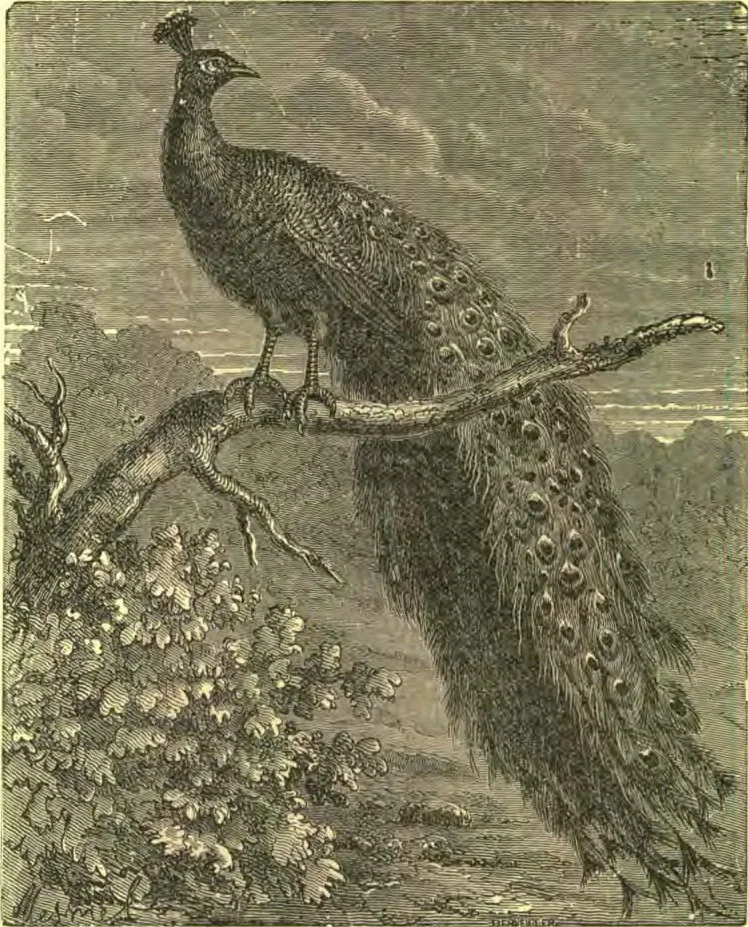
HIS bird, which is a native of India, was brought to Palestine by the fleet of Solomon, and to Europe at a very early period. It is now dispersed in a domesticated state all over Europe and the United States. It is much admired for its beautiful plumage; but the wild bird is much more brilliant than the domesticated ones. Griffith, the great naturalist, says of them: “We find in their incomparable robe all that glistens in the rainbow and sparkles in the mine,—the azure tints of heaven, and the emerald of the field.” It has been asserted that the principal use of its train is, by spreading it, to bewilder and terrify its enemies. It has not this effect, however, upon the tiger, to which this bird falls a frequent victim.
The voice of the peacock is harsh and disagreeable, resembling the word paon, which is the French name for this bird. It is very fond of being admired, and its vanity has been proverbial from early antiquity.
These birds in their wild state prefer wooded districts and low jungles. They roost on high branches, but their flight is low and heavy. They make their nests on the ground among thick shrubs, in which are laid from twelve to twenty eggs about the size of those of a goose. They raise but one brood in a year. The young birds do not get their full plumage until the third year, and only the males possess the beautifully tinted train. Their food consists of grain, seeds, fruit, and insects.
In ancient Rome the costliness of these birds made them favorite luxuries for the table, and a dish of peacocks’ brains and tongues was regarded as an essential part of every great feast. Even in the Middle Ages they formed a standing dish in grand entertainments; but modern people think their flesh dry and tough, and keep them only as ornaments.

“FISHERS OF MEN.”

“MAMMA,” said a sailor boy, leaving the boat He was making for Bertie, his brother, to float, “Mamma, after prayers came our stable-boy Ben, To ask me the meaning of ‘fishers of men.’ He said that his father, a fisherman brave, Was lost in a storm on the treacherous wave. When setting his lines and his nets on the bay, A tempest broke o’er him, and swept him away,— Away from his cottage, and children, and wife. He battled in vain with the ocean for life,— In vain, for he sank in the pitiless wave; The deep-sounding main was the fisherman’s grave. Then Ben spoke of fishers, who stand on the edge Of lake or of streamlet, by willow or hedge; For hours and hours go wandering about On chance of a nibble from perch, bream, or trout, Content if their basket at close of the day Contain the few fishes they proudly display As proof of their skill; but, said stable-boy Ben, ‘Surely fishers like these are not “fishers of men”!’ I told him, dear mother, you surely could tell What puzzled me sadly, and Bennie as well.”
“My boy,” said his mother, “When Jesus was here, He held every sinner most precious and dear; And grieved o’er the lost with a deep yearning love, Which comes as his gift from a Heaven above. He taught his disciples to seek them, and then He promised them they should be ‘fishers of men.’ Now, just as Ben’s father set nets for his prey, Christ’s followers seek for the souls gone astray, To gather them out of the depth of their sin, And teach them and bring them his pastures within. And just as the angler will patiently stand All day near a river, his rod in his hand, The ‘fishers of men’ will look out for the poor, And call the young lambs from each city and moor, And feed them, and clothe them, and teach them to rest Their troubles and cares on the Shepherd’s kind breast; Will seek out the garrets and streets full of crime, With the message of love from the Heavenly clime; Nor think of trials and troubles they meet If they bring one poor sinner to sit at His feet. And now, my son Alfred, tell stable-boy Ben That you, and that he, may be ‘fishers of men.’ Just show by your conduct how happy are they Who love the Lord Jesus, his precepts obey, And lure by example to enter his fold One sinner left perishing out in the cold, For want of a guide o’er the quagmire and fen Of sin and of sorrow; be ‘fishers of men.’”
—Missionary News.

Idle Heads and Hands Will Come to Grief

IDLE heads and hands will come to grief.

A German Widow's Children at Table

QUITE recently, I visited a German widow, living at a delightful country-seat with a little son of eight, and daughter of five. As we sat down to the well-spread table the little boy, folding his hands and closing his eyes, thanked our Father in Heaven for the food before us, and asked him to bless it. Then the little girl, in childish voice, repeated, “Lord Jesus, be present with us. Come, and this table bless, and do us good.”
The little ones were taught by their godly mother to think of Him whom they were addressing.—Family Friend.

SITTING UP.

“I don't want to,—I don't want to go to bed,” said little Clarence, and he burst into an outright fit of crying, as soon as his mother had said, “Come, my little son, it is quite bedtime.”
“I wish there was no such thing as bed,” sobbed Clarence. “I always hate to go to bed. I wish that I were a man, and then I would sit up all the time.”
“Why, you foolish little boy; I guess that you would soon be sorry enough if you really couldn't go to bed.”
“No, mamma,” urged the child passionately, “I wouldn't be sorry a bit, I know I wouldn't; I know that it would be just the nicest thing in the world.”
Mamma paused with the lamp in her hand, which she had taken up to light him to his pleasant little room. What could mamma be thinking of? Clarence looked in her face. It was very calm, but a little grave.
“Well, Clarence,” she said, “I am so tired of having you make this same trouble so often, when you are told to go to bed, that I have decided you shall do as you wish to-night. You need not go to bed.”
“What, not at all!” exclaimed Clarence in a tone of delight; “really true, mamma, do you mean I may sit up all night, this once?”
“Yes, my son; you may sit up all night, since it is such a dreadful thing to go to bed.”
“Oh, isn't it jolly! Thank you, mamma. Only think what a grand time I have to do everything in!”
So the little boy got out his box of water-colors, and busied himself a long time in coloring some engravings which his mother had given him for that purpose. When he grew tired of his pictures, he took up a book that he liked to read very much, because the words were all short and the letters were large and plain.
While he was reading, his two sisters left the room, and as they did so they each stopped and kissed him good-night. He straightened himself up considerably in his chair, as he turned to his book, for wasn't he doing just what his brothers, Charles and James, did in the evening? And it was nice to read late at night; yes, he was pretty certain that he liked sitting up.
But, somehow, the reading made his eyes ache after awhile; and then, too, he kept gaping. He would get his kitten and have some fun with her. He went out into the kitchen, but the girl had gone to bed and the room was dark. Calling his kitty, she quickly sprang out of the dark, and he caught her in his arms.
When he returned to the sitting-room, his brothers had both gone to bed. How strange everything seemed! Then the clock struck eleven. Just as he had counted the last stroke, his papa folded up the newspaper which he had been reading, and with a pleasant, “Good-night, Clarence,” went out of the room. Mamma took the lamp from the table and set it up on the high mantel-shelf. Then she crossed the room to where Clarence sat with his kitten in his arms, and stooping down, kissed the little boy, and saying, “Good-night,” left him alone.
When his mamma had gone, he tried to think of all the nice things that he used to imagine he would do if he could only sit up long enough. Somehow not one of them seemed pleasant. He thought he would whittle, and he took his knife and a little stick out of his pocket. But what if he should cut himself as he sometimes had done, and no one there to do up his finger. Perhaps he would bleed to death! He had heard of people bleeding to death. Then he thought he would whistle. He tried to begin; but it made such a noise he had to stop. How dreadfully still everything was!
Oh how lonely and wretched he felt! How long must he sit up? He had forgotten to ask mamma. His poor head felt so heavy,—he wished he could lie down on the floor. But then he knew he would go to sleep, and what was the use of a boy's sitting up if he did not keep awake. He wished it was morning. Just then the clock struck; he counted, twelve! It was so dismal to have to sit here, with everybody fast asleep. He thought of his own pretty room and his little white bed so soft and warm, and he could not keep back the great sobs.
He could bear it no longer! Putting his kitty down, he crept softly to his mother's door and gave a timid little knock. In a moment mamma opened the door, and Clarence threw himself into her arms, with tears and sobs and yet with such joy and gladness as he had never felt before. “Dear mamma, oh how glad I am you woke up. I was afraid you were so sound asleep that you wouldn't hear me. Please let me go to bed; I will never, never again—
“Never mind to-night, Clarie,” said kind mamma, as she quickly undressed him and tucked him in his bed. Then mamma left the room. Now that he was so happy in bed, he meant to think about it all, but somehow he didn't.
The very next thing he knew, mamma's voice had awakened him, and the sunshine was streaming merrily across the carpet.
“How does my little boy feel this morning?” said his mother.
“O mamma, I am sure that I shall never again want to sit up all night; why, you don't know how dreadful it was, when everybody was gone to bed and I was left there alone. Tell me, mamma, why did I not have a good time, as I expected I should? I didn't enjoy myself a bit.”
“Because my child, you insisted on having your own will gratified, though it was in opposition to the judgment and wishes of your mother, who knows much better than her little boy what things are calculated to make him happy. And if you do not learn to trust mother's love and wisdom in things that you have not tried, just as grown-up Christians have to learn to trust their Saviour, you will see many more miserable evenings than the one in which you tried ‘sitting up.’”—Christian Weekly.

HINTS TO YOUNG CHRISTIANS.

Don't be afraid to “show your colors.” Shrink from no declaration, from no duty, Christ desires of you. The timid, vacillating course is the hardest and most barren. The brave, outspoken, faithful life is the happiest and most effective.
There are many things you do not understand as yet. But let no doubts or uncertainties prevent you from acting on what you do know. There are some spiritual facts clear enough, plenty of Christian duties plain enough to you; act immediately on these. Do faithfully all you know you ought to do, and the larger knowledge will follow in due time.
Use earnestly every means that will enlarge and strengthen your Christian life. Study the Bible. Pray without ceasing. Don't neglect the prayer-meeting or the Sabbath-school. Keep your heart warm by doing good.
Make your life beautiful in the sight of men, and show them the sweetness and power of Christianity. Be conscientious in little things. Let the Master's spirit shine through every hour of your life. In school, in shop or field, in society, the young Christian ought to be the most faithful, the most courteous, the most generous and kindly, the noblest of any person there.
Follow Christ. Seek to reproduce his traits in your life. Do always as you believe he would do if he were in your place; so you will have a growing, joyful, successful Christian career.—Morning Star.

THE NATIVE OF ST. KILDA.

A poor inhabitant of the northern isles of Scotland left, for the first time, the rugged shore of St. Kilda, where, in the dark cabin of his father, he had been nurtured, as the arctic pine, amid the crevices of the rock. When the boat approached the coast of Mull, he gazed with wonder, as on an unbounded hemisphere. A passenger mocked the simple-hearted man with tales of the magnificence which reigned there. He also ridiculed the poverty of St. Kilda. The son of the rock listened in silence. If he felt the caustic, he forbore to retaliate. At length the officious narrator said, “Heard ye ever of God in that bleak island of St. Kilda?”
“From whence came you?” inquired the taciturn and grave Highlander.
“Oh, from a beauteous land, where the fields give us wheat before we ask for it, where rich fruits make the air fragrant, and honey fills every flower.”
“Came ye from so fair a land? Man might forget God there; in my own St. Kilda he never can. Building his home on a rock, suspended over a precipice, chilled by the wintry wind, tossed on the wild ocean, he never can, forget his God. No; he hangs every moment on his arm.” —Mrs. Sigourney.

Fear Nothing in the Way of Duty

FEAR nothing when you are in the way of duty.

LESSONS FOR CHILDREN.

LESSON CI.—RECAPITULATION WITH QUESTIONS.

“In six days the Lord made heaven and earth, the sea, and all that in them is, and rested the seventh day; wherefore the Lord blessed the Sabbath day, and hallowed it.”
“And the Lord God planted a garden eastward in Eden, and . . . . . . . . . . . . . took the man and put him in the garden to dress it and to keep it”; but Adam and Eve disobeyed God, and lost their beautiful home. This was indeed sad, but other trouble came upon them; for Cain, their oldest son, became jealous, and slew his brother Abel.
As men multiplied upon the earth, wickedness increased, until God was obliged to destroy them all, saving only the family of Noah. Noah and his sons were good men; but their descendants forsook the Lord, and so the Lord confused their speech at the tower of Babel, and they were scattered abroad upon the earth. After this, God chose Abraham, and called him to leave his native country and go into the land of Canaan. Isaac was the only son of Abraham and his wife Sarah. He was the father of two sons,—Jacob and Esau. Jacob was the father of the twelve patriarchs from whom the tribes of Israel were named. Joseph, the favorite son of Jacob, having been sold as a slave by his envious brothers, became, next to the king, chief ruler of Egypt. Finally, his brethren and their father came down to Egypt to escape the famine. Here they remained 215 years. While Joseph lived, they were well treated; but after his death, they suffered great affliction, till the Lord, by the hand of Moses, brought them out of Egypt into the land of Canaan. In making this journey they had to pass through a barren country, called in those days a wilderness. In this wilderness they had to wander forty years, till they had learned to obey the voice of the Lord.
At Mount Sinai they remained a year. Here the Ten Commandments were spoken by the voice of God, and written by his finger on tables of stone. Here, too, the tabernacle, with its holy vessels, was built, according to the pattern which the Lord showed Moses.
At the waters of Mer'-i-bah, Moses became impatient, and so displeased the Lord that he was not permitted to go into Canaan, but died in sight of the promised land, and was buried by the angels of God. Joshua then led the people across the Jordan. To make a way for this, the Lord rolled back the waters of the river, leaving its bed dry for the people to pass through.
On the plain of Jericho, Joshua was met by the Captain of the Lord’s host; and at the taking of Jericho, the Lord’s host threw down the walls of the city. At the siege of Ai, a much smaller city, the Israelites were put to flight, because there was iniquity among them; but when all had been made right, the Lord gave them an easy victory over the men of Ai.
Next, the ceremony was performed on Mounts Ebal and Gerizim, and soon after, Joshua was deceived by the crafty Gibeonites. The league with these men led to a battle with the kings of the surrounding cities, and it was in this battle that Joshua commanded the sun and moon to stand still. Then came the battle at Lake Merom, followed by the conquest of all the cities in the northern part of Palestine. Finally, about six or seven years after crossing the Jordan, Joshua completed the conquest of the country, and divided it among the different tribes of his people, just as Moses had directed.

QUESTIONS.

  1. How many days were employed in creating the world?
  2. Why did the Lord bless and hallow the Sabbath day?
  3. What home was prepared for Adam and Eve?
  4. How did they lose it?
  5. What other trouble came upon them?
  6. Why did God have to destroy all the people of the earth except Noah’s family?
  7. Why did the Lord confuse the speech of Noah’s descendants?
  8. Whom did the Lord choose after this?
  9. What did he tell him to do?
  10. Who was the only son of Abraham and Sarah?
  11. What two sons had Isaac?
  12. Who were Jacob’s sons?
  13. What ill-treatment did Joseph suffer?
  14. What did he finally become?
  15. What caused his brethren and their father to remove to Egypt?
  16. How long did they remain there?
  17. How were they treated by the Egyptians?
  18. How were they delivered from bondage?
  19. What did they have to pass through on this journey?
  20. Why did they have to wander forty years in the wilderness?
  21. How long did they remain at Mount Sinai?
  22. What happened there?
  23. How was Moses punished for setting a bad example at the waters of Meribah?
  24. Who then led the people?
  25. How did the Lord make a way for them to cross the Jordan?
  26. Who met Joshua on the plain of Jericho?
  27. Who threw down the walls of the city of Jericho?
  28. Why were the Israelites put to flight by the men of Ai?
  29. Where were the blessings and curses pronounced?
  30. Who deceived Joshua?
  31. What led to a battle with the kings of the cities around Gibeon?
  32. What remarkable things happened in this battle?
  33. What victories were gained in the northern part of Palestine?
  34. How many years did it take to conquer the country?
  35. When the conquest was completed, what did Joshua do?

GENERAL FEATURES OF PALESTINE.

The extent of this country is not great. That which was given to God’s people is one thing, and that which they occupied is another. The stretch of land actually occupied by them, generally called Palestine, is some 180 miles in length by 65 or 70 in breadth. There is a striking resemblance between the general outline of Palestine proper and that of the State of New Hampshire, the Connecticut River answering to the Mediterranean. Nor is the difference in extent very great, the length of New Hampshire from north to south being 176 miles, and its average breadth 45 miles.
The surface of Palestine is usually very rocky. We have for the general outlines, two mountainous and two depressed regions, all running north and south. The most striking feature of the country, upon the knowledge of which the proper understanding of its general structure depends, is the deep valley of the Jordan, which divides it into two unequal parts; the western, which is the land of Canaan proper, and the eastern, which includes Gilead and Bashan. This valley is an immense rift, extending all the way from Antioch on the north to the Gulf of Akabah on the south, through more than eight degrees of latitude.
In the lowest part of this valley, shut in on either side by precipitous, frowning cliffs, lies the Dead Sea, more than 1300 feet below the level of the Mediterranean, and having also itself a depth of 1300 feet or more. Into the northern extremity of the Dead Sea rushes the Jordan through a tortuous and rapidly descending channel, to lose itself in the briny waters of the sea of death.
The valley of the Jordan has on its west side a broad and mountainous belt, extending all the way from Lebanon to the southern desert, except where it is interrupted by the plain of Esdraelon. North of this plain the hill country extends to the border of the Mediterranean, leaving only a narrow strip of level land on the sea-shore. There are some beautiful and fertile plains interspersed among the ridges.
South of the plain of Esdraelon the mountainous belt now under consideration sinks down abruptly on the east to the valley of the Jordan; but on the west it gradually descends into a range of lower hills, which lie between it and the great plain along the Mediterranean. It is highest in the vicinity of Hebron; and its breadth, inclusive of the line of hills on the west, is stated by Robinson to be not less than twenty-five geographical miles. The breadth of the upper part of this mountainous belt is, by the same authority, some fifteen or twenty miles.
The general direction of the belt is from north to south, while the coast of the Mediterranean trends to the south-west. Thus there is left between the sea and the hill-country a triangular plain, interrupted in its northern part by the range of Carmel. The southern part of this plain, as far north as Lydda and Joppa, was called by the Hebrews Shepelah, that is, low country. North of Lydda and Joppa is the plain of Sharon of the Scriptures, so celebrated for its beauty and fertility, and extending to the ancient Cæsarea. The length of Sharon and Shepelah taken together is not less than seventy miles. In the vicinity of Gaza the breadth of this plain is about twenty miles. Opposite to Joppa it is not more than half that distance. North of the promontory of Carmel is the plain of Akka, or Acre.
We now come to the plain of Esdraelon before referred to, and in the Old Testament sometimes called the plain of Megiddo. This majestic plain is triangular in form. The length of its eastern side is not far from fifteen miles. The south-western side, which is skirted by the hill-country of Samaria, is eighteen or twenty miles in length. The length of the northern side, which extends, in the general direction, from north-west to south-east, is about twelve miles. This large triangle is nearly level. Thomson describes it as rolling up in long swells, like gigantic waves, and as being of unsurpassed fertility; but owing to the wretched government of the region and the consequent insecurity of life and property, it is mostly neglected and overgrown with rank weeds.
Beyond the valley of the Jordan on the east, is a high table-land, broken by deep ravines. Viewed from the west, this high plateau, sloping down precipitately to the Jordan and Dead Sea, presents the aspect of an immense rocky wall of nearly uniform elevation. It rises from 2000 to 3000 feet above the level of the Mediterranean, to which is added, in the lower part, 1300 feet for the depression of the Dead Sea below the same level. This, as already stated, is the region of Gilead and Bashan.
Another striking feature of Palestine is its intersection everywhere by numerous ravines having a general direction of east and west. Some of these have the character of broad and fertile valleys, but most of them are gorges, sometimes of great depth with precipitous sides.
A few only of these gorges are watered by perennial streams, the rest being torrent-beds through which the waters rush with violence in the rainy season, while they are dry the rest of the year. Indeed, the rivers of Palestine are chiefly winter torrents, the beds of which are dry in summer. Even the Kishon, “that ancient river,” which drains the east side of Carmel, is said to be a dry bed during most of its course, except in the wet season, when it rises to a great height. With the exception of the Leontes, which drains the valley between the Lebanon and Anti-Lebanon ranges, and passes through the northern part of Palestine proper, on its way to the Mediterranean, the Jordan may be said to be the only permanent river of Palestine. Many articles might be written in regard to this wonderful river, and then leave much unsaid.
EVA BELL.

LETTER BUDGET.

Eddie and Grace Prescott, of North Berwick, Maine, write: “We are a little brother and sister, eight and six years old. We have been taught to keep God’s holy Sabbath, and we know that Jesus is coming in a little while, and then we are going to live with him. Mamma reads the INSTRUCTOR to us, and teaches us the lessons for little ones. We have meetings at our house every Sabbath, and we both pray with the rest. We are trying to be good that we may be saved when Jesus comes.”
May God bless you, dear Eddie and Gracie, may he answer your little prayers, and save you when Jesus comes, is the prayer of the editor.
Here is a nice little letter from two sisters, Carrie and Lula Hill, of Grenola, Kansas: “Our ages are seven and four. We are keeping the Sabbath with our parents. We go to Sabbath-school every week, and always feel sorry when any of our class are absent, and think how sad it would be to miss them in Heaven. Sr. Mary L. Williams, of Kentucky, is stopping with us. Mamma reads the INSTRUCTOR to us, and we like it very much, and hope to be ready when Jesus comes to join its great family in his kingdom.”
God grant, dear Carrie and Lula, that your hope may be realized.

A NOVEL PLAY-HOUSE.

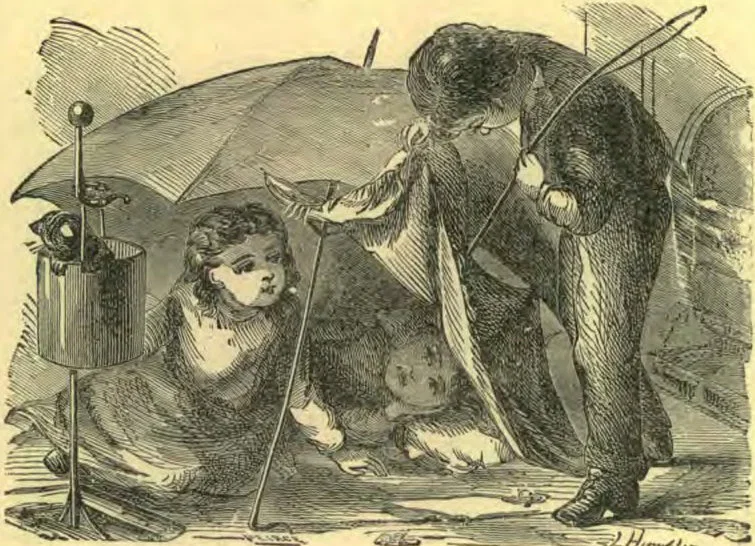
Little Mary Seaton has come to spend the afternoon with her twin cousins Paul and Pearl Terrill, and a happy time they are having. Mamma has let them take the umbrella, which, with a shawl, they have made into a play-house.
Paul is the coachman, and he has just come to tell them that the carriage is ready for them to take a ride. This carriage, by the way, is a large box, and the horses are two chairs harnessed together; but Paul cracks his whip, speaks to his horses, and fine rides they all have. But now Pearl tells Paul that May is taken very sick, and that they cannot go for a ride, but that he must go at once for the doctor.
Now all this is make-believe-so, but these little people enjoy it very much. And, indeed, by “playing it is so,” they almost imagine that it really is, and so their play becomes earnest to them.
We remember reading, not long since, of two little girls who never had any playthings because their parents were too poor to buy them. One night their papa brought them a basket of blocks from a house that was building near where he worked. Oh, how nice they were! The girls played that these pieces of wood were houses, and horses, and men,—indeed, we cannot begin to tell the shapes, and names that these blocks took in the minds of these little players. How much happiness they got out of these pieces of wood by simply “playing it is so!” Little friends, learn from this to try to make the most of what you have, and be happy. V. A. M.

WATCHES

WATCHES were originally made of steel and iron. No glasses were used until about 1615, the cases being wholly of metal; and to admit of readily seeing the time, the cover of the face was sometimes perforated in elegant designs.
Instead of the form now universally adopted, various styles of casing were employed, such as globular, octangular, cruciform, skull, acorn, pear, lemon, tulip, bird, and in fact, nearly every imaginable shape that ingenuity could invent or caprice suggest; and as a consequence of this, and the fact that many of those watches were provided with striking movements, they were so bulky that it was inconvenient to carry them in the pocket, and they were hung at the girdle with swivels, so that their faces could be readily turned for observation without being removed from their position.
The hair-spring was not introduced until about 1658, and was a great improvement on the early watches. About a century later, the smallest repeating watch ever made was presented to George III. of England. It was smaller than our silver half-dime, and weighed only five pennyweights, and one-eighth of a grain. It was necessary to make a set of minute tools for its construction. For this watch the manufacturer received a present from the king of five hundred guineas (about $2,500), and it is reported that he was afterward offered a thousand guineas to duplicate it for the emperor of Russia, but he refused it, so that his gift to the king might remain unique. A smaller watch than this, however, formed a part of the Swiss exhibit in the World's Fair of 1851, but this was not a repeater. It was only three-sixteenths of an inch in diameter, and was set in the end of a pencil-case. It not only gave the hours, minutes, and seconds, but the days of the month also.

ICELANDIC COSTUMES.

The full dress consists of a helmet-shaped head-dress of some stiff white stuff, with a golden tiara around the front of it, and a large lace veil over all; a black cloth jacket partly open in front, trimmed with velvet and gold embroidery; a black cloth skirt of medium length, and pretty full, embroidered with yellow silk. The belt is very handsome, being covered with gold ornaments. For out-of-doors, they have a long, round, black velvet cloak, trimmed with white fur and lined with green cloth.
The every-day dress is a black cloth jacket trimmed with velvet, but not embroidered; a dark shirt, and a large apron of some bright color. A silk necktie is also worn, the color of which ought to match that of the apron. Diversity of taste is exhibited both in the color of these parts of the dress, and in the fineness of the work on the chemisette and cuffs. The head-dress is a small, black worsted cap, with a long, black silk tassel, and it is worn by all classes, the only difference being in the gold, silver, or tinsel ornament on the tassel, and the slightly large size of the caps worn by the old women.—Good Words.

NEVER OUT OF SIGHT.

I KNOW a little saying That is altogether true; My little boy, my little girl, The saying is for you. 'Tis this, O blue and black eyes, And gray—so deep and bright— No child in all this careless world Is ever out of sight.
No matter whether field or glen, Or city's crowded way, Or pleasure's laugh or labor's hum, Entice your feet to stay; Some one is always watching you, And whether wrong or right, No child in all this busy world Is ever out of sight.
Some one is always watching you, And marking what you do, To see if all your childhood's acts Are honest, brave, and true; And watchful more than mortal kind, God's angels, pure and white, In gladness or in sorrowing, Are keeping you in sight.
Oh, bear in mind, my little one, And let your mark be high! You do whatever thing you do, Beneath some seeing eye; Oh, bear in mind, my little one, And keep your good name bright, No child upon this round, round earth, Is ever out of sight.—Sel.

You have reached the end of this edition.

The Youth’s Instructor · Dec 1, 1880