The Youth’s Instructor, Vol. 31, No. 30.

THE SUNDEW

The Youth’s Instructor

Jul 25, 1883

S. D. A. Publishing Association · Battle Creek, Mich. · Jul 25, 1883

THE SUNDEW.

ARTHUR, Ellie, and Freddie were taking a walk one summer afternoon with their Aunt Mary. They counted a visit at Aunt Mary's farm as a great occasion, for there were so many interesting things to see. An afternoon's walk with her through the fields and woods was sure to reveal to their eager eyes and minds many strange and beautiful things in the flowers and leaves and mosses, that, if alone, they would have tramped over carelessly; in the butterflies and insects that buzzed and fluttered around; and in the birds that sang, and built their nests in the trees. But there was always so much to see and to learn, with Aunt Mary to point out and explain the dozens of little things that they never would have noticed!
On this afternoon they were walking along in a shady path bordered on one side by a little brook, which ran through a bit of meadow. Soon Aunt Mary stopped, and from among the tall sedges and blue flags that grew along the banks of the brook, gathered some queer little plants that her sharp eyes had discovered.
The children had never seen such plants before, although they had been past that spot many times, and had picked cardinal-flowers and water-lilies in that same brook. Each little plant was formed of a cluster of round leaves spreading out an inch or two each way from the root, and a slender stalk in the center four or five inches high, with one or two tiny white, star-shaped flowers on top.
“Oh, how pretty!” said Ellie, who always saw the beautiful side of everything, while the boys were more interested to know all the strange facts, and to learn the use of every part. In answer to a question from Freddie, Aunt Mary told them that the plant was called the “sundew.” She said, too, that botanists call it Drosera, which name is made from a Greek word meaning “dewy.”
“And I can see the little dewdrops,” said Ellie.
Then the children examined the plant carefully, for it was quite different in looks from anything they had ever seen. The little leaves were quite round, not more than half an inch across, and were curiously covered on the upper side with fine reddish hairs. There were longer hairs around the edge, forming a deep border, or fringe, and each hair was terminated by a little knob, or gland, which gave out a tiny drop of glistening dew—at least they looked like minute dewdrops not so large as the head of a pin; but they would not dry up in the sunshine (so Aunt Mary said), and that is why the plant is called “sundew.”
The boys had by this time gathered some more of the plants, and found that there were two kinds, one of which had smaller leaves, which were longer than they were wide. The flowers, however, were all nearly alike. They grow along the side of the stalk, and open in turn, one after another, each remaining open but one day, and never expanding but in sunshine. Above the open flower the stalk with the buds is bent over and coiled, straightening as the flowers expand, so that the open blossom is always highest.
While Aunt Mary was explaining this, Arthur had discovered that the little drops on the leaves were very sticky, and of course had to ask what they were for.
“Why, to look pretty, of course,” answered Ellie.
But Aunt Mary told them that although the leaves were very pretty, they were arranged with hairs and dewdrops for a curious and remarkable purpose. “The fact is,” said she, “the sundew is a fly-catcher, and a very ingenious one.”
“I do n't see how these little leaves can catch flies,” said Ellie.
“It is only very small insects that are caught, of course. The way of it is this. These drops shining in the sun prove very attractive to any little flies and gnats that may come near. Some of them naturally alight on the leaves, right among the drops glistening on the ends of the little hairs; but then they find that the drops are sticky, and they cannot get away easily. Then, too, the long hairs around the edge of the leaf seem to suddenly become alive, and they slowly bend over and hold the victim securely; then the sides of the leaf roll up and partly enclose it, and there the poor fly is fast in a trap, and there it stays till it dies.”
“Why, who would think such a pretty little plant could be a fly-trap?” exclaimed Ellie.
“But it is,” Aunt Mary answered, “and sometimes you can find the leaves curled up with little dead flies inside of them.”
“Now, children, let us see what we can learn from this pretty but very deceitful plant, that will help us to be wiser and better. Are there not many things in the world that, like the sundew, seem not only harmless, but really attractive and pleasant, but of which experience tells us that the beautiful appearance is only a disguise to hide the trap beneath?—Do you think of anything like this, Arthur?”
“Yes,” said he in a minute. “You know the other day we learned the verses: ‘Look not thou upon the wine when it is red, when it giveth his color in the cup, when it moveth itself aright: at the last it biteth like a serpent, and stingeth like an adder.’”
“Yes, that is a very good application of the subject. We may consider the sundew as a good illustration , or symbol, of the wine-cup. The real danger and sin of drinking are often concealed by attractive appearances; and for this reason many are led into a trap subtle and deadly, which holds its victim with a power that only the greatest effort and the grace of God can break.
“Let us,” she continued, as they walked homeward, “shun whatever habits the experience of others has shown to be dangerous, although we may not see the full sin and danger at the beginning.”—S. S. Visitor.

MIDSUMMER

Now is the high-tide of the year, And whatever of life hath ebbed away, Comes flooding back, with a ripply cheer, Into every bare inlet and creek and bay; Now the heart is so full that a drop overfills it, We are happy now because God wills it; No matter how barren the past may have been, 'Tis enough for us now that the leaves are green; We sit in the warm shade, and feel right well How the sap creeps up and the blossoms swell; We may shut our eyes, but we cannot help knowing That skies are clear and grass is growing; The breeze comes whispering in our ear That dandelions are blossoming near, That maize has sprouted, that streams are flowing, That the river is bluer than the sky, That the robin is plastering his house hard by; And if the breeze kept the good news back, For other couriers we should not lack; We could guess it all by yon heifer's lowing,— And hark! how clear bold chanticleer, Warmed with the new wine of the year, Tells all in his lusty crowing! Joy comes, grief goes, we know not how; Everything is happy now, Everything is upward striving; 'Tis as easy now for the heart to be true As for grass to be green or skies to be blue,— 'Tis the natural way of living. Who knows whither the clouds have fled? In the unscarred heaven they leave no wake, And the eyes forget the tears they have shed, The heart forgets its sorrow and ache; The soul partakes the season's youth, And the sulphurous rifts of passion and woe Lie deep 'neath a silence pure and smooth, Like burnt-out craters healed with snow.
—James Russell Lowell.

CESAREA

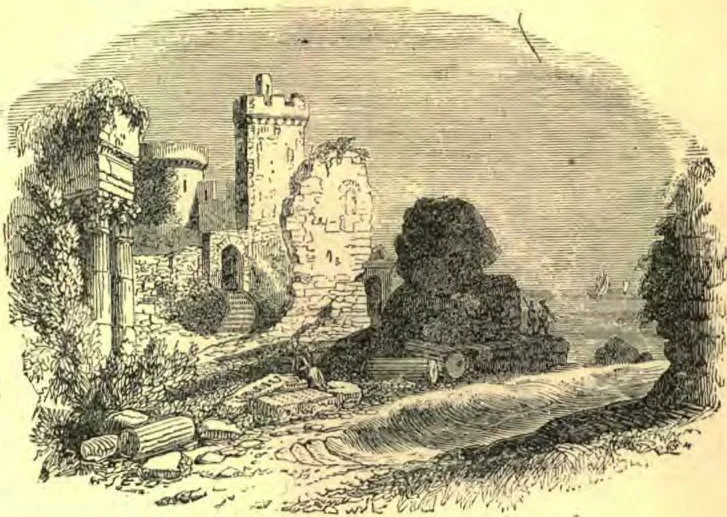
Following the Mediterranean coast north from Jaffa, after about two hours ride, the traveler comes upon the ruins of what seems once to have been a city of no small importance. The guide says that this is all that remains of Cesarea, sometimes called Cesarea Palestina to distinguish it from Cesarea Philippi, far north under the shadow of Mount Hermon. The ruins of the town lie close along the winding shore, projecting here and there into the sea, and presenting huge masses of shattered masonry and piles of granite columns to the restless waves.
Remains of two great moles, which once formed the harbor, stretch out into the sea; but one is almost entirely destroyed, and the other broken and shattered, so that the once famous port is filled with drifted sand, and not even a fishing boat would be safe here in a storm. On the southern mole are the remains of an old fortress which once served as a defense to the harbor. There is also a ruined wall, inclosing a space some eighty rods north and south by forty east and west. The wall, which was of small but well-cut stones, was strengthened by sixteen square towers, and protected by a broad ditch; but it could not have surrounded more than the citadel of the old town, for we cannot suppose that its vast population, stated as high as two hundred thousand, was confined in so small a space. There are abundant traces of suburbs scattered all over the plain, and extending along the shore for two miles or more.
Within the walls, all is in ruin. Not a building remains entire; confused heaps of stone and rubbish are seen, with here and there a solitary column or a disjointed arch, or a fragment of a wall, all overgrown with thistles and brambles. In the southern wall of the citadel is a gateway still almost entire, and on a rising ground a little within it stand four massive buttresses, the remains of a cathedral and the most conspicuous thing among the ruins. The view given in the picture is from the north.
It is not a pleasant place to linger after nightfall, as the scene is, even in the broad sunlight, dreary and desolate beyond description. No sign of life is to be seen on any side; and the sighing of the wind among the broken walls, the deep moan of the sea as each wave breaks upon the ruins of the ancient harbor, are the only sounds to be heard. Even the wandering Arab seems to avoid the spot; and one traveller says that the only living creature that he saw there during his stay of two days was a jackal in one of the crypts of the cathedral.
In the days of the apostles, Cesarea was the capital of Palestine, and the favorite residence of Herod Agrippa, who imprisoned Peter, and “killed James the brother of John with the sword.” It had been built up by Herod the Great from an insignificant place to a splendid city. He set out to make it the finest city in Palestine, and in this he succeeded. He was twelve years in building a wall around it and decorating it with beautiful and costly buildings of white marble, though it is not thought that the remains of the wall now standing is the one built by Herod. He also built the artificial harbor, to which reference has been made. The city was named Cesarea, in honor of Augustus Caesar under whom Herod held his power, and whom he was very anxious to please. There was a theater (probably the same from which Herod Agrippa was afterward carried out to die), and an amphitheater, with aqueducts for the conveyance of water, and a temple dedicated to Caesar, and many other splendid buildings.
Cesarea was decidedly a Roman city, yet it was intimately connected with the history of the early Christian church. Peter here first preached the gospel to the Gentiles, and here he baptized Cornelius, the first Gentile convert. It was to Cesarea that Paul was brought a prisoner from Jerusalem. It was in the palace of this city that he so spake of “righteousness, temperance, and Judgment to come” that he made Felix tremble; and here it was that his eloquence forced King Agrippa to exclaim, “Almost thou persuadest me to be a Christian.” And it was from this city that he embarked on that last long and eventful journey to Rome. Here also it was that Eusebius, the historian so often quoted in church history, spent nearly his whole life. Another great historian, named Procopius, was born here in the beginning of the sixth century. Truly the place is rich in memories as well as ruins! E. R. G.

WORK AND PLAY.

A WORD TO THE BOYS.

THERE are weeks of leisure just ahead of many of our boys. Some will go to the sea-shore, or to the country; some will stay at home. There will be a good many hours each day which have been given to school tasks, now free for other work.
Remember that Satan finds work for idle hands, and determine that he shall not be left to find work for you.
First of all, be on the lookout to see where you can be helpful to the friends just about you these days. Any bright, active boy can find employment for a good many leisure hours in “fixing up” about his own home. Then there is almost sure to be some neighbor or friend near by, who is not blessed with boys, and who would dearly love to see your bright face at her door, and to hear your cheery voice calling out, “Can I do anything for you this morning?” Boys are such a help, if they have a mind to be.
Then, too, there may be some sick or disabled children whose loneliness you can help to cheer, and still there will be time, and plenty of it, which you can spend in ways that will bring you both profit and pleasure in the days to come.
Of course you would like to earn money. Well, if in the country, see what you can find in the woods or fields that is salable. Blue-flag root, ginseng root, wild turnip, sassafras bark, all these, and many other things, are readily sold to druggists . Get advice from your elders as to what to do, and how to do it, and whatever you do, be sure to do it well.
Never mind if your summer’s work does n’t bring in money as yet. You are making money for the days to come, if you are putting away useful knowledge in your head and heart. Summer is a good time in which to make a “collection.” Whatever your taste may lead you to in this direction, let it be something in which you may get useful knowledge. Do your work systematically and faithfully, and with your might, and be sure that you will have a happier and better vacation in every way than if you selfishly try to keep all the time for sport.—Selected.

YE HAVE DONE IT UNTO ME.

“Ye have done it unto me, ye have done it unto me,” sung Jenny one Monday morning. “There! I’ll remember it this time, sure. But, dear me! I’m forgetting after all. The teacher said we must not only learn the words, but think of what they mean, and try to do them.”
“Let me see, now,” and she pressed her chubby hands to her forehead, “teacher said: ‘If we gave a cup of cold water to one of his little ones, for the Saviour’s sake, he would say, Ye have done it unto me.’ I don’t s’pose I know any of his little ones, but I’ll try if I can find ’em.”
She ran into the kitchen, where on the dresser she spied a large bowl, which was used to mix cake in.
“Ah!” thought she, “the Saviour is pleased if we give his little ones a cupful of water, he’ll like a bowlful better still. Bridget, may I take this bowl awhile?”
Bridget, who was busy with her washing, did not turn her head, but said,—
“O yes, take what you like.”
Jenny lifted the big bowl down very carefully; but how to fill it was the question. She did not want to trouble Bridget; besides, she had an idea that she ought to do it all herself.
A bright thought struck her; taking the cup that always hung on the pump, she filled it several times, and poured it into the bowl. “It’s cupfuls, after all,” she thought.
It was almost more than she could carry without spilling; but she walked slowly to the front gate. There was no one in sight, and Jenny set her burden on the grass, and swung on the gate, while she waited. Presently along came two little girls on their way to school.
“Want a drink?” called Jenny.
“Yes, indeed; it’s so hot, and I’m dreadful thirsty. I most always am. But how are we to get at it?” laughing as she saw the great bowl.
“Oh! I’ll soon fix that,” and Jenny ran for the tin cup, with which they dipped out the water.
“It tastes real good,” they said, and kissed her as they ran off to school.
The next that appeared was a short, red-faced Irishman, wiping his face with the sleeve of his flannel shirt, while an ugly dog trotted at his side.
“He don’t look much like ‘one of the little ones,’” thought Jenny, doubtfully; but she timidly held out her tin cup. He eagerly drained it, filling it again, and drinking.
“And it must be a blissed angel ye are, for it’s looking for a tavern I was, and now I won’t nade to go nigh one at all. And shure, afther all, water’s better nor whisky. Might I give some to the poor baste?” pointing to his dog.
Jenny hesitated; she did not like the idea of having the dog drink from her cup or bowl. But the man settled it by pouring the remnant of the water into his dirty, old hat, the dog instantly lapping it up.
After they were gone, Jenny filled her bowl again. But I can’t tell you now of all to whom she gave cups of cold water that hot day. But when she laid her tired head on her pillow that night, she thought,—
“I wonder whether, after all, any of ’em were his ‘little ones?’”
And the dear Saviour, looking down, and seeing that the little girl had done all that she could for his sake, wrote after her day’s work, “Ye have done it unto me.”—Selected.

THE MASTER AND THE BAIRNS.

The Maister sat in a wee cot hoose, To the Jordan's waters near; An' the fisher fowk crushed an' crooded roon The Maister's words to hear.
An' even the bairns frae the near-haun' streets War mixin' in wi' the thrang; Laddies and lassies wi' wee bare feet Stanin' the crood amang.
An' ane o' the twal' at the Maister's side Rase up and cried aloud— “Come, come, bairns, this is nae place for you; Rin awa' hame oot the crood!”
But the Maister said, as they turned awa', “Let the wee bairns come to me!” An' he gaithered them roon' him whar he sat, An' lifted them up on his knee.
Ay', he gaithered them roon' him whar he sat, And straikit their bonnie hair; An' he said to the won'erin' fisher fowk That croodit aroond him there,—
“Sen' na the weans awa' frae me, But raither the lesson learn— That nane'll win in at heaven's yett That isna as pure as a bairn!”
An' he that wis o' oor kith an' kin, Yet a great Prince ower us a', Gaithered the wee anes in his airms An' blessed them ane an' a'.
O thou who watchest the ways o' men, Keep our feet in the heavenly airt, An' bring us at last to thy hame abune, As leal as the bairns in heart.
—Selected.

NEW-TESTAMENT HISTORY.

LESSON 145.—PAUL AND BARNABAS AT ANTIOCH IN PISIDIA.

On departing from Perga, Paul and Barnabas took their journey northward through the mountains of Pamphylia, and across the table-land of Pisidia to the city of Antioch, in the northern part of that province. This Antioch, like the one on the River Orontes in Syria, was founded by one Seleucus, and named in honor of his father, Antiochus.
When the Sabbath had come, Paul and Barnabas went into the synagogue, and sat down. It was the custom on such occasions to have portions of the law and of the prophets read by a man standing in the middle of the synagogue, the people sitting all around. When he had read and expounded certain portions of the Scriptures, it was the privilege of others to speak. Paul and Barnabas being strangers received a special invitation from the rulers of the synagogue, who said to them, “Brethren, if ye have any word of exhortation for the people, say on.” Then Paul, standing up, and beckoning with his hand, said, “Men of Israel, and ye that fear God, hearken. The God of this people Israel chose our fathers, and exalted the people when they sojourned in the land of Egypt, and with a high arm led he them forth out of it. And for about the time of forty years suffered he their manners in the wilderness. And when he had destroyed seven nations in the land of Canaan, he gave them their land for an inheritance, for about four hundred and fifty years; and after these things he gave them judges until Samuel the prophet.
“And afterward they asked for a king; and God gave unto them Saul the son of Kish, a man of the tribe of Benjamin, for the space of forty years. And when he had removed him, he raised up David to be their king; to whom also he bare witness, and said, I have found David the son of Jesse, a man after my heart, who shall do all my will. Of this man’s seed hath God according to promise brought unto Israel a Saviour, Jesus; when John had first preached before his coming, the baptism of repentance to all the people of Israel.
“And as John was fulfilling his course, he said, What suppose ye that I am? I am not he. But behold, there cometh one after me, the shoes of whose feet I am not worthy to unloose. Brethren, children of the stock of Abraham, and those among you that fear God, to us is the word of this salvation sent forth. For they that dwell in Jerusalem, and their rulers, because they knew him not, nor the voices of the prophets which are read every Sabbath, fulfilled them by condemning him. And though they found no cause of death in him, yet asked they of Pilate that he should be slain. And when they had fulfilled all things that were written of him, they took him down from the tree, and laid him in a tomb. But God raised him from the dead: and he was seen for many days of them that came up with him from Galilee to Jerusalem, who are now his witnesses unto the people. And we bring you good tidings of the promise made unto the fathers, how that God hath fulfilled the same unto our children, in that he raised up Jesus; as also it is written in the second psalm, Thou art my Son, this day have I begotten thee.
“And as concerning that he raised him up from the dead, now no more to return to corruption, he hath spoken on this wise, I will give you the holy and sure blessings of David. Because he saith also in another psalm, Thou wilt not give thy Holy One to see corruption. For David, after he had in his own generation served the counsel of God, fell on sleep, and was laid unto his fathers, and saw corruption: but he whom God raised up saw no corruption. Be it known unto you therefore, brethren, that through this man is proclaimed unto you remission of sins: and by him every one that believeth is justified from all things, from which he could not be justified by the law of Moses. Beware, therefore, lest that come upon you, which is spoken in the prophets,—
Behold, ye despisers, and wonder, and perish; For I work a work in your days, A work which ye shall in no wise believe, if one declare it unto you.”
As the people went out of the synagogue, they begged that these words might be spoken to them again the next Sabbath; and as Paul and Barnabas left the place, many Jews and devout proselytes followed them. The apostles urged them to continue in the grace of God; but on the very next Sabbath, when nearly the whole city had come together to hear the word of God, the Jews were filled with jealousy, contradicted Paul’s preaching, and railed against him. Then the apostles spoke out boldly, saying, “It was necessary that the word of God should first be spoken to you. Seeing you thrust it from you, and judge yourselves unworthy of eternal life, lo, we turn to the Gentiles. For so hath the Lord commanded us, saying,—
I have set thee for a light of the Gentiles, That thou shouldest be for salvation unto the uttermost part of the earth.”
The Gentiles rejoiced at these words, and the gospel spread throughout all those parts. But the Jews, stirring up the honorable women and chief men of the city, raised such a persecution against Paul and Barnabas as to drive them from the province. Their disciples, however, were greatly blessed, being filled with joy and with the Holy Ghost.

QUESTIONS.

1. Which way did Paul and Barnabas journey when they left Perga?
2. Through what kind of country did they travel?
3. How far did they go? Acts 13:14.
4. What other Antioch have we learned about?
5. Who founded both these cities?
6. Where did Paul and Barnabas go on the first Sabbath after they arrived at Antioch in Pisidia?
7. How were the Sabbath services customarily conducted in the synagogue?
8. What special invitation was given Paul and Barnabas?
9. How did Paul respond?
10. How did he open his discourse?
11. Relate the brief synopsis of Jewish history which he gave them, down to the time of the kings.
12. Continue the history to the time of David. Verses 21, 22.
13. How did he introduce Jesus as the Saviour?
14. What did he say of John’s proclamation concerning him?
15. What announcement did he make to the Jews then assembled around him? Acts 13:26.
16. What did he say about the course of the leading Jews in Jerusalem?
17. What did he say about the evidences of Messiahship that were given after his crucifixion? Verses 30, 31.
18. What joyful proclamation does he now make unto them? Verse 32.
19. What scriptures did he refer to as being now fulfilled?
20. What did he say about David’s state after death?
21. Why does he speak of this?
22. How did he then make plain the doctrine of justification through faith in Christ? Verses 38, 39.
23. What warning did he give them? Verses 40, 41.
24. For what did the people plead, as they were going out of the synagogue?
25. How did the Jews and devout proselytes show their friendliness toward the apostles?
26. What exhortation did they receive?
27. What spirit did they show when on the next Sabbath nearly the whole city came together to hear the apostles preach? Verses 44, 45.
28. What course did the apostles then pursue? Verse 46.
29. What scripture did they quote?
30. How did the Gentiles receive these words?
31. How did the gospel of Jesus prosper in the hands of Paul and Barnabas?
32. How were they treated by the Jews?
33. How were their disciples blessed? Verse 52.

NOTES.

Acts 13:14. They came to Antioch.—Better, “But they having passed through from Perga, came,” etc. Pisidia lay inland to the north of Pamphylia, and Antioch was in its extreme northern part, so that the verb “passed through” is very correct, for they crossed the whole district. It was a long journey (80 to 100 miles), and as it lay almost entirely through rugged mountain-passes, while “rivers burst out at the bases of huge cliffs or dash down wildly through narrow ravines,” it must have been a perilous one. The whole region was, and to this day is, infested by robbers, as ancient history and modern travel abundantly testify; and there can be little doubt that to this very journey Paul many years after alludes, when he speaks amid his “journeyings often,” of his “perils of rivers” (as the word is), and his “perils of robbers.” 2 Cor. 11:26.—J. F. and B. Antioch in Pisidia.—This must be carefully distinguished from the much greater Antioch in Syria, whence Paul and Barnabas had first started. It stood on the great highway leading from Ephesus on the west to Iconium, and thence to the Syrian Gates, the narrow pass by which entrance was made to Syria.—Peloubet. By this thoroughfare armies, caravans, and travel of every description have passed, as a natural route, for centuries.—Whedon.
Ver. 16. Then Paul stood up.—Usually a Jewish preacher sat during the delivery of his sermon. See Luke 4:20. Paul, however, being in a Grecian country, adopted their custom of standing. Beckoning with his hand.—This was the customary gesture on rising to speak. It betokened respect for the audience and a request for attention.—Hackett.
Ver. 25. As John fulfilled his course.—As he was engaged in completing his work. His ministry is called a course, or race, that which was to be run, or completed.—Barnes.
Ver. 17. With an high arm.—This expression denotes great power. The arm denotes strength, as that by which we perform anything. A high arm, an arm lifted up, or stretched out, denotes that strength exerted to the utmost.
Ver. 19. When he had destroyed.—Subdued; cast out; or extirpated as nations. It does not mean that all were put to death, for many of them were left in the land; but that they were subdued as nations; they were broken up and overcome. Deut. 7:1. “And hath cast out many nations before them.” Seven nations.—The Hittites, the Girgashites, the Amorites, the Canaanites, the Perizzites, the Hivites, and the Jebusites. Deut. 7:1; Josh. 3:10; Neh. 9:8.—Barnes.
Ver. 20. Children of the stock of Abraham.—Descendants of Abraham, who regard Abraham as your ancestor.
Ver. 43. Religious Proselytes.—Probably proselytes of the gate, who had not yet been circumcised, but who had renounced idolatry, and were accustomed to worship with them in their synagogues.—Barnes.
Ver. 50.—Devout and honorable women.—Women of influence, and connected with families of rank. Perhaps they were proselytes, and were related to the magistrates of the city.—Barnes.

THE THANKFUL HEART.

If one should give me a dish of sand, and tell me there were particles of iron in it, I might look for them with my eyes and search for them with my clumsy fingers, and be unable to detect them; but let me take a magnet and sweep through it, and how would it draw to itself the almost invisible particles by the mere power of attraction! The unthankful heart, like my finger in the sand, discovers no mercies; but let the thankful heart sweep through the day, and as the magnet finds the iron, so it will find in every hour some heavenly blessings—only the iron in God’s sand is gold.—
O. W. Holmes.

LETTER BUDGET.

Thomas N. Blake, writing from Alma Center, Wisconsin, says: “I am eleven years old. I am keeping the Sabbath, and go to Sabbath-school. I love to read the INSTRUCTOR. I want to be a good boy, so that I can meet the INSTRUCTOR family in heaven.”
Lee and Cora Morris send letters from Plano, Texas. They say: “We like to go to Sabbath-school. We have learned four lessons in Book No. 2, and like to get them very well. Our mother takes the INSTRUCTOR. We want to remember to keep the Sabbath-day holy.”
Eva J. Bee writes from So. Lancaster, Mass. She says: “I am a little girl ten years old. I like the INSTRUCTOR very much, and should miss it a great deal if it did not come. I keep the Sabbath. I have two brothers and one sister, all older than myself. I am trying to be a good girl, so that I can be saved in heaven.”

WHO CAN IT BE?

“TAP-TAP! tap-tap!” I wonder what's that,— Is somebody building a house? “Tap-tap! tap-tap!” and a quick “rat-tat,” Then everything still as a mouse.
“Tap-tap! tap-tap!” Why, who can it be? Are the fairies at work in the wood? “Tap-tap! tap-tap!” We surely must see What's doing of bad or of good.
“Tap-tap! tap-tap!” Some carpenter sure; Here's sawdust all scattered about. But where can he keep himself hid so secure? That's something we'll have to find out.
“Tap-tap! tap-tap!” Ah, there! now I see A flash like the brightest of flame. There he goes! there he goes! in that old hollow tree— Golden-winged Woodpecker's his name.
—Elizabeth A. Davis.

THE YOUNG SLINGER.

IN a country far away from us there lies a beautiful valley, which is two or three miles long from east to west, and a little less than a mile wide from north to south. On the north side of this valley is a long, high hill, almost a mountain; and on the south side is another hill very much like it. Down through the middle of the valley runs a brook, which, when it rains, rushes along like a boiling river, but in the dry season is nothing but a crooked road filled here and there with smooth, round stones. On both sides of this brook are cornfields and wheatfields, while up on the sides of the hill are grape vineyards, and groves of olive trees.
One time, many long years ago, this valley was not so quiet as it is now. For on the north side was encamped, in hundreds of white tents, a great multitude of people who were serving the true God, and who had come out to keep their enemies from spoiling their country, and to drive them back home. There their enemies were, right before their eyes, encamped on the hill south of the valley; and there lay the valley with the brook running through it, right between the two armies. One morning something happened that made the people of God on the north hill actually quake for fear. A man eleven and a half feet high came down from the south hill to the edge of the valley, and shouted with a very loud voice over to the men on the north hill, and said, “Why are ye come out to set your battle in array? Choose a man for you, and let him come down to me. If he be able to fight with me, and to kill me, then will we be your servants; but if I prevail against him, and kill him, then shall ye be our servants, and serve us.” Now so large and terrible was this great giant, that no one could be found who dared to fight with him. And he came out and defied the people of God every day for forty days.
But finally the Lord raised up a deliverer for his people, and instead of taking some large and powerful warrior, he just took a young shepherd lad, as though to put the men in the army to shame for not trusting in him and going out to fight the giant themselves. Now this shepherd boy had come down to the army to see how his three older brothers were getting along, and to bring them some food. While he was talking with them, this giant came out, as he had done so many days before, and cried out, “Give me a man, that we may fight together.” It made the young shepherd very angry to hear this wicked man defy the army of God in this way, and he wondered that no one dared to meet him. He felt that because his people were serving the true God, the Lord would deliver even a youth out of the hands of this man, giant though he was. So he asked that he might go and fight with him. The king, when he heard of the boy’s courage, told him that a youth like him was not able to fight with this man of war. But the young shepherd told him how he had killed a lion and a bear when tending his father’s sheep, and said that the Lord, who delivered him out of the paw of the lion and the bear, would deliver him now out of the hands of this wicked man. So finally the king said, “Go, and the Lord be with thee.”
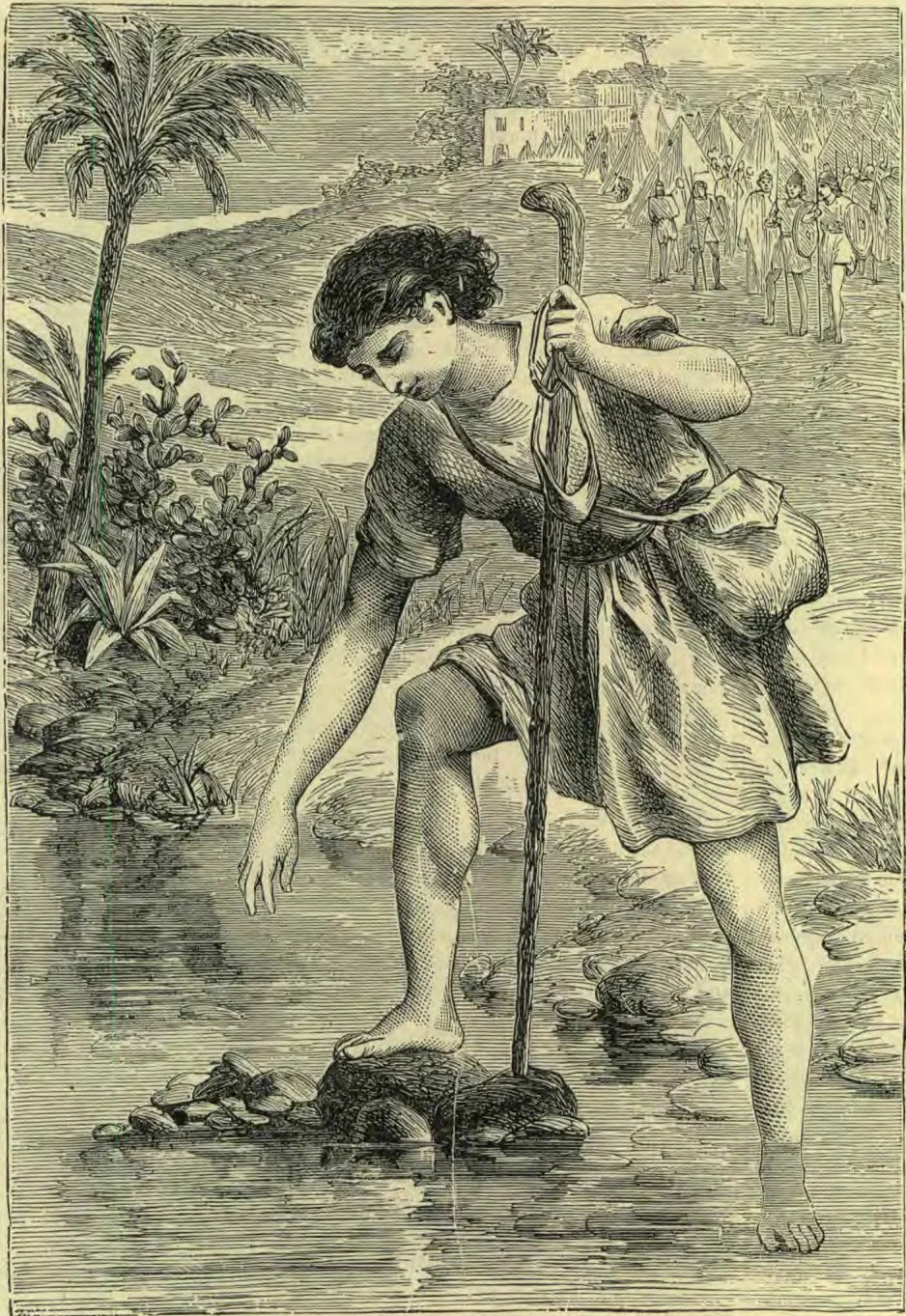
The king then put his own armor of brass and iron upon the boy, and gave him his own sword. But when the young shepherd tried to walk with the armor on, he said he could not use it. So putting it off, he went down to the brook, and picked out five smooth stones, which he put in a leather bag hanging at his side. He then took his staff and sling, and went down to meet the giant. He must have prayed to God very earnestly on his way down, for the very first stone that he hurled sank deep into the forehead of the giant, and he fell on his face. The youth then ran and stood on him, and cut off his head with his own sword. When the people on the south hill saw their champion dead, they turned their backs and fled, and the men on the north hill rushed down across the valley and up the south hill and chased their enemies home, killing a great many of them on the way.
The Lord continued to bless this young boy, and he afterward became king, and delivered his people from their enemies a great many times.
None of the children who read this may ever be called to fight men, but we all have an enemy much stronger than the great giant whom we have been talking about. He likes nothing better than to cause us to sin against God, and it is often as hard for us to fight him as it was for David to fight Goliath in the valley of Elah. But we must remember that as God helped David hurl the stone, so he will help us, if we always ask him, to resist temptation. C. H. G.
Continue reading: THE PATCH OF SUNLIGHT