The Youth’s Instructor, Vol. 37, No. 14.

THE AMERICAN EAGLE

The Youth’s Instructor

Apr 3, 1889

S. D. A. Publishing Association · Battle Creek, Mich. · Apr 3, 1889

THE AMERICAN EAGLE.
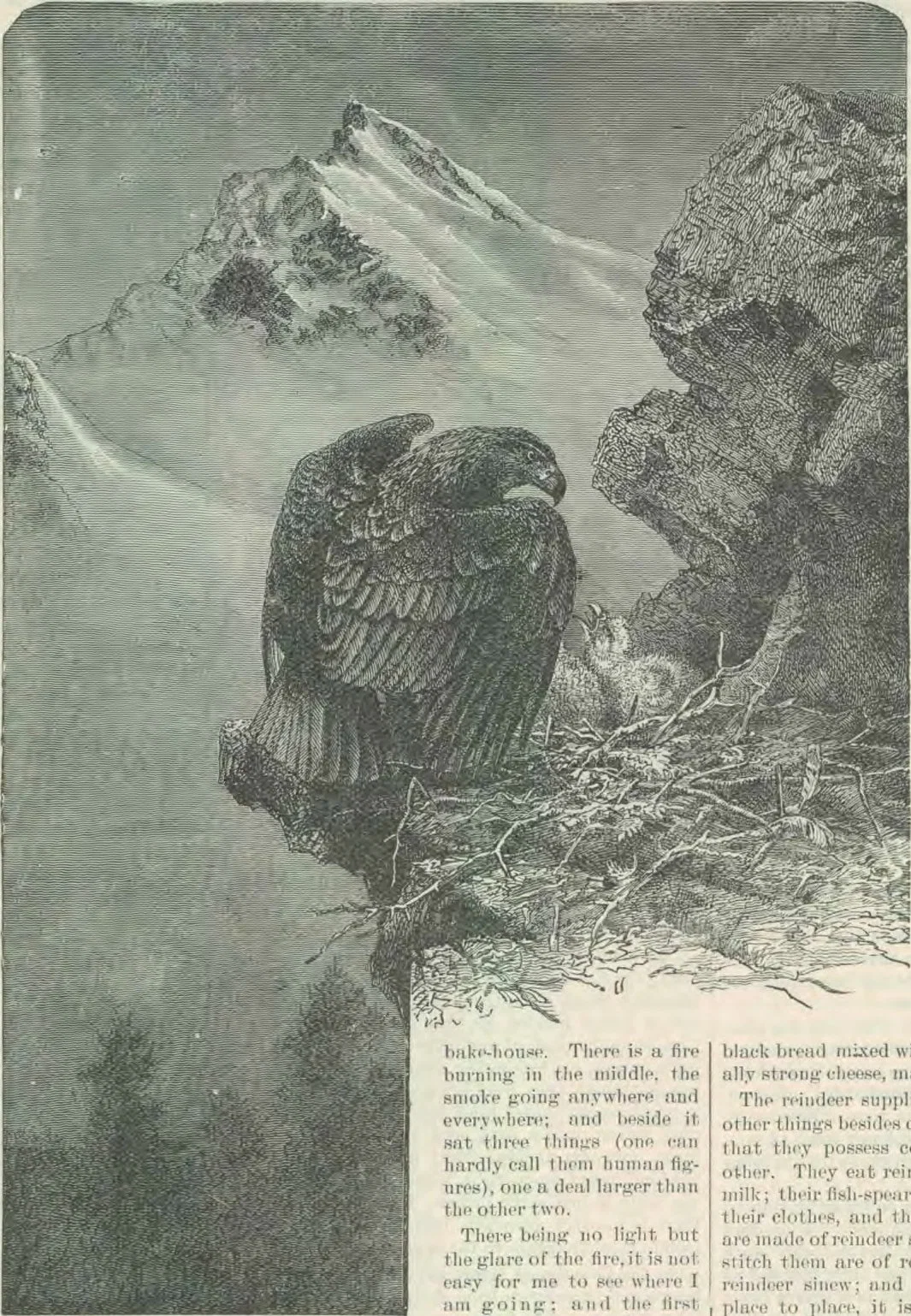
Bird of the heavens! whose matchless eye Alone can front the blaze of day, And, wandering through the radiant sky, Ne'er from the sunlight turns away, Whose ample wing was made to rise Majestic o'er the loftiest peak, On whose chill tops the winter skies, Around thy nest, in tempests speak—
What ranger of the winds can dare, Proud mountain king, with thee compare? Or lift his gaudier plumes on high Before thy native majesty, When thou hast taken thy seat alone, Upon thy cloud-encircled throne?
Bird of the sun! to thee—to thee The earliest tints of dawn are known; And 'tis thy proud delight to see The monarch mount his gorgeous throne, Throwing the crimson drapery by, That half impedes his glorious way, And mounting up the radiant sky, E'en what he is, the king of day!
Bird of Columbia! well art thou An emblem of our native land; With unbleached front and noble brow, Among the nations doomed to stand, Proud, like her mighty mountain woods; Like her own rivers, wandering free; And sending forth, from hills and floods, The joyous shout of liberty!
Like thee, majestic bird! like thee She stands in unbought majesty, With spreading wings, untired and strong, That dares a soaring far and long, That mounts aloft, nor looks below, And will not quail though tempests blow. —C. W. Thompson.

CHILDREN UNDER THE SNOW.

Far away up in the north, on the shores of that great frozen ocean lying beyond Europe and Asia, you may sometimes catch sight (as I did once) of a huge, gray, pointed thing, standing all alone in the midst of the snowy plain, just like an immense pear, with the stalk upward. I should have been puzzled had I not seen a thin curl of smoke creeping from the top of it; but that let me into the secret. This queer looking thing was a Samoiede tent!
The tent of a Samoiede is almost as simple an affair as that of an Arab. All you have to do is to plant a dozen long poles in the ground, slanted so as to let their tops meet; cover this framework with reindeer skins, leaving a hole at the top to let out the smoke; pile the snow high up around the lower part to keep off the wind—the “house” is complete.
But, outlandish as it looks, this little burrow is worth something in a real Russian frost, which freezes the very breath on one’s moustache; so I go right up to the door, which is simply a thick skin hanging over a hole in the side, lift it, and step in.
The inside is certainly warm enough—rather too warm, in fact, being almost as hot and choky as a bake-house.
There is a fire burning in the middle, the smoke going anywhere and everywhere; and beside it sat three things (one can hardly call them human figures), one a deal larger than the other two. There being no light but the glare of the fire, it is not easy for me to see where I am going; and the first thing I do is to stumble over something which seems like a skin bag, unusually full. But it is not—it is a child, wrapped, or rather tied up, in a huge cloak of deer-skin, and rolling about the floor like a ball.
In these out-of-the-way places, where a man may go for days without seeing a human face except his own, people call upon each other without waiting to be introduced, and my sudden entrance does not seem to disturb my new friends in the least. They greet me cordially enough, and bid me welcome in Russian, which most of the Samoiedes speak a little; and seating myself on a chest, I look about me.
As my eyes get used to the half-light, I see that the group by the fire consists of a woman and two little girls, muffled in skins from head to foot. Papa is away somewhere with his sledge and his reindeer, leaving mamma to mind the house and take care of the children. Funny little things they are, with great round heads, and dark brown skins, and small, restless black eyes, and faces as flat as if somebody had sat down upon them; but, queer as they look, they have learned to make themselves useful already, for they are hard at work stitching their own clothes. They are not a bit shy, and in another minute I have them scrambling up into my lap, and wondering at the ticking of my watch, which I take out to show them, while they clap their hands and shout “Pai, pai!” which is their word for “good.”
The tent is not a very large one, but every inch of its space has certainly been made the most of. The floor is carpeted with thick sheets of gray felt, and littered with chests, sacks, baskets, bark shoes, and bits of harness; while hanging from the tent poles, or thrust into the folds of the skins that cover them, are a perfect museum of things of every sort—caps, pouches, fish-spears, knives, hatchets, whips—and last, but certainly not least, the face of a baby, which has been thrust into a kind of pocket in the skin, like a knife into the sheath. I stoop to stroke the little brown face, while the round eyes stare wonderingly at me out of the folds of the skin.
Meanwhile the lady of the house (or rather tent), hospitable like all Samoiedes, hastens to set before me some black bread mixed with bark, and a lump of terrifically strong cheese, made of reindeer milk.
The reindeer supplies the Samoiedes with plenty of other things besides cheese; indeed, almost everything that they possess comes from it in some form or other. They eat reindeer meat, they drink reindeer milk; their fish-spears are tipped with reindeer horn; their clothes, and the very tents in which they live, are made of reindeer skin; the needles wherewith they stitch them are of reindeer bone, and the thread of reindeer sinew; and when they wish to move from place to place, it is the reindeer that draws them along. The Samoiede would be as badly off without his reindeer as the Arab without his camel.—Wide Awake.

The Power of Kind Words

Kind words produce their own image in men's souls, and a beautiful image it is. They soothe, and quiet, and comfort the hearer. They shame him out of his sour, morose, unkind feelings. We have not yet begun to use kind words in such abundance as they ought to be used.—Pascal.

DOWN AT THE ROOTS.

Lora’s amaryllis didn’t seem to grow. Very persistently she kept water in the saucer, loosened the earth about the roots, searched for insects on the foliage, and sponged the long, slender leaves free from dust. Still the plant was little, if any, larger than when first she brought it from the greenhouse, and not the least indication could she see of the gorgeous blossom she had hoped for.
The interest of all the household had become aroused in behalf of the puny lily, about which Lora made such dubious complaints; and many were the suggestions offered regarding the possible cause of its failure to grow. Papa suggested that it received too much handling; mamma proposed a change of light; Nora, Lora’s older half-sister, inquired if the needful charcoal had been put into the bottom of the jar; and little brother Ren developed such an interest in the culture of house-plants, as to read every paragraph on that subject he could find in the domestic department of the newspaper.
Meanwhile a more serious matter also claimed the attention of the family, causing them much concern; for Mrs. Eastman, whose headaches had long been a recognized feature of the home life, was now really ill; though not confined to bed, yet suffering much, and unable to endure the noise of the children or the care of the house.
As the physicians at home could not cure her, Mr. Eastman had proposed sending her to a sanitarium quite a distance from home. Mrs. Eastman dreaded this; for she much disliked to leave her little family. And her regrets were not only on account of leaving her own children, but her young step-daughter as well; for, contrary to what we often hear about step-mothers, Mrs. Eastman dearly loved the young girl, whose half-orphanage had been made much less grievous by the sympathetic interest of a good step-mother.
But now the lady’s health was such that she could not be altogether a help to her family, and so she consented to take the journey. In order to meet the necessary expense, Mr. Eastman proposed to use the old carriage still, instead of the new one he meant to get; generous-hearted Ren emptied his savings-box into his mother’s lap; Nora proposed to do without a new hat, wearing her old one another season; and Lora consented to forfeit the bird and cage which had been promised her for a birthday present. But Lora’s contribution was offered with none of the cheerfulness which had prompted the others; and the mother, who had received them with loving regret at the sacrifice required, was quite unwilling to accept that which her little daughter so grudgingly offered. Still, Lora sullenly insisted that she would not have the bird; and thus the subject rested.
When ready for her journey, and giving good-bye messages to all, Mrs. Eastman said to the daughter, “Try to do just as Nora wants you to, dear, and be as pleasant as possible.”
“Don’t I always do what she tells me to, when you are away?” questioned Lora.
The only answer was to clasp the little face between loving hands, and turn it to receive a parting kiss. The mother dreaded this separation, fearing that the little people who had demanded so much of her attention, would be a severe trial to their sister, and also suffer the lack of experienced care.
However, Mr. Eastman proved to be good help in government, and occasional contested questions were referred to him for decision. Impulsive Ren sometimes rebelled against his sister, declaring, “You’re not the boss of me!” but straightway he would grow sorry, and do his utmost to please.
Lora fulfilled her promise to do what she was told, for she had been carefully trained to that practice; but her mother’s request that she would do as Nora wished—alas, that was often disregarded. Indeed, some of Nora’s expressed wishes were fulfilled very ungraciously; and the little girl did not seem to consider herself under the least obligation to do anything she was not commanded to do.
One evening, when Lora again called attention to her drooping amaryllis, Ren exclaimed: “That does grow, ’cause I’ve been watching it; but it doesn’t stay growed; that’s the trouble.” When they laughed at his queer speech, he explained that new leaves came occasionally; but they didn’t live long, and thus the number failed to increase.
“Let us look at the roots, and see if something isn’t wrong there,” suggested Nora. Accordingly the earth about the bulb was removed, and the plant carefully drawn up. There, at the very heart of the cluster of fine roots was discovered the source of all the harm,—a horrid worm! While it had not been large enough to destroy all the roots, it had kept them so diminished that but a small supply of nourishment could be sent up by them to the plant. After the children had killed the ugly intruder, and planned to heat some earth for the plant, and thus destroy any animal life that might exist there, Ren went to his room for the night, and papa called his little girl to him for a chat.
“Another of our plants,” he said, “has appeared very much like yours.”
“Why, which one, papa? I hadn’t noticed it.”
“One of the very choicest. I have been watching it for quite a time. It puts out some leaves; but, as Ren intimated, they lack strength. I fear the difficulty with this, also, is at the roots. Evidently some usurper is taking the life that should develop the plant.”
“Why not get it out, as we did this one?” queried Lora.
“Won’t you do it for us, my child?”
Lora consented. Then Mr. Eastman explained that an offensive creature called “self” was so claiming the strength of his little daughter’s heart, that her life was losing much of its attractiveness; and such acts of goodness as did appear, lacked the vigor of loving, unselfish deeds.
And now Lora is learning to discern between unwilling obedience and happy service, and is trying to get rid of that disagreeable selfishness which used so often to prompt her to say: “I suppose I can if I must; but I don’t like to.”
MRS. ADA D. WELLMAN.

TWO QUEER ANIMALS.

In Abingdon Square, in the city of New York, in the stable of Mr. Taggert, a wealthy gentleman, stands a very funny horse, whose name is Yum Yum. This horse was born in the city of Hong Kong, in China, in 1883, and brought by a sea captain to Boston about a year since, where he was sold, and afterwards taken to New York, where the late Gen. Lee Yu Du purchased him. Upon the death of the General, Mr. Taggert came into possession of him, and keeps him for a saddle horse.
The head, neck, and body of this peculiar animal are of the size of a rather large horse; but his limbs, although stout and strong, are very short, and each one is double jointed, so that his gait, when in motion, is unlike that of any other animal. When turning a corner, his legs swing around like pivots, looking as though they were hung on hinges. The head is twenty-eight inches long, full, and well-formed; the neck eleven inches long and sixteen inches thick; hight, forty-six inches; front legs twenty-nine, and the hind ones twenty-eight, inches; and the length of the body is just sixty inches. It is not known that there is another authentic instance of equal opposition in measurements to the laws of nature.
On the Courtlandt street ferry boats, which carry teams and passengers from Jersey City to New York City, every day may be seen a span of large and fine brown mules, hitched to a heavy truck loaded with tobacco stems. They are the property of Lorillard & Co., manufacturers of chewing tobacco and cigars, whose factory is in Jersey City. The tobacco stems are hauled to a snuff factory in New York City, to be ground up into snuff, which is then shipped to the Southern States, and purchased by men and women who have become addicted to the degrading habit of “dipping.”
The team of mules have been in the service of this company for over eight years, and were early taught to chew tobacco, so that now they are inveterate users of the filthy weed. In the South, where tobacco is grown, no animal will even smell of the growing plant; but the tobacco merchant’s mules have become so depraved that they crave the weed as much as could an inveterate tobacco drunkard. Every day, as soon as the team reaches the ferry boat, the driver takes a large bundle of stems and leaves from his load, and feeds both mules, they testifying their delight by loud whinnies and brays. Crowds of passengers always congregate to witness the unnatural performance, and the driver acts as though he felt as proud of their proficiency as he ought had he taught them some useful and sensible lesson.
W. S. C.

WHICH SIDE ARE YOU ON?

COME, children, and listen: I'll tell you in rhyme A story of something that happened one time. There was war in the land, and each brave heart beat high, And many went forth for their country to die; But words fail to tell of the fear and dismay Which swept the small village of W—— one day, When the enemy's army marched into the street, And their own valiant soldiers were forced to retreat; Such hiding, surrendering, and trembling with fear! When what in the midst of it all should appear But Grandmother Gregory, feeble and old, Coming out from her cottage, courageous and bold! She faced the intruders who marched through the land, Shaking at them the poker she held in her hand. “How foolish!” her friends cried, provoked, it is true; “Why, grandmother, what did you think you could do?” “Not much,” answered grandma; “but ere they were gone, I wanted to show them which side I was on!” Now, children, I've told this queer story to you, To remind you of something the weakest can do— There is always a fight ’twixt the right and the wrong, And the heat of the battle is borne by the strong; But no matter how small or unfit for the field, Or how feeble or graceless the weapon you wield, Oh, fail not, until the last enemy's gone, To stand up and show them which side you are on. —Anna R. Henderson, in Our Youth.

BREVITY AND DISPATCH.

I PICKED up one of the daily papers the other day, and read this item: “The Arounder dropped into the post-office yesterday to post a letter, and while buying his stamp, saw a boy slowly counting a sheet of two-cent stamps. Any ordinary person, to be sure the stamps were the right number, would have counted how many there were in the top row, counted the number of rows, multiplied, and got the result. Not so the boy. Patiently he told over every stamp on the sheet until he had ascertained there were just a hundred, when he sighed for relief, and trotted away.”
Now, a boy who would waste time like that can never make his mark in this busy world. In doing any work, we all want to do it the best way, but we must learn next how to do it the best way in the least time. We must learn to use the multiplication table in everything we do.
One afternoon this week I got into a car on the elevated road going up-town. As I stepped into the car, I saw the top of a small felt hat between two of the cross-seats. I took one of the seats across the aisle. On his knees was a bright-eyed newsboy, about eleven or twelve years old. He was busily folding papers. Every paper was folded perfectly even, and carefully creased in the middle; after folding about two-thirds of what he had, he wrapped them in a piece of black oilcloth, but wrapped in such a way that he could easily get at them. The remainder were as carefully creased and folded, and laid in a pile outside of the others.
“Why do you not put them inside with the others?” I asked.
“’Cause then I could not reach them so fast. I don’t want ’em all to get wet. I’ll keep the rest dry till these are gone,” and he left the car whistling, going out into the fog and rain.
Another thing I noticed. Before our train went out of the station, the down train came in, with the front platform covered with newsboys, who were pushing and elbowing one another, and left the train, yelling like young Comanches. The newsboy in our train looked up with a smile, and said, “Some of them fellows will get left.”
“Why?” I asked.
“I’ll sell most of my papers before them fellows gets theirs. I always get down early. Ye catch the fellows then that leave their up-town offices early.”
I feel pretty sure that boy will be more than a newsboy before he is much older. He was careful, prompt, and alert. He would use the multiplication table in business instead of addition.—Christian Union.

THE PRAYING CORNER.

A MISSIONARY once preached the gospel to some negroes in Africa, and many became praying, believing Christians.
As they lived in huts, however, they could find no place for private prayer, and consequently each chose a spot in a little wood, where he could be alone and pray. In the course of time a path became worn to each of these spots, and when any one of them neglected his prayers, the others would remind him by saying, “Brother, the grass grows on your path.”
I am afraid many boys and girls need reminding in the same way. It is a great help always to pray in the same place, even if it be only a particular corner of the room. The familiar spot brings to our minds the use we put it to, and serves in some measure to fix our wandering thoughts,—Young Reaper.

Emeralds: Softness in the Mine and Rarity of Flawless Stones

When first withdrawn from the mine, the emerald is so soft as to crumble by friction, but it hardens on exposure to the air. It is so rarely perfect that “an emerald without a flaw” has passed into a proverb, and fine specimens are often worth from $100 to $200 the carat.

WHO TOLD?

'TWAS April, balmy, bright, And men, from early morn To night, had worked to turn the furrows Ready for the corn.
And now 'twas planting time, And Tim knew well indeed His part would be in every hill To drop a pumpkin seed.
Ah! how the crows did caw That bright half holiday; So free to fly the whole land over, Near or far away;
While he must plod and stoop Over his weary round, Tucking the seeds, hill-top by hill-top, Safely in the ground.
He sighed: “Who'd ever tell, Or who would ever know, If just so many seeds ain't really Planted in each row?”
No one! And so he dug Out a great hollow space, And heaped the whole field's future pumpkins Together in one place.
Who did tell? No one. But When sun and sweet, warm rain Had made the cornfield's long, brown furrows Green with growing grain.
In one far corner grew A most amazing mass Of stems and leaves, that told the story Only too well, alas!
Rank, twisted stems, and broad, Coarse leaves in tangles grew; And how they came there, who had done it, All the people knew.
They knew and laughed. To him It was a dreadful spot; And how even seeds can talk, he never In all his life forgot.
—Mrs. Clara Doty Bates, in Our Little Ones.

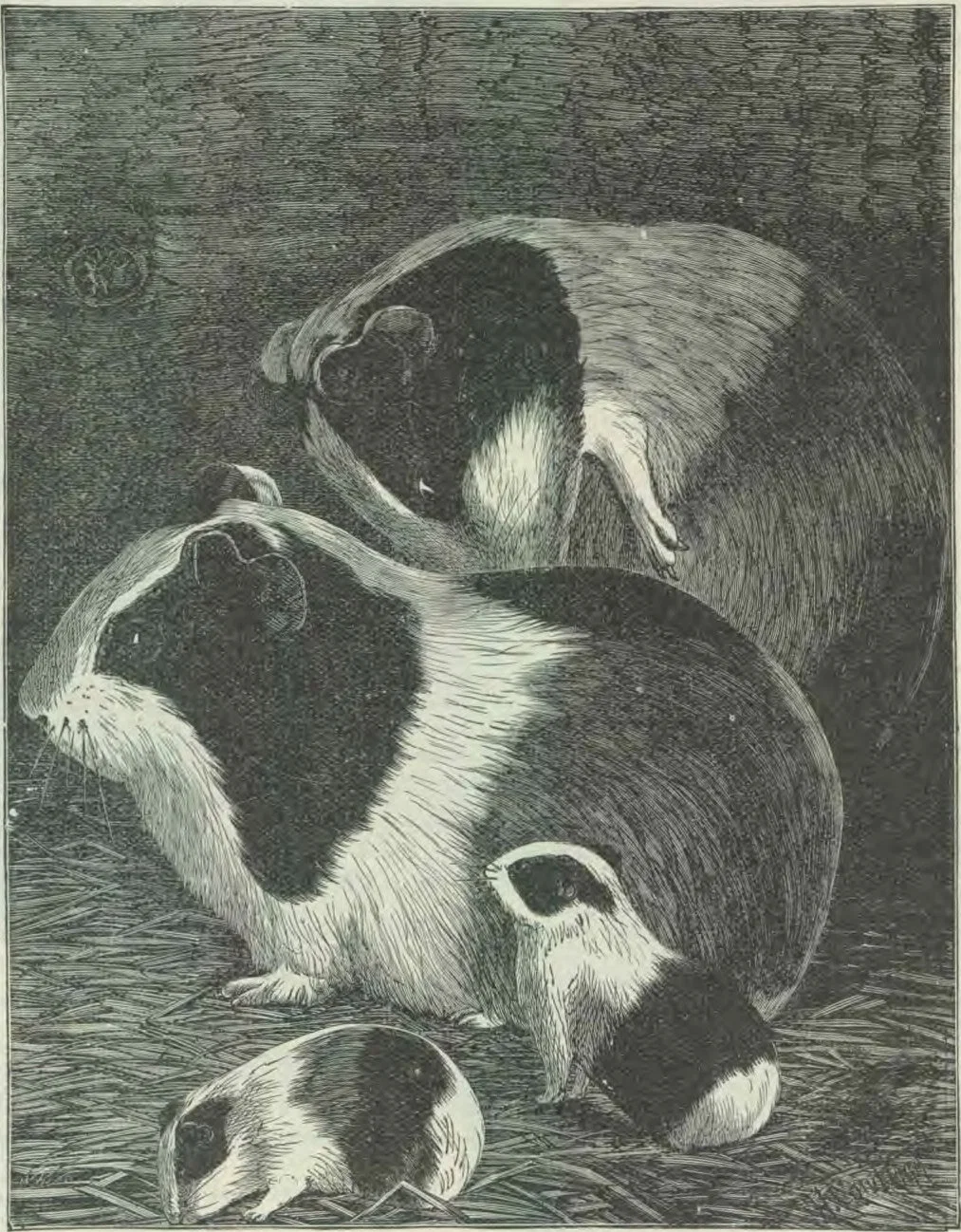
THE GUINEA-PIG.

MAY be you will wonder if there is anything in a name when I tell you that here is an animal that is called a pig, when it is no pig at all; and is called Guinea-Pig, although its native home is thousands of miles from Guinea, which is a country in Africa.
The Guinea-Pig was brought from the northeastern part of South America, from that part of it known as Guiana, or Guyana (pronounced Gu-a-ni); hence it would seem that it should have been called Guiana-Pig instead of Guinea-Pig.
I don't make out why it was called pig, though, unless because it squeals some like one; or else because its hair, although very fine, looks some like hog's bristles.
The Guinea-Pig belongs to the family of Rodents, which means animals that gnaw, like the squirrel, rat, rabbit, beaver, and many others. It lives wholly upon vegetables, and it is quite pleasing to see it sitting up like the squirrel to eat, holding its food in its forepaws. Pigs do not eat in this way.
You can always tell which animals are rodents, for between their front and side teeth there is a space in the jaw where there are no teeth. You who have pet squirrels, white mice, or rats, see if this is not so.
The Guinea-Pig is about the size of a large rat. It has a short tail, pretty brown eyes, and its skin is white, covered with orange and black spots of different sizes. Because it is pretty-looking and harmless, I suppose is the reason that many keep it as a pet. It is stupid, and so is easily tamed.
Here is what you may wish to remember about the Guinea-Pig:—
  1. There was a mistake made when giving the animal a name.
  2. It is a quadruped, because it has four feet.
  3. It is a mammal, because the baby pigs feed on milk.
  4. It is a rodent, because it gnaws like the rabbit, and has a "great toothless gap in each jaw." It sits upon its haunches, and holds its food in its forepaws, a thing pigs do not do.
Then you may like to know that it lies upon its stomach, and turns around two or three times before it settles down, like the dog; that it moves about like the rabbit; that when it fights, it rears up like a horse; and that it washes itself like the cat, and is a very cleanly animal.
M. J. C.

JOHNNY'S LOST DOLLAR.

By hook and crook, and many hard knocks, such as turning the grindstone, pulling cockle out of the wheat, and taking medicine when he was sick, Johnny Brown had picked up quite a fortune, as it seemed to him when reckoned in cents; for he had one whole dollar!
Don't you think that much? Well, my dear little fellow, how much money did you ever earn and lay up? Johnny never had a cent given him in his life; he earned his money like a man. But I must now tell you the story of what became of Johnny's earnings.
Johnny poured his cents out of the little tin box which he used for a safe (he had no brazen frog to swallow his cents), counted them carefully, tumbled them into his trousers' pocket, with much unnecessary jingle, and walked into town, where he exchanged them at the bank for a gold dollar.
He could not but feel that he had made a poor trade, as he walked home through the dust and heat,—a pocketful of money for that little yellow scale of gold.
As he trudged along, every now and then he tossed his shining treasure a few feet ahead of himself in the most careless way in the world, and then, when about to step over it, would accidentally catch a glimpse of it, and seize it with great ado, and brush the dust off till it shone again, and stare at it, and study the very few words on it, and throw it up and catch it, and do all sorts of queer things, as most boys do with their first money.
When Johnny had got home, he had not seen quite enough of his dollar; and so, before he showed it to his folks, he thought he would have one nice little play with it on the threshing-floor of the big barn.
So he brushed away the chaff and straw with an old broom, and cleared him a fine space for rolling his precious dollar.
Poor Johnny! The floor was just a little bit shrunken by the long drought; and, the very first roll, the dollar ended by slipping through a crack the width of a straw.
His fortune was lost! Johnny was a beggar! His heart stopped beating; the tears blinded him; his hand shook like his grandfather's.
But the hardy spirit that helped him to earn the money soon braced him up to try to regain it. He fetched a crowbar, and pried up the heavy plank, and looked down into the blackness under the barn.
“Nothing but dark, dark, dark, and may be toads and snakes and things,” thought Johnny. It was plain that he must have a light.
He ran to the house in a great hurry, for fear something might swallow his dollar while he was gone. Into the pantry he went, and took a tallow candle out of the candle-box, and a few matches from the safe.
As he went out of the kitchen door, his mother saw him, and asked what he was going to do with the candle.
Johnny very honestly told his mother all about his bad luck; and his mother shook him a little, then scolded him, and finally ended by pitying him.
Just then his father came in, and asked what ailed Johnny. Mrs. Brown told him all about it.
Mr. Brown scolded some, of course; but he did not shake Johnny, nor pity him.
“Let's go to the barn, and see what can be done about it,” he said to Johnny. “But you needn't bring that candle along; I can't have the barn burned up for a dollar!” So they went to the barn, and both of them got down upon their knees and peered into the dark, and got hay seed in their hair, and dust in their eyes, and cobwebs on their clothes.
“No use,” said Mr. Brown; “it's gone. Come, help me put back the plank.”
But, instead of helping to replace the plank, Johnny cried so loudly that the school-teacher, who was walking down the road, heard him, and went up to the barn to see what was the matter.
“I had a dollar,—a—gold dollar, and it's lost,” Johnny told him. And Mr. Brown explained the matter, and added that “it would not do to go down under the barn with a light, as there was so much dry litter about.”
“You never studied natural philosophy, did you, Johnny?” said the schoolmaster. “Now I am going to give you a short lesson in practical optics, if you will go to the house, and borrow two looking-glasses of your mother.”
Johnny went on the run, and soon came back with the little looking-glass from the spare bedroom under one arm, and the cracked one from the kitchen under the other.
The schoolmaster took them from Johnny, and going out in front of the open barn-door, leaned one of the mirrors at such an angle as to throw a dazzling beam of sunshine into the dusky barn. Securing the glass in position, he went into the barn, and standing near the opening in the floor, he held the other glass in such a way as to catch the beam of sunlight and throw it downward through the opening.
“Come, Johnny,” he called; “now look for your dollar!”
And Johnny came, and dropped upon his knees, and looked intently.
“Please make your sun shine a little farther the other way,” Johnny said; and the brilliant light moved slowly along.
“I see it! I see it! I SEE IT!” cried Johnny, as loud as he could; and swift as a flash, forgetting all about “toads and snakes and things,” he slipped under the barn, and in a trice up popped his little brown fist, with a gleam of gold between the closed fingers, followed by a very happy face, in spite of its netting of cobwebs.
“I've got it! I've got it!” cried Johnny.
So, you see, it wasn't so bad a case, after all; and I think Johnny will want to study natural philosophy, and learn more about optics, after this.—Lloyd Wyman.

A GREAT TROUBLE.

“Oh dear, I have dreadful trouble!” sighed Dolly Sweet. “It seems as if I couldn’t bear it. Nobody knows how I feel.”
“What great wave of sorrow has rolled over you now, Puss?” asked brother Ben, looking up from his Latin. “Is your cake all dough?”
“You know I haven’t any cake. You are laughing at me. You’d think it was trouble!” sobbed Dolly.
“Tell me all about it,” said Ben. “Who knows but I may find a way out of it?”
“There isn’t any way out of it,” said the little girl. “You see mamma has got the idea that I am careless. ’Tisn’t so; I’m just as careful, but some way my things get out of sight. Last week one of my rubber overshoes got lost, and then I couldn’t find one of my new red mittens, and my handkerchiefs are always losing; and so mamma said if I lost anything more, I should have to earn the money and pay for it. She said ’t would teach me to be careful.”
“Your mother is wise; it’s a good plan,” laughed Ben. “But I wouldn’t cry yet.”
“You don’t know the worst,” said Dolly. “This morning I borrowed mamma’s pearl-handled penknife, and to-night I put it into my pocket just as careful, and ’t isn’t there, and mamma says I’ll have to pay a dollar.”
“Did she know you borrowed it?” asked Ben.
Dolly hung her head.
“I asked her if I could take it to sharpen my pencil,” she said, very low; “but maybe she didn’t know how I wanted to take it to school.”
“I should think not,” said Ben. “But how will you earn the money? I’ve got a little I could lend you.”
“Mamma says I’ve got to earn it,” said Dolly. “She’ll pay three cents every time I wipe the supper dishes, and four cents if I go without dessert for dinner. How long will it take to earn a dollar?”
“Just about two weeks,” answered Ben, “if you don’t miss any days.”
There were signs of another tear-shower, which the kind brother hastened to avert.
“I don’t see as I can wipe your dishes, or divide my pudding with you,” he said, “for in that case I suppose you couldn’t earn your money; but I’ll do this: whenever you wipe the dishes clean and bright, without any tears or frowns, I’ll give you a ride down the long hill on my ‘Traverse.’ Will that help any, Puss?”
“Oh goody!” cried Dolly, the tears giving place to smiles.
“And I’ll give you the first one now,” said Ben. “Put on your wraps, and we’ll have a jolly slide.”
When Dolly came back, her face was so bright you would not suppose she had ever had any trouble.
For two long weeks she wiped the supper dishes and went without dessert for dinner. It was hard, and they all pitied her; but there came a day at last when Dolly stood before her mother, with a bright face.
“There, mamma, I’ve earned the dollar to pay for the knife,” she said, “and I’m so glad.”
“I am glad, too,” said mamma. “And I think, little daughter, that you are improving. You haven’t lost anything for a week—have you?”
“No,” said the little girl, “only a lead pencil; but I most lost a button off my cloak. Will you please sew it on? I put it into my pocket.”
“I don’t find it,” said mamma, looking in all the pockets.
“I surely put it there,” said Dolly.
“You said you put the knife into your pocket, but—why, here is a hole!”
Mrs. Sweet ripped a larger hole, and put her hand between the outside and lining, and took out two pencils, three chocolate creams, the missing button, and the lost knife.
“Oh! oh!” cried Dolly. “I did put it there, mamma, and now I’ve paid it besides.”
“Well, dear,” said mamma, “here is a little notebook I will give you, and you shall write it down whenever you lose anything, and, also, what you earn by extra work or self-denial, and we will balance accounts once a month. You will have a dollar on the credit side to begin with.”
“How nice!” cried Dolly. “And will you pay me all the money that’s left over?”
“Certainly I will,” said mamma.
Dolly clapped her hands. “I’ll have lots of money for next Christmas!” she said. “You just wait and see.”—Youth’s Companion.
Continue reading: OLD TESTAMENT HISTORY