Wartime News Notes: Peanuts, Iron Ore, Prohibition, and Books
Page 2
The Youth’s Instructor
Jun 25, 1918
Review and Herald Publishing Assn. · Takoma Park Station, Washington, D. C. · Jun 25, 1918
Wartime News Notes: Peanuts, Iron Ore, Prohibition, and Books
Four Virginia boys each planted an acre of peanuts. The profit of the four was $579.23, an average of $144.80 per acre for each boy.
Hibbing, Minnesota, is the iron-ore capital of the world, and the richest village on the globe, for here is located the Hull Rust Mine.
The soldiers want books, good books. In a city library sixty per cent of the books issued are fiction; in the camps less than half of the readers ask for fiction.
A new czar, Hunger, is assuming control in Russia. His rule may be as autocratic, his pressure as unrelenting, and his cruelty as great as that of any of the Romanoffs.
All of Canada, except the provinces of Quebec and Ontario, went dry April 1. December 31 these two provinces will also be in the dry column, making the sale or manufacture of intoxicating liquors prohibitive throughout the Dominion.
A portable office large enough to accommodate six persons has been designed for United States Army use. A telephone, a roll-top desk, drop shelves for three typewriters, a central table which may be put away when not needed, are numbered among the conveniences of this automobile.
In the First Liberty Loan campaign the Boy Scouts secured subscriptions to the value of $23,238,250; in the second, subscriptions to the amount of $102,084,100. If the increase of the third effort over the second is as great as the second over the first, the third effort will result in the securing of more than $400,000,000.
A new piece of tableware is a combination knife, fork, and spoon, which will serve in eating anything but soup. One side of the knife is for cutting. The other side curves up and divides into four prongs, below which is a flat surface which prevents the food from dropping off. With this implement a one-armed man can eat comfortably.
At an estimated cost of ten million dollars, it is proposed to level a hill which the people of Rio de Janeiro claim deprive them of the cool winds to which they are entitled. When the Brazilian government gives its consent to the removal of the obstruction, forty-seven million cubic yards of earth will be carted to a broad area of submerged land.
William R. Wilson, a nineteen-year-old soldier, of Newcastle, Pennsylvania, is alive today in a hospital in the rear of the American sector in France, and rapidly recovering from a minor wound. A Bible and a small trench mirror, which he was accustomed to carry in his left breast pocket, deflected a German sharpshooter’s bullet from his heart. Wilson says he is going to present the Bible to the United States as soon as he is discharged from the hospital.
The new Gladstone dock, the largest dock ever constructed, is in use at Liverpool. This dock is more than one thousand feet long and is closed by means of a great gate, or caisson, which weighs twelve thousand pounds. It takes more than forty-four million gallons of water to fill the dock basin to a depth of forty-five feet. This amount of water can be pumped into the basin within two and one-half hours. While similar docks are being built in Canada and in the United States, the Gladstone dock is the first of its size ever constructed.
Under the old-fashioned methods of operating railroads, every one with any authority, from the president down, could hold up a freight train to suit his personal convenience; but a great change has taken place in this respect. It was found that to stop the average heavy freight train, going at fifteen miles an hour, and to bring it up to the same speed again, means using from 300 to 750 pounds of coal. As a consequence, schedules are now arranged on well-managed roads so that there shall be as little interference with the movement of freight trains as possible, even if some passenger trains have to be inconvenienced by the process.
Boys from one of the Washington, D. C., schools, stirred by the Red Cross and Liberty Loan campaigns and by a recital of the needs of the country, have vowed among themselves not to spend money foolishly during the war. This vow, if faithfully kept, will not allow the purchase of cigarettes; but such boys are not of the kind that waste money and health on cigarettes. Why should not every INSTRUCTOR reader join hands with these boys in conserving our means for worthy purposes?
War Department officials stated that 1,000 Liberty aircraft motors were recently shipped from two American factories. Within a few weeks this figure will represent the daily average from American plants, it was said. The motors are being shipped abroad and to aviation training camps in this country. In a recent test one of the new motors carried an airplane to a height of 10,000 feet in seven minutes and fourteen seconds, which is believed to be an international record.
According to the writings of eminent Germans, including the kaiser, Germany aims to become a world kingdom. According to Daniel’s interpretation of Nebuchadnezzar’s dream of the golden image, there will never be another world kingdom. Rome was the last, and in the days of the ten kingdoms into which Rome was divided, the God of heaven is to set up his kingdom; therefore Germany can never realize her aims.
According to records discovered at the University of Virginia, Edgar Allan Poe, the poet, stands indebted to the university to the amount of two cents. It appears that while a student there Poe had once been charged sixty cents for keeping overtime certain volumes of history. A note following the item stated that fifty-eight cents of the debt had later been paid. No mention anywhere could be found of any further settlement.
An optiphone, or phonoptican, makes it possible for a blind man to read with his ears, for, by an electric optic, letters can now be transmitted into sounds. With a telephone receiver at the blind man’s ear, he passes highly sensitized selenium bars over the letters he wishes to read, thus securing a characteristic sound from each letter.
Roger Williams
By Charles M. Snow
CHARLES M. SNOW
Roger Williams was Rhode Island’s Declaration of Independence; and from the constitution of the State which he founded, the great Constitution of the United States drew many of its most vital and valuable principles.
The date of Roger Williams’s birth is not definitely known, but he was born in England about the year 1603. The years of his youth were times of great theological debates and strong theological feelings; for in those days it was a costly and generally very dangerous matter to hold opinions that were contrary to the creed of the established church. It mattered not how clearly those opinions could be proved from the Word of God, if they were contrary to the creed, they were dangerous heresies; and the more easily they were proved, the more dangerous they became—to the established church.
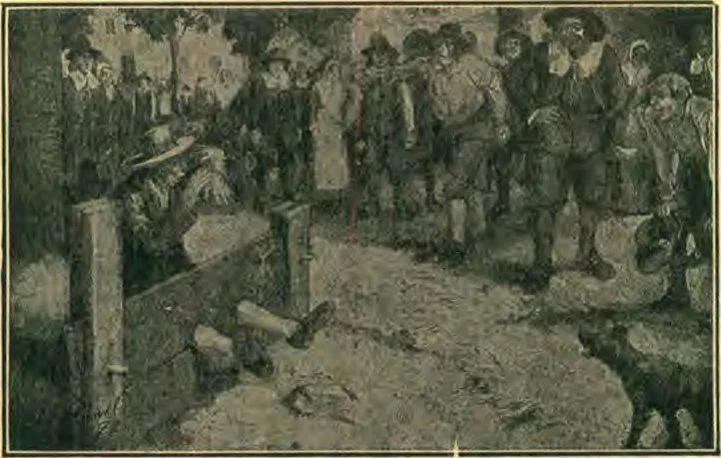
Quaker in the Stocks in Massachusetts for Dissent from the Statute-enforced Religion
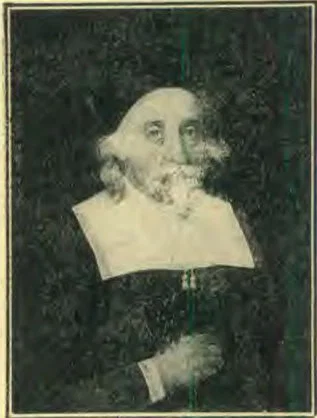
John Endicott
Those were the days of the Anabaptists, the Mennonites, the Separatists, the Pilgrims, and the Puritans. The first two named stood for the complete separation of church and state, and were practically the same, the one having grown out of the other. The Separatists separated from the state church in order that they might find in their conventicles and prayer meetings the religious refreshing which they did not receive in the meetings of the established church. The Pilgrims were Separatists who migrated to Holland in 1608, and twelve years later came to America. The Puritans were members of the established church who desired a simpler and purer form of worship in that church than that which obtained there. All were denominated nonconformists.
With the established church—the English Catholic—persecuting all these nonconformists, or dissenters, in England, and with the Presbyterian establishment doing the same for all dissenters from its creed in Scotland, with the Roman Church outlawed throughout the realm, Roger Williams had an excellent opportunity to study the workings of the church-and-state system. His early espousal of the principles of soul liberty soon made him an undesirable citizen in the eyes of the establishment, and his biographers indicate that when he left England, there were reasons of a very personal and imperative nature for his doing so; namely, to escape the wrath of the officials of the established church for the opinions which he held. A sample of the conditions existing in England at the time when Roger Williams left for America is seen in the way a man by the name of Leighton was treated for publishing his “Plea Against Prelacy.” For that act he was committed to prison for life, fined ten thousand pounds, degraded from his ministry , whipped, pilloried, his ears cut off, his nose slit, and his face branded with a hot iron.
It was in 1631 that Roger Williams landed in Boston. He had come to America for freedom of belief and worship; but he found a church here as truly established and as truly despotic as the establishment in either England or Scotland. He refused to join the church at Boston because it still held communion with the Church of England, from whose oppressive jurisdiction he had fled. He thought it his duty to renounce all connection with a church that would imbrue its hands in the blood of the Lord’s people. He made application for the rights of a “freeman” in the colony, but this was denied him because he refused to join the church, the rights of citizenship being specifically denied those outside the communion of the established church. It no doubt vexed the righteous soul of Williams to find in the New World the same oppressive conditions that had caused him4to flee from the Old, and without delay or diplomacy he began to combat the principle.
In spite of the disapprobation of the general court of the colony, the congregation at Salem elected Williams pastor. He soon found it conducive to his temporal peace, however, to take up his abode in the Plymouth Colony, where a greater degree of toleration existed, and there he continued to exercise his gifts as a minister of the gospel. He was again invited to become the pastor of the Salem church, and accepted the invitation, although the magistrates and ministers strongly objected. The majority of the church felt that they had a right to choose their pastor, and held to their choice. At once his opponents began to denounce his teachings, and he was summoned to appear before the court to answer charges brought against his “heretical” opinions.
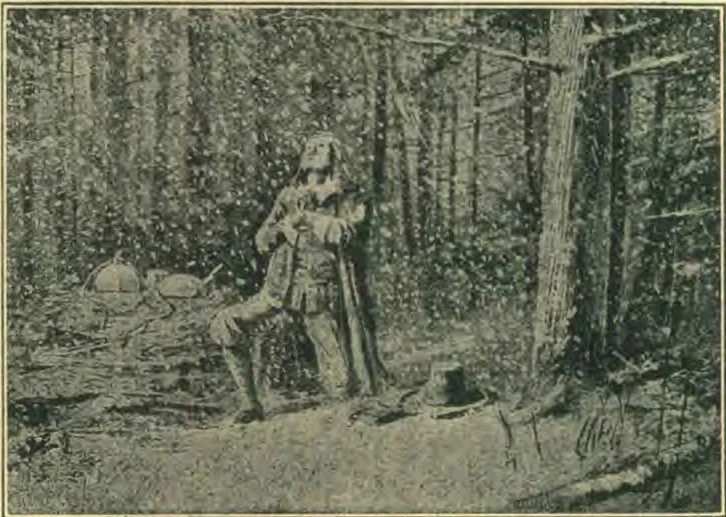
Roger Williams at Prayer in the Land of Exile
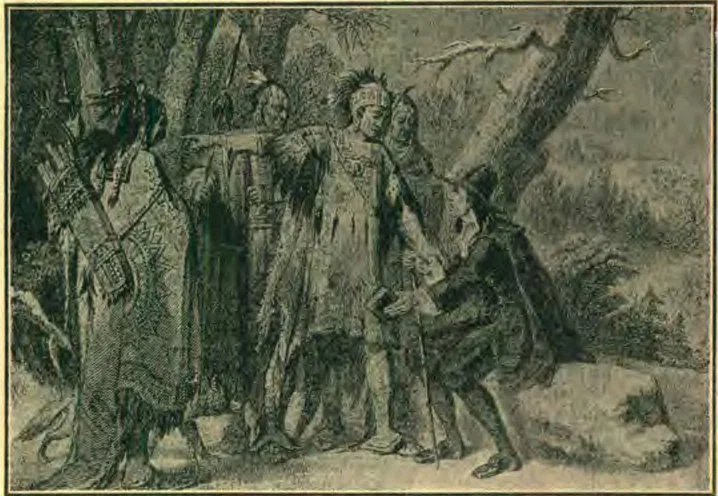
Roger Williams Sheltered by the Narragansetts
One of the teachings for which Roger Williams was called to answer was that the civil magistrate had no right to enforce religion and religious practices. Such teaching was, of course, diametrically opposed to the principles upon which the Massachusetts Bay Colony was founded, and was regarded by the officials as a very serious matter. Three days after Mr. Williams’s appearance in court to answer to these charges, the Salem church was refused legal possession of a certain piece of land for which they had applied, because of their having selected Mr. Williams as their teacher after being admonished by the magistrate not to do so.
Mr. Williams and his church then wrote letters of admonition to the churches of which those magistrates were members, setting forth the injustice of their action, and asking the churches to admonish the magistrates of the criminality of their conduct. These letters failed to have the desired effect, and even some of Mr. Williams’s congregation, because of the official pressure, began to waver. The difficulty grew, and finally Mr. Williams withdrew from the church because of its refusal to withdraw with him from the communion of the other churches. Mr. Williams’s friend, Endicott, was imprisoned for the crime of publicly justifying Mr. Williams’s letter of admonition to the churches, and a Mr. Sharpe was summoned to appear in court to answer for the same offense.
In October, 1635, Roger Williams was again summoned to appear in court. All the ministers of the colony were present. They had already decided that any one was worthy of banishment from the jurisdiction of the colony “who should obstinately assert that the civil magistrate might not intermeddle even to stop a church from apostasy and heresy.” Mr. Williams bravely upheld his teachings, but the following sentence was passed upon him, all the ministers present, save one, approving of the deed:
“WHEREAS, Mr. Roger Williams, one of the elders of the church of Salem, hath broached and divulged divers new and dangerous opinions against the authority of magistrates; as also writ letters of defamation, both of the magistrates and churches here, and that before any conviction, and yet maintaineth the same without any retraction; it is therefore ordered that the said Mr. Williams shall depart out of this jurisdiction within six weeks now next ensuing, which, if he neglect to perform, it shall be lawful for the governor and two of the magistrates to send him to some place out of this jurisdiction, not to return any more without license from the court.”
Here, then, truth, asserting itself, met bigotry intrenched behind the breastworks of temporal power. The Christian commissioned of heaven to preach the gospel as taught by the Word of God and the Holy Spirit, met the professed Christian bearing the sword of the civil magistrate and deciding for himself who shall and who shall not teach, and what shall and what shall not be taught. The sword-bearing restricter of other men’s liberties may triumph for the time, but his triumph is really a self-inflicted defeat; for in robbing other men of their liberties, he is robbing himself of his own. In imprisoning other men for their consciences, he is committing his own soul to the chains of soul slavery.
The exiled Williams was defeated for the time; but out of that defeat grew a monument to his name that succeeding generations have learned to revere. The triumph of the party of oppression has crumbled and gone; the defeat of Williams grew into a State that has influenced not the nation alone, but the whole civilized world as well.
The sentence of Roger Williams to banishment from the jurisdiction of the Massachusetts Bay Colony bore date of Oct. 9, 1635, and was to take effect within “six weeks now next ensuing.” Because of the inclemency of the weather at the time of year when his departure must take place, the time was extended. During this time Mr. Williams did not attempt to preach or teach in public; but a considerable number who sympathized with him would gather at his house from Sunday to Sunday, and listen to his discourses in private, thus absenting themselves from their accustomed places of worship on that day. This was very displeasing to the officials of the established church; it was also against the law, and increased the feeling of annoyance and irritation against him whom they had condemned to exile.
Roger Williams had for some time contemplated the founding of a state whose inhabitants should enjoy the fullest liberty in matters of conscience; and in founding such a state, he would recognize also the principle of equity toward the original inhabitants of the land. In fact, one of the expressed reasons for the banishment of Williams was the fact that he had protested against the injustice of taking possession5of the Indians’ land without their permission.
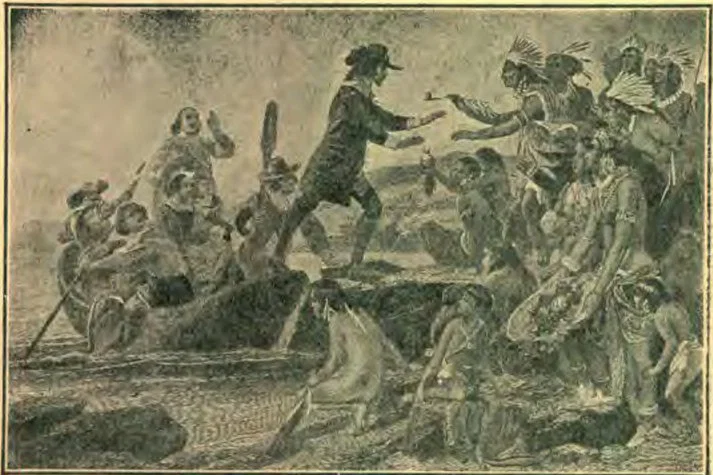
Landing of Roger Williams
The purpose of Williams to establish a new state based upon the principles of freedom of conscience and the rights of the Indians, determined the Puritan officials to get him out of their colony without further delay. A vessel was then riding at anchor in Boston harbor, and it was determined to send Williams to England on board that ship. A warrant was dispatched by the court at Boston, summoning Williams thither. He replied that he believed his life to be in danger, and did not obey the summons. An officer was dispatched to bring him; but when the officer arrived at Williams’s house, it was found that he had been gone three days, but to what place he had gone could not be ascertained.
Leaving his wife and three children, the youngest less than three months old, and having mortgaged his property at Salem for means to supply his wants, Roger Williams plunged into the wilderness to find among the savages that freedom which a union of religion and the state denied him among civilized men. He speaks of himself as being “denied the common air to breathe in, and a civil cohabitation upon the same common earth; yea, and almost without mercy and human compassion, exposed to winter miseries in a howling wilderness.” These miseries of the wilderness he endured for fourteen weeks, “not knowing what bread or bed did mean.” During this time whatever shelter he had was in the smoky, dingy lodges of the Indians. But their hospitality to him in his extremity, he sought, during all the remainder of his life, to requite by deeds of kindness.
During these days and nights of distress, Williams was teaching the Indians the principles of the gospel, which he ever sought to illustrate in his treatment of them and the rest of his fellow men. He had learned the language of the Narragansetts, and through this exile he became the first of the Pilgrims to carry the message of salvation to the Indians.
Circumstances so brought it about that the exile of Williams became for the New England settlements what the selling of Joseph by his brethren became to the children of Israel during the seven lean years. In the following stanza Williams refers to the kindly hospitality of the Indians while he was plodding through the snow from one Indian settlement to another in search of a place of abode:
“God’s providence is rich to his,
Let none distrustful be;
In wilderness, in great distress,
These ravens have fed me.”
At Seekonk, on the east bank of the Pawtucket River, Williams broke ground for a habitation, and began to build and plant; but before his crop had had time to mature, the Plymouth officials learned of his whereabouts, and, despite his former ministrations among them, warned him that he was a trespasser upon their domain, and must move on. With five companions he obeyed the ouster of his Plymouth brethren, embarked in a frail canoe, and began to descend the river. At the mouth of the Moshassuck River they landed, near a spring, and there founded a settlement, which they called Providence. This has since grown to be the city of Providence. “It was and has ever been,” as E. B. Underhill says, in his introduction to the reprint of Williams’s “Bloudy Tenent of Persecution,” “the refuge of distressed consciences. Persecution has never sullied its annals. Freedom to worship God was the desire of its founder,—for himself and for all,—and he nobly endured until it was accomplished.”
At several different times Roger Williams had it within his power to “avenge himself of his adversaries,” but no such thought seems ever to have entered his mind; and more than once he went far out of his way to do invaluable favors for those who had banished him, or for their supporters. Samuel G. Arnold, in his “History of Rhode Island,” dwelling upon the fact that some of the laymen opposed the decree for the banishment of Williams, while every minister save one approved of it, makes the following truthful and striking statement:
“A practical commentary is thus afforded on the danger of uniting the civil and ecclesiastical administrations. It suggests the reflection that, of all characters, the most dangerous and the most despicable is the political priest.”
There is no sadder demonstration in history than the demonstration of the truthfulness of that quotation.
The People's Prayer
By Amos E. Wells
God bless our dear United States,
Preserve the land from evil fates,
Lift high her banner fair and free,
And guard her bounds from sea to sea.
From foe without and foe within,
From open shame and hidden sin,
From boastful pride and greedy store,
God keep our nation evermore.
Forever may her friendly hands
Receive the poor of other lands
In kindliness of sisterhood,
And fill their arms with ample good.
Assailed by battle hosts of wrong,
God help our country to be strong;
Assailed by falsehood's crafty crew,
God help our country to be true.
God hold the nation's aim sincere,
God save her heart from coward fear,
God prosper her in true success,
And crown her head with worthiness.
God bless our dear United States,
Preserve the land from evil fates,
Lift high her banner fair and free,
And ever guard her liberty.
— Amos E. Wells.
— Philip B. Strong
By Philip B. Strong
Time
STERN truth did gentle Thoreau tell:
Whoever squanders time,
Against eternity as well
Commits enduring crime.
Life’s coffers hold no useless dross
That we may idly spend;
And present loss is future loss
For ages without end.
On earth we daily, hourly rear
The wealth our heaven shall hold;
Each minute we are given here
May prove celestial gold.
— Philip B. Strong
Christian Patriotism
By M. E. Kern
“The powers that be are ordained of God.” “Render therefore to all their dues.” Rom. 13: 1, 7.
The Saviour prayed not that his people should be taken out of the world, but that they should be kept from the evil. John 17: 15. The true Christian is kept by the power of God from doing evil, and exerts an influence in leading others to do right.
Governments Ordained of God
By nature, mankind is selfish; and in order to safeguard the lives, property, and liberties of all, governments are established among men. As Paul says, the powers, or governments, of this world are ordained of God. It is the will of God that men, even though they may not recognize and worship God, should organize governments and establish laws. Otherwise there would be confusion and every evil work.
In Paul’s day some of the most wicked rulers that ever lived were emperors of Rome. He evidently alluded to Nero when he said, “I was delivered out of the mouth of the lion.” Paul, however, extolled the system of law and order which Rome represented, and exhorted Christians to be obedient to constituted authority, and to pray for kings and rulers.
What to Do in Case of Conflict
Sometimes the governments of this world get out of their legitimate sphere, and make laws that interfere with the Christian’s duty to God. Then the question of the Christian’s relation to his government becomes a perplexing one. The instruction in the Scriptures, however, is very clear on this point. Where the laws of the state conflict with the laws of God, there is only one thing for Christians to do,—obey God, and submit to any punishment which the state may inflict. Like the apostles, they will say, “We ought to obey God rather than men.”
The true Christian is the best citizen. He is law-abiding and loves his country. He lives by the great principles of justice on which governments are based. He recognizes with gratitude the great benefits that come to him from the government. He willingly pays his taxes, and renders personal service to the nation just as far as he can do so without violating his conscience. He is a true patriot.
The noted preacher, Dr. F. B. Meyer, of London, has this to say about the Christian’s attitude toward government:
Patriotism the Child of Religion
“Patriotism is the legitimate child of religion. Was there ever a keener patriot than Isaiah or Jeremiah? Was it not of the essence of patriotism when our Lord wept over Jerusalem as he anticipated the gathering of the eagles over the lifeless carcasses of his people? Have not the aged saints of the church, men like Bernard or Luther or Knox, been devoted patriots?”
“Breathes there the man, with soul so dead,
Who never to himself hath said,
This is my own, my native land!”
“Cherish patriotism as part of your religion, although you realize that your citizenship is in heaven, and that your true country lies in the eternal.
“In Christ there is neither Jew nor Greek, barbarian or Scythian; therefore you discard your national antipathies and animosities; and, when they are laid aside, the flame of true patriotism will burn the brighter. On the whole, then, we are bound by the decisions of the government under which we elect to live, subjecting our personal preferences and tastes to the general conclusions to which our nation may be led.
“There is one notable exception, however. As long as we accept the protection given us by Cæsar, we are bound to give Cæsar his penny. ‘Render to Cæsar the things that are Cæsar’s,’ said our Lord. But when Cæsar goes beyond his province, and demands things which are not his, but God’s, then another principle steps in, and we are bound to refuse to give to the earthly ruler that to which he has no right, however vociferously he may claim it.
“What are these things of God?—Obviously our conscience, our loyalty to the divine voice, our devotion to the divine order.
Nebuchadnezzar’s Mistake
“So long as Nebuchadnezzar was content to demand of the captive Jews custom, toll, and tribute, he was within his rights in the demand, and they had no option but to pay. But when he went beyond these recognized limits, and demanded that they should prostrate themselves before his golden image, he was trespassing within a province where his law did not obtain, and the faithful three were justified in saying, ‘Be it known unto thee, O king, that we will not serve thy gods, nor worship the golden image which thou hast set up.’”
“Similarly, Daniel was perfectly justified in refusing to be bound by the king’s restriction as to prayer. ‘When Daniel knew that the writing was signed, he went into his house, . . . and prayed, and gave thanks before his God, as he did aforetime.’”
“If Paul had allowed that a man must become a Jew before he became a Christian, according to the ruling of the Pharisees, the offense of the cross would have ceased, and he would not have been subjected, first, to weary years of imprisonment, and ultimately to martyrdom.”
“If the early Christians had admitted that the emperor was divine, and had obeyed the law to give him divine honor, though the admission was given in the slightest manner possible, by scattering a few grains of incense on the altar fire, they would have escaped the ten awful persecutions that swept the empire like prairie fires. But they resolved that they must in these respects obey God rather than men, be the consequences what they might.”
“So is it still; there may be times in human history when a sole ruler, or the majority, may determine on a policy which conscience resents because it conflicts with its own solemn witness to the truth; and under such circumstances, as Luther said, ‘a man can do no other than refuse to submit, for it is not right for a man to sin against his conscience.’”
“Of course, it is legitimate to leave the country which has resolved on such demands. The Pilgrim Fathers acted on this principle when they crossed the ocean to found a New England beyond the seas. On the other hand, it may be better to stay in the country, as the Puritans did, and suffer privations and persecutions until they have led it to a better mind. But, however the matter may be decided, conscience must determine our course.”
May our young people be true to God, loyal and obedient servants of their country, and be able to lead many souls to the fountain of righteousness.
M. E. KERN.
The Duty That Lies Nearest Us
By Kingsley
THE only way to regenerate the world is to do the duty that lies nearest us.— Kingsley.
The Excellent Habit of Asking Yourself Questions
By Bruce Barton
A FEW days ago I opened the morning mail, to discover this interesting letter from a subscriber in Wakefield, Massachusetts:
“Dallas Lore Sharp, the naturalist and writer of nature books, told me that hop-toads possess the homing instinct. ‘Take one away from the spot where it has always lived, and he will return, even though you have carried him ten miles,’ said Mr. Sharp.”
“I resolved then to try an experiment with Teddy, the big toad who has made his home in my garden in Wakefield for the past five years. Writing my name on a tag, I tied it to Teddy’s hind leg, and took a train to Boston. There I transferred to an elevated train which carried me to Charlestown, on the outskirts of the city. At the corner of Perkins and Haverhill Streets, Charlestown, near the B. & M. signal tower where I am employed on night duty, I let Teddy out of the box. He blinked at the arc lights a second or so, darted out his tongue and gobbled a few Charlestown mosquitoes, and began straightway to hop along the side of the street to Mystic Avenue. When he reached the corner, he made a bee line for Wakefield, hopping off in the darkness at a lively pace.”
“It was just 11:15 P. M. when I went on duty at the tower, and 8:30 when I reached home the next morning. Imagine my surprise and pleasure when, on entering the yard, I discovered Teddy, in his accustomed place, under the sill cock, against the side of the house, taking a bath—I presume—after his long, dry, and dusty hop of nine miles. The tag with my name was still tied to his leg.”
I have preserved this letter, partly because of what it tells about the character of the hop-toad, which is interesting in itself, but chiefly because of what it tells about the man who wrote it.
If ever I am near Charlestown at night, I shall go out to the signal tower and meet him. For, humble though his job may be, he is in spirit a brother of Galileo and Columbus. There is within him something of the eagerness to experiment—that divine curiosity that has conquered and civilized the world.
For the world moves forward, not steadily, as it moves around the sun, but by jerks. And the jerks are prompted by some man’s curiosity, his insistence that he be shown.— Bruce Barton.
More Room in Holland
HOLLAND is planning to have more room for her agricultural industry. The great sea is to be drained, and the bottom used for farming purposes. For a hundred years the Dutch have been talking of this move, and went so far as to shut out part of the sea. Now a dam twenty-four miles in length is to be built from North Holland to the coast on the north-east. An island will form about five miles of this dike. An 882,000-acre lake will be formed, and then all the water will be pumped out except enough to make a small lake. The government will reimburse the fishermen who are to lose their fisheries by this new work. The estimated cost of the project is $90,000,000.— Young People's Weekly.
Where Styles Never Change
IN the ancient fishing village of Concarneau in Finistère, the Breton folks have no regard for the fleeting visits of fashion. Since the fourteenth century they have worn the same style clothes, as a matter of course, rejoicing in their peasant costume. The women wear very long full skirts of black woolen material, aprons woven by hand and gay in color, white caps starched to the condition of a board, and white collars long and fluted. On their feet they wear sabots, for shoes are almost an unknown luxury. These simple French people depend upon the sardine fisheries for their living. When the sardines are plentiful, prosperity pervades the village; when the sardines are scarce, dire poverty is the result.—Selected.