The Youth’s Instructor, Vol. 38, No. 4.

ROUND THE WORLD.—4

The Youth’s Instructor

Jan 22, 1890

S. D. A. Publishing Association · Battle Creek, Mich. · Jan 22, 1890

ROUND THE WORLD.—4.

THE CANARY ISLES TO CAPE TOWN.
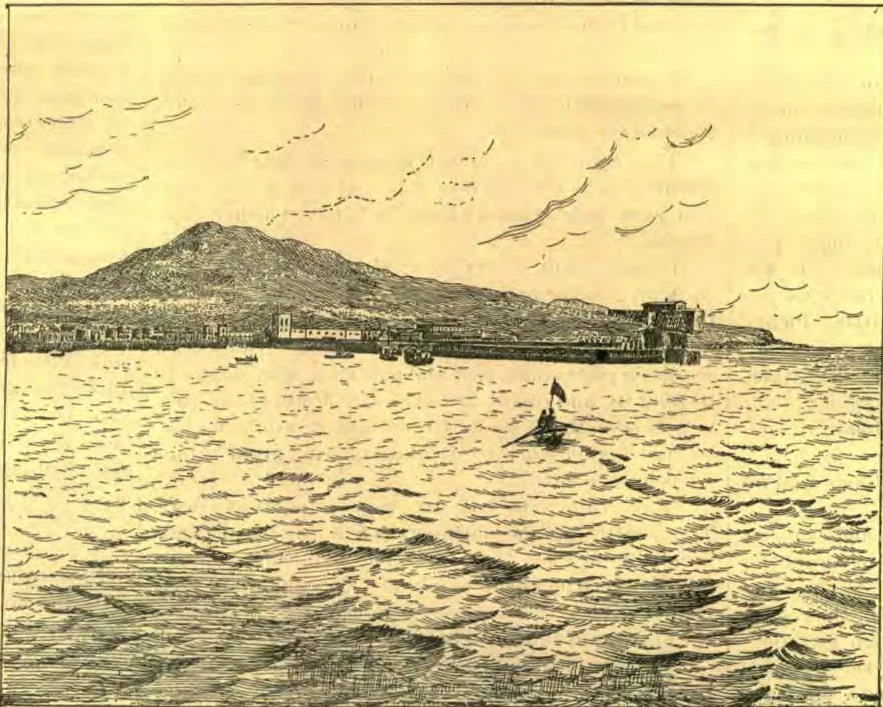
The Canary Islands are about twenty-seven in number, and lie fifty miles off the northwestern coast of Africa. Gran Canaria, with its capital, Las Palmas, is the largest and most important of the group, the only feature outside of it being Mount Teneriffe, a lofty, volcanic peak, which can be seen for many miles by passing ships. Even in the hottest weather there is always snow on its summit. The islands became the property of Spain years ago, and have been under that power ever since.
Scarce had the ship come to anchor, when we were surrounded by well-nigh a hundred boats laden with fruit, canary birds, wicker chairs, and other curiosities. Their owners, a motley gang of Spaniards, Africans, and mulattoes, literally swarmed up the side, and in none too harmonious tones vied with one another in advertising their wares.
A large party of us went ashore, where there were a host of little native ponies, followed by quaint conveyances, to take us up to Las Palmas, which lies on the side and at the base of a lofty mountain some four miles from the landing-place. The climate is remarkably salubrious and the soil very fertile. Las Palmas has been much frequented as a health resort by European and English people. There are many lovely trees and tropical fruits; the cypress, palm, banana, aloe, pomegranate, and vine flourish abundantly. We passed by many villas surrounded by beautiful gardens filled with flowers of varied hues. There are hedges of geraniums, growing from three to five feet tall, and covered with a profusion of scarlet blossoms.
The native men are a vicious-looking lot, each one carrying a sharp poniard, which he draws on the slightest provocation. The women are dressed a good deal after the Oriental style, and may often be seen carrying large earthen vessels of water on their heads, much the same as is represented in pictures of Bible times.
The houses are built of limestone, painted white, and almost all of them are one-storied and flat-roofed. The streets are narrow, paved, and remarkably clean. Many of the larger residences are constructed in the form of a hollow square, having a court-yard in the center, filled with palm, orange, or lemon trees. This makes a cool and pleasant place in which to sit during the heat of the day. There are no fine store buildings, and such as do exist have no glass in the windows; there is only a large square hole, and the goods are placed on receding shelves for exhibition. It is difficult to find souvenirs at Gran Canaria, as there is nothing manufactured on the island save smoking pipes and walking sticks. Canary birds are plenty in this their native home, but the fanciers ask more for them than one pays in either England or America, on the plea that it is worth much more to take one direct from the island.
We visited the government buildings, which are small but prettily decorated inside. There is also a museum, which contains nothing of much interest. But the sight at Gran Canaria is the Roman Catholic cathedral, a large limestone building, which has stood the storm and shine of many a year. Its top is ornamented with a number of towers and minarets.
The windows are of stained glass, and the interior is almost as dark as the religion of those who worship there. It contains several chapels ornamented with magnificent carvings of oak and other wood. The walls are covered with life-size oil paintings; prominent among them is a representation of the Saviour bearing the cross to Calvary. The expression of calm resignation on that holy face is so perfectly portrayed that one almost imagines it alive.
At the end of the choir chancel in the nave is a revolving lectern, on which are placed the sacred books. These consist of portions of the Bible and church prayer-book hand-painted on vellum sheets. There is also a book filled with music painted in the same manner. As we gazed upon them, we thought what a wonderful amount of patient toil it must have taken to paint and put together these books, and what a contrast they form to the printing-presses of modern days. The altar is placed in an alcove at the east end. Its top, sides, and front are covered with solid silver, beaten and hammered out in many beautiful designs. At the rear is a magnificent fresco of the Son of God ascending in the cloud to heaven, while beneath are the men of Galilee gazing after his receding form.
Upon leaving the cathedral, we visited the fruit market, and were then driven back to the jetty. We did not visit the famous cave of Attylla, which lies on the other side of the island, as time was limited; moreover, the occupants of it, who are descendants of Spanish outlaws, do not have a very enviable reputation; in fact, we were warned against visiting it except in large parties, as some who have done so have never returned.
At three P. M. all were aboard again, as the captain had declared he would sail at that hour, and wait for nobody. He did not, however; and we whiled away the moments by throwing pennies into the water, and watching the little native boys dive for them. They seldom miss a coin, and generally secure it long before it has time to reach the bottom. Sometimes they will dive underneath a large steamer, and come up on the other side.
By and by we were off again, and soon there was nothing in sight save the restless billows. For seventeen long days the good ship sailed along. On August twenty we crossed the equator. That night the north star was viewed for the last time, and on the next the southern cross was in sight. At this point of the journey the sailors had a good deal of fun at the expense of the less educated class of passengers, telling them that they would feel the ship give a tremendous jerk as she crossed the line, and that they would have to watch the compasses closely; for as soon as we were over, the needle would turn and point to the south.
In tropical waters the sea around the vessel at night looks like a lake of liquid fire. This is caused by phosphorus in the water; and for a considerable distance it also forms a lighted path in the wake of the ship. During the day the air is filled with flying fish. They never rise more than a few feet above the water, and when tired, dive out of sight in a moment. Sometimes the sailors catch them by placing down in the water a net containing a lantern; to this bait they will flock in great numbers.
On the last day of summer land is in sight. Speed on, good ship, speed on! With every throb of the propeller, every waft in the drawing sail, we near the haven. All are weary for land once more, and the regret we feel at leaving this staunch friend will still be tempered with satisfaction at the thought that once more activity can take the place of our lengthened present inaction. P. T. M.

THE CHILDREN'S COMPASS.

THERE is a story told of one of the kings of France, who explained to his little son the mariner's compass, and showed him how it could guide the sailors over the sea, as well as the travelers upon land.
The prince was so pleased with the idea that he begged his father to lend him his compass, and to allow him to try it for himself. The king gave him the compass, and permitted him to find his way alone through the forest, which was close to the royal palace. The little fellow struck off confidently into the depths of the forest, compass in hand, and much to his delight, it led him safely, after much walking, back to his father, who received him with expressions of affection and joy.
As we read this story, we thought of the compass which God has given us, to direct us safely from earth to heaven. In the Bible we have an unerring guide, and those who follow it can never miss their way. It is far better and surer than the compass about which we are speaking, because it can never lead us astray if we humbly seek the teaching of the Holy Spirit in reading its truths. Sometimes the mariner's compass has failed to point true, and then consequences have been very terrible.
There is a sad story of a vessel that was once driven upon a dangerous coast and lost. The pilot thought he was steering straight for the harbor; but all the time he was directing the ship toward the rocks upon which she perished. The owners tried to fix the loss of their vessel upon the officers in charge, but neither the steerman's skill, nor the captain's fidelity, nor the prompt obedience of the crew could be doubted.
At length it came to light that a passenger was trying to smuggle a basket of steel goods into port, and had hidden the unlawful merchandise in his berth. The berth lay nearly under the compass, and the attraction of the steel swerved the needle from the north, thus deceiving the pilot, and causing the ship to be driven upon the rocks and become a complete wreck.
Sin, hidden in the heart, will as surely wreck our souls as the unlawful steel, hidden in the ship, led to its destruction. You remember the words of the Psalmist: “If I regard iniquity in my heart, the Lord will not hear me.” God will never have a divided heart as his own. He wants it all. “My son, give me thine heart,” is God's request, and he asks not for a portion, but the whole.
God wishes us, I think, to use the Bible as the little prince used the compass. He wants us each to use it for ourselves. He wishes those who have Bibles to test them every day. They can be of no use to us until we put them to the use for which God designed them.—Our Monthly.

REMEMBER

In thy time, and times of mourning, When grief doth all she can, To hide the prosperous sunshine, Remember this, O man,— “He setteth an end to darkness.”
Sad saint, of the world forgotten, Who workest thy work apart, Take thou this promise of comfort, And hold it to thy heart,— “He searcheth out all perfection.”
O diligent, diligent sower, Who soweth thy seed in vain, When the corn in the ear is withered, And the young flax dies for rain,— “Through the rocks He cutteth out rivers.”
—Alice Cary.

ANOTHER WAY TO SPELL IT.

“MABEL KING has been asking me to join the flower mission,” said Emily Clifton, as she met her father at the breakfast-table.
“The flower mission?” he said, looking at her through kindly, preoccupied eyes.
“Yes. There will be a good deal of work about it, she says; for there are only a few engaged in it. Those who undertake it will have to do something in the way of raising flowers as well as distributing them.”
“I’m sure it would be a good thing for you, my daughter,” said her father, with eyes no longer preoccupied, but full of grave, tender interest. “It will be something to occupy you, now that your eyes are troubling you, and you can use them so little. Plenty of good exercise about it, too.”
“Yes. Please pass the buckwheat cakes to father, Tom.”
“It won’t be doing him much of a kindness,” grumbled Tom. “They’re mean and heavy.”
Tom was a good deal given to grumbling, and no one ever paid much attention to it.
Father declined the buckwheat cakes, and took instead a piece of bread, giving it a rather doubtful look as he said:—
“I think I’ll tell Hiram to spade up that strip of ground at the south end of the garden for you.”
“Do, father; it will be a fine place for the verbenas and mignonette. It will soon be time to set them out.”
“I have a kind of half-headache every time I eat pancakes,” grumbled Tom.
“I can sympathize with you there, Tom,” said his father, with a rueful smile, as Tom raised one of the cakes on his fork, and let it fall with a heavy flap on to his plate.
“What annuals would you suggest, father, besides verbenas and pansies, as giving the most satisfactory returns for the labor?”
“The beefsteak’s all dried up,” observed Tom. “Wish Cousin Bertha was back. We had decent things to eat then. Don’t you remember her nice, light biscuits and the custards—all foaming—just like pink snow?”
“Annuals, my dear?” The preoccupied look had come back to father’s eyes. “Why, you know more than I do about such things. I should say—well—well—sunflowers? hollyhocks?”
“O father, I guess you are better at doctoring than at gardening,” said Emily, with a merry laugh.
“And the coffee’s just like mud,” said Tom, impatiently, pushing away his plate and leaving the table.
“Dear me, how disagreeable Tom does make himself,” said Emily, as, after wishing her father good-bye as he hurried away, she sat down to finish her breakfast alone. “He breaks in upon every one with his complaints. But this coffee is miserable.”
“Are you at home, Emily?”
“Yes, come in, Bertha. I’m glad enough to hear a word from some one. Father hasn’t a thought for anything except his patients—and for me when he thinks it’s my eyes and health. Dear father! And Tom keeps up a steady growl about everything he eats.”
“No wonder,” said her visitor, a bright-looking lady a few years older than Emily. “I’m afraid your new girl isn’t doing very well.”
“No, indeed, she isn’t,” sighed Emily.
“Poor uncle!”
Mrs. Bertha Wilcox poked with a fork at the piece of steak left on his plate, and then took up the piece of bread which lay beside it.
“He has hardly eaten a thing,” said Emily, noticing that fact for the first time. “I do declare, Bertha, I wish, with Tom, that you were here yet. We’ve never had things comfortable since your wedding-day.”
“I don’t wonder he doesn’t eat,” said Bertha, soberly, bending the tough slice of bread between her fingers. “If this is the kind of bread he gets, the less of it he eats, the better. Well, I didn’t leave, you know, Emily, till you came home.”
“No, you didn’t,” said Emily, with a flush on her face. “Why, Bertha! Why couldn’t I see to things about the house, myself?”
“I’ve wondered why more than once,” said Bertha, laughing.
“And why didn’t you tell me so?”
“Because, dear, I felt sure that, sooner or later, you would see it yourself.”
“But I don’t know anything about it.”
“No, of course; for you have been away at school all these years since your mother died. But stupider people than you have learned.”
“And will you teach me?”
“Certainly. Get some big aprons, and come over through the back yard every morning.”
“Aunt Rachel,” said Emily a week later, “the ladies have been urging me to take part in the flower mission, but I told them I could not begin just yet because I was learning to keep house, and it would take all my spare time for awhile.”
The gentle-faced old lady, who had come for a visit, looked up from the toeing-off of her stocking with a smile as she said:—
“Thee couldn’t be better employed, dear, than in learning to be the mistress of a well-kept home. And I’m sure thee couldn’t have a better teacher than Bertha.”
“I know that. But now, auntie,”—Emily’s face took on a sober expression,—“there are two sides to it. There are not half enough people interested in the hospitals to do what ought to be done. And when I see those poor souls, sick and suffering, who ought to be read to, and ought to have more flowers than they get, it sometimes seems to me that it would be better and higher work to do than making good things for people to eat.”
“Good things to eat are very important, dear. The health of the members of a family depends largely upon what they eat. The well-being and usefulness of the members of a family depends upon their health. When thee looks at it in that way, it dignifies the making of things to eat.”
“Still, the people in the hospitals are far worse off than we in our homes. It is hard sometimes to know exactly what is one’s duty.”
“Never, never, my dearie.” Aunt Rachel laid down her knitting, as she went on with an earnest voice: “Doesn’t thee know that the Lord always expects of us faithful attention to the duties which lie nearest? When those duties lie in the sweet inner circle of home, how can there be a doubt about them?”
“But there are those who ought to attend to the hospital, and do not?” questioned Emily.
“The good Lord never intended thee to do duty for others.”
Bertha justified her character as a good teacher, and before long Emily decided to try her new-found skill in the preparation of a surprise dinner to her father and Tom.
“How is this?” asked father, bringing his wandering thoughts down to the meal before him, as he took a piece of bread in his hand. “You must have inaugurated a new dynasty in the kitchen, daughter.”
“I have, father.”
“Ho, ho!” laughed Tom. “Has Cousin Bertha come back to stay?”
“No,” said Emily, “but I am heading the kitchen dynasty myself.”
“But how can you attend to that and the flower mission, too?” asked father. “Be sure you do not over-exert yourself, my daughter.”
“Oh, I’m letting the flower mission go for awhile.”
“Flour mission—hurrah!” cried Tom, too loudly for table manners. “Wheat flour, buckwheat flour, corn flour! It’s the jolliest flour mission I ever heard of.”
Father’s eyes beamed as he said:—
“I think we may all be thankful, dear, if you are turning your attention to home mission work.”—Sydney Bayne.

THE NURSERY PSALM.

In Scotland, the twenty-third psalm is a favorite with the children. Their small mouths become so accustomed to its quaint, uncouth versification that they relish it better than they could the smoothest jingles. So it is called the Nursery Psalm.
One of the English ladies who went to the Crimea with Florence Nightingale to nurse the sick and wounded soldiers, found in a Scutari hospital a Highlander near death, and yet hard against God. She spoke to him, but he would make no answer. He even drew the sheet up over his head to keep her from speaking to him again.
The next time she went through that ward, he saw her coming toward his cot, and he covered his face again. Seating herself beside the bed, she began to repeat, in a low, kind voice, the Nursery Psalm:—
“The Lord’s my shepherd; I’ll not want; He makes me down to lie In pastures green. He leadeth me The quiet waters by.”
She noticed that before the psalm was finished, his hand went up to his eyes under the sheet. The next time she came, he was quite ready to listen to what she had to say of Jesus and his love. He gave his heart to the Lord, and five days later he died in great peace.
The Nursery Psalm was used to touch a chord that was not quite paralyzed by his bitter enmity against God. It was “mony a weary mile” from his mother’s knee in the Highland cottage, where, with her loving hand on his bonny bright head, she had taught him the dear old psalm, to the Crimean hospital, where, a rough, hardened soldier, he lay dying; yet the mother’s love, like Christ’s tenderness, reached all the way, and drew him back to God.—Sel.

A DOGS' BATH-HOUSE.

In all our large cities it is the fashion for ladies to keep pet dogs. In fair weather it is no uncommon sight to see elegantly dressed ladies promenading the streets, carrying or leading such pets, while nurses follow with the less valuable babies. Often these dogs cost large sums of money, and frequently their collars and blankets are studded with costly gems of great value. Professional dog doctors are numerous, and many acquire a competency as specialists of this kind. There are in addition dog boarding-house keepers and dog bath-houses.
A very large and elegant bath-house for dogs is located on Sixth Avenue, New York City. At the rear of the hall, in a large waiting-room, stand the bath attendants. As the owners enter with her dog, a proper entry is made in the “register,” giving a description of the dog and the “treatment” desired. Collars and ornaments are also recorded, taken off, and placed for safe-keeping with the clerk. An ordinary bath costs twenty-five cents. This entitles the dog to a swim in the public lavatory, to be sponge dried, and to have the hair combed out afterward. There are private bath for specially valuable dogs, and those whose owners are wealthy and pay liberally. An exclusive swim in one of these, and subsequent attentions cost fifty cents, while special combing for obstinate snarls or using perfume costs twenty-five cents more. Elaborate and intricate treatment will run the bill up to one dollar.
The patrons of the establishment are not permitted to be present during the bath, private sitting-rooms being provided upstairs, but they can witness all subsequent ceremonies, which include drying, cleansing, combing, crimping, perfuming, besides shampooing in many cases. Each operation is undertaken in a room specially prepared for it. Shampooing is performed immediately after the dog leaves the bath, and here strong, muscular young men are employed. The combing, perfuming, crimping, etc., are done by young women. They all wear white aprons and caps, and the woman in charge is well posted in dog necessities, and sees that each bather is properly attended to. Combing makes the dogs extremely pugnacious unless their owners have been careful of them, and often the men attendants have to be called in to control the brutes during the process. The lavatory does a thriving business, and often the pools are in use until past midnight.
W. S. C.

STRAIGHT PATHS.

“Who knows how to make a straight path through the snow?” said Uncle Frank one day, when he was out by the meadow fence with Tom and Johnny and me.
“Seems to me anybody ought to make a straighter one than that one Joe Bates has made across the meadow,” I said.
“Well, if you think so, suppose we each try it, and we’ll see who knows most about making straight paths,” Uncle Frank said, with a smile. “Johnny, you start somewhere toward the east corner of the meadow, and Tom, you start west of us, and Will and I will make our paths between. We should not be too close to each other, you know. We’ll stop about half-way across and compare notes.”
“Paths, you mean,” said Tom, starting toward the west side of the meadow.
Half-way across, Uncle Frank stopped, and we each turned to look at the path we had left behind us.
Before I turned around, I was sure I had not stepped either to one side or the other since I left the fence; but of all the crooked paths I ever saw I think mine was the crookedest. I could hardly believe it was my path when I saw it, but of course it was.
Johnny and Tom both made paths a little straighter than mine, though not much; but Uncle Frank’s path was straight as an arrow, or looked so compared with ours.
“There’s some kind of arithmetic or something that Uncle Frank knows that helped him,” Tom said. “He didn’t just happen to walk as straight as that.”
Uncle Frank knows so much about arithmetic and such things that he just thinks of a rule and goes by it whenever he wants to do anything.
“How did you do it, Uncle Frank?” Johnny asked. “I just fixed my eyes on that tree over in Mr. Bates’s field when I started, and I kept looking right at that. Of course, I went straight toward it so long as my eyes were fixed on it. That’s the way to make straight paths—look at one thing ahead of you,” Uncle Frank answered.
Then he went on to say something about “making straight paths for your feet.” That’s in the Bible. Uncle Frank knows as much about the Bible as about arithmetic, and somehow when he says anything about it, it seems different than when some other people talk about such things.
He says the way to make straight paths such as the Bible means is to fix your eyes upon Jesus, just as he fixed his eyes upon the tree in Mr. Bates’s field.
There is a song about “Fix your eyes upon Jesus” that we sing sometimes in Sabbath-school, and it seems to me I know better what it means since we made those paths in the snow this winter, than I ever did before.—The Giant Killer.

NOT BROKEN, BUT CRACKED.

'T WAS a set of resolutions, As fine as fine could be, And signed in painstaking fashion By Nettie and Joe and Bee; And last in the list was written, In letters broad and dark (To look as grand as the others), “Miss Baby Grace—her mark!”
“We’ll try all ways to help our mother, We won’t be selfish to each other; We’ll say kind words to every one; We won’t tie pussy’s feet for fun; We won’t be cross and snarly too; And all the good we can, we’ll do.”
“It’s just as easy to keep them!” The children gayly cried; But mamma, with a smile, made answer, “Wait, darlings, till you’ve tried.”
And truly, the glad, bright New Year! Wasn’t his birthday old, When three little sorrowful faces A sorrowful story told.
“And how are your resolutions?” We asked of the baby Grace, Who stood with a smile of wonder On her dear little dimpled face; Quick came the merry answer— She never an instant lacked— “I don’t think much of ’em’s broken, But I dess ’em’s about all cracked.” —Selected.

THE GULL

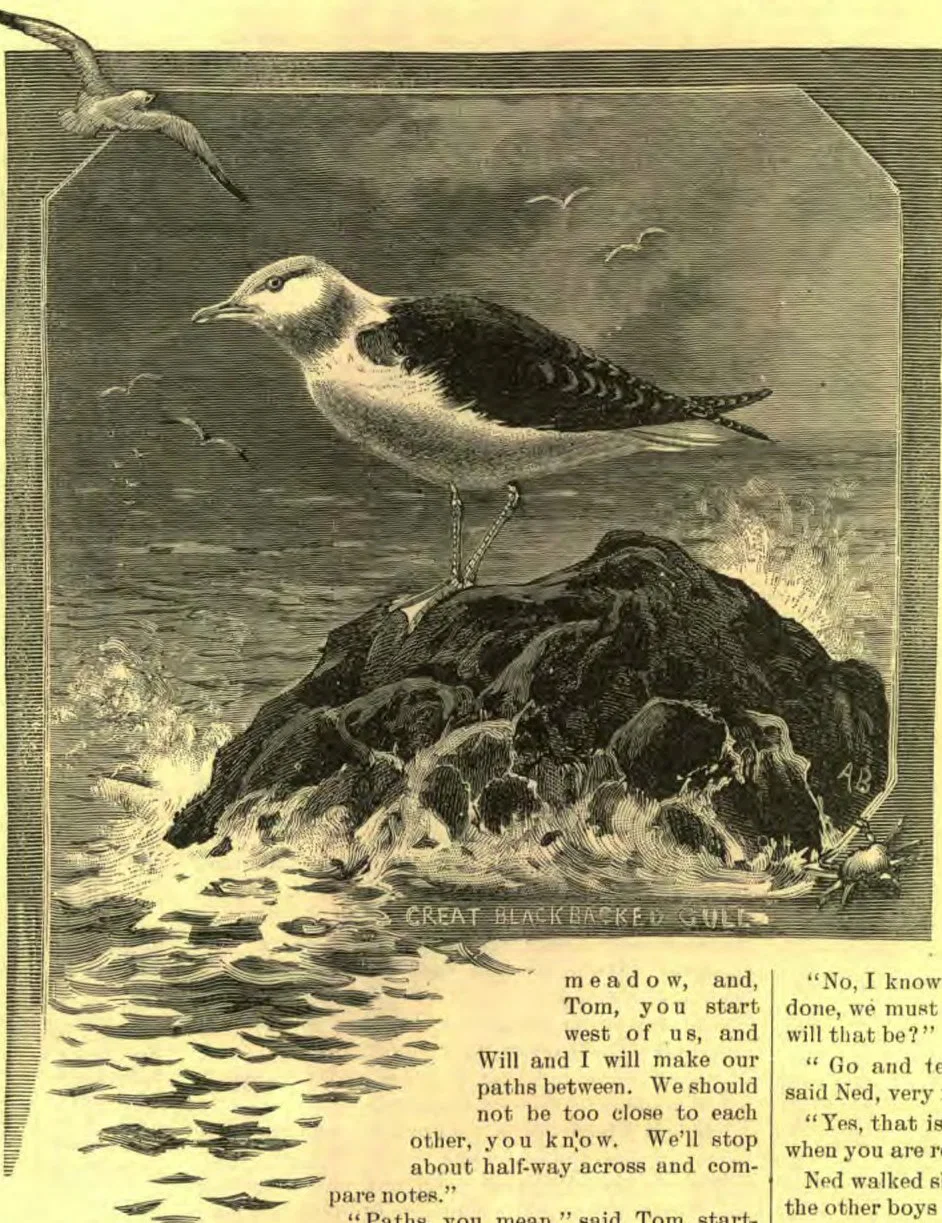
Who that has visited the seashore but has seen the gull? They are birds of the sea. Their home is on the waves, and they only seek the land to rear their young.
The larger gulls are rarely seen except on the high seas. They lead the life of pirates. They cannot dive or plunge on account of the size of their feathers. So they plunder their neighbors, and snatch the fish out of their mouths.
The smaller gulls are often seen near the shore. They wheel about, or skim on the waters, their silvery wings shining in the sun. Sometimes they seem to tread or walk on the waves, upheld by their strong pinions. They will even ascend the rivers in search of prey.
They are noisy, greedy, and rapacious. They feed on all kinds of creatures, dead or alive. They pursue the shoals of herrings on their way to and from the sea, and thin their ranks. They plunge headlong on the fish, and snatch it from the waters. It happens, now and then, that the gull does not succeed in carrying off his prey.
GREAT BLACK-BACKED GULL
The frigate-bird, if he chance to be near, will take a fancy to the fish himself. He will dart upon the gull, and force him to drop it. Then, by a clever swoop, he will catch it in his beak and devour it.
The gulls have all the fierce nature of the sea birds. It is not safe to be at their mercy. Once it happened that a fishing-boat was upset near to the seaport town of Yarmouth. All the men on board were drowned except one. He was a good swimmer, and tried hard to reach the shore, but the tide was against him, and he drifted a long way from land.
As he floated, exhausted and almost hopeless, on the water, he heard a flapping of wings. It was a party of sea-gulls coming to seize him for their prey. He could feel their wings touch his face, and he tried to strike at them with his arms, and drive them away. You may fancy how dreadful a situation this poor man was in! Happily, at this very moment a ship came in sight. He cried out with all his might, and the man at the helm heard him. Soon after, a boat came splashing along to rescue him. Thus the cruel gulls were disappointed of their victim.
The family of the gulls is a very large one. It includes all kinds of varieties. There is the black gull, and the herring gull, and the Iceland gull, and many others.
And there is the green-billed gull, or the sea-mew. The sea-mew has a hoarse, harsh voice, between a laugh and a scream. On some wild, rocky coast, the strange note of the bird mingles with the noise of the waves and the moaning of the wind.
Gulls like steep rocks and wild, desolate islands. In some places the clouds of gulls darken the air when they fly. And the noise they make is quite deafening.
It is a trade to collect the eggs of the gull. During the season, men are busy from morning till night. The eggs lie so thickly on the ground, it is scarcely possible to help treading on them.—The Sea and Its Wonders.
Continue reading: NED’S TRIUMPH