The Youth’s Instructor, Vol. 37, No. 15.

CAROL FOR SPRING

The Youth’s Instructor

Apr 10, 1889

S. D. A. Publishing Association · Battle Creek, Mich. · Apr 10, 1889

CAROL FOR SPRING.

Winter is done! Daisies are lifting their heads to the sun; Mayflowers, smiling the soft winds to greet, Burst into loveliness, sudden and sweet; Primroses, pale as with looking on snow, Crocuses, violets, see how they grow! Robins and bluebirds make nests in the sun: Winter is done! Sister of Summer, your reign is begun!
Winter is done! Out of its death all this glory is won! Down at the roots where the fallen leaves cling, Wrecks of the Autumn make blossoms for Spring, Dust of the rose-leaves gives bloom to the rose; Life out of death thus eternally grows; Earth's blooming children come back, one by one: Winter is done! Sister of Summer, your reign is begun!
—Selected.

BECAUSE I LOVE HIM.

It was Wednesday afternoon, and the half holiday that it brought to the boys belonging to the old school of Croftlands had been greatly appreciated by them. There remained, however, but ten minutes before the bell would summon them back to masters and lessons.
Just outside the Five-Court were three boys engaged in earnest conversation.
“Now, Hamilton,” said one, the tallest of the group, “no one would ever have made me believe that you were a coward; yet if you stick to it that you won’t go boating with us next Saturday, I shall believe you are. Ned Mills is the best boatman going; he says there will be lots of fish at the Point. His boat is as safe as a house, and the doctor and Mr. Walter are going to Churchtown; so there’s no fear of our being found out. Now, then, will you go?”
“No, Jack, I cannot go. And, oh, I do wish—”
“No preaching,” said the elder boy. “You must tell me why you say no. I say, and so does Arnot here, that you shall go.”
“No, Jack, I will not go. I dare not.”
“Coward!” “Baby!” cried out both boys at once. But they stopped rather suddenly. Somehow it seemed foolish to call the fine young lad who stood before them a coward. So fearlessly he looked at them with his bright brown eyes, so calmly he listened to their mocking words, though the flush on his cheeks showed that they wounded him.
“Now don’t be so obstinate,” said the younger boy, persuasively. “For the sake of old times, when you and I had lots of forbidden sprees together, come with us. Do you forget those old days?”
“I wish I could undo a lot of things I did in those old days,” answered the boy earnestly. “I see now how wrong I was. No, Arnot, I am not afraid in the way you think I am. But I dare not any longer break the rules; I am serving the Lord Jesus now, and I don’t want to do things that would grieve him, because I love him.”
“Oh! oh! so that is the way the wind blows, is it?” said the elder boy, with a whistle. “Well, I think no worse of you for sticking to your colors. But if you mean to be a goody-goody, you will have to give up cricket and football, and be as grave as old Solon.”
“No, Jack,” said Hamilton, “I shall try to show you that I can play football and cricket better than ever now. And you cannot say I look very miserable, can you?” he added with a bright smile.
“Well, we’ll give you three months to try it on,” said Jack, as the bell called in the boys.
Neither Jack nor Arnot broke the rules by going out boating among the dangerous rocks on the Saturday afternoon. Hamilton noticed this with great pleasure, but he did not know that it was chiefly the influence of his own example and words that kept them from it. At the end of the three months, Arnot had joined Hamilton in serving and loving the Lord, and daily they prayed that God would bring Jack to know and love him, too.
One day, as Arnot and Hamilton were returning from a stroll together on the cliffs, Arnot paused by the Five-court, and said:—
“It was just here that you and Jack and I talked that Wednesday afternoon. I could not forget your saying you did not want to do wrong things that would grieve the Lord Jesus, because you loved him. That seemed to me such a splendid way of living, so much better than those dry old ‘must not do this or that.’”
“So you tried it for yourself, didn’t you, old boy?” said Hamilton. “And you are not disappointed, are you?”
“No, indeed, I am not,” answered Arnot. “I love him now for myself, but not half as much as I want to.”—Our Own Magazine.

THE IRON INDUSTRY IN THE SOUTH.

It may prove of interest to many of the INSTRUCTOR readers to learn a little about the newly-opened iron fields of the South.
Perhaps the South was never considered as industrious and enterprising as the North, and this might continue to be true were it not for the vast mines of iron and coal which have lately been opened here, awakening the people to the fact that their worn-out farms are underlaid with a wealth they had not even dreamed was theirs.
Where only a few years ago were the low-spreading farm-houses of the planters, or the remains of little log-cabins, the homes of the slaves, are now erected great, towering furnaces and rolling-mills, whose smoke-stacks and flaming lights speak of another life to this people. For cities sprang up as if by magic, Northern capitalists came and invested, railroads were laid, and even the country itself varied its name, and is now termed by all “the new South.”
A person unaccustomed to iron furnaces, on coming into one of these cities by night, will suppose the whole place on fire; but instead, he would find he was only passing the coke ovens, or perhaps the furnaces, whose puffing, snorting, and roaring are kept up night and day. To enjoy fully a visit here, one should go at night, as the displays are then seen in all their grandeur.
The most important part of a furnace plant is the big furnace itself,—a kind of immense iron chimney, lined with fire-brick. In starting a furnace, a quantity of wood is stacked in the base of this great chimney, which seems a miniature tower of Babel; next a quantity of coke is put on, then a layer of ore mixed with limestone, then coke again, then another layer of ore, and so on.
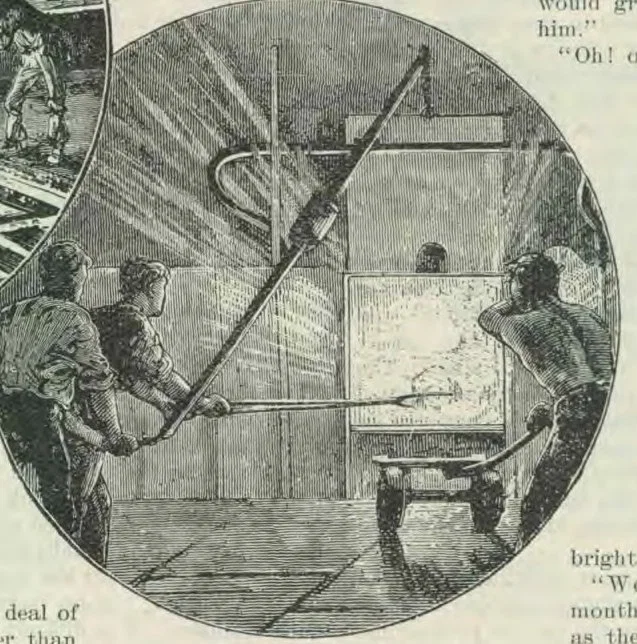
The workings of these furnaces are said to be simple, and every part works in perfect harmony with every other part. When all is in readiness, the wood is lighted. After ten or twelve hours, perhaps, the blast is turned on from the blowing machines, thus creating a draft. After the wood is lighted, the coke begins to burn, the ore and limestone to melt, and a quantity of gas forms in the top of the chimney. This gas, which is conducted from the top of the chimney by pipes, is used as fuel in heating the boilers that furnish steam to run the blowing engines. The blowing engines force great volumes of ore into the hot-blast stoves, and from the stoves into the furnace.
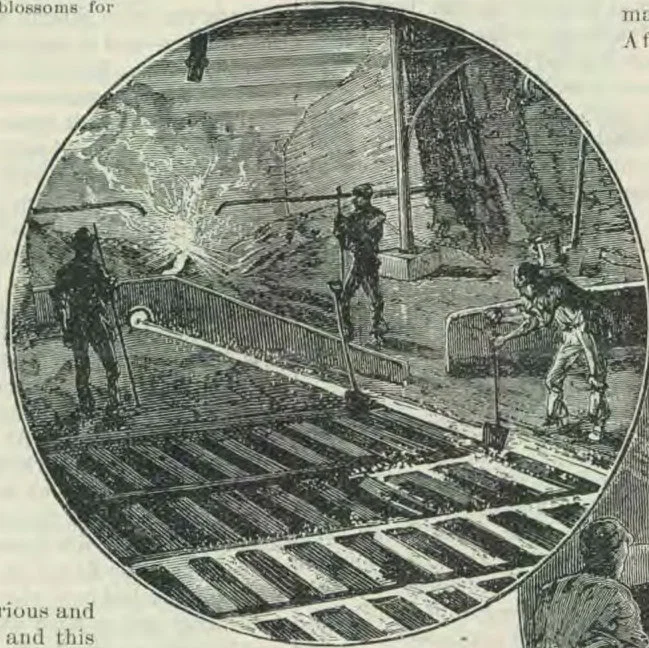
But the most interesting and beautiful part to us was the “drawing off.” In front of the furnace is a large bed of sand, made into trenches. When the ore has all melted, it is run into the trenches from the furnace. As down flows the fiery and beautiful iron river, happy, singing negroes stand ready to place a spade at the end of each mold after it is filled, so that no more iron may run into that one. After the iron molds are full, the iron is cooled with water; and before it is fairly cold, the men are busy stacking it on one side ready for shipping or to be used in the rolling-mills. This is now called “pig-iron.”
But in melting all this mass of ore, there is a great deal of dross. This is lighter than the pure iron, and floats on the top; so it is easily drawn from the furnace through an aperture above that through which the iron is allowed to escape. This dross is called “slag,” and is used for many things,—on railroad beds, for foundations for walks, and is not unfrequently made into pretty dishes.
Day after day and night after night the work is carried on, the new industry waking up and infusing new life into this part of the nation. E. M. O.

Accountability for Idle Words and Silence

As we must render an account of every idle word, so must we likewise of our idle silence.

Cooling and Stacking Iron in Molds

So that no more iron may run into that one. After the trenches, or molds, are full, the iron is cooled with water; and before it is fairly cold, the men are busy stacking it one side ready

THE INDIANS AS THEY ARE.

ONE whose knowledge of the Indians is founded upon what has been written about them, would hardly recognize those seen at the present time. Many very absurd things have been said of this people by writers who cared little for truth, but only wished to make an exciting story; and much else has been said regarding them, which, though true of the time of which it was written, does not at all apply to the small remnant of the American race now remaining.
When the Indians occupied alone a vast territory, entirely separated from all other countries, and surrounded by circumstances unlike those of any other people, it is not strange that they came to possess peculiarities of character, appearance, and practice; but since they have come in contact with the white people, these peculiarities have greatly worn away—except one, which has instead been copied by nearly all nationalities—that of smoking.
We are inclined to think that we have civilized the formerly barbarous occupants of our continent; but, while most of them are no longer accounted savages, they are in some respects worse than when in savagery. You may remember that when some of the earliest explorers of America landed among a crowd of astonished natives, the alcoholic liquor which the sailors offered, was passed from one to another of the Indians, untasted. They have since, however, learned to taste too greedily the beverage which makes a very ignoble wretch of the “noble red man,” as well as of the white man. They are more affected by its use; and a drunken Indian is one of the most repulsive creatures I ever beheld.
In Michigan, the sale of intoxicants to Indians is specially prohibited by law. But this law is openly violated; and a missionary among the Indians, who is at present trying to have it enforced, is threatened with violence by unprincipled liquor-dealers.
We are glad to know that there are some teetotalers among the Indians. It is reported that one of these was recently returning from a school in the East which he had attended for three years, when a young man on the train, rushing up to him, tried to repeat some of the trash he had read in story papers about “big Indian,” and extended a bottle of “fire water.” This the Indian refused, quietly remarking that where he had been, gentlemen didn’t drink intoxicating liquors; and he also advised the young man to read something more sensible than story papers.
In the various tribes are found all grades of civilization, from the primitive savage to the man of intelligence and education. Many schools are conducted among them, by the Government and by missionary societies; and some of their young men are educated in Eastern schools. A friend of mine was once offered a position as governess and music-teacher in the family of a Cherokee Indian. The Government has formerly assisted in the support of schools for the Indians in Michigan, and employed an agent to distribute the money devoted to this purpose; but at the last session of Congress, it was learned that the salary of the agent was more than the amount paid to the schools, and hence the work was discontinued.
The Cherokees are the most enlightened of the tribes, some of them conducting prosperous business enterprises, others practicing the various professions. We once had in our possession a paper published by a Cherokee, partially in English, the remainder in their own dialect. We have also traded with Indian merchants, boarded at a hotel conducted by Indians, and conversed with an Indian lawyer. Still, we cannot claim for this race an intelligence equal to that of our own race. Not having been accustomed, when young, to thorough study and work, they suffer the lack in later years; and most of the positions of responsibility among them are filled by white men. Even in places where they have long had schools and churches, it is seldom that one of their own number is found capable of acting as teacher or minister. If they received at home the training which the INSTRUCTOR children have, to work, and bear responsibility, and think for themselves, they would not remain thus inferior.
Some of the Indians still live, as did their forefathers, in poor little wigwams scarcely large enough for a play-house. We have sometimes come unexpectedly upon these abodes, the first sign of their nearness being the ever-present dogs. Some also still wear the meager clothing of the savage, spending their time in fighting, hunting, and fishing. They generally incline to their former shiftless habits, wandering about, working a little occasionally, perhaps picking berries in their season.
Others, however, occupy good houses, well kept, and cultivate farms or engage in other business, imitating the whites as far as possible. In one settlement which we visited was a brass band. Here we also beheld a young Indian dude! Many of their women also vie to excel in fashionable dress. If our girls could see how ludicrous some of the Indian girls make themselves in trying to appear stylish, they would think it an honor to wear simple clothing.
We once met an Indian funeral procession. It was not at all like those of which you may have read in United States history, but it did possess one peculiarity seen among all the less civilized peoples—the women were apart by themselves, several rods from the men.
Many of the Indians are still heathen, as were their ancestors; while quite a share of them have learned a little or much of the Christian religion. We once visited, in Northern Michigan, an Indian Catholic church, more than one hundred years old, which had been founded by missionaries from Canada, and which was under the charge of a German priest. Mingled with the ancient pictures of saints which adorned the walls, and the candles burning before the altar, were the fantastic ornaments so much made by Indians; and the wooden crosses which marked the graves in the churchyard were also hung with wreaths of many-colored paper flowers.
Again, we visited a Protestant chapel, and heard a sermon by an Indian preacher. You would not have thought it much of a discourse; but yet the earnest old man had done much to improve the condition of his people. They sang very correctly some of the old hymns which we hear in our churches, the words having been translated into their language.
This preacher informed us that the Old Testament is not printed in the language of the various tribes; and they generally have formed the opinion that it is of no use at the present time, but was intended for a people who lived long ago. He, however, had a copy of the English Bible, which he was able to read; and they, knowing this, would often exclaim, when he said anything which displeased them, “He reads that in the old book!”
Perhaps some of our little letter-writers who live in or near Indian Territory, could tell us some other things about the Indians which would be new to the readers elsewhere.
MRS. ADA D. WELLMAN.

WHAT SHE COULD DO.

Susan Bolles was the plain, quiet sister of a beautiful, brilliant girl.
At school, Lena, at the head of the class, rattled over French verbs or Roman history, which she had committed to memory in an hour, while Susan had pored over them in vain. It is true that Lena forgot her lessons as quickly as she learned them, but she had a faculty of displaying every scrap of knowledge in a way which won her notice and applause.
The whole school regarded her as a genius, and was proud of her poems and essays. They were not aware, what was nevertheless the fact, that there was a close resemblance in the ideas and words of all that she wrote to those of the last book which she had read.
Susan also at first labored over poems and stories, but failed utterly, and finally acquiesced in the opinion of the school-girls that she was a dunce. "Susan," said her teacher, "is no linguist, no musician, no mathematician. It is difficult to determine in what her talent lies."
But Susan's keenness of observation and her warm heart made her a helpful child. It was Susan who saw that her father's gloves needed mending, and who darned them so neatly; it was Susan only who knew how to make dry, crisp toast for her mother when she was ill; it was Susan who handled the baby more skillfully and tenderly than anybody else. No scrap of knowledge about the ordinary affairs of life was too trifling for her to learn.
"Susan," said Lena, contemptuously, "will be an admirable cook, seamstress, and nurse." She felt that she herself was born for something higher. But when one of the school-girls cut an artery one day, it was Susy who quietly made a tourniquet, and stopped the bleeding until the doctor came.
"You have saved her life, child," he said. "How did you learn to do it?"
"I saw it in a book," she said, modestly. She pored over books which taught of the care of the house, children, or the sick. These things she could remember. "I am a dunce, but I may be of some little use," she thought.
As time passed, her quick observation, her tact, and kindly sympathy, made Susan a practical, useful woman, and gave her a charm of manner which gathered about her hosts of friends. Lena was always showy, superficial, and helpless. As she grew older, she missed the applause which had followed her in youth, and grew bitter and ill-tempered.
We give this sketch of two real characters for the benefit of girl readers, who, because they have mediocre abilities as scholars, begin to fear that they have but a low, mean part to play in life.
The alert, tender, domestic woman, full of the homely wisdom which enables her to be helpful to the body and soul of all who come near her, is one of the most useful of God's ministers in the world.—Youth's Companion.

APRIL

Birds on the boughs before the buds Begin to burst in the spring, Bending their heads to the April floods, Too much out of breath to sing!
They chirp, “Hey-day! How the rain comes down! Comrades, cuddle together! Cling to the bark so rough and brown, For this is April weather.”
“Oh, the warm, beautiful, drenching rain, I don’t mind it, do you? Soon will the sky be clear again, Smiling, and fresh, and blue.
“Sweet and sparkling is every drop, That slides from the soft gray clouds; Blossoms will blush to the very top Of the bare old tree in crowds.
“Oh, the warm, delicious, hopeful rain! Let us be glad together. Summer comes flying in beauty again, Through the fitful April weather.”
—Celia Thaxter.

A DINNER IN SIBERIA.

A LETTER from Siberia says: “Our dinner-party in the evening—and it was really a dinner-party—was extremely merry. Each one laid his stores under contribution. Some brought out frozen bread, others frozen caviare, others still frozen preserves, others again sausages, which could not be bent, even if put against the knee and pulled with all the strength of both arms. Can you imagine without laughing the appearance presented of seven half-famished people sitting at table, with thirty dishes before them, and unable to touch one of them, except at the risk of breaking their teeth? Nothing could be done except to wait patiently for the dishes to be thawed. Gradually, as each article of food softened, faces brightened, and when at last a knife entered one of the dishes, there were shouts of triumph, which announced the beginning of the meal. At the close of the dinner, we ate excellent fruit, which had been kept frozen. Throughout Siberia, as soon as very cold weather sets in, all fruits are placed outdoors with a northern exposure. They are frozen through and through, and retain their flavor as completely as if they had just been plucked from the tree. When placed on the table, they are as hard as wood; and when they fall accidentally on the floor, they make the same noise that a wooden ball would do. While eating some game one day, out of curiosity I asked how long it had been killed. I was told, ‘over two months ago.’ When cold weather sets in, nearly every butcher kills all the meat he requires during the winter. Fish become so solid that in all the markets they are seen leaning against the wall, on their tails, no matter what their length or weight may be.”—Selected.

A PRACTICAL JOKE.

Most squirrels keep two or more stores of food. Wood, the British naturalist, tells of a friend who found one of these reserve stores which a squirrel had provided for an exigency, and the friend, in a moment of thoughtlessness, determined to play a joke on the squirrel. He accordingly replaced the nuts by small round stones, and carefully concealed all evidences of his visit. One cold day in winter he passed the spot, and found that the squirrel had called there a short time previously. This he knew by the fact that ten inches of snow had been scratched from the top of the hole, outside of which the stones had been cast by the disappointed animal. This struck the joker with remorse. He said: “I never felt the folly of practical joking so much in my life. Fancy the poor little fellow, nipped with cold and scanty food, but foreseeing a long winter, resolved to economize his little hoard as long as possible. Fancy him at last determined to break this, perhaps his last, magazine, and cheerily brushing away the snow, fully confident that a good meal awaited him as the reward of his cold job, and, after all, finding nothing but stones. I never felt more mean and ashamed in my life, and really would have given a guinea to have known that injured squirrel’s address. He should have had as fine a lot of nuts as would have put him beyond the reach of poverty had he lived to a good old age.”—Globe Democrat.

ALL ABOUT RATS.

Less than two hundred years ago, the common brown rat had never been out of Asia. There these animals lived in great numbers, and were governed by a rat king. In the time of an earthquake, many were frightened from their homes; they marched westward, and so entered Europe.
The black rat had long been at home there; but the emigrants made war on the natives, and, being fiercer and stronger, killed nearly all of them.
In America, the big brown fellow has conquered again, so that a black rat is seldom seen here. Both varieties came over hidden in ships. In the same way they have gone to all countries. It is a wonder how they manage to get on board. They have been seen walking on the cable by which the vessel is moored to the dock. And they are good swimmers, as we know.
If rats were less mischievous, they would be more interesting. They are said to be the most destructive animal on the face of the earth. Ten rats will eat enough to feed a man, and will waste as much more. There are millions about the great granaries of Western cities, where they are a real pest, just as they often are on board ships.
The rat has four long and very sharp teeth, two in the upper, and two in the lower jaw, formed like wedges. With these he easily opens a way through wooden walls; he also gnaws into lead water-pipes, and even attacks brick and stone. His hind feet are so supple that he can turn his toes behind, and hang on by them to a tree, or wall, or railing, when he wants to let himself down.
Rat fur brings a price in the market. The dressed pelt is so fine and soft that it is used for making thumbs of the best gloves.
It is to the credit of the rat that he is a very cleanly animal. He spends much time sitting on his hind legs washing his knowing little face, and sleeking his coat. There is nothing he detests so much as any substance that will stick to his fur. Even rats that live in sewers will keep themselves neat.—Our Little Ones.

CARELESS POLLY.

Something was always happening to Polly Loomis and everything she had. The covers came off her picture-books; her dolly’s dishes got broken or lost; her scissors and little silver thimble were gone for days together; she tore holes in her dresses, and spilled ink on her aprons. Polly was a careless girl.
One thing she wanted very much. It was a dolly with “really, truly hair” on its head. She teased papa, and mamma, and grandpa, and Aunt Carrie to get her one. She promised to be so careful; she wouldn’t let the “leastest” thing happen to it if she could only have it.
Aunt Carrie felt sorry for her little niece. “May be she will learn to be careful if she has one,” she remarked to Mrs. Loomis, one morning.
The next time Aunt Carrie came from town, she brought a long package with her. It was a dolly, with blue eyes that opened and shut, and long, golden hair.
Polly danced up and down, and hugged her treasure in delight.
Miss De Waxy was soon robed in a gay dress. She was the object of Polly’s deepest devotion for about a week. Then there fell a night when no little maid-in-waiting came to put her ladyship to bed. She was left, face down, on the veranda, where Aunt Carrie found her the next morning. If Miss De Waxy had had feelings, surely they would have suffered from such cruel neglect. As it was, nothing was hurt but the pretty dress and sash, which a light shower in the night had ruined.
It was afternoon before Polly wanted to play with her doll again. Then Aunt Carrie, looking out of the window, saw a mass of brown curls bobbing up and down over the lawn, and an anxious pair of grey eyes peering under every bush and shrub.
“Polly! Polly! come here,” she called at last.
Polly turned slowly toward the house.
“Have you lost anything?” she asked sympathetically, for she really felt sorry for Polly.
Polly hung her head to hide her rosy face, and did not reply.
“I saw you hunting, and I thought you must have lost something,” she continued; “besides, I found something that I think belonged to you.”
Polly drew nearer to her auntie, and began to roll up the strings of her apron.
“Yes’m,” she managed to stammer at last, “I—can’t—find—my—dolly.”
“Where did you leave it?”
“I don’t know. I played with it on the porch, and then Hoppy cackled, and I went to see if she had laid an egg—and I don’t know where I did put it.”
“Well,” replied Aunt Carrie, “I found a dolly on the veranda this morning, and her nice clothes were all spoiled by rain. Do you think it was yours?”
“Yes’m,” said Polly, faintly.
“Do you think I ought to give her to you?”
There was no reply.
“I think,” said Aunt Carrie, “that you should be punished a little to make you remember. So I shall not let you have Miss De Waxy again for two whole weeks.”
“Two whole weeks!” echoed Polly, with wide-opened eyes.
“Yes,” replied Aunt Carrie.
“Polly burst into tears. “I—can—remember—now,” she sobbed. But her auntie would not give it to her.
It was the longest two weeks Polly ever knew. There was nothing it seemed would be nice to play with but that dolly.
At the end of two weeks Aunt Carrie was very glad to give it to her again, and Polly promised that she never, never would forget any more. But she did.
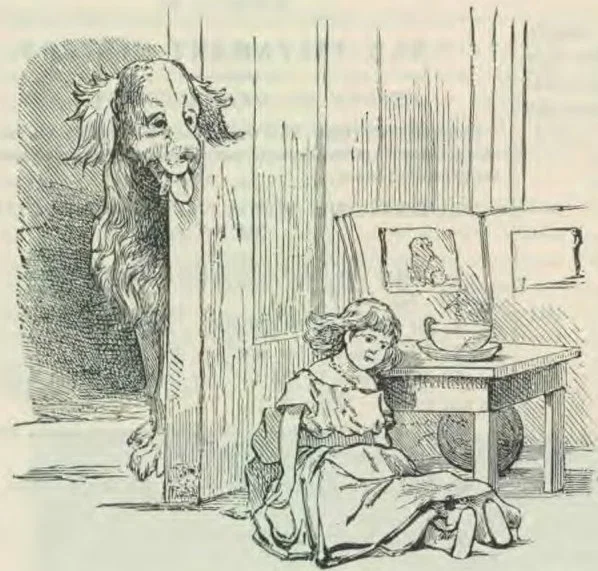
One day she ran off and left the nursery door open. Miss De Waxy was sitting on the floor.
Now Miss De Waxy had another ardent admirer in the house besides Polly. It was Rover. Rover especially loved dollies.
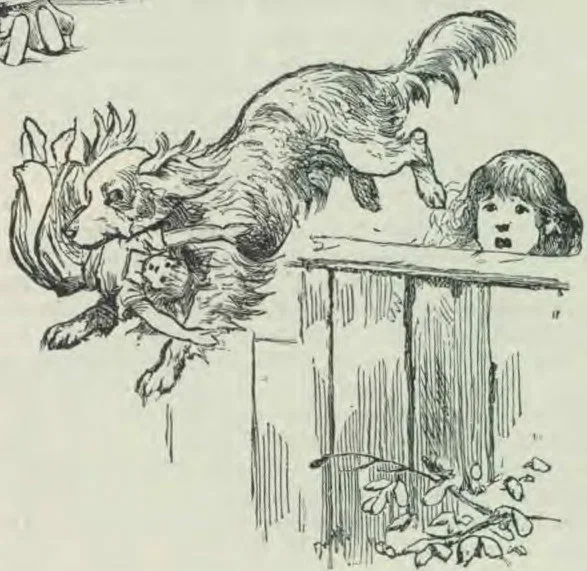
He was walking up and down the hall when Polly went away. He saw the open door, and peeped in. Miss De Waxy lay temptingly near. Rover seized her in his mouth, and ran outdoors.
He scampered across the lawn. Polly saw him, and ran after him. The more Polly ran, the faster Rover went. He leaped over a high board fence that Polly could not climb. He tore a great hole in the beautiful dolly, and shook the sawdust out, and broke her head.
Polly could not save her treasure. She stood by the fence and cried. The next day she had a funeral, and Aunt Carrie went to it.
Polly never had another wax dolly. I do not know whether she has learned to be careful or not. She is trying, and if she does not get discouraged, I think she will succeed. W. E. L.

HOW HULDAH LEARNED TO TRUST IN THE LORD.

“I’m glad you’ve come, Huldah. Run quick to Mr. Ray’s and get some wormwood. Your father has sprained his ankle and it is very painful.”
“Oh mamma, how did it happen?”
“Never mind now, dear, I’ll tell you when you get back. Go as quickly as you can.”
Huldah was a little girl eight years old, who lived in a mountainous district in the northern part of New York. She had no brother, and she had been to drive up the cows, as she often did for her father.
It was always a delight to her; for she loved the woods, and the lanes bordered with shrubs and wild flowers, through which she had to pass. Sometimes in her eagerness to watch the squirrels or find a bird’s nest, she would linger until the evening shadows gathered.
Mrs. Ray, to whom Huldah was sent on the errand, lived a mile distant. There were no neighbors between the houses, and as Huldah hurried along, the trees and bushes cast such queer shadows that they looked like huge beasts, and she began to be afraid, and wondered if there really were bears and panthers in the woods.
She would have turned back had she been upon any other errand; but she thought of her poor suffering father, and felt that she must go on. All at once a text which she had learned the week before came to her mind, and she began to repeat it to herself: “What time I am afraid, I will trust in Thee.” She did not feel so much alone now. “The Lord is in the dark,” she said, “and he won’t let anything hurt me.” Her little feet flew very fast over the rough, stony road, till she arrived, almost breathless, at Mrs. Ray’s door, and told her errand.
Mrs. Ray went quickly to the garret for a bag of wormwood, which had been carefully cut and dried the year before, and placed in a sack to keep from the dust. As she handed a package of it to Huldah, she said: “Aren’t you afraid to go alone? Don’t you want Mr. Ray to go with you?”
“No, ma’am,” said Huldah, “I was afraid, till I remembered that the Lord was in the dark, and then I wasn’t afraid any more;” and away she flew, leaving Mrs. Ray gazing after her into the darkness.
The way did not seem half so long to little Huldah as she sped homeward, although it was much darker.
Her father called her his “good little girl,” and her mother praised her for going so quickly.
By and by, after the wormwood had been steeped and bound upon her father’s ankle, and he had been made comfortable in bed, while Huldah helped her mother wash the tea dishes, she learned all about how the accident happened, and felt glad that she had been able to do something for her dear father.
As she kissed her mother good-night, she said, “I shall never be afraid to go down cellar in the dark again. When I was going to Mr. Ray’s, I was afraid, and once I thought a bear was coming out of the bushes, and I didn’t dare go on till I remembered the text you taught me last week, and then I wasn’t afraid any more. It seemed as though Jesus was walking with me, and I shall always remember that he is with me in the dark as well as in the light.” And she kissed her mother again, and ran lightly up the stairs to her own little room.—The Sabbath Visitor.

A MODEST CAT'S SOLILOQUY.

BEFORE the blazing fire, on a downy Turkish rug, Lay pussy gently napping, quite as snug as any bug: She looked supremely happy, and most musically purred, Nor imagined for a moment she was being overheard; But I happened to be present, and caught every word she said, And this is quite the train of thought that ran in pussy's head:— “Oh, what a grand and glorious thing it is to be a cat! Yes, every day I live I grow more positive of that.
“For all the great, big, busy world—as is quite right and meet— Comes humbly every day to lay its tribute at my feet! Far down within the damp, dark earth, the grimy miner goes, That I, on chilly nights, may have a fire for my toes; Brave sailors plow the wintry main, through peril and mishap, That I, on Oriental rugs, may take my morning nap; Out in the distant meadow meekly graze the lowing kine, That milk in endless saucerfuls, all foaming, may be mine:
“The fish that swim the ocean, and the birds that fill the air— Did I not like their bones to pick, pray think you they'd be there? But first of all who wait on me, pre-eminent is man; For me he toils through all the day, and through the night doth plan; Especially the gentleman who keeps this house for me, And takes such thoughtful, anxious care that I should suited be. He's stocked his rare old attic with the finest breed of mice,— A little hunting, now and then, comes in so very nice!
“And furthermore, the thoughtful man, a wife has married him To tidy up the house for me, and keep it neat and trim; And both of them with deference my slightest fancy treat; And as I'm quite fastidious about the things I eat, They never offer me a dish, to please my appetite, Until they've tasted it themselves, to see if all is right; And to entice my palate, when it's cloyed with other things, All fattening in a gilded cage, a choice canary swings.
“But, best of all, they're training up, with pains that can't be told, Their children, just to wait on me, when they have grown too old. Ah, truly I am monarchess of all that I survey; No rules or laws I recognize, no bells or calls obey. I eat and sleep, and sleep and eat, nor ever have I toiled; No kind of base, degrading work my paws has ever soiled. Oh, truly 'tis a gladsome thing to be a pussy-cat! I'm truly glad, when I was born, I stopped to think of that!” —St. Nicholas.
Continue reading: HOW JAMIE CHANGED HIS MIND