The Youth’s Instructor, Vol. 38, No. 1.

BETTER THAN COASTING

The Youth’s Instructor

Jan 1, 1890

S. D. A. Publishing Association · Battle Creek, Mich. · Jan 1, 1890

BETTER THAN COASTING.

“Say, boys! Wait, can’t you? There’s just splendid coasting down the side hill, and Bob and I have this big sleigh. Can’t hardly manage it alone, it’s so clumsy, but it goes like lightning when you get it started once. Can’t you come along, and help us balance the thing?” Will Bartlett came up to the Harrison boys all out of breath, dragging a great coasting sleigh behind him.
“Thank you, Will,” said John, good-naturedly. “We would like to go coasting, but we have more important business on hand, as you can see by our buck, saw, and ax.
“Where are you going? and what are you up to that you can’t go coasting?”
“Oh, we’re going down to Mrs. Holden’s, to split up some wood for her. Father took her a load of slabs yesterday, and as there are no men folks there, he said he thought we boys ought to go and help her get her wood in shape to burn.”
“What are you going to get for it?” asked Will.
“Nothing, as I know of. We’re not working for pay, you see.”
“Well, you are great spoonies, that’s all I have to say. I’d let the old lady split up her own wood, or pay for getting it done.”
“Well, we haven’t been brought up to have the opinions you express. Mother has always taught us to do to others as we would have them do to us, if we were in their situation. Now just suppose you were a poor woman left alone in the winter, wouldn’t you be glad to have some strong young fellows like us come and chop you up some wood?”
“Humph! Don’t know what I should like. I’ve never been a poor, forlorn old woman yet, and never expect to be. But never mind that. Come and coast awhile anyway. You’ll have plenty of time for the old lady’s wood after awhile.”
“What’s that we sang in Sabbath-school?” said George. “Just say No,—a good, round, hearty No. I’m afraid that if we went coasting, the wood-pile would be forgotten. ‘Business before pleasure,’ you know. We’ll have a chance to coast to-night. Say, would you mind lending us your bob to-night?”
“Rather think I would,” said Will, angrily. “Fellows that won’t accommodate me, I don’t propose to accommodate.”
“Very well,” said the boys, “it’s all the same to us.” And they turned the corner to go to Mrs. Holden’s.
“I would like to have taken a few coasts,” said John, looking back toward the hill, “but I guess we’ll have some fun getting that pile of wood cut up.”
As soon as the boys came into the yard, they were glad they had not gone coasting; for Mrs. Holden was trying to cut up some wood herself with a hatchet, and she looked much pleased as they told her they had come to cut it for her.
“I declare,” she said, “if I believed in fairies, I should certainly think two of them had come to my help.”
“Guess we don’t look much like fairies,” said John. “But we can make that wood change its stubborn appearance.”
“I expect it will be with me something as it was with the old woman who tried to get her pig over the style, only the rhyme will read, ‘The boys began to chop the wood, the widow began to pick the sticks, the fire began to burn them up, the oven began to bake the apples;’ and, boys, when they are baked, you shall have some.”
The boys split the wood vigorously, and it did Mrs. Holden good to hear them whistling and singing at their work. They piled it up in the wood-shed all ready for use. Their faces grew rosier and rosier, and their hearts glowed with real happiness.
Mrs. Holden soon had a blazing fire in the stove, and when the boys were through chopping for the night, she called them in to have some warm baked apples and biscuit. How good the lunch did taste! Mrs. Holden looked admiringly at their bright faces, and enjoyed seeing them eating so heartily of her simple relish.
“How I would like to have two such boys as you are. I had once,” she said, the tears gathering in her eyes, “but they are both dead. I hope you will come in often; for it seems like old times to have you here.” Mrs. Holden got her album, and showed them the pictures of two beautiful boys about their own age, who had been drowned. A sudden pity for the lonely woman sprang up in their hearts, and they stopped awhile to visit with her. They sang for her, and told her of their life on the farm before they moved to town, so that, before they left, she seemed quite cheerful.
“Why, you are quite late,” said their mother as they came home. “I began to think you must have gone coasting after chopping wood.”
“No,” said George, “we stopped to visit with Mrs. Holden, and she gave us a capital supper. I tell you, I just like to work for her. She’s what I call a first-class woman. Say, John, let’s go every night till we get the wood all cut up and piled in the shed. I’d rather do it than coast.”
“All right,” said John, “I think we probably had as much fun as Will Bartlett had this afternoon.”
“Did you hear about the accident, then?” asked Will, John’s younger brother.
“What accident? No. What happened?”
“Why, Will came down to coast this afternoon, and he was as mad as a hornet about something; he wouldn’t let one of us ‘small fry,’ as he calls us, get on his bob. Well, you see the thing was so big he couldn’t manage it, and instead of going down hill, it whirled over the side, and came ker-chunk against the rocks and timber, and smashed the sleigh all to pieces. Will was pretty badly banged up himself, and we boys had to carry him home, but the doctor says there are no bones broken. But say! boys, there’s lovely skating on the pond, and father said we might all go for an hour.”
“Hurrah for the ice!” said the boys, hurrying to get their skates. They found the ice as smooth as glass, and they had a delightful time. As they were going home, the snow began to fall in great, feathery flakes, and in the morning they found it about a foot deep.
“Good thing we didn’t go coasting yesterday,” said John. “Mrs. Holden would have a hard time getting at her wood to-day. Say, we’d better rustle down there before school, and shovel out her paths. One good turn deserves another, you know.”
In about two weeks after the boys had finished Mrs. Holden’s wood, a couple of packages came addressed to the two boys. On opening them, they found a pair of mittens for each, and a slip of paper, on which was written, “Inasmuch as ye have done it unto one of the least of these my brethren, ye have done it unto me.”
“What does it mean?” said John. “Who could have sent us these fine mittens?”
“I know,” said George. “It was Mrs. Holden. I saw her knitting this very color of red the last time I was there, and don’t you remember how she came and took our mittens in off the wood-pile, to get them warm for us? I see through the whole thing. But this writing I don’t understand. Let’s ask mother what it means.”
Mrs. Harrison read it slowly, and said, “It means that if you do ever so little a thing for one of God’s children, whoever it may be, Jesus counts it as if it had been done for him.”
“Does it mean even chopping wood?” asked John.
“Yes, even chopping wood.”
“Well, then, I’m gladder than ever that we didn’t go coasting.” FRANCES E. BOLTON.

THE HOLLY-TREE.

READER! hast thou ever stood to see The Holly-tree? The eye that contemplates it well, perceives Its glossy leaves Ordered by an intelligence so wise As might confound the atheist’s sophistries.
Below, a circling fence, its leaves are seen, Wrinkled and keen; No grazing cattle through their prickly round, Can reach to wound; But as they grow where nothing is to fear, Smooth and unarmed the pointless leaves appear.
I love to view these things with curious eye, And moralize; And in this wisdom of the holly-tree Can emblems see, Wherewith, perchance, to make a pleasant rhyme, One which may profit in the after-time.
Thus, should my youth, as youth is apt, I know, Some harshness show, All vain asperities I, day by day, Would wear away, Till the smooth temper of my age should be Like the high leaves upon the holly-tree.
And as, when all the summer trees are seen So bright and green, The holly leaves their fadeless hues display Less bright than they; But when the bare and wintry woods we see, What then so cheerful as the holly-tree?
So, serious should my youth appear among The thoughtless throng; So would I seem, amid the young and gay, More grave than they; That in my age as cheerful I might be As the green winter of the holly-tree.
—Robert Southey.

A NEWSBOYS’ HOME.

Among the many worthy and amiable organized charities of our large cities, none perhaps have proven more efficient and productive of good than the newsboys’ homes, or lodging houses. The one in New York City is a model in its way, and has been the means of saving many a poor boy from a career of crime.
This building is located at the corner of Duane and Chambers streets. It will accommodate over five hundred boys at night. At the head of the steps inside the entrance hall is the superintendent’s office, and on the same floor the great kitchen and the dining-room. Three meals are served daily, the charge per meal being six cents. The boys pay their money at the office, and receive checks in return. In the kitchen, which is a marvel of neatness and cleanliness, large caldrons of soup and boiling meat are always to be seen. The bill of fare, changing four times each week, consists of pork and beans, corned beef and cabbage, two kinds of soup and fish, and a plentiful supply of generous slices of bread, with all the butter, tea, and coffee a boy can ask for. No one is allowed to leave the table hungry if it can be helped.
The school-room and office are on the second floor, and each boy, before retiring, has to pass through the latter, and register his name. The school is one of the best in the city, and in it the boys obtain the rudiments of an education. Medals and prizes are offered for competition in the various grades.
A habit of saving is inculcated by savings-boxes, in which many of the boys keep their earnings. One boy is worth over $200, and to him new impecunious arrivals go to be started in business. He furnishes them papers, and takes half the profits until they are able to buy for themselves. Another monopolist rents out blacking-boxes and “kits” to his less fortunate companions, and so accumulates quite a sum weekly, which he prudently puts in his bank.
At the foot of the stairs on this floor which leads to the story above is the wash-room, with large troughs around its sides. Here every boy must take a bath before getting between the clean sheets of his bed.
The dormitory above has five hundred small spring cots, built on iron frames. Each frame has two cots, one above the other. The room is heated by steam, and is well ventilated. Above on the next floor, is another large dormitory for the very small boys; all these beds are occupied every night. In a side room leading off from this room are twenty cots much larger than any of the others, and more tastefully arranged, being separated from one another by turkey-red curtains hung on poles. The charge for these beds is ten cents nightly; for the others, six cents.
The boys call this room “The Dudes’ Retreat, or the Home of the Upper Ten.” The object in furnishing this room is to create a desire among the better boys to rise above their present condition into a better way of living, and to seek more remunerative employment than newspaper selling.
The top floor forms a large gymnasium most completely furnished. Here the boys have grand times tumbling somersaults, turning on the trapezes, climbing the ladders, or swinging through the rings, until 9:30, when all rush down to the bath-room for a wash, and then to bed.
The institution is under the care of the Childrens’ Aid Society; and though boys able to do so are compelled to pay their way, no poor boy is ever turned away. Last year the expenses amounted to $15,000, of which the boys paid less than $5,000.
W. S. C.

ROUND THE WORLD.—1.

VOYAGE ACROSS THE ATLANTIC.

The shades of a July evening were drawing over the landscape, as the express left the Michigan Central depot at Battle Creek, bearing us away on our journey around the planet on which we reside. The last farewells had been said, the last visit to familiar spots had been made, and now the long trip was really commenced.
A twenty-six hours' ride over the Michigan Central and West Shore railroads brought us to New York City. One day was spent at that place, and then we boarded the steamship Etruria, which was to take us across the Atlantic. This ship is an ocean greyhound; she belongs to the Cunard Company, and has made one of the fastest trips on record, in one day running over 500 miles, and completing the entire journey of about three thousand miles in five days, one hour, and twenty minutes. Our voyage, however, was destined to be of longer duration than this, owing to a strike among the firemen, occasioning the employment of inexperienced hands, who could not feed coal fast enough so that the engineers could run the iron horses to their full capacity.
We left the docks under clear skies; nature seemed to smile on the departure of the big leviathan of the deep, rather than to mourn over it. Hundreds lined the wharf as the propeller commenced to cut the water; some cheered, others wept, and the remainder manifested a stolid indifference.
During the first three days of our voyage the sea ran high, and a strong head wind was blowing. Our ship cut her way through the water, hardly rising at all, but at times rolling so much that huge green seas would break over her, washing the decks fore and aft. During this time the cabins were well filled, and the deck chairs comparatively empty, most of the passengers being engaged in culinary operations for the fish. After a time the waves and winds went down, and the sea was calmer. Under steam and sail the good bark swept along, at times disturbing a shoal of porpoises, who would try to run races with us for awhile, but would soon weary, and be left in the rear.
There is something truly grand in scenery at sea, as viewed at night from the deck, the huge black hull treading its way on the restless billow, and the dark sails and rigging clearly outlined against a starry sky. These vessels appear like a wonderful monument of modern skill, and yet one cannot help but be impressed with the thought of what a little thing it would be for that ship, with her precious cargo of living freight, to be sunk with all on board, and none escape to tell the tale.
Time at sea is reckoned by bells. Every half hour the bell rings in the following manner: At twelve noon it rings eight times, at half past twelve it rings once, and at one o'clock twice; every half hour an extra ring is given, till four o'clock is reached, and then it rings eight times again, after which the same routine is followed for the next four hours, and so on every four hours of the day and night.
Aft of the forecastle deck on an ocean steamer is the “Lookout,” and just behind and above it is the bridge, where the officers stand to navigate the ship. On the former, which is really nothing but a second bridge, one sailor is always on watch during the day, and two during the night. They pace to and fro, anxiously scanning the horizon for ships, icebergs, or danger of any kind. After dark the sailor on the port, or left side of the “Lookout,” sings out, every time the bell rings, “All’s well!” This is taken up by his comrade on the starboard side, and then repeated by the officers on the bridge. The cheering sound of their usually deep bass voices seems to inspire courage in all on board, as the ship plunges on through the darkness.
Each different line of steamships has its own road across the ocean, and is by law bound to keep to it as much as possible; this is done in order to avoid collision. A bright headlight swings in front of the forward mast, a green one on the starboard quarter, and a red on the port. By the rules of the water, ships must pass each other on the side of the green light.
We had put to sea on the twentieth of July, and one week from that day, about ten A. M., the cry of “Land ahead!” resounded throughout the ship, and the barren cliffs of the west coast of Ireland hove in sight. Historians and lovers of romance have given to this place the name of “Emerald Isle,” but little on the southwestern coast would lead the expectant tourist to believe that a merited title had been bestowed. The rocks are almost perpendicular as they rise out of the water, and they are entirely devoid of vegetation. Not a house and hardly a hut is to be seen for miles and miles. Soon the Fastnet Rocks appeared, on which there is a light-house, and from which the safe arrival of the steamers is wired on to London, and back to the United States. We now rounded the headland, and the scene was more animating. Green fields and verdant woodlands, with straw-thatched cottages nestling beneath the hills, appeared to view; and although there is not much in their appearance that bespeaks wealth, there certainly is that which tells of comfort and contentment. At the Cove of Cork a tender came alongside to take off the mails and passengers wishing to visit Erin’s Isle. We bade farewell to the Etruria, and were soon once more on land.
P. T. M.

“HANDSOME IS THAT HANDSOME DOES.”

OUT of sight, my boys and girls. Every root of beauty starts; So think less about your curls, More about your minds and hearts. Cherish what is good, and drive Evil thoughts and feelings far; For, as sure as you're alive, You will show for what you are. —Alice Cary.

A PRETTY WORLD.

I once strolled through a miserable Mexican village. The shadows were creeping over the cabins, where women came and went in silence, and men sat smoking at the cabin doors, while children played in swarms by the water. The air was like a breath of God, and all nature seemed as sacred as rest to a weary man. A black, bent old negro woman, all patches from head to foot, frosty-headed, and half blind, came crooning forth with a broken crock, tied together, in which she had planted a flower to grow by her door. I stopped, watched her set it down and arrange it; and then, not wishing to stare rudely at this bent old creature, I said,—
“Good evening, auntie; it's a pretty evening.”
She slowly straightened up, looked at me, looked away at the fading sunlight on the hills, and said, softly, “O, it's a pretty world, massa!”
That old woman was a poetess—a prophetess. She had a soul to see the beauty, the poetry about her. “O, it's a pretty world, massa!” She had no other form of expression, but that was enough. Hers was the password to nature. “And God saw everything that he had made, and behold it was very good.”—Joaquin Miller.

THE “DRIVER” ANTS.

THE most formidable of the insect pests that affect the dwellers on the West African coast is the “driver” ants. These insects move in vast armies of several millions, marching in a dense column two feet in width, at a uniform pace, and in a straight line.
If a native hut lies in their path, and the inmates fail to prevent the ants from gaining the threshold, the hut must be vacated till the long line has passed through and consumed everything eatable within the building.
The author of “Glimpses of Feverland” says that the only thing which will stop the “drivers” is a large fire directly in their line of march. A native, when he discovers in time that the ants are marching towards his hut, kindles a fire in front of the advancing column. It turns neither to the right nor to the left, but plunges into the flames; for every ant seems impelled to go forward, no matter at what cost.
After the “drivers” have walked into the fire for an hour or two, and several hundred thousand have been consumed, their sturdy stoicism weakens. They deflect their line to the extent of a few feet, and, passing the fire, set out on a fresh path of destruction, which leads them clear of the hut they had threatened.

“I DON'T SEE WHY.”

I know a little girl who has a very pleasant home, and the very kindest of parents, and who is yet often discontented and unhappy. She pouts her lips, and throws her arms about, and sulks, and stamps with her feet, and makes a strange noise in her throat, between a growl and a cry. It is not because she has not enough to eat, of good, wholesome food; nor because she has not time to play, and plenty of playthings, and brothers to play with her. She is not blind, nor lame, nor deformed in any way, but has health, and strength, and everything which any little girl could wish, to make her happy in this world, except a good heart.
What was it that made her fretful?—Why, she had a kind mother, who told her what she must do, and what she must not. I will tell you what I heard.
“Caroline, you must not take my scissors.”
“Why, mother, I have no scissors to cut off my thread,” said Caroline, pettishly.
“Well, my dear, I will give you a pair, but you must not take mine.”
“I am sure I don't see why. It's only just to cut off my thread.”
The scissors were of the finest kind, and highly polished; and Caroline's mother knew that it would soil them if she should handle them with her moist hands; and that if she had them once, she would want them again. Caroline's business was to obey cheerfully, whether she saw the reason why or not.
“Caroline, my dear, you must not climb upon the chair to reach your work. You must ask some one to get it for you.”
“I'm sure I don't see why. It is less trouble to get it myself than to ask somebody to get it.”
“Very well, my child, you shall do it in your own way, and see.”
That very afternoon Caroline mounted a chair to get her work. She reached too far, and over went the chair, and Caroline went with it. Her work was scattered over the floor—the needle-book in one direction, and the thimble in another, and the cotton in another; and, what was worse than all, her head struck the edge of the door, and a large gash was cut in her forehead. She cried sadly, and did not get over her hurt for weeks. Was it less trouble to get it herself? If she had trusted her mother, she would have saved herself all this pain; but for the sake of knowing the reason why she should not get up on the chair, she caused herself a severe wound, and a great deal of shame and sorrow.—Young Reaper.

AUNT DEBORAH'S TABLE.

THERE was just one piece of frosted cake on the plate,—all the rest was plain sponge,—and Nancy reached over and took it. Nancy's little brother George rolled his big black eyes at his Aunt Fanny, and her little sister Mary stared from one to the other with her solemn, shocked blue ones, but neither said anything. They knew Nancy ought not to have done that, and she the oldest, too, but they were too abashed to say anything when they were visiting. All three were spending a week with their Aunt Fanny Winslow, who lived in Duffield.
Aunt Fanny did not say anything, either. She sprinkled a little powdered sugar out of the bowl over the children's squares of sponge cake, and did not seem to see that Nancy was eating her frosted piece.
Nancy tried to appear unconcerned, but there was an ashamed and defiant smile on her little face when she looked at her brother and sister.
The little ones had to go to bed half an hour after tea, but Nancy sat up an hour longer, as she was the oldest.
She sat with Aunt Fanny in the parlor, and sometimes they played games. To-night they did not. Directly after the children went to bed, Aunt Fanny went across the room, and dragged into the middle of the floor an old-fashioned table that stood against the wall. She put up the leaf, and twisted one of the legs around to support it. That brought two of the legs very close together, about a foot apart, at the edge of the table.
Aunt Fanny pointed to them. “I guess you'll have to sit here at Aunt Deborah's table,” said she.
Nancy hung her head; her aunt's tone said more than her words.
“I don't know what you mean, Aunt Fanny.”
“Well, you see,” said Aunt Fanny, “there are nice places for just three persons to sit at this table, but the fourth would have to sit here, and that is not comfortable at all. Nancy, you just pull your chair up here and try it.”
Nancy dragged her chair up hesitatingly, and sat down. Her knees bumped against the two legs, and there seemed to be no place for her feet.
“You wouldn't like to sit there very well, would you?” said her aunt.
“No, ma'am.”
“Well, that was where I sat and had my supper for three years when I was a little girl. You sit there while I tell you about it, Nancy.”
Nancy's cheeks were very red. She kept her eyes on the beautiful old table, while her aunt, in the rocking-chair beside her, went on:—
“You know my father and mother died when I was a very little girl, and I went to live with Aunt Deborah. Well, this was my Aunt Deborah's tea-table. It wasn't made for a tea-table; it was an old-fashioned card-table, but she always used it for that purpose. There was only Aunt Deborah and I to sit at it, so we managed well enough, and nobody had to sit in that uncomfortable place where you are.
“Well, one afternoon when I was about nine years old, we had company to tea. Aunt Deborah had invited the doctor's wife, Mrs. Cutts, and an old lady whom everybody called Madam Winter. Everybody in town stood a little in awe of her. Her husband had been old Squire Winter, and she lived in a beautiful old house with fluted pillars, and she always wore a black silk gown, and a pearl brooch to fasten her handkerchief, and a tall white cap.
“The ladies came early,—they always did in those days,—and we had tea about four o'clock. Well, there were four plates laid at that table, and one of them came in that uncomfortable place, and there Betty had set my own mug, with pink roses and ‘Remember Me’ on it in gilt letters.
“When we all went out to tea, I spied it, and I just slipped in before the others, and changed my mug to the next place, and sat down, and that obliged Madam Winter to sit in front of the two legs. Aunt Deborah flushed up, and she gave one look at me, but she didn't say anything. She never reproved me before company. The little silver tea-pot and creamer were at one of the comfortable places, and she had to sit there herself or have the confusion of changing them, and she had already motioned Mrs. Dr. Cutts to her seat, so there was nothing to do for her but to make the best of it. Madam Winter kept hitching her chair, and trying to get nearer the table, and it did seem as if she had fairly to stretch her little hands in their black mitts, to butter her bread on the plate. But Aunt Deborah sat behind the cream and sugar, and never seemed to notice; she looked just as gentle and peaceful as ever.
“But I couldn't eat much; we had tarts for tea, too, and hot cream biscuit. I knew Aunt Deborah wouldn't scold, but I knew I should have some punishment. I didn't find out what it was until the next afternoon, either, and that made it worse. I worried about it all day. Aunt Deborah never mentioned it to me that night after the company was gone, or the next day, until tea-time. Then I found my mug in the place where you are, before the two legs.
“I sat down; I did not dare to say anything. Then Aunt Deborah spoke: ‘You will sit there and eat your supper until you are twelve years old, and old enough, I hope, to know and observe good manners,’ said she.”
“And I did. It used to seem to me that my knees were sore from bumping against those legs. I had to butter my bread at arm's length; but I sat there and ate my supper every night until I was twelve years old. Then I hope I had grown to observe good manners, or rather unselfishness, which is the root of good manners, a little better, but I don't know. However, I never see myself or anybody else guilty of anything of the kind, but I think of that table of Aunt Deborah's.”
Nancy's small face was all of a soft pink, and there were tears in her eyes. She did not speak for a few minutes.
“I'm sorry I took that piece of cake,” she said finally. “And—I'll sit here the rest of the time we stay, if you'll have tea on this table, Aunt Fanny.”
Her aunt smiled.
“I'm afraid somebody's else stool of penance won't do,” said she. “No; I told you the story, child, that you might see the lesson one little girl had, and get a little profit from it.”
Nancy put her head down on Aunt Deborah's table and wept, and her aunt comforted her, and sent her to bed. Nancy was as bright as ever the next day, but at tea time, when the plate of cake was passed, she took a piece of plain sponge, although there was plenty of frosted.
“Take a piece of the frosted cake, child,” said Aunt Fanny, kindly.
But Nancy turned her blue eyes upon her aunt with a look of innocent resolution.
“I'm nine and a half now,” said she, “and I don't mean to eat a mite of frosted cake till I am ten years old.”—Congregationalist.

THE COWS OF INDIA.

Do you ever stop to think how many different kinds of animals are used, the world over, to carry people from one place to another? We use the horse, which is really the best for all purposes. But in many countries there are no horses. In some places the horse could not live and do the work that other beasts find it easy to do.
In the cold, frozen country of Greenland, tough little Esquimau dogs are used to carry burdens and draw sledges. In Lapland, the swift reindeer takes the place of the horse.
Over the long, hot, sandy desert wastes, where a horse would perish from thirst and heat, great camels carry their loads in ease and safety.
Elephants, and goats, and donkeys, and camels, and oxen, and I don't know how many other animals, all fill a place of usefulness as beasts of burden.
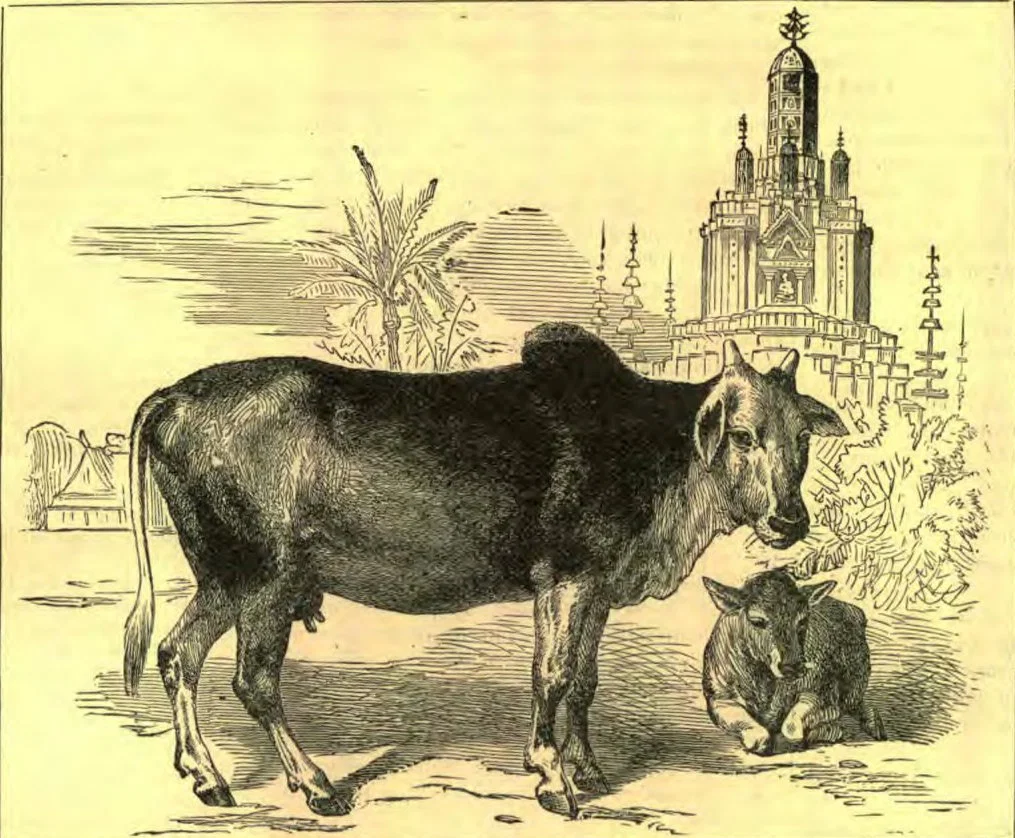
In our picture you see the hump-backed cows of India. The common name for these animals is Zebu. They are so quiet and easy to learn that they can be trained to do many useful things. They learn to draw carriages and plows. They travel with steadiness, but they cannot go fast.
People sometimes ride on the zebu's back. It can carry a rider for fifteen hours in a day, and will travel five or six miles an hour.
There are several kinds of zebus; and they vary in size from an ox to a large dog. One kind the Hindoos of India worship. This is the sacred Brahmin bull. The Hindoos place the sacred mark of one of their gods on its body, and let it wander where it pleases, up and down the streets.
You may imagine these animals walking in a stately manner up and down the streets, thrusting their noses into anything that happens to please them, or stopping to munch at the contents of a green-grocer's stall, while the poor grocer-man stands to one side, watching his wares disappear in the huge beast's mouth. But he will not dare to drive him away, nor even say anything to the beast. Indeed, if a Brahmin bull should choose to lie down in a place so narrow that none could get by, no one would think of disturbing him, but would wait until he chose of his own accord to get up.
Does it not seem strange that people should ever worship animals? How careful we should be to remember the true God, and to study our Bibles to learn how to become like him. W. E. L.

Somebody.

SOMEBODY, somebody—oh, dear me!— Who can that wonderful somebody be? He's always about us, yet never in sight, And constantly busy, from morning till night.
This somebody does all the mischief, you know; And when he has done it, pray, where does he go? Though he takes all the blame, he eludes the disgrace, By finding some out-of-the-way hiding-place.
If anything is broken or lost or mislaid, Then somebody instantly takes a tirade. That somebody does it is certainly true; But who does he look like?—A little like you.
The next time he does a thing worthy of blame, Just hunt for him, children, and find out his name; I know that he has them by dozens and scores; Perhaps it may happen this time to be yours. —Mrs. J. M. Dana.

Annie's Day of Helpful Kindness

hour. Then I helped my sister to do her sums; and then I went on an errand, and on the way, I met a child who had lost one of her playthings, and I found it for her. Then I went and read a story to a sick girl who is alone all day; and before I went to bed, I saw my two little brothers quarreling, and I coaxed them to make up and be good friends.”
Well done, Annie; you are rightly named. If you keep on that way every day, you will do a great deal toward making this world bright and happy like yourself.—Selected.

ANNIE BRIGHTFACE.

LITTLE Annie Brightface, if you are not too happy to stand still, let us see what you look like! How cheery you are all the time! What makes you so merry?
“I try to make everybody that meets me happier or better, and that makes me glad.”
How do you do that, Annie?
“Well, the other day I saw mother was weary, and I told her to lie down, and I would keep house till she was well rested. So she smiled, and lay down for an

LOOK UP.

I LOOKED at the clouds, And a star came through; It seemed to say, “I was watching for you.”
I looked on the ground, And the star hid away, And now can you guess What it meant to say?
“Life has sometimes a smile When it seems to frown, But to see it, my dear, Look up, and not down.”
—The Child’s Paper.

A TOUCH OF NATURE.

“One day on Broadway,” says an observer, “I heard a boy’s voice ring out above the noisy roar of the vehicles, clear and distinct, saying:—
“‘Hold on, blind man! stop still, blind man! wait till I can get to you.’
“Looking for the owner of the voice, I discovered a slender messenger boy, of fifteen or sixteen years, threading his way through a mass of vehicles to a spot just by the opposite curb, where a gray-haired man was standing as if riveted, with a look of mild despair on his face. It needed only a glance to see that the poor man had sightless eyes; that he had become bewildered, and was likely to be run over; that the quick-witted messenger boy alone of all the vast crowd had seen the dilemma, and had rushed to the assistance of the unfortunate creature.
As the lad brought the blind man safely to the sidewalk, I could not help thinking that here was an expression of that one touch of nature that makes the whole world akin.—Golden Days.
Continue reading: How Letters Are Carried