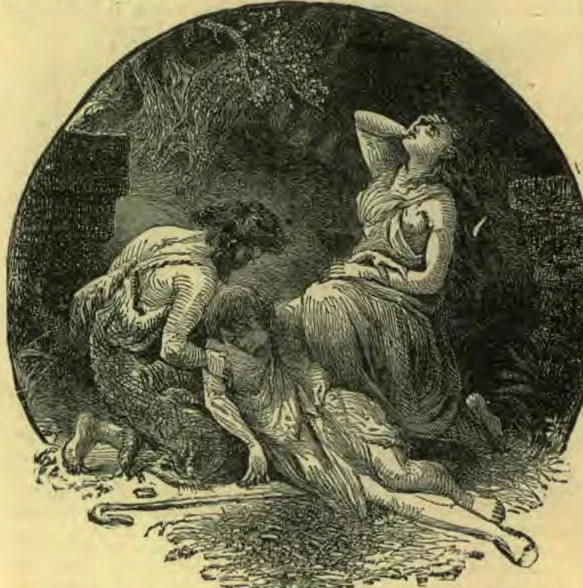
ABOUT four thousand years before Christ was born, there lived a boy who was so very much like some boys we see now, that I think I will have to tell you about him. I do not believe he was a thoroughly good boy, because he made a bad man. This bad boy had a brother who was very good.
If I should tell you that the name of the bad boy was Cain, and the good one was Abel, you would say right off, “Oh, yes; we know all about them; we learned it in our Sabbath-school lesson. They were the very first boys in the world.” And then you would go on to tell that when Cain grew to be a man, he was a farmer and raised grains and fruits; and that his brother was a shepherd, and looked after the flocks.
You will remember that one day the Lord commanded them each to bring one of the firstlings of the flock and offer it for a burnt-offering; and that when the day came, Cain, instead of bringing a lamb, brought the fruits of the ground. No doubt Cain thought it was a great deal of trouble for him to go to the flocks and get a good lamb, and he did n't see why the Lord needed to be so particular about what was brought for an offering, so long as an offering was made. I think Cain must have been selfish, and did n't want to put himself out of the way to please any body.
Abel took pains with his offering, and brought the best lamb he could find. God was pleased with it, sending fire down from heaven to burn it up. But Cain's offering stood unnoticed, just as he had brought it. This made him very angry indeed.
One day he was out in the field talking with Abel. I suspect that by this time Cain had begun to think he was a very much abused person, and that somehow Abel had n't treated him quite right. At any rate, as they talked, Cain grew so angry that at last he forgot the great God was looking down from heaven and watching all that he did; and he rose up and killed his brother! Think how sad Adam and Eve must have felt when they saw their dead son,—the very first death in all the fair new earth!
Do you think Cain all at once grew wicked enough to kill his brother? It always seemed to me as if he must have begun when he was a little boy. May be at first he did n't mind his mother the first time she spoke to him, thinking that some other time or some other way would do just as well; and at last he came not to mind her at all, and thought he knew the best. Then it would be very easy to go a few steps farther, and disobey the great God.
And I do n't suppose that the first time he grew angry, he would have killed any one. But instead of trying to put away all these wrong feelings, he carefully cherished them, and thought them over; and so his hatred and jealousy grew until it overmastered him.
So it always is; one little wrong makes it easier to do a greater one. And in the same way one good act makes the next good one easier. We cannot grow very good or very bad all at once. I hope the INSTRUCTOR boys and girls will remember this, and be very careful about the beginnings of things, to see that they are right; then it will be easy to have the whole right. W. E. L.
ONLY A CHILD.
By F. S. Hafford
ONLY a child; what can I do
That will be noble, grand, and true?
My hands are small, my voice is weak,
I have scarcely learned to think and speak.
Only a child, whose nimble feet
Have only trod 'mong grasses sweet.
They say that thorns and thistles wild
Will some day vex their little child.
Only a child,—and yet I know
How to lighten another's woe;
How to soften a hardened heart,
And bid the tear of repentance start.
Only a child, yet I can tell
Of Jesus' love for those who fell;
And how to ransom us he came
And bore the cross—despised the shame.
Only a child, yet Jesus said,
As to him a little child was led,
That in the bright and happy land
Where he shall reign, the children stand.
Only a child. O, in that day
When heaven and earth shall pass away,
When sinners quake, mid ruin wild,
May I be Jesus' little child!
F. S. Hafford.
PRUE'S MISSIONARY MONEY.
“O mamma, my potatoes are looking splendid, and papa thinks there will be at least six bushels; and if they are fifty cents a bushel, there will be three dollars. Only think! won't that be a good deal of money?” So saying, Phil Sanborn drew up to the dinner-table delighted.
“Yes, my son, that will be a good deal, indeed,” said Mrs. Sanborn, as she smiled down upon her ten-year-old boy.
The spring previous some of the ladies of the Woman's Board of Missions had been in that town to tell of the grand work they were doing, and even the boys and girls were interested. Phil had been told that he might plant some potatoes, caring for them himself, and have their price for missions when these ladies came around.
Prue, Phil's nine-year-old sister, heard, and her large blue eyes grew sad, for she had nothing to give.
“Eat your dinner, Prue,” said mamma; “I thought my little girl was fond of apple dumplings.”
“So I am—I was thinking.”
“Of what?” asked papa. “Any new disease attacked your dolly?”
“No, papa; but such wonderful things are to be done.”
“What wonderful things? Is Barnum coming up here with his museum?”
“Why, no, papa; but about missions; and you and mamma and auntie, and even Phil, have something to give, and I—I haven't anything.” And Prue ended with a sob.
“Who ever expected girls could earn anything, I'd like to know? See here, Prue, I'll give you ten cents of my potato money,” said Phil.
“I do not want it,” returned Prue.
“I'll give you twenty-five cents,” said papa.
“That would not be earning it myself, as the rest of you do! No, I don't want to give what is not my very own,” she said.
After the dishes were washed, mamma sat down to her sewing, and auntie to her knitting, while Prue, with the kitten in her lap, was in a brown study.
“O mamma! I've got an idea,” and Prue gave such a jump that the kitten went out of the window. “Auntie said I was very clever at making dolls' clothes. And I might make a few suits, real nice ones, and put them in Mr. Roberts's store. He will let me, if it is for missions, and then I'll have some money all my own to give.”
“So you shall, dearie,” said auntie. “Get your silks and merino, and your dolly, and we will begin. I will cut and fit, and you shall sew every stitch.”
In November the missionary meetings were held again. Phil gave three dollars and seventy-nine cents—the dollars from potatoes, and the cents from chestnuts. Then happy little Prue brought her offering—four bright new silver dollars, with her eyes shining like stars.
That night, as they talked the meeting over by the fire at home, Phil said: “I have changed my mind about girls, since Prue earned so much. I don't know that many boys could have done better.”
And Prue whispered to mamma: “Wasn't it work for Jesus, too, mamma?”
“Yes, darling, if you did it for the love of helping Him,” replied mamma.
“It seemed to-day as though Jesus stood there and smiled at me, saying: ‘Prue, I know you love me, for you gave up those pretty clothes for me.’”—Canadian Missionary Link.
NEVER SWEAR.
1. It is mean. A boy of high moral standing would almost as soon steal as swear.
2. It is vulgar—altogether too low for a decent boy.
3. It is cowardly—implying a fear of not being believed or obeyed.
4. It is ungentlemanly. A gentleman, according to Webster, is a genteel man—well-bred, refined. Such a one will no more swear than go into the street to throw mud with a chimney-sweep.
5. It is indecent—offensive to delicacy, and extremely unfit for human ears.
6. It is foolish. “Want of decency is want of sense.”
7. It is abusive—to the mind which conceives the oath, to the tongue which utters it, and to the person at whom it is aimed.
8. It is venomous—showing a boy’s heart to be a nest of vipers.
9. It is contemptible—forfeiting the respect of all the wise and good.
10. It is wicked—violating the divine law, and provoking the displeasure of Him who will not hold him guiltless who takes his name in vain.—Sel.
Letter Budget.
By Editor
This week's Budget contains extracts from many letters, which includes nearly all received up to January. You see it is necessary to make most of them very short, so that we can print some of the many other waiting ones. The editor has read every word, and sends happy greeting to each little penman. Nearly every one has said, “I want to be good,” or, “I am trying to be good, so I may be saved.” We think most all of you have been instructed how you may be saved, but are you all making the effort God requires of you,—to just live for Jesus, doing every thing to please him; living always as if he were by your side? You would be very careful of your words and actions then. But he sees and knows all you do, so if you really want to be saved, if you will make your ways and words please the Saviour, he will just as surely provide a place for you in his many mansions. How many of the little girls and boys whose names appear in this paper will enter the gate which gives right to the tree of life? The letters are as follows: First—
Four little girls, each nine years old,—BERTHA JONES, of Minnehaha Co., Dak., INA S. BRYANT, Franklin Co., Maine, LILLIE B. PARKS, Grand Isle Co., Vt., and EDITH M. GRIFFITH, De Kalb Co., Ind., wrote letters a long time ago for the Budget. They were all attending school and Sabbath-school but Edith, who says, “I have the whooping-cough so that I cannot go to school or Sabbath-school.” Bertha writes, “Grandma lives with us now.” Ina says, “I wash the dishes when I am home, but do not have time when I go to school. I had a wax doll given me last Christmas.” Lillie writes, “Our Sabbath-school is at the house of a neighbor one Sabbath, and the next Sabbath at our home.”
ANOTHER little girl nine years old, LOUELLA WILSON, wrote ever so long ago, at which time she was interested in “Walks about Boston.” She is the daughter of a farmer, and with her brothers and sisters lives with her parents. But she has two sisters and one brother who do not keep the Sabbath, and she wants you to pray for them and for her.
SOPHIA JOHNSON, aged seven years, wrote during the holidays from Douglas Co., Neb. She loves to study the Bible and her Sabbath-school lessons.
We received a letter from Presque Isle, Maine, last October, written by a little girl eight years old; but the name of the writer was left off. She has a brother five years old. She was learning her Sabbath-school lessons in Book No. 2, and had begun to read the Bible through by course. Her father was teacher of a Bible class. Will she please give us her name?
CARRIE E. SNOW, of Aroostook Co., Maine, writes for the first time. She is ten years old. She has a brother attending school at South Lancaster.
GEO. POWERS sent a letter from St. Lawrence Co., N. Y. His mother and grandmother had been dead about a year. As his father did not keep house, he was living at Mr. Andrew Cobb's. He attends Sabbath and day school, and wants to meet his mother with the INSTRUCTOR family in the new earth.
We have a letter from Marshall Co., Ind., written by VIOLA M. ALBERT. She is eight years old, and has a twin brother who goes with her to school and Sabbath-school. Then she has a little brother five years old. Her papa is superintendent of the Sabbath-school.
With the waiting letters is a short one each from WILLIE KINNEY, Monona Co., Iowa, MARY FROM, Wash. Co., Neb., and LYDIA JOHNSON, Shelby Co., Iowa. These love the INSTRUCTOR, and hope for a place in the new earth.
Also, we have a letter from SADIE HAYES, who lives at Huntington Co., Ind. Sadie gave a sketch of how their family came into the truth. We hope they are still firm in keeping God's commandments.
ANNA BIDWELL writes from Adams Co., Wis. She says: “I have two brothers and two sisters, and we are all members of our Sabbath-school, which is only half a mile from our house. I joined the Sabbath-school and church one year ago. One brother and I were baptized by Eld. Johnson last May. My older brother is teaching school. I shall be eleven the 17th of April. My sisters and I have each a sheep, bought with money an uncle gave us for that purpose. I paid my tithes yesterday. I hope all the readers of the INSTRUCTOR give to God his share of their money; and you know the Bible says the Lord loveth a cheerful giver. I am trying to live the life of a Christian.”