The Youth’s Instructor, Vol. 49, No. 9.

LOST IN OREGON CAVE

The Youth’s Instructor

Feb 28, 1901

Review and Herald Publishing Company · Battle Creek, Mich. · Feb 28, 1901

LOST IN OREGON CAVE
TWENTY-FIVE years ago a party of hunters were camping in the mountains of Oregon, southwest of Grant’s Pass, at a spot called The Lakes. One day while a member of this company was hunting in the dense forest about two miles from camp, his dog started a bear, and chased the animal down the steep side of a cañon until it disappeared in a hole near the bottom. The hunter, attracted to the spot by the barking of his dog, found that from this hole, at the bottom of a low, rocky cliff, issued a stream of clear, cold water. This in itself was of little consequence, for such places are common in the mountains; but as he approached, he was met by a strong, cold breeze, which told him plainly that the hole was the entrance to a large cave.
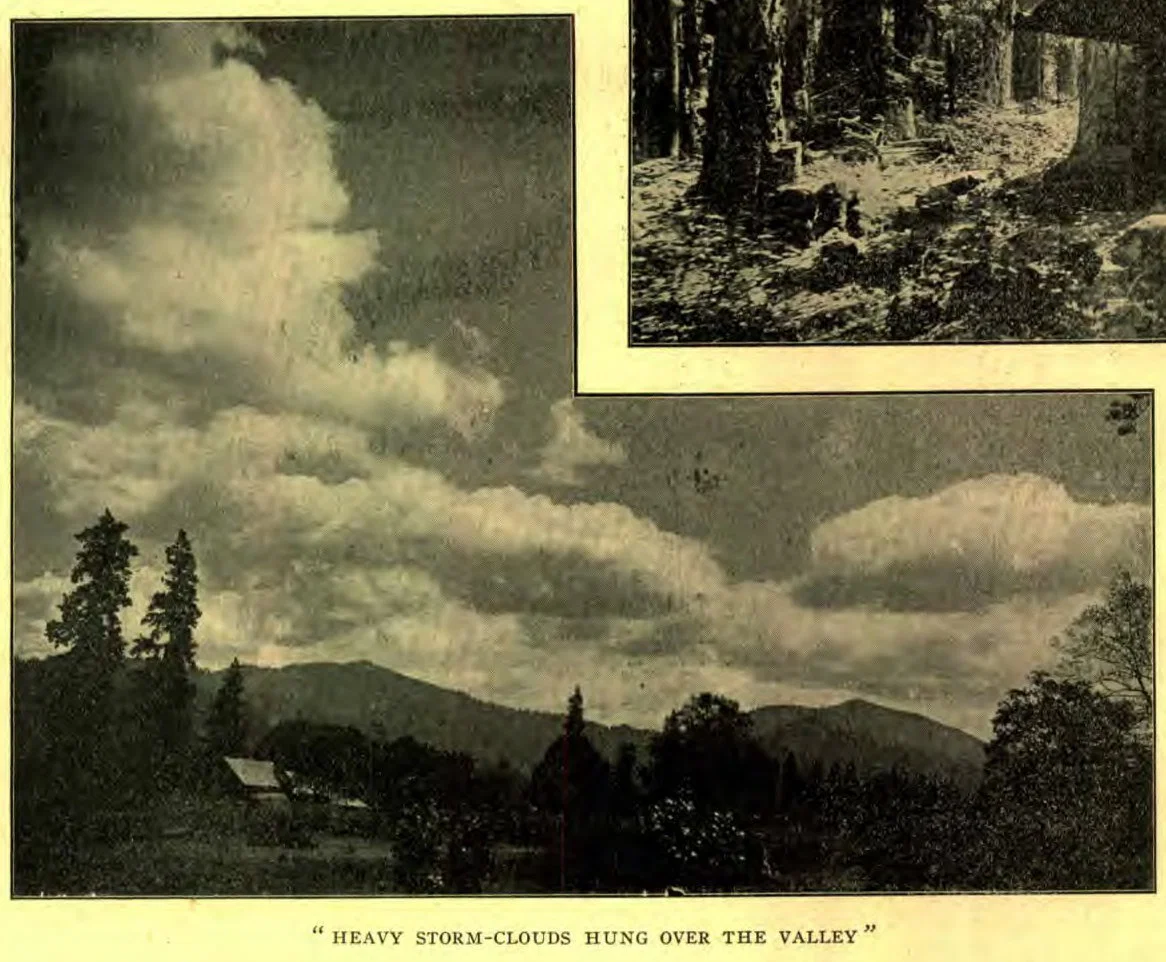
HEAVY STORM-CLOUDS HUNG OVER THE VALLEY
This man and others partially explored the cave; and a few years later another entrance was discovered several hundred yards higher up the side of the cañon. There are really two separate caves, quite distinct in character; but as they are connected by several winding passages, through which it is possible, with much crawling and still more climbing, to pass, they are usually known as one—“The Great Oregon Cave.”
As the years passed, many persons visited the cave, and, returning, told such wonderful stories of its size and the beauty of its limestone formations, that it acquired considerable local fame. Then a San Francisco paper, more noted for sensationalism than veracity, sent a party of men to visit the cave, and write an account of their explorations. Wonderful reports they sent back, and the cave had a boom. A company was organized; and when they secured control of the cave, they began to build a road to it along the most feasible route. A substantial log cabin was put up for the guides; a rustic bridge was built across the cañon below the entrance to the cave; and in the cave itself passages were worked out, and ladders placed wherever it was necessary to make the most interesting points more easy of access. Then the company learned that the cave was not of sufficient interest to attract a paying number of tourists to a place so difficult of access. When the work was abandoned, the company left the cabin, the rustic bridge, the ladders, and a few bad debts to testify to what it had attempted.
Many exaggerated stories have been, and still are, told about the Oregon Cave. I have heard men claim that it extended seven miles underground; others assert that a four-horse coach could be driven four miles into the cave, and then turned around. One man, I remember, told me that it rivaled, if it did not outrank, the Mammoth Cave of Kentucky. To verify or disprove these rumors was for a long time my desire, but the opportunity did not come until early in August of last year.
THE DESERTED CABIN
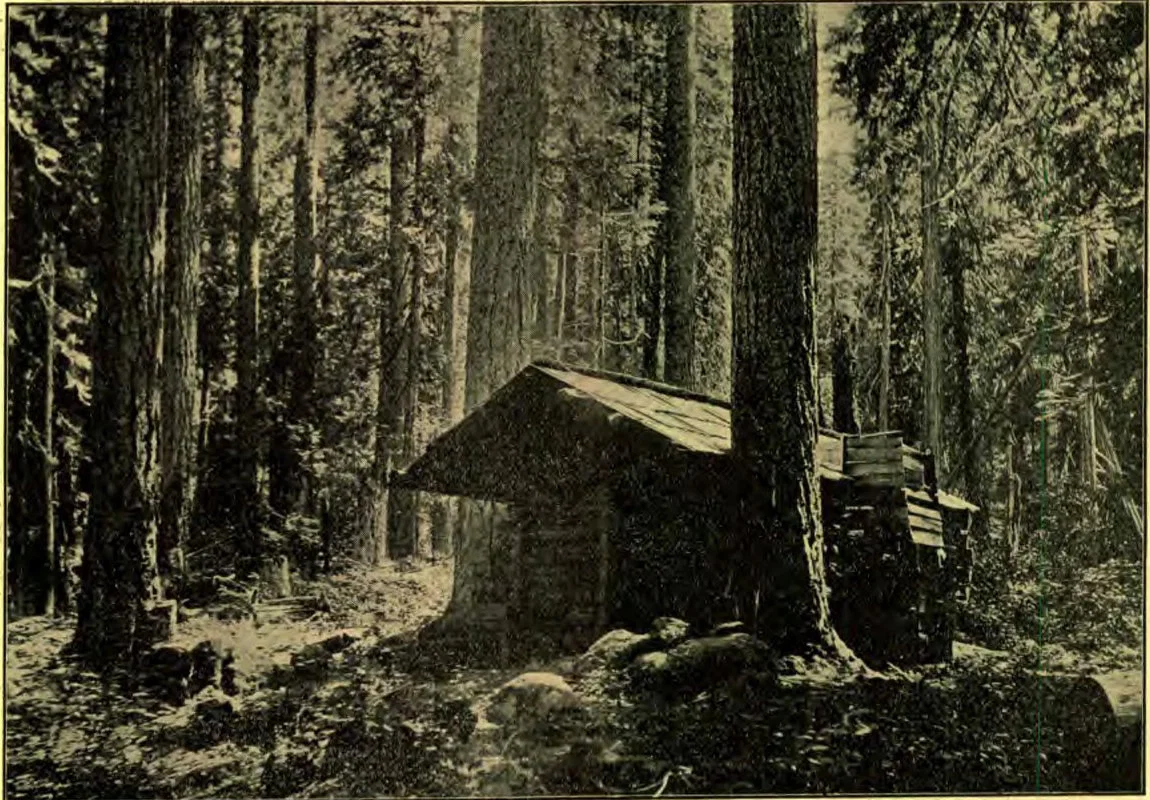
THE DESERTED CABIN
From Grant’s Pass two roads lead to the cave, —one by the way of Williams Creek, the other through the village of Kirbyville. The reports as to the condition of the roads were very conflicting, but I finally decided to go by the Williams Creek route.
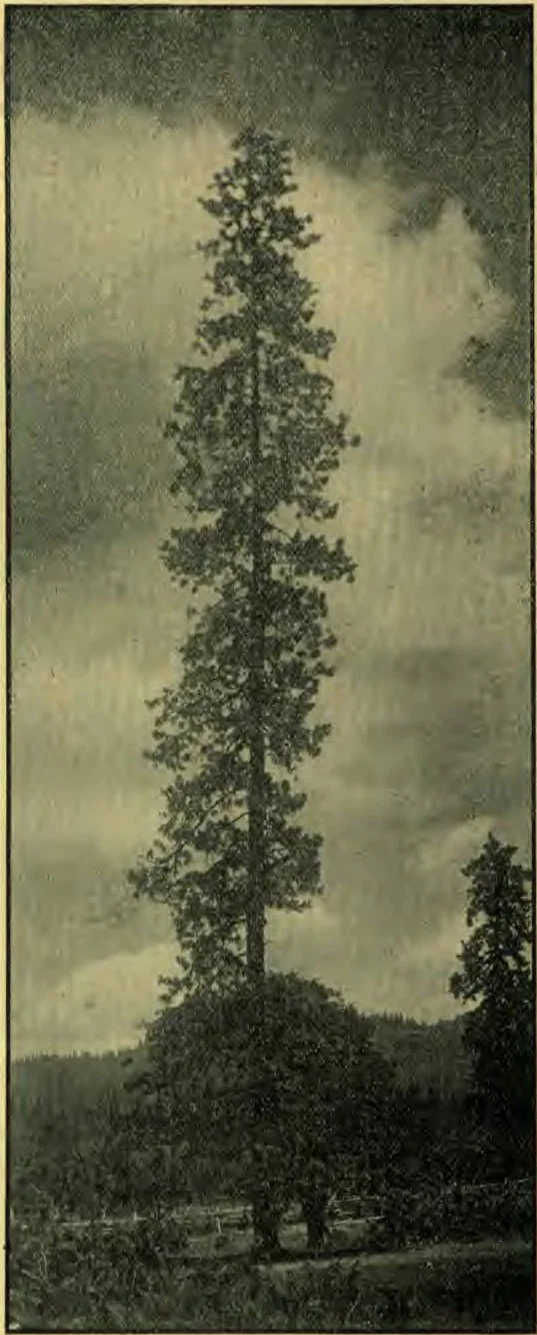
Early in the morning I started out with my camera and plates, a sleeping-bag, and sufficient provisions to last a week, on my wheel. It made rather a heavy load,—about seventy pounds,—but I found the roads tolerably good, and made fair progress up through the beautiful valley of Williams Creek. The hills, and in some places the valleys, were covered with dense forests of mixed timber. The tall and stately sugar-pine grew side by side with the sturdy oak. The madrona, with its smooth, red bark and bright-green leaves, grew in the shadow of the giant fir. Heavy storm-clouds hung over the valley that morning; but I had no fear of rain, for I knew that a shower would settle the smoke that obscured the view, and made it quite impossible to photograph the distant mountains. I could have found shelter under a fir-tree, and would have been willing to finish my journey in the mud for the sake of having a clear atmosphere.
At that season, rain is very uncommon in southern Oregon,—so rare, indeed, that the farmers in Williams Creek Valley depend upon irrigating ditches to moisten their fields. In some places the water had broken from these ditches, and flooded the road. This was the only thing about the road that I could have wished changed, and it proved no serious obstacle; for I reached the head of the valley, twenty-six miles from Grant’s Pass, early in the afternoon.
At the last house on the road I had been told I would be able to get reliable information regarding the trail that led from that point to the cave. I was there told that the trail was excellent, and that in some places it would be possible to ride my wheel. I had intended to leave my wheel there, and carry my things on my back the remainder of the journey; but as I was assured that it would be much easier to push the wheel with its load, I concluded to take it on to the cave.
“THE TALL AND STATELY SUGAR-PINE”
Expecting to reach the cave early the next day (it was only eleven miles), I camped there at the end of the road. That night I slept on a bed of fragrant fir boughs, lulled to rest by the music of a mountain stream.
Next morning I was not long in discovering that I had been grossly misinformed regarding that trail. It was simply a steady climb up, up, up—lifting the heavily loaded wheel up rocky steps, or over fallen trees; or carrying it through deep mud caused by numerous hillside springs; still higher and higher, up a seemingly interminable hill.
Shortly after noon I met a prospector, who gave me the only accurate information I had been able to get about the trail. I was nearly at the top of that divide, he told me; then I would have a short and not very steep descent to make. But he warned me that the next mountain was worse than the one I was on. When I reached it, I left the wheel beside a deserted cabin, and started up the mountain with my pack on my back. The mountain was steep, and the trail was rough; but my load was out of my way, and I did not mind the climb. There are no springs on that part of the trail, but there are several on the summit of the mountain, where there is quite a large open space, called “The Meadows” by some, and “Mud Flats” by others.
J. EDGAR ROSS.
  • (To be continued.)

CHRIST'S ENTRY INTO JERUSALEM

II

On the crest of Olivet the procession pauses. Before them lies the city of Jerusalem, with its temple of pure white marble, which just now is gilded with glory by the rays of the setting sun. It is a picture of unsurpassed loveliness. Well might the people apply to this city the words of the prophet, “a crown of glory in the hand of the Lord, and a royal diadem in the hand of thy God.” At the entrancing sight, the throng join with renewed fervor in their shouts of praise. Branches are stripped from the palm trees, and placed in the path of the Saviour, while hill and mountain give back the glad shouts of the joyous and triumphant multitude. Their eyes turn to Christ, to see how he is impressed by the scene; but lo, the Son of God is in tears.
The glad company can not understand the cause of the Saviour’s sorrow; they do not know that the iniquities of Jerusalem are bringing her final calamities upon her. A mysterious awe falls upon the procession, and calms in a degree its enthusiasm.
As Christ’s eyes rest upon the temple so soon to be desolated, he weeps. The Israel of God, to whom he has given every advantage, will soon reject their King and their God. In a few short hours the world’s Redeemer will be taken by wicked hands and crucified. Not the Romans, not the Gentiles, but the people for whom he has done so much, are to be his murderers. Christ’s prophetic eye takes in the future of Jerusalem, when the glory which God designed should rest upon this chosen nation would be removed, and the grace which bringeth salvation would no longer be heard in the city. This is the cause of the Saviour’s sorrow. He weeps not for himself, but for those who have rejected his love and despised his mercy. The tender tears he sheds over Jerusalem are the tears of rejected love. In a voice of anguish and lamentation he cries: “O Jerusalem, Jerusalem, which killest the prophets, and stonest them that are sent unto thee; how often would I have gathered thy children together, as a hen doth gather her brood under her wings, and ye would not! Behold, your house is left unto you desolate: and verily I say unto you, Ye shall not see me, until the time come when ye shall say, Blessed is he that cometh in the name of the Lord.”
Christ had come to the earth to reveal the principles of the kingdom of heaven. His character as Saviour and Life-giver had been demonstrated only a short time before at the grave of Lazarus; but in their pride the Jews rejected him. To the Hebrew nation had been committed the oracles of God. They had been taught the commandments and statutes and judgments of the Lord. God designed that the faith of this people should be communicated to all other peoples on the face of the earth. How different would have been Christ’s attitude, had the priests and rulers been true to the trust reposed in them! Had they done the work that God designed they should do, the glory of the Lord would have been revealed to the idolatrous nations.
“And when he was come into Jerusalem, all the city was moved, saying, Who is this? And the multitude said, This is Jesus the prophet of Nazareth of Galilee.” A large number in that throng bear in their own bodies the evidence that divine power is among them, and each has his story to tell of the merciful works of Christ. The relation of these wonderful works only increases the fervor of their feelings. Disciples and people join together in the songs of praise.
“Who is this?” We ask Isaiah, and he answers: “Unto us a child is born, unto us a son is given: and the government shall be upon his shoulder: and his name shall be called Wonderful, Counselor, The mighty God, The everlasting Father, The Prince of Peace.” John the Baptist tells us who he is: “Behold the Lamb of God,” he says, “which taketh away the sin of the world.” And the beloved disciple adds his testimony: “In the beginning was the Word, and the Word was with God, and the Word was God.”
MRS. E. G. WHITE.

SPIDERS SPINNING

A WRITER in La Nature gives some account of work done by spiders. He shows what appliances they have for use in spinning, by drawings of different forms of spinnerets. The observations upon the manner of production of the thread will help naturalists in their study of these insects.
The thread is formed only on its exit from the insect’s body. As soon as the paste reaches the air, it dries and becomes solid. Before its exit from the animal’s body, the soft matter has no form. The spider expels it through two or three pairs of spinnerets that are situated at the lower part of the abdomen. The extremity of the spinnerets contains numerous small apertures, and to each of these corresponds a very small open tube.
It is through these tubes that the pasty matter makes its exit. These various jets, still soft, unite, and form but a single filament—the spider’s thread. This thread is therefore made up of a large number of threads. We may judge of its slenderness when we remember that the compound thread itself is the emblem of tenuity.
Sometimes the spider is provided only with a sort of gland, which produces merely a species of thread; and sometimes it is provided with several glands, which furnish threads whose tenacity, tenuity, and elasticity differ. Imagine a cow that gave various kinds of milk, more or less rich in butter or caseous matter!
The rôle of the spider is not limited to the production of the raw material; like a skillful spinner it finishes and polishes the crude thread, and renders it regular, and then directs the filament thus prepared in order to form the net, or web, or whatever you wish to call it. It draws everything from its own resources; for it neither hemp nor flax is sown; it is both a spinning and a weaving machine; it carries with it the raw material, the mechanism, and the machinist.
The extremities of its feet are true combs, some having fine and close teeth, and others strong and distant ones. It is interesting to see it at work, turning aside the thread with one leg, or guiding it through the teeth, just as a woman, comb in hand, makes furrows in her hair when she is dressing it.
The spinnerets are not all grouped in the same way. Some are arranged in bundles and others in clusters. It is quite natural to conclude from this that the thread has not the same qualities in these various cases, and that its diameter, tenacity, elasticity, and flexibility must vary with its form, that is to say, according as it is more or less dense or more or less twisted.—Selected.

IT IS TIME

It is time to be brave; it is time to be true; It is time to be finding the thing you can do; It is time to put by the dream and the sigh, And work for the cause that is holy and high.
It is time to be kind; it is time to be sweet, To be scattering roses for somebody’s feet; It is time to be sowing; it is time to be growing; It is time for the flowers of life to be blowing.
It is time to be lowly and humble of heart; It is time for the lilies of meekness to start; For the heart to be white, and the steps to be right, And the hands to be weaving a garment of light.
— Mary Wheaton Lyon.

LOST

Lost — a casket of priceless treasures, Stolen or scattered along the way; Joys, and duties, and cares, and pleasures, Lost with the hours of a wasted day.
Lost — a golden heart. Unfriended, One in sorrow went past my door. The sun has set, and the day is ended; The chance for helping her comes no more.
Lost — a diamond cross. This morning Dull it looked in the dim, sad dawn. If only some one had given me warning Of half its value before ’twas gone!
Not to be found by years of labor, Jewels glorious, pure, unpriced,— The help I might have given my neighbor, The word I might have spoken for Christ!
— Mabel Earle.

IN THE LABORATORY

In a corner of the laboratory is a still; and here, one day, I found the chemist with an array of tubes, jars, and coils of pipe, all of which were boiling, steaming, and strongly odorous with bubbling, dripping liquids.
“You look like a scene from the witches’ kitchen!” I exclaimed; “and what kind of broth are you brewing?”
“Pure and flavored extracts of coal tar,” he answered. “See! here are my wares,” and he pointed to a row of shelves containing scores of small vials of many-colored liquids. “This,” he continued, “is the great phenyl family; these are the children and grandchildren, to some generations, of common coal tar, obtained from distilled soft coal. In this vial is a form of ammonium; here is tar naphtha, or light-oil; and here is pitch, or asphalt. Here, made out of the light-oil, is benzol, clear, colorless, and innocent-looking, but able to dissolve, besides the fats, caoutchouc, sulphur, and phosphorus; and here is toluol, much like benzol. This is nitrobenzol, made by the action of nitric acid on benzol; and here, made from this, is aniline, pure and colorless in this bottle, and in this, reddish-brown by the action of the air; and here is the great, gay family which comes from the union of aniline and toluidine,—the aniline dyes.
The chemist pointed to the array of vials containing liquids of a hundred delicate or intense shades of coloring,—yellow, emerald, red, pink, rose, deep, glowing violet, and many other hues. “You see,” he said, “what coal tar will do,—give light and heat for your houses, assist in making the useful and beautiful products of many trades and arts, pave your streets, cleanse and color goods in any shade you may choose. The heat, power, and brightness of the sun, stored up in the ancient forests, and hidden away beneath the ground, have come out now to do their work for man.”
All this usefulness and beauty, I thought, hidden away for countless centuries in the dull, black coal, and now brought out to light and service by the skill of the chemist!
Who knows what beauty and what power lie hidden in many a human soul? And God does not leave these to be brought to light and use by the chance hand of a human workman. He is himself not only the Creator of all things, but the great divine Chemist, ever in his world-laboratory, and ready in his own good time to bring the souls that are his to the refining and distilling fires, and to touch them with the keen acids which bring out their best power and beauty, and prepare them for the highest, noblest service and joy.—Well Spring.

THE WHITE-BREASTED NUTHATCH

It is a cold day in early February as I write. The sleighing is fair, and the air sharp and tingling. A thin mist of clouds covers the sky, but both sky and earth are white with the exceeding brightness of a winter day. It seems like an inopportune time to observe birds; but as a brisk walk in the cold winter air acts as a tonic, shortly before dinner, armed with a field-glass, I set out.
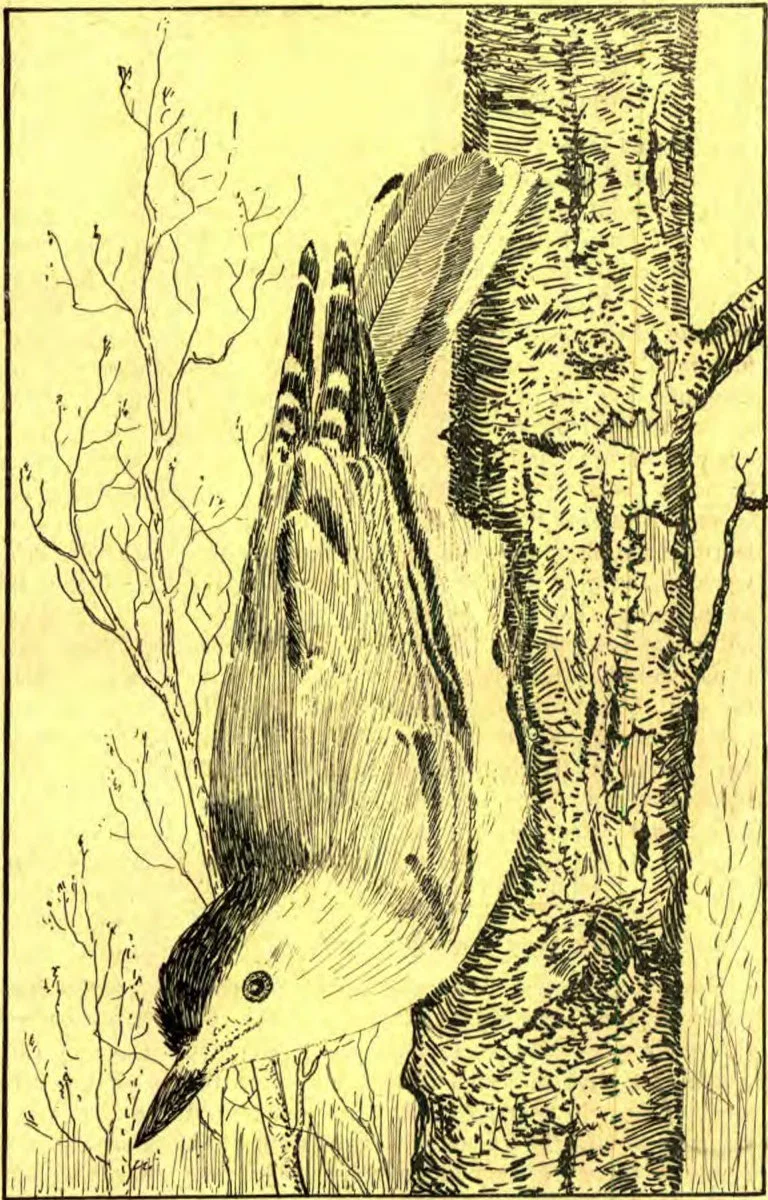
WHITE-BREASTED NUTHATCH
A half-hour’s walk brought me to the outskirts of the city. Not a bird seemed to be about. I could not find even an English sparrow. I tramped about for a bit, and, discouraged, started for home. I think I had not gone ten paces when unusual bird-sounds brought me to an instant standstill.
Just over the fence to my left, along a hedge, was a flock of Slate-colored Juncos. They were very active, and apparently quite happy. In a tree almost over my head was a Nuthatch. This little creature had apparently a small nut in his beak, and was moving about on the side of the tree-trunk as if in search of something. First it came down the trunk toward me, head downward; and then, quickly turning about on the side of the tree, ascended as quickly as he had come down. He flew to another part of the tree, came down a limb head foremost, and then flew across the street to repeat the performance. At close intervals he uttered a creaking note sounding something like “Ink! ink!” Occasionally his tones were much louder, sounding then like “Yank! yank!”
Presently he found a crevice in the bark of the tree. Here he lodged the bit of food he had been carrying, and set about hammering it with his beak so fiercely it seemed he surely would drive his beak through his head. He was trying to earn his dinner. But he seemed to make no appreciable impression on the nut. At last, as if disgusted with the tree, and having had enough of my curiosity, he picked up his particle of food and flew away.
A Blue Jay was hammering at the top board of a fence near by, and a little farther away I heard the whistle of a Cardinal.
But to return to the subject of the Nuthatch. His peculiar habit of hammering, or hacking, nuts has given this bird the name of Nuthack, or Nuthatch. The word “hatch” of this compound word is another form of the Old English word “hack.” In the word “hatchet” we have the old form “hatch” preserved; and in the word “hash”—something hacked—we have another form of the word “hatch.”
In breaking open a nut, the Nuthatch holds it with his claws, or jams it into a crevice in the bark of some tree, and hammers it as I saw this one do to-day.
The Nuthatch seldom lights on the ground, but Mr. Torrey has observed it in this attitude. He says: “One is always glad to find a familiar bird playing a new rôle. . . . It may be assumed, therefore, that I felt peculiarly grateful to a white-bellied Nuthatch, when I discovered him hopping about on the ground, . . . a piece of humility such as I had never before detected any Nuthatch in the practice of. Indeed, this fellow looked so unlike himself, moving briskly through the grass with long, awkward leaps, that at first sight I failed to recognize him. He was occupied with turning over the dry leaves, one after another,—hunting for cocoons, or things of that sort, I suppose. Twice he found what he was in search of; but instead of handling the leaf on the ground, he flew with it to the trunk of an elm, wedged it into a crevice of the bark, and proceeded to hammer it sharply with his beak. . . . The sparrows were inclined to make game of my obliging little performer; but he would have none of their insolence, and repelled every approach in dashing style. In exactly three weeks from this time, and on the same hillside, I came upon another Nuthatch similarly employed; but before this one had turned up a leaf to his mind, the sparrows became literally too many for him, and he took flight,—to my no small disappointment.”
The Nuthatch is a permanent resident of the United States, but in summer, during the nesting season, it stays close about home and is seldom seen. From now until the first of May is an excellent time to study this bird. During April you should also find the Brown Creeper and the Kinglets. These birds we will consider in the next two articles.
L. A. REED.

THE WEATHER BUREAU

How many have seen the maps, posted in post-offices or prominent places of business, showing the conditions of the weather all over the United States? or have noticed bulletins predicting the weather for the next day, and wondered how it could be accurately foretold? Let us step into a station,— there are two hundred and forty of them in the United States,— and see what we can learn.
The man in charge will respond, speaking in substance as follows: “This machine, a revolving cylinder with several tracing-pencils, turns once in six hours, and passes a line every five minutes. An upright with four extended arms turns at one third the velocity of the wind, and makes a jog for each mile measured. With this as a basis, we calculate the speed of the wind. Then we have an instrument on the roof, which registers the direction from which the wind blows. To show when the sun shines, we use a tube with lampblack in one end, that closes an electric circuit, when heated, and a zigzag mark is made on the paper. When the sun goes behind a cloud, the lampblack cools, the circuit is opened, and the tracing pencil makes a straight mark. A column of mercury, thirty inches high, with an area of one square inch, weighs fourteen and seven-tenths pounds at the seashore. When the mercury is low, the temperature is high; and just as surely as water flows down-hill, so air will flow from a high to a low area. Thus we are able to tell from what direction the wind will blow, and whether it will be cold or warm. By taking the temperature, and knowing that cold air will hold less moisture than warm, we can easily predict whether snow or rain will fall. By taking the results from several storm-centers, and getting a general average, we can predict what will follow the present storm area. At first it was largely guesswork, but now about ninety per cent of the forecasts are correct.”
If you wish to investigate this further, write to the chief of the Weather Bureau at Washington, D. C., telling him you desire maps for one month, in order to study them. He will readily forward you a daily map, also one each week. From these you will gain an intelligent idea of the workings of the Bureau. JAMES C. ANDERSON.

GIRLS IN CHINA

“WHAT is your name, little one?”
“Springtime.”
“What a strange name!”
“She was born in the spring,” volunteered one of the larger girls.
“And what do they call you?” to a little, dirty, neglected-looking lass.
“O, she is called ‘Only,’ because she is the only one, and also because she is just a girl.”
“And what is this big girl’s name?” we asked, turning to a girl of twelve.
“I have no name.”
“What! no name. But what does your mother call you?”
“O, she calls me ‘Girl,’ that’s all.”
We spoke about this to her father, who was a Christian, and he soon gave her a beautiful, high-sounding name; but I am afraid it did not stick to her, and though we tried to call her by her new name when she came to school, at home she was still “Girl” and nothing more. Her mother was not a Christian, and did not treat “Girl” very well. She would make her do all the dirty work about the house; and when that was done, “Girl” had to go off with a big basket on her back, and a rake in her hand, to gather small twigs and straw for fuel. Her mother was often in a bad temper, and then she would beat “Girl” and call her bad names. “Parcel of Useless Goods,” “Idle Eater of Rice,” were some of the strange names her mother would hurl at her. These were not the worst; but we could not write the others down, they were so bad.
Early on a beautiful sunny morning in the summer-time, I saw “Girl” near our front door with her basket and rake, hobbling about on her poor bound feet, gathering straw and rubbish for the kitchen fire. I never saw her again. What had become of her?—She had gone home with her basket, and her mother had met her with curses and blows; and then she had left the house and disappeared, no one knew whither. No trace of her could be found.
“I heard a splash in the river,” one man remarked, carelessly; but what it was that made the splash he could not say.
By and by a water-carrier was found who said that about the time “Girl” had been missed, he had seen a girl run along the opposite bank of the river, cover her face with her apron, and throw herself into the water. So they searched and inquired, and after several days the poor little body was found entangled among some tall piles far down the river. And that was the end of little “Girl.”
She was so miserable in this world that she wanted to get away from it all; and she thought that if she could only die, she would get rest; and so, as the Chinese call it, she “took the short road.”
But would she find rest in that way? Alas, no! There is only one way to find rest from all our troubles and from all our sins. JESUS says, “Come unto me, all ye that labor and are heavy laden; and I will give you rest.”
In China there are many poor girls, and grown-up people too, who, like “Girl,” are very miserable, and who, like her, think that the “short road” is the only way out of their misery. Pray that many of these poor, misguided people may come to Jesus, who is the only “Way” to happiness, and holiness, and heaven.—“China’s Millions.”

CRITICISM AND LEPROSY

If eternal love does not fill our hearts, and put within us a disposition to work for humanity, we shall certainly begin to look with a critical eye upon our immediate associates and fellow workers. When Miriam, the sister of Moses, lost the true spirit of service, she could not resist the spirit of criticism (Num. 12:1), and she began to find fault with the way Moses did things. She imagined, like many nowadays, that she was not appreciated as she should be. Finally she spoke against Moses; “and the Lord heard it,” just as he hears faultfinding and criticism to-day.
As a result of her sin she was stricken with leprosy; but in reality she already had spiritual leprosy: the outward disease was simply a type of the moral disorder. Miriam was put in quarantine for several days. The disease of criticism is particularly infectious, and it would be well for the work of God if such persons could always be put in quarantine. They would have less to answer for in the day of judgment, and they would not have the same opportunity to inoculate others with this disastrous malady.
DAVID PAULSON, M. D.

HOW THE INDIANS HUNTED DEER

“FIRE-HUNTING deer was a favorite pastime with the Indians,” says a writer of “Remembrances and Episodes” of early times.
To escape from the millions of mosquitoes that infested the woods, the deer would flee to the water, and wading into it as twilight faded away, would stand in quiet comfort for hours. The Indians knew that a light moving noiselessly on the river would draw the attention of the animal without frightening it away. A torch was therefore fixed in the fore-part of a canoe; an Indian, holding a bow or rifle, seated himself beside it; and another paddled as quietly as possible down the stream. The deer gazed at the moving light in dazed and questioning wonder; and when the canoe had come near enough, it was shot, drawn out of the water, and borne home in triumph.
S. ROXANA WINCE.

THE LONGEST OF ALL RAILROADS

THE Trans-Siberian Railway, begun by Russia seven years ago, is fast nearing completion. The total length of the new line is forty-seven hundred miles, connecting Moscow with Vladivostock, and sweeping across the “entire northern part of the Asiatic continent.” If the railway from Moscow to St. Petersburg—a line over two thousand miles in length—is included, the new railway will have a total length of over six thousand miles, connecting the Baltic Sea with the Pacific Ocean. Seventy thousand men have been at work on it, and its estimated cost is about $425,000,000.
It seems that during the winter “the work was frequently carried on when the thermometer was between fifty and sixty degrees below zero, and the ballast had to be quarried in spots twenty-five miles from where it was used.” Again, “The tall forests of firs, which grew thickly together in some places, formed barriers which required years in removing.” So difficult was the road to construct, that “no contractor could be found willing to assume the responsibility,” and “most of the work had to be done by engineers of the Russian government.”
Lake Baikal, situated in about the center of Northern Asia, is crossed by a train-ferry vessel, which was constructed at Newcastle, England, transported in sections, and set up on the shores of Lake Baikal. This vessel has proved satisfactory, having been able to force its way, when loaded with a train, through ice over three feet thick, at the rate of about seven miles an hour. At the point crossed, the lake is forty-two miles wide.
AUGUSTIN J. BOURDEAU.

Conquering the Habit of Discontent

THE wretched discontent which makes some people so miserable themselves, and such destroyers of happiness in others, is only the natural result of the habit of discontent indulged through years. Any one who is conscious of such a misanthropic disposition should be so ashamed of it that he will at once set about conquering it, and transforming his gloomy spirit into one of happiness and joy. God help us in all such efforts to do his will, and to grow into the grace and beauty of Christ!—Selected.

KEEP YOUR TROUBLES TO YOURSELF

Keep your troubles to yourself; Put them on an upper shelf, Far away as they may be, Where no eye but God’s can see. Other people have their share Of affliction, pain, and care; Why should you, though sorely tried, Burden them with yours beside? Give of treasures you possess, Loving care and tenderness; Cheerful smiles or sordid pelf; But keep your troubles to yourself. — Josephine Pollard.

GROWN-UP LAND

*“Good morrow, fair maid, with lashes brown; Can you tell me the way to Womanhood Town?”*
“Oh, this way and that way — never stop: ’Tis picking up stitches grandma will drop, ’Tis kissing the baby’s troubles away, ’Tis learning that cross words never will pay, ’Tis helping mother, ’tis sewing up rents, ’Tis reading and playing, ’tis saving the cents, ’Tis loving and smiling, forgetting to frown,— Oh, that is the way to Womanhood Town.”
*“Just wait, my brave lad, one moment I pray; Manhood Town lies where — can you tell me the way?”*
“Oh, by toiling and trying we reach that land — A bit with the head, a bit with the hand; ’Tis by climbing up the steep hill Work, ’Tis by keeping out of the wide street Shirk, ’Tis by always taking the weak one’s part, ’Tis by giving mother a happy heart, ’Tis by keeping bad thoughts and actions down,— Oh, that is the way to Manhood Town.”
*And the lad and the maid ran hand in hand To their fair estates in the “Grown-up Land.” — Selected.*
Continue reading: THE BLUE PIG WITH THE BLACK TAIL