The Youth’s Instructor, Vol. LI, No. 12

The Old Missions of California

The Youth’s Instructor

March 26, 1903

Review and Herald Publishing Company · Battle Creek, Michigan · March 26, 1903

The Old Missions of California

EARLY in the eighteenth century it was written that “by virtue of discoverie and exploring, Spain dothe claim ye vast territorie of California and hold it.”
Later in the same century Spain concluded to open “ye vast territorie,” and sett'e it. She asked her counselors how it could be done. The Catholic Order of St. Francis said, It can be done in this way: I will go over there and build missions. From them you can civilize the native red man, and develop all the resources of the great country. These words seemed so good in the ears of Spain that she provided “both ships, soldiers, and stores abundant,” and commanded the Catholics to go and do as they had said.
So, just seven years before our Declaration of Independence, the first mission building was started at San Diego, making there the beginning of California’s oldest city. From that time, missions followed one another rapidly northward, till twenty-one in all had been built.
Of course this work could not be done by the Spaniards. It took an army to do it—an army of Indians. From the very first the red men had shown their friendliness, and the keen padres were not slow in availing themselves of the native labor. They offered inducements, and the Indians settled by thousands around the missions, living in little adobe houses of their own, building the great mission structures, planting miles of orchard and vineyard, caring for immense herds of cattle, and receiving as pay simply their food and clothing.
The great herds of cattle, the big orchards, the thousands of people working for practically nothing,— all these meant money to the pockets of the padres. The missions became enormously rich. To England, Spain, and the American Colonies they sent ship-loads of hides, manufactured articles, and liquors, and their yearly income is said to have been more than two million dollars. No wonder that pirates hovered like vultures along the California coast, awaiting the merchant ships, with their treasure.
But the padres cared very little for the pirates. They lived at ease, in luxury and idleness, safely guarded by great garrisons of Spanish soldiers, and content to look out from cool, quiet rooms over the richest and most beautiful gardens in the world, and know that these were theirs.
The fathers were kind and wise, in their own interests. They made feasts and processions, picnics and ceremonies, daily—a continual round of change to keep the Indians happy. The lone herdsman on the plains could dream all day of pleasures just past, and others soon to come. He had no time to brood over fancied wrongs and stir up trouble. The ringing of the mellow chimes morning and evening called him gladly, with thousands of his tribesmen, to worship, receive instruction, offer a simple prayer, chant the Te Deum and Ave Maria, and then join his associates in their games, frolics, and pleasures.
These missions, with San Gabriel as their acknowledged queen, enjoyed peace and prosperity, freedom from want and strife, for more than half a century; but at last the end came.
In 1822 the rule of Mexico succeeded to that of Spain, and Santa Ana, the Mexican governor, soon stretched out his long arm, and grasped the missions as the rightful property of Mexico, and tributaries to the public treasury. Sadly the padres bade farewell to the scenes of their long and profitable labors. Sadly, too, the Indians left these loved associations, and went their ways into the wilderness whence they had come, quickly to forget the unsubstantial religion they had known, and drift back again into the ways of savage life. So closed a period of time whose like the world has never known before or since.
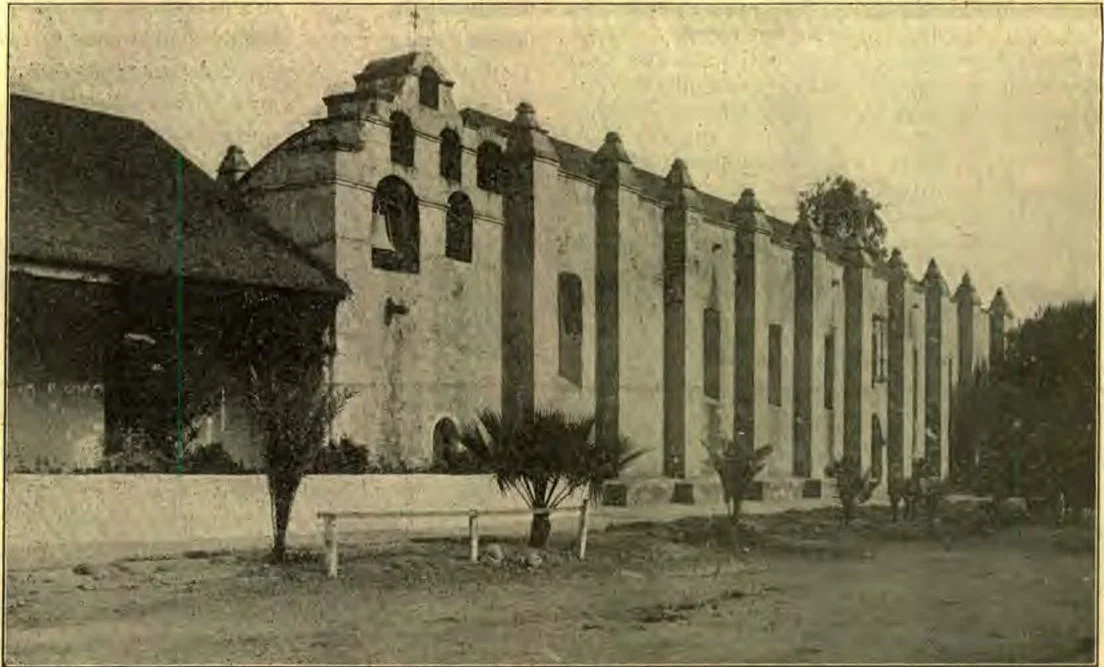
To-day most of the missions lie in picturesque ruin, visited by every artist and sight-seer who comes to California. At Santa Barbara is the best preserved mission in the State. For a hundred and seventeen years it has been occupied by the Franciscan Brotherhood, being the only one so inhabited throughout its entire existence. Its repairs and restorations have all been made without altering the style of its Spanish architecture; large gardens are kept up, its relics are preserved, and so, taking it altogether, this one gives the visitor a fair idea of what the missions once were.
EDISON DRIVER.

Repentance a Gift of God

Those who are saved in the kingdom of God will have nothing of which to boast. The praise and the glory will all belong to God, and to him it will all be given. Sometimes young people who really desire to be children of God, are putting their trust in something besides the blood of Christ. They have faith in what they themselves can do. “I have a great deal to do before I can come to Jesus,” they say. “When I have done all that I can do, then I will go to him for help.” They think that when they have done what they can do to save their souls, Jesus will supply what is lacking, giving the finishing touches to their salvation.
THE SANTA BARBARA MISSION
But no one can be strong in God until he acknowledges his helplessness, and comes to Christ as the only one who can save him from the power of sin.
In Egypt the Israelites were required to sprinkle the lintels of their doors with the blood of a slain lamb, that when the angel of death went through the land, he might pass over their homes. But if, instead of performing this simple act of faith, they had barricaded the doors, taking every precaution to keep the destroying angel out, their efforts would have been in vain, for they would have testified to their unbelief. The blood on the lintel was enough. It secured the life of the firstborn. So it is to-day. It is the blood of Christ that cleanses from sin. Without this, all effort to gain salvation is in vain.
It is the work of the sinner to accept Christ as his righteousness. Thus he is reconciled to God. Only through faith in Christ can the heart be made holy. Many think that repentance is a work which men must carry forward themselves before they can come to Christ. They think that they have something to do before they can find Christ a mediator in their behalf. It is true that there must be repentance before there is pardon; but the sinner must come to Christ before he can find repentance. It is the grace of Christ that strengthens and enlightens the soul, making repentance possible.
Peter has made this matter clear. He says of Christ, “Him hath God exalted with his right hand to be a Prince and a Saviour, for to give repentance to Israel, and forgiveness of sins.” Repentance is as certainly the gift of Christ as is forgiveness. He whom God pardons he first makes penitent. Repentance can not be found without Christ. From him comes the grace of contrition, as well as the gift of pardon. Only through his atoning blood can either be obtained.
MRS. E. G. WHITE.

The Man Who Is Twelve Years Old

THERE'S a man that I know of, and he lives near you, In a town called Everywhere; You might not think he's a man from his hat, Or the clothes he may chance to wear; But under the jacket with many a patch Is a heart more precious than gold,— The heart of a man 'neath the coat of a boy, A man who is twelve years old.
He only is waiting to wear the crown That is already made for his brow; And I pray that his mind will always be clean, His body as pure as now; His heart always fresh and sunny and warm, With none of life's canker and mold; And may he be worthy his waiting estate, This man who is twelve years old.
We never can tell what the future will make Of the boys that we carelessly meet; For many a statesman is doing the chores, And presidents play in the street; The hand that is busy with playthings now The reins of power shall hold, So I take off my hat and gladly salute This man who is twelve years old.
FRANK E. MARSHALL.

The Fiftieth Chance

In the handsome waiting-room of the great oculist there were, on that dismal day of rain and fog, but few waiters. There were but two. They sat the width of the room apart, and gazed absently out of opposite windows. There was not one apparent trace of similarity between them, except the fact of their waiting together in that room.
“Spectacles! I won’t do it!” Constance Quay was fuming, inwardly. “I could bear eye-glasses, but spectacles—never! He may talk and talk. It’s too dreadful to be borne! And to wear them always—never to take them off—that was what he said. I heard him telling father. No! no! no!”
The girl was sweet and dainty from her beautiful hat to the soles of her pretty boots. Every detail of her costume was perfect, every feature of her lovely face. She looked straight out into the rain through wonderful, indignant gray eyes. She tapped nervously with her fingers on the window-sill. The faint, indefinable perfume that enveloped her stole across the room on the breeze to the other girl.
“The idea! O, why can’t they see what it would mean to me—daddy and Dr. Bell and Aunt Pamele? One might as well be deformed, and done with it, as to go through life spectacled like an old, old woman! I tried on the housekeeper’s when she didn’t know—I looked at myself in the glass. It was awful, but I had to do it. And—I—saw!”
The climax of her thoughts wrung a little groan from her lips. Constance Quay had never known a trial before, and the taste of this one was bitter on her tongue like gall. She was sure she could not bear it. She was sure no one else had ever had so terrible a possibility looming before her.
“He told daddy I’d have to wear spectacles—spectacles—spectacles, like the housekeeper’s spectacles. He told daddy so,” her thoughts wailed on.
Her eyes turned toward the beautiful, sumptuous room, and roved about its luxurious appointments, coming to rest on the other waiter across the room. She was not beautiful nor sumptuous. She wore spectacles. Constance shivered unconsciously.
“He is so long! It is terrible to wait!” Judith Reese mused. “She will go in first, that other girl, and I shall sit here, and wait—and wait! It is the hardest part to wait.”
As the minutes lengthened to half an hour of waiting, she could not subdue her anxiety. It was impossible; she could not sit still. She got up and walked about restlessly.
The “other girl” watched her, in idle misery of her own. She saw her take off her glasses once, and grope ahead of her like a blind person. It reminded her of when she was a little tot, and “played blind” with a tight hold of the nurse’s hand.
By and by the incongruity of her being there at all occurred to Constance. Dr. Bell’s prices were notoriously high, and this girl, in her shabby reefer and sailor hat, did not suggest a fat purse. She had come to the wrong place probably. There was another—why, yes, another Dr. Bell around the corner, who performed miracles of healing in general. The papers all teemed with his advertisements. Daddy had joked this Dr. Bell about him. Now Constance remembered it.
Judith Reese’s aimless circlings around the room eddied nearer Constance. Suddenly Judith halted. She began to speak hurriedly, her voice strained and high.
“It’s Wednesday, ain’t it?”
“I beg your pardon.”
Constance drew her slight figure up frigidly, and her skirts rustled softly.
“It’s Wednesday, ain’t it?—to-day?”
“Yes, it is Wednesday.”
There was a tone of finality in the cool, low voice. It seemed to end the conversation definitely. But the other voice went on.
“I made sure it was; of course I knew it was. But I had a sudden feelin’ that I’d made a mistake, maybe. And then I got to bein’ afraid——”
A faint color deepened in her sallow, lean little cheeks. She peered into Constance’s face with near-sighted eyes.
“Wednesdays are the days it’s—it’s free, ain’t they? The consultin’, I mean? Of course I know it is; only——”
It seemed difficult for her to go on. She circled about the room once more, and came back to the same spot.
“Only I’ve been sittin’ here, dreadin’ it so. An’ I got all confused in my head. But of course I know it’s Wednesdays. I couldn’t have mistook that.”
The indignant color had flushed the fair face of Constance Quay in a warmer tide. Impulsive, scornful words rose to her lips. Did this—person think she would be here—she, Constance Quay—if it was a “free” day?
But the words tarried on Constance Quay’s sweet, fresh lips. A sudden pity for this poor, excited creature held them in leash there. Afterward she was glad. She was glad the girl had never known there were no “free” days here.
The inner door opened noiselessly, and a lady led out a little child with bandaged eyes. They were both laughing gaily.
“It’s only fun making b’lieve blind, isn’t it, mama?” piped the little one. “We’ll have a reg’lar play, same as that nice doctor man said to.”
“Yes, sweetheart, a reg’lar play.”
The mother’s eyes met the pitying ones of Constance, but they smiled back happily.
“It’s all right,” she whispered as she passed. “She’s only got to wear the bandage a little while, and then she will be cured! I was so afraid to go in there with her—but it’s all right now. I could jump up and down for joy, right here in this room!”
“Le’s play you told me what the color o’ the sky was, mama, and the grass and everything. That’s the way they do blind folks.”
The cheerful little voice trailed back to them faintly through the half-closed door. Then Dr. Bell appeared at the other door.
“Your turn, Miss Quay,” he said, briskly, and Constance went in. But she came back instantly, and motioned to the other girl who was waiting.
“No, you go first. I can wait,” she said. “I did not think at first about your being here longest.”
And the other girl went in. She stumbled across the room blindly. At the door she turned a white face toward Constance.
“Good-by,” she said, wistfully.
It was nearly half an hour before she came out again. Then she was not stumbling or wild. She walked quite firmly and straight, but her face was terrible with dumb despair. Constance uttered a cry of horror when she saw it.
The girl crossed the room to Constance slowly.
“It’s over,” she said, quietly. “I’m glad of that. He told me I was goin’ to be blind.”
“No, no!” Constance cried.
“In a little while. I think he said six months. That isn’t long, is it? When you’re going to be blind, six months ain’t long to be left to you, is it? He was very kind. I—I might have known what he’d say.”
She gasped a little as if she were under water.
“He said I was goin’ to be blind. I think he said six months,” she repeated, dully. “I forgot to ask him if it was free Wednesdays, but of course I know so. I don’t suppose doctors ask much, anyway, to tell you you’re goin’ to be blind.”
Constance caught the little working fingers entreatingly.
“Don’t! please don’t!” she said. “Don’t say it again. I can’t bear it! I am so sorry—you don’t know how sorry I am for you! No, you must not try to go away yet—you are not strong enough. See, I want you to wait here in this easy chair while I am gone; then we will go away together. You will be better then.”
She was talking in steady, cheerful tones, and gently forcing the trembling little figure into one of the softest chairs. In all her care-free life Constance Quay had never been so deeply moved before. The horror of what this girl had told her appalled her. And she had thought nothing could be worse than wearing glasses!
“Dr. Bell,” she began, abruptly, in the inner room, “are you sure? Can’t anything be done for her? Wait; please don’t answer yet! If it were I, instead of that girl out there, if I was the one who was going blind——”
Constance shuddered violently.
“Would there be no hope for me at all, Dr. Bell, not one ray of light?”
“There would be one chance in fifty—for you. There is no chance for her, I am afraid. There might be under different circumstances, but I did not tell her so. It seemed cruel.”
The great man paced the floor nervously. He had told hundreds of poor souls their fate within those four walls, but his kind heart ached for this last sufferer.
“I told her the truth. God pity her!” he said, as if to himself.
“One chance in fifty—for me. What does that mean, doctor?”
Constance was pacing, too, beside him. She peered up into his grave face intently.
“It means, if she—if you—could spend six months in absolute darkness and quiet; if you could be surrounded with cheerful influences and every luxury under heaven except the blessed light of day; if you could have the costly treatment, daily, that only money could provide,—well, it means that then you would have one chance in fifty. You see it would be a very little ‘ray of light,’ Miss Quay?”
“Yes—I see,” murmured Constance, thoughtfully. “But it would be something to hope for; it wouldn’t be counting the days you had left, for six terrible months. Think of it! one hundred and eighty days, one hundred and seventy-nine, one hundred and seventy-eight, seventy-seven, seventy-six,—always one less,—the horror creeping on you every day!”
“God pity her!” murmured the kind great man in his beard.
“And I thought it was all one could suffer to wear glasses!” laughed Constance, tremulously.
Six months afterward, three people came together again in that inside room. It was Constance Quay’s face that was white with dread. The face of little Judith Reese was flushed with eager hope. There seemed a bond of quiet affection, and the familiarity of long dwelling together, between the two girls; and Judith’s bandaged eyes were turned always toward the sound of Constance’s voice. But Judith did not hear the low, strained whisper.
“Let me take them off, doctor, when you say ‘Now.’ You need not be afraid; I will be calm.”
Dr. Bell was drawing some of the shades and darkening the room. He moved about briskly. His good face was full of courage. Why not? Things had worked along so well, there had been every chance in the world. Surely now—
“Now,” the doctor said, quietly.
The bandages slipped away from Judith’s patient eyes. An instant’s breathless waiting—then a clear cry of joy.
“I can see! It isn’t dark!” And again: “It is light! I can see!”
Judith caught Constance’s hands and gazed rapidly into the joyous face, as if she must see that first. Was it the light there she saw?
“I can see everything, Miss Constance. I can see the tears in your eyes, but you aren’t crying! O, how beautiful it is! how beautiful it is! It’s the end of six months, and I’m not blind. I can see!”
Constance took off her glasses and wiped them hard; then she set them astride her pert little nose again, and curled their slender golden bows around her ears. She looked at the smiling doctor gaily through them.
“I can see, too,” she laughed.—Annie Hamilton Donnell, in Christian Endeavor World.

This Too Shall Pass Away: A Poem on Life's Changes

“Art thou in misery, brother? This I say, Be comforted: thy grief shall pass away. Art thou elated? Ah! Be not too gay, Temper thy joy: this too shall pass away. Art thou in danger? Still let reason sway, And cling to hope: this too shall pass away. Tempted art thou? In all thine anguish lay One truth to heart: this too shall pass away. Do rays of laureled glory round thee play? Kinglike art thou? This too shall pass away. Whate’er thou art, where’er thy footsteps stray, Heed Wisdom’s voice: all things must pass away.”

IV—Saving the Soil's Wealth (Nitrogen)

How are your neighbors?—I mean those families, the Sands and the Clays and the Mucks? I hope you are becoming well acquainted with them.
In our study of how to take care of that great plant-builder, nitrogen, we found drainage to be one way of saving it. We shall now put down, for number—
2. Avoid the constant growing of one crop on the same ground. Everything in nature requires change and rest. The soil is not an exception to this rule. It is true that it has nitrogen enough for a century of wheat-growing, but it wants other tenants besides wheat. After feeding the wheat with nitrogen for one or two good harvests, the soil begins to close up the door of her treasure-house; and if wheat comes again for nitrogen, she must be content with short rations.
In God's instructions to Israel, this principle of resting the land by a change was recognized. It is mentioned in the twenty-fifth chapter of Leviticus. Each seventh year the land was not tilled nor sown, but it was allowed to produce “that which groweth of its own accord.” The most successful agriculturalists of the present day also recognize the principle, and practise it in the management of their soil. We find two ways of resting the land now in vogue. Summer-fallowing gives a complete rest, the land being cultivated, and nothing allowed to grow upon it for one season.
Rotation of crops rests the land by giving it a change in the thing grown. It has long been known by farmers that clover is a good crop to grow on run-down land. They knew that the fertility of the land was restored by it, but could not tell why. Within the past fifteen years it has been discovered that clover roots store up nitrogen, which is given to the soil, and thus saved for the use of other plants.
If you will take a spade and dig up some clover roots, you will find scattered about upon them little wart-like growths. These are called “tubercles.” They resemble very small potatoes as they first begin forming upon the roots of their stem. If you do not find them upon the first root, dig up another, selecting one of last year's growth. I took up a fine specimen, a few months ago, in the yard of my old Michigan home. After washing the root, I counted dozens of the little nitrogen-holders fastened upon all the branching rootlets.
These nitrogen-collecting tubercles also grow upon the roots of peas, beans, and other plants of the leguminous family. The leaves of these plants have been endowed by the Creator with the ability to extract nitrogen from the air. It is carried down to the roots, and stored for future use. When clover sod is plowed up, all this nitrogen of the roots remains in the soil.
You can now see why it is best to grow a crop of clover after one of wheat. The wheat has taken much nitrogen away from the soil, but gives none back. The clover uses some soil nitrogen for its growth, but it pays back much more than it borrowed. But the farmer wants to grow other crops besides wheat and clover. And he finds that the land gets its needed rest by growing corn next year on this year's clover field. Then he may follow the corn with a crop of oats, and the oats with wheat again. This arrangement is called a “four-year rotation.”
3. Our third way to save the nitrogen of our land will be to return to the soil its products, as much as possible. Nitrogen once taken into plant structure can be used by the soil over and over again for other plants. It is the same with the other plant foods,—potash, phosphoric acid, etc. So if the straw from the various grains is returned to the land, it carries with it some of these elements already manufactured into suitable food for the next crop. This is one reason for taking back to the land each year the straw, mixed with other fertilizing material collected in the barnyard.
4. A fourth way to keep the soil rich in nitrogen is to grow nitrogen producers upon it. Clover and peas are known to be the two favorites for this purpose. Sometimes we find soil so much “run-down” that it is necessary to plow under the whole crop of clover or peas, in order to restore its fertility.
5. Cultivation is another important means of keeping soil supplied with this “staff of life” for plants. Every time the plow turns the soil, it buries some form of vegetable growth containing nitrogen. Besides, the stirring of the soil allows the sunshine and the rain to gain an entrance, and these agencies of heaven act an important part in the soil's laboratory where nitrogen is gathered, worked over, and made ready for use.
J. C. ROGERS.

The Most Useful Tree

Of all forest trees the eucalyptus is the most beneficial to mankind. The list of useful articles it furnishes to the world is almost incredible.
It is predicted by the United States Bureau of Forestry that within a few years the different varieties of eucalyptus will solve the fuel problem, both in America and Europe. In the rapidity and hardiness of its growth this tree has no equal. Five years from the time of planting, groves raised from seedlings will yield seventy-five cords of stove wood an acre. Three to five years from the time of cutting, sprouts that spring from the stumps mature into trees that produce more cords to the acre than the original growth. Repeated cuttings add to the thriftiness of the eucalyptus. A period of twenty-five years will develop trees the size of oaks known to be three hundred years old. In some sections of the Southwest where oak has been nearly exhausted as fuel, the eucalyptus is taking its place.
Some varieties thrive in tropical swamps; others flourish in the mountain snows far above the timber-line. To every degree of climate and condition between these extremes some species from this prolific genus is adapted. Scientists have demonstrated that eucalypts have a wonderful effect upon climate. From some of the swampy areas of Italy malaria has been banished by the growth of eucalyptus groves. This is due both to the tonic and medicinal effect of its aroma and to the tree’s phenomenal capacity for absorbing water.
Notwithstanding the latter trait, however, some varieties of the blue gum will thrive on arid plains. Soil on which not even cactus will live will produce great eucalyptus trees.
The genus is invaluable as a source of timber. The uses it is put to in this regard are amazingly diverse. In Australia it is used extensively in the construction of ships, buildings, bridges, vehicles, agricultural implements, furniture, barrels, and hundreds of minor articles.
Faultless hardwood logs over two hundred feet long, twelve feet in diameter at the top and thirty feet in diameter at the base, are hewn from giant eucalypts.
It is one of the most durable of hard woods. This is a remarkable fact when the celerity of its growth is considered. In repairing a decayed pier at Santa Barbara, California, it was found that a few piles were perfectly sound. Examination disclosed that they had been hewn from eucalyptus trees.—Saturday Evening Post.

Joshua, a Man Who Could Wait

JOSHUA, the soldier par excellence of the Old Testament, was a man who could wait. He followed and learned for forty years before he was called upon to lead. He was the man he was because of his long training. When he heard the words, “Moses my servant is dead; now therefore arise,” he obeyed just as he had done all the thousands of little things that were his to do during the forty years in which he had been a subordinate. He did the things that his hands found to do with his might. Some one has said that “trifles are trifles only to triflers.”—Pilgrim Teacher.

Wise, but Cowardly

IN an early German school there was a young man of good mind and exceptional prospects. He had a comprehensive understanding of the sciences, and was familiar with the countries of the earth and the events of history. He was an orator of splendid powers, and the people were captivated when he spoke. They wanted the emperor to place him in a very important position in the government. This the aged ruler at length decided to do, provided the young man could pass a satisfactory examination.
Summoning the young fellow, the emperor handed him letters to deliver in different parts of France, telling him above all things to remember the dignity of his country and his king, and stand up for them all the way. On this the success of his mission would depend. It was the test of a lifetime.
All went well till he came one evening to an inn on the southern border of Germany. A number of men were there, drinking, playing cards, and talking politics. Apparently unnoticed, the German became interested in their conversation; for they were speaking of the German emperor. “The old duffer,” said one, “imagines that we will accede to his crazy notion regarding the line through Strasborg and Metz.”
“Yes,” answered another of the party, “but he will do well to consider with whom he has to deal, and the sentiment of this region.”
In a dark corner of the room sat a man writing, or pretending to write, and watching with hawk-eyes every motion of the young German. Presently the pen moved over the paper, and left these words: “Finding the sentiment of the place Anti-German, Von Guilden quietly removed the ribbon of orders from his coat, and put it, as he thought unnoticed, in his pocket. He spoke French to the landlord, though the place is more German than French.”
Three days later the emperor muttered “Coward,” and threw a scrap of paper in the fire.
On the next night of his journey, Von Guilden found himself in another inn, not far from Lesten. Here again was a crowd of men, and here was the mysterious writer. Four days later the German emperor read: “Von Guilden wears no orders. At the inn to-night some one became excited over the Strasborg-Metz line, and asserted that he knew there was not a supporter of the German emperor in the room. It was only a friendly discussion; there was no danger. Von Guilden turned pale, then flushed, but said nothing.”
“Coward!” exclaimed the emperor. “It is too bad, for he is one in a million;—but, no; he will not do—a blade broken in the trying!”
Particularly applicable is this little sketch from history to your work and mine to-day. We are representatives of a King and a country. Do we honor or disgrace them? Do we carry our Bibles under our coats? Are we silent when we might speak to the advantage of the truth? Do we cower under many a challenge of the devil? Do we? If we do, we are made of the stuff that fails.
EDISON DRIVER.

THE WEEKLY STUDY

“The Midnight Cry” and the Second Angel’s Message

(March 29 to April 4)
THIS experience, foretold in the parable of the ten virgins, will be to the end a beacon light to advent believers. Bearing in mind the parable of the ten virgins, give a brief, pointed review of the thrilling times when the advent believers discovered the mistake in fixing the time, and saw that the twenty-three hundred days must end in October, 1844.
Basis of Study.—“Rise and Progress,” chapters VI and VII; the middle portion of chapter XXII, “Great Controversy,” entitled, “Prophecies Fulfilled,” dealing with the cause of the mistake, the rectifying of the error, and the effect of the awakening message; and chapter XXI, “A Warning Rejected;” “Early Writings,” pages 96-103.
I am working on the supposition that those in charge of the Young People’s meetings will have access to these standard books, either by possession or by borrowing. If this is not so in any case, the young people in that company have an important work to do in seeing that these works are somehow procured. How can we expect to be intelligent as to the aim and mission of this people if we have not the books which God’s providence has provided as truly as he commanded Joshua to set up the monument of stones by Jordan as a memorial?
The short portion in “Early Writings,” page 101, “The Second Angel’s Message,” might be read in the meeting by some one. We are to remember that just as the “midnight cry” swept over the country with compelling power, so now the cry, “Behold, the Bridegroom cometh,” is to be sounded in all the world.
In Sister White’s first vision, the relation of this “midnight cry” movement to our work is clearly shown: “At this I raised my eyes, and saw a straight and narrow path, cast up high above the world. On this path the advent people were traveling to the city, which was at the farther end of the path. They had a bright light set up behind them at the beginning of the path, which an angel told me was the midnight cry. This light shone all along the path, and gave light for their feet so they might not stumble. . . . Soon some grew weary, and said the city was a great way off, and they expected to have entered it before. Then Jesus would encourage them by raising his glorious right arm, and from his arm came a light which waved over the advent band, and they shouted, Alleluia! Others rashly denied the light behind them, and said that it was not God that had led them out so far. The light behind them went out, leaving their feet in perfect darkness, and they . . . fell off the path down into the dark and wicked world below.”—“Early Writings,” page 10.
We are walking this path, and now the city is but a little way before. Now Satan will try to make men forget what the advent movement means, and to despise the simple faith of the early believers. But let us keep our eyes on Jesus and the real city before us. They in 1844 were mistaken as to the event, but God would have the world stirred as the judgment hour began. Now that the judgment hour is closing, the midnight cry is raised again, for now is the Bridegroom truly coming, without long delay.
Do not fail to note how the expectation of meeting Jesus influenced men in their financial affairs. They preached the message by their business plans.
Do not forget that this Young People’s movement stands for work, and in all the study insist upon finding incentives to present service.
W. A. S.

Denial

Not only Peter in the judgment hall, Not only in the centuries gone by, Did coward hearts deny thee, Lord of all, But even in our time, and constantly; For feeble wills, and the mean fear of men, And selfish dread, are with us now as then.
To-day we vow allegiance to thy name; To-day our souls, ourselves, we pledge to thee, Yet if a storm-wind of reproach or blame Rises and beats upon us suddenly, Faltering and fearful, we deny our Lord, By traitorous silence or by uttered word.
We close our lips when speech would wake a sneer; We turn aside, and shirk the rougher path; We gloss and blink as if we did not hear The scoffing word which calls for righteous wrath. All unrebuked we let the scoffer go, And we deny our Lord and Master so.
Come thou, as once of old thou camest in And “looked on Peter” in the judgment hall; Let that deep, grieved gaze rebuke our sin, Questioning, recalling, wakening, pardoning all, Till we go out and weep the whole night long, Made strong by sorrow as he was made strong.
—Susan Coolidge.

Union College Society

THE Dorcas department of the Young People's Society of Union College is planning to make three hundred garments for the natives of Nyassaland, Africa. A program was rendered in the college chapel, February 16, and the work of Brother Booth, one of our missionaries there, was discussed. Elder Watson, president of the Colorado Conference, who was present, gave a very interesting account of Brother Branch and his family, who have gone to assist Brother Booth. The students were deeply interested, as it seemed to bring the field nearer home.—Central Advance.

Question Hints

(To be given to different members, and answered in the meeting)
OBSERVE the preparation made in 1844 by the brethren who were expecting soon to enjoy the society of God and the angels. In view of this, what preparation are we to make? See Rev. 18:2-4; 2 Cor. 6:17; Ps. 1:1. Notice carefully the three details mentioned in the last scripture. Find other scriptures bearing upon this thought.
In connection with what is said in “Early Writings” concerning the light that guided the advent people in their upward path, read Ex. 13:21, 22; 14:20; John 1:5; Matt. 6:23. Show how there is danger in rejecting light to-day.
How can the truth be preached in our business relations? Give illustrations showing how men have been brought to believe in God by the integrity of his professed children in their business dealings.
Continue reading: MISSIONARY HENS