The Youth’s Instructor, Vol. 30, No. 51.

REAL GRATITUDE

The Youth’s Instructor

Dec 20, 1882

S. D. A. Publishing Association · Battle Creek, Mich. · Dec 20, 1882

REAL GRATITUDE.
The following is the true story of a little boy who by his bravery won the name “The Boy Hero.” He lived in Newfoundland, which has not a pleasant climate like ours, but is very cold and dreary. You will find it on the north-eastern coast of North America.
The people who live in this cheerless place are very poor; they have no comfortable houses to live in, no nice clothing to wear, and no dainty food to eat. Their dwellings are huts of mud, their clothing is made from the skins of the bear and the wolf, and their food is principally fish. Would the boys and girls who read this story like to live in such a way? I fear the most of you would think it very hard to be dressed in a bear’s skin, and have to eat half-cooked fish and poor bread.
But although this boy was deprived of many blessings which you enjoy, God had given him a kind father and mother, who loved him as dearly as your parents love you, and who were glad to do all they could to make him happy.
But he was not long to share the love and care of these fond parents; for while he was yet very young, his father was taken from him by the cruel fever, which passes like a scourge over this barren country. Soon after this, his kind mother was also taken, leaving the poor child alone in the world, with no one to care for him. But God, who cares for the fatherless, opened the hearts of a kind family, who, though very poor, and having two small children of their own, took the little wanderer and shared their scanty living with him.
Fishing is the chief occupation of these people, and at the beginning of their short summer an English brig takes them up the coast to Labrador, which you all know is noted for its fisheries. The families are left about ten miles apart, as the vessels sail; but following the coast over hill and dale, and around bays and capes, it is often twice as far. This family was left the farthest up the coast, and a long distance from any human being.
Here they made a home, such as it was, and went to work. The father and his foster child caught the fish, while the mother prepared the meals, and did the rest of their meager housework. They worked away, and things went on finely, until, from exposure and overwork, the husband and father sickened and died; thus leaving the poor mother with two small children to care for, and no one to aid her but this little boy.
He did not sit down and cry, as many would have done; but manfully, as best he could, filled the place of the dead father. He cheered the heart of the sad mother, and although only twelve years old, kept on fishing, as he had seen his father do. Soon a new sorrow came to him, for in a few weeks the mother, his only living dependence, was taken away, and the three children were left alone. But the noble boy, with dauntless courage, cared for the younger ones, cooked the fish, and made the bread of meal and water, as he had seen his mother do, and kept on fishing.
Finally the fish failed, and their chief supply of food was thus cut off. This, however, did not dishearten him. Thinking that the brig would come for them as it usually did, he waited until his store of provisions was nearly gone. Then, knowing that he must do something, he cooked up what meal and fish he had, and taking the two children with him started down the coast to the nearest family, a distance of more than twenty miles.
For days he led on his little charges over rocks and hills, cheering and helping them forward as best he could, until, tired and nearly sick, they could go no farther. With loving tenderness, he found them a sheltered place among the rocks, left them all his food, and started on alone, half-starved, and not knowing when he would find friends. Bravely he struggled forward, and finally, just at night-fall, he reached the hut he was seeking. The men were away fishing, but he told the women how he had left the children; and then, I suppose, many of us would have considered our duty done. But it was not so with this little boy. His gratitude to the friends who had been so kind to him was such that he wanted to do all that he could for their orphan children. After eating something himself, and taking food for the children, he started back to find them.
In the early morning the kind fishermen went to search for them, but only two were alive. The night had been bitterly cold, and our noble boy had taken off his jacket to protect the suffering little ones. Finding this was not enough, he laid his own body over them, and when they were found, the Angel of Death had been there, and the poor boy was frozen stiff. The children, however, were alive and warm. Brave boy! He gave his life for his friends, and was he not a hero?
The above story was told me by our great American artist, William Bradford, who has been on many expeditions to these cold regions. Here he obtained the themes for many of his elegant paintings. HATTIE WARREN.

THE SNOW-STORM.

In the upper regions, By companies and legions, The vapors collected in crowds, And counseled and blustered, And marshalled and mustered, And formed themselves into clouds.
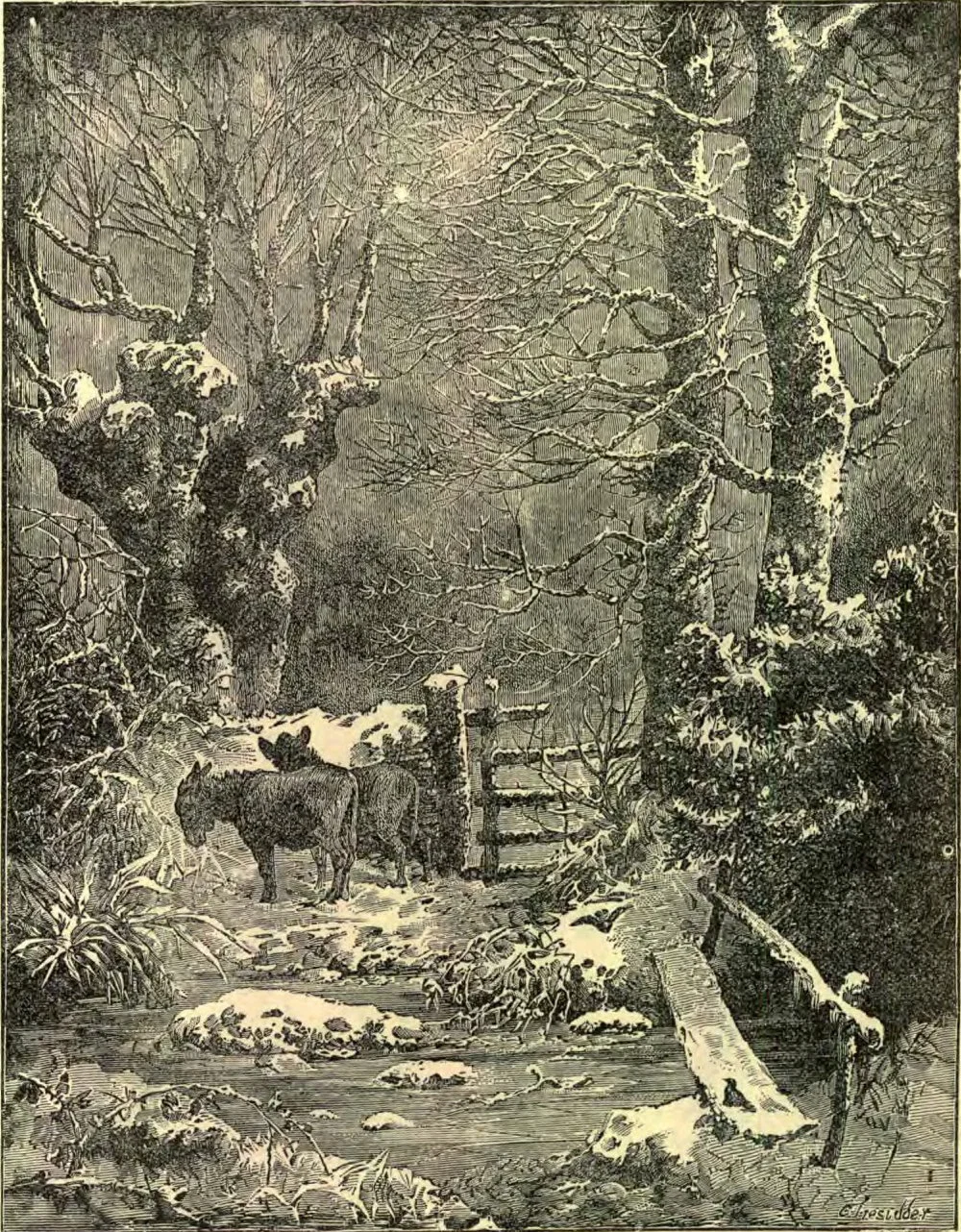
Down from the other world, Down to the nether-world, Silently, solemn, and slow, Soft as the eider-down, Light as a spider-gown, Came the beautiful snow.
Then faster and faster, Till over the pasture, Over the ponds and the lakes, Over the meadow-lots, Over the garden-plots, Lay the beautiful flakes.
Then with the snowing, Puffing and blowing, Old Boreas came bellowing by, Till over the by-ways, And over the highways, The snowdrifts were ever so high.
—Little Sower.

TESTS

There is an old ballad called the Mistletoe Bough, which sings the story of an unfortunate lady, who, on her wedding evening, in a frolicsome mood ran away from her companions and hid in an oaken chest. It closed with a spring lock. She could not make herself heard, nor could her friends find her. Many years after, when her story was almost forgotten, the chest by chance was opened, and there was found the moldering remains of a person whose identity was made known only by the bridal jewels she wore. These alone had borne the tests of time.
When the Countess of Salisbury was burned at the stake, during the persecution of Christians by the Romish church, her pearls and diamonds were found among the charred remains, uninjured by the flames. They stood the test of fire.
Are we placing in our characters jewels which shall stand the tests around them? It is not in every-day life, when friends are near, and the world goes easy, that we can test our patience, cheerfulness, courage, or Christianity. It is only when the severer experiences of this world come, that we can measure their worth.
You know how it is at school. An indolent scholar, by deceit and cheating, may pass through the term, and his true standing be undiscovered; but examination, if rightly conducted, will reveal just what is the truth. Or another scholar may recite the lesson perfectly, in a parrot-like way, but if the test of questioning is applied, he is wholly bewildered.
So many of us pass along, and there seem to be no flaws in our characters. We are honest, for there is nothing to tempt; patient and cheerful, for all is pleasant around; Christians, it may be, in profession; but let an emergency come, would we be ready for it? A character which will resist temptation and endure trial is not formed in a moment. It is the result of years of watchfulness and prayer. If we would have a character which when troubles come, shall rise superior to them, a patience which nothing can disturb, a cheerfulness that goes singing when clouds gather darkest, a religion upon which we can rely when everything shall fail, then must we be preparing that character by constant patience and cheerfulness, and an earnest exercise of all Christian virtues.—Selected.

TWO FLOWERS THAT WAIT

I SUPPOSE you have gathered a great many flowers in the summer days, the sweet wild flowers that blossom for all, and which you can pick without asking leave of any one. How bright the earth is with them,—from the early spring days, with bloodroots, dandelions like spots of gold, then the dainty violets, blue and white! Summer brings wild roses, buttercups and daisies, lilies and golden-rods; and the autumn has its own purple asters, gentians, and cardinal flowers.
Do you ever think, I wonder, as you fill your hands with these, how kind our Father in heaven is to give us such pretty flowers! and how they show his love to us? For, surely, one who did not love us would never have given us such beautiful things. It pleases him if we enjoy what he gives us, and love whatever is pure and sweet. So, when we pick a violet or a rose, let us think, “This is a thought of the good God, one of his loving thoughts toward us.”
If you should look for flowers now, you might find a stray clover in the pasture, an aster or an everlasting; but the fields are brown, the leaves have fallen, and flowers are nearly gone. Not quite gone either. It is a November day while I write this, yet on my window-shelf is a pitcher of pale yellow flowers, gathered in the last October days; and many more may yet be found in rough, damp pastures and by rocky and moist road-sides. You know some plants spring up and blossom quickly, like the dandelion, some trees have flowers before their leaves, like the peach and maple; but this shrub, the witch-hazel, waits until summer is over, until almost all other trees are leafless, then it blossoms.
What is it doing all the summer time? First, ripening its seeds from last year’s blossoms. Then, slowly, all through the August days and early autumn, it is getting its little buds ready for their late opening. I suppose, if it blossomed in the summer when there are so many other flowers with brighter colors and more fragrance, we should not care much for it; yet it is very pretty. Its pale yellow petals, long and narrow, are so placed that the flowers look as if they were winged. Its breath is sweet and spicy. The whole room is filled with a delicate perfume from my pitcher of blossoms; and, after its long time of waiting, it comes to cheer us in the short November days.
The good Quaker poet, as Whittier is often called, has written a song to this little flower, which you will find in his book entitled Hazel Blossoms.
You all know the arbutus, that sweetest of all early wild flowers of New England; and I hope many of you have been so happy as to gather it from its own home, peeping out of a brown carpet of pine leaves or clinging to the ground on some sunny hill-side. If you should gather a spray of it now, perhaps it would surprise you to find it full of buds. You might wonder if the bright sunshine of autumn or early winter had been coaxing it to blossom now, or had it forgotten that spring is a long way off? Oh, no, it is only preparing for its blossom-time; for the arbutus, too, has its time of waiting, not like the witch-hazel, through warm summer days, but in the long, frozen winter. If you should gather some of it before the snow comes, put it in a fernery, covering the roots with moss, in a month or two it would blossom, showing that the buds are fully formed before winter sets in.
When the bright spring days come, and you gather handfuls of arbutus, pink and shy and sweet-breathed, remember how the buds have braved the storms of winter, how they have lain on frozen ground or covered deep with snow through nearly half of the year, until April showers and sunshine gently fell upon them, and their long time of waiting was over.—Leslie Raynor.

The Power of a Smile in Sabbath School

A LADY and her little daughter were passing out of church, when the child bade good-bye to a poorly dressed little girl. “How did you know her?” inquired the mother. “Why, you see, mamma, she came into our Sabbath school alone, and I made a place for her on my seat, and I smiled, and she smiled, and then we were acquainted.” It was but a smile, but it did great work. The whole world needs more of these smiles.—Sel.

The Grand Essentials to Human Happiness

THE grand essentials to human happiness are, something to do, something to hope for, and something to love.

THE MIRAGE

Written for the Instructor.

THE MIRAGE.

A STORY is told in an Eastern clime, To the traveler of to-day, Of a servant on a long journey sent, With food and drink for the way.
The scorching sun poured down its beams, As he plodded along the road, It seemed that the earth and his soul were scorched As he panted beneath his load.
“Turn not to the right nor to the left, Be sparing of water and bread, ’Tis only thus you can save your life,” On parting the master had said.
But the way was long o’er the desert sand, And his burden heavier grew, So he cast about in his fevered brain, For a better way to do.
Just then he saw flowing through the sand, A beautiful, sparkling stream, He thought, “What a worse than useless thing Does this waterflask now seem.”
So he poured its contents upon the ground, And walked with a freer step; His heart was light, but the beautiful stream, Afar in the distance kept.
He lay and slept, but arose at last, With languor before unknown, While the crystal stream to a silver lake, In the valley below had grown.
The sun went down o’er the mountain’s crown, And the mirage vanished away; O’ercome by thirst, uncheered, and alone, ’Neath the pitiless stars he lay
And his life went out like the ebbing tide, With his agony-cry unheard, And all because he had failed to trust To the master’s wisdom and word.
Simply for want of the crystal drops He had poured on the thankless sand, Thinking they could readily be replaced, From the lakelet so near at hand.
Let us trust no mirage however fair, ’T will never supply our need; Let us list for the Master’s words with care, And his lightest whisper heed.
The river can never flow back, if it would, To its early mountain home; If the water be spilled, it is gone for aye— Lost moments no more will come.
MARY MARTIN.

SCENES IN THE LIFE OF CHRIST.

LESSON 100.—THE LORD'S SUPPER.

We have been noticing what took place at the Passover supper. As Jesus and his disciples sat down to this supper, he told them how much he had desired to partake of it with them, and that this would be the last time that he would celebrate the Passover with them, on the earth. He warned them against striving among themselves for the highest honors. During the supper, Jesus rose up, and washed the disciples' feet, telling them that as he now did to them, they should hereafter do to one another.
After this, he was troubled in spirit, and said that one of the disciples should betray him. On being questioned, he gave a sign by which his betrayer might be known. Judas, having taken the sop, went immediately out, and after he had gone, Jesus gave the commandment that his disciples should love one another as he had loved them, declaring that by this sign all men should know who were his disciples indeed.
Before they had finished their meal, Jesus instituted what is known as the Lord's supper. He took bread, and when he had blessed, he took it and gave it to his disciples, saying, “Take, eat, this is my body which is given for you: this do in remembrance of me.” Then he took a cup of wine, and blessed it, and passed it to his disciples, telling them to all drink of it: “For,” said he, “this is my blood of the new testament which is shed for many for the remission of sins.”
Thus we see that the bread and wine of the Lord's supper, or the Holy Sacrament, as it is sometimes called, are meant to represent the body and blood of Jesus, who gave himself as a sacrifice for us; and as often as we keep this supper, we do it in remembrance of his death.
Then Jesus said unto his disciples, “All ye shall be offended because of me this night; for it is written, I will smite the shepherd, and the sheep of the fold shall be scattered abroad. But after I am risen again, I will go before you into Galilee.”
Peter was greatly perplexed at this saying of Jesus; for he could not understand what it meant. Hardly knowing what question to ask, he said, “Lord whither goest thou?” Jesus said, “Whither I go thou canst not follow me now; but shalt follow me afterward.” Peter said, “Lord, why cannot I follow thee now?” Then said Jesus, “Simon, Simon, behold, Satan hath desired to have you, that he might sift you as wheat! but I have prayed for thee, that thy faith fail not; and when thou art converted, strengthen thy brethren.” Peter was very ardent, and said, “Lord, I am ready to go with thee, both into prison, and to death. I will lay down my life for thy sake.” Then Jesus spake solemnly, saying, “Wilt thou lay down thy life for my sake? Verily, verily, I say unto thee, The cock shall not crow, till thou hast denied me thrice.” But Peter knew that he loved his Lord, and was very confident that he could prove faithful under all circumstances. He said, “Though I should die with thee, yet will I not deny thee!” Then all the disciples joined with Peter in protesting that they would be faithful unto death.

QUESTIONS.

  1. What did we notice in the last lesson?
  2. What did Jesus tell his disciples as he sat down to this supper?
  3. What did he say, that was calculated to make them sad?
  4. Against what did he warn them?
  5. What did he do during the supper?
  6. What did he say to them about this humble ceremony?
  7. What distressed him after this?
  8. By what statement did he startle the disciples?
  9. How did he say they might know who was to betray him?
  10. After taking the sop, what did Judas do?
  11. What commandment did Jesus give his disciples, after Judas had gone out?
  12. Of what was such love to be a sign?
  13. Before the Passover supper was fully ended, what did Jesus institute? Matt. 26 : 26 ; 1 Cor. 11 : 23–25.
  1. In instituting this solemn ordinance, what did Jesus first do?
  2. As he gave them the bread, what did he say?
  3. What did he give as an emblem of his blood?
  4. What did he say of the wine as he passed it to them?
  5. What do we thus learn about the bread and wine of the Lord's supper?
  6. What do we keep in remembrance as long as we celebrate this ordinance?
  7. What did Jesus say about the experience which his disciples should have that night?
  8. What scripture did he quote?
  9. What did he say he would do when he should rise from the dead?
  10. How was Peter affected by these words?
  11. What question did he ask Jesus?
  12. How did Jesus reply?
  13. How did Peter then show his anxiety to follow his Lord? John 13 : 37.
  14. What solemn words did Jesus then speak to him? Luke 22 : 31.
  15. What prayer did Jesus say he had offered for him?
  16. What admonition did he give him?
  17. What did Peter say he was ready to do?
  18. What question did Jesus then ask him? John 13 : 38.
  19. What did Jesus predict?
  20. Of what was Peter fully confident?
  21. How did he manifest this confidence? Matt. 26 : 35.
  22. What mind did the other disciples express?

NEW-TESTAMENT HISTORY.

LESSON 114—THE ASCENSION.

AFTER appearing to the disciples at the Sea of Galilee, and communing with them there, Jesus made an appointment to meet them on a certain mountain. On coming to him there, they worshiped him; but some still doubted his being the Messiah. In his talk with them, he said, “All power is given to me in heaven and in earth. Go ye therefore and teach all nations, baptizing them in the name of the Father, and of the Son, and of the Holy Ghost; teaching them to observe all things whatsoever I have commanded you: and lo, I am with you alway, even unto the end of the world.”
“He that believeth and is baptized shall be saved; but he that believeth not shall be damned. And these signs shall follow them that believe; in my name shall they cast out devils; they shall speak with new tongues; they shall take up serpents; and if they drink any deadly thing, it shall not hurt them; they shall lay hands on the sick, and they shall recover.”
As he went on instructing them, he said, “These are the words which I spake unto you, while I was yet with you, that all things must be fulfilled, which were written in the law of Moses, and in the prophets, and in the Psalms, concerning me. Then opened he their understanding that they might understand the Scriptures, and said unto them, “Thus it is written, that Christ should suffer, and rise again from the dead the third day; and that repentance and remission of sins should be preached in his name among all nations, beginning at Jerusalem. Ye are witnesses of these things. And behold I send the promise of my Father upon you: but tarry ye in the city of Jerusalem, until ye be endued with power from on high.” “For John truly baptized with water; but ye shall be baptized with the Holy Ghost, not many days hence.”
While they were thus together, they questioned him, saying, “Lord, wilt thou at this time restore again the kingdom of Israel? He said unto them, It is not for you to know the times and seasons, which the Father hath put in his own power; but ye shall receive power, when the Holy Ghost is come upon you; and ye shall be my witnesses, both in Jerusalem, and in all Judea and Samaria, and unto the uttermost part of the earth. And when he had said these things, while they were looking, he was taken up; and a cloud received him out of their sight. And while they were looking steadfastly into heaven, as he went, behold, two men stood by them in white apparel, who also said, Ye men of Galilee, why stand ye gazing up into heaven? This same Jesus, who is taken up from you into heaven, shall so come in like manner as ye have seen him go into heaven. Then returned they unto Jerusalem from the Mount called Olivet, which is from Jerusalem a Sabbath-day’s journey.”
“And many other signs truly did Jesus in the presence of his disciples, which are not written in this book: but these are written, that ye might believe that Jesus is the Christ, the Son of God; and that believing, ye might have life through his name.”
Thus we have traced the history of our Lord from his birth to his crucifixion and death on the cross. In childhood and youth his life was so obscure and humble, so seemingly destitute of important events, that even the pen of inspiration gives us but a single incident. He seems to have been engaged in the duties of a common laborer, and did not appear on the stage of public action until he was about thirty years of age. Born at an inn, cradled in a manger, brought up in a mean city, a member of a poor family, and a carpenter by trade,—he seemed to have nothing to recommend him to public favor.
On being baptized in the Jordan, the Holy Spirit in visible form descended upon him, and a voice from heaven proclaimed him the Son of the Infinite. From this time forward, to his death, his life presents a series of events unparalleled in the record of history. No persecution or distress could divert him from his work of instructing the people, healing the sick, comforting the sorrowing, and inspiring hope and courage in the hearts of those that were cast down. No difficulty or danger could daunt him; no flattery or success could elate him. He passed through the most intense suffering; withstood the fiercest assaults of Satan; endured the severest trials; giving us an example of a perfect life, and shewing that by faith in God, it is possible to meet the requirements of his law. If we make his life our study, if we take him for our pattern, drink in of his spirit, and devote our lives to his service, we may have to pass through trials and sufferings, as he did, but we shall finally be glorified with him, and enjoy him forever and ever.

QUESTIONS.

  1. Describe the interview Jesus had with the disciples at the Sea of Galilee.
  2. What appointment did he make for another meeting?
  3. How did they honor him, when they came to the appointed place?
  4. How were some of them still troubled?
  5. In his talk with them, what did he say about the honor that God had conferred upon him? Matt. 27:18.
  6. What solemn charge did he give them? Verses 19, 20.
  7. What did he say about those to whom this message should be given? Mark 16:16.
  8. What signs did he say should follow them that believe?
  9. As he went on instructing them, what did they say with reference to the fulfillment of Scripture? Luke 24:44.
  10. How did he then enlighten them?
  11. How did he lay down the elementary principles of his gospel?
  12. What commandment did he give them? Acts 1:4.
  13. What promise did he make them? Verse 5.
  14. What question did they ask him?
  15. What did he say it was not proper for them to know at that time?
  16. When were they to receive power?
  17. What were they then to do?
  18. When Jesus had spoken these things, what took place?
  19. As the disciples were looking steadfastly toward heaven, watching their Saviour as he ascended, who appeared standing by them?
  20. What did they say to the disciples?
  21. What did the disciples then do?
  22. What does John say about the other signs and miracles which Jesus performed? John 20:30.
  23. For what purpose did he say those were recorded, that are described in the gospel?
  24. What have we thus traced to its completion?
  25. What may be said of the childhood and youth of our Saviour?
  26. In what does he seem to have been engaged during the early part of his life?
  27. When did he appear upon the stage of public action?
  28. What circumstances of his life would naturally prevent him from receiving public favor?
  29. What remarkable manifestation was given at his baptism?
  30. What may be said of his life from this time forward?
  31. What was every persecution and distress unable to do?
  32. How did he manifest a calm, unwavering trust in God?
  33. What did he withstand?
  34. What did he endure?
  35. Of what did he thus give us an example?
  36. What did such a life prove?
  37. How may we be sure of being glorified with him, and of enjoying him forever and ever?
  38. Through what seeming discouragements may we have to pass?

THE BRAVE CABIN-BOY.

DARK-EYED boy, with a pale, sad face, stood leaning against the railing of a ship, looking at the foaming waves, which were dashing against the sides of the vessel. The ship had left port only a few days before, and this was the first time that Allan, the cabin-boy, had ever been on the sea. He seemed to avoid being with the other sailors, who were rough, wicked men, and swore and drank liquor. Though he was quick to do whatever was asked of him, yet he spent his spare time in gazing over the waters toward the land which they had left behind. The sailors often tried to get him to taste of their liquor, and would laugh and sneer at him and sometimes cruelly torment him because he refused to do so.
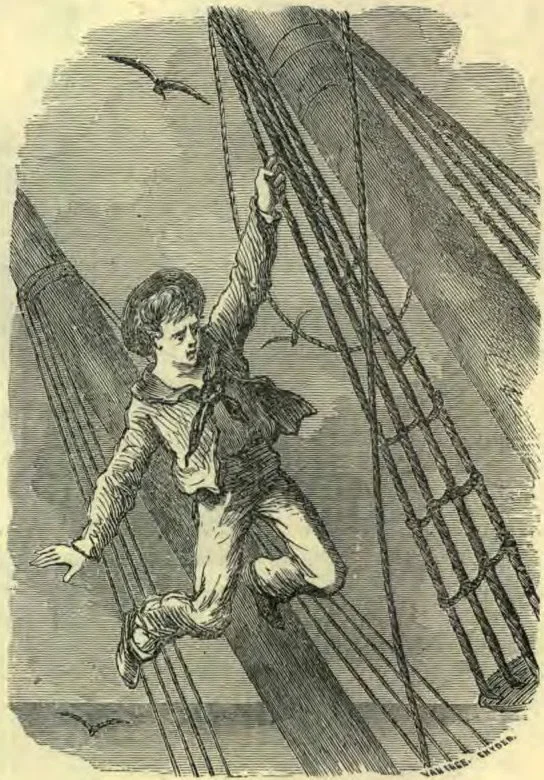
Finally, they agreed among themselves to make Allan drink some liquor; and finding him one day alone near the stern of the ship, one held him, while another tried to pour the rum down his throat. The others laughed loudly to see the fun. “Laugh on!” cried Allen, with a firm voice, “but I will never taste a drop of it. You ought to be ashamed to drink it yourselves; and much more to try to force it down a boy!” And just as the sailor was about to pour it into his throat, quick as a flash, Allen snatched the bottle and flung it overboard. The captain and the mate, hearing the noise, came that way, much to the joy of Allan, who supposed they would put a stop to the sailors’ abuse. But the captain was himself a rough, drinking man, and when he heard the cause of the trouble, he said he would “soon make the lad take his medicine.” When he learned that the boy had thrown the liquor overboard, he cried angrily, “Hoist that fellow aloft into the main-top-sail! I’ll teach him better than to waste my property!” Two sailors came forward to carry out the captain’s order, but Allan quietly waved them back, and said, in a low, respectful tone, “I’ll go myself, captain; and I hope you will pardon me, for I meant no offense.” His hand trembled a little as he took hold of the rigging, for he was not used to climbing the ropes of a ship. As the captain saw how slowly and carefully he climbed, he cried, “Faster, faster, there!” and faster Allen tried to go, but his foot slipped, and clinging by one hand, he hung dangling over the water. A coarse laugh from the captain, a jeer from the sailors; but Allan again caught his foot-hold, and in a few minutes more was in the watch-basket.
“Now, stay there, you young scamp, and get some of the spirit frozen out of you,” muttered the captain as he withdrew to his cabin.
The mate was a kind-hearted man, and begged the captain not to leave the boy there all night, else he would be chilled to death. The captain refused to let him come down, but said he would go on deck and see how he was doing.
“If I allow you to come down, will you drink what is in this glass?” shouted the captain; and he held up a sparkling glass of his favorite wine.
“No, sir; I cannot do it!” cried the brave boy.
“There, that settles it,” said the captain, “he’s got to stay there all night; he’ll be toned down by morning.”
After dark, the mate, unbeknown to the captain, managed to carry the poor boy a blanket and some food and hot drink. By early dawn the captain came on deck; and when to his call of “Ho, my lad!” there was no reply, he began to be alarmed, and ordered the boy taken down. A glass of warm wine and biscuit was standing beside the captain, and as Allan’s limp form was carried in before him, his voice softened a little as he said, “Here, my lad, drink that, and I’ll trouble you no more; but you will have to do this just to show how I bend stiff necks on board my ship.”
The boy was weak and cold, but he straightened himself up, and said, “Captain Harden, two weeks ago, I promised solemnly by my mother’s open grave that I would never taste the terrible drink which had ruined our once happy home, and sent my dear mother to an early grave. The next day I stretched my hand through prison bars to bid my poor father good-bye. With tears in his eyes, he said, ‘Pray for me Allan; and remember my boy, never, never to taste of strong drink.’ Do with me what you will, captain; let me freeze to death in the main-mast, throw me into the sea below, do anything, but do not for my dead mother’s sake make me drink that poison.”
The boy sank back, and burst into a fit of tears. The captain stepped forward, and laying his hand, which trembled a little, upon the lad’s head, said to the sailors, “For our mothers’ sakes, let us respect Allan Bancroft’s pledge; and never,” he added, “let me catch one of you ill-treating him.” Without another word the captain strode hastily away to his cabin.
Children, how many of you are brave enough to resist temptation, even at the cost of your life?
E. B. C.

Children Helping Their Parents at Home

LITTLE children should not wait till they grow up before helping their dear parents. God gave two nimble feet to take steps for mother, and eight fingers and two thumbs to bring and carry for her.

Letter Budget.

Ruby J. Andrews writes from Florence, Oregon. She says: “I am twelve years old. I once lived in Mich., and have one grandmother there now. I now live within two miles of the Pacific Ocean, and often go down to the beach. I have no sisters, but have two brothers, one ten years old and the other five. I will try to get some more subscribers for the INSTRUCTOR.”
Carrie Williamson writes from Covington, Ohio. She says: “I have taken the INSTRUCTOR three years and a half, and I like it very much. My uncle who lives in Battle Creek sent it to me one year, and the next year papa had it sent me as a New Year’s gift. I am trying to get up a club for the paper. We do not keep the seventh day, but the first. I am saving all my papers.”
Walter Hodges sends us a nice letter from Cleburne, Texas. He says: “I am a little boy five years old. I have a little brother two years old. Our grandpa and grandma live near us. We go to see them every day. Grandma is an Adventist. I would like to go to Sabbath-school with her, if papa was willing. She reads the INSTRUCTOR to me, and teaches me little Bible lessons. I like to hear her read the stories and the letters from the children in the paper. I want to a good boy, so when the Lord comes he will take me, with all the rest of the good children, to live with him in that beautiful home which grandma says he is getting ready for all who love him. I have never been to school, and do not know how to write, so grandma writes this letter for me. When I get old enough to go to school, I will try to learn fast, so that I can write to you myself sometime.”

WHAT THE SNOW-BIRDS SAID.

“Cheep! cheep!” said some little snow-birds As the snow came whirling down; “We haven't a nest, Or a place to rest, Save this oak tree bending down.”
“Cheep! cheep!” said the little Wee Wing, The smallest bird of all; “I have never a care In this winter air— God cares for great and small.”
“Peet! peet!” said her father Gray-breast; “You're a thoughtless bird, my dear; We all must eat, And warm our feet When snow and ice are here.”
“Cheep! cheep!” said little Wee Wing; “You are wise and good, I know; But think of the fun For each little one When we have ice and snow!”
“Now I can see, from my perch on the tree, The merriest, merriest sight— Boys skating along On the ice so strong; Cheep! cheep! how merry and bright!”
“And I see,” said Brownie Snow-bird, “A sight that is prettier far: Five dear little girls With clustering curls, And eyes as bright as a star.”
“And I,” said his brother, Bright-eyes, “See a man of ice and snow; He wears a queer hat, His large nose is flat; The boys made him, I know.”
“I see some sleds,” said Mother Brown, “All filled with girls and boys; They laugh and sing, Their voices ring, And I like the cheerful noise.”
Then the snow-birds all said, “Cheep!” and “Chee!” “Hurrah for ice and snow!— For the girls and boys Who drop us crumbs As away to their sport they go!”
“Hurrah for the winter clear and cold! When the dainty snow-flakes fall, We will sit and sing On our oaken swing, For the dear God cares for all.”
—Our Little Ones.

You have reached the end of this edition.

The Youth’s Instructor · Dec 20, 1882