The Youth’s Instructor, Vol. LII, No. 35

Sin Tsai Hsien

The Youth’s Instructor

August 30, 1904

Review and Herald Publishing Assn. · Washington, D. C. · August 30, 1904

Sin Tsai Hsien
OUR mission station was reached November 7. The clean mission compound was a grateful refuge to us after our varied experiences; we appreciated the rooms Brother Piliquist had prepared and reserved for us. The cities in China are arranged in three classes or ranks. A city of the first rank is called a Fu city, as Runing-Fu; one of the second rank is called a Cheo city, as Sin-Iang-Cheo; of this kind was our old mission station; while one of the third class is called a Hsien city. Our city belongs to this third class, Sin-Tsai-Hsien. Besides these there are a number of towns and villages. All these cities are governed by a mandarin, who is the chief executive, and is respected by the people according to the size of the city which he governs. There are various minor officials, all under the mandarin, such as magistrates and the chief of police. The government is very corrupt, from the highest to the lowest; it is a system of extortion by taxes levied upon the people.
The imperial government demands a certain amount of silver from each Seng or province, and the governor of this province levies a certain amount that is apportioned to each city in his province, the amount depending upon the size of the city. The mandarin of the city must raise this amount. He does it by charging property owners a tax; he has also other resources for getting money. At each of the four gates of the city he has his tax collector stationed, who collects a tariff on all the produce brought into the city. He always makes this tax so high that there is a large surplus left to go into his own pocket. Besides this he receives a stated salary. This makes the office of mandarin much sought after by the people. Men will spend all the money they have in getting the office, being assured that it will all come back to them, and that they will be made rich thereby later on. The same is true of the governor of the province. He also requires more of the cities than the imperial government requires of him, and thus secures for himself a large booty.
The people of China placed two and a quarter million taels of silver in the hands of Li Hung Chang with which to repair the banks of the Yellow River. He used one million taels in the construction, and kept the rest. As a result the walls were imperfect; and when the waters raised, the river flooded the country, and over a million Chinamen fell victims to the swelling waters. Because of this act the Chinese have no love for Li Hung Chang.
There is much ill feeling on the part of the common people against the ruling element of the country. This feeling has brought about the present condition of the country in which there is no spirit of patriotism, and no interest in public improvements. The cities of the Fu, Cheo, and Hsien classes are walled, the walls as a rule being about thirty or thirty-five feet in height, built of kiln-dried bricks. Outside the wall is a deep moat filled with water; inside, the earth is banked up to within six feet of the top. The smaller cities have four gates—east, west, north, and south—and these are kept locked during the night. The larger cities not only have an outer wall, but inside this there are walls dividing the city into several divisions.
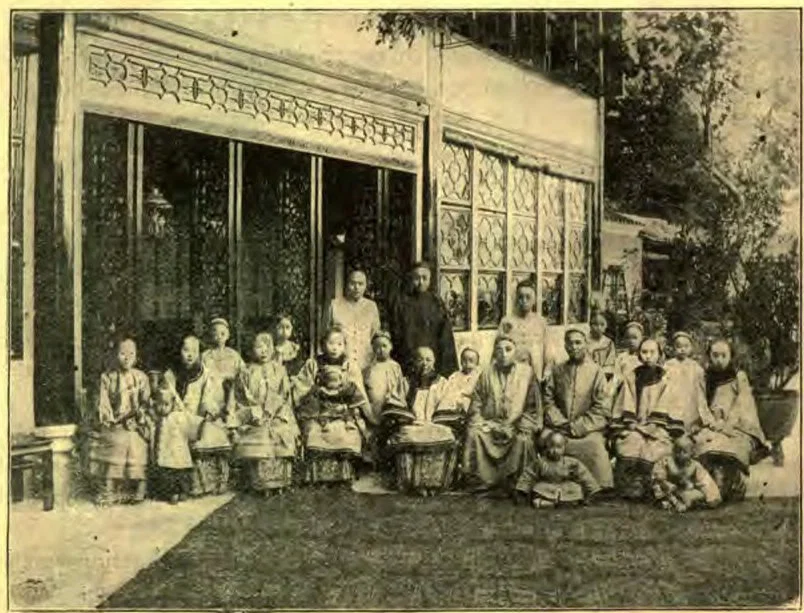
THE FAMILY OF A WEALTHY CHINAMAN
As a rule there are four main streets named after the four points of the compass. There seems to have been some order in the laying out of these four streets; otherwise the city is built promiscuously, with a few narrow streets and alleys here and there. Within the city there are always to be found several large ponds that were made when the earth was taken to build the wall. These ponds serve as a breeding place for fish, and for irrigating purposes. The women of the city resort here to do their washing.
Though the streets are supposed to be a passageway it is not an easy task to make one's way through them because of the many obstructions. The carpenter piles his logs in front of the shop, and fills up half the street; a man wants his house freshly plastered with mud, so he has five or six cart loads of earth hauled and dumped in the middle of the street, there to remain for probably three or four weeks. The tanner lines the street in front of his shop with hides for the people to trample on, and thus hasten the tanning process. The farmer, coming in with his load of straw, cane, stalks, or vegetables, sits down with his load in the midst of the street to rest and have a smoke; nobody tells him to get out of the way, but the people either stop and wait or go around him. On either side of the street the shopkeeper has benches, and on these are displayed the larger part of his stock of goods.
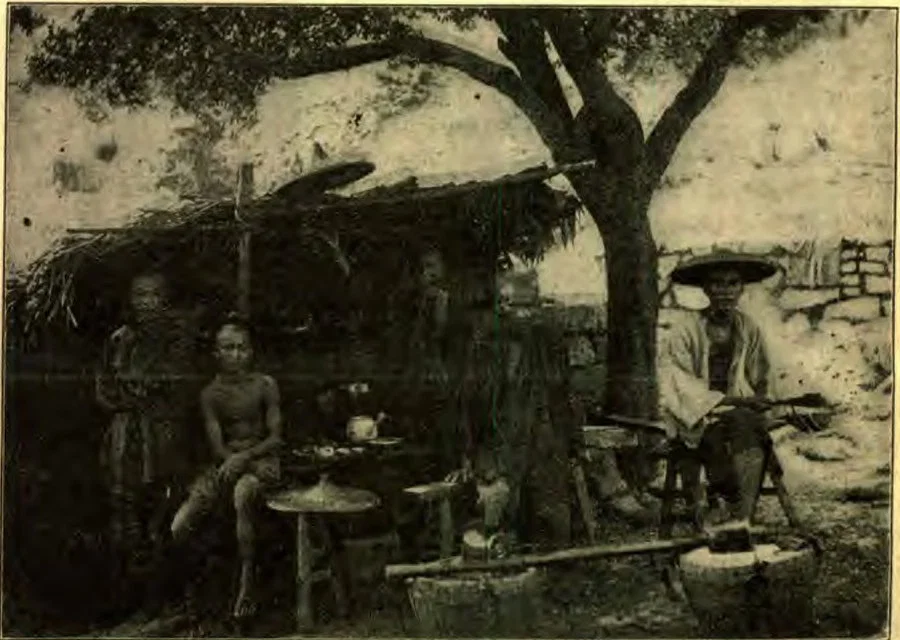
A BOOTH RESTAURANT IN THE STREET
The place of the lunch-counter and restaurant is largely supplied by the numerous food vendors. These men carry their outfit on a pole; on one end is a supply of foods and a table; on the other is a mud stove with a basin of rice or fried cakes or a mixture of vegetables cooking. If accosted by a hungry native, the man places his restaurant down in the center of the street, and serves his customer. The man who has bought the bowl of food squats down and takes his meal. At this season of the year while New-year's sales are in progress, not only the sides of the streets are lined with benches, but there is a row of benches in the middle of the street piled with goods, leaving a way on either side wide enough for pedestrians to pass single file.
Sin Tsai Hsien is in the east central portion of Honan, surrounded on all sides by a fertile farming country that sustains an immense population. While Brother Piliquist was preaching in a city about fifty miles to the east of here, a citizen of this place came requesting him to come and preach in Sin Tsai. From the first, the attitude of the people has been very friendly.
The mandarin and leading men of the city are kindly disposed, and have helped us in many ways. The people in the surrounding country and villages seem to be much more interested in the gospel, and the greater number of our converts are the country people.
Our mission quarters are on the main street running north and south, in a very favorable place to attract the attention of the passer-by. The mandarin issued a proclamation which was hung on the wall of our chapel, stating that if the passer-by wanted to hear the “true doctrine,” he should stop in and behave himself; if not, he should pass on and not molest us. One of our native converts remains in this street chapel the greater part of the time, preaching, selling Bibles, and talking to those who stop to inquire.
We have a large number of sick calling upon us daily for treatment, many of them in the very last stages of their disease, but all expect to be helped. From the country and cities around about comes the call for some one to come and teach them the true doctrine, but we are few in number and can not fill half the calls.
A. C. SELMON, M. D.

What Led Me to Become a Foreign Missionary
FROM childhood I had been interested in missions. In college the greatness of the kingdom of God began to take hold of me, and I often revolted against the general indifference to foreign missions and the frequent prejudices against it. From time to time I would think of missions as possibly my own life-work, but this first became a subject of continued thought when I entered the theological seminary. Life had begun to focus, and the choice of a particular field became an imminent question. Here, also, for the first time, I came in contact with the Student Volunteer Movement, which made a powerful appeal to me.
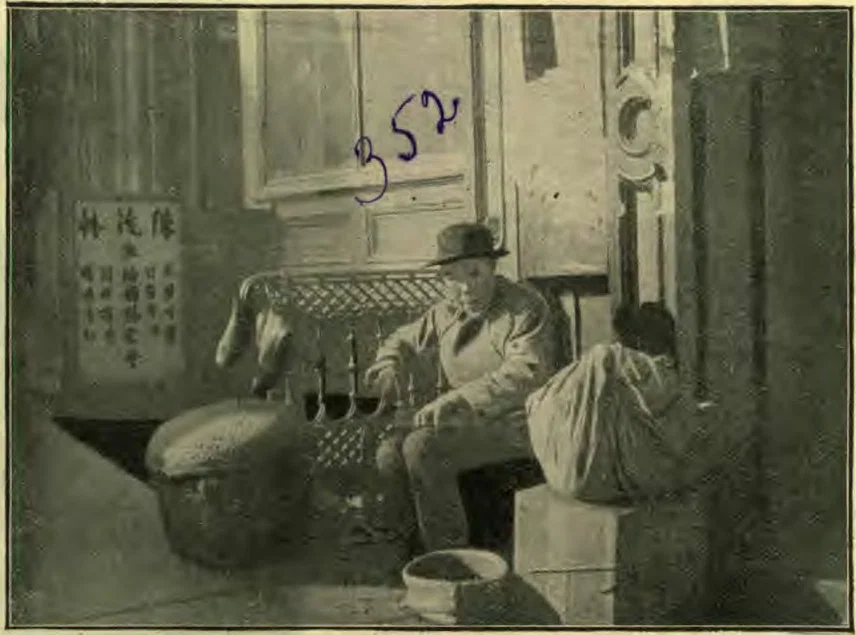
A CHINESE SHOEMAKER AT WORK IN THE STREET
Meanwhile, however, the opportunities and attractions of the work at home were filling my mind and staying my decision. I knew the specious counter-claims which so easily beset a man's mind the moment the appeal of the foreign work comes home to him, and I tried to guard against them, and to stifle selfish considerations. Yet it seemed to me that it ought not to be a foregone conclusion that I should go to the foreign field, but that being favorably disposed to that work, I could safely wait till my senior year, when doubtless I would be in better position to decide the question.
I would give much now if I could reverse that decision; for by it I lost, through nearly three years of my student life, what afterward became the greatest inspiration that I have ever known, and I lost three years of service and influence for the cause of missions.
I came to the middle of the senior year with the question not a whit nearer decision. I had prayed to know the will of God. Perhaps if I had prayed more faithfully, I might have received what would have seemed more like divine guidance; but as it was, I came to the conviction that I had all the light necessary for a decision, and had had for three years past.
It was merely a question of where my life would count for most. The appalling need of the heathen world, the increasing danger that the West shall give the East the externals and the vices of its civilization without giving it the saving truth which has fostered that civilization, the greatness of the work and the fewness of the men to do it,—these things could leave no doubt as to where my life could be best invested.
One Sunday I went out to preach in a church which offered much the same work that I had hoped to begin with, if I remained at home. In the course of the day one of the deacons wished to know if a “call” would be considered. I told him that it would, of course, but that I already had a call which I was seriously considering. That brought the thing to a crisis.
I felt that I had been drifting and allowing circumstances like this to shape my life. From this I would go up-stream. Returning to my room, I prayed that God would send me to the foreign field. Why had I not done that in the beginning? The result was a peace of mind that led me without further hesitation to offer myself for this work.
I have been here in China only a year—that first year of struggle with the language, when discouragement is most likely to come. But I can say that from the point of view of a life investment, mission work in China gives cause for a sober and lasting enthusiasm.—Rev. W. H. Millard, American Baptist Mission, Hang-Chow, China.

Character Building

IN this busy world of ours we can look about us on every hand and see great buildings being erected, powerful machines being constructed by the machinist, a name of notoriety being made by the popular man, a mountain of wealth being collected by the financier, and the professional man storing his brain with knowledge. All these require building, require genius, and careful thought. In them we may or may not be interested, may or may not participate.
To-day we have before us a subject, “Character Building,” in which all may not be interested, but in which all must participate, yes, are participating. It can not be shunned. It would be unmanly or unwomanly to shun it if one could. If the building for the above-mentioned results require careful thought and study, should not this infinitely more important subject receive our closest attention? Its importance is declared in the following quotation from “Education:” “Character building is the most important work ever entrusted to human beings; and never before was its diligent study so important as now. Never was any previous generation called to meet issues so momentous; never were young men and women confronted by perils so great as confront them to-day.”
It is not uncommon for a young person to have a fixed, definite aim in regard to what vocation he should follow in life. He has his ideal, and strives to accomplish its end. If we take so much interest in gaining success in these things, should we not have a definite character, a definite ideal,—namely, Jesus Christ, an ideal far above and beyond us,—buoying us up and luring us on to heights unseen?
Character is what we are. Our actions make habits. Our habits make us what we are. What we are determines our destiny. Therefore, character is destiny.
Let us stop a moment and investigate to see what manner of men we are. Look around us, and see what kind of character is predominant in the world. Go into what is called “good society” and find out the desires, the ambitions, and aims that the people have in life. To call your attention to the low standard, to the frivolous condition that is so prevalent, seems unnecessary, since society has become so openly and definitely marked with these characteristics.
Knowing that character determines destiny, should it not be a strong appeal to you and me to exert every possible power to change character to the true and noble, and thus point to the great divine Pattern, and so have a part in changing the destiny of our fellow men?
Great responsibilities are resting on the young people of this denomination. Greater responsibilities are to fall upon them. Do we desire to be successful, to master the situation? If so, we must have a firm character built up within ourselves. Is it not true that the great need among young people to-day is structure on which to build? It has been said by one that “thoroughness is structure for character building.” Then let us study and do those things that demand thoroughness on our part and severe discipline within ourselves. To cultivate habits of industry, promptness, and thoroughness is to make a structure on which a grand character may be built. It is in the years of childhood that such habits must be formed. For the benefit of those who have not formed right habits for life during childhood and youth as well as for the building of character in our own lives, should you and I not be very painstaking to see that our own actions carry a right influence and teach right habits. Many a father whose life has been wrapt up in his son has been disappointed because of wrong habits, indulged in by the child, and suffered by the father until his star of hope, which had arisen luminous to the meridian, is forced to settle down behind a clouded and blackened horizon.
I am reminded here of a few declarations given by Mr. Smiles: “Work is one of the best educators of practical character. It evokes and disciplines obedience, self-control, attention, application, and perseverance, giving a man deftness and skill in his calling, and aptitude and dexterity in dealing with the affairs of ordinary life.
“Work is the law of our being—the living principle that carries men and nations onward. The greater number of men have to work with their hands, as a matter of necessity, in order to live; but all must work in one way or another if they would enjoy life as it ought to be enjoyed.
“Labor may be a burden and a chastisement, but it is an honor and a glory. Without it nothing can be accomplished. All that is great in man comes through work, and civilization is its product. Were labor abolished, the race of Adam were at once stricken by moral death.”
Which is better, to be brought up in the theoretical knowledge of the gospel of Jesus Christ without the above principles firmly fixed in the life, or to have the above principles without the knowledge of the gospel? Does not the Scripture in Luke 11:42 have application here? “These ought ye to have done, and not to leave the other undone.” It is not hard to imagine a person in the first condition, for such cases are only too common. But let us follow it a little further. Suppose he later received genuine conversion. Has he structure on which to build?—Far from it. The wrong habits formed in early life will surely bear their fruit in after years, and will make him weak, whereas, if he had formed habits of industry in earlier life, he would have been a strong man for God. H. A. MORRISON.
(To be concluded)

The Devout Welsh

IN hymns for devotional hours, the fervent Welsh poets have produced many that breathe the purest and highest spiritual longings of the human heart. Their lovely valleys, and the traditions of centuries of fightings and oppressions, but above all, the ardor of Welsh devotion, have inspired many of the most expressive and beautiful of hymns. A century and a half ago there lived the poet preacher, Rev. William Williams, who is said to have ridden ninety-five thousand miles on horseback during his forty years of ministry. His journeys took him over lonely mountain paths and through unfrequented woodlands, and through the dark Welsh valleys when the times were rude with highwaymen. As he was never molested, it was but natural that he should reflect on the providences and tender mercies of God. He became the Watts of Wales, and wrote that hymn that is now the heirloom of the Christian church,—
“Guide me, O thou great Jehovah, Pilgrim through this barren land; I am weak, but thou art mighty; Hold me with thy powerful hand.”
The translation of the Bible into Welsh by Bishop Morgan in the sixteenth century, says Prof. William Sharp, marks an epoch in the life of the Welsh people and their literature. Therewith the history of the people begins.—Selected.

Gathering Cloves

CLOVES are now cultivated in many of the tropical regions of the earth. A clove tree begins to bear at the age of ten years, and continues until it reaches the age of seventy-five years. There are two crops a year, one in June and one in December.
The tree is an evergreen, and grows from forty to fifty feet high, with large oblong leaves, and crimson flowers at the end of small branches in clusters of from ten to twenty. The tree belongs to the same botanical order as the guava. The cloves, which are the undeveloped buds, are at first white, then light green, and, at the time of gathering, bright red.
Pieces of white cloth are spread under the trees at harvesting time, and the branches are beaten gently with bamboo sticks until the cloves drop. They are dried in the sun, being tossed about daily until they attain the rich dark color which proclaims them ready for shipment.
In this country and in England they are used almost wholly as a condiment, but in France they are employed in medicine for their tonic properties.—Boy's World.

Wasted

LIFE without a plan— As useless as the moment it began. — Cowper.

Earth's Imperishable Souvenirs

WHILE passing down a beautiful avenue in a southern California city, a wee lad paused suddenly to search for a dime, which unfortunately he had dropped while on his way to a store to make a small purchase for some one else. Finding his efforts useless, the poor little fellow became so overwhelmed with a tide of unpleasant thoughts, that he burst into tears. A kind-hearted gentleman passing that way, ascertained the cause of his grief, and gladly replaced the missing coin; and in so doing he brought back the sunshine and happiness of a few moments before. In such beautiful acts lies the secret of good manners considered in their broadest sense,—forgetfulness of self in thoughtfulness for others. The gentleman referred to did not seem to be a man of “great possessions;” but beneath his commonplace garb was a heart which throbbed in sympathy for the woes of humanity to such a degree that both time and money could be sacrificed for the sake of making even a little child happy.
“When the wandering wind finds out an Eolian harp, it becomes musical.” So when an opportunity to cheer a fellow traveler on the path of life, comes to him who rightly appreciates it, his benignant soul immediately responds. And “as the sword of the best tempered metal is most flexible, so the truly generous are most pliant and courteous in their behavior to their inferiors.” There is never an occasion in life when one can afford to dispense with good manners. Customs may be disregarded at will, but good manners, never. It matters not in whose society one may be placed, he is under obligations to treat with becoming dignity every soul with whom he comes in contact. Christ on earth was the personification of all good manners; and he who imitates most nearly the example of the great Benefactor of the human race, is the best versed in all that pertains to ethics.
To be good and to do good constitute the highest aim of humanity. And there is no one trait of character which is more indispensable to success, both day by day and ultimately, than the pure, simple, but fascinating charm of good manners, of which the golden rule—“Whatsoever ye would that men should do to you, do ye even so to them”—is the grand embodiment. Wealth, honor, and fame are by no means its prerequisites. He who was cradled in the rude manger in Bethlehem, whose life was surrounded by the wants and deprivations of poverty, gave to the world a perfect example of consideration for the happiness of others, which culminated in the agonizing scene on Calvary, when all the joys of heaven, and life itself, were sacrificed for your happiness and mine.
One may acquire much learning, and have great worldly possessions; he may profess to be a follower of the meek and lowly Jesus, and yet lack the essential of good manners, without which no life can be complete, nor can its influence upon others tell to the honor and glory of God. Bishop Middleton truly asserts that “virtue itself offends when coupled with forbidding manners.” And we are instructed that “had the believers in the truth purified their minds by obeying it; had they felt the importance of knowledge, and of refinement of manners in Christ’s work, where one soul has been saved, there might have been twenty.” “Through observing our lives, the people of the world form their opinion of God and of the religion of Christ.” The lack of true dignity and Christian refinement in the ranks of Sabbath-keepers is against us as a people, and makes the truth which we profess unsavory.”
Good manners are essential to the salvation of souls, and like every other good achievement, they cost something; but the grand returns are well worth all the expenditure. To really possess good manners, means to dwell in an atmosphere of usefulness; to give to the world that which is its due in all that pertains to good deportment. And he who falls short of this, prevents those with whom he comes in contact from filling up the full measure of life which it should be their privilege to enjoy in this world, and may also deprive them of the unending bliss of the world to come. O that every soul who professes to follow the divine Pattern, might sense this great truth as it really is!
To possess good manners, means to have such a tender regard for the happiness of others that self will be lost to sight. And we have these sweet assurances: “Whosoever will lose his life for My sake shall find it.” “It is more blessed to give than to receive.” Ah, he who pauses to pluck thorns from the pathway of others when his own inclinations would lure him on to more inviting employment; who will yield cheerfully his preferences for the sake of others’ welfare and comfort, will always find his own happiness increased thereby.
When Lot welcomed the strangers at the gate of Sodom, his act of courtesy brought his own salvation. When Abraham cheerfully extended his hospitality to the three travelers who came to him “in the heat of the day,” he “entertained angels unawares.” The thrilling story of the good Samaritan is but a striking example of good manners, and is well worth considering. Boys and girls, if you are not familiar with this brief narrative found in the tenth chapter of Luke, read it with care, studying all the circumstances in connection with it. Weave its blessed principles into the fabric of your every-day life, and bear in mind that beautiful manners never seem so beautiful as when exercised in behalf of an enemy.
Through the twilight shadows of time there echoes still the soft refrain, “Mark the perfect man, and behold the upright: for the end of that man is peace.” He who is “perfect and entire, wanting nothing,” lets “patience have her perfect work;” and as a result, he possesses a well-rounded character, which always includes the indispensable charm of good manners.
In the cherished autograph album of my schooldays, a thoughtful girl friend once inscribed that helpful quotation, “Trifles make perfection, but perfection is no trifle.” Good manners may be said to be composed of trifles,—little acts of kindness and courtesy which, considered singly, seem very insignificant; but taken as a whole, they constitute the intricate beauty of design revealed in the fabric of the perfect life. No one can afford to ignore the small opportunities for making others happy. “It is the unpretending acts of daily self-denial, with cheerfulness and gentleness, that God smiles upon.” “It is the little attentions, the numerous small incidents, and simple courtesies of life, that make up the sum of life’s happiness; and it is the neglect of kindly, encouraging, and affectionate words, and the little courtesies of life, which help compose the sum of life’s wretchedness.”
The great billowy sea is made up of single drops of water, while its boundless shores are composed of single grains of sand. It is the single touches of the artist’s brush that, one by one, bring out the marvelous beauty of the completed picture. It is the single blows from the sculptor’s chisel that gradually reveal the outlines of the perfect statue. So it is the single opportunities for making others happy, rightly improved, that little by little give to life’s panoramic picture its marvelous tints and radiant hues; that one by one shape the beautiful monument of a perfect character.
Every important truth has its counterfeit, and so it is with good manners. Many indorse affectation in place of good manners. It is easy to wear, as has been said, if one admires it; but it is never becoming to anybody. It is one form of ill-manners which mars the perfect character just as unskilful chiseling mars the perfect statue. Good manners are of the heart and soul, while affectation is but outward show, an artificial flower devoid of the living luster and inward fragrance which endear the genuine to every human heart.
Samuel Johnson says: “The difference between a well-bred and an ill-bred man is this: one immediately attracts your liking, the other your aversion.” And how true it is that every individual with whom we come in contact impresses us either favorably or unfavorably, as he possesses or lacks in the essential charm of good manners. Much ado is made concerning those matters of outward form which are considered so indispensable to proper conduct in society; but the weightier matters, which pertain to the heart and soul, and without which form is but a vain and empty show are too often forgotten. Genuine heart religion has its forms and its ceremonies, but these alone, avail nothing.
Good manners, properly considered, are but the outward manifestation of the inward adorning. A smile, a kind word, a loving ministration that comes from the heart, rest as a benediction upon the human soul struggling on the upward trend of life. These are earth’s imperishable souvenirs, prized at the time, and treasured in after-days when perhaps the generous giver has been lost to view.
How fondly we cherish the memory of those sweet lives whose kindly courtesies have come to us as the perfume of flowers, and whose blessed influence remains as a halo over all the past, inspiring us to imitate their loving example in seeking to make others happy.
MRS. M. A. LOPER.

Honor Must Be Active to Preserve Its Luster

“Honor must be active to preserve its luster.”

September Field Study

(September 10)

Opening Exercises:—

Singing.
Prayer.

Scripture Study:—

The Ideal Missionary.

He was a volunteer. John 10:17, 18.
He was a man of prayer. Luke 6:12.
He loved mankind. John 15:12, 13.
He sought the sinner. 1 Tim. 1:15.
He was willing to serve. John 13:4, 5.
His presence gives light. Isa. 60:1-3.
He is our pattern. Phil. 2:5-11.

Field Study:—

A Visit to our Missions in Syria and Egypt.
Review and Herald, July 21, 28.
The East Caribbean Conference. Review and Herald, August 4.
Entering Ceylon. Review and Herald, August 11.
Progress in Norway. Review and Herald, August 11.
One-minute Messages from Panama, River Plate Conference, South Africa, Spain, Japan, British Central Africa, Caucasia, Trinidad, Society Islands, and Latin Union Field.

Closing Exercises.

Note

The Scripture Study may be arranged in the form of a reading, handing each text to a different individual. Encourage all to bear some part in the meeting. A map will be of excellent service in outlining Elder Conradi’s tour in Syria and Egypt.
E. H.

Pleasure or Duty

SHE lay on a bed of illness, Her young life was wasting away; The smile of hope on her face Grew fainter each passing day. She sought for relief from her suffering, But she sought for it in vain. Her strength was ebbing fast away, And sharper grew the pain; Yet a smile of peace was resting On her face, as day by day She waited to hear the message That would call her from earth away.
But sometimes she was weary, And the day seemed tiresome and long. She wished she might hear happy voices, Kind words, or a snatch of a song. Had her friends really forgotten her? Did they no longer care That she should pine and suffer And none of their pleasures share?
At first they came so often; Flowers and kind words they sent. It almost made the sufferer “Forget and be content.”
But to-night a friend had promised She would come and lend her aid To cheer her; and the sick one thought She would keep the promise made, But she waited for her steps in vain. Just a pencilled note was sent, Stating she would come to-morrow, But to-night, on pleasure bent, She was going to the lakeside With some friends; but she would call And would tell her about it. On the morrow; that was all.
That pale, sweet face, it paler grew As she was left alone. “To-morrow, then, I think she’ll come.” From the pale lips came a moan. But ere to-morrow’s light appeared, The wearied pulse was still. Her trials were o’er before her friend Her promise could fulfil. Oh, why had she not listened To her friend’s last dying plea? “If you’ve done it to the least of these, You have done it unto Me.”
IVA I. NAY.

Wisconsin Conference

THERE are but ten fully organized Societies in our State, but this by no means represents the work that is being done by, and for, our young people. There are very few churches that have not some systematic plan of work with, and for, the young. The fear that the work of the Young People’s Societies might lead away rather than draw the young people to the church has kept many of our churches from organizing societies. The Manual that has been prepared and sent out by the Sabbath-school Department of the General Conference will be a great help in overcoming this objection, and we hope to see our churches take hold of the young people’s work with renewed energy.
I have noticed that it has not been the churches whose Young People’s Societies have been the most thoroughly organized that have accomplished the most in the work of soul-saving. I have in mind a small church where one young mother became convinced that something should be done for the young people. She invited them to her home one Sabbath morning. Only one or two came, but they had a precious time seeking God in prayer and the study of his Word. Thus they met, just two or three, for a number of weeks. Sometimes one or two others would come for a time or two, and then drop out. But finally there was a real revival in that church, and it began with the young people. During the past year, four young persons from that church have been engaged in the Lord’s work in the State. The secret of the success of that Society was the willingness of that one sister to follow the leadings of the Spirit, and begin work where she was, and in the best way she knew how, and not allow herself to grow faint because she did not see the immediate results of her efforts. I feel sure a real working Society could never have been organized there by beginning in a formal way.—Lottie E. Farrell, Educational Secretary.

When Praise Ascends, Blessings Descend

“WHEN praise is going up, showers of blessing are sure to be coming down.”

Considering What God Has Done

“CONSIDERING what God has done, will soon lead us to rejoice in what he will do.”

Upper Columbia Conference

The following is a brief summary of the reports from Young People's Societies in the Upper Columbia Conference:—
COLLEGE PLACE, WASHINGTON.—Fifty-nine members. These are actively engaged in distributing periodicals and tracts, visiting those who are confined indoors, holding meetings, etc. The interest is good, and many are manifesting a true missionary spirit. Meetings are held every Sabbath evening, at which time the lessons outlined in the INSTRUCTOR are used. Fifteen dollars and twenty-four cents has been collected and donated to Earl Rees, of Japan, and Geo. Enoch, of Trinidad.
WILCOX, WASHINGTON.—Twenty-eight members. The interest is good. Meetings are held every Sabbath afternoon. One dollar and thirty-two cents collected has been expended for Earl Rees.
MILTON, OREGON.—Twenty-two members. Meetings are held every Sabbath afternoon, and the lessons in the YOUTH'S INSTRUCTOR are studied. Signs and the Life Boat are being sent by this society to the penitentiary. Five dollars and forty-five cents has been collected, of which amount two dollars and ninety-four cents has been expended for Earl Rees, and two dollars and fifty-one cents for the Indian boy.
BOISE, IDAHO.—Seventeen members. Eight added during the quarter. The society meets every Sunday at 7:30 P. M. The studies outlined in the INSTRUCTOR are used. Active missionary work is being done among the poor and sick, literature is distributed, and the Life Boat is sent to the penitentiary. The amount of donations is seven dollars and seven cents, of which five dollars was paid for transportation for Earl Rees, and two dollars and seven cents for supplies. They are of good courage because of the interest and the number of members added during the quarter.
ONTARIO, OREGON.—Ten members, who are making missionary visits and distributing tracts and papers. A good interest is manifested. Meetings are held every Sabbath afternoon, and the lessons in the INSTRUCTOR are considered.
EMMA S. NEWCOMER.

The Worth of a Person Measured by Effects

“A PERSON is worth in this world the effects he can produce—no more, no less.”

Keep A-Trying

SAY, “I will!” and then stick to it — That’s the only way to do it. Don’t build up awhile, and then Tear the whole thing down again. Fix the goal you wish to gain; Then go at it heart and brain, And, though clouds shut out the blue, Do not dim your purpose true With your sighing. Stand erect, and like a man Know “they can who think they can.” Keep a-trying.
—Selected.
Continue reading: A King's Son—A True Story