Pacific Press Publishing Company · New York · Sep 17, 1896
“CHRISTIAN HYPOCRISY.”
By Editor
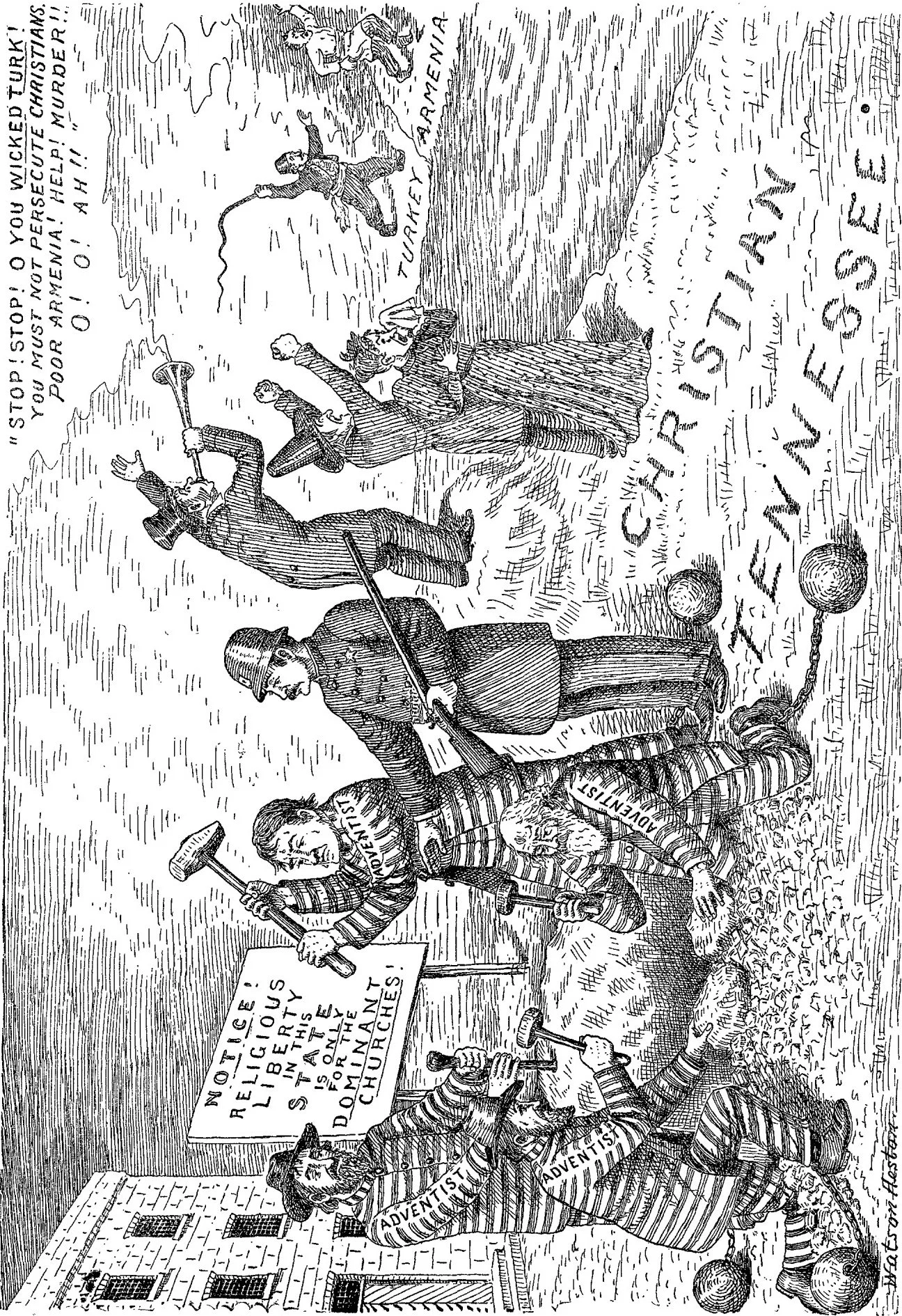
The cartoon which we print on the second page of this paper, by permission of the Truth Seeker, is a forcible illustration of how infidelity is fostered by the inconsistencies of so-called Christianity.
The persecution so forcibly depicted in this cartoon is utterly abhorrent to Christianity, even as it is to the innate sense of justice, implanted in the human soul by the Creator, which leads the editor of the Truth Seeker to cry out against it. Believing this, we are more sorry than we can tell that candid agnostics everywhere do not look away from the false to the true; that turning away from the imperfections of men they do not discover the divine perfections of the Lord Jesus Christ, that beholding Him they might be changed into the same image.
All men admire the character of Christ, as depicted in the gospels; but so little of that character appears in the lives of many of his professed followers that multitudes regard his perfections as only beautiful ideals quite beyond the reach of mankind; hence they think Christianity is impractical and even injurious, since it neglects the attainable for the unattainable, and fosters hypocrisy by leading men to make a profession, not only beyond their attainments, but beyond any possibility of attainment.
The trouble is that men are too prone to judge Christianity, not by the teachings of Christ, but by the lives of those who profess it; not by the best types produced by it, but by the poorest; not by the genuine, but by the pseudo. But this is illogical. What would be thought of a man or a set of men who would judge of a system of medicine solely by the success of the poorest type of physicians who professed to practice it, without first inquiring as to the best results attained by the ablest and best practitioners, and without examining the system itself and comparing the practice with the rules of the system as laid down by its founder, to see whether it was faithfully followed or not? Certainly all must see that the same rule ought to apply in both cases. A system of medicine ought to be judged, not by the profession of its disciples, but by the practice and rules of its founder; not by the worst results of the professed practice of the system, but by the best results of its exact and conscientious practice as laid down by its author. In like manner Christianity should be judged by what it is, not by what it is not.
Unbelievers do not point the finger of scorn at the Founder of Christianity. They do not, as a rule, assail the system itself as laid down by the Lord Jesus Christ. They do not even impeach the characters of the best representatives of Christianity, such as Bunyan, Baxter, Wesley, Whitefield, Judson, and a host of others who might be named; but they judge the system by the poorest types, the quacks and impostors, so to speak, of the Christian profession.
When persecution arises, as it always has arisen, instead of attributing it to the natural intolerance of the human heart, to the selfishness of human nature unrenewed by divine grace, men too often charge it up against Christianity. But Christianity does not teach persecution. Christ is the author of Christianity, and he himself denounced persecution. Upon one occasion when he had set his face to go to Jerusalem, “he sent messengers before his face: and they went, and entered into a village of the Samaritans, to make ready for him. And they did not receive him because his face was as though he would go to Jerusalem. And when his disciples James and John saw this, they said, Lord, wilt thou that we command fire to come down from heaven, and consume them, even as Elias did? But he turned, and rebuked them, and said, Ye know not what manner of spirit ye are of. For the Son of man is not come to destroy men’s lives, but to save them.”
And this which we have quoted is in harmony with the whole tenor of the gospel. “God is love,” and the gospel is the means by which he saves men. Says the apostle, “I am not ashamed of the gospel of Christ: for it is the power of God unto salvation to every one that believeth.” “God so loved the world, that he gave his only begotten Son, that whosoever believeth in him should not perish, but have everlasting life.”
As “God is love,” so his law is a law of love; and instead of being responsible for the hatred and selfishness of his creatures, he commands them to love one another, and to do as they would be done by. But this rule is most grossly violated by persecution, as our infidel friends well know. How then can they consistently charge it to the religion of Him who said: “All things whatsoever ye would that men should do to you, do ye even so to them; for this is the law and the prophets”?
Just at present there are no Seventh-day Adventists in prison or in the chain-gang in Tennessee. Three Adventists were imprisoned for twenty days each in Lake County the latter part of July and the first days of August. Balls and chains were actually provided in anticipation of compelling these men to work on the public roads, but for some reason the full measure of the proposed indignity was not meted out to them. But in other counties in that State Adventists have been required to work, not actually in chains themselves, but in the chain-gang with vicious criminals, while armed guards stood over them, as shown in the cartoon.
And the spirit of persecution is still abroad in the land, as is shown by the fact that another honest, Christian man is, as our readers know, under indictment in Rutherford County, Tenn., for exercising his constitutional and God-given rights in the matter of Sabbath observance. This man will be tried in October, and may be compelled to work just as represented in the Truth Seeker’s cartoon. But should this be the case or should any number of Seventh-day Adventists be sentenced to prisons and to chain-gangs, let not the wrong be attributed to Christianity, but rather to the lack of it, or to such a perversion of it as amounts to a practical denial of the second great commandment, “Thou shalt love thy neighbor as thyself.”
ANOTHER EXAMPLE OF CHRISTIAN HYPOCRISY.
These Adventists are honest American citizens who are persecuted, fined, imprisoned, and tortured as common felons because they exercise their Constitutional right to worship God according to the dictates of their own consciences, and observe the Sabbath instead of the pagan Sunday.—Picture, title, and comment from the “Truth Seeker” by Permission. (For editorial comment see the preceding page.)
Intelligence and Liberty Aid Religious Life
“INTELLIGENCE and liberty are not a hindrance but a help to religious life.”
PULPIT POLITICS REBUKED.
The stultification of person and office which results to the clergyman who turns his pulpit into a political rostrum, and to which so many of this class seem oblivious, is not hidden from the eyes of secular observers. In evidence, we reprint from the Chicago Times-Herald, of September 8, some forcible comments upon the case of a well-known New York clergyman, who has made himself conspicuous of late in this line of effort. The Herald’s rebuke is all the more noteworthy because of the fact that the Herald and the clergyman in question stand together upon the issue which has been the latter’s theme of discourse:—
“Christianity has been sufficient to dominate the most enlightened portions of the earth for eighteen hundred years. Its philosophy has overcome the legacy of Egypt, Greece and Rome, and continues to triumph over the intellectual syndicates of skepticism that follow each other in monumental groups, age after age. The irresistible sweetness of its creed has carried pioneers through the perils of the wilderness as broad streams bear the ships along during the night. Its warmth has kept alive humanity in everlasting snows and cooled the brow of suffering in the everlasting291tropic. Vast as imagination, adequate to every conceivable need of any clime, of every country, of all classes of the human race, eternal as its adherents believed Deity itself, there is a time when it is rolled up like a scroll, as the heavens some time are to be rolled, according to the prophet; and the rolling in these days is done by some little political preacher. On his lips Christianity withers and campaign sensation becomes its squalid substitute.
“The political preacher, no matter to what denomination he may attach himself, is almost invariably a man who, through lack of native ability to acquire distinction as an expounder of Christianity or grace to be content with obscurity, resolves to obtain notoriety by offending against religion. The first duty of a patriot priest is to preach respect for law and obedience to authority. The last offense a congregation should tolerate in a pulpit is incitement of anarchy and suggestion of treason.
“Rev. ——, of New York City, finds Christianity too pygmy for him while parties wrangle. His gigantic intellect, towering above that of Christ and his apostles and disciples, deliberately and with purpose aforethought, discarded religion from his alleged sanctuary Sunday last at New York City and delivered itself thus:—
If Bryan is elected two million more men will be idle, and, added to the million men idle caused by the present administration, we will have in this country three million idle men. Will these men starve? No; they will fight for bread. They will pillage, burn and murder. What will Mr. Bryan do? He will turn the army and navy on these men. The starving men will fire on the flag and war will follow. When the flag is fired on farmers of the West, the men of the South, who are to-day talking free silver and supporting Bryan, will rally round the flag and shoot down these three million starving men. The starving and desperate men will be killed and the nation will be saved. For this nation will survive for ever, as I believe we are God’s favored people.
“This is the language of a lunatic or of an incendiary. The brutal farce into which he degraded his office was terminated, we are told, in the pathetic irony of a ‘benediction.’ More logical indeed would it have been if his congregation had replied with a malediction upon him who did not bless but on that occasion at least defiled a temple they had dedicated to Christian truth.
“There are times when patriotism may with propriety be voiced from a chancel. There is never a time when partisanship . . . can enter a church without leaving behind it a need of holy water. . . . Let the people take care of their political concerns and let the pulpit preach the gospel. ‘Render unto Cæsar the things that are Cæsar’s, and unto God the things that are God’s.’ If the pulpit observed this commandment better the pew would not be empty so large a part of the year.”
VIOLATING LAW TO ENFORCE “LAW.”
By Editor
An interesting fact has come to light in the case of B. A. Philpott, the Seventh-day Adventist, recently arrested in Rutherford County, Tenn., for working on Sunday.
As most of our readers know, these prosecutions in Tennessee are not under the statute, which provides simply a fine of three dollars for Sunday work, to be recovered before a justice of the peace, by whomsoever first sues for the same; but under the common law of nuisance, by indictment by the grand jury and trial in the Circuit Court.
Now the law presumes that if anything is a nuisance somebody will be interested in prosecuting the offender, and therefore withholds from the grand jury inquisitorial powers in such cases. A valid indictment can only be returned at the instance of some citizen who comes forward to act as prosecutor, and whose name must be indorsed upon the indictment as prosecutor.
We are reliably informed that Mr. Byron Freeman, the gentleman whose name appears as prosecutor upon the indictment against Mr. Philpott, denies emphatically that he is prosecutor. He says he is only a witness, and an unwilling one at that, and never authorized the use of his name as prosecutor. If this statement is true, and we cannot doubt the gentleman’s word in the matter, somebody has violated the law in his zeal to enforce “law.”
This fact adds a new element of interest to this case, as it gives an opportunity to gauge the temper of the authorities of Rutherford County. If the judge and attorney-general are disposed to be fair in this matter they can do nothing else than dismiss the case when the facts are brought to their notice at the time of trial. If they are not disposed to be fair, they may force the case to trial. However this may be, they should have opportunity to show what manner of spirit they are of. If we were to venture an opinion it would be that the court will be governed by the law, and quash the indictment if the facts are as we believe them to be.
CIVIC DUTIES.
By s.
In an article in the Ladies’ Home Journal for September, on the subject of “The Young Man as a Citizen,” the Rev. C. H. Parkhurst seeks to mould public sentiment to the belief that the moral responsibility of an individual is inseparable from his activity in politics; that to fail to do active work in politics is to be neglectful of the interests of his community, and of the State. The man who will thus let “his State or city shift for itself,” is, he declares, “false to his corporate duty,” and “a despicable shirk.”
This view represents a natural reaction from another view, noticed by Mr. Parkhurst in these words: “Meditation, worship, and orthodoxy have, through most of the centuries of church history, constituted the area within which Christianity has confined its interests and its endeavors. It has been thought of as a commodity that best fulfills its purposes, not by mixing itself with the affairs and events of the world we now live in, but by isolating itself from all such concerns and concentrating its ambitions upon the world we hope to live in by-and-by.” A reaction from this view is certainly quite proper, but like all reactions from extreme positions, its tendency is to swing to the opposite extreme, and favor a mixing of political privileges with moral obligations which confounds the two and tends directly to a union of Church and State.
“A great deal of our political misery,” says Mr. Parkhurst, “is due to the fact that men, who are fairly faithful in most of the relations in which they are placed, do not hesitate, and are not ashamed, to be drones and renegades in their relations to the town or nation that they belong to. They would,” he continues, “consider themselves reprobates were they to allow a neighbor to suffer abuse without an attempt at intervention, but would see their entire city with all its machinery of government go to the dogs and the harpies without one definite effort at rescue or one distinct thought that such inaction was wicked and inhuman.” The remedy, he declares, must lie in the creation of a public sentiment which will compel the individual having the privilege of participation in the government, to go to the polls and primaries and discharge his “duty.” “Nothing will correct this evil but the creation of a sentiment so energetic and pervasive that decent people will not have the cowardly audacity to neglect the primary duties that pertain to them in their civic capacity. Citizens will attend the primaries, register, and vote, when the prevailing sentiment of attachment to our institutions is so pronounced and compelling that failure to discharge the functions of a citizen will be branded as contemptible.”
The actual absurdity of this proposed remedy for civic wrongs appears when we descend from generalities to particulars. Imagine, for instance, a Republican berating a Democrat (or vice versa), firing at him the Rev. Mr. Parkhurst’s denunciations for neglect of duty and branding him as a “contemptible shirk,” because he failed to go to the polls on election day and cast his vote! This would add a new and strange feature to political campaigns. It is natural for political enthusiasts to talk in this strain, because it is natural for each one to think that the person who puts study upon the question which constitutes the political issue will see it as he sees it, and that the honest person must vote as he would vote. This is why people are urged by the politicians to study the question. If they thought for a moment that such study would lead to a vote on the “other side,” it would not be urged. The conscientious, honest voter is relied upon to indorse by his vote the honest platform; and all the platforms are “honest,” in the minds of those whose views they represent. All the political parties appeal to the honest intelligent voter for his support. Each treats the issues of the campaign as if there could be no doubt that a careful, candid investigation of the same would lead to an indorsement of its views.
It is safe to say that many thousands of votes in the coming national election will be cast upon opposite sides of the issues before the country, all in conscientious compliance with the demands of “duty.”
It is evident, of course, that the same duty cannot lead men in opposite directions. And this brings us to a truth already stated, namely, that “politics” do not rest upon any basis of infallible authority. We have no political gospel. And while it is clear that one ought to pay tribute for the government’s support, and in every rightful way, by precept and example, seek to uphold that means which God has instituted among men for the preservation of human rights, his adherence to party or platform represents his personal opinion rather than his moral duty. Of course, there may be issues in the campaign, such as that of simple prohibition of the traffic in strong drinks, or the abolition of slavery, with reference to which we may be guided by the statements of God’s Word. But such occasions are few and far between.
Let Christianity touch every moral issue in the community, through the lives of those composing it, in the same way that it touched such issues through the life of Jesus Christ, and no one will have reason to complain that the interests of that community are being left “to go to the dogs and the harpies.” Any religion which does not directly and powerfully tend to uplift the community in which it exists, is not Christianity.
s.
CHURCH AND STATE IN ECUADOR.
By S.
THE Church and the State are on bad terms in Ecuador. One of those quarrels which are sure to result sooner or later from the unholy marriage which joins Church and State together, has occurred, and the Church finds herself unable to maintain her position of supremacy. The facts relative to the case are given as follows by the N. Y. Sun of September 8, which speaks from a Roman Catholic standpoint:—
The new revolutionary president of Ecuador has created alarm among the Roman Catholic clergy in that country. Soon after General Alfaro took the field against the government last year, he ordered the arrest of a number of Jesuits upon the charge that they were concerned in an intrigue to undermine the Liberal Party which had risen in revolt. Not long afterward hundreds of priests, knowing that they were held in suspicion by Alfaro, left Ecuador and took refuge in adjacent countries. Next we heard of the departure of many nuns, most of whom went to Bogota, while others of them came to this country.
Alfaro was very angry because the church authorities stood by the government and opposed the change which he sought to bring about. His anger was increased when a church dignitary, Bishop Schumacher of Portoviejo, took command of a military force, at the head of which he fought against the revolution. Both as a warrior and as a spiritual foe the bishop gave much trouble to the revolutionists, fighting them all the way from Caleta to Quito, and denouncing them with all his energy.
Alfaro declared that the “clericals” were the enemy who must be crushed, and hence the severe measures to which he resorted against the leaders of what he called the “clerical party,” the party that upheld the government of President Cordero. Since the revolution has been installed in power at Quito, and has obtained full control of the country, his animosity against the leaders of the defeated party has been manifested in his decrees and in the banishment of several of these leaders. One of his decrees, which has caused much uneasiness in ecclesiastical circles in Ecuador, provides that, in the event of further armed opposition to his revolutionary authority, the property of the enemy shall be seized and held subject to his disposal. This decree, it is understood, refers chiefly to the property of the Catholic Church which has been derived from the State, as the Church is supported by the State. Bishop Schumacher’s property, for example, would come under the terms of the decree.
It is not surprising, therefore, that there is alarm in the “clerical party,” which renewed the struggle for supremacy a few weeks ago, and has refused to become reconciled with the revolution which ended in Alfaro’s triumph. Under the decree, even the religious houses might be declared confiscate, and the estimates for the church withdrawn.292By advices from Quito, however, we have learned that it is not now the purpose of the “Supreme Chief” to proceed to extremities in this matter. He has given assurance that, because of the security of his government, the property of the church will be protected, and the safety of all peaceful ecclesiastics will be guaranteed. The priests, nuns and Jesuits who left the country when they believed they were in danger, are free to return to it at their pleasure, and to resume their places and their duties as servants of the church. Hereafter the business of teaching will not be under the exclusive authority of the hierarchy, and new privileges will be granted to Protestants; but, at the same time, the liberties of the Catholic Church are to be fully preserved under the revolutionary government.
It is a judicious policy that General Alfaro has adopted. He could not permanently maintain his power in opposition to the church, which, ever since the Spanish conquest, has been supreme in Ecuador. Liberty of religion is essential in a republic.
This contest is, of course, nothing more than the effort of the State to throw off the papal yoke and secure that “liberty of religion” which the Sun declares to be essential in a republic, but which under papal domination, means only liberty for Rome to do as she may please. And when Rome does as she pleases, both her adherents and people who are not her adherents must also do as she pleases, or suffer very unpleasant consequences. It is to be hoped that the rising spirit of liberty which is struggling for emancipation from the slavery of papal domination in the priest-ridden republic, will be able to secure for the people the birthright blessings so long denied them. S.
TURKEY'S RIVALS.
By S.
WHILE all the world is shuddering at the tale of Turkish atrocities in Armenia, it may be fitting to call attention to the fact that that government is not without formidable rivals for the palm on the point of cruelty, among the so-called “Christian” nations to which appeal has been made for the Turk’s suppression.
In our last issue we published a report setting forth the utter disregard of life manifested by the English soldiers toward the poor South African heathen whom they met in arms; and now the record of the French Government on the subject is brought to light by the reported escape of a French military officer who had been banished to “Torture Island” for alleged selling of government secrets to the Germans. This island is a short distance off the coast of French Guiana, and is a place of punishment for the worst class of political and criminal offenders. Of the fate of the hapless being sentenced to existence in this place, the New York Journal says:—
The punishment to which the French Government condemned Dreyfus is the most dreadful which the imagination can depict.
Banishment to the Isles de Salut means more than death. It means a period of bodily and mental torture which lasts for months or years, as the vitality of the convict may be great or little.
The islands lie off the coast of French Guiana, but a few degrees north of the equator. Their area is small, and they are covered with dense tropical forests.
It was the murderous climate of the isles which caused them to be selected by the French Government as a place of banishment for its most desperate criminals.
For eight months in the year, or from November to June, the average rainfall is 180 inches, or four times as much as in New York. July, August, September and October are the dry months, and during this period the thermometer for weeks at a time registers 115 degrees in the daytime.
The lowest temperature at any time of the year is 85 degrees.
To stand even for a few moments in the blazing sun during the dry season is almost sure death to one not thoroughly acclimated. The year round the poisonous exhalations which charge the atmosphere bring on the deadly fever, which, unless the convict stricken with it has an iron constitution, soon makes an end of his suffering.
It has been estimated that should all the island’s outlets to the sea be dammed up the whole country would be fifteen feet under water at the end of the wet season.
The forests teem with animal life. Venomous reptiles and stinging insects swarm in the tropical growths. Panthers and other savage beasts abound, a constant menace to the lives of the poor creatures condemned to live among them.
From the moment the convict sets foot on the islands his identity is lost and he is known only by number.
His trials begin at once. He is forced to march with companions in misery to the “camp,” which is to be his home while he lives. These camps consist of strongly-built, iron-barred huts situated in the midst of the forest. The only articles of furniture in them are tables and benches fastened to the floor.
Hammocks are swung at night, but the swarms of stinging insects and the fear of the creeping reptiles which are sure to enter the huts unless a constant watch is kept make sleep next to impossible.
Exhaustion from want of rest is one of the lesser agonies which the convicts have to endure.
The labor they are forced to perform is the most arduous that can be devised—that of draining marshes and clearing ground.
This labor is performed under a blazing sun, which, beating down upon the poor creatures, withers up their bodies with its awful heat. So great is its power that the very picks and shovels with which they perform their toil become so hot as to blister their hands.
Standing knee deep in a trench of stagnant water, with swarms of gnats and mosquitoes stinging them into a frenzy, the convicts dig for hours while the alternate fever and ague racks their bodies.
The guards are armed with rifles and have orders to shoot to kill at the least sign of insubordination.
Scores of prisoners deliberately run over the dead lines to draw the shots of the guards and insure themselves a release from their sufferings.
The fact that these awful cruelties are inflicted upon criminals and not innocent persons, does not in the least alter the nature of the light which is reflected thereby upon the government which gives them sanction. To inflict torture upon any person or thing is an act utterly at variance with the spirit of Christianity and love of humanity.
S.
SUNDAY AGITATION AT ASHLAND.
By May Wakeham
BY MAY WAKEHAM.
The Ashland Park and Pleasure Boat Company, Nebraska, seem to be creating no small stir among the religious circles of this city. The boat is a barge about 18x24 feet, propelled by a gasoline engine, and runs from Ashland Beach in the south western part of town to the park a few miles up Salt Creek. Of course Sunday is the day on which most of the excursions are held. Sunday, July 12, the excursionists were entertained at the park by shooting matches, bicycle races, a nigger-head target for rotten eggs, etc., and plenty of beer.
According to one of the city papers the churches were all represented at the park. This so aroused the righteous indignation of one of the ministers that he preached a sermon on Sabbath desecration last Sunday evening. He took for his text the fourth commandment. After introducing his subject he exclaimed, “Do you want the people of Ashland to think the sabbath, that holy day on which Christ rose from the dead, is done away? Methinks if the Lord Jesus Christ had come to the park last Sunday he would have thought it was a week-day.”
He then appealed to the moral citizens to stand shoulder to shoulder and “form a law-and-order league if necessary.” He told them the time was coming when a hue and cry against this evil [Sunday desecration] would be raised from every pulpit in the land.” People say, “What can we do?” They forget the possibilities we have in our State laws. He suggested that committees be appointed so that if anything of the sort should happen again on Sunday “every one of the excursionists could be arrested.”
After the sermon he offered a closing prayer in which he thanked the Lord for the “fourth commandment, which not only commands us to keep the Sabbath, but to see that others keep it;” also that he has “given us the civil laws.”
His whole sermon was a sad exhibition of “zeal not according to knowledge.” It is difficult to understand how any one could read the fourth commandment and other texts he read and apply them all to the first day of the week.
We can but be thankful for truth which is so plain and consistent, and when we contrast it with the error on every hand, it shines brighter.—Nebraska Reporter, August 17.
PERSECUTION.
[From Liberty, a local Seventh-day Adventist paper published in Toronto, Ontario.]
As a people we have long believed and taught that the time would come when persecution would be felt among us in all its force. In several places the fulfillment of this belief and teaching has been realized during the past few years, and many of our brethren have been treated as though they were criminals, having been compelled to work on the roads in the chain-gangs, wearing the prison garb, living on prison fare, and all because they have dared to keep all of God’s commandments. And we expect to see more of it in the future.
But there is a different form of persecution to which we wish to call special attention in this article. It is the work of harassing one because of his religious belief. There are various ways in which this form of persecution is carried on, and the judgement alone will reveal the multitudes who have suffered everything even death itself in consequence of it. Work which belonged to a man, morally speaking, has been withheld, and people have been influenced to deprive him of the means of support in order to drive him to give up his faith or to drive him out of the neighborhood. Or if he has not the means of getting out of the presence of such Christian piety, for it is professed Christians who carry on this sort of work, drive him to starvation.
Such persecution requires more of the grace of God to endure than confinement in jail, or impressment into the chain-gang would require; because in the latter case one is sure of prison fare at least, whereas in the other case he is driven to depend upon charity. And “the tender mercies of the wicked are cruel.” The charity of those who will engage in such persecution is not of a character to impress one as coming from a pure heart with faith unfeigned.
We had a case of this kind of persecution here in the city of Toronto not long since. A Swiss who had been living in the city for a number of years accepted the truth recently and began the observance of the Sabbath of the Lord. All went well for a time, but when it became known that he kept the Sabbath, he was waited upon by a number of clergymen who tried to persuade him that he was in error, but failing in this, they resorted to the gospel of force.
The Swiss kept a general repair shop, and he was an excellent workman; but those who293had brought him work before he became a Sabbath-keeper, suddenly dropped off, and even went out of their way to take it to an inferior workman. Others would use abusive and insulting language to him, and to those who still brought him work to do, calling him “sheeny,” that is, a Jew. Finally his work dropped off entirely, and he was reduced to want.
On visiting him we found him in the greatest distress of mind, considering whether it was best to go on and keep the Sabbath and see his family starve, or to give up the whole thing. But he gained the victory, and though having had but little to eat for several days, and with no prospect before him for the future he firmly resolved to obey God, let the consequences be what they might.
We have talked about persecution in the past, and some have indeed had to go to jail, and to suffer other indignities, but let a man be brought to a place in which he must choose between starvation and obedience to God’s commandments, and he will have a test of faith that very few know anything about as yet.
“THE SICK MAN.”
[New York Journal, September 9, 1896.]
It is almost half a century since Nicholas I. of Russia christened Turkey “the Sick Man” of Europe, and though Nicholas himself, his successor, and most of his contemporaries have since died, “the Sick Man” is still holding on to existence. Nevertheless the partition of Turkey seems nearer at hand than at any period before since the memorable conversation of the Czar with Sir G. Hamilton Seymour in January 1853.
It was at a reception given by the Archduchess Helen, at her palace in St. Petersburg, that Nicholas confided his views with regard to Turkey to the British Minister to Russia. “We have on our hands,” said the Emperor, “a sick man—a very sick man. It will be a great misfortune if one of these days he should slip away from us before the necessary arrangements have been made.” Nicholas was much chagrined when the English Minister and the English Government, after he had repeatedly reiterated this idea that England and Russia should divide “the Sick Man’s” property, answered his overtures by saying that they did not consider it usual to enter into arrangements for the spoliation of a friendly power, and that England had no desire to succeed to any of the possessions of Turkey.
It was at about this period that the report of a mysterious clause in the will of Peter the Great, that has since been proved not to be genuine, alarmed the European powers. According to this document, Peter enjoined all succeeding Russian sovereigns never to relax in the extension of their territory northward on the Baltic and southward on the Black Sea shores, and to encroach as far as possible in the direction of Constantinople and the Indies: “To work out this,” the alleged will was supposed to read, “raise wars continually—at one time against Turkey, at another against Persia; make dock-yards on the Black Sea; by degrees making yourself master of that sea as well as of the Baltic; hasten the decay of Persia and penetrate the Persian Gulf; establish, if possible, the ancient commerce of the East via Syria, and push on to the Indies, which are the entrepot of the world. Once there you need not fear the gold of England.”
Although this alleged will has been proved to be mythical, there is little doubt that the policy of Peter and his great follower, Catherine, would have been in thorough harmony with such a project, and that it is still down in Russia’s books as a possibility. The possible partition of Turkey revives interest in these half-century-old traditions.