THE only wild animal that lives under the same roof with man is the rat. We pay for his keep, although we are not on friendly terms with him. In return, he plagues us in many ways: he gnaws our walls and furniture, steals our food, and, above all, is active in the spread of disease. The annual rat bill of the United States for food alone is estimated by Mary Dudderidge, writing in The Forecast, at one hundred and sixty millions of dollars.
The rat not only disseminates bubonic plague, but carries tapeworms, trichinæ, flukes, roundworms, and other parasites, besides being suspected as an active agent in communicating leprosy and infantile paralysis. It can gnaw through any common building material except stone, hard brick, cement, glass, and iron. It destroys whole fields of grain, climbs trees to steal fruit, eats both fowls and their eggs, and destroys game. It steals costly furs and laces for its nests, when it can get them. Much of our annual loss by fire is due to the rat, and he also starts floods by burrowing in dams and levees. He is a great traveler, and is fond of living on shipboard, though, fortunately, he journeys little by rail. Finally, his fecundity is prodigious, the fond mother presenting him with numerous additions to the family circle, sometimes as frequently as once a month.—Literary Digest.
How Cortland Went Dry
CORTLAND was prosperous. The majority of the citizens felt well satisfied with existing conditions. A few farsighted men and women, however, claimed that a much greater prosperity awaited her if she would forever banish the liquor traffic, and that she was even committing an unpardonable crime against her own citizenship by permitting the traffic to exist. But the wets said, “Not so. When you destroy the liquor traffic, you destroy the revenue. City government cannot be carried on and necessary improvements made without this revenue. Besides, abolishing saloons will hurt business and increase taxes.”
This question was discussed vigorously at a town meeting. One who had taken a prominent part in the opposition argument, left the meeting determined to fight prohibition to the finish, though he himself was an abstainer.
On returning to his office he sat thinking over plans for carrying out his resolution, when he fell asleep and dreamed that he was accosted by a man of unusual physique and surprising intelligence. As they conversed he learned that the stranger was a representative from Mars, sent here to learn what he could of conditions in our world. As they talked together they heard the screams of a woman in distress. While seeking to determine their source, a fair-haired baby girl came out of a near-by house and cried, “My papa is hurting my mamma!”
The men hastened over, and found that the husband had just choked his wife to death on her remonstrating against his cruel treatment of their three-months-old baby.
“Tell me,” said the Martian, “what could lead a man thus to harm his own household?”
“Drink. Alcoholic or intoxicating drinks, such as whisky, rum, and beer, when drunk in sufficient quantities, make men commit crime.”
“By accident, I suppose, this man drank this vile stuff?”
“No, for almost two years he has been under the influence of liquor a large share of the time. Before he began to drink he was one of our leading business men, upright and industrious, a devoted husband and father; but he unwittingly fell into a trap set by a certain saloon keeper to catch him as a patron, and he has since rapidly gone to the dogs. He seems to have no self-control. He is a shame to the community.”
“How is it that a man is allowed to sell such deadly substances to his neighbor?”
“Men will drink liquor, and men will sell it; so the town regulates the sale by licensing certain persons to sell it. In this way the sale is better controlled, and the town gets so much clear money out of it.”
“It may be clear money; but it certainly is not clean money. Why do you speak of controlling the business when such tragedies as we have just witnessed are possible, and you yourself say many others are perpetrated?”
“I mean we limit the sale to a few men by charging them a high license. We limit the hours of sale; and forbid its sale to minors and to drunkards.”
“How many saloons do you have in this place?”
“We have one hundred, and each pays $1,200 into the city treasury. This $120,000 helps out considerably in our expenses and improvements.”
“Your town, then, has licensed one hundred men to do their utmost to sell stuff that makes other men commit horrible deeds against their own families, such as we have just witnessed? Is this the province of civil government?”
“Of course, all who drink do not do such things.”
“But such results are not only probable, but are expected, are they not?”
“Yes, I suppose it must be expected that some drunkards will be made wherever liquor is sold, and that some of them will commit crime.”
“This is certainly an anomaly in government,—licensing that which destroys government. Does a man know what he is doing when under the influence of liquor?”
“No, it seems that often he is irresistibly impelled by the liquor to commit the deed, but does not sense what he is doing.”
“Why should not the saloon keeper and the town voters be held responsible for the deed even more than the man who committed the crime? What will be done with this man who has just killed his wife and maimed his three-months-old babe?”
“He will probably be imprisoned for life or hanged.”
“What will become of the afflicted babe and of that angel child who gave the alarm?”
“I suppose they will be cared for in the city orphanage. I was told the children have no relatives who can assume the burden of their care.”
“You will pardon me, but I should like to learn what other crimes men have committed under the influence of the stuff you permit one of your citizens to sell to the rest.”
“I read of them, but as they do not directly concern me, I do not remember them.”
Just then an acquaintance of the business man came up, and after a few words of general conversation, the Martian said, “Friend, tell me what use alcoholic liquors serve.”
“Sir, as beverages they serve no good use whatever. The alcohol, the intoxicating element in hard drinks, in its pure form has mechanical and scientific uses; but when taken internally it is only an evil. I have given much study to this question, and I will tell you frankly that the liquor traffic is our nation’s greatest curse. It causes at least 75 per cent of the nation’s crime; 60 per cent of its poverty; 50 per cent of the defectives; and 30 per cent of the insanity. There are more than 800,000 liquor-orphaned children in this country, and thousands upon thousands of little ones die yearly from the alcoholic sins of their parents, and 2,500 are smothered to death by their drunken parents.”
“The traffic murders in cold blood thousands of wives and ruins tens of thousands of girls yearly, besides bringing untold sorrow and trial upon hundreds of thousands of other women. It debauches boys and girls, wrecks manhood and womanhood, digging 100,000 drunkards’ graves annually. It is responsible for a large share of the preventable sickness and death. Tuberculosis, our most fatal disease, carries off two hundred out of every 100,000 of our population annually. This disease costs the nation in loss of earnings, through sickness, in possible earnings stopped10by death, and in expense of sickness, $1,000,000,000. No small proportion of this expense and suffering would be averted were it not for alcoholic liquors; for it is estimated that ten out of every one hundred deaths from tuberculosis are due directly or indirectly to alcohol.”
“The traffic seriously interferes with the efficiency of our workmen, and is the direct cause of thousands of accidents; it is the chief cause of nonsupport, divorce, and immorality.”
“It depletes each year our State and national treasuries to the amount of $2,500,000,000 directly and nearly $3,000,000,000 more indirectly.”
“These are some of the material aspects of the problem, but the woes and heartaches from every place where the saloon exists are unutterable and indescribable.”
“Why, then, is such a traffic allowed to exist?”
“Simply because some men care more for money than for life. They, of course, make themselves believe that they have legitimate excuses for condoning the traffic; but these have all been proved absolutely futile, as all know who have given careful study to the question.”
“How is it about the revenue being necessary to compass city and State expenses?”
“That idea is absurd. The money involved in the tragedy that just occurred here gives a concrete illustration of my contention. The burial of the wife, the care of the children, the trial and imprisonment of the father, will amount to no small sum. This, with the care of all the other victims of the liquor traffic, costs the city at least $175,000 annually. Our citizens spend more than $2,000,000 for the drink. It surely is not good policy to spend $2,175,000 for the purpose of getting back $120,000, in revenue, or license fees.”
“I will cite one other concrete example of the cost of crime. A citizen of one of our counties bought a quart of whisky, got drunk, and went out and killed a man. It cost the county about $5,000 to send the murderer to the penitentiary. The circuit court set aside the verdict, and sent the case back to the lower court for a new trial. It cost the county about $6,000 more to put the man behind the bars at Columbus. Two years later the governor pardoned the murderer. The fellow went back to the county and bought another quart of whisky, got drunk, and killed another man. It cost the county $5,000 more to send him again to the penitentiary. Once more the circuit court reversed the decision and sent it back on error for a new trial. The defendant asked for a change of venue, and the case was heard in another county. It cost the first county approximately $8,000 more to send the man finally to the penitentiary for life. The two quarts of whisky cost $24,000 for prosecution and trial of the drinker.”
“This is only one illustration of the great expense accrued in dealing with liquor-produced crime. People fail to consider the real cost of crime in dollars, else they could not voluntarily vote to license an institution that is directly responsible for three fourths of all crime. Our national expenditure for liquor directly and indirectly is conservatively estimated to be $5,000,000,000. Our revenue from the liquor traffic the last year was only $223,948,646.09. Yet our liquor friends insist that the government could not exist without the revenue from the traffic.”
“The revenue idea is a myth; mercantile and other business loss said to be due to prohibitory legislation is as great a fake as the revenue plea. Twenty-four States, thousands of towns, cities, and business corporations testify that business conditions improve under prohibition of the liquor traffic; in fact, wherever prohibition is given but half a chance, it makes good. We can financially well afford to eliminate every vestige of the liquor traffic; and certainly there is no question but that moral and spiritual benefit would result from its annihilation. The silver dollar before the eyes of the liquor sympathizer and dealer is the only thing that keeps the traffic alive in this enlightened age. Some X ray or other scientific ray will surely in time be discovered that will allow these to see right through the dollar the real status of the traffic. Then the death lance will be thrown. The liquor traffic will be no more.”
The force with which the orator delivered this desired death blow was sufficient to arouse the sleeper from his dreams; and although on first opening his eyes he glanced about for his companions, he soon realized that he had been dreaming. But he could not shake off the feeling that the dream was but a presentation of facts. He was pricked in his heart as he reviewed the points of the dream. He went to his library and took down some books which he had not cared heretofore to read. Study and serious thought tore away all the silver scales from his eyes, and he saw men as men, as brothers, to be protected rather than exploited for private gain. He had a new vision, a new dream. His vote at the next election was the one vote that saved Cortland from the maw of the insatiable liquor traffic. The drys won!
A Prohibition Circus
THE manager of the Hagenbeck-Wallace circus, in booking the big circuses for 1916, gave preference to dry towns. He said:—
“We do better business in a dry town than in a wet one. We noticed the difference in Missouri; always the day’s receipts were better in a town that had gone dry under local option than in a town where saloons were open. And business is better in Kansas than it is in Missouri.
“We showed in Crawfordsville, Ind., this summer, and that town is dry. It was dry in more ways than one this year, for the rains were scarce and crops bad, hard times apparently pushing on. Yet we showed to capacity crowds. A few days later we went to Shelbyville, Indiana, where the streets are lined with open saloons. Rains had been plentiful in this region, crops were fine, and there was plenty of money. The streets were crowded with people at 9:30 in the morning, but our second section was delayed by a wreck and we didn’t get our parade on until about noon. By that time many of the men had gone into the thirst parlors and spent their cash over the bar. They didn’t have any desire left for the circus, and their wives and children wandered up and down the streets without money, and they didn’t see the circus either. So we played to miserably small crowds.
“I have seen this whole game up and down and backward and across,” he concluded, “and I want to tell you that all this talk about a town needing saloons or gambling houses to stimulate business is the purest bunk.”
A Child's Odd Description of a Giraffe
According to the small girl a giraffe is a horse with a periscope.
“What’s Dat?”
By J. G. Lamson
J. G. LAMSON
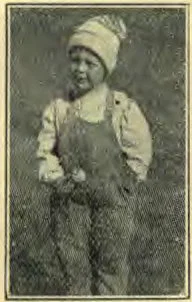
“What’s dat?” you say, you little pedagogue; “What’s dat?” you know, you little rogue. “Dat” bright thing hanging from your rompers’ pocket Is but an imitation of big brother’s locket.
You think it’s fine? Well, so it is for boys; As fine as need be if to all your joys It adds another; but I wish you’d show “What’s dat” in your pocket: I should like to know.
Yes, I know “dat watch fob” indicates a “tick,” But I cannot hear it, maybe it is sick. Let me see it, won’t you? Oh, you rogue, I know You are wearing watch fob only for a show.
Well, then, tell me, Roguey, what’s the time o’ day? All you know about it is “the time to play”? All right, play ahead then: best thing yet for boys. Trouble’s coming soon enough; just enjoy your joys.
Attacked by Wild Cattle
By W. S. Chapman
W. S. CHAPMAN
JUDGE W. L. PIERCE, one of the prominent lawyers of the now famous city of St. Petersburg, Florida, had, in former years, an adventurous life in the then rough Far West, and occasionally tells of some of his interesting experiences. To a reporter of the Daily Independent of that city he recently narrated a very thrilling incident.
He stated that about fifteen years ago he became interested in following up a supposed great find of gold in Monterey County, California, which turned out a failure, it being but a small, though rich pocket. Being thus disappointed in his hopes, he determined to have a good time fishing in a famous trout stream some miles farther on. After a week's outing, he returned to Jolon, one of the old Wells-Fargo stage stations, now a sort of wayside inn for travelers. What follows let the judge tell in his own words:—
“Four miles up the valley of the little stream that flowed through the place, the Nacimiento, if I remember correctly, still stood the ruins of an old Spanish mission. The chief marvel of this locality consists in this, that one could not take up a shovelful of the dust of even the road, nor pulverize one of the ancient adobe bricks of the tumbled mission, but that on washing in a miner’s pan, one would find colors of fine gold. It was too fine to wash in the ordinary way, though in the rainy season a few Chinamen still managed to make two or three dollars a day by arduous toil. This flour gold was thinly scattered everywhere, and I conceived the idea that possibly by diverting the Nacimiento far enough up its course a flume might bring down a sufficient volume of water to hydraulic the lower hills and the valley, and thus out of the great volume of washed dirt, the flour gold in paying quantities might be saved.
“So one morning, without saying to Mr. Dutton, the proprietor of the stopping place, just where I was going, I borrowed a high, two-wheeled gig, or sulky, and an old, unshod mare, tied the two together, and made a journey of about twelve miles up the old abandoned road along and many times across the Nacimiento Creek, to a point where I believed I was high enough to divert a sufficient flow of water for my purpose. Here I lunched, and grazed my horse, and then started on my return.
“The old mare was perfectly gentle, and I thought required no guiding, so my eyes rested mostly on the sides of the yellow hills hemming in the valley, with a view of ascertaining if a flume could be conveniently lodged along their sides.
“My mare was very tender-footed, the road mostly of gravel, and where she saw a bit of easier sand or dirt to walk upon she would meander more or less from side to side to ease her feet.
“Probably a hundred years prior to the commencement of our tale an acorn took root at this place, which was now the side of an abandoned mining trail. It flourished and grew to a goodly size until somebody with an ax, who had no use for the tree, thought he wanted it for some purpose, and cut it down. There the old trunk lay, seasoned by many summers, and winters too, unused. The branches either had been used by campers for firewood or else had decayed. The stump remained, and during all these years had remained waiting for me. Just think, an innocent stump, the relic of an innocent tree, the product of an innocent acorn of one hundred years ago, like the ‘wild man of Borneo,’ had just come across me. A little sand, too, with diabolical purpose, had likewise drifted over the gravel at the side of the pebbly road, and my mare, to ease her corns, turned a bit aside to tread on the softer material. My eyes still traveling over the hillsides, had not noticed the stump nor the mare’s side-step. A moment’s upheaval, a scramble to balance, and over I went, falling heavily on my side, my left hip striking12the hard ground with great force. The pain was so great that for probably a minute I could not raise my head from the ground. It was excruciating, the severest I have ever suffered. I have been struck, and even shot through the body, but the pain suffered at this time, was the most extreme of my life.
“When I could raise my head, I tried to rise, but found my left leg useless. It was broken at the hip. It was about one o’clock in the afternoon of the twenty-seventh of May. It was hot in the daytime, but very cold at night, in those mountainous regions. I looked around. There stood the old mare looking at the ruin which she had wrought. The sulky was on its side. All nature was serene, but I was in a bad fix. The road was seldom traveled. The mines to which it had once led were long since abandoned, and there we were, twelve miles from habitations—the mare, the cart, and I.
“Making up my mind that I could escape only by a superhuman effort, I managed to get to a sitting position, placed my broken leg across the sound one, and attempted to hitch along by the use of my hands to where the mare stood, thinking I might be able to get hold of the collar around her neck and raise myself to a standing position, then with the strength of arms and one leg, drag myself back to the sulky, one thill of which was on her back, the other between her legs, and in some way disengage the thills and right the gig. The mare, after some side-stepping, allowed me to approach her, and getting hold of the collar I did my best to raise myself upright. The pain was so great that at each effort I would almost swoon, and could not retain sufficient strength to bring myself up. Each time I would sink back to the ground, and it would be several minutes before I could begin another attempt. Finally I had to give it up.
“Now, what next could be done? I must do something. I concluded to cut the mare loose from her harness, believing she would return home and thus tell the tale of my undoing. I accomplished this, and after some urging the mare stepped free from the sulky; but to my chagrin, she simply turned around and looked at me, as I sat upon the ground. She would not leave me, and she did not leave me until about two o’clock the next morning, when she got hungry and wandered off to graze. She never did voluntarily return home; and two weeks afterward it cost me ten dollars to hire a man to find her, which he finally did, a full ten miles from the place of my accident.
“Night was coming on, and I knew it would be very cold. A few rods from where I sat in the road were the remains of an old sheep pen, or corral. Near the side of the road was the log, or trunk, of the tree whose stump had been my undoing. Picking up my riata, or hair rope, from where it had fallen from the gig, I hitched along to the old corral, and tied as many of its stakes in a bundle as I could haul over the ground, then taking hold of the end of my rope I hitched along, dragging my fuel to the old log. I made several trips, and got together quite a woodpile. I then whittled some shavings, a hard job with a small penknife, for my hunting knife was in my pack at the stage station. Placing some sticks over the shavings and against the log, I soon had a fire, and it was time, for night had come on, and it was quite cold. The log was very old and dry, so it soon caught fire, and I felt glad to realize that doubtless, whatever might betide, I should have a good fire all the coming night; and I did.
“I became very thirsty, but tried to assuage it, and did to some degree, by keeping a little pebble in my mouth. I could not lie down, as my broken bones would separate and cause increased agony. So I sat by the log fire all night. I would get very cold on one side, and as I could not turn within a short radius without too much pain, I was obliged frequently during the night to make quite long detours, several rods in diameter, in order to change sides to the fire. It was a moonlight night, about full moon, I think, and I watched that moon as it so calmly steered its course through the blue-black heavens, and wished it might speak to some one of my predicament. But another trial of my fortitude was before me.
“The evening before I had heard cattle lowing in the adjacent mountain, and about three o’clock in the morning they again commenced their music, and started on their way down the mountain side to the river a half mile or so below my enforced camping place. I heard them, but thought nothing of it, as I did not expect them to come near me. But erelong one old curious cow came to my resting place, spied me, and after an astonished gaze, gave vent to a bello royal. She was answered in similar tones from numerous localities, and soon there were gathered in front of me and perhaps a hundred feet distant, at least fifty bulls, cows, and steers. They were all very curious, and asked me what I was doing there, and many other questions. They commenced pawing up the earth, and seemed to be calling for reënforcements. The crowd already congregated seemed enough for any diabolical purpose that might form within their behorned pates.
“The uninitiated, those unacquainted with the cattle of the plains, may not be aware that to a dismounted or wounded man, no other animal is more dangerous than the cow or bull of those localities, as they are entirely unfamiliar with the sight of man unless he is mounted on a horse.
“Many a dismounted man has been killed by the plains cattle. Without the horse, they deem him a monster, and readily toss and trample him to death. I well knew this, as I had years before had to do with cattle on the ranges, and pretty well knew their habits.
“Whether these now talking to me were wild cattle or whether they were of the familiar class we see around the barnyards I had no knowledge; but anyway, there they were, and they did not act politely either.
“Knowing that they might easily rush and trample me to death and that I did not have much time, I wrote on a leaf of my memorandum book: ‘Fell from the cart last night. This morning the cattle are all around me. If they kill me, you will know how it happened.’ I tore out the leaf and inserted it in a split stick which I stuck in the hard earth, wishing my family to have some idea of how I came to such a tragic end.
“And then I thought, Is there nothing a resourceful man can do to give him a better chance for life? for the cattle were getting wilder and noisier, and were more furiously pawing earth. Then I remembered that when I was in the cattle business and sometimes accompanied the cowboys on their round-ups, at night, to keep the gathered cattle quiet and from stampeding, the boys always built four fires, placed13the cattle within the line of fires, and then all night, by watches, rode around the lines singing, singing, singing, all the night through. Cattle, while hearing the human voice, strange as it may appear, will remain quiet; while without it, the screech of an owl, the cry of a coyote, or even the leap of a rabbit, will frequently set them off in a wild stampede.
“So I thought, They will not cross my fire to get at me. More than half of my log was unconsumed, and I still had quite a number of gathered stakes from the sheep corral, and in a minute more I had several fires built on the other side of me and between me and the cattle, so I was now sitting between the fires. Then, wounded and in pain as I was, I commenced to sing. I sang ‘John Brown’s Body,’ ‘Dixie Land,’ ‘The Muley Cow of the Brazos,’ ‘The Holy City,’ and many others. After a time, the cattle seemed to listen, then to grow quieter. Their excitement seemed to abate, but I kept on singing. That was one audience I intended should have enough of my kind of music, and I ‘sang for dear life.’
“If I could have got up and moved around, the cattle would have thought nothing strange of my appearance, but remaining on the ground as I was compelled to do, they knew something was wrong, and for considerable time, notwithstanding my musical efforts and my frequent swinging and brandishing of the flaming brands, they were loath to leave me.
“I tried to act as casual and natural as possible, as if I was just sitting there because I preferred that position, tossing carelessly the brands back and forth from one fire to another, making pretense that I could get up if I wished to. Finally, either my ruse succeeded, or else they became disgusted with my music, for the old cow, who claimed me by priority of discovery, raised her head, and emitting a long bellow, started for the river. The rest of the cattle followed. The morning concert was ended. I hope they felt the better for it. I know I did, because of their departure.”
He was found and rescued the next day and carried to Jolon, but it was months before he could walk or leave for his home.
One of God's Great Books
By M. E.
(Texts for February 18-24)
CAN you read? Read the two great books God has given us. They are his witnesses in the world, and they are given that we may acquaint ourselves “with him, and be at peace.” The Bible tells of our heavenly Father's great gift, it explains the plan of redemption, and tells us how to be saved; nature, God's other great book, is a silent declaration of his omnipotence. When we look into God's great nature book, and remember that the Ruler of the universe, who made all things, who gives life to the tiny spire of grass under our feet, who guards the bird in its flight, who has held millions of worlds in position during the ages, and kept them moving on schedule time in their appointed orbits,—when we remember that this great God is our loving Father who gave heaven's best gift in order to save us, surely we cannot doubt his love nor yet his ability to care for us.
Today as God is turning the pages of his nature book before you, what are you reading on them? The bird that sings at your window; the flower that blooms in your yard; the grass on the lawn; the trees on the hills; the herds in the pastures; the river that goes singing by; the mountains with their hidden treasures; and all else that God has made,—the heavens above and the earth below,—are included in God's nature book.
It is to the blue canopy overhead that David calls our attention in Ps. 19:1-6. How well he read this page of God's great book! He had learned to love it while a shepherd boy on the heights around Bethlehem, where for six months in the year he could gaze into a cloudless sky. Night after night, month after month, when the sun disappeared behind the western hills, he saw the evening sentinel report for duty in his appointed place over the dark mountains of Moab; every night the numberless stars in the same orderly course rode silently across the heavens above him.
Modern scientists may smile at the psalmist's astronomy. He knew nothing of the solar spectra, or of stellar distances. Today the scientist speaks with mathematical accuracy of the magnitude of heavenly bodies, and the distance between them. With the help of powerful telescopes he can gaze five hundred times as far into the heavens as David could. Still beyond his lengthened vision are heights and depths that he cannot sound; and if the most learned astronomer of today with the most powerful instruments at his command, does not hear the name of the Creator and Upholder of all things sounded from the abyss above, then the unscientific psalmist who did hear “was nearer the heart of the mystery than the scientist.”
You may not know how many moons Saturn has; you may not be able to describe the orbit of Jupiter; and you may not know the magnitude of Arcturus, but still, you may hear the message written in the heavens for you. And until you hear God's name in the message of the heavens, you cannot feel at home with nature.
The great book of nature is everywhere. Everywhere “the heavens declare the glory of God.” “There is no speech nor language, where their voice is not heard.” Nature, all through the ages of earth's history, has been whispering to the listening heart this eternal truth: An unseen hand is moving all things in harmony with a supreme Will. “All earthly things fade and pass away. The whole order of human society has been repeatedly changed, revolutionized, and set up anew, while the flood of ages sweeps along. But the hosts of heaven are marshaled forth in the same symmetrical order upon the measureless fields of space. The clouds and the tempests of earth have not dimmed the light of the stars. The shock of armies and the thunder of a thousand battles have not shaken one gem from the diadem of night. . . . God's unwearied, unaided hand still holds up the firmament with its millions of worlds. He still preserves the order, the harmony, the everlasting beauty of the infinite host.”
And this wonderful, almighty God is our Father! No wonder that this beautiful psalm offers an inferred protest against the worship of heavenly bodies. Possibly when David wrote it, he was thinking of the nations about him that were worshiping the sun and14other planets instead of the God who made them; for in his opening exclamation he sweeps away the whole foundation of such idolatry. It is God whom the heavens glorify; it is his handiwork that they show forth. Then he speaks of the sun, the crowning glory of the heavens, how it visits the entire earth with its penetrating rays, warming and illuminating all; but this bridegroom among heavenly bodies is a servant of God; his race is marked out for him, and he obeys the commands of the Ruler who has pitched a tabernacle for his nightly rest. Notice how the psalmist's superb description of the heavens is constantly lifting the eyes of the reader beyond the heavens to the God who made them—a most convincing protest against idolatry.
God wants you to read his great nature book, as well as the Bible, that your heart may have peace. A study of nature helps to magnify many of the precious promises given in his Word. Do you think that because of your success, or your talents, or your money that you do not need God? Or have you met with losses so severe, or disappointments so bitter, that you doubt that God cares for you? Look into the starry heavens, and read God's message of humility or faith for you. How can we fret and worry when we know that the God whose mighty arm holds the worlds in place, and whose loving hand ministers to the tiniest blade of grass without weariness, is the God who cares for us?
MEDITATION.—Help me to read more clearly each day thy message in nature to me.
SPECIAL PRAYER.—Let all pray earnestly this week for the health of our missionaries everywhere.
M. E.
The Bible Year
By M. E. K.
Senior Assignment
February 18: Numbers 20, 21. Sin of Moses and Aaron; life for a look.
February 19: Numbers 22 to 24. “The hire of wrong-doing.”
February 20: Numbers 25 to 27. The second census; the new leader.
February 21: Numbers 28 to 30. Offerings and vows.
February 22: Numbers 31, 32. Conquest of Midian.
February 23: Numbers 33, 34. Encampments; boundaries of Canaan.
February 24: Numbers 35, 36. Cities of refuge.
For notes on this assignment, see Review for February 15.
Did you ever attend a kindergarten school? You at least have seen one; and you have noticed how the children are taught by means of objects. The human family is the Lord’s kindergarten class, and he often uses objects to teach us about heavenly things. This is especially necessary because our minds have been so beclouded by sin. This is the way the Lord taught the children of Israel.
He said to Moses, “Let them make me a sanctuary; that I may dwell among them.” Ex. 25: 8. And it was to be made after a “pattern” shown Moses in the mount. Verse 40. The earthly tabernacle was a miniature representation of the sanctuary in heaven, where Jesus, our High Priest, ministers for us. Heb. 9: 23; 8: 2.
Sometimes this part of the Bible does not seem very interesting; but when we stop to think that the tabernacle and all its furnishings and its services represented the great temple of God in heaven and its services, it makes it all very interesting. I suppose this portable tent house which was made at Sinai, although it was very fine and costly, was as far below the heavenly things, as the kindergarten sticks, sand pile, etc., are below what they represent; yet these things help us to imagine something of the glories of heaven, which “eye hath not seen, nor ear heard,” and to understand the wonderful work of atonement for us.
In “Patriarchs and Prophets” (p. 357), we read, “The heavenly temple, the abiding place of the King of kings, where ‘thousand thousands minister unto him, and ten thousand times ten thousand stand before him,’ that temple filled with the glory of the eternal throne, where seraphim, its shining guardians, veil their faces in adoration,—no earthly structure could represent its vastness and its glory. Yet important truths concerning the heavenly sanctuary and the great work there carried forward for man’s redemption were to be taught by the earthly sanctuary and its services.”
Doubtless some of the Junior boys would like to read in Exodus 26 and other chapters all about the tabernacle, and make a diagram of it. It would be interesting to stake out on the ground, the tabernacle and its court, and locate the altar, laver, etc. This would give a good idea of the size. Count eighteen inches for a cubit. Toward which direction should it front? M. E. K.
Missionary Volunteer Society Programs for Week Ending February 24
THE programs for this date, with notes, illustrations, and other helpful material, will be found in the Church Officers’ Gazette for February.