There are yet other important authorities that are worth recalling in this connection, in order that the reader may have as nearly as possible a complete presentation of this important subject—especially in view of the fact that some of the most prominent men in the country seem to have forgotten it all.
First, there is the authority of one of the makers of the Constitution—John Dickinson—in a pamphlet of 1788, on “The Federal Constitution.” He said:—
“It must be granted that a bad administration may take place. What is then to be done?—The answer is instantly found: Let the Fasces be lowered before—the supreme sovereignty of the people. It is their duty to watch, and their right to take care, that the Constitution be preserved, or, in the Roman phrase on perilous occasions—to provide that the Republic receive no damage.”
“When one part [of the Government], without being sufficiently checked by the rest, abuses its power to the manifest danger of public happiness; or when the several parts abuse their respective powers so as to involve the commonwealth in the like peril; the people must restore things to that order from which their functionaries have departed. If the people suffer this living principle of watchfulness and control to be extinguished among them, they will assuredly not long afterwards, experience that of their ‘temple’ ‘there shall not be left one stone upon another, that shall not be thrown down.’”
Further, we have the authority of George Bancroft, the historian of the Constitution. In his work, “The History of the Formation of the Constitution,” discussing the “Federal Judiciary,” he makes the following statement concerning the Supreme Court, which is also but an extension of the principles laid down by Alexander Hamilton in his discussion of the Judiciary in the Federalist, No. LXXVIII:—
“The Supreme Court was to be the ‘bulwark of a limited constitution against legislative encroachments.’ [“Federalist,” LXXVIII.] A bench of a few, selected with care by the President and Senate of the nation, seemed a safer tribunal than a multitudinous assembly elected for a short period under the sway of passing currents of thought, or the intrepid fixedness of an uncompromising party. There always remains danger of erroneous judgments, arising from mistakes, imperfect investigation, the bias of previous connections, the seductions of ambition, or the instigations of surrounding opinions, and a court from which there is no appeal is apt to forget circumspection in its sense of security.”
“The passage of a judge from the bar to the bench does not necessarily divest him of prejudices, nor chill his relations to the particular political party to which he may owe his advancement, nor blot out of his memory the great interests which he may have professionally piloted through doubtful straits, nor quiet the ambition which he is not required to renounce, even though his appointment is for life, nor cure predilections which sometimes have their seat in his inmost nature.”
“But the Constitution retains the means of protecting itself against the errors of partial or interested judgments. In the first place, the force of a judicial opinion of the Supreme Court, in so far as it is irreversible, reaches only the particular case in dispute; and to this society submits, in order to escape from anarchy in the daily routine of business.”
“To the decision on an underlying question of constitutional law no such finality attaches. To endure, it must be right. If it is right, it will approve itself to the universal sense of the impartial. A judge who can justly lay claim to integrity will never lay claim to infallibility, but with indefatigable research will add, retract, and correct, whenever more mature consideration shows the need of it. The court is itself inferior and subordinate to the Constitution; it has only a delegated authority, and every opinion contrary to the tenor of its commission is void, except as settling the case on trial.”
“The prior act of a superior must be preferred to the subsequent act of an inferior, otherwise it might transform the limited into an unlimited constitution. When laws clash, the latest law is rightly held to express the corrected will of the Legislature; but the Constitution is the fundamental code, the law of laws; and where there is a conflict between the Constitution and a decision of the court, the original permanent act of the superior outweighs the later act of the inferior, and retains its own supreme energy unaltered and unalterable except in the manner prescribed by the Constitution itself.”
“To say that a court, having once discovered an error, should yet cling to it because it has once been delivered as its opinion, is to invest caprice with inviolability and make a wrong judgment of a servant outweigh the Constitution to which he has sworn obedience. An act of the Legislature at variance with the Constitution is pronounced void; an opinion of the Supreme Court at variance with the Constitution is equally so.”
This passage is worthy of more extended notice.
(a) “The Supreme Court was to be the ‘bulwark against legislative encroachments’” upon the rights of the people. This was the purpose of the founders of that tribunal. But did the people erect no bulwark against89judicial encroachments? Or did they suppose that supreme judges were so decidedly infallible that there was no possibility of their encroaching even unconsciously? Did they think it impossible for that Court to make a mistake?—Nothing of the kind. They knew that even supreme judges, being only men, are just like other men, having the same weaknesses and the same liability to mistakes as other men, and therefore being as liable as legislators to mistake the meaning of the Constitution and to encroach upon the rights of the people. And knowing that “a court from which there is no appeal is apt to forget circumspection in its sense of security,” and is thereby only the more apt to make mistakes and encroachments, the people, while setting the Supreme Court as the bulwark against legislative encroachments, retained to themselves the right of final appeal, judgment and decision upon the decisions of the court touching all questions of the Constitution.
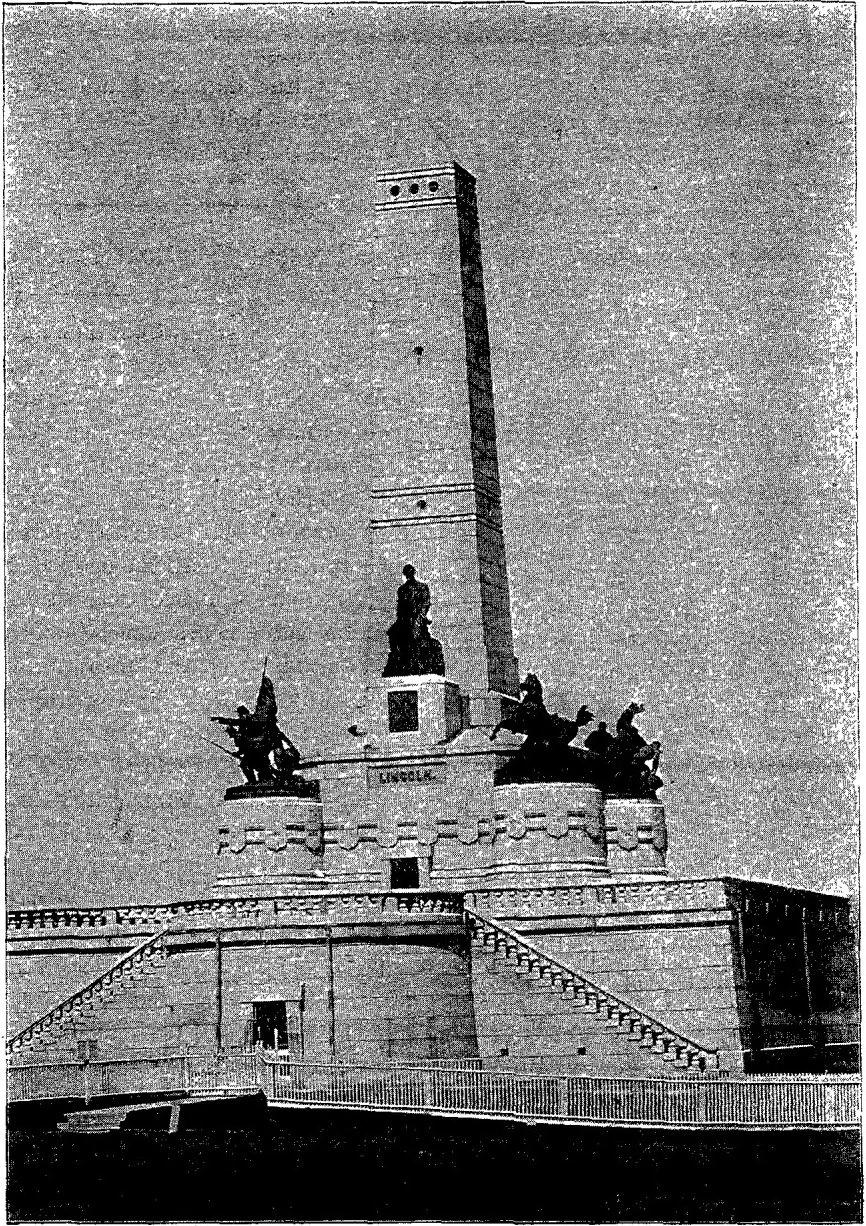
LINCOLN'S MONUMENT, SPRINGFIELD, ILL.
(b) “Where there is a conflict between the Constitution and a decision of the court,” etc. But if every decision of the Supreme Court is final in all respects; and if said decisions are to be accepted as final as to the meaning of the Constitution; then it would be impossible that there ever could be any such thing as a conflict between the Constitution and a decision of the Court.
Yet, as it is expressly declared in the Constitution that the people have reserved certain rights and powers exclusively to themselves, and so have forbidden the Supreme Court any jurisdiction in these, it is clearly possible for a conflict to be made between the Constitution and a decision of the Court. And where there is a conflict there must of necessity be some authority to decide. And as the people made both the Constitution and the Court; and as the people stand outside of and above both the Constitution and the Court; it is perfectly plain that in all cases of conflict between the Constitution and the Supreme Court, the right of final judgment and decision lies with the people as an inalienable right.
(c) The court “has only a delegated authority, and every opinion contrary to the tenor of its commission is void.” But if every decision of the court is to be accepted as final in all respects, how would it be possible for any opinion ever to be void? And even though it were possible, how could the fact of its being void ever be discovered? It is true that the court has only a delegated authority, and that every opinion contrary to the tenor of its commission, that is, every opinion contrary to the tenor of the Constitution, is void. And it is equally true that it lies with the people, who delegated this authority, to discover and to disregard and set aside as void every such opinion. And this prerogative lies with the people as their inalienable right.
(d) “An act of the Legislature at variance with the Constitution is pronounced void. An opinion of the Supreme Court at variance with the Constitution is equally so.” An act of the Legislature at variance with the Constitution is pronounced void by the Supreme Court. But when an opinion of the Supreme Court is at variance with the Constitution, whose prerogative is it to pronounce this void and to treat it so?—Clearly this is the prerogative and right of the people.
It is here said, and repeated, that every such opinion90of the court “is void.” This is true; and if such decisions were completely ignored by everybody, and so left meaningless and void as they are, they could never do any harm. But it is hardly possible that there could ever be a decision in which nobody would have sufficient personal interest to seek to make it of force as far as possible; and every decision, void or otherwise, always stands as a matter of record to be taken up by interested parties and used as a precedent upon which to carry any principle involved, to its fullest extent in real factitive law. For this reason it is incumbent upon the people to see that every such decision is so positively pronounced void, and so regarded by themselves—the supreme and ultimate authority—that it shall not be cited even as a precedent.
There is another excellent statement of this principle, which, though not bearing exactly the force of national authority, is well worthy to be set down here. It is in every respect true, and shows how this subject presents itself to a disinterested mind. Mr. Bryce, in his great work, “The American Commonwealth,” speaks thus:—
“How and by whom, in case of dispute, is the validity or invalidity of a statute to be determined?—Such determination is to be effected by setting the statute side by side with the Constitution, and considering whether there is a discrepancy between them. Is the purpose of the statute one of the purposes mentioned or implied in the Constitution? Does it in pursuing that purpose contain anything which violates any clause of the Constitution? Sometimes this is a simple question which an intelligent layman may answer; more frequently it is a difficult one, which needs not only the subtlety of a trained lawyer, but a knowledge of former cases which have thrown light on the same or a similar point. In any event it is an important question, whose solution ought to proceed from a weighty authority. It is a question of interpretation, that is, of determining the true meaning both of the superior law [the Constitution] and of the inferior law [the statute], so as to discover whether they are inconsistent. Now the interpretation of laws belongs to courts of justice.”
“How is the interpreting authority restrained? If the American Constitution is capable of being so developed by this expansive interpretation, what security do its written terms offer to the people and to the States? . . . There stands above and behind the Legislature, the executive, and the judiciary, ANOTHER POWER, that of public opinion. The President, Congress, and the courts are all, the two former directly, the latter practically, amenable to the people. . . . If the people approve the way in which these authorities are interpreting and using the Constitution, they go on; if the people disapprove, they pause, or at least slacken their pace. . . . The people have, of course, much less exact notions of the Constitution than the legal profession or the courts. But . . . they are sufficiently attached to its general doctrines, they sufficiently prize the protection it affords them against their own impulses, to censure any interpretation which palpably departs from the old lines.”
And upon all this it is well to bear in mind, and proper ever to say, that “there is not in this view any assault upon the court or the judges.” It is simply maintaining the fundamental principle of the Government of the United States, and the vital principle of the rights of the people.
Nor is this to say, nor in any sense to imply, that every man is at liberty to disregard, or disrespect, whatever decision of the court he may not personally agree with. It is to say that it is absolutely incumbent on every citizen to be so well read in the Constitution that he shall know for himself the limitations upon the Government, and shall know how to act accordingly. Every citizen must hold himself, as well as the court, and the Government, altogether, strictly to the Constitution.
The Present Practical Bearing of this Discussion.
THIS discussion would be well worth all the space that is given to it in these columns, even though there were nothing more to it than the calling of the minds of the people anew to a vital principle of their government that is almost wholly forgotten.
But this is not all there is to this matter. The question has a present practical bearing, that is of the greatest importance to all the people of the nation. In 1892, the Supreme Court of the United States expressed its opinion that the first amendment to the Constitution has one language and one meaning with organic acts whose object was “the establishment of the Christian religion;” and that therefore the meaning of the Constitution is that “this is a Christian nation.”
This decision has been seized upon, and has been pushed ever since, by the combined religious elements of the country as authority for demanding that religious customs, rites, and dogmas shall be recognized and enforced in the legislation and the actions generally of the Government.
In this crowding religious practices upon the Government, and upon the people by governmental power, the ecclesiastical managers find it “a very wholesome doctrine, and one very full of comfort,” that from a decision of the Supreme Court there is no appeal,—that a “Supreme Court decision is a ‘Thus saith the Lord.’”
As stated by a Catholic priest, as illustrating the doctrine of the infallibility of the Pope, it stands thus:—
“It is strange that a rule which requires a Supreme Court to give final decisions on disputed points in our Constitution, should be abused and slandered when employed by the Catholic Church. Citizens and others may read the Constitution, but they are not allowed to interpret it for themselves, but must submit to the interpretation given by the Superior [Supreme(?)] Court. The Bible is the constitution of the Catholic Church, and while all are exhorted to read this divine constitution, the interpretation of its true meaning must be left to the superior court of the church founded by Christ. The decision of our Federal Supreme Court is final; the decision91of the superior court of the church is final also, and, in virtue of the divine prerogative of inerrancy granted the church, infallible. The church has not, does not, and cannot, permit the violation of God’s commandments in any case whatever.”—Reported in Catholic Mirror, March 2, 1895.
The professed Protestantism of the country, is, if anything, more zealous than is Catholicism in the advocacy of this doctrine. And both alike are greatly pleased to find eminent “statesmen” insisting with all their power and influence upon the same doctrine.
All these vast influences are steadily and rapidly molding public sentiment into the fixed doctrine that Supreme Court decisions on constitutional questions are to be accepted because they are such decisions, without any question as to whether they are right or wrong—as soon as a decision has been made and because it has been made, it is a governmental and national Thus saith the Lord.
Public sentiment is thus being prepared so to accept any decision that may come from that source. And thus the way is surely being paved for the establishment of a national religious despotism. By repudiating that doctrine, Abraham Lincoln succeeded in averting the establishment of a national civil despotism. And nothing but the repudiation of that doctrine again, by the whole people, can avert the establishment of a national religious despotism. Yet for this, it must be confessed the evil has already spread too far; and it is too late to avert it.
A Mythical Alliance.
THE State Superintendent of the Nevada Christian Endeavor Society, Rev. Francis L. Nash, states in the Christian Endeavorer for February, 1897, that an alliance exists in Nevada between Seventh-day Adventists and the saloon. Here are his words;—
“The saloons and gambling hells make more money on that day [Sunday] than on all the other days of the week, and whenever an attempt is made to rescue the Sabbath, the Seventh-day Adventists stand in with the saloon men and do their best to stamp out the very last vestige of respect and reverence for the day which ought to be loved and honored. As a result, in many places the day is dreaded by the wives and mothers as the worst day in the week—the day for drinking, carousing, and horse racing, a day for fights and brawls, rioting and murder, heaven-daring impiety and beastly impurity.”
And upon this the editor of the Endeavorer comments:—
“We are very sorry that this course should be pursued by these people, and hope that in the near future such an alliance of saloon-keepers and Seventh-day Adventists will be unknown.”
All this reminds us of the familiar saying, “Important if true.” But is it true?
We never heard of any alliance between seventh-day observers and saloonists, from either of the parties themselves. All talk of such a thing has come from other sources.
It is pretty certain that liquor dealers have had no suspicion that they have allies in the Seventh-day Adventists. About the last thing in the world that saloon men would want is a universal acceptance of Seventh-day Adventist doctrine on the subject of temperance.
Reason: Seventh-day Adventists use no intoxicants. In their communion there are neither drunkards nor moderate drinkers. And no saloon-keeper has ever thought of applying for membership in one of their churches. Does this indicate an alliance with the saloon?
More than this: Seventh-day Adventists are, and always have been, prohibitionists. Their literature proves this. We never knew liquor dealers to regard prohibitionists as their allies.
It is true, this religious body are the advocates of the seventh-day as being the Bible Sabbath, and are uncompromisingly opposed to the doctrine that the Sabbath is Sunday. And they are not backward in proclaiming these views, for they believe them to be part of a divine message which must go to the world. But does this constitute an alliance with the saloon? We think not.
And now a glance at the record of those who are publishing this “alliance,” by way of comparison. What is their attitude toward the saloon?
Who are the ones that are advocating and working for a law to close all the saloons—on Sundays? Are they Seventh-day Adventists? No; they are the people represented by the Endeavorer. They would have a law closing saloons on Sunday, and allowing them to run the other six days of the week. And thus they would make of the saloon—that iniquitous thing—a law-abiding institution, wherever it would be willing to close its doors on Sunday; and this it is showing itself quite willing to do. It matters not that the Endeavorers desire prohibition, as we fully believe, and have that as their ultimate aim. What they and Sunday advocates generally are actually working for now is the establishment of the saloon by law; for that is what Sunday prohibition means. Seventh-day Adventists regard the saloon as by nature an outlaw.
It will be a good day for the saloon, and a bad day for the cause of temperance, when that evil institution shall be established in our land by a law which rests upon the will of the (professedly) Christian Church.
The saloon wants nothing better than the opportunity to say, I am a law-abiding institution; I am respectable, for I keep Sunday.
Where then is the real alliance, if there be one, between church people and the saloon? Is it to be found with the advocates of the seventh day or of the first?
Finally, it may be mentioned that in 1893 the saloonists of Chicago joined heartily in the plea of the Church people that the World’s Fair be closed on Sundays. Of course this constituted no real alliance between the saloon and the Church. The saloon would be better patronized on Sunday with the Fair closed, and it would92be both business and good policy on its part to join in the petition. But there was just as much of an alliance as exists between the saloon and the Adventists.
The “alliance” of this people with the saloon is a myth.
No Representatives in Religion.
The members of the State and National legislatures are, as legislators, the representatives of the people. Representatives in what? In religion? No; certainly not. Then what can Congress or a State legislature properly have to do with religious affairs?
As individuals, legislators are like other men accountable to their Creator in all things; but they are not and cannot be accountable to God for other persons, for each individual must render his own account to God. He who expects to render his account or to settle it with God through a State legislature, or even through the Congress of the nation—if there be anyone so foolish—will find himself terribly mistaken in the day of reckoning.
Who is willing to be represented by another in religious faith and practice? Who is willing to make a member of his State legislature or of Congress his representative in religion? Who is willing to be bound in religion93by an act of any legislative body? Who will in the day of Judgment fall back with confidence upon such an act as valid authority for his own religious conduct?
The advocates of religious legislation say that legislators are like all other men, bound by the law of God; and so they are. But they are not so bound for other men, but only for themselves. Here is the vital point in the whole subject,—the point which the would-be reformers who are besieging our legislatures overlook or ignore. There can be no representative capacity in religion; and hence while each legislator is bound individually by the divine law, as representative of the people he has nothing to do with religious questions. He must confine himself to civil matters only.
This is not to say that he is to act against religion or against morality. The domain of things secular is not in any sense opposed to that of Christianity, any more than truth and justice in the one sphere are opposed to truth and justice in the other.
Legislators, like all other persons, may properly be urged to be obedient as individuals to the law of God. But to urge them to act thus for their constituents, as their representatives, is a different thing altogether. However righteous it may sound, or however necessary it may seem to be for the good of the country, in reality it is neither necessary nor righteous.
The Almighty will not recognize any arrangement by which one person is made to act for another in religion. Any such arrangement is in reality a heaven-daring piece of iniquity.
Legislators must simply refuse to deal as legislators with religious questions. Such matters must be settled in another way than by legislation. They must be left to the individual conscience and the Word of God.
The Object of Civil Government.
By H. E. Giddings
BY H. E. GIDDINGS.
THE employment of physical power in self-defense, and in governing others, is wholly an artificial use of this gift. Physical power is God-given at creation; and so is natural, and was appointed to natural and satisfactory ends. The Creator endowed man with intelligence to enable him to control the lower orders of creation; the genius of self-control; and the faculty and physical power to pursue happiness. But sin entered, turning the natural endowments of man into unlawful channels. The race multiplied with men in possession of all their natural rights and powers; but with the inclination to use them wrong, and in selfishness refuse to allow them to others.
Self-defense and civil government, therefore, became artificial necessities. The genius of government, which was of God to the individual that he might govern himself, was now employed to form a system to control those who had lost the power of self-government. The physical power given to enable man to improve the earth and pursue happiness, must now be employed to hold in check the vicious, to secure to as many as possible the enjoyment of their natural rights.
What, then, is delegated to government by the consent of the governed? Power. What kind of power? Physical power.
And this physical power given to man to be employed in other ways, in the pursuit of happiness, is largely consumed by being hurled against the vicious, in the form of police force and armies.
To sum up, all must agree that each political citizen is a factor in the government exercising sovereignty; that all the responsibility of government rests alike on each member; and that each person occupying this position does so by consent. Each consents to the form of administration, the payment of its expenses, the choosing and payment of officers to do the business, and they agree to furnish the power needed to make it all effective.
All the power of civil government is simply physical power, given by the Creator originally for other purposes. The principle of civil government is derived from the genius of self-government, which the Creator implanted in the individual.
Government, as we have it, is an artificial necessity, and not a natural provision of the Creator. The powers that be were originally ordained of God in the individual to keep him in harmony with the right; but sin having made inroads into this arrangement, the same power is now employed by outward means to control those who refuse to recognize order within themselves: or who have entirely lost the genius of controlling themselves from within and now must be controlled by others from without.
It is the power that is in the persons by nature, that was ordained of God; and not the persons in power, nor the measures which they may adopt in the use of that power. It has more often occurred that men have made a wrong use of the power, than otherwise.
Nebuchadnezzar, king of Babylon, was using this power when he compelled all to worship a false God, and attempted to destroy those who were true to the Creator; but this was a wrong use of the power. And God showed him that He did not approve of such a use of the power. When Pilate gave sentence against Christ he was using the power; but not properly.
All bad statutes and all injustice in all ages have been due to a wrong use of the right power. The power was ordained to perpetuate a condition of peace and happiness by the observance of the divinely implanted principle of self-control which was in the heart of each person. In this way, originally, each was his own government, and perfect peace prevailed with no expense or cost of life, money, or labor. No organized effort was needed: there was no place for any such thing.
When men lost from their hearts this divine principle and power of self-government, then in order to approach as near as possible to the conditions necessary to secure in an imperfect state, life and its blessings, they had to be governed from without by organized force, whose symbol is the sword.
With a “government of the people by the people and for the people” who compose it by consent, and give their power to it by consent, as well as assume all its responsibilities by consent, the question may well arise, Who is properly a citizen in this political sense? The responsibility is a grave one.
A Long Felt Want.
THE February Christian Endeavorer contains the following:—
“Intense interest was caused by the publication, in the January Christian Endeavorer, of Rev. S. W. Gamble’s discovery that ‘the Jewish Sabbath was not Saturday, but was a movable one.’ Letters have been pouring in to him and into this office from all over the land, expressing the thanks of the writers that this new theory has been made known. Lack of space prevents our publishing a tithe of the letters that have been received from leading men of every denomination.”
Well, we have always thought there was a good deal of uneasiness and uncertainty in the camp of the Sunday forces regarding the genuineness of their sabbath, and now we know it. Their action in this case confesses it. The greeting accorded Mr. Gamble’s “great discovery” by “leading men of every denomination,” is that of something which supplies a long felt want. A dubious testimonial this, for all the argument which was supposed to furnish an abundant support to the Sunday sabbath heretofore!
And by this very fact, the Rev. Mr. Gamble’s “discovery” has done more already to weaken the Sunday institution than it can ever do to sustain it. For erelong it will be found that this “discovery” is not what it seemed at first, and the long felt want will make itself more keenly felt by the adherents of tradition than ever before. These “great discoveries” which overthrow the Sabbath of the fourth commandment have been coming regularly for a long time, and they will continue to come with their accustomed frequency. But meanwhile the Sabbath, like Moses before the infidels, manages to keep right side up.
The Cold Wave in London, Ontario.
By J. F. Ballenger
BY J. F. BALLENGER.
THE cold wave of “Christian Citizenship” is not confined to the States, but has crossed the Lakes and struck Canada with its chilling blast of “moral reform through political economy.”
The Rev. Dr. E. O. Taylor, of Chicago, came to this city by invitation of the W. C. T. U. He spoke in the First Presbyterian Church last Sunday afternoon. He spent one hour in defining what “Christian Citizenship” is. We have heard and read a good deal of the aim and object of this movement, but we never heard or read anything in which the real character of this organization was unmasked as in the above lecture.
The speaker did not try to hide the fact that “Christian Citizenship” meant that the Church should run the State, as the following utterances will show. He said:—
“Human governments are divine, and God’s ministers are appointed to administer in civil as well as religious things.”
The apostles said, “But we will give ourselves continually to prayer and the ministry of the word.” Acts 6:4.
Now if to administer civil governments means to minister the Word, then it follows that the minister must use the power of the civil government to enforce the Word.
This position was further defined by another statement, that—
“Every question, both civil and religious, should be settled by the book” [meaning the Bible].
Then it follows again, that the minister must define the terms of settlement according to the Bible, and when he has decided what the Bible says are the conditions of settlement, he must use the power of the State, which is the sword, to enforce a settlement.
Did pagan or papal Rome ever contend for any more than this? If they did we would like to be shown the page in history where it is recorded.
Again, the speaker said, “Remove the stumbling blocks out of the way of the Church and thus make it easy for man to do right by improving your civil laws.”
We had always supposed that the gospel was the94power of God to enable men to do right by planting the righteousness of God in the heart through faith in Jesus Christ. Rom. 1:16, 17. We never once dreamed that it was in the power of civil law to remove the cross and make the straight and narrow way to heaven easy.
*“Must I be carried to the skies
On flowery beds of ease,
Whilst others fought to win the prize
And sailed through bloody seas?”*
Indeed, we can according to the above, just come and join the Christian Citizenship movement and improve our civil laws, and thus make it easy to do right by legislating away the cross. Then we will not need to be “crucified unto the world.” We won’t need to “suffer with Christ that we may reign with him.” We shall need no longer to “watch and pray lest we enter into temptation,” for temptations will be removed by improving civil law, and making it easy to do right. Then according to this proposed revolution we can all “live godly in Christ Jesus” without suffering persecution.
Once more; the speaker said:—
“Some people are very strict in attending to the ordinance of baptism and the sacrament, but neglect the ballot box. It is just as much our duty to vote as to pray or to take the sacrament.”
Then the commission to preach the gospel should read, Go ye into all the world and preach the gospel to every creature, and he that believeth not and does not vote to help to improve the civil laws and make it easy to do right shall be damned!
How any man with an open Bible in his hand and the history of the past before him can put forth such reasoning is a mystery that we are not able to solve.
But such is the blindness of men when they “walk in the sparks of their own kindling.” Were it not that the prophets have described and warned us against just such a state of things in the last days, we could hardly make ourselves believe that men could descend into such dense darkness.
Did we not read from the sacred page that there would be a union of religion and the State which would bring about the last great struggle between the powers of light and darkness, we could hardly believe our own ears as we listen to such sentiments as are put forth by these would-be reformers.
“Watch therefore: for ye know not what hour your Lord doth come.”
London, Ont., Feb. 2.
National Reform Party Abandons Christian Amendment Effort
The National Reform party has now abandoned hope with reference to its so-called Christian Amendment to the Constitution, so far as concerns this session of Congress. After being so thoroughly disposed of before the hearing given by a committee of Congress last year, it was left in the hands of the committee without further action, and to a request recently preferred by its advocates for another hearing, reply was sent that no further discussion of the matter could be allowed. Of course it will make its appearance again before the new Congress.
Speeches of Lincoln and Douglas: A Book Notice
THE extracts from the speeches of Lincoln and Douglas, presented in this paper, are taken from a volume entitled, “Political Speeches and Debates of Lincoln and Douglas.” It is a book of 555 pages and is indispensable to every one who would understand the fundamental principles of the Government and the history of the country. Price, $1.50.
Please Share This Number of the American Sentinel
To every person who reads this number of the AMERICAN SENTINEL, we say, Please see that a copy of it is put into the hands of all your neighbors, and keep a copy for yourself for reference. It is needed by everybody now, and will be needed more, later on, and you will be glad if then you have it at hand.
Moses Ross Pardoned Under District Profanity Law
Moses Ross, a resident of the District of Columbia, narrowly escaped being a victim of the old District law against profanity. He was convicted under the statute December 29, and sentenced to pay a fine of $20 and serve ninety days in the workhouse; but the President pardoned him.
TO OUR PATRONS:
By Editor
Write names plainly.
Remit by P. O. Money Order, or Express Order, or by Bank Draft on New York. Personal checks are not desired.
Make all Orders and Drafts payable to Pacific Press Publishing Co., not to the editor or any other individual.
We will receive Postage Stamp in small quantities and any kind of good money. Defaced coins will not be taken. If paper money or coin is sent, register the letter.
Any one receiving the American Sentinel without having ordered it may know that it is sent to him by some friend. Therefore those who have not ordered the Sentinel need have no fears that they will be asked to pay for it.
That “Superb” Bible.
By R. G. W. Collins
Dodgeville, Wis.
AMERICAN SENTINEL, New York City:
The Bible came to hand all right. To say that I am pleased with it will but faintly describe my feelings. It would take too much space to enumerate its many points of excellence, so I will sum it all up in the one word “superb.”
There are so many “aids to the study of the Scriptures,” and they are so helpful and just what I have been wishing for since I became a “Bible Christian.”
Friends and neighbors all say, “I wish I had one like it,” and “So cheap.” Our seventeen-year-old daughter is about to start out to obtain subscriptions for the SENTINEL, as she wishes for one “just like it.”
Please accept my warmest thanks, and believe me to be,
Ever sincerely yours,
R. G. W. COLLINS.
[See advertisement on last page.]
THE EMPIRES OF THE BIBLE
By Alonzo T. Jones
Invaluable to Bible and History Students.
THE EMPIRES OF THE BIBLE
FROM THE TIME OF THE FLOOD
TO THE BABYLONIAN CAPTIVITY.
By ALONZO T. JONES.
Recent research in Babylon and Egypt has brought to light many valuable historical records that were inscribed in stone by the very men living in those ancient times. These records and the Bible history of the same time are woven together in one connected story. Another important feature of the book is the tracing in a series of twenty-one maps, the course of those empires. The design of the book is unique, and every student either of Bible or history will find it invaluable.