The Youth’s Instructor, Vol. 35, No. 32.

SPEAKING PLAIN

The Youth’s Instructor

Aug 10, 1887

S. D. A. Publishing Association · Battle Creek, Mich. · Aug 10, 1887

SPEAKING PLAIN.

THE arithmetic class stood in line in the school-room, slates and pencils in hand, and Squire Curtis was on the platform by the teacher, listening to the recitation. Squire Curtis was the most faithful of the trustees, for he often called at the school to see how the children were getting on with their lessons.
This morning he had given Harry’s class a very long column of figures to add.
“You may go to your seats,” said Mr. Ropes, “and do the adding, while I call another class.”
“Mine ain’t a bit like yours,” said Walter Burns, Harry’s seat mate.
Harry said nothing, but worked away at his figures.
Walter turned over the pages of his Greenleaf. “Here’s the very sum,” he said in a whisper, as he compared the lines on his slate with the book. “Squire Curtis didn’t give it to me out of his head; he copied it right out of the book, and here’s the answer. I’ll make mine right in a jiffy;” and the answer given in the arithmetic was soon copied on to his slate.
“Look here! yours isn’t right, old fellow,” he said again, looking over Harry’s shoulder. “You’ve got a six there, and it ought to be a four, and an eight where it ought to be a three. What a foolish boy you are to fuss away adding up all that great row of figures, when here it is as plain as day before you.”
But Harry was an honest boy. He knew it was expected of him to do the calculation himself, and it would be like telling a lie to copy the answer out of the book. So he worked away, going over the columns three times very carefully. But he couldn’t help remembering about the figures Walter had said were wrong, and after the third trial, he was glad they came just as Walter had said they ought to. And yet there was a little feeling in his heart that he had not been exactly honest. What should he do about it?
Just at that minute Mr. Ropes called the class up for their answers.
All were wrong but Walter and Harry. Walter was chuckling to himself over his good luck and little trouble; Harry dealt with his conscience.
“I know boys,” said Squire Curtis, “it was a pretty hard practice for you, for the lines were longer than you are used to, and I don’t much wonder that you didn’t get the figures all right. Once adding so long a row is never enough to make sure of a correct answer. You ought to go over it two or three times, beginning first at the bottom and adding up, then at the top and adding down, and then in the middle and adding both ways. If the answers agree, you may be pretty sure you are right. I’m glad we have two boys to give us the right answer. You didn’t look in your books for it boys, did you?” asked the squire.
Walter shook his head for no, but Harry blushed and hesitated. All at once it flashed through his mind about the man whose tongue was loosed by Jesus so that he could “speak plain.”
“I’ll ‘speak plain;’ I don’t want any ‘impediment’ about me;” thought he; and out it came.
“I didn’t look in the book,” said he, “but I knew what the right figures were, and I worked and worked till I got ’em. But if I hadn’t known, I don’t believe I should have got ’em all right.” Harry spoke very distinctly.
“How did you know the answer if you didn’t look in the book?” asked the teacher.
“I don’t like to tell, if you’ll please excuse me,” said Harry; but Mr. Ropes understood from Walter’s confused and trembling looks the truth.
“I did work it all out myself,” said Harry; “I added the lines up three times, but if I hadn’t known the answer, I shouldn’t have done that. I didn’t try to find out the answer, and I couldn’t help knowing; but it seemed like a lie, after all, so I felt I must tell.”
“You are right, my boy; you have made an honest confession,” said the squire. “It is good to clear your conscience. If at any time you have the least shadow of a feeling in your heart that you haven’t told the whole truth, never rest until you have turned your heart inside out.”
“But he hasn’t told the whole truth, squire, for he hasn’t explained how he found out the answer,” said Mr. Ropes.
“Well, but you see, Mr. Ropes, how it is; I do. He couldn’t tell without exposing somebody else, and he doesn’t want to tell tales. I hate a tell-tale; so do you. This little chap has told the whole truth about himself; he’s set himself right; and now if there’s any boy in the class that knows the other part of the story, and don’t tell it, why, he’ll have a load on his conscience that won’t be pleasant to carry. This little boy has spoken ‘the truth in his heart’ this morning, and God bless him!”
Poor Walter hung his head and held up his hand to speak.
“What is it, Walter?” asked his teacher.
“I told Harry the right figures. I wasn’t looking for the answer, and just happened to see that the sum in the book was like the one on our slates. But I know Harry worked it all out himself.”
“Did you?”
It was with a great effort, but the words came out, “No, sir.”
“I’d rather be Harry Ford than Walter Burns,” said Mr. Ropes. “Who thinks as I do?” And every hand went up.—“Lips to Speak,” in Harry’s Bible Series.

FIELD PREACHING.

I HAVE been out to-day in field and wood, Listening to praises sweet and counsel good Such as a little child had understood, That in its tender youth Discerns the simple eloquence of truth.
The modest blossoms, crowding round my way, Though they had nothing great or grand to say, Gave out their fragrance to the wind all day; Because His loving breath, With soft persistence, won them back from death.
And the right royal lily, putting on Her robes, more rich than those of Solomon, Opened her gorgeous missal in the sun, And thanked Him, soft and low, Whose gracious, liberal hand had clothed her so.
The stately maize, a fair and goodly sight, With serried spear-points bristling sharp and bright, Shook out his yellow tresses, for delight, To all their tawny length, Like Samson, glorying in his lusty strength.
And every little bird upon the tree, Ruffling his plumage bright, for ecstasy, Sang in the wild insanity of glee; And seemed, in the same lays, Calling his mate and uttering songs of praise.
The golden grasshopper did chirp and sing: The plain bee, busy with her housekeeping, Kept humming cheerfully upon the wing, As if she understood That, with contentment, labor was a good.
I saw each creature, in his own best place, To the Creator lift a smiling face, Praising continually his wondrous grace; As if the best of all Life’s countless blessings was to live at all!
So with a book of sermons, plain and true, Hid in my heart, where I might turn them through, I went home softly, through the falling dew, Still listening, rapt and calm, To nature giving out her evening psalm.
While, far along the west, mine eyes discerned, Where, lit by God, the fires of sunset burned, The tree tops, unconsumed, to flame were turned; And I, in that great bush, Talked with his angels in each burning bush. —Phoebe Cary.

HIS PETITION.

The Berlin journals bring us a touching story of the Emperor's last birthday, which, our readers will remember, was celebrated with great pomp throughout Germany.
Countless gifts were sent in to the aged Kaiser, expressive of love and reverence, costly tokens from his brother-sovereigns, and almost as splendid offerings from his soldiers and wealthy subjects.
On the morning of his birthday the Emperor, after having shown himself to the people, passed through the hall where these gifts were displayed, and examined them with much emotion. On a table, close beside a rare service of priceless china, sent by Queen Victoria, lay a wooden box, tied by a bit of twine.
The King, curious, directed it to be opened. Inside was an ill-spelled letter on a piece of gray paper. It was written by a child. It said:—
“DEAR KING. I have nothing to send you on your great day, but a prayer to the good God to keep you long our King. Now I will tell you of my father, who was shot in the foot in the war with Austria, and is ill, and has yet no pension. I have two brothers and two sisters, and often we have no bread to eat. And now I send you my name.
“AUGUST WOLF.”
“August,” the Emperor said, “has made the best gift of all. He has given me the chance to be just to a brave man.”
He ordered inquiry to be made into the case, and a pension to be given to the wounded soldier.
After all, one need not be a Kaiser on his birthday for the opportunity to be just and generous. The chance comes to us all every day, but how many of us receive it as a blessing?—Youth's Companion.

THE AFRICAN PARTY.

Thousands of the readers of the INSTRUCTOR will be interested to hear from the company that left New York on the steamer Baltic for Liverpool, May 14, en route for Africa. It is sufficient to say that our voyage across the Atlantic was a pleasant one. There are ten in our little company. On the 25th of May we reached Liverpool, where some of our friends met us. Our steamer was delayed two days in leaving New York, on account of the fog; and you can imagine how grateful we all felt for that when, on landing at Liverpool, we learned that two days before there had been a terrible storm on the English coast, and a number of vessels came in with their masts blown away; but He who controls the wind and the waves had mercifully preserved us from the raging storm.
Upon arriving in England, some of our company went to Norway to attend the camp-meeting, the first one ever held in that country. It was a good meeting, I think; but I could not understand what the Norwegian men and women and boys and girls said. I would smile at their strange talk, and they would do the same at mine. There was one thing that pleased me much, and that was the politeness of the people, and especially that of the children. Little boys not more than three or four years old, will lift their caps and politely bow whenever you meet them upon the street.
By looking on the map, you will see the route our steamer took in going to Norway. Starting from Hull, England, Friday evening, we sailed across the North Sea, about seven hundred miles, landing at Christiania, Norway, on the following Monday morning. Here we took another steamer for Moss, where the camp-meeting was to be held. We inquired the distance, and were informed that it was only six miles. Imagine our surprise a little later upon hearing that it would take four hours to reach the place; but we soon found that the six Norwegian miles were each one equal to seven English miles.
Returning to England, we spent about one week in London, embarking on the steamer Hanarden Castle on Wednesday, July 6. As we steamed out into the river, every familiar countenance was lost to view. Eld. Haskell, who had secured an elevated position above the crowd, could be distinctly seen the last of all. Our sail down the Thames was all that could be desired; the river was smooth, and the country on each side was beautiful to look upon. In about twenty-four hours we landed at Dartmouth, where we remained one day. Dartmouth is a very old city. Many of its streets are not more than ten or twelve feet wide between the houses. The city contains old walls and the remains of old castles built in the time of Cromwell. It is located on a steep hillside, the streets rising terrace above terrace, and are reached directly by stone steps. The inhabitants number about 8,000. At twelve o'clock, Friday, June 8, our ship weighed anchor, and we steamed off across the British Channel and the Bay of Biscay for the city of Lisbon, our next stopping place; and we are just entering port this early Monday morning. This is the place where in 1755 so many thousands of people were swallowed up by an earthquake. The morning sun shines hot, and all feel disposed to put on their thinnest clothing. But our letters must be mailed here, and so I shall have to put off a description of this old city till some other time.
D. A. ROBINSON.

A BIT OF ADVICE.

I caught myself wondering to-day if all girls have their bags and baskets of darning-cotton and yarn near at hand, neatly arranged, well filled, and ready for action; and if, when the stockings are brought from the wash, the heels and toes are duly examined, and holes, which will be small if the weekly inquiry is rightly followed, are nicely darned with the fine weaving good darning is? If this is so, it is a comfortable comfort, one the family will quickly notice and miss if suspended.
The very mention of darning stockings will cause some girls to strike an attitude of dismay, but there can be nothing alarming in the act or the fact if viewed in the light of reason and a little sense. To begin, all know who have ever worn stockings, “hole-y,” that hole spelled with a “w” is decidedly preferable, also that well-cared-for hose will last much longer than that neglected. One daughter of the family will find, if she makes it her weekly practice to faithfully look over each pair belonging to the members, it will become much less of a task than she may suppose when she sees the big holes of the hastily and seldom mended. To keep the darning-basket well supplied and well appointed will grow to become good practice. It will train her in a practical way that will not come amiss in the work of life. Then the discipline of nicely and patiently doing the plain, homely work will be a gain, besides the skill of needle acquired. Added to this comes the pleasure and economy of tidy foot-wear, and last but not least, it lifts a decided burden from the shoulders of mother. If a daughter should start up of herself and take the family stockings as a share of her work, the mother’s face would brighten more than I can tell. She would think of it often and remember it long, and when that daughter has left the home-nest and settled for herself in a broader sphere, it will still be repeated and told of her.
Let some of the useless fancy-work slide. What does it amount to in a short time?—Fashion gone by, dust well settled, and presently banished. Such is the price often paid for hours and hours of precious time and tedious labor. Darn the stockings and help your mother! One thing you may be sure, she will appreciate your labors. You will be rewarded oftener than you imagine, and a prick upon the finger now and then from a darning-needle is no worse than from a worsted-needle, and the strain on the eye-sight is much less than in most of the worsted patterns. But comfort, industry, and skill all together, are not equal to the pleasure and happiness such a course will give your mother, nor to the smiles she will give you. Try it.
“Hundreds of dew-drops to greet the dawn, Hundreds of bees to sip the clover, Hundreds of butterflies on the lawn, But only one mother, the wide world over.”
—Christian at Work.

SELF INSPECTION.

Make sure that, however good you may be, you have faults; that, however dull you may be, you can find out what they are; and that, however slight they may be, you would better make some—not too painful, but patient—efforts to get quit of them. * Now, therefore, see that no day passes in which you do not make yourself a somewhat better creature; and, in order to do that, find out first what you are now. Do not think vaguely about it: take pen and paper, and write down as accurate a description of yourself as you can, with date to it. If you dare not do so, find out why you dare not, and try to get strength of heart enough to look yourself fairly in the face, in mind as well as in body. I do not doubt that the mind is a less pleasant thing to look at than the face, and for that reason it needs more looking at; so always have two mirrors on your toilet table, and see that with proper care you dress the body and mind before them daily.—John Ruskin.

Wisdom Recognizes Ignorance Through Experience

A wise man knows an ignorant one, because he has been ignorant himself; but the ignorant cannot recognize the wise, because he has never been wise.

QUEER LITTLE JACKETS.

As I strolled down the quiet wood-path, What should I chance to see But a queer little row of jackets Pinned to the bark of a tree. No tatters nor missing buttons. No holes in the elbows, I find; Why in the world are these jackets So carelessly left behind?
Where are the boys who wore them? Gone for a game of ball, A plunge in the rippling river, Or a climb in the oak-trees tall? No boy in the world could wear one, They were made not for boys or men: The three little trim brown jackets Will never be worn again.
Hark! from the leafy branches, A sound comes shrill and high: There is a jacket's owner— A gay little harvest fly. He with his two brown brothers Crawled up from the earth one day, Pinned their jackets tight to the tree-trunk, Burst them open, and flew away.
And now in their new-winged freedom, With a shrill and merry tune They drone out their song of gladness All the August afternoon. Merrily up in the tree-top They swing in the sun and rain; But their queer little cast-off jackets Will never be worn again.
—Wide Awake.

PRAYER

LESSON 1.—ADMONITIONS TO PRAYER.

1. WHAT seems to be the essential element of prayer?—The yearning of the heart for God.
2. What did David say, when filled with this yearning? Ps. 42:1.
3. How does he express this feeling in Ps. 63:1?
4. What does this yearning lead him to do? V. 4.
5. How does Job express the same strong desire? Job 23:3.
6. For what purpose does he desire to come so near to God? Verse 4.
7. How does he express a desire to know the will of God concerning him? Verse 5.
8. By what words does the prophet Hosea give a sweet invitation to prayer?—“Take with you words, and turn to the Lord.” Hosea 14:2.
9. How is the invitation repeated through the apostle Paul?—“In everything, by prayer and supplication with thanksgiving, let your requests be made known unto God.” Phil. 4:6.
10. How general is this invitation?—“I will therefore that men pray everywhere, lifting up holy hands without wrath and doubting.” 1 Tim. 2:8.
11. How are we warned against putting off the work of seeking God by prayer?—“Seek ye the Lord while he may be found; call ye upon him while he is near.” Isa. 55:6.
12. What danger is implied in this scripture?—That the time may come when our prayers will not be heard. Prov. 1:28.
13. When David had brought up the ark from the house of Obed-edom, how did he admonish the people to pray?—“Give thanks unto the Lord, call upon his name.” 1 Chron. 16:8.
14. How did he exhort to faithfulness and constancy in this exercise?—“Seek the Lord and his strength, seek his face continually.” Verse 11.
15. How is the same thing urged through the apostle Paul?—“Continue in prayer” (Col. 4:2); “Pray without ceasing” (1 Thess. 5:17).
16. To what end did our Lord give a parable on one occasion? Luke 18:1.
17. Relate the parable. Verses 2–5.
18. What lesson may be learned from this?—That if the unjust judge would yield to the importunity of one whom he did not love, the compassionate Father of all will answer the prayers of his children, though for their good the answer may be delayed.
19. Against what is prayer recommended as a safeguard?—Against falling under temptation. Matt. 26:41.
20. How did the Saviour especially enforce this thought during the hour of trial just before he was betrayed? Luke 22:46.
21. What strong motive to prayer is urged by our Saviour upon those who are to witness the signs of the last day? Luke 21:36.
22. What admonition does he give to those who shall see heaven and earth pass away? Mark 13:33.
23. Since the end of all things is at hand, what exhortation is especially applicable to us? 1 Pet. 4:7.
24. Upon whom is the wrath of God to be finally poured out?—Upon the kingdoms that have not called upon the name of the Lord. Ps. 79:6.

NOTE.

Why do not Men Pray More?—Surely it is not for want of encouragement. If they have it not in the very nature of God, yet in his invitations, his promises, and his past acts of unsolicited kindness, they have all they could desire. Nor is it that they have no need of God. Never one of the prayerless will say that. They all know what would become of them but for that overlooking eye, and that supplying hand, and that supporting arm. And do they not know that God has a heart too,—that he can love with all the fervor of a friend? And can they not imagine that in the interchange of affection between God and the soul of man there may be, and indeed must be, ineffable delight? And who that looks but a little way forward, does not perceive an exigency when, in the utter inadequacy of earthly and human resources for comfort, he will want “the consolations of God”?
Ah, it is a sad as well as a strange thing, that so many enter no closet, seek no retirement, either in their houses or elsewhere, where they may be a little while alone with God; where they may look up and meet the light of his countenance as he looks down on them; where they may confess their sins, and receive the assurance of his pardoning love; where they may thank him for mercies past, and humbly ask for more; where they may take counsel of him; tell him of their griefs; and have their tears wiped away, and with him leave the weighty burden of their cares.
I know not whether this excites more my grief, or my wonder. I am not so much surprised that men should neglect a manifest duty, but when I think what a privilege it is, what a happiness, what an honor, to be on terms of intimacy, and in habits of intercourse with God, it amazes me that they should forego it. How will such reflect upon themselves hereafter,—how execrate their folly? How will they wonder that they could have deliberately done their souls such a wrong? Then it will be too late to redress the wrong. They sought not the Lord while he might be found—they called not upon him while he was near. Yea, though he called, they refused. Now they may call, but he will not answer. If any one who is living in the neglect of secret prayer shall read this, will he not be persuaded to begin the practice the very day he reads it, aye, the same hour, if it be possible? If it be not convenient, let him make it convenient. Let other things give way for this, rather than this for anything. Can he think his heart right in the sight of God, or his condition safe in prospect of eternity, while he neglects prayer? How dare he live without prayer? Without it can he have courage to die? At the mercy-seat of God he may decline to appear, but before his judgment-seat we must all stand. How a frequent access to the first would prepare us for final arraignment at the other. How it would familiarize us with the presence of God. How it would serve to break the shock of the entrance into eternity.
Does any one who is not in the habitual and daily practice of secret devotion, pretend to be a Christian? It is but a pretence. He may believe the creed of the Christian, but certainly he does not pursue the practice nor possess the spirit of the Christian. Breathing is essential to living, and prayer is the Christian’s vital breath. Does he walk with God who never converses with him?
Is any one inquiring after truth? What place more appropriate for asking “What is truth?” than the closet? Who so likely to be taught of God as they who ask of God? Some men carry that question to the Bible, and press it there, as indeed they should; but they carry it not to the throne of grace, and press it there also. They read to know what truth is, but do not pray to know it.
O, how an hour in the morning, spent with God, prepares us pleasantly and profitably to pass the other hours of the day with men; and at night, what so composing as communion with God? In resigning ourselves into the arms of sleep—that image of death, what security like that of prayer? It engages him who never slumbers nor sleeps, to watch over us.
—Nevins.

ANIMAL INVADERS.

In writing of animal invaders for the St. Nicholas, Charles F. Holder says:—
“The most marvelous invaders are the lemmings. They are near relatives of the short-tailed field-mouse, and are about five inches long, with round heads, brown fur, and bead-like eyes. Their home is in the highlands, or fells, of the great central mountain chain of Sweden and Norway, where they build nests of grass for their young. The lemmings are spiteful little creatures when aroused, sitting up on their hind legs and fighting with a will. Not only are they pugnacious, but extremely restless and migratory as well; and every five, ten, or twenty years they seem possessed by a desire to see foreign lands. Thereupon, they one and all leave their settlements and start out in tens of thousands, overrun the cultivated tracts of land in both Norway and Sweden, and ruin the plants and vegetation. They march only at night, pressing on slowly in one straight course, and allow nothing to disturb them. Birds and various animals follow and prey upon them; but, notwithstanding this, they actually increase in numbers, gaining recruits as they advance. Rivers are swum and hills crossed, until, finally, the Atlantic or the Gulf of Bothnia is reached. But, still impelled by the same blind instinct that has led it onward, the entire vast concourse plunges into the sea, swimming onward, the little animals piling one upon another as they are beaten back, until at times their bodies have formed veritable sea-walls. Boatmen returning to the beach have found their way obstructed by a struggling horde that has just reached the sea. The number of lemmings in these bands is beyond all computation. Sometimes the march is kept up for three years before the water is reached.
“The most dreaded insect invader is the white ant. In Africa, their houses are dome-shaped mounds, often eighteen feet high. These insects erect pyramids one thousand times higher than themselves! The ants on their travels so conceal their approach that their presence is not suspected until the damage is done. They usually tunnel into any object which they attack, often reducing it to a mere shell. In this way they have been known to ascend within the leg of a table, devour the contents of a box upon it, and descend through a tunnel bored in another leg, all in one night. An officer of the English army, while calling upon some ladies in Ceylon, was startled by a rumbling sound. The ladies started with affright, and the next instant they stood with only the sky above them; the roof had fallen in and lay all about, leaving them miraculously unharmed! The crash of the fall was distinctly heard all over the city. The ants had made their way up through the beams, hollowing them out until a great part of the framework of the house was ready to fall at the slightest shock.”

Tradition in Regard to Cholera.

The Chinese have a tradition in reference to cholera, that locates its origin in the province of Chan-tong, on the Yellow Sea. One day in the year 1820, a singular reddish vapor was noticed rising from the sea. At first only a light vapor, it gradually increased in density as it continued to rise, until for several hours it hung over the coast a dense red cloud, like a funeral pall. The terrified people burnt quantities of magic paper procured from the Bonzes, or priests, throwing the pieces while burning, into the sea. Next they formed a long procession, carrying an effigy of the Dragon of Rain, the god whom they supposed was producing the phenomenon. As the cloud still remained, every man, woman, and child seized a tam-tam, or some utensil or metal instrument, and beat upon it—producing a terrific clamor, to which their wild outcries were added. Suddenly a violent wind began to blow, and parting the cloud into several large columns, scattered them in various directions, driving them inland. These columns spread over the country in a winding course, following the valleys, and sweeping over towns and villages. Wherever they went, death followed, hundreds in apparent health dropping lifeless, a putrefying corpse, within a short time after the passage of the cloud. Passing through the province of Chan-tong, it turned northward to Pekin, from whence it seemed to cross the great wall, disappearing on the route of caravans through the “Land of Grass, or Tartar meadows; on its way to the Russian station of Khiaktha, from whence it probably extended to Siberia, then to Russia, and finally appearing in France in 1830. These seem to be facts for which there appears abundance of proof. W. S. C.

HOW COAL IS MADE.

Do you know that coal is made from plants? Not one child in a hundred knows that! The very heat it gives out is what the plant first took in.
What is there more valuable than coal, that warms our houses so nicely and gives us such beautiful gas-light to sit by on cold winter nights?
All kinds of machinery are worked by it, from the factory to the engine. Even the oil that we use in our lamps comes from coal and the remains of plants. If you were to take a piece in your hands you can see the impression of leaves like those you gather in the country lanes.
Many have stems too. They are very, very hard, and even have the marks where the roots grew!
Many kinds of ferns and huge trees of the forest often make coal, for every coal mine has more or less of these; even the cones of the pine have been found in the coal.
Peat is the beginning of a bed of coal before it grows hard. You know what a nice fire it makes. Coke, which you have often seen burning so brightly in the grate, is made by driving out all the oil and gases from coal,—the very gas that we burn.
Tar often oozes out of the lumps of coal on a fire, making little black bubbles, which burst and burn. Paraffine oil is made from this very tar, and benzoline too. Aniline comes from benzoline, which makes some of our most beautiful dyes. Essences that are put in the candies you buy, and taste so good, come from tar. So you see that from coal we get nearly all our heat and light, colors and pleasant flavors. Isn't it useful, though!—Mrs. G. Hall.

JAPANESE MUSIC.

The character of any nation finds peculiar and corresponding expression in its music. Eminently true is this of the courteous, refined, and beauty-loving Japanese, regarding whom all travelers unite in singing praises. Gay in temperament and having peculiar aptitude for combining the comic and serious side of things, their pleasing songs and skillful manipulation of stringed instruments are instinct with dainty, quaint, and agreeable effects.
The Japanese have in all twenty-one musical instruments. These may be divided into stringed, wind, and percussion instruments. The great favorite, however, is the guitar, or sam-sin, with three strings, which is usually manipulated with a piece of ivory, the shape of which resembles an axe. It is true that Japanese music cannot be compared with our own, but the Japs have an exceptionally correct ear, and sing and play in perfect unison, observing with great accuracy the peculiar and frequently very difficult rhythm of their melodies.—Christian Weekly.
“SPEAK, LORD, FOR THY SERVANT HEARETH.”

THE CHILD SAMUEL.

The world is full of story-books, but many of the stories they contain are made-up, and of but little use, if any. Children never tire of stories, but they like true ones best. Do the little people know that there is not in all the world so interesting a story-book as the Bible? “The old, old stories” in this book are true, and always seem new.
Who does not love to read and re-read what has happened upon the earth since away back in the beginning, when the first man and woman were living? Where can more entertaining stories be found than are recorded in God’s holy book? Beginning with the story of Adam and Eve, there is that of Cain and Abel, the Flood, the Tower of Babel, Abraham and Lot, Isaac and Rebecca, Jacob and Esau, Joseph and his brethren, Moses and Pharaoh, and,—well, these are only a beginning of what the book contains, every one of them more charming than any made-up story.
The same book gives the record of a remarkable boy who lived more than three thousand years ago, of whom we will tell you a little. The child’s name was Samuel. He was born in the city of Ramah, while the tabernacle was pitched at Shiloh, and Eli was high-priest. From Ramah, his parents, Elkanah and Hannah, went every year up to the tabernacle to offer sacrifice.
Elkanah had two wives, Peninnah and Hannah. Peninnah had children; but before Samuel was born, Hannah had none. This made Hannah very unhappy; and one time when she was worshipping at the tabernacle, she prayed to God very earnestly for a son. She made a vow that if the Lord would answer her prayer, she would give him back the child. Her prayer was answered, and the child was named Samuel, the name meaning, “Asked of God.”
Some people are very free to vow to the Lord when they desire a blessing, but are very careless afterward about paying. This was not Hannah’s way, although it was her only child, that she had learned to love dearly. As soon as the child was weaned, his parents took him to the tabernacle, where he was to stay always; for he had been consecrated to the Lord.
Even while Samuel was a child it is said of him that “he ministered unto the Lord before Eli.” Do you wonder what a little boy could do for the Lord there?—He began by waiting on the priests, doing the little errands for them. He was so faithful, and did his work so well, that it was plain to be seen that God was with him. After a time he was allowed to minister with a linen ephod, as the priests did; and the Lord had so much confidence in him that he told him things which were to come to pass in the future.
This all came about by his being faithful in the little things, like shutting doors, lighting the lamps, bringing a cup of water, and such things as they had to do for the priests.
The Lord notices all the little things children do; and if they are real faithful in everything he keeps it in mind, and blesses them in proportion as they continue faithful.
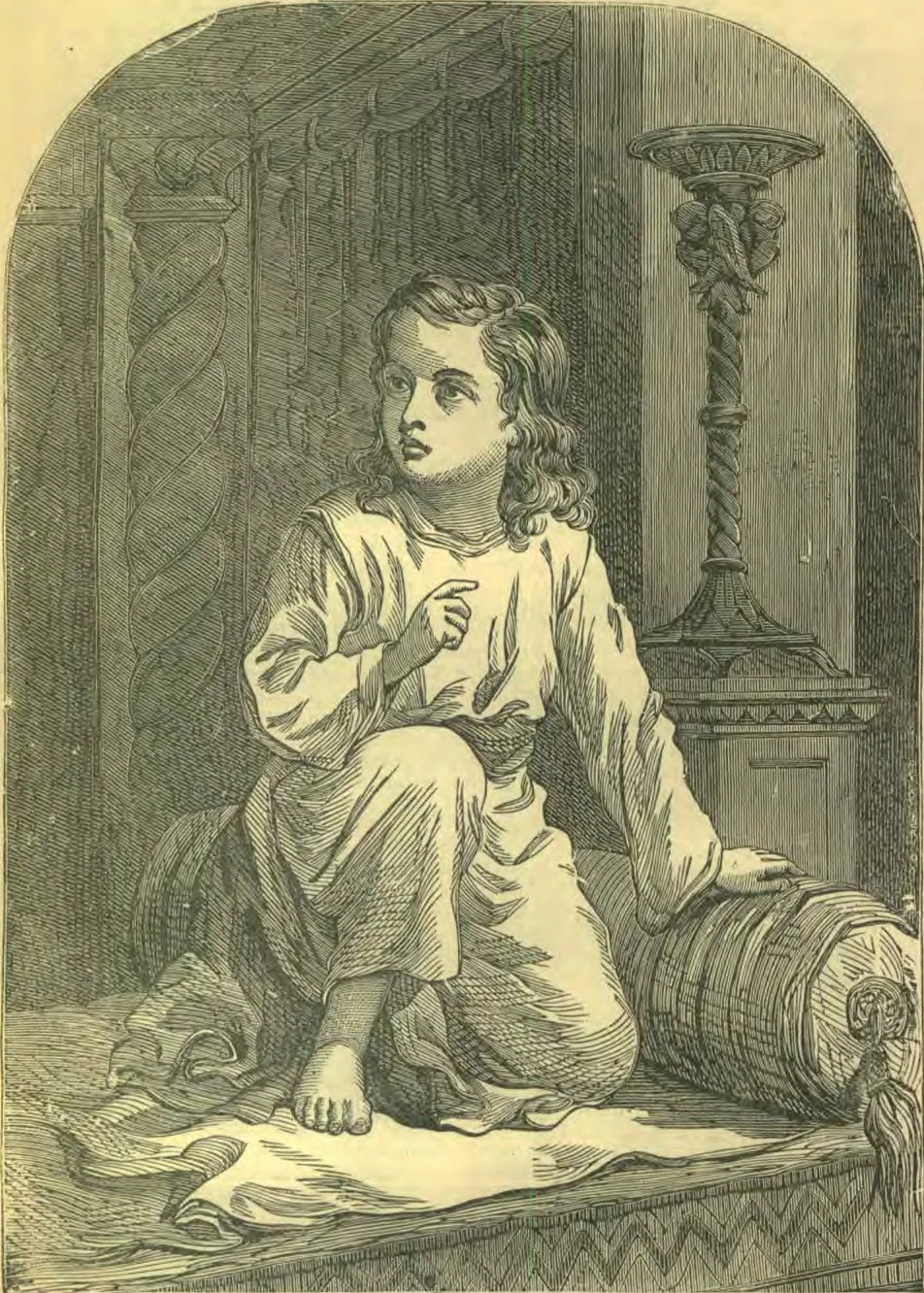
It is supposed that Samuel slept in a room near to Eli’s. One night after Samuel had lain down to sleep, a voice called him, which he thought was Eli’s. Samuel ran to the high-priest, asking what he wanted, when Eli told him to lie down again, as he had not called him. The voice called again, and Samuel did as at first. After being called the third time, Eli was sure the Lord had a message for Samuel, and he told him when he heard the voice again, to say, “Speak, Lord, for thy servant heareth.”
The Lord gave Samuel a message about Eli’s wicked sons, and the judgments which would fall upon them and their house, for their sins. “And all Israel, from Dan even to Beer-sheba, knew that Samuel was established to be a prophet of the Lord.”
It must have been a great cross to deliver such a solemn message to a high-priest; but Samuel was so zealous for God’s honor that he would have suffered death rather than prove unfaithful to his trust.
“And the child Samuel grew on, and was in favor both with the Lord, and also with men.” The people testified of Samuel that he was never unjust, never took a bribe or anything that did not belong to him. More than this, he was a great reformer among them, as he advanced in years. He established schools of learning, and always studied the best interests of the people. A learned man said of him, “If there ever was a heaven-born minister, it was Samuel.”
Other acts in his life you can read in I Samuel. Dear children, will you not learn to honor God as did the child Samuel? M. J. C.

WHAT ARE EYELIDS FOR?

I WILL tell you a good proverb—I wish you would always remember it—“God has given us eyelids as well as eyes.” Do you understand it? What are eyelids for? Not to see. Your eyes are to see with. Your eyelids are not to see. Remember, there are a great many things in life—bad things—and God has given us eyelids that we may not see them, as well as eyes to look at the good things. Use your eyelids. Do not see the bad things.—Sel.
Continue reading: Letter Budget