The Youth’s Instructor, Vol. 28, No. 38.

COLORADO SCENERY

The Youth’s Instructor

Sep 15, 1880

S. D. A. Publishing Association · Battle Creek, Mich. · Sep 15, 1880

COLORADO SCENERY.

Most of the INSTRUCTOR readers are, no doubt, fond of scenery, and eagerly scan every picture representing those portions of the world which are renowned for their natural views, particularly health and pleasure resorts.
At one time, Niagara Falls attracted multitudes of pleasure-seekers, and excited the admiration of all beholders. But the mind soon tires of familiar sights and scenes, and seeks a change, and a trip to the “Falls” is now considered dull and destitute of real pleasure as compared with a journey across the “plains” and a climb through the mountains of the “far West.”
It would be next to impossible to fully describe the scenery of this “Switzerland of America,” where nature has seemed to use all her powers to produce grand and awe-inspiring sights;—the beetling rock, the frightful gorge, the mysterious canyon, the mountain cataract, and the cloud-capped peak, all are well calculated to call forth expressions of adoration toward Him who “spake, and it was done,” who “commanded, and it stood fast.”
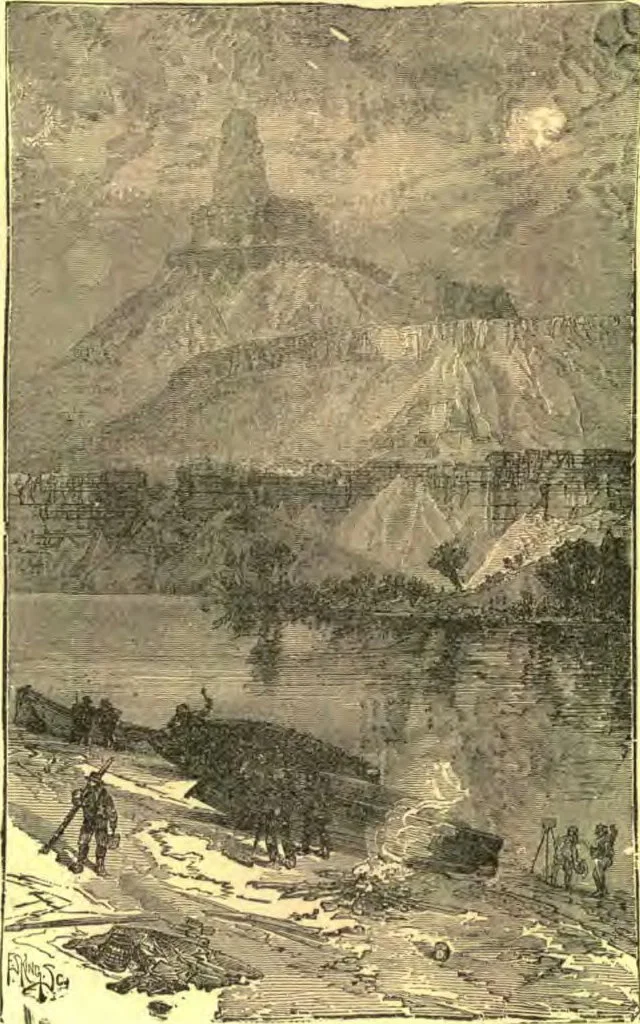
The accompanying cut is a good representation of one of the numerous scenes that greet the eye of the pleasure-seeker in the Rocky Mountains. The high peak in the distance, known as “Gunnison’s Butte,” is twenty-seven hundred feet high. It received its name from Lieutenant Gunnison, of the regular army, who was killed in that vicinity by the Indians a number of years ago. The reader can see that its top is represented as penetrating the clouds.
The grandest sight in nature that one could possibly enjoy would be to stand on the top of such a mountain and watch the lightning flash from the storm-clouds as they gather beneath his feet, while above and around him the sun is shining in all its strength and glory. The writer well remembers, when riding over the “Divide,” encountering such a storm. He passed from sunshine up into it, and then down on the other side into sunshine and dry weather again.
There is one thing of which we wish to speak, that may seem strange to some of our readers. The higher one goes up, the longer time it requires to cook anything by boiling. In some places it takes a number of hours to boil potatoes so that they will be soft enough to eat. The reason for this is that at those extreme points of altitude water boils at very low temperature, or, in other words, it requires but little heat to boil water, and therefore, when at the boiling point, the water does not contain heat enough to cook as rapidly as at less altitude.
In the foreground of the picture can be seen a group of men standing by a surveyor’s compass, while others are busily engaged in repairing their boats, which are drawn up on the banks of Green River. This river takes its rise, principally, in the Wyoming Mountains, flows in a southerly direction, and empties into the Colorado River, through which it finds its way into the Gulf of California. Green River flows through green shale (a soft slaty rock), which is supposed to contain arsenic or chloride of copper. This becomes detached by drainage, and is deposited in the bottom of the stream, where it fastens itself to the pebbles, thus causing the water to have a green color.
In viewing the scenes of nature, one can scarcely refrain from exclaiming, as did the Psalmist, “O Lord, how manifold are thy works! In wisdom hast thou made them all; the earth is full of thy riches.” “All thy works shall praise thee, O Lord; and thy saints shall bless thee. They shall speak of the glory of thy kingdom, and talk of thy power.” J. O. CORLISS.

THE CLOSE OF VACATION.

The summer is ended, vacation is o’er, And back to his books comes the schoolboy once more; With a sigh of regret in his lingering good-by To the hills and the meadows and fair summer sky, To the sweet, idle hours vacation has brought, And the pleasures Dame Nature his young heart has taught, To all and to everything joyous and gay, Which made his vacation so happy each day.
But earth cannot always lie idly at rest With the sunbeams and shadows at play on her breast. There is work to be done, for the harvest is near, And the white-haired old winter-king soon will be here. The grasses and flowers will turn them to seed, Nature’s wisest provision for next summer’s need; Thro’ day and thro’ night she will work with a will, This busy Dame Nature, who never is still.
So cease your regrets for the summer now past, And turn to your lessons and studies at last; Remember, my boy, there’s a ladder to climb, Which leads up to fame and true wisdom in time; Turn your back to the tempter, and fasten your looks Upon pencil and slate and your long-hidden books; And, for comfort, remember that once in each year There’ll be time for the shout of “Vacation is here!”
—Christian Weekly.

THE MORNING OF LIFE.

[The following lines were written by Sr. Mary Martin, who has for several years cared for the children of Eld. Canright,—Genevieve and Freddie. We are sure that all our little readers will be interested in this lovely picture of “The Morning of Life,” and the closing stanzas must touch a tender chord in the heart of many parents.—Ed.]
Riding on the haycart, Hiding in the hay, Gladly picking berries, Till ’t is work, not play.
“Wish I had my trumpet!” “Wish I had my drum!” “All the clouds are crying, See the raindrops come.”
Little hat and sunbonnet Seldom on the pegs. Looking after hens’ nests— “Only pattern eggs!”
Eyes as blue as berries, When the bird’s nest’s found. Lips as red as cherries— “It grows on the ground.”
Saving all the old ones, “For the birds next year.” “Crows can’t catch the chickens, Vieve and I are here.”
“Can a fish do thinking?” “There, I’ve caught an eel!” “See the grasshops winking.” “Wonder if they feel.”
Deep in small ship-building, Sailing paper boat. “When can I have trousers, And a man’s great-coat!”
Sewing for “the million,” Is it, or not quite? “Only twenty dollies,” Counted up to-night.
“What for do they call these ‘Little dusty millers’?” “What are skeeters made for?” And “what, pattykillers?”
“See the troops and horses In the fire there.” “No, you see ’ts a dolly, In a little chair.”
“Toads are dull and poky.” “Wonder if they know Children lose their breakfast, When they are so slow?”
Girl can wash the dishes, Make a saucer pie. “I have learned ’most ev’rything, Auntie, haven’t I?”
Boy has graduated, (No diploma written). He “can count to twenty,” And “catch the wildest kitten.”
Oh, the strangest questions, Ad infinitum. Cyclopedia’s useless, Dictionary’s dumb.
“Hold me, please,” says nightdress, Eyes of brown or blue, “When I’m big I’ll love you, And I’ll hold you too.”
Oh, what shall I say of the lessons? What would be the words of a mother? To-day you’ve done bravely, my children, But to-morrow there’s coming another.
And the nests—oh, the pain of the learning, But you’re young, and your hearts have not known, Although fashioned with love and with beauty, They are naught when the birdies have flown.
And the pictures the fire has painted, Of what you most think, love, or care,— God pity, if when you are older, All you’ve wished or have hoped is still there.
If you ever can tell with your wisdom, For all things the “what,” and the “why,” It will take bitter lessons to gain it, And you’ll have to be older than I.
But as on you go, dreaming and climbing, Whether velvet or thorns must be pressed, Love your God and the pathway of duty, And he will take care of the rest.

Prosperous Belgium.

The little Kingdom of Belgium, lying on the northern coast of Europe, and wedged in between the two great States, Germany and France, is at once the most free, the most prosperous, and the most thrifty nation in Europe.
It is a young nation, though inhabited by the Flemings, a very ancient people. Down to the year 1830, its territory was included in the kingdom of the United Netherlands, and was ruled over by the king of Holland. In that year, the city of Brussels—one of the brightest and fairest cities in Europe—revolted against the Dutch crown; and after the Dutch troops had failed to put down the revolt, the present little kingdom of Belgium was crowded out of his dominions, westward of the Rhine. This was done by the intervention of the great powers, especially by those of England and France.
A free monarchy was at length created, and a very wise and able prince, Leopold of Saxe-Coburg—the widower of the Princess Charlotte of England—was chosen as the first king of Belgium. His second wife was Marie Louise, daughter of Louis Philippe, king of France.
From the very first, Leopold's reign was a successful one. It insured complete liberty to his busy subjects; it established education; and it gave every scope to the skillful industries of the people. Belgium was protected in its independence by England, and has been so protected to this day. Any threat of violence against Belgium would be at once resented by England, even to the point of war.
Leopold molded his little State on the example of the English Constitution; and there is no other European State which, in its government, so closely resembles that of England.
When the great revolution broke out in 1848, which, beginning in France, spread more or less over all Europe, Belgium for a moment caught the infection. There were disturbances in several of its towns, and in Brussels, the capital, an attempt was made to raise barricades, and to overthrow the monarchy. But this was soon put a stop to, in a very shrewd way, by the wise king Leopold. He said to his people that there was no need of their rising in revolt against him. “If you do not want me to rule over you,” he declared, “I will go away at once. The crown is a burden to me. I do not need any force to compel me to give it up.”
This frank speech had an instant effect. The people overwhelmingly declared that they desired nothing so much as that the good Leopold should continue to be their king; and so he remained until his death, in 1865, at a ripe old age.
He was succeeded by his eldest son, Leopold II., who is the present king, and who has continued the wise, liberal, paternal rule of his father.
A few weeks ago, the Belgians celebrated, amid bonfires, music, illuminations, festivals, reviews, and balls, the fiftieth anniversary of their independence as a nation. The stately old Flemish cities, Bruges, and Ghent, and Antwerp, and Brussels, and Mechlin, were alive with many crowds, and gay with festoons and flowers.
And well might this peaceful and industrious people rejoice; for while Europe has been again and again involved in war, and while there is scarcely a country in it that has not witnessed the ravages and desolation of battle, and borne the fiery ordeal of revolt, Belgium has waxed rich and prosperous, and has dwelt happily in the security of peace.
Her population has increased more rapidly than that of any other country; she has been obliged to keep up but a small army; her cities, hoary with age, and rich in every romantic association of the past, have grown, and have constantly added to their industries; and the freedom of every Belgian has been carefully maintained and securely guarded.
It is no secret that the mighty Empire of Germany covets Belgium as one of her provinces; but it is to be hoped that it will be long before this thrifty and free little kingdom will be swallowed up by her big and grasping neighbor.—Youth's Companion.

WHAT CAME OF IT.

A LITTLE over a century ago, in the year 1763, a Jewish lad, named Meyer Anselm, entered the city of Frankfort, Germany, barefoot and carrying on his back a small bundle of rags, his entire store of earthly wealth. Industrious and wide awake, he soon found employment, and carefully hoarded his meager earnings. With the money saved he afterward opened a small banking institution. In this he prospered, and acquired money rapidly. The sign over his door was a little shield, painted red. The word for shield in German is schild, and the word for red is roth. The two words, red shield, thus became, when joined together, rothschild, and that became the name which Meyer Anselm afterward bore,—a name which is familiar to many of our readers on account of the great wealth which has become the possession of the Rothschild family.

LESSONS FOR CHILDREN.

LESSON XC.—THE DREAM FULFILLED.

WHEN Daniel had finished the interpretation of the dream, he gave Nebuchadnezzar excellent advice. He said, “Wherefore, O king, let my counsel be acceptable unto thee, and break off thy sins by righteousness, and thine iniquities by showing mercy to the poor; if it may be a lengthening of thy tranquility.” Although Nebuchadnezzar had done very wrong in some things, he had been very kind to Daniel, and had really many good qualities. Daniel loved him, no doubt; but he knew that there was no way for the king to escape the punishment threatened in the dream but to turn from his bad ways and do right.
We are not told whether Nebuchadnezzar tried to follow Daniel’s counsel or not. If he did, he soon forsook it; for about a year after, as he was walking in his palace, or, as the margin reads, upon the palace, he said, “Is not this great Babylon, that I have built . . . . by the might of my power, and for the honor of my majesty?” By these words the king showed the pride of his heart, and that he thought all his glory had come through his own wisdom; but “While the word was in the king’s mouth, there fell a voice from Heaven, saying, O King Nebuchadnezzar, to thee it is spoken: The kingdom is departed from thee, and they shall drive thee from men, and thy dwelling shall be with the beasts of the field. They shall make thee to eat grass as oxen, and seven times shall pass over thee, until thou know that the Most High ruleth in the kingdom of men, and giveth it to whomsoever he will.”
Nebuchadnezzar had had abundance of time to repent since the warning given him in his dream a year before, and now his punishment was to come without delay. The Bible says, “The same hour was the thing fulfilled upon Nebuchadnezzar; and he was driven from men, and did eat grass as oxen, and his body was wet with the dew of heaven, till his hairs were grown like eagle’s feathers, and his nails like bird’s claws.”
Insane people sometimes imagine themselves to be beasts of some kind, and are determined to go with those beasts, eating just what they eat, sleeping with them at night, and acting as nearly like them as possible. It is supposed that this was the case with Nebuchadnezzar. He was in this condition seven years, just as it had been shown in the dream, and then his reason came back to him. He says, “And at the end of the days, I Nebuchadnezzar lifted up mine eyes unto heaven, and mine understanding returned unto me, and I blessed the Most High, and I praised and honored him that liveth forever, whose dominion is an everlasting dominion, and his kingdom is from generation to generation. . . . At the same time my reason returned unto me; and for the glory of my kingdom, mine honor and brightness returned unto me; and my counselors and my lords sought unto me; and I was established in my kingdom, and excellent majesty was added unto me.”
Nebuchadnezzar’s gratitude for the return of his reason was so great that he could hardly find words to express it. He says, “Now I Nebuchadnezzar praise and extol and honor the King of Heaven, all whose works are truth, and his ways judgment; and those that walk in pride he is able to abase.”

QUESTIONS.

  1. How did Daniel show his friendship for the king, after having interpreted his dream?
  2. What did he say to him? Dan. 4 : 27.
  3. What cause had Daniel for loving the king?
  4. What was the only way for the king to escape the punishment threatened in the dream?
  5. Did Nebuchadnezzar try to follow Daniel’s counsel?
  6. How do we know that he did not continue to follow it?
  7. Repeat his proud words.
  8. What did he show by speaking thus?
  9. What happened while the words were yet in the king’s mouth?
  10. What did the voice say about Nebuchadnezzar’s kingdom?
  11. What did it say should be done to him?
  12. What lesson was he to learn by this experience?
  13. How soon did this punishment come upon him?
  14. What is said of his appearance after he had been in this condition some time? Verse 33.
  15. What do insane people sometimes imagine?
  16. What are they then determined to do?
  17. What is thought in regard to Nebuchadnezzar’s case?
  18. How long was he in this condition?
  19. What did he do as soon as his understanding returned unto him?
  20. What had he to be thankful for besides the return of his reason?
  21. How did he show his gratitude?
  22. What did he say of the works and ways of God?
  23. What did he say of God’s power?
  24. What lessons may we learn from Nebuchadnezzar’s experience?

BIBLE LESSONS FOR YOUTH.

LESSON CXVI.—REVIEW OF LESSONS CXIII-CXV.
  1. Who were the parents of John the Baptist?
  2. Describe Gabriel's visit to Zacharias.
  3. How was Zacharias convinced of the divine authority of the angel's message?
  4. On what mission was Gabriel sent to Nazareth about six months after this?
  5. What did Gabriel say to Zacharias about the work that should be done by the son that was promised him?
  6. What prophetic words did Zacharias utter in regard to him soon after his birth?
  7. What called Joseph and Mary to Bethlehem?
  8. What were the best accommodations they could find for the night?
  9. What prophecy was fulfilled by the birth of the Saviour at Bethlehem?
  10. Describe the visit of the angels to the shepherds who were keeping their flocks near Bethlehem.
  11. What precious tidings did they bring?
  12. Repeat their song of praise.
  13. Describe the visit of the shepherds to Bethlehem.
  14. By what outward token was he designated as a child of Abraham?
  15. When was he presented at the temple, and why?
  16. What testimonies to his Messiahship were borne on that occasion?
  17. What distinguished visitors came from the countries of the East?
  18. What probably led them to suppose that this strange star betokened the birth of Christ?
  19. What place in Judea did they first visit?
  20. For what purpose?
  21. How was their question answered?
  22. What instructions did Herod privately give them?
  23. What secret purpose did he have in mind?
  24. Describe the visit of the wise men to Bethlehem.
  25. What course did Herod take when he found that the wise men had mocked him by returning to their country another way?
  26. How was he thwarted in accomplishing what he had in view?
  27. Describe the closing scenes of Herod's life.
  28. What disposition was made of the kingdom over which he ruled?
  29. Describe Joseph's return from Egypt.
  30. What led him to settle in Nazareth?

BABYLON

The country of Babylon, or Babylonia, is far to the east of the Holy Land. A part of the great Arabian Desert lies between them. The southern part of Babylonia, bordering on the Persian Gulf, was called Chaldea; and sometimes the entire country was called Chaldea, instead of Babylonia. To the north and north-east of Babylonia, lay Mesopotamia. In Mesopotamia was the country of Padan-aram, where Laban lived, and where Jacob spent so many years of toil. Farther west was Syria, with Damascus as its capital. North-east of Babylon was Assyria. The city of Nineveh was in Assyria on the river Tigris, and was the capital of the great Assyrian empire, which for many years ruled over Babylon, Persia, and many other nations. It was the Assyrians, under Shalmaneser, that subdued the kingdom of Israel, and carried its people into captivity. Still farther north, near the Black Sea, is the beautiful country of Armenia, where may still be seen the mountains of Ararat, on which the ark rested. It is generally supposed that the garden of Eden was situated somewhere in Armenia. On the east of Babylonia were the countries of Elam and Susiana.
The kingdoms of Babylon and Assyria are very ancient. From Gen. 10 : 10 we learn that the kingdom of Babylon was founded by Nimrod, who lived more than four thousand years ago. Asshur began to build Nineveh about the same time, and thus laid the foundation of the Assyrian empire. We read in the eleventh chapter of Genesis of the building of the city and tower of Babel. Babylon is the Greek word for Babel; so both words refer to the same place. In the time of Abraham the king of Shinar is mentioned among the kings that came up to fight against the king of Sodom, and others in the vale of Siddim. Since Babylon was in the plain of Shinar, it is probable that the king of Shinar was the king of Babylon. Babylon was long ruled by Assyria, but finally became independent. Just how large the city of Babylon was, it is now hard to tell; for ancient records do not agree in regard to it. It is generally supposed to have been about sixty miles in circumference, and to have been surrounded by a wall as much as eighty feet thick, and more than three hundred feet high. It had one hundred gates of brass, and its walls were surmounted by two hundred and fifty towers. The river Euphrates ran through it from end to end, and it was surrounded by an immense ditch, filled with water from the river.
Babylon reached its highest pitch of glory during the reign of Nebuchadnezzar. Nebuchadnezzar’s palace was surrounded by a strong wall, six miles in circumference; and inside this, was still another fortified wall, all the principal gates being made of brass. Within this inclosure stood the magnificent palace of his father, besides a castle of prodigious size and strength, and the hanging gardens, built by himself. The hanging gardens were built to please Queen Artemis, who had become tired of the level country around Babylon. They were a miniature mountain, supported by arches, watered from the river by machinery hidden within, and so covered with earth, rocks, waterfalls, trees, and flowers, as to imitate the mountains of her own native Media. The mound was four hundred feet high, overlooking not only the entire city and its walls, but the beautiful plains beyond. It is here that Nebuchadnezzar is supposed to have been walking when he said, “Is not this great Babylon, which I have built?” This seems consistent with the Scripture account, since the gardens were within the palace inclosure.
Babylon was a city of great wealth and beauty. It was called “the praise of the whole earth;” “the beauty of the Chaldees’ excellency.” It is said that twenty years’ provision was kept constantly on hand within the city; and since it was so abundantly watered, and so strongly fortified, it seemed impossible that it could be taken. But the people became proud and wicked, and the Lord, through his prophets, declared that it should be destroyed, and finally be without an inhabitant. Of its present condition a recent writer says: “No vegetation adorns the soil; wild beasts prowl there; and its ruins are most desolate. Thus most completely have divine prophecies been fulfilled.”
G. H. BELL.

CAUGHT

Of course the fruit looked very tempting as it hung upon the trees in Farmer Bell’s orchard. There were apples, pears, and peaches in abundance, to say nothing of the grapes which hung in ripe clusters on the vines.
Farmer Bell lived about two miles from the village of Wilton, where there was a boys’ academy. The boys of this school took long rambles out into the country, and often passed this well-kept farm, where everything told of good management, thrift, and hard work. Finally, these boys held a consultation one day, and ten of them decided that the next evening they would go to the orchard and help themselves to the fruit, and then meet in the barn and make a fair division of it.
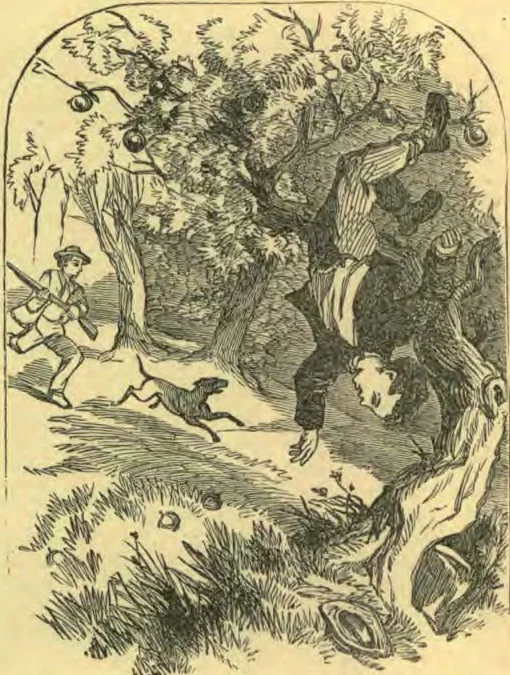
So these ten started out about nine o’clock in the evening, stole around through meadows, leaped stone walls, and at last reached the orchard. Some climbed the pear-trees, and filled their pockets with the luscious fruit; others sought the rare, ripe apples; others gently disengaged the downy peaches from their tender boughs; while others plucked the tempting grapes. All were busily engaged in this pilfering business, when, hark! a low growl, heavy footsteps, and then a fierce-looking dog, barking furiously, chased vigorously boy after boy as they dropped from the trees and started to run away; and following close behind was the farmer with a long club. There was a great scampering among the boys, each one looking out for himself.
Unfortunately, Harry Grey did not escape. In attempting to descend from a tree, his foot caught, and he fell to the ground. In a moment the dog was upon him, but the farmer called him off, and taking Harry by the hand, he went to the house. Farmer Bell had a long, serious talk with Harry about the injustice of their act toward him, as well as their sin against God. He then allowed him to go home.
The next week there came an invitation from Farmer Bell to the professors, teachers, and pupils of the academy to come to his house and have a good time generally,—play games and have refreshments on the lawn, with all the pears, apples, peaches, and grapes that they wanted. All were invited except the ten who were specified by name, stating that, for certain reasons best known to themselves, their company must be dispensed with.
And when the ten watched the teachers and scholars walking off together that lovely afternoon, pleasantly discussing Farmer Bell’s kindness, they felt very crest-fallen and wretched.
But some of them, I think, fully realized that they had not only offended the honest farmer and their teachers, but that they had sinned against God, who, thousands of years before, amid the thunders of Mount Sinai, issued this command to his people: “Thou shalt not steal.”—Well-Spring.

VITALITY OF SEEDS.

THE duration of vitality of seed depends upon a variety of circumstances. Some seeds will retain their germinating power for an almost indefinite period. The so-called mummy wheat is said to have been raised from grain taken from an Egyptian sarcophagus. But whether this be true or not, it is, however, not impossible that some seeds may retain their germinative force for a much longer period than that for which we have unimpeachable evidence.
A humid atmosphere is very destructive to seed life, but exposure to a moderately dry air acts beneficially. The degree of cold a dormant embryo will bear with impunity, providing it has not been saturated with liquid, seems to be practically unlimited.
Perfectly ripened seeds of different plants vary greatly in their germinating force. Some seeds, such as coffee, etc., must be sown soon after they are collected; others, like those of the birch and sycamore, will rarely germinate the second year; while others retain the power for an unknown period.
Radish seeds have been known to grow freely when seventeen years old, and it is also recorded that kidney beans one hundred years old, and rye one hundred and forty years old, have germinated. So far as experience goes, prolonged vitality seems to depend on the nature of the pericarp, testa, or albumen, though there are some exceptions.—Ready Print.

THE ORANGE-TREE.

The orange is the longest-lived fruit-tree known. It is reputed to have attained the age of three hundred years, and been known to flourish and bear fruit for more than a hundred years. No other fruit-tree will sustain itself and produce fruit so well under neglect and rough treatment. It begins to bear about the third year after budding, and by the fifth year produces an abundant crop, though the yield is gradually increased by age and favorable circumstances. The early growth of the orange is rapid, and by its tenth year it has grown more than it will in the next fifty, so far as its breadth and height are concerned; but it is age that multiplies its fruit-stems.

LETTER BUDGET.

The first letter that the mail brings us this week is from Ruby C. Maddock, of Swansea, Minnesota. She says that she and brother Harry are raising beans to sell to pay for the INSTRUCTOR next year. When they have read their papers, they send them away for others to read. She is going to try to get a new subscriber. We hope that all our little friends will work for the INSTRUCTOR.
Bertie Noland, of Fairview, California, writes: “This is my first letter to the INSTRUCTOR. I think that our little paper is very interesting. I attend Sabbath-school. I want to be a good boy and meet all the INSTRUCTOR family in Heaven.”
Here is a letter from a little friend in Iowa, Mary B. Towne. She says that she keeps the Sabbath with her mother. Her father does not keep the Sabbath, but he thinks that it is right to keep it. She is praying for him. She desires the prayers of the INSTRUCTOR family.
Zoe M. Huffman, of Yorktown, Indiana, writes us of her papa’s coming out in the truth, about one year ago, under the labors of W. W. Sharp, and how glad she is. She wants to be an overcomer. If this letter is printed, she thinks that she will write again. She is nine years old.
Matilda M. Reese, of Maiden Rock, Wisconsin, says: “I am a little girl eight years old. I have kept the Sabbath with my parents ever since I can remember. My father is away most of the time, laboring among the Germans. This is the first letter that I have written to the INSTRUCTOR. I believe all that it teaches me. I hope to meet the INSTRUCTOR family in the kingdom.”

SEPTEMBER

The golden-rod is yellow; The corn is turning brown; The trees in apple-orchards With fruit are bending down.
The gentian’s bluest fringes Are curling in the sun; In dusty pods the milkweed Its hidden silk has spun.
The sedges flaunt their harvest In every meadow nook; And asters by the brook-side Make asters in the brook.
From dewy lanes at morning The grapes’ sweet odors rise; At noon the roads all flutter With yellow butterflies.
By all these lovely tokens September days are here, With summer’s best of weather, And autumn’s best of cheer.
—Scribner.

You have reached the end of this edition.

The Youth’s Instructor · Sep 15, 1880