The Youth’s Instructor, Vol. 28, No. 27.

LIGHT-HOUSES

The Youth’s Instructor

Jun 30, 1880

S. D. A. Publishing Association · Battle Creek, Mich. · Jun 30, 1880

LIGHT-HOUSES

LIGHT-HOUSES are of great antiquity, and there is room for much interesting study in regard to them. The most celebrated one in ancient times was on the island of Pharos at Alexandria, 280 B. C. The style and workmanship are represented to have been superb, and the material was a white stone. The height was about 550 feet, and the light, which was always kept burning, was visible about forty-one miles. This tower existed for 1,600 years.
These signal lights are rapidly increasing, but no country, perhaps, rivals France in its system of light-houses. It has four classes. Those of the first order indicate localities, and serve as a guide to vessels which do not come near the coast. The second and third order point out bays, reefs, and roads; and those of the fourth order are placed at the mouth of rivers, and entrances to ports.
Revolving lights are the most common. These are so arranged as to cause illuminations and eclipses, and the rapidity with which these succeed each other forms the distinctive sign of the light-house.
In the English Channel, which lies between France and England, there is a group of rocks called Eddystone. These are daily submerged by the tide, and can only be discovered by the waves which eddy about them. The frequent shipwrecks on these rocks led to the erection of a light-house on them in 1696-1700. It was built by the learned and eccentric Winstanley, but being of wood it was completely swept away in a storm three years after its completion, the builder being submerged with the tower.
Another light-house was built in 1706-1709, also of wood, with a stone base. For a time it withstood the storms, warning sailors from the fatal rocks, until one night the building, from an unknown cause, took fire and was burned.
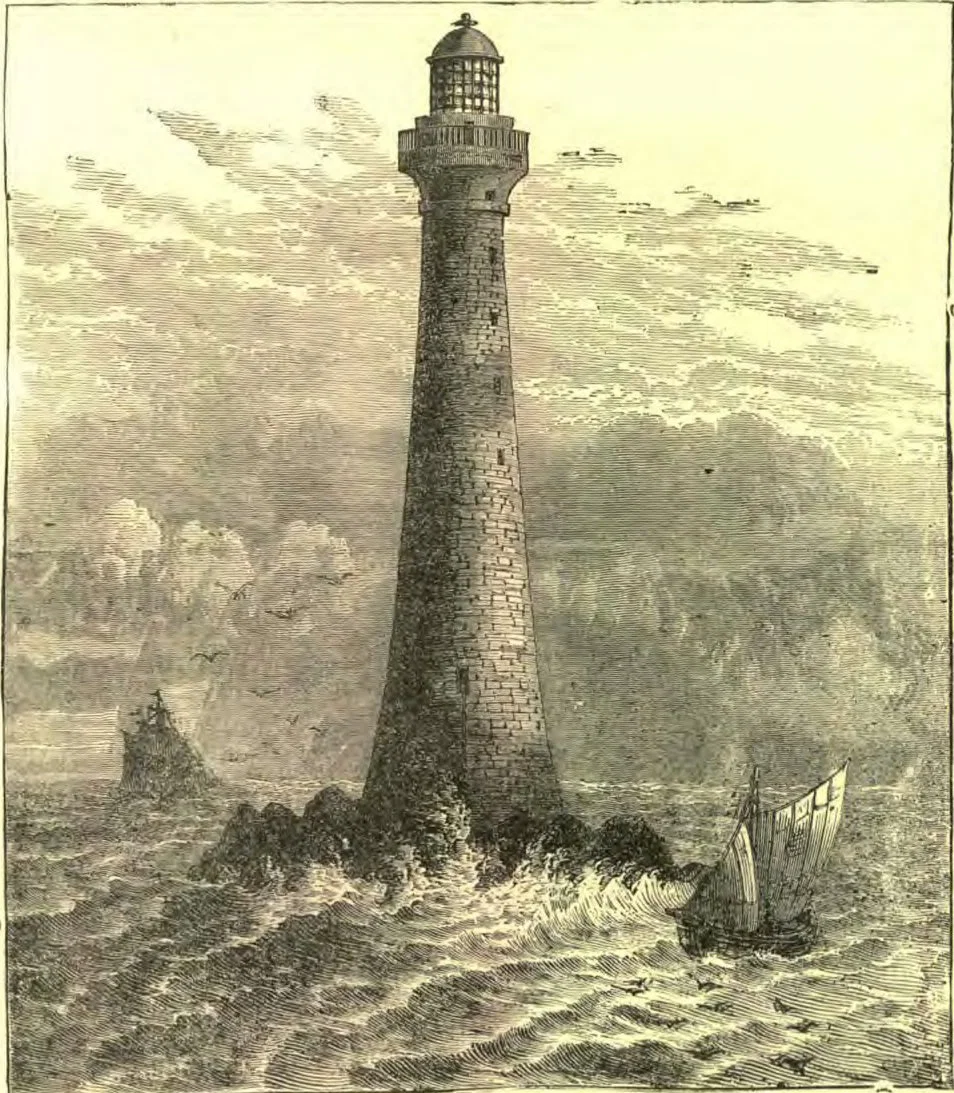
The present building, which is so beautifully represented in this picture, was constructed by Mr. Smeaton in 1757-1759. It is noted for its strength and the engineering skill it displays. The trunk of an oak-tree is said to be the model from which it was built.
It stands on the sloping side of one of the rocks, and is built of blocks of Portland oolite, of one or two tons’ weight, incased in granite, the granite being dovetailed into solid rock. The base is about twenty-six feet in diameter. The tower is eighty-five feet high, rising from the base in a gentle curve. The light is a fixed one, at the height of seventy-two feet above the water, and can be seen at the distance of thirteen miles.
Smeaton put on it no boastful inscriptions like those of Winstanley, but on its lowest course he put, “Except the Lord build the house, they labor in vain that build it;” and on its key-stone, above the lantern, the simple tribute, “Laus Deo!” (Praise to God!) and the structure still stands, holding up its beacon-light to the storm-tossed mariner. *

THE LIGHT-HOUSE AND ITS KEEPER.

On a sunken rock in the open sea, Stood a light-house high and strong; And the lamp was there with its splendid flame, And the keeper, all night long.
But the keeper had naught of pity or love; A hard, selfish man was he; He shaded the lamp, and sent out no light O'er the dark and perilous sea.
Safe in comfort himself, the nightly ship Might strike, or go safely by. “Let them strike, and go down, who cares?” said he; “Men have only once to die.”
One dismal night, by a strong wind driven, Came a ship with all sails spread: No one thought of danger; for no one knew Of the sunken rock ahead.
Fast sweeping along, came the sail-clad ship, The white foam leaped from her prow; “All's well!” cried the watchman pacing the deck; “All's well!” passed from stern to bow.
But scarce died away had the watchman's cry, When crash,—plunged the ship to her fate; And there was the beacon that would have saved; But 't was seen, alas! too late.
Oh! fearful cries of the drowning men From the seething waves that night; And they cursed, as they sank, the merciless man Who refused his saving light.
The men of the ship are the heathen world; The beacon, the book of God; The keeper, the Christian who shades his lamp, And sends not its light abroad. —The Children's Record.

INCIDENTS IN THE EARLY LIFE OF S. V. S. WILDER.

While sailing up the Columbia River to attend a camp-meeting at Milton, Oregon, a few weeks since, we became much interested in reading the life of this great and good man, the first, and for twenty-five years, the only, president of the American Tract Society. We now propose to give the Instructor readers a few of the facts and incidents in his early life, hoping that some may be benefited by his example.
Mr. Wilder was born in Lancaster, Mass., just one hundred years ago the twentieth of last month. He was blessed with having upright, God-fearing parents, who ever sought to instill into his mind principles of strict honesty and integrity. His great-grandmother lived in Holland at the time when the Pilgrim fathers visited that country, previous to their sailing for Plymouth Rock in 1620. During their stay there she imbibed largely of their religious principles, and soon after, accompanied by her youngest daughter, followed them across the water to find “freedom to worship God.” Just before her death, this daughter, Mr. Wilder’s grandmother, obtained permission of his parents to educate him for the ministry.
He was at once placed in a grammar school, where he studied with the utmost diligence until the age of thirteen, when his father on his death-bed expressed the wish that he would enter mercantile life, in order to give more support to the family. At the age of fourteen he was placed in a store at Gardner, Mass., about fifty miles from Boston. But this not proving to be a very good place, at the end of two years he engaged some one to take his place and he returned home.
While at Gardner, he had often been sent to Boston in charge of wagons of produce which he sold and invested in goods. Here he became acquainted with several merchants who now offered him employment. He partially arranged to go with one firm at a salary of $150 a year, but on returning home, his mother objected so strongly that, in compliance with her wishes, but much against his own will, he went into a store of one Mr. Henley, in Charlestown, at a salary of $50 a year. This, of course, was a great damper on his naturally ambitious spirit, but while here he formed the acquaintance of Rev. Dr. Morse, D. D., who gave him the privilege of coming to his house and using his library, and who also gave him private instructions every Saturday evening.
“Thus,” says Mr. Wilder, “in consequence of obeying my mother, I was brought under the notice of Dr. Morse, near whose house was Madame Henley’s store; for Mr. Henley dying while I was there, his wife carried on the business, and I became her head clerk.” Through Dr. Morse, Mr. Wilder became acquainted with a French gentleman, and through him, a few years later, when sent to France to buy goods on commission, he received special protection from the French government. This protection enabled him to form under his own roof various societies for the distribution of tracts and the Bible.
All his success in life, Mr. Wilder attributes to his “implicit obedience to the wishes and entreaties” of his mother. Let all young men and women having pious parents profit by his example. As in this case and in that of Washington, obedience to a mother may be the hinge upon which your entire future course may turn.
During the latter part of Mr. Wilder’s clerkship with Madame Henley, an interesting incident occurred which we will here give as nearly in his own words as space will allow:—
Being engaged in winding up the concerns of my late employers, preparatory to commencing business on my own account, an old country customer called one morning, and after making a selection of several articles which we still had on hand, and wishing, in order to complete his assortment, half a bale of Russia duck, which we had not, I told him that he might calculate upon having it at the time he was to call for the other articles, which was at one o’clock.
I soon left for Boston, in order to obtain the article wanted. Having purchased it, and not meeting with the truckman who usually transported merchandise over to Charlestown at noon, I engaged a young man with a wheelbarrow to take over the bale of duck. After accomplishing my other business, I started home. On reaching the street leading to Charlestown bridge, I found the young man sitting upon the wheelbarrow, quite overpowered by the heat of the day.
Having promised the goods at one o’clock, and it being already half-past twelve, I immediately seized the wheelbarrow, dressed as I was in Nankeen small-clothes, with silk stockings, white Marseilles vest, a striped gingham coat, and a white fur hat.
Thus I was propelling along the wheelbarrow when overtaken by Mr. Codman on horseback. “What,” said he, “Mr. Wilder turned truckman?” “Why,” replied I, “I have promised these goods to be ready for a customer at one o’clock at our store, and am determined not to disappoint him.” “Good! good!” said Mr. Codman, and rode over the bridge and called at his sister-in-law’s, at our store. Said he, “I witnessed a scene just now, in coming over the bridge, which afforded me much satisfaction, being nothing less than your head clerk with a wheelbarrow loaded with a heavy package, which it seems he had promised to a customer of yours at one o’clock, and it now wants but twenty minutes. I understand,” said he, “that that young man is about commencing business for himself. You may say to him on his arrival, that such is my approval of the energy of character displayed in not hesitating to wheel the barrow rather than disappoint a customer and break his own word, that when he commences business my name is at his service for thirty thousand dollars, so long as he does not indorse for others.”
On reaching the store, I found the customer there with his other goods packed, and only waiting for the duck, which arrived just in time to be loaded on.
A few months after, I commenced business in Boston on my own account, and although I never availed myself of the offer of Mr. Codman, yet during the first year of my business he made several consignments of goods to me which I disposed of on commission, and which resulted in the aggregate in over ten thousand dollars.
Let the young who are now approaching the period when they will be called to enter upon the stern realities of life, profit by this example, and make the prayer of David their own: “Let integrity and uprightness preserve me.” Let them ever have courage to do what is right and necessary; and let them only “be ashamed who transgress without cause.” M. K. W.

AN OLD MAN, ONLY FOUR YEARS OLD.

A Persian monarch inquired of an aged man, “How many of the sun’s revolutions hast thou counted?”
“Sire, I am but four years of age.”
“What!” interrupted the king, “fearest thou not to answer me falsely? or dost thou jest on the very brink of the tomb?”
“I speak not falsely,” replied the aged man. “Eighty long years have I wasted in folly and sinful pleasures, and in amassing wealth, none of which I can take with me when I leave this world. Four only have I spent in doing good to my fellow-men; and shall I count those years which have been utterly wasted?”
Like the royal Preacher, he “looked on all the works that his hands had wrought, and on the labor that he had labored to do, and, behold, all was vanity.” Eccl. 2:11.

A Little Girl Learns Love One Another

A LITTLE girl four years old learned the Bible text, “Love one another.” “What does ‘Love one another’ mean?” asked her oldest sister. “Why, I must love you, and you must love me; and I’m one and you are another,” was the answer.

LESSONS FOR CHILDREN.

LESSON LXXIX—JEHOSHAPHAT TO JOTHAM.

After the death of Asa, Jehoshaphat his son reigned in his stead. He also feared God, as did his father. He did not allow any one in all the country to worship idols. He sent priests into every part of the land to teach the people the law of God, and how to worship him. So the people feared the Lord, and all the nations round about were friendly toward Jehoshaphat, and made him presents; for they were afraid of the God whom he worshiped. He also set judges throughout the land, and charged them to be upright in judging the people; and to always have the fear of God before them.
When he did wrong, as he did sometimes, the Lord sent his prophet to reprove him; but Jehoshaphat received the reproof kindly, and tried to turn from every evil way.
When great armies came up to fight against him, he asked God to help, and told his men to pray, and sing praises to the Lord. Then the Lord turned his enemies to fighting one another, until they were all destroyed.
After the death of Jehoshaphat, his son Jehoram reigned in his stead. Jehoram was very wicked. He killed his own brothers, worshiped idols, and went in the ways of the kings of Israel; for he had married the daughter of Ahab. He reigned only eight years; for the Lord smote him with a terrible disease, and he died.
Next, Ahaziah reigned one year, and after him, his mother Athaliah reigned six years. Both were very wicked. Athaliah was killed by some of the chief captains, and Joash began to reign when he was only seven years old.
Six years before, Athaliah had tried to kill Joash, so that he might not have the kingdom; but the good priest Jehoiada and his wife had kept him hid in the house of God up to this time.
While Jehoiada lived to counsel and guide him, Joash reigned well; but after the priest died, the people began to worship idols, and became very wicked.
And the Spirit of God came upon Zechariah, the son of Jehoiada, and he reproved the people. Then Joash ordered the people to stone him. So Joash killed a good man, the son of the one who had saved his life and made him king.
Then Amaziah reigned twenty-nine years. At first he reigned well, but afterward he became proud, and worshiped idols.
After him Uzziah reigned fifty-two years. He was a good king, and the Lord prospered him greatly. Finally he became proud also, and went into the temple, and burned incense before the Lord. When the priests reproved him, he was angry, and the Lord smote him with the leprosy; so he had to dwell in a house by himself all the rest of his days.
After Uzziah, Jotham his son reigned sixteen years. Jotham was a good king, and served the Lord. He built much in Jerusalem. He also built cities in the mountains of Judah, and in the forests he built castles and towers. So the Lord blessed him, and he became a great man.

QUESTIONS.

  1. Who reigned in Jerusalem next after Asa? 2 Chron. 16:13; 17:1.
  2. What kind of man was he?
  3. What would he not allow?
  4. For what purpose did he send priests into every part of the land? Chap. 17:9.
  5. What effect did this have upon the people?
  6. How did the surrounding nations behave toward Jehoshaphat?
  7. Why were they so friendly?
  8. What charge did Jehoshaphat give to the judges that he set up in every part of the land? Chap. 19:5-7.
  9. How did he act when the Lord reproved him for doing wrong?
  10. What did he do when great armies came up to fight against him?
  11. What did he tell his men to do?
  12. How did the Lord help him?
  13. Was Jehoram like his father? Chap. 21:4-6.
  14. What wicked things did he do?
  15. How was he led to go in the ways of the kings of Israel?
  16. How long did he reign?
  17. What caused his death? Verses 18, 19.
  18. How long did Ahaziah reign? Chap. 22:2.
  19. Who was Athaliah?
  20. How long did she reign?
  21. How did she meet her death? Chap. 23:12-15.
  22. Who reigned after Athaliah? Chap. 24:1.
  23. How old was Joash when he began to reign?
  24. Who saved his life when Athaliah, his grandmother, tried to kill him? Chap. 22:10-12.
  25. Why did she want to kill her grandson?
  26. How long did Joash reign well? Chap. 24:2.
  27. How did the people act after the death of the good priest Jehoiada? Verses 17, 18.
  28. When the son of Jehoiada reproved the people, what did they do? Verses 20, 21.
  29. Who commanded them to do this wicked thing?
  30. How did Amaziah reign at first? Chap. 25:1, 2.
  31. What change took place in him?
  32. What kind of king was Uzziah? Chap. 26:3, 4.
  33. What wicked thing did he finally do? Verse 16.
  34. How was he punished? Verses 17–21.
  35. Who reigned next after Uzziah? Verse 23.
  36. What course did he take? Chap. 27:2.
  37. What did he build? Verses 3, 4.
  38. How was he rewarded for serving the Lord?

BIBLE LESSONS FOR YOUTH.

LESSON CV.—ANTIOCHUS EPIPHANES.

Ptolemy Epiphanes succeeded Philopater, and was made king when he was only five years of age. Of course he could take no part in the administration of the government, and Egypt was virtually without a king. Antiochus the Great, king of Syria, taking advantage of this state of affairs, wrested Palestine from Egypt. The Egyptians then sought the aid of the Romans against the encroachments of Antiochus. The Romans had just ended the second Carthaginian war by the utter defeat of Hannibal, and were becoming formidable to the nations around them.
By the aid of a Roman army the Egyptians drove Antiochus from their country, but Palestine still remained under the control of Syria. Antiochus the Great, having been slain by his own people for plundering a temple, was succeeded by Seleucus Philopater, who, after a reign of twelve years, was followed by Antiochus Epiphanes. The title “epiphanes” means illustrious, and this man was certainly illustrious for his cruelty.
A good man by the name of Onias was at this time high priest at Jerusalem; but Jesus, a brother of Onias, bought the priest’s office of Antiochus for 360 talents, and Onias fled to Egypt, where he built a temple and offered sacrifices. This Jesus was a bad man. He encouraged the heathen worship of the Greeks, and tried to put down the Hebrew customs and religion. Not liking his Hebrew name, he changed it to the Greek name, Jason. Jason was supplanted by another brother, who took the Greek name of Menelaus, and favored Greek customs even more than Jason had done.
“Antiochus now undertook an expedition into Egypt, and was successful. While he was there, the Jews heard a report of his death, at which they showed signs of great joy. Hearing of this, Antiochus, on leaving Egypt, went to Jerusalem to chastise them. He besieged and took the sacred city; slew forty thousand Jews, and sold a like number as slaves; and to show his contempt for the Jewish religion, entered the holy of holies, sacrificed a sow on the altar of burnt-offering, and sprinkled broth made of its flesh all over the building.”
Attempting another invasion of Egypt, he was met and sent back by a Roman ambassador. This put him in a bad humor, and, “to chastise the Jews, he sent to Jerusalem a general named Appollonius, who executed his commission with terrible rigor. Waiting till the people were all assembled in their synagogues on the Sabbath, he made a frightful massacre, slaying the men, seizing the women and children as slaves, demolishing the city and its walls, and building the fortress of Acra with the ruins.”
Antiochus consecrated the temple at Jerusalem to Jove, and set up a statue of Jupiter Olympus on the altar of burnt-offering. For more than three years the worship of the true God was excluded from the temple. An edict was issued requiring all people under his dominion to worship the Greek gods; and to observe any of the Jewish customs was made a capital offense. “Two Jewish women that were found to have circumcised their children, were led through the streets with their children fastened to their necks, and cast headlong over the steepest part of the walls. At the feast of Bacchus, the god of wine, the Jews were forced to join, carrying ivy, and taking part in the abominations of the festival.”

QUESTIONS.

  1. Who succeeded Ptolemy Philopater as sovereign of Egypt?
  2. How old was he when he was made king?
  3. In what condition was Egypt virtually left?
  4. How did Antiochus the Great improve this opportunity?
  5. What course did the Egyptians pursue?
  6. What great success had the Romans just achieved?
  7. What position were they beginning to take among nations?
  8. What was the result of this Roman interference in behalf of Egypt?
  9. Under whose control did Palestine remain?
  10. How did Antiochus the Great end his days?
  11. By whom was he succeeded?
  12. How long did Seleucus Philopater reign?
  13. By whom was he succeeded?
  14. What does the title epiphanes signify?
  15. In what way was this man illustrious?
  16. Who was high priest at Jerusalem at this time?
  17. How was he dispossessed of his office?
  18. Whither did he flee?
  19. Describe the character and course of his brother Jesus.
  20. Give the name and character of the one who succeeded Jason.
  21. What expedition did Antiochus now undertake?
  22. What report did the Jews hear when Antiochus was in Egypt?
  23. What feelings did they manifest on hearing this report?
  24. What effect did this have upon Antiochus?
  25. On his return from Egypt, what punishment did he inflict upon the Jews?
  26. How did he show his contempt for the Jewish religion?
  27. How was he prevented from again invading Egypt?
  28. How did this disappointment affect him?
  29. How did he chastise the Jews?
  30. On what day did Appollonius attack the Jews?
  31. Would they resist him on the Sabbath?
  32. What was their sad fate?
  33. What devastation was brought upon Jerusalem?
  34. To whom was the temple consecrated?
  35. What was set up on the altar of burnt-offering?
  36. How long was the worship of the true God excluded from the temple?
  37. What edict was issued by Antiochus?
  38. What was made a capital offense?
  39. What cruelty was practiced upon two Jewish women for circumcising their children?
  40. What were the Jews compelled to do at the feast of Bacchus?
THE LOST BOY.

MANY bright lights were shining from the windows of dwellings scattered among the hills and valleys of Pennsylvania one chilly night in October. At bed-time nearly all were put out; but in one small house, standing alone in the great forest some miles from any other, the light did not go out the whole long night; for from that home a boy had strayed away, and could not be found.
The news spread far and wide, and men came hurrying to join in the search for the missing one. Two days flew quickly by, and no tidings had come to the anxious father and mother. Still the search went on, the men anxiously peering into every nook and corner, and looking behind logs and trees for some trace or token of the boy.
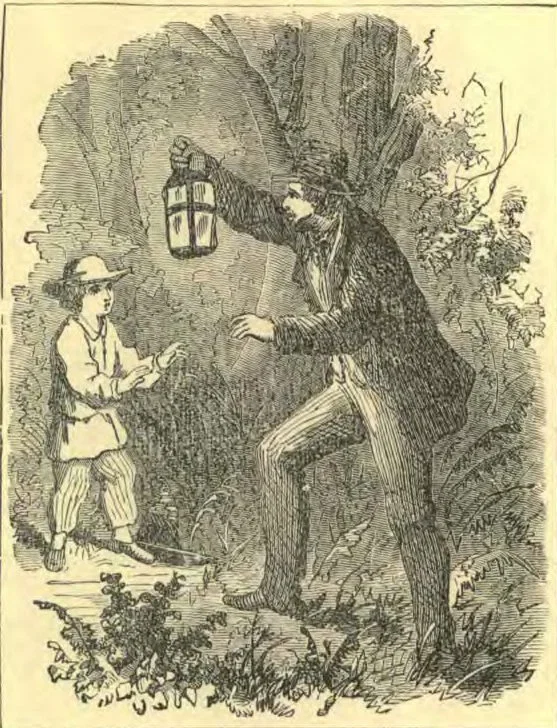
Suddenly one of the men came upon him in the deep, dark forest. And as the light of his lantern revealed the boy standing before him, how he made the woods ring with shouts that the boy was found; and when he was restored to his father and mother, oh, what joy there was in that little home, more joy than in any other among the hills or in the valleys!
How glad the little boy was to go home; for although the woods were pleasant in the summer and when the sun shone, and he had friends with him, yet now when the trees were bare, and the winds blew cold, and he was alone with darkness over all, he found no pleasure, and home seemed the most pleasant spot on earth.
Dear children, try to understand when I tell you that this world is like the great, dark forest, and we are all lost in it, even as the little boy was lost in the woods, till Christ finds us; then if we are willing to go home (to Heaven) with Christ, what a shout goes up from all who love the Saviour! Reader, has not Christ found you, and asked you to go home with him? and will you not go? V.

LETTER BUDGET.

Camden, New Jersey. Dear Instructor: I am a little boy eleven years of age. I keep the Sabbath with father and mother. I love the INSTRUCTOR very much, and hope to meet the INSTRUCTOR family in Heaven. Pray for me. Willie Logan.
Bertrand, Neb. Dear Editors: I am fourteen years old. I keep the Sabbath with my mother. I take the INSTRUCTOR, and love to read it very much. I love to read the Bible, too, and hope I shall some day be able to teach from it. I am trying to live just right, so as to influence others to be good. I want to live with all the INSTRUCTOR family on this earth when it is made new. Pray for me. Cora Gary.
Meriden, Minn. Dear Editors: We are trying to keep the Sabbath with our parents. We have four sisters. We take the weekly INSTRUCTOR and like it very much. We are young and easily tempted to do wrong, but we want to overcome our evil ways that we may be children of God. Pray for us. Peter Nelson. James Nelson.
Magnolia, Iowa. Dear Editors: I was eight years old last Wednesday. Mother said I might write you a letter. We have a good Sabbath-school. I love to go, and I try to learn my lessons well. I study in “Bible Lessons for Little Ones.” My brother takes the INSTRUCTOR, and I love to read it. I keep the Sabbath with my parents and brothers. My father is superintendent of our Sabbath-school. We use the “Song Anchor.” Mother is going to copy my letter for fear you could not read my writing. I want to be a good girl. Pray for me. Yours truly, Bessie Irys.

THE PLANET MERCURY.

THIS swift-footed member of the solar brotherhood will be an evening star during the month of July, and this is one of the three favorable times during the year when the fiery little planet may be picked up by a bright-eyed observer. Mercury is so close to the sun, and moves so rapidly, that he never sets more than two hours and a few minutes after the sun, or rises by more than that interval before him.
His apparent motion, as seen from the earth, is alternately from west to east, and east to west, in nearly straight lines, the extreme points being called his elongations. He is now on the east side of the sun, and will reach on Tuesday, the 6th of July, his greatest eastern elongation, or most favorable position for observation.
During the week before and after this period, he may be looked for in the western sky about an hour after sunset, not far from the point where the sun went down. It is no easy thing to see this brilliant star, which is shy of showing itself to mortal eyes. Many astronomers have died without the sight. Copernicus, who discovered that the sun was in the center of the system, and that the planets revolved around him, never saw Mercury, though he often looked for him. But patient observation and bright eyes will catch a glimpse of the planet as he rolls on in his course nearest to the sun.
If the atmosphere be clear and the sky cloudless, Mercury can be found, and when once seen, will never be forgotten. He shines on the still, bright sky, with a peculiar brilliancy with which few stars can be compared when seen under the same light, and is so perfectly distinct, when once his place is found, that the observer cannot understand how he manages to escape detection from the undirected eye.
Among the shining orbs that stud the sky, the planets have a special interest. They are our brothers and sisters, born at the same time, pursuing the same course, and traveling to the same incomprehensible goal. Who will catch the first sight of the smallest member of the system, famed for his amazing swiftness, and his wondrous supply of heat and light?—Youth's Companion.

WHY NOT TRY THE VELVET TONGUE?

“When I was a boy,” says one, “I and a number of playmates had rambled through the woods, until, quite forgetting the fading light, we found ourselves far from home. Indeed, we had lost our way. By the edge of the field we saw a man coming along, and we ran to ask him. Whether he was in trouble or not I do not know, but he gave us some very sharp answers.
“Just then came along another man, a near neighbor, with a merry smile on his face.
“‘Jim,’ said he to the sharp talker, ‘a man’s tongue is like that of a cat. It is either a piece of velvet, or a piece of sand-paper. Try the velvet, man, try the velvet principle.’”

NOT BY HALVES.

If you're told to do a thing, And mean to do it really, Never let it be by halves; Do it fully, freely.
Do not make a poor excuse, Waiting, weak, unsteady; All obedience worth the name Must be prompt and ready.

You have reached the end of this edition.

The Youth’s Instructor · Jun 30, 1880