The Youth’s Instructor, Vol. 28, No. 45.

SOME THINGS ABOUT SPIDERS AND THEIR WAYS

The Youth’s Instructor

Nov 3, 1880

S. D. A. Publishing Association · Battle Creek, Mich. · Nov 3, 1880

SOME THINGS ABOUT SPIDERS AND THEIR WAYS.
(Concluded.)
A CURIOUS thing in the natural history of spiders is their power of reproducing their limbs after they have been broken off. In such cases it is never a part of a limb which is reproduced; but if a portion is removed, the wise spider proceeds at once to throw off the residue; and after the next moult behold the entire missing limb again appears!
Spiders’ webs have been manufactured into a delicate fabric for dresses and gloves; but it is said that to obtain one pound of spiders’ silk, the webs of six hundred thousand spiders would be needed. Probably the production of silk from spiders will always be more a matter of curiosity than of utility. But spiders serve one important purpose in the economy of nature,—they catch an abundance of flies and insects by their geometrically constructed webs, and, in turn, they are devoured by birds and reptiles. And, disgusting as it may seem, they form a part of the diet of barbarous peoples, as the Indians, Africans, and Australians. Spiders’ webs are also in high repute among physicians for staunching the flow of blood from wounds.
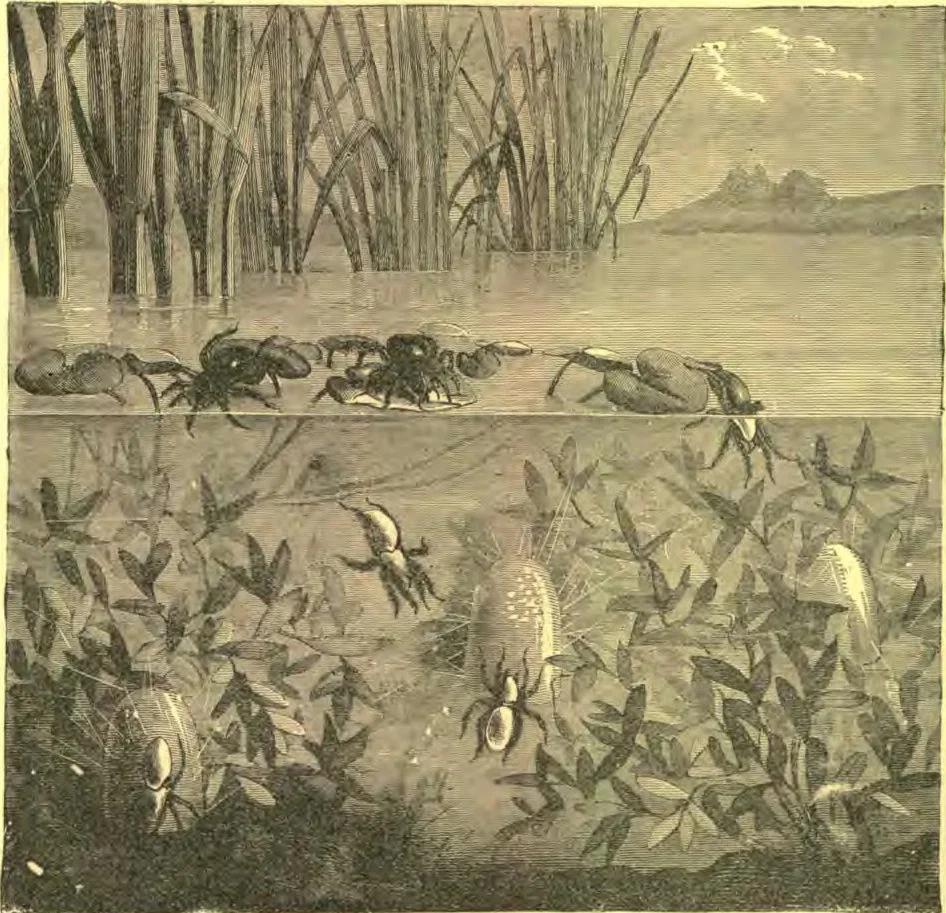
We have already remarked that there are a number of species of the spider family. One class, called Natantes, or Swimmers, are water-spiders. Such are the nimble little water-skippers shown in the engraving. This variety are wholly aquatic in their habits. They spin a cup-like web, which answers the purpose of a diving bell. They can readily exhaust the air from this miniature web-cup, which is about half the size of a common acorn, and then descend beneath the surface to feed on water insects below; or when they wish, come to the top to disport on the water. Their tiny hairs keep their bodies from becoming wet, and in their nests in the water they are as dry as if they were in a hole in the wall.
One species of spider, known as the Attidæ, i. e., Jumping Spiders, makes no web, but wanders in search of its prey. It is common in summer on the walls and windows, basking in the sun. It crawls stealthily up to flies, and jumps with great accuracy upon its victims. Before leaping upon a fly it fixes a thread to secure itself from falling. Mr. Livingston mentions a South African spider of this variety which can leap a foot.
Another species is called Thomisidæ, or Crab Spiders. Some of them seem to walk better sidewise than forward. The large crab spider of South America is able to leap upon and destroy humming-birds and lizards. That part of its victim which it does not eat, it suspends by a cable from a limb for future use. This spider is about three inches long, and its legs extend over a space of eight or ten inches.
The Lycosidæ, or Running Spiders, have long legs, and are very active, living in open places, and catching their prey without webs.
The Agalenidæ, another variety, make flat webs, with a funnel-shaped tube at one side, in which the spider remains waiting for his prey.
The Mygalidæ includes the largest spiders known. They live only in warm countries. They have marked anatomical differences from the other families of spiders.
The long-legged cellar spider, called the Pholcus, has a curious habit of hanging on a cable by its legs and whirling round so fast that it can scarcely be seen.
The distinguished naturalist, Walckenner, divides all spiders into five different groups as follows: 1. Hunting Spiders; 2. Wandering Spiders; 3. Prowling Spiders; 4. Sedentary Spiders; And, 5. Water Spiders.
Daddy Long-legs, frequently called Grandfather Graybeard, is of the spider species. Little cow-boys frequently catch them and make them point in the supposed direction that the cows are, before going for the evening herd.
Spiders have the bad reputation of being animals that bite; but Mr. Emerton, a very careful writer about their habits, says, “Notwithstanding the number of stings and pimples that are laid to spiders, undoubted cases of their biting the human skin are very rare; and the stories of death, insanity, and lameness from spider-bites are probably all untrue.”
The lives of pious persons have been saved in times of persecution by a spider spinning his web across the entrance to the cave in which they were secreted, their persecutors thinking that no one could have entered without tearing away the web.
In the Holy Scriptures the little spider is referred to as an emblem of industry.
G. W. AMADON.

TWO SPIDERS.

Two spiders—so the story goes— Upon a living bent, Entered a meeting-house one day, And hopefully were heard to say, “Here we shall have at least fair play, With nothing to prevent.”
Each chose his place and went to work; The light webs grew apace; One on the sofa spun his thread, But shortly came the sexton dread, And swept him off, and so, half dead, He sought another place.
“I’ll try the pulpit next,” said he; “There surely is a prize; The desk appears so neat and clean I’m sure no spider there has been; Besides, how often have I seen The pastor brushing flies.”
He tried the pulpit, but, alas! His hopes proved visionary; With dusting-brush the sexton came And spoiled his geometric game, Nor gave him time nor space to claim The right of sanctuary.
At length, half-starved and weak, He sought his former neighbor, Who now had grown so sleek and round, He weighed the fraction of a pound, And looked as if the art he’d found Of living without labor.
“How is it, friend,” he asked, “that I— Endure such thumps and knocks, While you have grown so very gross?” “’T is plain,” he answered; “not a loss I’ve met with since I spun across The contribution box.”—Sel.

MEASUREMENT OF DEPTHS AT SEA.

The seventh day of our voyage we pass over the deepest waters of the Atlantic. As ascertained by actual measurement, the water here is over four miles in depth. “Throwing the lead” and “sounding” in shallow water is a simple process compared with sounding in these waters.
In shallow water, a piece of lead some ten inches in length and two inches through, with a cord attached, answers the purpose. To this cord are fastened bits of different colored rags, or different shaped pieces of leather. Then the lead is thrown, and as soon as it touches the bottom, the line slackens, and the one who is “sounding” knows by these colored rags, or different shaped pieces of leather, which lie on the surface of the water, the number of fathoms, or feet, deep the water is, and calls it out at once. Sometimes this lead is partly hollow at one end, and this cavity is filled with lard or tallow, to which the dirt or sand adheres when it strikes the bottom, and thus the soil in the bed of the ocean may be ascertained.
In deep water, like this over which we are now passing, a heavy cannon ball or a piece of iron as heavy as a man can lift is used, and it takes nearly a whole day to simply pass out the line. Toward the last, the line moves so slowly that it is difficult to tell when it has ceased to move and the weight has reached the bottom. A line so many miles in length is never drawn in again. The weight is so great that it would break the line at once; so they cut the line off, and let it go. Knowing the length of the whole line, they have only to measure the length of that not passed out, and deduct it from the whole length, and they have the depth of their sounding at once.
While discussing this subject, the noon observation has been made and reported,—distance sailed to-day, two hundred and thirty-two miles; whole distance from New York, eighteen hundred and fifty-six miles.
As night approaches, a strong wind from the north-east bears heavily upon us, and we have a terrific night. Our great ship pitches at a furious rate. Although we have become so accustomed to the sea that we escape sickness, and although we are told that there is no danger of rocks or shoals here, yet this night is the most gloomy one of the voyage. Crash! crash! The dishes in the dining-saloon are being thrown to the floor, our loose baggage is sliding about the state-room, and we have to hold on to our berths to keep from being pitched out on to the floor.
As we pass over the crest of a great wave, the stern of the ship is out of the water, and the propelling wheel, being for a little time released from its pressure against the water, whirls at a furious rate, making a terrible racket; then as it is suddenly submerged, it endangers the machinery of the ship. To avoid breakage, the speed of the ship is lessened; and finally, when the storm is at its height, for more than an hour the engines entirely cease their motion. This makes us feel solemn, and we begin to realize our danger. We know that many steamers have broken a wheel or a shaft in just such storms as this, and with all on board have sunk to the bottom.
With the dawn of the eighth day the wind calms down, and the clouds pass away. The noon observation shows a progress of only one hundred and sixty-seven miles. This is the shortest distance passed over in any one day since we commenced our journey. We take courage, however, for we are now two thousand and twenty-three miles from New York, and the captain thinks that within three days we shall see land again. J. N. L.

A Little Girl Saved from the Narragansett Disaster

A LITTLE girl from the Sunday-school of Dr. Mutchmore, in Philadelphia, was on board the Narragansett at the time of the disaster. Kneeling down, she asked God to save her. The captain saw her in prayer, and rushed to her, and taking her in his arms declared that whoever else might be lost she should be saved. He carried her to the life-boat and sent her safely to the shore. The school held a special thanksgiving meeting for her rescue. This, by the way, is the school that was started by the dying gift of four dollars and thirty cents in silver, from a little girl who made Dr. Mutchmore promise to build a church for poor people. It now has five hundred and five scholars.

A TEMPERANCE PLEDGE FOR LITTLE BOYS.

A PLEDGE I make No wine to take; Nor brandy red, That turns the head; Nor whisky hot, That makes the sot; Nor fiery rum, That ruins home. Nor will I sin By drinking gin; Hard cider, too, Will never do; Nor brewer's beer My heart to cheer; Nor sparkling ale My face to pale. To quench my thirst, I'll always bring Cold water from the well or spring; So here I pledge perpetual hate To all that can intoxicate.

A LESSON FROM NATURE.

As the Saviour went from Bethany to Jerusalem, he saw a fig-tree in the way, and being hungry he went to it to seek fruit; but finding nothing but leaves upon it, he cursed it, saying, “Let no fruit grow on thee henceforward and forever.”
The tree had all the appearance of a fruit-bearing tree; yet when Christ came to it he found nothing but leaves. Just so it is with many professing Christians; they bear no fruit.
Christ says, “I am the true vine, and my Father is the husbandman. Every branch in me that beareth not fruit he taketh away.” He also says that “as the branch cannot bear fruit of itself, except it abide in the vine; no more can ye, except ye abide in me.”
As the fig-tree withered, and also the vine-branches, when severed from the vine, so professing Christians, unless they abide in the vine (Christ) and bear fruit, will wither away, and will finally hear the sentence, “Depart from me, I never knew you.”
“Oh that each from his Lord may receive the glad word, Well and faithfully done! Enter into my joy, and sit down on my throne.”
CLARA BANKS.

Japanese Execution by Fan Ceremony

THE Japanese criminal of rank is politely executed by means of a fan. On being sentenced to death, he is presented with a fan, which he must receive with a low bow, and as he bows, presto! the executioner draws his sword and cuts his head off.

LESSONS FOR CHILDREN.

LESSON XVII.—THE REBUILDING OF THE TEMPLE.

King Cyrus lived only a few years after the Jews returned to Jerusalem. After Cyrus died, Cambyses reigned over the Persian empire. In the Bible, this king is called A-has-u-é-rus; but Ahasuerus is only a title of honor, and was given to several other kings as well as to Cambyses. Cambyses reigned only eight years, and then wicked Smerdis came to the throne. In the Bible, Smerdis is called Artaxerxes [Ar-taz-erx'-es]; but there were at least three other Persian kings that had this title. It means the great king; and so when we wish to show which king we refer to, we have to put his real name with the title. For instance, we say Artaxerxes Longim'-a-nus, Artaxerxes Memnon, etc.
All this time the Samaritans kept trying to hinder the building of the temple. They wrote letters both to Cambyses and to Smerdis. In these letters, they made complaints against the Jews, saying that Jerusalem had been a rebellious and bad city; and that if the Persian king allowed the Jews to build it up, they would rebel against him and refuse to pay tribute. They said that if the king would search the records, he would find that the Jews had done just so in former times, and had made so much trouble that their city had to be destroyed. When King Smerdis read the letter, he searched the records of history that were laid up in his palace, and found that the Jews had formerly refused to pay tribute, and that they had had some “mighty kings” who had ruled over all the countries west of the Euphrates River. So Smerdis sent a decree that the Jews must not build; and the work on the house of God had to cease. But Smerdis reigned only a few months, when another king, called Da-ri'-us Hys-tas'-pes, took his place. This king was more kind and generous; and in the second year of his reign, the Lord put it into the minds of his prophets, Haggai and Zechariah, to urge the people to resume their work on the temple.
The people thought it a bad time to take hold of the work; for there had been a drought, and although they had sown much, they had brought in but little, and they did not seem to be prospered in anything. But the prophets encouraged the people, telling them that if they would take hold of the work, the Lord would bless and prosper them, and that in spite of their enemies the house of God would be finished; for the Lord had said that the same Zerubbabel who had laid the foundation of the house should finish it.
So the people took hold of the work; but as soon as the Persian governor who was set over the countries west of the Euphrates heard of it, he came to inquire who had given them permission to build. Then they told him about the decree which the great king Cyrus had made. So the governor wrote to Darius, king of Persia, telling him what the Jews had said. As soon as Darius received this letter, he sent men to search the records; and when the decree of Cyrus was found and brought before him, it was seen, by the reading of it, that Cyrus had not only given the Jews permission to build the temple, but had ordered that the expenses of the building should be paid out of the king's treasury.
Then Darius made a decree that no one should hinder the Jews in building the temple, and that money should be given them to pay the expenses of the work. From this time on, the Jews were not disturbed; and the house of God was finished in the sixth year of Darius Hystaspes, twenty years from the time of its commencement.

QUESTIONS.

  1. How long did King Cyrus live after the Jews returned to Jerusalem and began to build the temple?
  2. Who reigned over the Persian empire next after Cyrus?
  3. What is he called in the Bible? Ezra 4:6.
  4. Is Ahasuerus a real name, or only a title of honor?
  5. How long did Cambyses reign?
  6. Who next took the throne?
  7. What is he called in the Bible? Verse 7.
  8. Is this to be regarded as a name, or a title?
  9. How many other Persian kings had the same title?
  10. What do we have to put with the title, in order to show which of these kings is meant?
  11. How did the Samaritans act all this time? Ezra 4:4, etc.
  12. How did they try to set Cambyses and Smerdis against the Jews?
  13. What did they say about Jerusalem? V. 12.
  14. What did they say the Jews would do as soon as they had built up their city again?
  15. What did they ask the king to do in order to find out if these things were true? Verse 15.
  16. What did king Smerdis learn by searching the records of history that were laid up in his palace? Verse 19.
  17. What decree did Smerdis then make? V. 21.
  18. How long did this wicked king reign?
  19. Who then took his place?
  20. What was the character of this king?
  21. What way did the Lord take to get the people to resume their work on the temple?
  22. What did the people think about taking hold of the work?
  23. Why did they think it a bad time to commence it?
  24. How were they encouraged?
  25. What did the prophet say the Lord had said?
  26. As soon as it was known that the work on the temple had begun again, what course was taken by the Persian governor who was set over the countries west of the Euphrates?
  27. How did the Jews answer him?
  28. When the governor had written to Darius, how did the king find out the truth of what the Jews had said? Ezra 6:1.
  29. What did king Darius learn from this decree which Cyrus had made? Verses 3–5.
  30. What course did Darius then pursue?
  31. Were the Jews disturbed any more in building the house of God?
  32. When did they finish it? Verse 15.

THE AID OF THE HOLY SPIRIT.

A PROFESSOR in one of our theological seminaries once said to his graduating class, “Young gentlemen, you are comparatively few in numbers; but if you will double your spirituality, you will double your numbers.” Let us here and now say to the teachers of our Sabbath-schools, If you will double your spirituality, you will quadruple your power. We have a deep and abiding conviction that it is the high privilege of all teachers and Christian workers so to increase their spiritual forcefulness as to add many fold to their usefulness, as well as to the joy of their Christian experience. Would God we could persuade all Sabbath-school teachers earnestly to seek and confidently to expect such large manifestations of divine grace and power as our gracious Lord delights to bestow!
There seems to be a vast amount of practical skepticism concerning the personal presence and teaching power of the Holy Spirit. We may not understand the mysterious and delicate process, but we cannot deny the facts. Mind acts on mind. Dull eyes light up to the gleam of sympathy. Smile responds to smile, and heart pulsates responsively to the generous beating of other hearts; and often an electric thrill of sympathy goes through an entire audience, struck out by one earnest magnetic nature. Why, then, should it be thought a thing incredible that the divine should act on the human, the Creator on the creature? Water at a low temperature is hard and brittle. Add a few degrees of heat, and it becomes liquid, yet inert and tame. Super-heated and confined, it evolves a power that has revolutionized continents and to-day controls the commerce of the nations. Yet power is in itself an absolute mystery. We cannot understand or describe it. Its source and mysterious secrets are beyond our ken. “God has spoken once, yea, twice have I heard this, that power belongeth unto God.”
Let us now inquire what special helps and aptitudes this spiritual power affords the teacher.
1. IT GIVES COMFORT. The teacher’s work is no sinecure. It is not a position of ease or luxury. The majority of Sabbath-school teachers are busy men and women, sometimes sadly overworked, often snatching moments from needed rest or recreation for preparation for the work and for the work itself. Mental acquirements and resources are not always abundant. Helps are few, and there is not seldom a lack of skill in using them. Children are restless and inattentive to divine things. Human nature is perverse. The enemy is ever sowing tares. Strength and patience sometimes give way; and the teacher needs such comfort and encouragement as human help and sympathy can never give. How sweet at such times the still small voice of the Spirit speaking to weary workers in tones and words of infinite tenderness!
2. IT GIVES JOY. The teacher needs a cheerful, joyful experience. Long-faced, sombre, disconsolate Christians must have rare tact and grace if they do not absolutely repel the young. A cheerful type of piety is ever attractive and doubly useful, especially to children. The Spirit gives joy as well as consolation. “These things have I spoken to you that in me ye might have peace.” “Ask, and ye shall receive, that your joy may be full.” How expressive the language? The Master would have us full of joy as the brimming goblet is filled with limpid water.
3. IT PROMOTES CHRISTIAN GROWTH. Teachers should be growthful Christians. They should steadily advance in love and patience and self-control, and in all such elements as constitute symmetrical Christian character, and especially in that faith without which it is impossible to please God,—without which in active exercise the real source of growth and power must be perpetually ignored.
“We teach and we are taught by something about us that never enters into language at all.” We teach not so much by what we say as by what we do,—not so much by what we profess as by what we are. The teacher’s life is the great object illustration of the truth, the exponent of what he teaches, for better or for worse. A quaint old writer says that it is of no use to teach cream and live skim-milk. The commonest and homeliest truths become radiant in pristine beauty, if translated into beneficent action, if fairly and fully illustrated in the life.
4. IT QUICKENS THE INTELLECT. The Spirit of God not only lights up the sacred page with wondrous beauty and significance, but it arouses dormant energies, quickens moral perceptions, clears up our notions of right and wrong, and so lets in the hidden light of divine truth. “Open thou mine eyes that I may behold wondrous things out of thy law.”
If we would see clearly and understand fully the beauty and significance of what we teach, we must seek help and light from the divine Messenger, who will teach us all things and bring all things to our remembrance. The telegraph performs its wondrous work rapidly and well when the electric current is full and strong, when connection and insulation are perfect, when the operator is alert and competent. The Spirit of God supplies the subtle current of our power, inspires the agencies, perfects all mediums, and applies and renders effective the great instrument. Let us remember that the highest function of the teacher is not so much to impart knowledge as to stimulate the pupil in its love and pursuit. The Spirit of God is our best teacher, because it arouses and stimulates the dormant powers within us.
5. THIS SPIRITUAL POWER IS ABSOLUTELY ESSENTIAL TO HIGH SUCCESS IN TEACHING. The most careful study of lessons and methods is important and, in a sense, essential. We are not likely to attach too much importance to these matters. But mental furnishing alone is of small value unless vitalized by the spiritual and the divine. One may be orthodox in doctrine, outwardly correct in life, complete in mental culture, and yet “faultily faultless, icily regular, splendidly null.” We aim at spiritual results, to reach the heart and influence the life. Spiritual power is absolutely essential to this end. We may pile coal and wood on the grate, and adjust with all nice propriety, but without the glow of fire all will be cold and drear. We may set candles on a hundred silver candlesticks, and turn the gas on a thousand jets in “golden chandeliers,” but without the touch of flame all will be dark and desolate.
Lastly, WE NEED IT IN LARGE MEASURE. The teacher needs not only ordinary grace, but to be robed with the Holy Spirit as with a garment. He needs the tongue of fire, power to understand the truth, to feel its force and beauty, so that it may be felt by other hearts and consciences, so that it shall not be fruitless and void. “He will dwell with you and be in you.” Let us seek this indwelling presence, not as a stranger tarrying for a night, but as an almighty Friend and Helper taking up his abode with us. Large measure of this divine presence is essential to great success. It is like the full stream of water to the mill, like the full pressure of steam to the boiler, like the healthy, vital current to the heart’s pulsations. With small measure of grace, our experience is sad and dejected, and our work is fitful and discordant. Filled with the divine, our experience shall be full of joy, our lives of healthful vigor, and our work abundant in its fruitage.—J. BENNET TYLER, in Preparing to Teach.

LITTLE CHRISTIANS.

“COUSIN HAL,” said little Lou Towers, “Christians are different from other people; don’t you think so?”
“Why, yes; of course they are, or ought to be. What made you ask?”
“Because Lucy Smith said at school the other day that there was no use in being a Christian, for those that she knew were no better than other people.”
“Can’t you show her that there is something real, something different, in being a Christian, Lou?”
“I’m only a little girl, cousin Hal.”
“Yes, darling; but I am sure that there must be some way for little girls, even, to show their love for Jesus.”
Lou began from that time to be very careful about what she said and did, and she asked God to fill her heart with love to everybody, even to those who were unkind to her.
Not long after this, Lucy Smith came to her one day at recess, and whispered, “Dear Lou, I want to take back all I said about Christians. I’ve been watching you, and you are so kind to that disagreeable Sue Nolan, though she does all she can to vex you, that I am sure Jesus helps you. After all, Lou, I would like very much to be a Christian.” * * *

“STORIES FOR THE CHILDREN.”

Some time since, I read in the INSTRUCTOR, Vol. 28, No. 30, a letter from a little girl in Michigan, written, or printed it may be, on her slate, on her sixth birthday. In writing of the INSTRUCTOR she says, “I wish there were more stories in it for the children.” Perhaps Allie did not think, when writing, that this remark would forcibly impress some one, and, after much meditation and prayer, some stories would be sent to assist our dear editors, who have so much care and anxiety to make our dear little paper so nice for us. We all love the INSTRUCTOR dearly, and think just what we heard a lady say the other day, one, too, who is not a S. D. Adventist; she said, “I think the INSTRUCTOR is the best child’s paper I ever saw.” God bless the editors is our prayer. Allie tells us that she prays every day. Does she remember to pray for the editors? Let us all who belong to the INSTRUCTOR family, remember these dear sisters in our seasons of prayer.
But Allie, and may be many other six-year-olds, would like a story to read. Now it happened that on the same day Allie’s letter was read I saw in another paper a short missionary story about a little girl of the same age. For some reason whenever the letter comes to mind, this little story will be forcibly impressed, and I believe the Lord wants me to send it for the readers of our little paper.

“‘LORD, BLESS MY PENNIES.’”

“A little girl six years old, who was very desirous of putting her pennies into the missionary box with others, when saying her evening prayer at her father’s knee, hesitated a moment, and then added, ‘Lord, bless my two pennies for Jesus’ sake. Amen.’”
“After the child had gone to bed, her father asked his wife, ‘What made Gracie say that?’”
“‘She has prayed thus every night since putting her pennies into the missionary box,’ was the mother’s reply.”
We do not learn the result of her missionary effort, but believe, yes, know that God hears and answers the prayers of little children; and no doubt eternity will reveal wonders concerning the dear child’s two pennies.
Now, does Allie ask God’s blessing on the pennies she gives to advance the cause of her dear Saviour? We hope that she and all the girls and boys who read the INSTRUCTOR will become little missionaries; that instead of spending their pennies for candy or some other injurious or useless article, they will use them to help pay the expenses of the Sabbath-school and other branches of missionary work.
I wonder if Allie’s mamma has read and explained to her Bro. Haskell’s story of “Missionary Work for Children” in Review, Vol. 56, No. 6. We hope all the children, where the Review is read, have had a little sermon from papa or mamma on missionary work with Bro. Haskell’s article for the text. Knowing from experience something of the happiness of hearts engaged in this blessed work, we want the little ones to begin to learn the lesson of work and sacrifice for God. May the parents faithfully perform duty in training them as God requires; then, as their little minds open up to receive religious instruction, they will find it much easier to obey God.
Now, will Allie print or write a letter to Sr. Sanborn, telling her what she thinks about trying to be a true missionary for God? What missionary work is she now doing, and what does she desire to do? God bless the children.
MRS. HATTIE T. H. SANBORN.
North Scituate, R. I.

The Wrong Side of Heaven

A LITTLE girl, when looking up at the stars, exclaimed, “Oh! if the wrong side of Heaven is so beautiful, what must the right side be.”

THANK GOD FOR WATER.

Drink, pretty creature, drink,— The mountain spring was made for you; The early rain, the evening dew, Are drops of mercy, daily new, From God who careth thus for you. Drink, pretty creature, drink.
Drink, pretty creature, drink,— The mountain brook, or wayside lake, Or bubbling spring, our thirst may slake, And teach thanksgiving as we take His mercies, who, for our dear sake, Fills all with good our life to make. Drink, pretty creature, drink.—Myrtle.

You have reached the end of this edition.

The Youth’s Instructor · Nov 3, 1880