Her Revised Constitution — The Republic of China in Reality Only a Name
By ROSS C. PORTER
Editorial Correspondent, Shanghai
SOME weeks ago, in an article on "China Reacting Toward Heathenism," I stated that China was in the throes of a reaction that would prove to be both anti-republican and antichristian. The antichristian demonstrations since that time have abundantly confirmed that phase of what was anticipated.
THE CONSTITUTION REVISED
The revised provisional constitution was promulgated May 1. In it China is still called a republic, and the "sovereignty" of the nation is said to be vested in the whole body of the people. Yet the provisional constitution confers all power on the president. He is responsible only to the citizens of the republic. He will convene the senate, and can dissolve it. The dissolution is dependent only on the consent of the new administrative council, and the condition that another senate will be convened within six months from the time of dissolution.
THE PRESIDENT IN EFFECT A DESPOT
In times of great distress, if the senate can not be convened, the president is authorized to issue regulations which, when approved by the administrative council, will be enforced, subject to approval of the senate when it convenes. The president is commander-in-chief of the army and the navy, declares war and martial law, and closes peace. He appoints the officers, and confers orders and titles. He is authorized to mitigate punishment and grant pardons. The concurrence of the senate is required to grant a general amnesty.
If the president becomes guilty of high treason, four fifths of the members of the supreme court will be constituted a committee, or special court of justice, for his trial. Three quarters of this court must concur in conviction in order to establish guilt. He can declare sessions of the senate secret, which otherwise would be public; and he publishes all laws. The national assembly chooses the committee of ten for the revision and redrafting of the permanent constitution. When it has been announced by the president, the present provisional constitution becomes void.
THE END OF THE EXPERIMENT
Commenting on the provisional constitution, the China Press speaks editorially, in its issue of May 8, as follows:
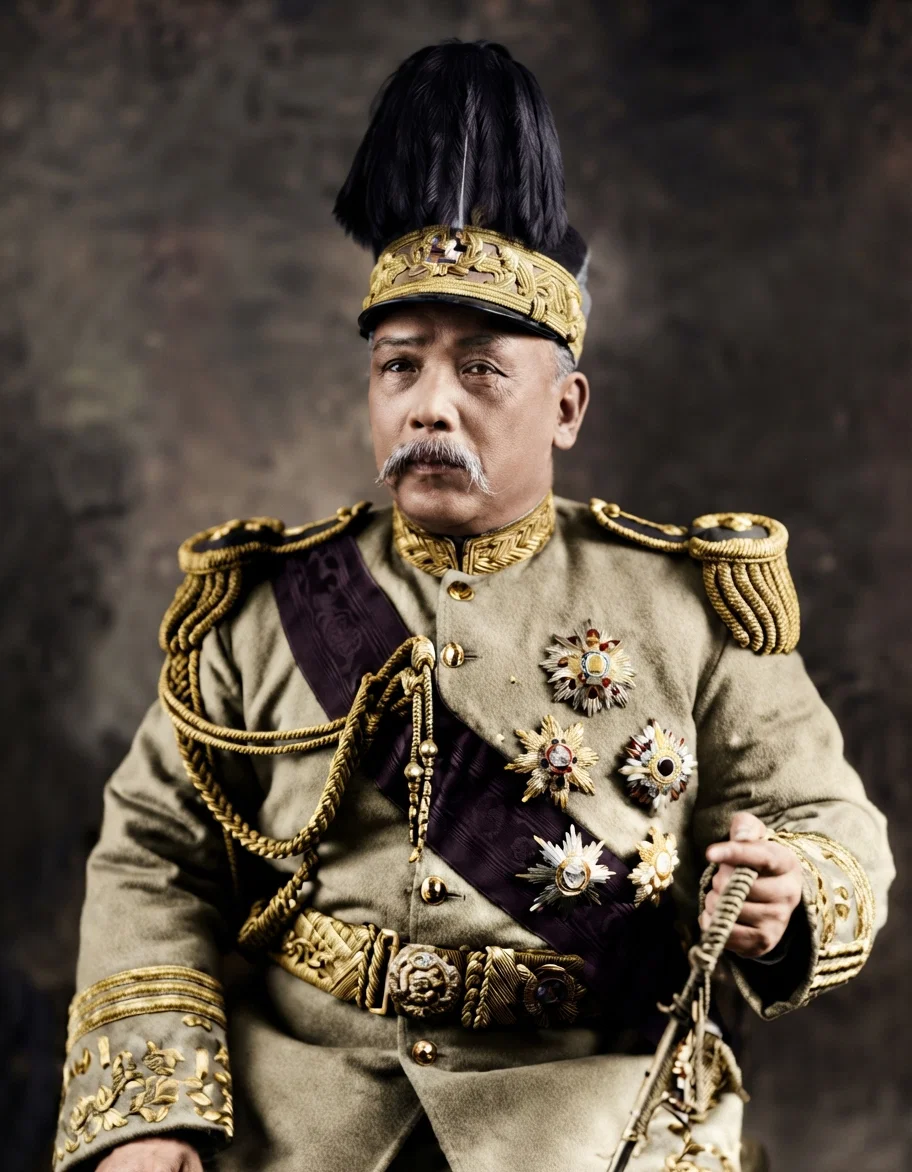
YUAN SHI KAI, PRESIDENT CHINESE REPUBLIC
"China's new constitution . . . marks the end of the experiment of representative government in this country, and the formal inauguration of a dictatorship. . . . In terms similar to those of the original Nanking constitution, certain rights and privileges, such as freedom of speech and publication, immunity from arbitrary arrest and domiciliary search, secrecy of correspondence, and freedom of religious belief, are guaranteed to the Chinese people. But a perusal of the whole constitution intimates that these guarantees are not worth the paper they are written upon. Freedom of publication has already received a severe blow from the recently promulgated press law, which was issued by the president without its even undergoing the formality of passage through the political council."
The evidence accumulates, as time passes, making it plain that China is preparing to act her despotic part in the closing drama of earth's history, when awakened heathen nations shall assemble for the Armageddon battle.
Seek Those Things Which Are Above
By Paul
If ye then be risen with Christ, seek those things which are above, where Christ sitteth on the right hand of God.—Paul.
Light Shines Beyond the Clouds
By William Covert
DOWN in the valley, as we camped by the Cumberland during the war, the clouds were hanging low, obscuring all the beauties of the hills by which we were surrounded, and not even the sun in the heavens could be seen by men with the keenest of eyes; but we knew the sun was shining, although we could not see it except by faith. So, when the bugle ordered us forward, we began to climb toward the mountain top. For hours, as we ascended, the mist held sway, for we were actually enveloped in it. But about ten o'clock we reached an altitude higher than the clouds, and O, how glorious was the shining of that autumn day of 1863 to us when we had by sturdy climbing overcome the mist which still was enshrouding every object down in the valley!
The markings between the sunshine and the clouds were so distinct that every man knew when he stepped out of the darkness into the light. And still the dense fog abode in the valley all day long, while the mountain range above the cloud line was sun-crowned and radiant with the unusual contrast that was made between darkness and light.
When the van of our army emerged from the cloud, with drum and fife leading, they began to express their joy before the rear guard reached the day line.
THE LIGHT MADE THE DIFFERENCE
But their exultation was nothing strange, for walking in the light made the difference; yet the men could not appreciate the beautiful sunshine while they were marching through the fog. However, the sun was shining all the time as they were climbing.
As the mist hid the sun from view, so may we allow doubts to hide the sunshine of God's love from our view. Yes, He does love us even though we allow doubts to becloud our pathway up the ascent to the land of glory.
God's love is constant as the sun, and neither night nor clouds can hinder it. What we should do is to climb up higher, and by faith get nearer to God. There are beautiful things all around us, but sometimes down in the valley the clouds hide them from view. All the morning up the mountain road we were passing beautiful hills and pleasant valleys, but the mist kept them out of our sight, and we became in mood like the fog along the way. Let us pray for a faith that can see God through the clouds, and enable us to sing even before we cross over the daylight line.
WILLIAM COVERT.
The Papal Power in Prophecy
By Jean Vuilleumier
Three of the Ten Kingdoms Fall Before It—A “Little Horn” with a Stout Look—“The Eyes of a Man”—A Persecuting Power—Assumes Power to Change the Bible—The Time of Its Existence—Its Apparent Destruction
By JEAN VUILLEUMIER
In reading this article, keep in mind that Elder Vuilleumier presented last week that portion of the prophecy of the seventh chapter of Daniel which tells of the four world monarchies that were to exist, and that the last one of the four was to be broken into ten parts. The prophet saw that among these ten kingdoms, another power would arise. The last named, the ecclesiastical empire, is the subject of this article.
Next week the theme will be the eternal kingdom that is soon to supplant all these governments of earth. Incidental mention will be made, in the article, of the reestablishing of the papal power that seemed broken in 1798.
“I CONSIDERED the horns, and, behold, there came up among them another horn, a little one, before which three of the first horns were plucked up by the roots: and, behold, in this horn were eyes like the eyes of a man, and a mouth speaking great things.” “Then I desired to know the truth concerning . . . the other horn which came up, and before which three fell, even that horn that had eyes, and a mouth that spake great things, whose look was more stout than its fellows.” Dan. 7:8, 19, 20.
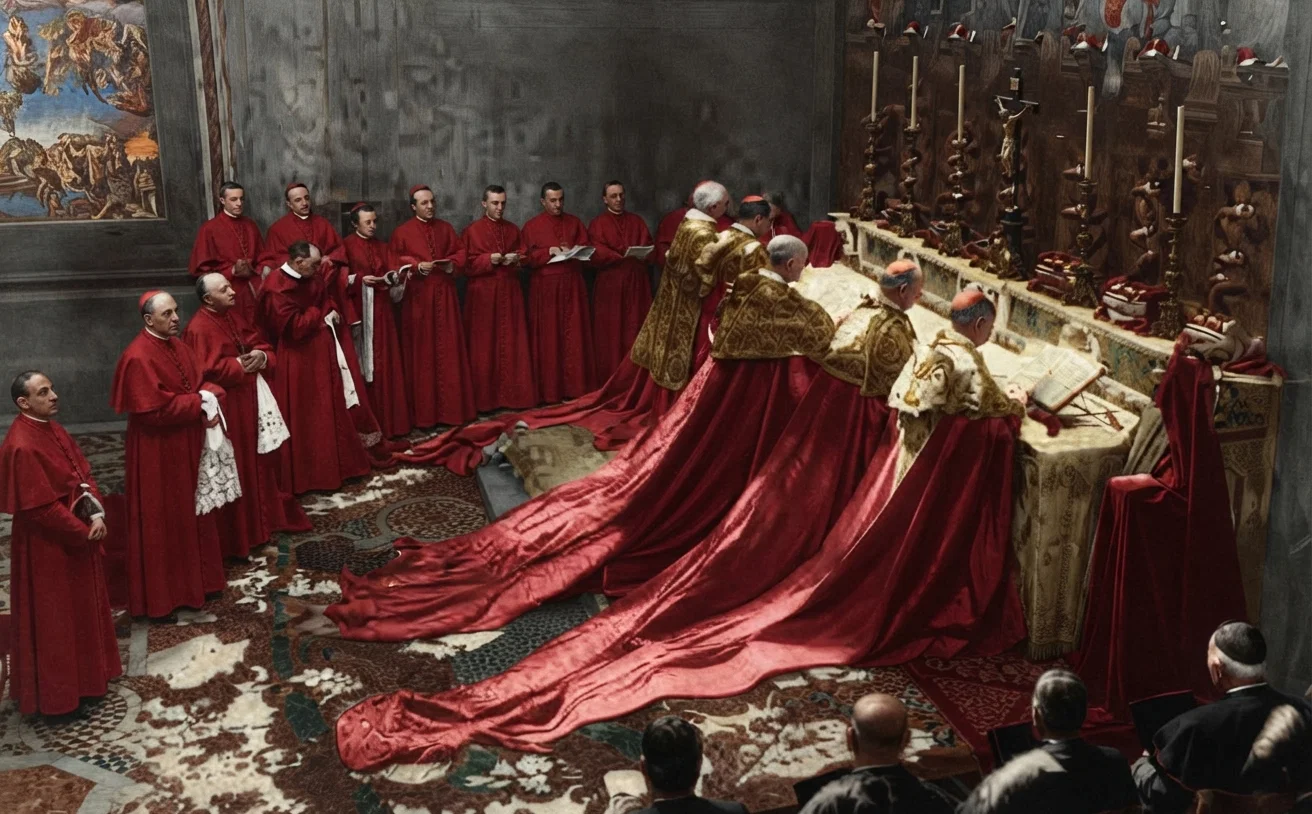
THE NEWLY CREATED CARDINALS CELEBRATING MASS IN THE SISTINE CHAPEL OF THE VATICAN
The foregoing describes the vision the prophet had concerning that mysterious power.
INTERPRETATION IS GIVEN
“Thus he said, . . . And another shall arise after them [the ten kings]; and he shall be diverse from the former, and he shall put down three kings. And he shall speak words against the Most High, and shall wear out the saints of the Most High; and he shall think to change the times and the law; and they shall be given into his hand until a time and times and half a time.” Verses 23-25.
Next to the division of western Europe into the different states, living side by side for over a thousand years, the most conspicuous fact in the history of the middle ages and of modern times is the supremacy of the bishop of Rome. This power, both political and ecclesiastical, answers exactly to the description of the eleventh horn, which represents another king, different from the other ten, endowed with almost superhuman insight, surrounded by greater pomp, whose utterances are more startling even than its deeds, who lays its hands upon the saints of God and upon His law, who is to exercise a supremacy over Europe nearly until the coming of Christ.
Let us briefly compare the salient point of this prediction with a few historical facts that will show the marvelous exactness of this vision.
THREE KINGDOMS FALL BEFORE THE RISING PAPACY
“Before which three of the first horns were plucked up by the roots.” Verse 8. Few persons are acquainted with the fact that the triple crown worn by the pope represents really three kingdoms that had to yield their place to the growing papacy, at the end of the fifth and the beginning of the sixth century; namely, the Heruli in 493, the Vandals in 533, and the Ostrogoths in 538.
SMALLER AND YET GREATER THAN THE TEN
“That horn . . . whose look was more stout than its fellows.” Verse 20. “At the outset, the bishops of Rome were very humble and retiring, having nothing else in view but the propagation of the religious, moral, and democratic teachings of the Nazarene. They played no role in the state until the time when Constantine, after making Christianity the religion of the empire, made Constantinople the new capital of the Roman world. . . . The bishop of Rome, protected by the emperor, gained influence over the masses, and this influence grew still more during the invasions of the barbarians. . . . Great is the contrast between the humble beginnings of this Christian republic and the spectacle offered by Christianity a few centuries later—that of an absolute monarchy, in which the clergy forms a separate class, enjoys special privileges, and in which the bishop of Rome, heir to the authority of the councils, sovereign arbiter of nations, assumes the right of governing consciences, of distributing kingdoms, and of ruling over both soul and body.” (“Larousse Dictionary,” article “Papacy.”)
A MARVELOUS INSIGHT
“In this horn were eyes like the eyes of a man.” Verse 8. Heir of the shrewd diplomacy of the Roman Senate, the papal government has for hundreds of years exercised its policy with astuteness and sagacity. This wisdom can be attributed to four main factors: the confessional, the celibacy of the clergy, Jesuitism, and the unbroken papal succession, factors that have enabled the papacy to place itself in intimate relationship with the common people, and to follow up its schemes from generation to generation.
ASTOUNDING WORDS
“In this horn” was “a mouth speaking great things. . . . And he shall speak words against the Most High.” Verses 8, 25. It is a well-known fact that the pope is commonly called by his followers “holy father,” “most holy father,” “sovereign pontiff,” “head of the church,” all of which are the names of God the Father and of Jesus Christ. John 17:11; Eph. 1:22. In Heb. 8:1, the words “high priest” are translated “sovereign pontiff” in some Catholic versions.
Pope Gregory VII says, in his “Maxims,” “There is only one name in the world, that of the pope.” This is what the apostles Peter and Paul said of Jesus Christ. Acts 4:12; Phil. 2:9.7Pope Martin V called himself “the most holy and happy, who is the arbiter of heaven and the lord of earth, . . . the master of the universe, the father of kings, the light of the world.” Again these are names and prerogatives that belong to God alone, and the usurping of which, on the part of a man, brands him as a blasphemer.
With reference to earthly powers, the popes have made utterances that no other human being has ever dared to make. In his “Maxims,” just quoted, Pope Gregory VII wrote: “All earthly princes must kiss the pope's feet. . . . He has the right of deposing emperors.” Innocent III compared his power in relation to that of other kings to the light of the sun as compared with that of the moon.
PAPAL GRANDEUR
“Whose look was more stout than its fellows.” Dan. 7:20. Several kings had to experience the bitterness of these claims. Robert, king of France, excommunicated by Pope Gregory V, had to humble himself to the dust before him in order to retain his throne. Henry IV, emperor of Germany, had to take the famous trip to Canossa before he could resume his imperial dignity. His son, Henry V, and Frederick I, called Barbarossa, went through the most humiliating ceremonies in the presence of Popes Pascal II and Adrian IV respectively.
The culmination of papal grandeur was reached under Innocent III, in the beginning of the thirteenth century, half way between the rise and the fall of papal supremacy. “The pontificate of Innocent III is only a moment in history,” says Larousse Illustré. “But what a moment! . . . What glory! Everything around it is magnificent, as if to enhance the brightness of this throne of thrones occupying the center of the scene. . . . The pope is not only the greatest of popes; the other kings, the events, the genius of the century, everything, is in harmony with his grandeur.”
A PERSECUTING POWER
“The same horn made war with the saints, and prevailed against them.” He “shall wear out the saints of the Most High.” Verses 21, 25. Sadly notorious are the barbarous persecutions organized and carried on by the papal government for more than a thousand years. The massacres of Waldenses, of Albigenses, Hussites, and Calvinists, the Saint Bartholomew, the “holy Inquisition,” the dragonades, the revocation of the edict of Nantes, are too well known to require more than a passing mention.
The victims of persecution under pagan Rome have been estimated at three millions, while the victims of papal Rome for “conscience' sake,” according to a moderate estimate, mount up to fifty millions.
HERETICS MUST BE EXTIRPATED
Far from denying the facts of history branding her as a persecuting power, the papacy has erected persecution and bloodshed against heresy as a dogma; to wit, clause 5 of the act of abjuration (June 2, 1697) of Frederick Augustus, a Saxon prince, when he took the throne of Poland under the name of Augustus II: “I profess that . . . all heretics . . . must be extirpated by sword and by fire without exception or consideration, and that they must all be sent to hell body and soul.”
A similar declaration is embodied in the oath of allegiance of all the Roman bishops. Intolerance and persecution as a doctrine is taught to-day by many authorized Catholic books and periodicals, and preached from Catholic pulpits.
THE LAW OF GOD CHANGED BY PAPACY
“He shall think to change the times and the law.” Verse 25. This accusation of the prophecy is corroborated by the papacy itself. The above quoted abjuration, framed by the high clergy, says:
“I profess that a decree made and proclaimed by the pope, however new it may be, whether or not based on the word of God, is of divine origin, and must, as such, be respected by believers, more highly than a command of the living God.” (Clause 2.)
“I profess that the reading of the Bible is the origin of all pernicious sects and associations, as also the fertile source of all blasphemies.” (Clause 6.)
“I profess that the Roman pontiff has the power to change the Holy Scriptures, to add thereto, and to take from.” (Clause 10.)
From such assertions, we may confidently expect that the papacy has not failed to change the law of the Most High.
What are these changes? Read the Ten Commandments in the Roman Catholic catechism “prepared and enjoined by order of the third plenary council of Baltimore” (Boston, 1885), and compare them with the divine text in Exodus 20. The wording of those holy statutes spoken by the voice of God on Mount Sinai has not been faithfully transcribed in this catechism for the Catholic people who have no access to the Bible.
THE COMMANDMENTS MUTILATED
The second, third, fourth, fifth, and tenth commands are mutilated. The second is joined to the third, and the tenth cut in two, thus changing the numbering, so as to make it match with European catechisms, where the second commandment is completely left out. In the second commandment, the words “Thou shalt not bow down thyself to them” (graven images) are changed into “Thou shalt not adore them,” which is an unwitting admission that to bow before an image is to adore it.
The fourth commandment, numbering more than ninety words in the Bible, has only seven in the catechism. All specifications about Sabbath-keeping, all mention as to what day of the week is the Sabbath, and all reference to the creation of the world as a basis for the commandment, are left out. In the explanation of the second commandment, the same catechism justifies the invocation of saints, the honors paid to relics, and the kneeling before pictures, images, and crucifixes. And in the explanation of the fourth commandment, it justifies “the church” in “commanding us to keep the Sunday holy instead of the Sabbath.”
TWELVE HUNDRED SIXTY YEARS OF SUPREMACY
“And they [the law and the saints] shall be given into his hand until a time [one year, or 360 days, a Jewish year] and times [two years, or 720 days] and half a time [half a year, or 180 days,—in all, 1,260 days].” Verse 25. These are prophetic days, each of which represents a literal year, according to the rule given in Eze. 4:6. The whole period, therefore, equals 1,260 literal years, during which the papacy was to exercise its baneful power over the saints and the law of God.
The supreme power of the pope was asserted by churches, bishops, and councils as early as the fourth century. From that time onward, the Roman emperors of the East ordered, in their laws, that all should “embrace the religion of the Roman pontiff.” In 534, Pope John thanked the emperor Justinian for “submitting all things to him,” the pope, and for “publishing an edict requiring the destruction of heretics.” In 538, Vigilius caused Pope Silverius to starve to death, and became pope in his place, thanks to a party in the empire which had pledged to elevate him above the council.
The year 538 A. D., therefore, is the starting-point of papal supremacy. This supremacy European nations accepted and submitted to until the end of the eighteenth century, when it disappeared in a storm, but not without having undergone a process of decay.
FORCES THAT OVERTHREW IT
The Reformation of the sixteenth century gave the papal theocracy an irreparable blow. In the eighteenth century, the prestige and influence of the church was seriously undermined by the philosophical movement led by Rousseau and Voltaire. At that time most of the Catholic kingdoms of Europe expelled the Jesuits; and in 1773, Pope Clement XIV was compelled to sign the suppression of this order, loathed by all intelligent people.
And now a great storm breaks out. The French Revolution in 1793 vents its rage upon the French clergy, and in 1798 upon the pope himself. In February of that year, Rome was entered by the French, and the pope was taken away as a captive, while a republican government was proclaimed in the “eternal city.” Pius VI, at the advanced age of eighty-two, and though afflicted by many infirmities, was driven through Italy in a carriage, carried in a litter over the bitter cold passes of the Alps, and finally left in Valence to die, 1799.
The papacy remained beheaded for nearly a whole year. Thus exactly 1,260 years after it had begun, this power that had been lent the papacy to lord it over the world, had suddenly disappeared. Thus, through a long course of centuries, had every detail of this prophecy met its fulfilment, bringing us finally to the threshold of eternity, and proving to us the absolute certainty of God's promises.
All Will Crumble into Ruins
By G. W. Reaser
At Karnak, Egypt, are some of the most massive columns ever built by man. It is three millenniums since these monuments of human skill were erected. The basin wherein they are located, happened to be a suitable site for a modern reservoir to store water for irrigation purposes. The action of the waters, intended to make the desert blossom as the rose, has caused the colossal columns to crumble into utter ruin. Even so will all the works of mankind, built for the glorification of man, crumble and fall, never to rise from their ruin, when the earth is flooded with the glory of the coming King, and Eden restored will bloom again for the delight of the redeemed human family and for the glory of God. G. W. Reaser.
THE GUIDANCE IN NATURE
By L. A. R.
Frank Admission — The Young Ouzel That Knew — The Dramatic Mother Duck — Whence the Intelligence of Nature and These Dumb Creatures?
WHAT is instinct? We believe that the question can be answered. In a previous article, we showed that the Creator has impressed the organism with the law of its life. Therefore God is the guide. Instinct is the mere blind obedience of the creature to the Creator.
THE MARSHALING OF ATOMS
What is growth and development? What is conformity to type? — It is the process by which wheat always produces wheat, and rye produces rye, and the child is like the parent. Why, in the plant, does one part produce a limb, another a leaf, another a flower, and finally a fruit? — This is an infallible movement of cells, a marshaling of the atoms into their proper places, and it shows a guiding power.
Evolution says that this was impressed by the parent, as its law of life, upon the offspring. But such a statement is no explanation of origin. It is simply to say that the offspring has what it has, because its ancestors always had it; and take it back as far as you may, this is dodging the whole question. It is saying that the child receives from the parent, and the parent from its parent, and so on until we are too tired to try to follow the matter any further.
REFUSING TO GO BELOW THE ROCKS AND ACCOUNT
It accounts for nothing. It is as unscientific as the old statement about the final foundation of the earth — that it was rocks — rocks all the way down. This is an absolute refusal to go down below the rocks and account for the rocks.
"TURNED ITS CRESCENT TOWARD THE MAN"
Thus the evolutionist refuses to find the origin of the impressions, and simply puts it into a series running so far back that he can forget or grow tired before he finds its beginning. It is putting origin into the far distant past, exactly as Tyndall himself does:
"It [the hypothesis of evolution] does not solve — it does not pretend to solve — the ultimate mystery of this universe. It leaves, in fact, that mystery untouched. For granting the nebula and its potential light, the question whence they came would still remain to baffle and bewilder us. At bottom the hypothesis does nothing more than transport the conception of life's origin to the indefinite distant past."—"Fragments of Science," Tyndall, page 133.
ADMITTEDLY EVOLUTION DOES NOT SOLVE
This is frank and to the point. It is an admission that evolution does not solve the mystery, does not explain origins. We do not quote this from Tyndall merely because it is an admission, but because he, being an evolutionist of the agnostic type, states a fact. There is nothing in the hypothesis of evolution that does anything definite toward explaining the origin of life, and its phenomena. Such men as Tyndall are honest enough to admit it, and that settles the question, it seems to us.
Refusing to admit a Creator, and His power over nature, they can not explain origins, for they refuse utterly that which explains. By some means, God is able to impress the atoms and the molecules, and marshal them into orderly array. As world attracts world through the power of gravitation, so atom attracts atom in accordance with the law of life. As an invisible power guides the planets and the suns in their paths, so an invisible power guides the atoms and molecules that build up an organism, and guide that organism itself.
THE YOUNG OUZEL KNEW HOW
Take some examples from instinct. The duke of Argyle gives the following incidents that are very plain in presenting this wonderful power of instinct with which animals are equipped.
In 1874 a number of water-ouzels built their nests in the hole of a wall of a small tunnel at Inverary. This tunnel had been completed in order to carry a rivulet under the walks of a pleasure-ground. The season was one of great drought, and the rivulet, during the whole time of incubation and of the growth of the young in the nest, was nearly dry. One day, the duke examined one of these nestlings that was almost entirely fledged. While he was so examining it, the other birds became alarmed, darted out of the hole, and ran down the tunnel toward its mouth. At this point there was a pool of water. It lay in their path. They did not seem to seek it, for they were moving in aimless flight. One of the little birds, thus fluttering along, stumbled into the pool. It paused as though surprised, and then seemed to wake to its power. Down into the water it dived, with all the facility of its parents. It used its wings, which are adapted to both air and water, with seeming perfection. It remained so long under the water, that the duke feared it had drowned; but later it appeared, and was put back into the nest.
Here was no opportunity for education, or experience. The bird at once knew its powers, knew its environment, was perfectly at home.
TWO WEEKS OLD, BUT OUT-WITS THE DUKE
To give another example: On a secluded lake of the Hebrides was discovered a sun-diver, of the family of the red-breasted merganser. With her was her brood of ducklings. They were only a fortnight old, yet it was almost impossible to capture them. They would swim long distances under water, and emerge at unexpected places, and for a time they baffled all human efforts.
At length one of the little birds made for the shore to hide in the grass and the heather on the margin of the lake. It was pursued closely. A long drought had left a broad margin of small, flat stones and mud between the water and the usual bank. The bird was seen to disappear.409An eye was kept upon the spot where it was last seen. The boat was run up on the beach, and the duke thought to find and pick up the chick. He reached the place where it had disappeared. This place he had kept under his eye every moment, but there was no sign of the chick. The closest scrutiny failed to discover it.
In his search, he went too far. Realizing this, he turned to look back. Like an apparition, the little creature arose from the stones, dashed past the boat, and having regained its wind by the rest it had secured by making itself invisible among the stones, it reached the lake, and dived and disappeared. It was applauded for this clever work with cheers from the whole company.
It had shown remarkable tact and skill. About two weeks before, however, it had been coiled up on the inside of the shell of an egg. A month before, it was a mass of albumen and fatty oil. Yet now it was equipped with a wisdom and a tact and a skill that could outwit a duke.
THE DRAMATIC DUCK
Another incident: Walking along the side of a river with overhanging banks, the duke came suddenly on a group of wild ducks — anas boschas. The young were just out of the nest. The mother duck fluttered out from under the bank and into the stream with loud cry, and all the struggles to escape of a helplessly wounded bird.
THIS MOTHER DUCK WAS A PERFECT ACTRESS
Any one realizes how difficult it is for an actor to show extreme feeling and do it well, but this mother duck was a perfect actress. The labored, half convulsive flapping of the wings, the wriggling of the body, the straining of the neck, the expression of painful and abortive effort, were all admirable. Thus she skilfully maneuvered until she was well out.
When she saw she could not tempt them to follow, she made resounding flaps on the surface of the water to draw attention to herself, seemingly to say: "Here I am. Come out here." Then she flew around back to the spot she had originally left, and maneuvered all over again as before.
All this she was doing to draw attention away from her little ones to herself. She was willing to take the risk of sacrificing herself for her young. At the same time, the little ones had such remarkable instincts, knew so well what to do under the circumstances, that they could not be found.
THE BUTTERFLY THAT KNEW
Any one who is willing to give patient study to nature, will find examples similar to these. The writer once occupied a house covered with an ivy vine, one branch of which had cream-colored leaves. Every evening, about sunset, a large, white cabbage-butterfly used to search out these half-dozen white ivy leaves, perch upon them, and roost there for the night, practically invisible. It was guided by instinct, infallibly, to choose leaves of its own color rather than green ones, which would have made it conspicuous to its enemies, and its life would have been a forfeit for this prominence.
CUNNING OF SOME OTHER BIRDS
Startle a blue tit, and it will seek the high branches against the sky, where its blue, brown, and green colors will make it almost invisible. A robin, however, flees to the shadow of a bush. It knows enough, even when threatened by an older robin, to take refuge near some reddish brown color, that its own reddish brown body may be made as nearly invisible as possible.
A thrush, almost as soon as fledged, is clever enough to find its own tints on some wall or tree trunk. Keep your eye on it. It is motionless. Remove the eye for even a twinkling, and the bird instantly hops out of sight noiselessly, before you can look again.
Have you ever noticed how the meadow-lark refuses to show its broad, conspicuous crescent to the passer-by? It always turns toward its enemies those parts of its body that are less conspicuously colored. At one time, a lark that was threatened by a hawk took refuge near a man. It turned the grayer portions of its body toward the hawk, its implacable enemy, and turned its crescent toward the man, as much as to say, "If I must choose between hawk and man, I choose man." And the man proved not unworthy of his trust by sparing the lark, and driving away the hawk.
All creation being guided by an infallible wisdom, impressed by the Creator, stamped with His law of life, thus, as the Word says, "The Lord is good to all: and His tender mercies are over all His works." Ps. 145:9.
"All common things His footprints bear,
From shining skies to lowly sod,
That man may look to things unseen —
From nature up to nature's God."
L. A. R.
A WORD TO OUR READERS
By Editor
We send no papers from this office to individuals without pay in advance. When persons receive copies without ordering them, they are sent by other parties, and we can give no information in regard to them. Persons thus receiving copies of the SIGNS are not indebted to the office, and will not be called upon to pay for them. Please read the papers you may receive, and hand them to your friends to read.
DATE OF EXPIRATION
The SIGNS wrapper bears date of last issue due on your subscription. Unless renewed in advance, paper stops with expiration date.
If herewith is an order-blank, you will know you have overlooked sending renewal. You will not wish to miss a single issue. Back numbers often can not be furnished.
SCRIPTURE QUOTATIONS
Our authority for the doctrines we teach is the Bible. Quotations are usually from the King James Version or the American Standard Revised.