The Youth’s Instructor, Vol. 32, No. 44.

A RIDE THROUGH SWITZERLAND

The Youth’s Instructor

Oct 29, 1884

S. D. A. Publishing Association · Battle Creek, Mich. · Oct 29, 1884

A RIDE THROUGH SWITZERLAND.

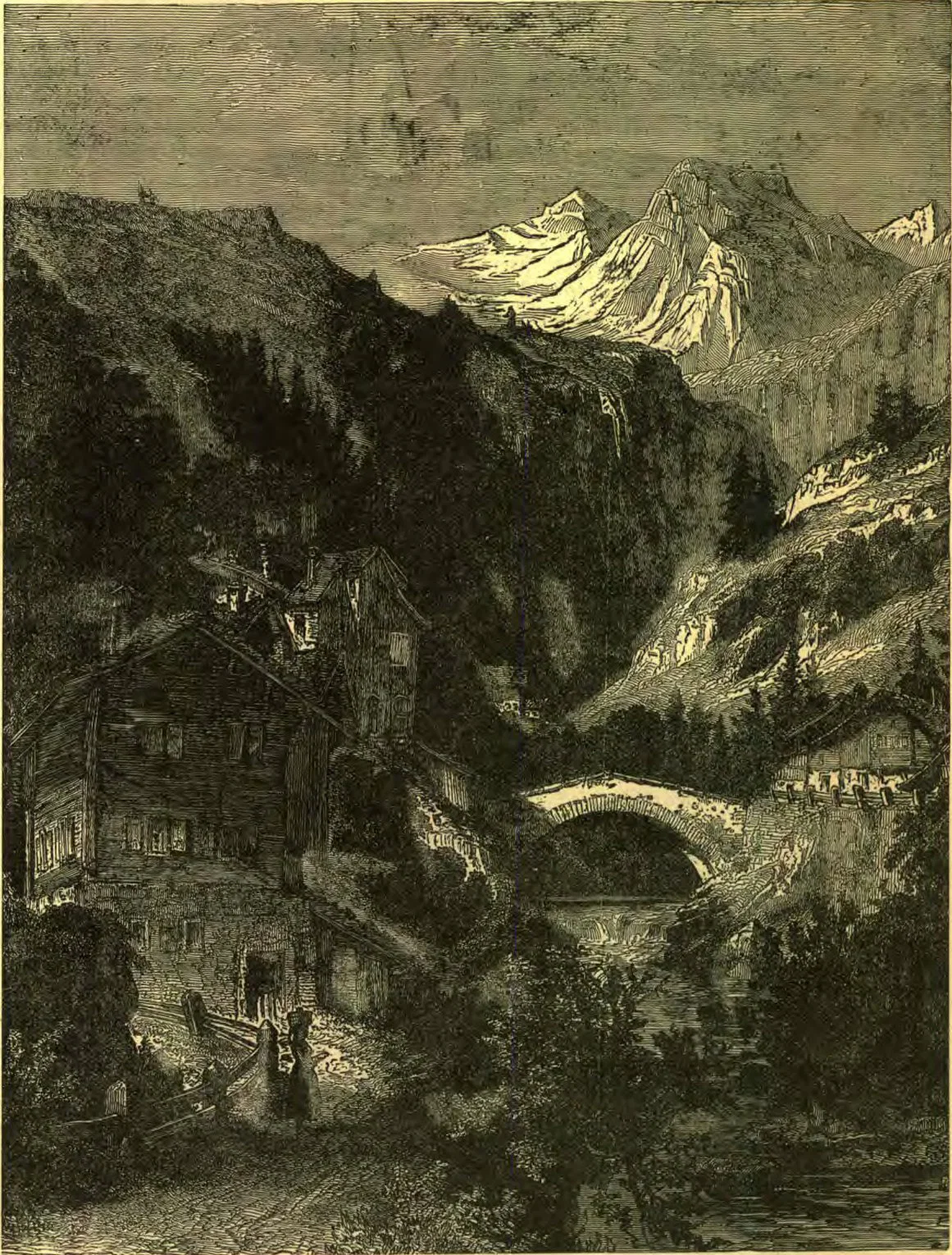
While traveling in Europe last year, our party took a trip through Switzerland, starting from Bâle one beautiful morning in June, in company with two friends, who spoke French fluently, and would be of service to us, our knowledge of that language being very limited.
We had decided to go to Mt. Blanc, so we had a long journey before us. Soon Bâle was left in the distance, and we were riding through a beautiful country. We started off in good spirits, feeling exhilarated by the fresh morning air, as it came in through the open window.
Our train glides slowly around a mountain; then over a bridge, from which we have a fine view of the valley below, crossed by the broad river; and now it enters an enormous tunnel. So the scene is constantly changing, until, after a few hours, we reach Berne, where we have half an hour to wait, and we will improve it by looking around the city. Berne is situated on a peninsular, around which the river Aar flows. This place is full of interest to travelers, as it is different from other Swiss cities, having preserved the quaint customs of former years. The houses are built in arcades, forming a covered walk, with shops on one side and pillars on the other. The inhabitants of Swiss cottages do not often live in the first story, as that is used for a shop or store-room. The windows of the dingy-looking houses are made bright by flowers, and pretty little red cushions on the window-sills, about five inches wide, upon which the women can rest their elbows, and watch the doings of their neighbors.
Bears are carved everywhere in wood and stone, ornamenting public buildings, dwelling houses, gate-posts, and hitching-posts, and every other object worthy to be beautified by the figure of a bear. There are also several bear pits here, where live, performing bears are kept. The Swiss costume is worn here, though it is out of fashion in other parts of Switzerland, and is seldom seen except on fête days, or holidays.
But we must leave this picturesque little city, and resume our journey. We soon reach Freiburg, where we have some little time to wait before changing cars, so we will see what there is here. We pass over the two renowned suspension bridges, and all around the city, then, wishing to purchase some stereoscopic views, direct our driver to take us where we can obtain them. He drives out about a mile in the country, though it seems strange such pictures are not kept in the city.
Stopping at a sort of way-side inn, an old man hobbles out to see what we want. After considerable time has been wasted, it dawns upon his mind that we are in search of pictures of the city. Turning his head to one side, and placing his forefinger on his forehead, he seems suddenly to recollect that he has a few somewhere. We wait impatiently while he goes in search of them. He returns after a long time with some pictures, but we cannot succeed in making a bargain with him, for he keeps changing and raising his price, and will take nothing less than the last-named; so we drive off without them.
We would be glad to stay here until evening, and hear the great organ of Freiburg, but our train is already due, and we must hasten. We are soon comfortably settled in the cars once more, and are riding through beautiful scenery. Fields radiant with flowers, brooks sparkling in the sunlight, with cattle at their edges, lazily drinking the cooling water; rounded hills, covered with green verdure, snow-capped peaks, with Mt. Blanc in the distance,—all combined make a striking picture. After miles of such scenery as this, all is lost to our vision for a few moments, as we pass through a long tunnel; and, as we near the end, our train slightly slackens its speed, and there before us lies Lake Geneva, in all its beauty, just as the sun is setting. The many-hued waves are gently rocking to and fro, and everything is so quiet that we scarcely notice the rumbling of the cars, as we ride slowly along the edge of the lake. As we round a curve, we see we are nearing the Castle of Chillon, which looks dark and gloomy even in the sunlight. It is built on a huge rock, several rods out in the water. We just get a glimpse of the ruins of an old abbey, completely covered with ivy, when our train suddenly begins to make up for lost time, and we ride along in the fast-deepening twilight, thinking of the picture we have just seen.
Almost before we are aware of the time that has elapsed, we have arrived at St. Maurice, a little tumble-down town among the mountains, where we are to spend the night. We have a good night's rest, and the next morning take the cars for Martigny, where we are to travel over the mountains in a different manner. The train suddenly stops, and it is made known to us that we are at Martigny, though we cannot see in just what direction it is, as we stand by the side of the railroad track, baggage in hand. We can see no depot, no houses, no people. Almost in despair, one of our party starts off down a little beaten path, in search of something. He soon returns with a man who brings a cart for our baggage. He leads us down the path, round a hill, where we find a large hotel and several houses. We order horses and a carriage for our ascent over the mountains to Mt. Blanc; and while waiting for them, visit a beautiful gorge close by. When we return, we find three saddled horses waiting for us, and we look around for the carriage. Here comes a man running at full speed toward us, with a horse hitched to a stout little dog-cart, that he says is to carry two of our party and the baggage. We are soon nicely settled in the dog-cart and on horseback, with two guides to lead us. Just before reaching Martigny, we had noticed an immense cascade falling thousands of feet over a mountain. Our guides take us directly to this place, and lead us across a narrow bridge over the foot of the cascade; then we turn around, and cross another bridge a little higher up. So we go zig-zagging along till we have crossed thirty bridges, and are at the top of the mountain, where we have a magnificent view of the Rhone valley. Leaving this behind us, we travel up and down mountains all day, sometimes stopping to rest in a little Swiss village, which consists of a few black looking houses huddled up together, with roofs reaching almost to the ground, giving them very much the appearance of “huge toadstools.” Sometimes we see a Swiss cottage built two or three stories high, but not often. The people are very tender-hearted and unselfish, giving their cattle one side of their house, while they occupy the other. We frequently meet a peasant woman, with a tub of butter or other produce on her head, plodding slowly down the mountain, to some town, where she is taking it to sell.
Almost every traveler among the Alps has his adventure, and we had ours as well. Twice during this day's journey, accidents occurred which frightened our horses badly,—when we were riding along the most dangerous places of the whole route, a great mountain of solid rock on one side of us, and a dark ravine thousands of feet below. And, without doubt, we would have been hurled down the abyss, had not our guides come quickly to the rescue. We could not quiet our horses by speaking kindly to them, for they could not understand one word of English, and the only French word we knew which they understood was hue! which was to urge them forward.
When it was almost dark, we reached a little village three or four miles this side of Chamouny, where there was a suspicious looking old building called a hotel. Here our guides urged us to stay all night, telling us that it would be impossible for them to take us on to Chamouny that night, as it would be dark soon, and the road was very dangerous. We had almost decided that we must spend the night here, when we saw a party of English travelers talking together. They beckoned to one of our party and told him not to stay, as it was an old trick of the guides to urge people to stay, for they were well acquainted with the keepers of the hotel, and wanted to have a good time. Besides that, they told us that the building was soaking in water, it having rained the night before. All of their things were wet through, so they had to stay there. After much urging on our part, and gesticulating on the part of the guides, they were prevailed upon to take us on to Chamouny. They drew a large carriage from under a shed, hitched our horses to it, and soon we were riding on the best road we had yet gone over among the mountains.
The finest view of Mt. Blanc is from Chamouny, a little village which gets its living off travelers who throng the place. Here we found a very large hotel, having all the modern improvements. It was too dark to see the mountain that night, so we went to some of the shops in search of curiosities to take home. In one shop we found some beautiful shells, which the clerk said came from the “Mer de Glace.” It would indeed have been a curiosity had this been true, but we happened to know that the Mer de Glace was one of the glaciers we had passed in coming to Chamouny, and was a sea of ice.
We could not find many genuine curiosities, and as we did not intend to take home any sham articles, bought some pieces of fine wood-carving, which we knew to be no imitation.
We were glad to find a good resting-place for the night after such a tedious journey, and went to bed with excited hopes of seeing Mt. Blanc the next morning. But we were doomed to be disappointed. It was so foggy in the morning that we could not get a good view of it. We were not sorry that we had made such a long journey, however, and set about making plans for a pleasant homeward trip. C. B. K.

A SOFT ANSWER.

I WONDER how many of the INSTRUCTOR family have ever been to the sea-side, or have crossed the ocean? Perhaps on a beautiful summer’s day you visit the sea-side; all is calm, and you almost wonder that so many should be ship-wrecked, and sent to a watery grave. But should you stay for a week or more, you would find that the ocean is not always so placid. Why not?—Because an unseen power disturbs the quiet waters, and causes the huge waves to rise and rush madly along until the whole surface has become a sea of mighty, rolling billows. You can no longer stand on the sandy beach, close to the water’s edge; for the huge waves, as they come rushing in, leap with fury upon the land, as if to engulf it. But when far out at sea, with no land or rocks to oppose them, they seem to vent their wrath on the helpless ships.
What can be done in such cases to quiet the turbulent ocean? When the angry waves endanger the ship, it has become a common practice to place a barrel of oil on the deck, and after making a small hole in it, to allow the oil to trickle down the side of the ship into the sea. As the ship drifts along before the gale, the oil, which will not mingle with the water, spreads out upon the surface, causing what is termed a slick. This often proves a great safeguard to the vessel, and calms the troubled waters until the wind subsides. It does not prevent the heaving of the waves, which are deeply stirred; but it does prevent their breaking over the defenseless ship.
So it is in life. We are at times calm and quiet, as the sea on a pleasant day; and it would seem impossible that we should become angry. But as an unseen power caused the mad waves to rise, so another power, more cruel than the wind, takes possession of our hearts, and stirs them to anger. Unlike the ocean, which is lashed with fury on the surface only, we are stirred to the very depths of our souls. The hot blood rushes to our faces, and cruel words fly from the lips.
Suppose a friend becomes thus angry with us. What shall we do? Shall we also become angry, and speak cruel words in return? That would be as useless as to try by force to keep the mad waves from leaping over the ship. What can be done? “A soft answer turneth away wrath.” Yes, like oil upon troubled waters, the soft answer quiets the angry words. It spreads over the surface of our hearts; and, although the bosom heaves with the recent emotion, the angry word is checked, the cruel power vanquished, and we become calm.
Can nothing be done to keep this cruel tyrant from gaining such power over us? A great sea-wall is laid across the entrance to many of our harbors, to beat back these furious waves; but this work is done in times of calm, otherwise it could never be done. Just so with our hearts; we must rear a strong wall against our enemy, and this can be done only in our calm moments. We must have a strong foundation for our wall, even the love of God, well grounded in our hearts. Then, when the enemy comes upon us, we have something that enables us to resist him, and to help others to do the same. Let us return the soft answer, and thus be followers of the great Pattern, “who, when he was reviled, reviled not again.”
ALBERT H. KING.

EDITOR'S CORNER.

We want to recommend to you, boys and girls, all who have not already begun the practice, to have always with you a little memorandum or scratch book, where you may make a record of important items and facts which come to your notice from time to time, and which you might otherwise forget; for nearly every day you will see or hear things that would be of great benefit to you afterward if you could remember them. With a little painstaking, one can in this way secure some choice bits of wisdom.
And you who are pursuing a course of reading or study will often come across an elegant expression which you will do well to preserve; and in conversation, or in listening to public speaking, many times a beautiful idea is advanced which is worthy of more thought than you can give it at the time. Be sure to jot it down for further attention.
It does not matter how plain or cheap the book used for this purpose; for you can afterward revise the fragments you have gathered, and copy them; or, what is better, you can transfer them to the tablets of the memory, where they will ever be ready for use. A good memory is a great treasure, and it is within the reach of you all. Accidents sometimes happen to books, and it is not always convenient to carry a record book of much size with you; so the safer place in which finally to store your gathered gems is the memory.
Possibly when you hear persons repeat long extracts from different authors, giving names and dates almost without end, you incline to give them credit for having a special gift, some faculty which you do not possess. But with proper effort, you may acquire a memory as wonderful as any you have observed in others; for beginning in infancy, the wisest had to learn all their wisdom, and their remarkable memories were acquired. Some will not take upon themselves a little extra effort for even the benefits of a good memory. If one could be gotten with money, they might, perchance, trade for it. We trust none of you are of this class.
There is no study that will develop a good memory like memorizing, or, as we sometimes say, learning by heart. We know an individual who will recite whole books of poems, will give dates of all the principal historical events both in this country and the old world, and is as familiar with Bible history as school boys and girls are sometimes with their old readers at the time of exchanging for a higher one. In fact, this person is almost a walking cyclopedia. Now, nature did no more for him than it has for many of you; but the secret of his great memory is that he began in his youth to study, and to learn by heart choice things, until he had a well-filled storehouse ever at his command.
We do not recommend learning by heart any and every thing that the eye may rest upon, but only such things as will be of most profit, such as will develop all the better faculties of the mind and soul. The practice of learning Scripture by heart, as you do in Sabbath-school, cannot be too highly recommended. And as you have leisure, learn other portions of the Bible than your Sabbath-school lessons, being sure to commit to memory as many of God's promises as possible; then should any misfortune happen to your eyesight, as frequently does to individuals, or should you be deprived in any other manner from reading the word of God, you can still feast upon it, and be fortified against the temptations of the enemy.
So here is business for you,—to preserve by copying and committing to memory. “Take fast hold of instruction; let her not go.” M. J. C.

THE SURE WITNESS.

The solemn wood had spread Shadows around my head; “Curtains they are,” I said, “Hung dim and still about the house of prayer.” Softly among the limbs, Turning the leaves of hymns, I heard the winds, and asked if God were there. No voice replied, but while I listening stood, Sweet peace made holy hushes in the wood.
With ruddy, open hand, I saw the wild rose stand Beside the green gate of the summer hills; And pulling at her dress, I cried, “Sweet hermitess, Hast thou beheld Him who the dew distills?” No voice replied, but while I listening bent, Her gracious beauty made my heart content.
The moon in splendor shone; “She walketh heaven alone, And seeth all things,” to myself I mused; “Hast thou beheld Him, then, Who hides Himself from men In that great power through nature interfused?” No speech made answer, and no sign appeared, But in the silence I was soothed and cheered.
Waking one time, strange awe Thrilling my soul, I saw A kingly splendor round about the night; Such cunning work the hand Of spinner never planned,— The finest wool may not be washed so white. “Hast thou come out of heaven?” I asked; and lo! The snow was all the answer of the snow.
Then my heart said, “Give o’er; Question no more, no more! The wind, the snow-storm, the wild hermit flower, The illuminated air, The pleasure after prayer, Proclaim the unoriginated Power!”
—Alice Cory.

IMPORTANT BIBLE SUBJECTS.

LESSON 18.—REVIEW.

[NOTE—Nearly every question in this review lesson may be answered directly by quoting a text of Scripture that has been given in some preceding lesson. Do not, then, be content with anything less than a Bible answer. If the previous lessons have been thoroughly mastered, this lesson, although somewhat long, will not be found difficult.]
1. What is the meaning of the word “immortal”?
2. Quote three texts which prove positively that man is not immortal.
3. Who alone has immortality?
4. May man ever become immortal?
5. What must he do in order to receive immortality?
6. Can we earn immortality, or do we receive it as a gift? Give proof.
7. Where must we look for immortality?
8. Can you prove from the Bible that eternal life will not be given to the wicked?
9. For what purpose did Christ come to earth?
10. Who alone does Christ say have everlasting life?
11. In what sense do we have it now?
12. When shall we come into possession of it? Give proof.
13. In the Bible, by what figure are the dead often represented? Give instances.
14. In what place are they asleep?
15. Until what time do they sleep?
16. Is there any business carried on in the grave? Quote proof.
17. Do the dead know what their friends on earth are doing?
18. Do any of the dead praise the Lord?
19. State in Bible language just how much the dead do know.
20. At what point of time do men thus lose all consciousness?
21. From whom does the breath of life come?
22. To whom does it return at death?
23. What is the difference, if any, between the breath of man and that of beasts?
24. Of what is man composed?
25. To what does he return at death?
26. What is the difference between the death of men and that of beasts?
27. Then what is it that makes a man's life so much more valuable than that of a beast?
28. Give two texts of Scripture that you have already learned, which prove that men can derive no benefit from praying to the Virgin Mary.

AN EXPLANATION.

There has been complaint, and not without some reason, about the lateness of the quarterly summary. It may be well to give a few words of explanation. When the time came to print the summary for the quarter ending June 30, sixteen of the States had not yet reported to the General Association. For these reports we have been waiting, only this morning receiving the last one. Some of the blame may perhaps justly rest on the schools themselves, in that they were dilatory in filling out and sending back the blanks mailed them. Each school should take especial pains to fill out this blank, and return it to the State Secretary immediately, so that there can be no possible excuse for delay.
By this time each school should have received a blank for the quarter ending Sept. 30. If you have not yet received one, let your State Secretary know about it immediately. We hope that all our schools will try to help us get the summary printed on time; for what is worth doing at all, is worth doing promptly and thoroughly.

Disaster Comes From Without, Defeat From Within

DISASTER comes from without; defeat comes from within. Let the enemy batter down the walls, silence the guns, storm the defenses, even shoot away the colors,—that is only disaster. It becomes defeat, when the garrison, of its own choice, upon its own responsibility, makes the sign of surrender. Not the surrounding colors of the enemy, though they be thick as autumn leaves, but the white flag on its own ramparts, shows that the fort has fallen. There remains a possibility of victory to those who will fight, a hope for all save the hopeless, possible salvation for him who admits the possibility. Yet despite this fact, many a one, at one point or another, will insist on practically giving up the contest. This in little things and in larger. From the use of tobacco, for example, a friend's advice, a physician's warning, or a pastor's counsel, will never dissuade a man who persists in urging that because he tried to break the habit last year, and failed, it would be useless for him to try again. No drinking man but will drink till he dies—and probably die of drink—who is ready to concede that the drink-demon is stronger than he is. He has already hung out the white flag of absolute surrender. Disaster has become defeat. Whoever has a besetting sin—and who has not?—may never get out of reach of its assaults. It may work disaster to his peace of mind, he may even be once or again worsted by it, and yet finally conquer. But the instant he acknowledges its supremacy, he is in the enemy's hands. Not failure as a fact, not failure as a confession, but failure as an excuse, brings hopelessness.—Selected.

GENERAL SUMMARY OF S. S. REPORTS

For Quarter Ending June 30, 1884.
Names of States Names of State Secretaries No. Schools reported Membership Average Attendance New Members Enrolled Dropped from Record Number Under 14 Number Over 20 Church Members Number of Classes Number of Members in Primary Division Intermediate Division Senior Division Keep Complete Records Number of Instructors Taken Contributions Received Amount Sent State Association Amount State Sent General Association
Canada Miss Libby 7 77 67 13 20 47 48 10 20 57 1 36 $2 70 $30 $05
California Mrs. G. D. Ballou 29 1271 995 213 206 450 604 722 170 656 146 365 26 888 $290 96 $22 82
Colorado
Dakota Vesta J. Olsen 12 394 238 50 21 137 186 185 44 132 70 168 10 108 $20 79 $1 58
Indiana Leanna Morrell 31 841 613 73 70 291 425 435 108 284 136 280 29 477 $40 51 $3 31 $35
Illinois Lizzie S. Campbell 28 733 436 83 20 234 352 333 79 163 111 296 16 261 $28 94 $3 67 $35
Iowa Mrs. P. A. Holly 41 1261 828 97 134 439 554 487 144 307 158 546 26 404 $52 42 $3 67 $5 00
Kansas Josephine Gibbs 44 1172 782 145 76 431 525 557 138 831 95 597 29 356 $39 31 $4 63 $2 30
Kentucky
Michigan Eva Bell Giles 75 2480 1895 106 92 307 415 1132 308 527 322 1295 62 1827 $196 82 $15 76 $2 00
Missouri Vita Morrow 21 505 385 41 39 189 245 261 63 159 66 282 11 209 $36 63 $3 08 $95
Maine Mrs. A. K. Hersum 14 219 180 20 8 57 106 91 33 32 31 103 1 60 $15 01 $5 20 $50
Minnesota E. S. Babcock 45 1181 798 159 71 403 570 606 158 515 130 550 32 435 $56 20 $4 06 $60
New York Mrs. N. J. Walsworth 11 241 126 19 8 39 122 118 33 26 8 88 9 101 $9 99 $59 $66
North Pacific R. D. Benham 7 208 162 39 36 92 75 78 27 63 24 96 4 100 $2 45 $1 50
Nevada
New England Mrs. E. D. Robinson 22 464 333 78 65 113 271 249 63 94 25 333 20 381 $64 23 $6 70 $1 00
Nebraska A. E. Shepherd
Ohio Verna N. Mason 26 587 435 58 35 206 289 325 79 189 60 292 23 326 $53 04 $2 46 $25
Pennsylvania Mrs. F. C. Oviatt 23 414 276 61 34 138 228 221 61 90 51 227 17 176 $27 29 $93 $1 00
Tennessee J. T. White 5 101 76 14 8 33 52 56 16 31 13 52 3 46 $3 71 $40
Texas Susie C. King 5 176 123 18 16 37 52 76 24 22 16 39 80 $2 00 $45 $5 00
Vermont Ann E. Smith 14 286 186 54 8 84 164 169 33 66 28 171 8 108 $11 47 $76 $08
Virginia Lillie D. Woods 5 130 95 17 7 51 36 49 18 48 23 54 4 34 $1 59 $59
Wisconsin Mrs. Nellie Taylor
Upper Columbia Lizzie J. Halley 3 86 59 23 6 30 44 21 8 22 17 47 40 $3 20 $90
Totals 468 12827 9076 1381 960 3781 5362 6218 1617 3577 1530 5938 331 6448 $959 25 $80 34 $21 89
WINNIE LOUGHBOROUGH, Secretary General Association.

“A PEOPLE NOT STRONG.”

“So your little black farmers are ants, Roy! Well, do you know, my boy, that you couldn’t have pleased me better than by showing them to me? It’s my play to study insects, and ants are my pets among them all.” And Uncle Ralph threw himself down in the shade of a tree, where he could watch them at his leisure.
“Good for you, Uncle Ralph,” said Roy. “I suppose you can tell me lots about them, then, and I’m interested in them, too. I used to watch them when we lived in New Hampshire, but I never saw those do such curious things as these do out here in Texas.”
“I wonder, then, if you have learned the lesson from them which the wise king learned, Roy.”
“I don’t know who the wise king was, Uncle Ralph. I don’t know much about kings anyway. But these little fellows are so extra busy always, that it makes me ashamed when I feel lazy. And I declare, I believe I’d like to be a farmer myself, they seem to enjoy it so. Just look at those over on that hill. See how they are tugging out the weeds. They don’t let a single one grow near their ant-rice, and doesn’t it look pretty waving on their little hills? Do they plant it all themselves, Uncle Ralph?”
“Perhaps it sows itself, Roy. But they certainly cultivate it, and this species is therefore called the agricultural ant. But as to the wise king, I think you know him. Didn’t you learn the Primer questions: ‘Who was the first man?’ ‘Who was the first woman?’”
“Oh! now I know, Uncle Ralph. You mean King Solomon. I remember; mother used to ask me those questions; and one was, ‘Who was the wisest man?’”
“Yes, Roy. He was a wise king, and a wise scholar, too. He studied plants and animals in his leisure minutes. And don’t you remember what he says in Proverbs: ‘Go to the ant, thou sluggard. Consider her ways, and be wise!’ But there’s another verse in Proverbs which reminds us of another lesson. It says: ‘The ants are a people not strong, yet they prepare their meat in the summer.’ These little creatures have more curious ways of storing up their winter food in summer than Solomon ever knew, too. In fact, they all seem to be looking forward to the future in one way or another. And so ought we to be preparing for the future too, Roy, not only to be ready for heaven, but to be useful Christians in this life. Perhaps, if I tell you some of their ways, you will try to learn this lesson too.”
“Oh! do tell, Uncle Ralph,” said Roy.
“Some store up grain for winter, as you know. Others keep little insects in their nests, called aphides. Some people call them ant-cows, because the ants seem to milk them for a kind of sweet liquor, which they eat. They have other ways of laying up food, too; but come! I want to show you something which I brought from Mexico.”
“Oh! what are they? White currants!” exclaimed Roy, when his uncle opened the glass jar.
“Do they look like them?” asked his uncle.
“Not exactly. They’re too yellow; and such funny black stems.”
“Eat some, Roy.”
“Why-ee! They’re honey-berries,” he cried.
“Honey ants,” replied his uncle. “They hang themselves up in the nests, and the worker ants feed them until they are round and full like these. The black stems are their heads and legs. In fact, they are made into honey-jars for the other ants to feed upon.”
“I’d like to be fed on honey all my life that way.”
“I think you can do better than to make a honey-jar of yourself, Roy,” replied his uncle. “These ants seem to me to be martyrs; for don’t you see it causes their death? People gather and eat them, just as we eat honey-comb. But, after all, they do good and give pleasure by the means. If you can do as much, my boy, your life will be a happy one.”—S. S. Times.

GRABBING RIDES.

One day, as I was taking a cross-town car, I noticed among a little knot of persons all waiting to take the same car, a little, hunch-backed, crippled boy. Watching to see if he got safely up the steps, what was my surprise to see the crooked, doubled-up figure suddenly straighten out, as the boy jumped nimbly up and seated himself on the back platform, peering cautiously around the side of the car, to see if the driver had noticed him.
There he sat, as straight, handsome, and bright a boy as one would wish to see. I wondered if this boy ever realized the price he was willing to pay for the pleasure of a ride on the platform of a street car; and as I left the car, after riding a few blocks, I asked the little fellow to give up his ride and walk a few steps with me.
“What is your name, my boy?” I asked, as we stepped upon the pavement.
“Martin Luther Smith.”
“Well, Martin,” said I, “I don’t believe the good man for whose sake you were named ever stole.”
“I don’t steal!” and my little companion fixed his brown eyes upon me with a look of wonder and indignation.
“I don’t believe he told lies, either,” I continued.
“Neither do I tell lies.”
“I took you for a little crippled boy a few minutes ago.”
“Oh,” the brown eyes dropped, “I was only foolin’.”
“Fooling whom?”
“Why, the car driver.”
“You didn’t fool me.”
“No, ma’am, I wasn’t trying to.”
“Nor yourself.”
“Of course not.”
“Nor God.”
No answer.
“I am afraid, Martin,” said I, “that if you keep on ‘fooling’ in this way, you will be a cripple some day.”
“I guess not; I never run risks like some boys that grab rides.”
“Not in a certain way, perhaps; but you run the same risk that all boys do who try to deceive and cheat. You run the risk of growing up a crippled character. You would think it a great pity to lose the use of your limbs, and go through life maimed and unfitted for work or pleasure; but it would be a far greater pity to grow up a deceitful boy, with a conscience warped and twisted by tricks of dishonesty.
“Keep a straight conscience, Martin. Be ‘upright in heart.’ Then you will be ready to do God’s work in the world, and enjoy the good he has in store for you; for ‘no good thing will he withhold from them that walk uprightly.’ Will you try to remember all that?” said I, as we shook hands good-by.
“Yes, ma’am, I will.” And Martin looked as though he meant to keep his promise.—Selected.

Letter Budget.

Mark Record, of Waseca Co., Minn., says: “I am a boy twelve years old. We live four miles from any town. I have two brothers and two sisters. I go to Sabbath-school. We take two copies of the INSTRUCTOR. I have got through Book No. 1, and now get my lessons in ‘Present Truth.’ Our Sabbath-school is small.”
We trust Mark does his part toward making his Sabbath-school interesting. Small schools can be made very attractive by proper effort.
Lulu Curtis writes from Hardin Co., Ohio. She says: “I am ten years old. I go to Sabbath-school every Sabbath, and try to have a good lesson. My papa is dead. He was killed by the cars. I have two brothers and two sisters at home, and I live with my grandma, uncle, and aunt. They are going to take me to camp-meeting at Columbus. I want to be a good girl, and live in the new earth. This is my first letter, and I hope you will print it.”
It is real nice to have a grandma, isn’t it? A great many little boys and girls have none. Did you go to camp-meeting, Lulu?
Continue reading: FADED LEAVES