The Youth’s Instructor, Vol. 28, No. 48.

PEARL’S THANKSGIVING

The Youth’s Instructor

Nov 24, 1880

S. D. A. Publishing Association · Battle Creek, Mich. · Nov 24, 1880

PEARL’S THANKSGIVING.

“DON’T care anything about Thanksgiving-Day,” said Pearl Radney. “We never have things as nice as other people, and I don’t feel a bit thankful. I don’t see anything to be thankful for.”
“I’m sorry for that,” said her mother, who worked hard to provide for her three fatherless children, and tried to make them happy. Pearl was twelve years old,—old enough to understand that she was saying something very unkind to her self-sacrificing, devoted mother, but she did not seem to think of that. She lay pouting on the lounge before the ruddy sitting-room fire, and her mother sat silently at the table darning the family stockings.
By-and-by Pearl felt very sick, and in a moment it seemed to her that several of the neighbors were in the room and the doctor was there. “She has the fever,” some one said. Pearl well knew what that meant. A terrible, contagious fever had lately broken out in the town, and the worst of it was that it left people almost if not quite blind. Oh, how her eyes and head ached! and how hot she was! “Mother, mother,” she moaned; but her mother did not come near her. Again she called for her mother; but some one said that her mother was sick, also, in the room overhead. She had never lived an hour in her life without her mother’s care, and she wept and raved now, so delirious was she with pain; but only strangers were about her. Yet the disease upon her brain prevented her seeing even their faces. Oh, the agonizing pain of her head! It seemed to drown every other feeling. How long did she bear it? It seemed to her weeks, months almost.
By-and-by they told her that her mother was dead. Then she settled down into a hopeless misery and anguish that she believed would kill her. But it did not. “She will get well,” said the doctor’s voice, “but she will be blind.” Already she felt the seal of blindness upon her lids. She could not open them. Never again would she see the sunshine, flowers, or sky. All was darkness.
“Pearl, dear, what makes you moan so? You had better not sleep by the hot stove.” It was her mother’s voice, and there was her dear familiar face bent over her work as she still sat by the table darning stockings.
Oh, what a beauty and preciousness was in that countenance to Pearl then! A gust of mingled grief and thankfulness swept through her heart, and in a moment, all trembling, she flung herself upon her mother’s shoulder.
“Oh, mother, I have had such a terrible dream; I thought you were dead.”
“No, dear, no,” kissing her cheek. “You have your mother yet, such as she is.”
“The best, the most beautiful mother that ever lived!” cried Pearl. “Oh, I am an ungrateful, selfish girl! You do everything for me. I am comfortable and have everything I need. And, oh! mother, I am not blind, as I dreamed. I can see and hear you, and that is enough to have a thankful heart for.”
Yes, Pearl’s terrible dream had taught her a good lesson. When Thanksgiving dawned, on the following day, instead of restless and dissatisfied, it found her humble and grateful.—Zion’s Herald.

The Torn Book.

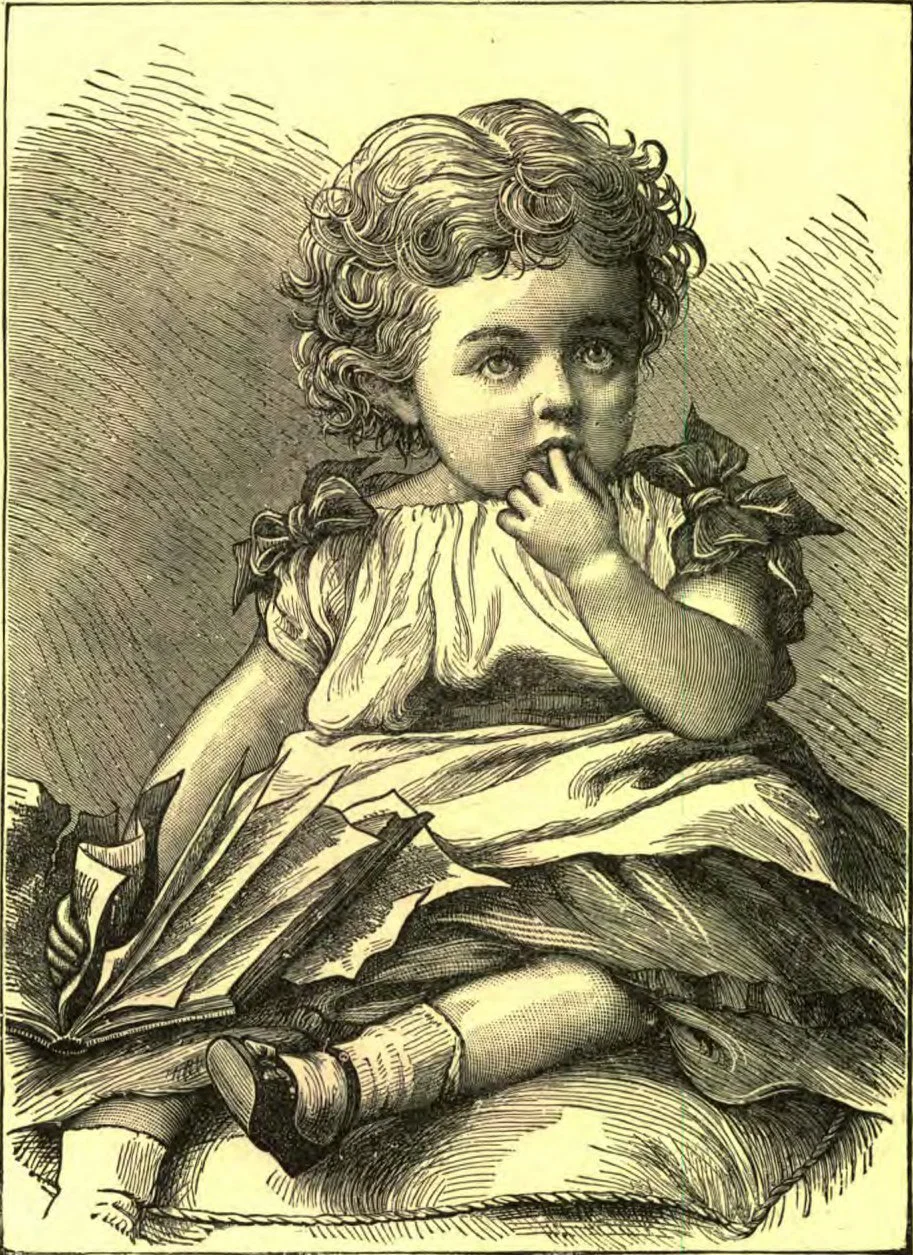
Put the pretty book away That your hand is tearing; Let mamma see the sorry look Your baby face is wearing.
It is not the book alone, Your little hand is tearing, But your own heart’s baby peace, And its quiet feeling.
Go at once to mamma, then, She’ll drive from off thy cheek The shadow that is lurking there;— Her voice will comfort speak.
Turn, then, from the wrong away; Doing what is right Makes us happier, day by day, Keeps us in God’s light.
V. A. M.

LEAVES

“Look here, Hal; isn’t this lovely?” And as she spoke Ida held up a beautiful autumn leaf of the richest crimson hue mingled with green.
“Pshaw!” said Hal, looking up from a book filled with fascinating pictures of lions and tigers and other wild animals; “it does very well for a leaf, but that’s nothing.”
“You’re mistaken there, my boy,” said his father, who had seemed to be too much absorbed in his paper to hear what was going on. “A leaf is a very valuable part of a plant. In fact leaves are the lungs of most plants, and without this breathing apparatus the plants would droop and die. There is one plant, however, the euphorbia, the stem of which is swollen so much that the air-cells are contained in that, and so it is leafless, as foliage would not be really necessary. Then, if I remember aright, Hal, when you came in last night, all heated up with your game of ball, you took a leaf to fan yourself with, and could not say enough in its praise. Notwithstanding the variety of fans made here and imported from year to year, there is certainly nothing that answers the purpose of a fan better than the palm-leaf. Then the leaves of palms are not only used for fans, but, in the country where they grow, for hats and mats, and also for thatching the huts of the people. In some places in the East, the leaves of the Palmyra and Talipot palms are used to write upon instead of paper. Under a single leaf of the latter there is said to be shelter for forty persons, and one of these same leaves spread over the ceiling of a collection of Natural History was known to cover it completely. “On the Amazon of South America, the immense leaves of the Victoria Regia are seen, giving the river at a distance the appearance of a great green plain. These leaves are from six to eight feet in diameter, and the stems which support them spread out underneath like the framework of an umbrella. The stems make such a solid foundation that water-birds often rest upon the leaves in passing, or make them their couch at night. Not only birds have rested upon them in perfect safety, but a gentleman, being assured of their strength, once placed his little daughter upon one of them, and she walked upon it without sinking. There is a story told about the Hindoo goddess Vishnu, with her scepter in her hand, crossing the eternal waters on a leaf of this plant.
“The leaves of the sensitive plant are very curious, as they close immediately on being touched; and the leaves of a plant called Venus’s fly-trap seem almost as if they had animal instinct, for many unconscious little insects are caught while walking over them, the leaves closing up and making prisoners of them, and they languish and die in their dungeons.
“Now, Hal,” said his father, “that I have told you something about the curious and the useful in leaves, perhaps you will regard them with more respect; and always remember, my son, that whatever God has made, he has made with a purpose.”—Elmer Lynda.

Mother.

Mother! What a world of tenderness there is in the simple word! What hosts of recollections are clinging about it! The first dear word our baby lips ever framed; the one word that fell as music all through our childhood; the rich soprano of the home melody, linking all the other chords together.
Dear, loving mother! The little child clings trustingly to the helping hand, and falls to sweetest slumber in the protecting arms. The boy, treading out and on to the farther bounds of childhood’s enchanted land, tosses aside books and ball whenever a shadow dims his sky, and goes to mother for comfort. She can dispel the clouds; she can brighten every pleasure a thousandfold; she holds the magic key that unlocks all of life’s most secret springs. The man, grown weary with all his striving with the world, all his battling with wrong, all his hopes, and fears, and aspirations, comes back to mother,—comes with the old trust, as in other years, to lay his fevered head, safe and sheltered, in those dear arms, and be comforted as only a mother can comfort. The woman—“my girl,” mother always says, be she young or old, maiden or wife—comes to fall into many of the old-fashioned thoughts and ways for mother’s sake. And when overburdened, sad, and heart-sick, when all adrift, shadowed over, and shut in by clouds of doubt and fear, whose hand can smooth life’s ills away but mother’s? Whose eye can see beyond the clouds? Whose voice can sing to our souls that above it all God’s blessed sunlight is always burning with steady radiance? Who, but mother?
Precious name! Speak it gently, aye, reverently,—mother! She has suffered much, loved and waited long, ever hopeful, prayerful; “our household angel.” Pray God that time’s silver be sparingly sprinkled among the tresses we love so well. Pray God always and ever to bless and keep mother.—Mrs. C. E. Fisher.

THE SURETY.

TOM NOLAN had been turned out of Sabbath-school. He had become so unruly that it seemed impossible to bear with him any longer; and then, too, his influence over the other pupils was so bad that for their sake it was thought best to expel him. But his parents brought him to the school again, begging the superintendent to take him back and give him one more trial.
“I should be very glad to do so if I could feel sure of his good conduct. But it is a sad thing for such a big boy to set such a bad example. However, I will see;” and the superintendent went into the school-room.
“Boys,” said he, “Tom Nolan wants to come back to Sabbath-school, and if some one will become surety for his good conduct, I will gladly receive him into the school again.”
There was silence for a few minutes. The larger boys shook their heads, for they knew him of old. Then one of the smallest boys said, “Please, sir, I will.”
“You,” said the superintendent, “you become surety for a boy twice as large as you are! Willie, do you understand what it means to become surety for any one?”
“Yes, sir; it means that when he is bad, I am to be punished instead of him,” was Willie’s reply.
The superintendent then went out and told Mr. and Mrs. Nolan that they would receive Tom into the school again as Willie Graham had become surety for his good conduct.
Tom’s heart was touched; and as he followed the superintendent into the school-room, he made a mental resolve that little Willie Graham should never have to be punished for his misconduct.
This touching story is a good illustration of the position in which Christ stands toward the Christian,—he has become his surety before the Father. He has promised to bear his sins, and the Father for Christ’s sake accepts of him. And this is not all; he offers to become the surety for every sinner, if he will accept of him as such.
“His blood was shed for all our race, And sprinkles now the throne of grace.”
Dear reader, let me ask, “Have you accepted Christ as your surety before the Father?” If not, I beg of you to do so at once; for
“The Father hears him pray, His dear anointed One; He cannot turn away The presence of his Son.”
V. A. M.

NOTES ON THE LESSON.

THE SAMARITANS.

WHEN Shalmaneser, king of Assyria, carried the Israelites away into captivity, he sent other people from the countries of the East to settle in the land where the Israelites had dwelt. These people mingled with the Israelites that remained in the land, and the united people were called the Samaritans, because Samaria was the capital of their country.
At first they worshiped the heathen gods of the countries from which they had come; but so many of the people were killed by lions that they became alarmed, and sent for an Israelitish priest to return, and teach them how to worship the “God of the land,” meaning the God of the Jews; for they thought that different countries were ruled by different gods.
When the Jews returned from the captivity, the Samaritans wanted to help them build the temple, but the Jews refused; for the Samaritans, although they claimed to worship the true God, worshiped idols also. It will be remembered that, when the children of Israel came up from the land of Egypt, the blessings were pronounced from Mount Ger'-i-zim, and the curses, from Mount Ebal. So, when the Samaritans were not allowed to help build the temple at Jerusalem, they built a temple of their own on Mount Gerizim, which is not far from Samaria. Here they have worshiped from that day to this, although their temple was destroyed many years ago.
Travelers in the Holy Land frequently visit these people. They carry out the forms of worship given by Moses, and are said to be very careful in the observance of the Sabbath. They now number about a hundred and fifty persons, and dwell in the valley between Mount Ebal and Mount Gerizim. Their village is now called Nab-lous, but in ancient times it was called She'-chem and afterward Sy'-char.

Ezra and Nehemiah.

Both these men were highly esteemed by Artaxerxes Longimanus, the Ahasuerus of the book of Esther. They were noble men, well deserving the good opinion of the Persian king, and were remarkable for force and ability, as well as for honesty and faithfulness.
When the king gave Ezra permission to visit his countrymen at Jerusalem, he made a decree that the treasurers beyond the river should furnish Ezra with money and provisions, and that whatsoever Ezra or the God of Heaven should require for the house of the Lord should be done speedily; “For why,” said he, “should there be wrath against the realm of the king and his sons?” It would appear from this remark that the Persians had seen so many proofs of the divine power that even the king had learned to fear the God of Heaven, and seek his favor.
The decree also made it the duty of Ezra to appoint magistrates and judges to judge the people. He was to choose for office, men who knew the law of his God, and was to teach that law to those who knew it not. Power was also given him to punish those who would not obey the laws of his God and of the king, by sending them out of the country, by taking away their property and using it for the public good, or by putting them in prison. The king, his counselors, and many others gave large sums of money to be used by Ezra and the priests at Jerusalem in buying animals for sacrifice, and in such other ways as they might think best calculated to honor God and his worship.
When Ezra went up to Jerusalem, he was accompanied by a large number of his countrymen, probably about six thousand in all, including women and children. Before starting, all these were gathered in a company at the river Ahava. When Ezra looked through the company, he found no priest among them, and refused to go until priests could be found who were willing to join them. After some delay, about forty priests were obtained, and two hundred and twenty Nethenim, men whose business it was to assist the priests in the services of the temple. Then Ezra carefully weighed out the gold and silver, and the costly vessels that had been given for the services in the temple, and gave all into the hands of the priests, to be kept and guarded by them while on the journey, and delivered into the hands of the chief of the priests and fathers when they should arrive at Jerusalem. When everything was ready for the journey, they fasted and prayed three days, consecrating themselves to their God, and asking him to protect them on their long and dangerous journey through the wilderness, which was then, as now, infested by prowling bands of fierce robbers. Ezra said he was ashamed to ask the king for a guard of soldiers, because he had spoken unto the king, saying, “The hand of our God is upon all them for good that seek him, but his power and his wrath is against all them that forsake him.”
And the hand of the Lord did protect them; for in a little more than four months they accomplished, on foot, this dreary journey of at least seven hundred miles. We can easily imagine how joyfully they were received by their brethren at Jerusalem, who were in great need of help.
About thirteen years after Ezra went up to Jerusalem, Nehemiah heard that his countrymen in Judea were in great affliction and reproach, and that the walls of their city were still in ruins. This made him so sad that he wept, and prayed to God most earnestly, confessing his sins and the sins of his people, and pleading for the fulfillment of the promises that had been made them.
Now Nehemiah was the king’s cup-bearer; and when he came in, as usual, to wait upon his master, the king noticed the sorrowful expression of his countenance, and inquired into the cause of it. Then Nehemiah said, “Why should not my countenance be sad, when the city, the place of my fathers’ sepulchres, lieth waste, and the gates thereof are consumed with fire?” The king cheerfully granted Nehemiah the privilege of going to Jerusalem to build the wall of the city and set up its gates. But the king thought so much of the company and services of Nehemiah that he made him promise to return at a set time.
For further particulars in the lives of these good men, our young readers are directed to the Bible; for each of them wrote a book which bears his name.
The example of these godly men deserves much praise. They were both favorites with the greatest king then living, and probably enjoyed all the luxuries that could be desired; yet they were anxious to leave all, and go to the aid of their poor brethren at Jerusalem. In this they manifested the spirit of our Saviour, who left the court of Heaven to come to the aid of sinful men. Let us all cultivate the same noble spirit! G. H. BELL.

LESSONS FOR CHILDREN.

LESSON C.—REVIEW OF LESSONS XCVII-XCIX.

1. WHAT king succeeded Cyrus, a few years after the Jews had returned to their own country?
2. How long did he rule the empire?
3. Who then reigned for a few months?
4. Who was the third king after Cyrus?
5. Who hindered the building of the temple?
6. How did these enemies finally put a stop to the work?
7. When were the people encouraged to take hold of the work again?
8. How did the Lord speak to them?
9. What objection did the people make?
10. How were they answered?
11. When the people began to build again, who came to inquire into the matter?
12. What right did the Jews claim to have for building the temple?
13. To whom did the governor report the case?
14. What search did the king make?
15. What did he find?
16. What decree did Darius then make?
17. When was the temple finished?
18. What Persian king ruled next after Darius Hystaspes?
19. How long did Darius reign?
20. What course did he pursue toward the Jews?
21. After Xerxes had reigned about twenty-two years, who took his place?
22. How did Ahasuerus come to put away his wife?
23. Whom did he take to be queen in Vashti’s place?
24. To what nation did she belong?
25. Who was her nearest relative?
26. What had he done for her?
27. Why had he brought her up?
28. Who was Haman?
29. How did Mordecai displease him?
30. What terrible punishment did Haman try to bring upon Mordecai?
31. How did Esther risk her life to save her people?
32. What new honor did Haman receive?
33. How did he become enraged at Mordecai?
34. What preparation did he make for destroying him?
35. What was he obliged to do for Mordecai on the very day when he intended to hang him?
36. How did Haman come to be hung on the gallows which he had prepared for Mordecai?
37. How was Mordecai honored?
38. When was Ezra sent to Jerusalem?
39. What good things did Ezra do?
40. How was the wall of Jerusalem built?
41. What prophet was sent to reprove both the priests and the people?
42. How were the Jews ruled for the next four hundred years?
43. How were they treated by most of the nations that held dominion over them?
44. What cruelties did they suffer?
45. How did they come to fall under the control of the Romans?
46. What cruel governor did the Romans finally set over them?
47. What title did he finally obtain?
48. Tell some of his cruel deeds.

THE HABIT OF SEEING TRUTH CLEARLY.

THE power of fixing our attention on objects and truths will enable us to see them with greater clearness. Many see truth indistinctly, as the man in the gospel saw men as trees walking. Few have the clear, definite perceptions of truth, especially of spiritual truth, that are desirable.
The teacher should aid his pupil to form this habit, by causing him to fix his attention steadily and long on the truth to be seen, and by causing him to view it from various stand-points, and by the aid of varied illustrations. A clear statement of the truth is not sufficient. This may not cause the pupil to see it clearly. The teacher must lead the pupil to see the truth for himself. A series of questions and of illustrations may be necessary to cause him to see a truth that can be clearly stated in a very few words. When the pupil can in his own words state the truth clearly to his teacher, he sees it clearly. Nothing short of this is proof of the fact.

SOMETHING NEW.

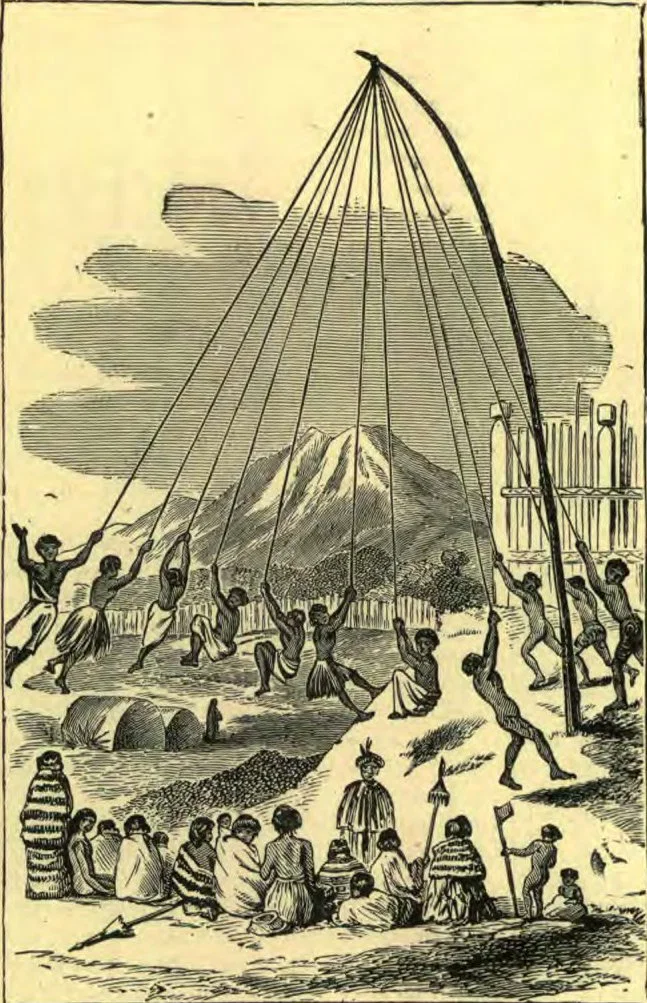
Children all like to play, but their games sometimes get old, and they desire something new. Our artist gives us on this page a picture of a kind of swing which will, we think, be new to our readers.
By looking at the picture, you will see that these children do not look like those you are accustomed to see. Their dark skin and scant dress show that they belong to a savage race of people, who live, perhaps, on the islands of the Pacific, in the wilds of Australia, or on the burning plains of Africa.
But, savage or civilized, black or white, boys and girls all love to play, and these children seem to be enjoying their play very much. Listen! It seems as though we could almost hear them shout and laugh.
Notice, too, how peacefully they are playing. While some are sitting on the ground resting, others are taking their turn at the swing. There is no quarreling, no fighting. How many games are broken up by this naughty spirit getting into the hearts of the players! How much better to cultivate a spirit of love, and play peacefully, happily! V. A. M.

"I'LL TAKE THE SHORTEST, PAPA."

ONE day a gentleman entered a shop, accompanied by his two little daughters.
“Buy us each a lead pencil, papa, please,” said Ada.
“Yes, do, papa,” said May entreatingly. He studied a moment, and then said, “I'll get one and divide it between you,” which he did; but, contrary to his intention, one piece was longer than the other. Laying the two pieces together, he said, “One piece is smaller than the other, daughters. What shall I do?”
I expected to see the pink lips pout out; but instead, the clear voice of little May, the younger of the two, rang cheerily, “I'll take the shortest, papa.”

LETTER BUDGET.

W. B. Hill, of Eagle Lake, Minnesota, under date of October 13, 1880, writes:
“Dear INSTRUCTOR family: I promised our dear little Frankie that I would write to you a few words for him. He was once an interested reader of the INSTRUCTOR, but a few days ago he fell under the power of the last enemy. Diphtheria was the cause of his death; he was sick eleven days. Although he was only ten years old, he had great faith in God and his precious promises. He found the truth he learned in the INSTRUCTOR and Sabbath-school was able to cheer him as he went down into the dark valley. He loved to talk about the blessed Jesus and the ‘coming kingdom.’ He said, ‘There will be no pain there, no sorrow.’ When he could speak only in a whisper, he said that he wanted to meet all the INSTRUCTOR family in Heaven. Oh, how we miss him! His voice is no more heard in the Sabbath-school nor in family worship. But he sleeps in Jesus; this is our consolation. Let us all, dear children, be faithful and meet him in God’s kingdom.”
“Frankie’s father.”
“He sleeps in Jesus.”
The best sentence that could be written of him. Oh that each one of the INSTRUCTOR family may so live that if called to lie down in the last, dreamless sleep, they may be as well prepared as was Frankie! In behalf of the INSTRUCTOR family, we tender to the parents our heartfelt sympathy.

ORIGIN OF PLANTS.

All our farmer boys ought to be acquainted with the origin and history of all ordinary plants, so as to know their nature, country, and condition. Such knowledge would not only be a source of pleasure, but would often enable them to explain phenomena in the habits of many plants that otherwise would appear inexplicable.
Wheat, though considered by some as a native of Sicily, originally came from the central table-land of Thibet, where it yet exists as a grass with small mealy seeds. Rye exists wild in Siberia. Barley exists wild in the mountains of Himalaya. Oats were brought from North Africa. Millet, one species, is a native of India; another, of Egypt and Abyssinia. Maize (Indian corn) is a native growth of America. Rice was brought from South Africa, whence it was taken to India, and thence to Europe and America. Peas are of unknown origin. Vetches are natives of Germany. The garden bean is from the East Indies. Buckwheat came originally from Siberia and Turkey. Cabbage grows wild in Sicily and Naples. The poppy was brought from the East; the sunflower, from Peru. Hops came to perfection as a wild-flower in Germany. Saffron came from Egypt. Horse-radish is a native of South Europe. Tobacco is a native of Virginia and California; another species has also been found wild in Asia. The grasses are mostly native plants; and so are the clovers, except lucerne, which is a native of Sicily. The gourd is an eastern plant. The potato is a well-known native of Peru and Mexico. Coriander grows wild near the Mediterranean. Anise-seed was brought from the Grecian Archipelago and Egypt.—Grange Bulletin.

THANKSGIVING-DAY

Over the river and through the wood, To grandfather’s house we go; The horse knows the way To carry the sleigh Through the white and drifted snow.
Over the river and through the wood,— Oh, how the wind does blow! It stings the toes And bites the nose, As over the ground we go.
Over the river and through the wood, To have a first-rate play. Hear the bells ring, “Ting-a-ling-ding!” Hurrah for Thanksgiving-Day!
Over the river and through the wood, Trot fast, my dappled-gray! Spring over the ground, Like a hunting-hound, For this is Thanksgiving-Day.
Over the river and through the wood, And straight through the barn-yard gate. We seem to go Extremely slow,— It is so hard to wait!
Over the river and through the wood,— Now grandmother’s cap I spy! Hurrah for the fun! Is the pudding done? Hurrah for the pumpkin pie! —L. Maria Child.

Doing Small Things for the Master Daily

Do a little thing for the Master to-day, then another one to-morrow.

You have reached the end of this edition.

The Youth’s Instructor · Nov 24, 1880