The Youth’s Instructor, Vol. 37, No. 4.

WINTER

The Youth’s Instructor

Jan 23, 1889

S. D. A. Publishing Association · Battle Creek, Mich. · Jan 23, 1889

WINTER
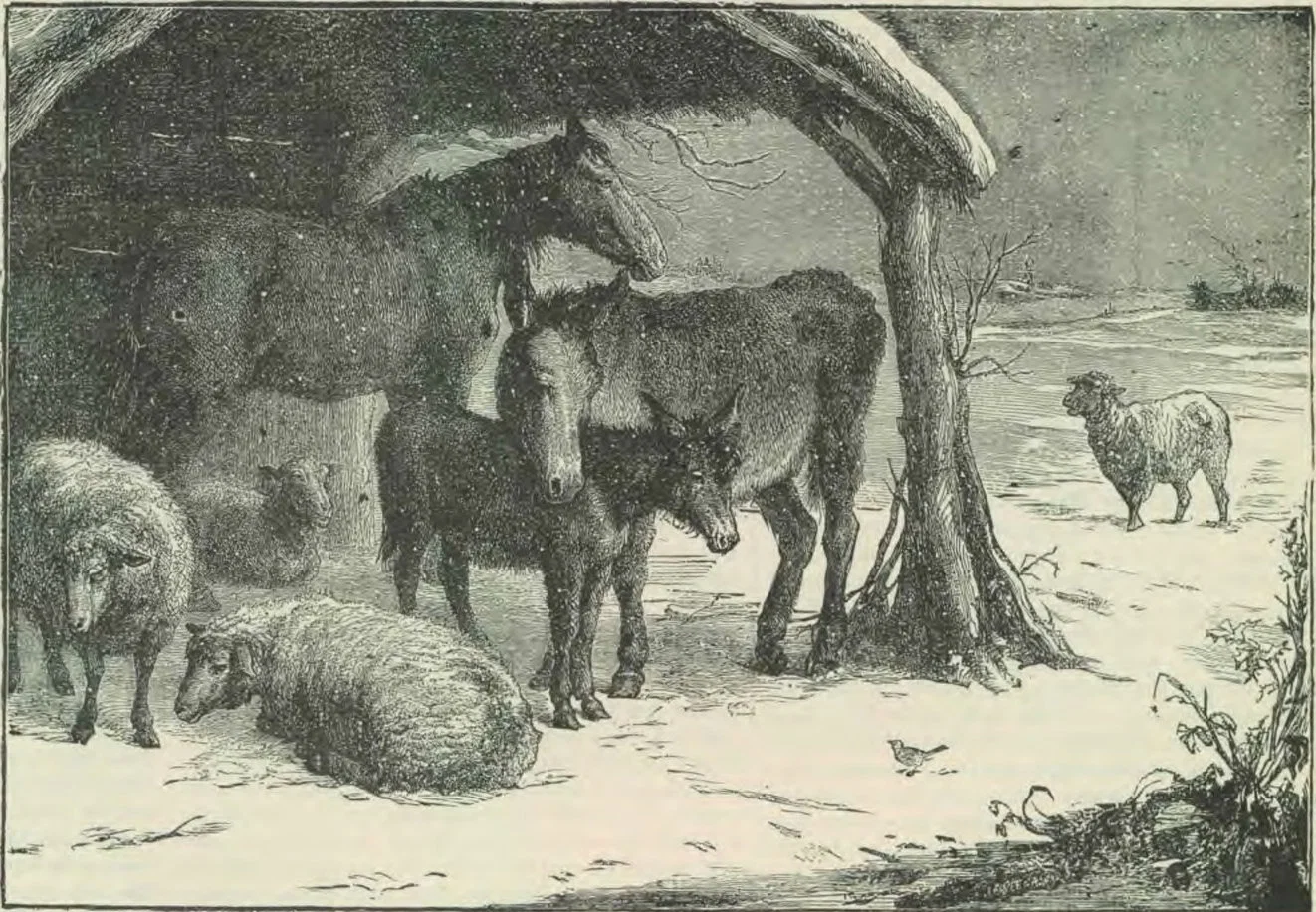
DEAD white upon the pasture lies the snow; The shivering flocks are gathered into fold; The meadow brook is frozen still and cold, And no sound lives, save now and then the bold, Loud voice of winds that through the tree-tops blow, Or fall of axe beyond the empty fold, Or woodman's voice heard through the sleety cold, Across some pathless fields of heaping snow. The dead owl lies wrapt in his frozen shroud; The rabbit dreams far from the misty cloud Of falling flakes—all warm within some low, Dark fastness of the fields. To the dull ear Nature seems dead, save that we lovers know Those throbs, half heard, are her heart's answering cheer.
—Arthur's Magazine.

WINGED WARRIORS.

The quiet little village of Holzmengen, in Transylvania, was all in an uproar one bright summer afternoon, long ago; for its Saxon inhabitants were fighting for their lives against terrible odds, as they had fought many a time before. The whole slope of the hill, on the brow of which it stood, was one great crowd of wild-looking men, with dark, fierce faces and white turbans and strangely-fastened armor—those dreaded Turkish soldiers, the memory of whose fierceness is still preserved in our saying, that any man of savage temper is “a regular Turk.”
And all this time, while the air was rent with the din of battle, and Death was gaping to devour the village and all within it, a little girl, barely ten years old, with long, fair hair, and eyes as blue and bright as the sky overhead, was at work in her little garden just behind the village church, as quietly as though no enemy were within a hundred miles of her.
But this was not so strange as it looked. Little Lizzie was the daughter of the sexton who had charge of the church, which, as the largest and safest building in the place, was always used as a hospital in time of war; and the work upon which the little woman was so busy was the preparing of bandages for the wounded who were now being brought in, thick and fast.
But in the midst of all this uproar and agony and death, the sun shone as brightly as ever, and the trees of the tiny garden rustled, and around the twelve neat hives that stood ranged in a row, the bees were humming blithely as they hovered among the flowers; and any one who had shut his ears to the frightful din below, might have thought this spot the most peaceful in the whole world.
And now Lizzie, catching up a whole armful of bandages, hurried away into the church, where she was soon so busy among the wounded men that she hardly noticed that the noise of the battle was growing louder, seeming to roll nearer and nearer every moment.
But suddenly a fearful cry from without made her look up, and through the nearest window she saw the Germans crowding wildly into the one small gate of the church-yard wall, while behind them the dark Turkish faces and snow-white turbans were eddying like a flood among the houses. The Turks had taken the village, and were coming on to attack the church itself!
Luckily it could only be attacked on one side; for on the other the rock was so steep and slippery that no man alive could have scaled it. So the brave village bailiff, though bleeding from several wounds, ranged his men along the side of the wall that faced the enemy, and encouraged them to stand firm and fight it out to the last.
On came the Turks, with hoarse yells of triumph, and in a moment the whole space outside of the church-yard wall was a sea of grim faces and flashing steel.
And now the swarming assailants made a third charge, which brought them right up to the foot of the wall that sheltered all who were left of the defenders; and while some thundered upon the gate with axes, others planted ladders against the wall, or tried to clamber up it on one another’s shoulders.
Another moment, and all would have been over; but just then Lizzie, struck with a bright idea (which came to her from an old story she had heard one winter evening), darted back into her little garden, seized two of the beehives, one in each hand, and springing upon the low wall, hurled them among the swarming assailants. Two more instantly followed, and then other two, until the whole dozen hives had been flung down upon the heads of the clambering Turks.
The bees, enraged to madness, at being sent whirling through the air so unceremoniously, fell like fury upon the shaven heads and bare arms of the Turkish soldiers, and gave them such a pricking that the Saxon arrows, which had been falling so thick among them, seemed as mere nothing in comparison.
Every man in the front ranks was literally black with the infuriated insects, which kept stinging the more fiercely the more the bewildered Turks tried to beat them off. There was no more thought of battle or assault; for who could wield a sword or climb a wall with his head covered with a perfect nose-bag of enraged bees, and every exposed inch of his body smarting as if pierced by a thousand red-hot needles? Away flew the enemy, and away flew the bees after them, while the yells of pain of the discomfited Turks were answered by the uproarious laughter of the triumphant Saxons, who might well laugh to see a whole Turkish army put to flight by the device of one little girl.—Harper’s Young People.

“FINISH IT.”

WHEN Samuel F. B. Morse, afterwards famous as the inventor of the electric telegraph, was a young painter studying in London, he made a drawing from a small cast of the Farnese Hercules, intending to offer it to Benjamin West as an example of his work.
Being very anxious for the favorable opinion of the master, he spent a fortnight upon the drawing, and thought he had made it perfect.
When Mr. West saw the drawing, he examined it critically, commended it in this and that particular, then handed it back, saying, “Very well, sir, very well; go on and finish it.”
“But it is finished,” said the young artist.
“O no!” said Mr. West; “look here, and here, and here,” and he put his finger upon various unfinished places.
Mr. Morse saw the defects, now that they were pointed out to him, and devoted another week to remedying them. Then he carried the drawing again to the master. Mr. West was evidently much pleased, and lavished praises upon the work; but at the end he handed it back, and said, as before, “Very well, indeed, sir; go on, and finish it.”
“Is it not finished?” asked Mr. Morse, by this time all but discouraged.
“Not yet; you have not marked that muscle, nor the articulations of the finger-joints.”
The student once more took the drawing home, and spent several days in retouching it. He would have it done this time.
But the critic was not yet satisfied. The work was good, “very good indeed; remarkably clever;” but it needed to be “finished.”
“I cannot finish it,” said Mr. Morse, in despair.
“Well,” answered Mr. West, “I have tried you long enough. You have learned more by this drawing than you would have accomplished in double the time by a dozen half-finished drawings. It is not numerous drawings, but the character of one, that makes a thorough draughtsman. Finish one picture, sir, and you are a painter.”
It was a good lesson. One principal part of a teacher’s business is to keep his pupil from being too easily satisfied.—Exchange.

Glimpses of Switzerland: Fribourg, Lausanne, and Lake Léman

GLIMPSES OF SWITZERLAND.—NO. 9.

A ride of about an hour brought us from Berne to Fribourg. Here I had planned to stop off, as it was nearly time for the Sunday vesper service, to see and hear the immense organ, whose pipes welcome the repairer or interested visitor to walk among them as in a small forest, as they occupy a large space in the cathedral there. This organ is capable of producing a grade of music, which in volume, richness, and wondrous combinations, is excelled by none in the world. A friend who had listened to its peals and crashes and soft, sweet refrains while a skilful musician executed the “Thunder Storm” upon it, was enthusiastic in its praise, and had advised me to see this famous instrument if possible; but previous arrangements beyond my control deprived me of this privilege, and I went directly on to Lausanne.
Here, from a high lookout station above the city, we obtained a most beautiful view off at the east and south. At the foot of the height from which we looked lay Lake Léman (or Geneva), with its wondrous shadings of blue reflecting its immediate surroundings, the mountains, villages, and the stately castle of Chillon, all made especially delightful by the lovely tints of the sunset glow of that bright June day; while beyond were the outposts of the Alps, Dent du Midi, and the Jumelles (tooth, or peak, of the south, and the twins), and from a street in descending to the city, the king of the southern view, Mont Blanc, claimed our willing admiration. All this combined to make as charming and picturesque a landscape as ever I was privileged to behold, or ever expect to see in this sin-marred world. I doubt whether there is a more beautiful sheet of water on the face of the earth than Lake Léman. It carried my mind over to the pure river of water of life, and the glories of the earth renewed, as I drank in the loveliness of this scene.
Byron, Hugo, and others have, under the influence of poetical inspiration, chanted its praises. Of it Voltaire says, “My lake stands the first;” and Oliver, whose earliest recollections were of the lovely scenes on its shores, in maturity, when far separated from his beloved home, wrote thus:—
“O blue Léman, ever grand, ever beautiful, May I on thy shore at least find burial.”
Transferring the couplet to the English somewhat mars the rhyme, but the idea remains to illustrate the inspiration of scenery to the Swiss poets, instances of which abound in their writings. Who finds evidence of such inspiration and real patriotism in the productions of American poets?
Whoever can contemplate the wondrous beauty and grandeur of the creation of God, as it appears in these parts, without being drawn nearer the Infinite One, and having all the good and holy aspirations quickened, is not affected by these views as they influenced me.
I might mention many items concerning visits, in company with friends from Lausanne, to Montreux, at the head of the lake, one of the most interesting points to tourists, going up the mountain railroad funiculaire of Territet-Glion, and then clambering up higher on foot, into the sweetest perfumed air any of us had ever breathed; of visiting Chillon, the most noted of Switzerland’s remaining castles; then going out into the valley of the Rhone to St. Maurice, one of the oldest towns of the country and near the foot of the snow-clad Dent du Midi; of rides on the calm lake back and forth and to Geneva in the lake steamers; then a visit to Lake Neuchâtel and several towns along its borders, with views from there of Mt. Blanc and the Alps, seventy-five miles distant; then of Bienne, one of the leading towns in the watch-making business, its fortifications almost two thousand years old, its funiculaire* railway inaugurated while I was there; the sublime sunset view from there of Jungfrau, Finsteraarhorn, etc., the only view I ever had of the Alps in their sunset shadings and glows, and which proved to be my last glimpse of Switzerland’s grandest attraction. But I would not weary the reader with further details of this two weeks’ vacation, and I refrain. Of Chillon, however, I will say a word. It is built up from the bottom of Lake Léman, and some of its towers are used as dwellings; and others, with dungeons below the level of the lake (as is the old tower mentioned at Bienne), are still used as prisons. Only a few weeks since, a young lady from Scotland was arrested while pursuing her work as a Salvationist, and condemned to one hundred days’ confinement in the gloomy prison of Chillon. To me, this little tour in Suisse was full of interest, pleasure, and profit, and it is always with grateful recollections that I think of it.
ADDIE S. BOWEN.

The Bible: Revelation, Languages, and Translation

THE BIBLE.—NO. 2.

I TOLD you in the first number of this article of the tons of Bibles that are printed and sent everywhere; that the poor can have them without cost; and that God inspired or directed holy men to speak and write what he had revealed to them.
The Bible is called a revelation, because God has revealed, uncovered, brought to light, things we could not otherwise know. We should be thankful for this revelation, and prize it very highly.
The men who wrote the Bible did not write it in English, as we now have it. There was not a person in the world, when these men lived, who could speak and write our language. These men talked and wrote in their own language. Those who wrote the Old Testament wrote in the Hebrew language. Those who wrote the New Testament wrote in the Greek language. The Hebrew language was that used by the ancient Hebrews, or Jews.
Moses and Joshua and Samuel and others spoke this language. About five hundred years before Christ was born, this language became changed by being mixed with another, the Chaldee (pronounced Kaf-dee). The Chaldee language was that spoken by the people of the great city of Babylon, where Daniel was taken a prisoner, and where he was thrown into the den of lions. The mixed language was called the Aram'ic, or the language of Aram, a country north-east of Palestine. It is said that the Pharisees, those proud and deceitful Jews who lived in the time of Christ, spoke this language.
The Greek language was spoken by people of Greece. In the days of Christ and the apostles the Jews spoke this language almost altogether. Jesus, it is likely, spoke it. Many of the Jews could not speak their old language. By living among so many different people they would naturally drop their own language and adopt the one spoken by the people around them. The Greeks spread themselves over Palestine, the Jews' country, and in the course of years their language became the common one spoken by nearly all the people. Indeed, as I said, many of the Jews could speak no other. But the learned could speak Hebrew.
The Jews divided the Bible (the Old Testament) into twenty-two books, which corresponded in number to the letters of their alphabet. There were thirty-nine books in all, the same as we have, but they counted several sets of them as one. Ruth and Judges they counted as one, and Ezra and Nehemiah as another, and twelve of the smaller books of the prophets as another, and so on.
The long Psalm, the one hundred and nineteenth,—the longest chapter in the Bible,—is divided into twenty-two parts of eight verses each. These divisions are the same in number as the letters of the Hebrew alphabet. Each part begins in the Hebrew Bible with each separate letter in order. In the English reference Bibles the names of these letters are printed all through the Psalm at the head of the different divisions. This long Psalm has much to say about the law and commandments, and in it we learn much about them,—how holy they are, and how they reach out everywhere, pointing to our every duty. We would do well to read and study it every day.
In the days when the Bible was written, the people did not have paper, but used other material to write upon. The best was called parchment, which was prepared from fine skins of animals, and what was written could be blotted out. Wood, the broad leaves of plants, and tables covered with wax, were used also. Parchment books were not made of leaves bound together, as is common among us, but of long strips or sheets which were fastened to rollers and rolled and unrolled like a map. When one column or page was read, it was rolled under and another was ready for reading. N. J. Bowers.

THE DRY TORTUGAS.

“O Uncle Cap! I read in the paper this morning that a large ocean steamer was ashore on the Dry Tortugas. Will you please tell me where and what they are?” asked one of the Gordon boys, after the children had gathered in the library for their evening talk.
“Let us look at the atlas,” said Uncle Cap; and when it was brought, he pointed out, on the map of the United States, some black dots in the Gulf of Mexico, about a hundred miles southwest of the southern extremity of Florida. These the children, looking over his shoulders, saw were named “Tortugas Islands.” Between them and Key West, seventy miles away on the east, they noticed another group of small islands marked “Marquesas.”
“Well, I never!” exclaimed Jack. “I always thought the Marquesas were islands of the South Pacific.”
“While I,” said Bryce, “should have said that the Tortugas were islands of the West Indies.”
“And both of you would have been right,” laughed Uncle Cap; “for there is a group called Marquesas in the South Pacific, forming part of the Mendana Archipelago, and in the West Indies there is an island of Tortuga, lying just north of Hayti. Our own islands, which are commonly known as the ‘Dry Tortugas,’ are, however, so much more important than any others of the name, that they are the ones referred to, usually.”
“What makes them important, uncle?”
“Their position at the main entrance to the Gulf of Mexico, and the fact that they mark the southern extremity of the United States. They lie at the western end of the great Florida reef that extends its treacherous length for more than two hundred miles to the eastward and northward of them, and nearly all shipping entering the Gulf must pass them. They are a group of six low, sandy islets, built by coral insects, and surrounded by a far-spreading network of the most dangerous reefs and shoals. These seemingly insignificant islets inclose a superb deep-water harbor nearly nine miles in circumference, and only to be gained by three narrow and very crooked channels through the reefs. To protect this harbor, which, in case of war with a foreign nation, would become a very important one, our Government has erected on Garden Key, the largest of the Tortugas, a magnificent work called Fort Jefferson, which is only exceeded in size in this country by Fortress Monroe. This great fort cost over thirty millions of dollars, and covers about ten acres of ground. Within its walls, the coarse white sand of the Key has been buried several feet beneath a layer of rich, black soil, brought in hundreds of schooner loads from the main land, and in it now grow many tropical trees and flowering shrubs.
“Just outside its massive gateway is one of the funniest little houses you can imagine. It is built of the gilded and gaily-painted wood of scores of wrecks, and is ornamented and adorned with ships’ figure-heads and bits of carving. In this quaint cabin lives a full-blooded Pequot Indian, who claims to be the last of his tribe, and whose name is Calvin Nedson, though he is always called ‘Chief.’ He was making a voyage in a Connecticut schooner, when a boy, many years ago, and was wrecked on the Tortugas, where he has remained ever since.”
“Do any other people live there?” asked one of the children.
“Yes; there is a sergeant in charge of the fort, and a keeper of the light that rises above its eastern wall. There are also several people on Loggerhead Key, two miles west of this one, and the uppermost point of land. On it stands a fine brick light-house, one hundred and fifty-two feet high, bearing a superb, first-order light. There is always other company in this out-of-the-way corner of the world besides these; for, in spite of the warning lights, wrecks are still so frequent on the Tortugas that one or more small wrecking vessels are constantly hovering about the islands, looking for them.”—Harper’s Young People.

The Ostrich Feather as Emblem of Truth

If an ostrich-feather is held upright, it is at once seen to be perfectly even and equal on both sides, the stem dividing it exactly in the center; whereas the stems of other feathers are all more or less on one side. Perhaps this is the reason why the ancient Egyptians chose the ostrich-feather as the sacred emblem of truth and justice, setting it upon the head of Ma, Goddess of Truth.

TINTO, THE FERRY-HOUSE PARROT.

Tinto was a beauty, dressed in green and crimson, with here and there a dash of gold. He could talk very well, and was fond of doing so. He lived at a ferry-house, on a river in Alabama.
Tinto’s master kept a refreshment room. His cage used to hang at the door, where the people passed in going to and from the boats. This parrot was in the advertising business. He was quick in picking up words and short sentences.
“Hot coffee, sir?” “Have a bite?” “Here’s the place!” “Come in, all!” He kept using these phrases, and brought in many customers to his master.
Tinto not only said what he was taught, but he would imitate many sounds he heard. He could whistle to the dogs he saw, and they would run all about to find their masters. He tried to crow like the old rooster in his master’s yard; but this was almost the only thing he could not do.
Tinto was a very noisy bird. He used to scream very loud, and chatter, as though he were laughing. He seemed to take an interest in everything that was going on near the ferry.
One day he played a sad trick upon a poor horse. Dobbin was a good horse, and always obeyed his driver. He used to draw loads, brought across the river in the boats, up to the town. When Dobbin’s master went to dinner, he used to leave his horse by the ferry-house.
The wagon was backed down the gangway, ready to take in a load. Tinto saw the horse every day, and heard what was said to Dobbin. I don’t know whether the parrot meant to be naughty or not, but he cried out, as loud as he could, “Back up, Dobbin! Back up, Dobbin! Back up, sir!”
Dobbin had backed down the gangway hundreds of times before when he heard the order. He did so this time. Tinto kept saying the same words, and Dobbin kept backing. He backed the wagon off the gangway, and then went over into the river himself.
A boy saw all this, and called Dobbin’s master. After some hard work, the poor horse and the wagon were taken out of the water. Tinto was kept in the attic a month for this trick. Perhaps he wished he had done nothing but the advertising business.—Ruth Argyle.

THREE LITTLE SAILORS.

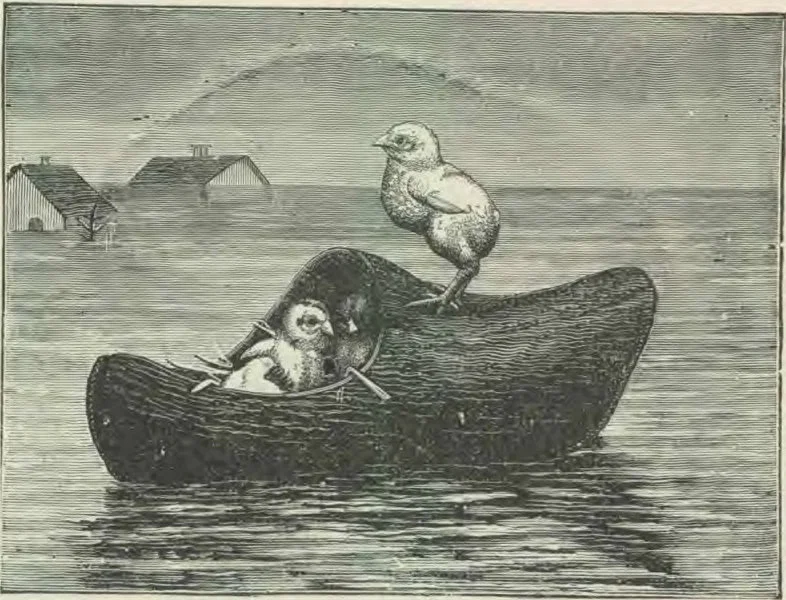
You have have heard of the three wise Gotham men Who went to sea in a bowl? But then, Nobody knows where they found a port, For the bowl was weak, and the story short.
But one little chick, and two little chicks, Soft and yellow, and plump as ticks, Sailed away, one April day, On the funniest boat that was ever afloat Upon any sea or bay.
It was off in a land of wooden shoes, On a river’s bank; and the water rose From the melting snows, Till it reached their house and wet their toes; It was late to choose What ship to take, you may well suppose!
Close by the door was a wooden shoe, And they hopped on that, the one, and the two, For nobody knew what else to do— Not even the bragging “Coo-ca-doo,” Who sprang to the roof, and seemed to say, In his pompous way,— “You silly birds, see! as I do, do you?” Some old folks think that their babies may.
Adrift, adrift, now slow, now swift, The little scared sailors go, Ever and ever adown the river Along the overflow, Till by and by they are high and dry In a garden far below!
A little miss found them there alone, And she took them in to be her own, Made them a bed, and gave them bread; And, “Little chicks, what have you seen?” she said; “You have traveled so far I am sure you are As wise as owls!” But, poor little fowls, They had traveled and traveled, and knew no more Than they did before!
—George S. Burleigh.

THE LITTLE COTTON-PICKERS.

Mother had been very sick, and could not work. There was hardly anything in the house to eat.
“Minnie, you and I can pick cotton,” said Charlie. “John Travers told me he had earned five dollars this season. We must try to help mamma.”
Minnie was very glad to do something. Their mother was willing they should try to earn some money. They took their school-bags, and went off in search of a good field.
This was in one of the States where they raise cotton. The seeds are planted in the spring. The plant grows all summer, and becomes a bush. It buds and blossoms like other plants. When the bud opens, like a rosebud, the flower is a bunch of cotton. An apple grows from a blossom on the tree. In the apple are the seeds. If these seeds are planted in the ground, little plants will come up, and after many years grow into apple-trees. The cotton seeds are in the bunch of cotton.
Charlie and Minnie found a large field, in which a great many men and women, boys and girls, both black and white, were picking off the cotton. The plants do not all blossom at the same time, and each field has to be picked over several times. The first picking is the best; for there is more cotton then. The two children went to work. When their bags were full, they took them to a man who weighed the cotton they had picked. He put the weight on tickets, which he tied to their bags. They worked hard till night, and then their tickets showed that they had picked fifty pounds. The man paid them twenty-five cents for their work.
At night all the cotton that had been picked was put into great baskets, from two and a half to four feet high. The negro men and women carry these baskets on their heads to a great shed, where it is stored, ready for “ginning.” The cotton is full of large seeds. “Ginning” is getting the seeds out of the cotton. They do it with a machine called a cotton-gin. After the seeds are taken out, the cotton is sold. In the great mills of England and America, it is made into cotton cloth, calico, thread, and other goods we wear or use every day.
This is a true story, and perhaps some of the cotton Charlie and Minnie picked may be in the dress worn by our little reader in San Francisco, Chicago, New York, London, or Paris.
Mamma was very glad to get the money the little ones earned. She bought food with it. The next day and every day during the season, Charlie and Minnie picked cotton. After a few days’ work, they learned to pick quite fast. When Christmas came, they had earned money enough to buy some clothes, and a turkey for dinner. Their mother was quite well then, and was able to take care of them.—Ruth Argyle.

A GUEST IN THE SCHOOL-ROOM.

“What is a guest?” asked a little boy.
“Don’t you know?” said his sister. “When we go to grandma’s, we are her guests.”
“Oh, yes; and when grandma comes here, she is our guest.”
“Guest and visitor are just the same thing, you know.”
One day a guest entered a large school-room. Fifty boys and girls were all seated there. None of them saw the guest. The teacher was trying to give the scholars a new lesson. It was a lesson in drawing.
“Look at the copy,” said she. “Now, children, where you see a line, make one like it. No matter if it is not just the same. ‘Do your best, and leave the rest.’”
Some of the children tried, and drew the little picture. Some fretted, and made bad lines. Some did not try at all.
“Why do you not try?” asked the teacher.
“I can’t,” said one boy, and “I can’t,” said another, and “I tried, but I can’t,” said a third.
“My dear children,” said the kind teacher, “we have a bad visitor here to-day.”
The children looked about, but could not see any one.
“This guest makes me very unhappy. He will make you unhappy all your lives. You may not see him, but he is here. Before we go on with our lesson, we will decide what we shall do with him. Are you willing to have a visitor in our pleasant room, who will spoil our lessons, make us weak and naughty, and follow us like a shadow all our lives?”
“No, no, no, ma’am,” said the children.
“He is a wicked enemy. Shall we drive him out, and shut the door? Shall we tell him he must never come in again?”
“Yes, yes, yes, ma’am,” said the scholars.
“The name of this guest is ‘I CAN’T.’ I will open the door wide. You shall send him away. We will not let him get into our hearts, or touch our lips. He does not like books or any good thing. Shall we banish him for ever?”
Then all the children said, “Yes, ma’am,” over and over.
The teacher opened the door, and the children sang this little song. No one ever saw it printed until now.
“Leave our school-room, Bad ‘I Can’t;’ Leave it now forever! We will try, and try again, And listen to you never.
“Leave us, leave us, Bad ‘I Can’t;’ You have naughty brothers,— ‘Will,’ and ‘Shall,’ and ‘Won’t,’ and Sha’n’t, And too many others.
“Good by, good by, Bad ‘I Can’t;’ Shut the door behind you; In this school-room nevermore Shall our teacher find you.”
The teacher then closed the door. The scholars clapped their hands, and the drawing lesson went on.
Each one read the lesson, and spelled the words, or counted the numbers, every day. The kind, patient teacher had a smile and a pleasant word for them all.
“I Can’t” does not visit that school-room now. Perhaps he has gone to another school. Who can tell?—Our Little Ones.

STORY OF A LITTLE GIRL WHO BUILT A CHURCH.

A new church was needed in a certain place, so a good man who loved to work for the Lord went about among the people, asking them to give the money with which to buy the materials and pay the workmen. But one man said, “No.” Another said, “I can not.” Another said, “I am too poor.” Somehow or other, every one found some excuse for himself, and not one cent was raised. At last he applied to a member of the church who was poor of purse, but large of heart; possibly he might help him.
“No,” said the church-member; “I have my wife and children to support, and this year I can do no more.”
“But,” urged the good man, “if you put down your name, others may, perhaps, follow your example; if you refuse me, I must give up, discouraged.”
“Father,” said a little voice by his side, and the bright eyes of his little daughter looked up into his face; “father, if you will only put down your name, I will earn the money by picking berries and selling them. Honest and true I will. Please don’t say no, father.”
The bright eyes were very earnest. The father could not resist his little girl’s pleading, so he promised to pay a certain sum. The discouraged worker again took heart, and went once more among the people, telling them of the love and zeal of this little girl. Many were touched by the story, and one after another put his name on the paper, till there was an abundance of money. Then the stone-masons came, and the carpenters, and the bricklayers, and after a time, a beautiful new church was built; and the people always said that it was all owing to one little girl. —Selected.

The Wings of Youth

The wings of youth are strong and fleet; Far and fast they fly; The dreams of youth are bright and sweet, Keep them pure and high. —Selected.
Continue reading: LESSON 6.—HARDENING PHARAOH'S HEART