Your ShelfYour Projects

Signs of the Times, Vol. 25, No. 26.

THE ONLY TRUE MEDIATOR

Signs of the Times

Jun 28, 1899

Pacific Press Publishing Company · Oakland, California · Jun 28, 1899

THE ONLY TRUE MEDIATOR.
"AND if any man sin, we have an Advocate with the Father, Jesus Christ the righteous." "For there is one God, and one Mediator between God and man, the man Christ Jesus." "For if the blood of bulls and of goats, and the ashes of a heifer sprinkling the unclean, sanctifieth to the purifying of the flesh; how much more shall the blood of Christ, who through the eternal Spirit offered Himself without spot to God, purge your conscience from dead works to serve the living God? And for this cause He is the Mediator of the new testament, that by means of death . . . they which are called might receive the promise of eternal inheritance."
Jesus is our Advocate, our High Priest, our Intercessor. Our position is like that of the Israelites on the day of Atonement. When the high priest entered the most holy place, representing the place where our High Priest is now pleading, and sprinkled the atoning blood upon the mercy seat, no propitiatory sacrifices were offered without. While the priest was interceding with God, every heart was to be bowed in contrition, pleading for the pardon of transgression.
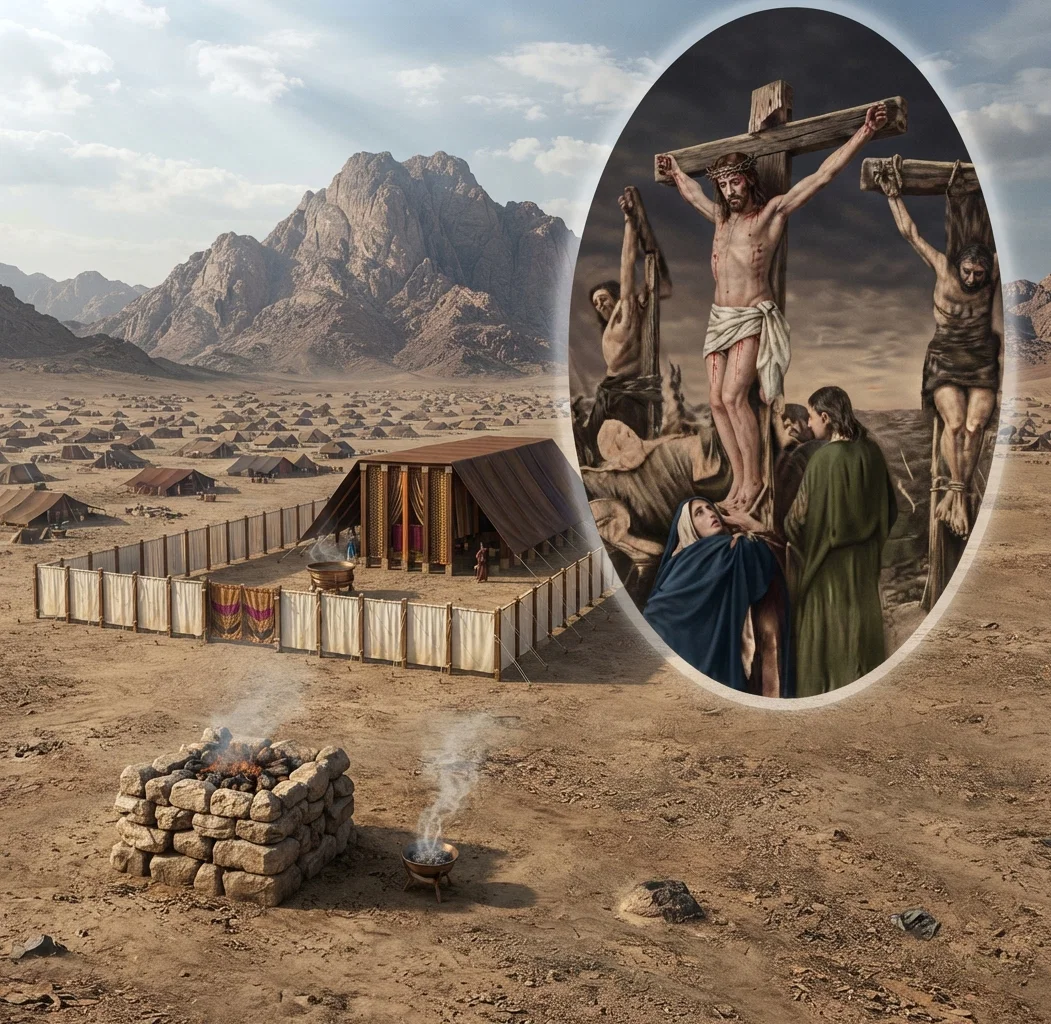
Type met antitype in the death of Christ, the Lamb slain for the sins of the world. Our great High Priest has made the only sacrifice that is of any value in our salvation. When He offered Himself on the cross, a perfect atonement was made for the sins of the people. We are now standing in the outer court, waiting and looking for that blessed hope, the glorious appearing of our Lord and Saviour Jesus Christ. No sacrifices are to be offered without, for the great High Priest is performing His work in the most holy place. In His intercession as our advocate, Christ needs no man's virtue, no man's intercession. He is the only sin-bearer, the only sin-offering. Prayer and confession are to be offered only to Him who has entered once for all into the most holy place. He will save to the uttermost all who come to Him in faith. He ever liveth to make intercession for us.
This makes of no avail the offering of the mass, one of the falsehoods of Romanism. The incense that is now offered by men, the masses that are said for the deliverance of souls from purgatory, are not of the least value in God's sight. All the altars, sacrifices, traditions, and inventions, whereby men hope to earn salvation, are fallacious.
The Tabernacle and Typical Service under the Shadow of Sinai, Pointing to the Offering "Once for All" on Calvary.
Priests and rulers have no right to interpose between Christ and the souls for whom He has died, as though invested with the Saviour's attributes, and able to pardon sin. They are themselves sinners, and are only human. One day they will see that their deceptive doctrines have led to crime of every stripe and type. They are responsible for many terrible wrongs which men have perpetrated upon their fellow-men. Martyrs have been tortured and put to death by men instigated by Satan to perform wicked deeds. These things have been done under the rule of the man of sin, who has placed himself as God, sitting in the temple of God, and taking upon himself the prerogatives of God, that he may carry out his own schemes. The Judge of the whole earth will call those who have done those deeds to account. The case of every soul that has been imprisoned, every human being that has been tortured, has been noted by the recording angel.
"It is written in the prophets, And they shall be all taught of God. Every man therefore that hath heard, and hath learned of the Father, cometh unto Me. Not that any man hath seen the Father, save He which is of God, He hath seen the Father. Verily, verily, I say unto you, he that believeth on Me hath everlasting life."
The mightiest human being, whatever may be his claim, is not infinite. He can not understand infinity. Christ plainly stated, "No man knoweth the Father but the Son." A teacher was once endeavoring to present the exaltation of God, when a voice was heard saying, "We can not as yet understand who He is." The teacher nobly replied, "Were I able fully to set forth God, I should either be a god myself, or God Himself would cease to be God." The mightiest created intellect can not comprehend God; words from the most eloquent tongue fail to describe Him; in His presence silence is eloquence.
Christ represented the Father to the world, and He represents before God the chosen ones in whom He has restored the moral image of God. They are His heritage. To them He says, "He that hath seen Me hath seen the Father." No man "knoweth the Son, but the Father; neither knoweth any man the Father, but the Son, and he to whomsoever the Son will reveal Him." No priest, no religionist, can reveal the Father to any son or daughter of Adam. Men have only one Advocate, one Intercessor, who is able to pardon transgression. Shall not our hearts swell with gratitude to Him who gave Jesus to be the propitiation for our sins? Think deeply upon the love that the Father has manifested in our behalf, the love that He has expressed for us. We can notmeasure this love; for measurement there is none. Can we measure infinity? We can only point to Calvary, to the Lamb slain from the foundation of the world.
"For if, when we were enemies, we were reconciled to God by the death of His Son; much more, being reconciled, we shall be saved by His life. And not only so, but we also joy in God through our Lord Jesus Christ, by whom we have now received the atonement. Wherefore, as by one man sin entered into the world, and death by sin; and so death passed upon all men, for that all have sinned; . . . Therefore, as by the offence of one judgment came upon all men to condemnation; even so by the righteousness of One the free gift came upon all men unto justification of life. For as by one man's disobedience many were made sinners, so by the obedience of One shall many be made righteous."
"For their sakes," Christ prayed, "I sanctify Myself, that they also might be sanctified through the truth. Neither pray I for these alone, but for them also which shall believe on Me through their word; that they all may be one; as Thou, Father, art in Me, and I in Thee, . . . that the world may know that Thou hast sent Me. . . . Father, I will that they also, whom Thou hast given Me be with Me where I am; that they may behold My glory, which Thou hast given Me; for Thou lovedst Me before the foundation of the world. O righteous Father, the world hath not known Thee; but I have known Thee, and these have known that Thou hast sent Me. And I have declared unto them Thy name, and will declare it; that the love wherewith Thou hast loved Me may be in them, and I in them."
Thus the great Intercessor presents His petition to the Father. No middle-man comes between the sinner and Christ. No dead prophet, no buried saint is seen. Christ Himself is our Advocate. All that the Father is to His Son He is to those whom His Son in humanity represented. In every line of His work Christ acted as a representative of the Father. He lived as our substitute and surety. He labored as He would have His followers labor, unselfishly, appreciating the value of every human being for whom He suffered and died.
The promise of the Father was pledged that if Christ clothed His divinity with humanity, if He endured the test that Adam failed to endure, His obedience would be counted as righteousness to His people. Thus He would conquer in their behalf, and place them on vantage ground. Thus they would be given a probation in which they might return to their loyalty by keeping God's law. And in this Christ would see of the travail of His soul, and be satisfied. MRS. E. G. WHITE.

WHO WEARS THE VAIL?

A N Eastern exchange presents this problem to its denominational adherents:—
If our dearly-beloved Seventh-day Adventist brethren, who read the Bible with the vail before their eyes, manifest so much zeal in prosecuting their work, what ought we to do from whose faces the vail is removed?
Accrediting us with “so much zeal,” etc., is a credit for sacrifice in the work we are “prosecuting.” We confess that both our zeal and our sacrifice ought to be much greater than they are, yet we are mindful that “to obey is better than sacrifice” (1 Sam. 15:22); and it is because we teach the doctrine of obedience to the law of God that our contemporary accuses us of reading the Bible with a vail before our eyes. The writer of that paragraph evidently got his inspiration from a very common perversion of 2 Cor. 3:14. But the vail which was over the Jewish mind (referred to in that scripture) was their failure to see Christ in the sacrifices and services of the sanctuary, and in the Scriptures which His Spirit had dictated for their learning. This “vail was done away in Christ;” that is, those who accept Christ as the Saviour to whom the Jewish services pointed are not blinded by the vail. But the doing away of this vail did not do away with the necessity for the spirit of obedience; for it is done away in Christ,” and He was the embodiment of obedience to the law of God. By the Spirit of prophecy He said, “I delight to do Thy will, O My God; yea, Thy law is within My heart.” Ps. 40:7, 8. Again, He said to the Jews, “Think not that I am come to destroy the law, or the prophets; I am not come to destroy, but to fulfil.” Matt. 5:17. The prophecy also says, “The Lord is well-pleased for His righteousness’ sake; He will magnify the law, and make it honorable.” Isa. 42:21. Those who read the Word of God with the spirit of disobedience, as did the unbelieving Jews, are they who read “with the vail before their eyes.” They cannot lay claim to faith in Christ or in His Word, as is shown in the question and answer of the apostle Paul: “Do we then make void the law through faith? God forbid; yea, we establish the law.” Rom. 3:31. Of those who look upon the law as a vail hiding the reader from Christ, it can never be said, “Here are they that keep the commandments of God, and the faith of Jesus.” Rev. 14:12.

THE TEMPLE OF KNOWLEDGE.

An Allegory.

(Continued.)

ONE day an inquiring soul approached the Temple of Knowledge. He was young and buoyant, and filled with queries of the unanswered "why's" and the mysterious "whence." As he was ascending the preparatory slope, with his eye fixed on the glittering domes of the temple, a passing dove dropped an inscribed feather from her wing, and this was its four-fold inscription:—
"Be astonished, O ye heavens, at this, and be horribly afraid, be ye very desolate, saith the Lord. For My people have committed two evils; they have forsaken Me the Fountain of living waters, and hewed them out cisterns, broken cisterns, that can hold no water." Jer. 2:12, 13.
"Who is among you that feareth the Lord, that obeyeth the voice of His servant, that walketh in darkness, and hath no light? let him trust in the name of the Lord, and stay upon his God. Behold, all ye that kindle a fire, that compass yourselves about with sparks; walk in the light of your fire, and in the sparks that ye have kindled. This shall ye have of Mine hand; ye shall lie down in sorrow." Isa. 50:10, 11.
"The wisdom of this world is foolishness with God. For it is written, He taketh the wise in their own craftiness."
And again:—
"The Lord knoweth the thoughts of the wise, that they are vain. Therefore let no man glory in men." 1 Cor. 3:19-21. See also 1 Cor. 1:18-31 and chapter 2.
"I can of Mine own self do nothing."
Halting on the brink of indecision, the soul glanced across a low morass in the direction whence the dove had flown, and saw, rising from a rocky promontory beyond, in fair, whitegrandeur, simple and pure, the walls of the Temple of Truth. "This is the source of my warning," he said; "this is the path that I ought to tread."
But he looked again toward the world's pavilion, resplendent in the morning sun. A rosy haze seemed to rest upon its splendid heights, and the blood of ardent ambition rose high in his veins. There was a fascination about those untried heights that he could not resist. This new-fledged soul with untried wings could not brook the doctrine of soul-dependency, and the tempter whispered: "You are young. There is plenty of time. You surely are not going to bury your splendid talents and glorious possibilities in that prison. I never knew any one who chose that path that ever amounted to anything. Try for one of my prizes; and you can come back at any time and take this course, when you have had a little experience, and know better what you want."
The soul stood hesitatingly where the road branches. The "strait" road led through a small wicket gate, down a slope, across a slippery bog toward the Temple of Truth, while the right-hand road led downward through a magnificent arch—a broad, beaten thoroughfare, over which the great tides of humanity flowed, a continuous, motley throng. In niches on either side of this grand portal, high on their pedestals, sit the twin goddesses, Fortune and Popularity, scattering their gifts and favors among the eager fortune-seekers, as their caprice or cunning dictates.
Again a white-winged message came in solemn, tender warning: "Enter ye in at the strait gate; for wide is the gate, and broad is the way that leadeth to destruction, and many there be which go in thereat; because strait is the gate, and narrow is the way, which leadeth unto life, and few there be that find it."
Just then the goddess Fortune turned on him a flattering smile, and dropped a gold medal at his feet, and Popularity also bestowed honors. The tempter triumphed, and as the soul passed under the arched entrance, he read on the keystone, "Excelsior," and above it the legend, "All things are possible to him who wills."
Fired with ambition to excel, he looked around for some way to use his youthful ardor and splendid natural gifts. Here Reason met him, and with grave, proud bearing and conceitful flatteries, offered to guide him through Vanity Fair; for he was bewildered by the Babel voices of the champions and the clanging discords of the place. "Surely," thought the soul, "there must be truth somewhere in this confusion, and with Reason for my guide I will try to find it."
"Certainly," said the guide; "I can teach you everything that is necessary to life and happiness. Plato, the world's most profound philosopher, lived by my light alone. You want to begin with history. The lives of great men move us to emulate their glorious deeds. Choose your favorite here, and read him until his life and spirit are woven into the very fibers of your being."
The soul obeyed, and in spirit soared up the heights that his "hero" had gone, and touching the topmost round of human glory, he beheld a grand mausoleum, a crumbling urn, an obliterated inscription. He descended, faint with soul-hunger and discouraged by the brief limit and scope of human greatness.
"Science will satisfy your desire for research," said Reason then. "The world is her workshop; her resources are limitless, and her achievements the marvel of the nineteenth century." So this soul flung himself into the intricacies of scientific investigation. With the keen sight of a fine intelligence focused to intensity, he peered into the mysteries of life and natural law, and by shrewdest experiments he sought to surprise nature, as it were, in her citadel, and wrest from her the key to her mysteries. But she ever eluded his skill, and Reason failed him in his contemplation of the vast unsearchable profound.
"O God, this is too wonderful for me!" cried the soul. "O that I might know the Author of this majesty and power! ‘My soul thirsteth for God; for the living God.’"
But here a dark temptation overtook him. Having lost faith in Reason, one Fate was assigned him, who thus plied his seductive art: "If God has placed you here amid the unknowable, and has withheld from you the power to comprehend Him and His works, He can not blame you if you do not do what you do not know. Content yourself with doing the best you can, and all will be well. There is much good to be got out of life if you only give yourself up to seek for it and enjoy it. I know a place where you may have a rare experience, and it will cost but a trifle."
The discouraged soul consented to be enlivened by the "rare experience," and cast himself on the mercy of Fate, who, with an air of calm assurance and pleased anticipation, strolled into a literary opium-den. There, on a silken cushion, the soul reclined, to draw from the pipe of forgetfulness a solace for his wounded, despairing heart. As he drew on the fatal pipe, he seemed wafted upward in a mist of dreamy delight till his soul seemed to bathe itself in rainbow clouds of ecstasy. All color, light, perfume, and harmony held the enchanted senses by a spell. An enchantress, in the person of a married society queen, wrought her voluptuous charm on him; her glance meets his, and he, notwithstanding a husband is beside her, yields to the seductive witchery of her eyes. More and more he bows to the sensuous charm, until from a height of ecstasy (the bliss of possession) as from a pinnacle, he seemed to fall—down, down, through utter darkness into the abysmal depths of unutterable despair and remorse, while from above pealed forth demoniac laughter, cruel, triumphant, merciless. Hope leaves him; all is lost! A whisper, "Pray." Quick at the straw of faith he snatches, remembering the wonderful mercies of God. "Lord, save; I perish!" Instantly he feels underneath "the everlasting arms." Upward he is borne. Hope returns. The fiends of darkness assail him with all their hellish power, to make him lose his hold on the saving One; but he is held. Up, up above that hell of chaotic discord, blackness, and despair! Up! up! O joy, thanksgiving! his heart is bursting with praise as he opens his eyes and realizes that life, hope, and opportunity are his once more.
"Surely the Lord is in this place, and I knew it not," cried the thankful heart. Gen. 28:16. "If I make my bed in hell, behold, Thou art there." Ps. 139:8. See Gen. 20:2-6; Prov. 5:3-6; 9:17, 18; 2:16-19. He rushed out into the rotunda, crying, "What must I do to be saved?"
"Here," cried Christian Science, "here is nepenthe for the heart-sick. All is good. There is no evil. Come and drink of the true ‘water of life;’ only believe, and all is yours—life, health, happiness, love."
"Here," cried Spiritualism, "here is power undeniable. What more evidence can you ask than the signs and wonders I can show you? Seeing is believing. Come and see for yourself."
"What’s the matter with you, man?" sneered Universalism. "Do you think God is such a monster as to burn His children up in unquenchable fire? A human father would not do that. All will be saved in His own good time. What’s the use to worry yourself? Let God take care of you."
"Here," cried Masonry, "here is the broad and liberal platform of the universal brotherhood and the common fatherhood. Here are honors, and emoluments, and religion enough to get through on, and not enough to be troublesome; come with us."
"Here," shouted a black-robed priest, "know you not that there is no salvation outside the heart of the holy mother? We have the keys of heaven and hell, and God Himself dare not revoke the decrees of our authoritative head. All power is given to us in heaven and in earth, and whom we will we bind, and whom we will we loose. Submit to the authority of the Mother Church and all will be well; but dread her anathema."
"Here!" "here!" "here!" "here!" cried harlot daughters. But he put his fingers in his ears, and ran, crying, "Life, love, joy, peace, O Lord, they are not in this place."
As if by instinct his feet carried him back to the place of his first warning. There, looking across the dark morass, he saw the divine glory of the Temple of Truth. Now the Temple of Truth is built on a mighty Rock in an exposed inlet of the great sea (Rev. 17:15), where for ages it has been buffeted by tempests of persecution and hurricanes of wrath, stirred up by the great wizard, the presiding genius of the Temple of Knowledge, who is the mortal enemy of the Prince of Truth, and loses no opportunity of venting his spite on the Prince’s subjects; and the causeway to the Temple of Truth leads, as I have said, across the low-tide flats, where for ages have been cast up by the great sea the spume and filth of shame, humiliation, and ill-repute, so that the approach has come to be called "the valley of humiliation."
And so, as the soul stood the second time at the crossroads of decision and choice, amid the ruins of his youthful hopes and ambitions—bursted bubbles of rainbow promise—the pure white temple of light seemed to his heart like a great safe haven of refuge. He had known what it is to "be horribly afraid" and "very desolate." He had lain down in sorrow, and now the valley of humiliation had no terrors for him. The favor of the world and its scorn were alike to him if only he might enter the service of the One who had revealed Himself as a Saviour, Helper, and Friend, and had opened his eyes to the hypocrisy of the deceiver and his deadly purpose; and as he looked back on the Temple of Knowledge, scintillating from pit to dome with its myriad colored lights, he could more clearly see its unstable "sand" foundation and its perishable structure.
A voice to his heart whispered, "Come unto Me, all ye that labor and are heavy-laden, and I will give you rest. Take My yoke upon you, and learn of Me; for I am meek and lowly in heart; and ye shall find rest unto your souls."
He put out his hand to open the gate, when "a horror of great darkness" fell about him, and hellish doubt crept into his unwilling heart and seemed to take possession. Faith departed, and the friends of darkness gathered round to snatch him back from the gates of life, and hope, and joy. They scoffed at his presumption and ridiculed his unworthiness. They pierced him with remorse and shame, and heaped on him a mountain of condemnation for past sins. They branded him a deserter, milk-sop, woman-heart, taunted him of lost honors, and tempted his racking thirst with a tantalizing goblet of sensual pleasure. But his soul was steadfast, tho racked with doubt and tried by the old appetite for the lusty wine. "Tho I die, I will never drink the accursed draught again," he cried; "Lord, help mine unbelief." Then the pressure gave way, and faith, hope, and love once more claimed their own. This great spiritual victory brought down a whirlwind of satanic wrath which well-nigh took his life; but faith and love quickly drew him through the little gate, and attended him over the awful quag, where at every step there seemed to be no bottom, yet when it was taken he felt the everlasting Rock beneath. Faith helped him take each trembling step, and Love’s strong arms were round him, while Hope flew on before, to point out the way, and cheer his fainting spirit with her promised joys.
The fiends of temptation had left him, tho Shame and Scorn dogged him all the way. But on the defeated tempter’s informing their chief of the deserter’s escape, he stirred up a most tempestuous sea against this soul, so that before he could reach the Rock, he was well-nigh overwhelmed with wave after wave of persecution and trouble. Everything he possessed was washed away—home, property, favor of friends, family, love—all, all were swept away by the besom of destruction that flooded his soul, till he could make no headway against it, and could only cling to the Rock and pray. Ps. 69:1, 2.
Faith, Hope, and Love never left him, but bade him be patient and "wait on the Lord," assuring him that all the powers of hell could not wrest from that Rock the weakest soul that will hold on by faith; for no man is able to "pluck them out of My hand," saith the Lord. Thus comforted, he clung close to the Rock, tho the waves dashed him sore. His life was almost gone when a strong hand of help lifted him bodily onto the Rock above, and the voice of Father-love spoke to his trembling heart:—
"Fear thou not; for I am with thee; be not dismayed; for I am thy God; I will strengthen thee; yea, I will help thee; yea, I will uphold thee with the right hand of My righteousness." "For I the Lord thy God will hold thy right hand, saying unto thee, Fear not; I will help thee." Isa. 41:10-13.
"I have put My words in thy mouth, and I have covered thee in the shadow of Mine hand, that I may plant the heavens, and lay the foundations of the earth, and say unto Zion, Thou art My people." Isa. 51:16.
Then was he glad in the Lord, and worshiped at the feet of Jesus. And he took up this psalm of thanksgiving from an overflowing, grateful heart:—
"Out of the depths have I cried unto Thee, O Lord," "when my spirit was overwhelmed." "All Thy waves and Thy billows are gone over me." "I waited patiently for the Lord; and He inclined unto me, and heard my cry. He brought me up also out of an horrible pit, out of the miry clay, and set my feet upon a Rock, and established my goings. And He hath put a new song in my mouth, even praise unto our God."
"If it had not been the Lord who was on our side, when men rose up against us; then they had swallowed us up quick, when their wrath was kindled against us; then the waters had overwhelmed us, the stream had gone over our soul; then the proud waters had gone over our soul. Blessed be the Lord, who hath not given us as a prey to their teeth. Our soul is escaped as a bird out of the snare of the fowlers; the snare is broken, and we are escaped. Our help is in the name of the Lord, who made heaven and earth." Ps. 124:2-8. See also Ps. 121; 119:67, 72, 75; 18:5, 6, 16-19.
RUTH.
(Concluded next week.)

HIS GIFT.

CHEER up, dear one, look up and live, There's hope for you above; Give Christ yourself, then He will give To you His peace and love.
Real peace—'tis known but by a few, Although 'tis granted free; 'Tis offered now, dear one, to you— What will your answer be? C. F. LADD.

Blessed Is He Whose Transgression Is Forgiven

“BLESSED is he whose transgression is forgiven, whose sin is covered.”

Rejoice in the Lord, O Ye Righteous

"REJOICE in the Lord, O ye righteous; for praise is comely for the upright."

THE PERIOD OF THE REFORMATION.

“FAITH is the polar star that guides the Christian’s way,” and when that is left out of an education the life and energy are gone and but an empty shell remains. D’Aubigne, speaking of the days of papal supremacy, expresses it by saying that “men forsook the precious perfume of faith and bowed down before the empty vessel that contained it.”
At the time the first faint rays of a coming reformation cast their beams athwart the darkness, the exercise of faith in religious matters was dead; as for faith in education, or as a basis for mental development, there was none. Man had been for centuries under the grasp of an invincible power. One earthly government after another had striven in vain for its overthrow, only to be itself dashed to pieces as the waves at the foot of a cliff. Nothing but the power of the Eternal could accomplish this end, yet when begun by Him, what mighty things could be accomplished with what seems but the slightest effort!
We wonder when we see the slender blade of wheat forcing aside the clod of dirt which, if placed there by mortal hands, would crush its life. This is the force directed by the Word of God. Similar forces were at work in the sixteenth century, and indeed in the years preceding, which paved the way for that great upheaval. Great moves begin not suddenly. As the seed falls into the crevice of the cliff, takes root, and long after splits the rock asunder, so for years there had been forces at work, destined from the very beginning to shake the whole structure of the Papacy. As the ability of that power to hold in check human progress lay largely,—one might say almost wholly,—in the system of education, or in that system which, so far from being one of education, kept the people in hopeless ignorance, it is but reasonable to look for a countermove to begin with a class of people whose minds were broadening, and in those institutions where learning was offered.
We have seen that schools were started as a result of the progress made by the Mohammedans in the twelfth and thirteenth centuries, and after finding that these institutions had come to stay, the papal power did the next thing at hand; she placed her seal upon the work, and so modified the effort as to realize the least harm possible from the growing idea of an increase of knowledge. But even this could not crush the move. It was God-given, and the plant was bound to grow, producing seed which in turn also grew and multiplied.
Disaffection had been felt in the German States for some time. Frederick of Saxony, in the year 1502, founded the school at Wittenberg. It seems strange that he should declare in its charter that he and his people should look to this school as to an oracle. How well it would meet this object they could but faintly guess. Here was cradled the sixteenth century Reformation.
Luther, the monk, was called to occupy the chair of physics and logic. But he had already heard the voice which said, “The just shall live by faith,” and his soul hungered and thirsted for the bread of life. Not long after, he was granted the degree of bachelor of divinity, and then began his career as a teacher of the Scriptures.
The new life was receiving recognition. The fountain head of knowledge had been approached, and the stream of living water flowed out to mankind. Thousands flocked to hear him. The secret of success is revealed in the words of the historian: “Luther’s lectures, thus prepared, had little similarity with what had been heard till then. It was not an eloquent rhetorician or a pedantic schoolman that spoke; but a Christian, who had felt the power of the revealed truths, who drew them forth from the Bible, poured them out from the treasures of his heart, and presented them all full of life to his astonished hearers.” “This entirely new method of expounding truth made a great noise; the news of it spread far and wide, and attracted to the newly-established university a crowd of youthful foreign students.”
Of the student life in many other universities of the same period, Painter declares: “The state of morals . . . was very low. Idleness, drunkenness, disorder and licentiousness prevailed in an unparalleled degree. The practise of hazing was universal.” The same author quotes from Duke Albrecht of Saxony, who says: “Customs before unheard of, inexcusable, unreasonable, and wholly barbarian, have come into existence. When any person, either of high or low rank, goes to any of our universities for the sake of pursuing his studies, he is called by insulting names; . . . and insulted, abused, derided, and hooted at, until, against his will, and to the great injury and damage to himself and his parents, he has prepared, given, and paid for a stately and expensive entertainment.” Then he describes the disgraceful actions of these entertainments, which distinctly remind one of the fraternity swells of more modern times.
Such actions are the natural outgrowth of the studies pursued. The Latin, the logic, the philosophy—what did it bring forth? Bacon quietly describes it thus: “The wit and mind of man, if it work upon matter, which is the contemplation of the creatures of God, worketh according to the stuff, and is limited thereby; but if it work upon itself, as the spider worketh his web, then it is endless, and brings forth indeed cobwebs of learning, admirable for the fineness of thread and work, but of no substance or profit.” Who can wonder that when the great Reformer cleared Wittenberg of its old text-books, rooted out its long courses of classics, and placed the Bible in its proper setting, students flocked there in hundreds, and that the walls of that university saw such earnest, consecrated work as Luther describes? It became the training-ground for the Christian workers of Europe.
The secret of success in all educational effort, could we but recognize it, lies hidden in these methods. The same methods to-day would produce the same results. Men clamor and toil, stretch forth the hands and seek, but it is in vain, for they fail to accept that beginning of wisdom which is the fear of God, and the acceptance of which means the laying aside of all human inventions and the exercise of simple faith. Those now inclined to feel that to make the Bible the basis of all education would cheapen and degrade, forget that it was a translation of the Scriptures into the vulgar tongue that first awoke the English nation; that laid the foundation of all English literature; in fact,
that made it possible to have a Milton or a Shakespeare, a Bunyan or a Bacon. Luther’s German translation of the Scriptures did as much for his native country. Protestantism, which had its birth in his time, and in his country, fostered public education. This was the era for the beginning of universal education, but it is well to remember that it began and was carried forward by arousing faith in the Word of God.
Luther’s anxiety to turn from the pagan philosophy which then occupied a large place in the courses of the universities and required eight or nine years of a student’s life, was but an indication of the direction in which true religious reformation would turn the minds of educators. The new plan was correct, and would have developed a nation with prospects as bright as the future appeared to the Jewish nation at the time of Solomon’s gift of wisdom; but man has ever run to extremes. It is easy to foresee the result, should the pervading spirit of the reformer for a time be lost sight of. As Zwingli in Switzerland lost sight of the true principles of Protestantism by attempting in his zeal to carry them forward with the weapons of the State, and as a result plunged his country into a most terrible politico-religious war, in like manner the system of education inaugurated by Protestantism in the days of its purity was side-tracked by a compromise with paganism.
The Papacy, if it could not overthrow the Reformation, could meet it with a counter-reformation. This it did in educational lines, as well as in strictly religious ideas, and the order of Jesuits sprang into existence. Was there complaint that worldly institutions fostered lawlessness, debauchery and kindred evils? It was met on the part of the Jesuits by the strictest vows of chastity, order and obedience. Again, Bacon says on this subject: “Take example of the schools of the Jesuits, for better do not exist. When I look at the diligence and activity of the Jesuits, both in imparting knowledge and molding the heart, I bethink me of the exclamation, ‘Since thou art so noble, I would thou wert on our side!’” The education of all Catholic countries passed into their hands, and their schools were filled with children of all classes; “for,” says one writer, “they taught not only gratuitously, but well.” Such a system, subtile in the extreme, was far more difficult to meet than open opposition, and it was in such a way that the pure seed sown in Germany was found to be so much mixed with tares when the harvest appeared.
That system which placed God and his Word in the lead drifted into an abstract theological system. As there is a wide distinction between Christianity and theology, so in the days which followed close upon the life of Luther and Melancthon came those years of theological discussion and study of subtle doctrinal points which barred out all life and truth. The study of nature and the natural sciences had awakened an interest, but these things were either replaced or largely overshadowed by the classical courses in the colleges which made the study of Greek and Latin, both dead languages, the final goal for students. Says Painter: “Latin was the Moloch to which countless minds fell an offering in return for the blessing granted to a few. A dead knowledge of words took the place of a living knowledge of things. Latin school-books supplanted the book of nature, the book of life, the book of mankind.”
You who read, does this not well describe the work done in our high schools and colleges of to-day? Have you not followed this well-worn path to knowledge, and altho frank enough to acknowledge that much you learnedwas absolutely useless when you took up life's duties seriously, are you not pushing your son and daughter through the same grind?
Continue reading: SOUL IN THE OLD TESTAMENT