Pacific Press Publishing Company · New York · Mar 5, 1896
THE POWER OF THE REFORMATION.
The weapons of Christian “warfare are not carnal, but mighty through God to the pulling down of strongholds.”
When the gospel commission was given, eighteen hundred years ago, to a handful of despised Jews, Rome ruled the world; and it was a capital offense to introduce into that empire any new religion.
The gospel commission challenged, therefore, the authority of the Cæsars. It said: “Go ye into all the world, and preach the gospel to every creature.” Rome said: “Whoever introduces new religions, . . . shall, if belonging to the higher rank, be banished; if to the lower, punished with death.”
But Christ said, “Go;” and his followers obeyed. He organized no army to accompany them; he provided no safe-conduct bearing the seal of the empire; he simply said: “Lo, I am with you alway, even unto the end of the world.” It was the word of God against the powers of earth; and that word which “is quick [living], and powerful, and sharper than any two-edged sword,” “went forth conquering, and to conquer.”
As the powers of earth had persecuted the Master, so they also persecuted his servants. As foretold by the Saviour, the world hated them even as it hated him. The authority of Rome, wielding fire and sword, was repeatedly invoked against the gospel and those who proclaimed it; but its progress was irresistible. The more Rome opposed the truth the more it spread. “The blood of the martyrs was the seed of the Church.”
At last “Christianity” ascended the throne of the Cæsars and swayed the scepter of the world; but it was no longer the Christianity of Christ. His weapons “are not carnal, but mighty through God.” But now the Church relinquished “the sword of the Spirit, which is the word of God,” and seized a material sword. She had exchanged the power of God for the power of the State, and in so doing had apostasized from Christ.
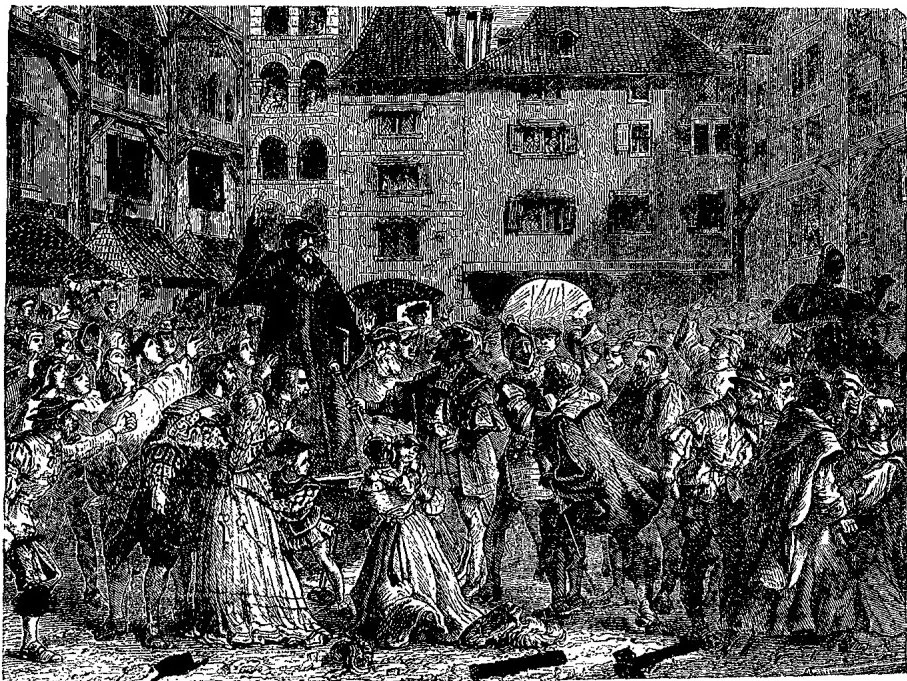
Preaching the Gospel in the Time of the Reformation.
From century to century a worldly church, living in adulterous union with the kings of the earth, lending herself to their ambitions and receiving in return such power as they had to give, sank deeper and deeper into the slough of spiritual darkness; until at the close of the fifteenth century she made merchandize of the grace of God and waxed rich from the sale of indulgencies, issuing licenses to sin and granting “pardon” for money! Notwithstanding Peter’s rebuke to Simon, the sorcerer, the gift of God was offered in exchange for filthy lucre.
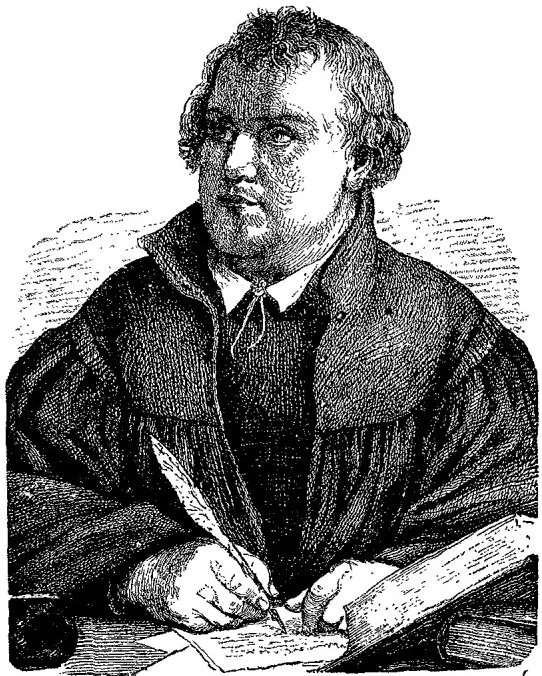
Martin Luther.
And then came the Reformation. It was not a schism in the Roman Catholic Church; it was not a revolt against the pope of Rome; it was not primarily even an effort to attain to purity of doctrine: it was a return to the simplicity of the gospel, the acceptance of “the righteousness of God which is by faith of Jesus Christ unto all and upon all them that believe.”
Martin Luther’s soul, panting after God even as the “hart panteth after the water brooks,” failing to find him in penances, discerned him in the still small voice which whispers, “Believe on the Lord Jesus Christ and thou shalt be saved.” That moment the Reformation began in his own heart, and the story of his experience welling up to his lips and flowing from his tongue proved to be to other thirsty souls the same gospel message given by the apostles fifteen centuries before, and the same divine power was in it.
As depicted in our illustration, the wrath of evil men was stirred, but God overruled it for his glory. The divine word was fulfilled: “Surely the wrath of man shall praise thee: the remainder of wrath shalt thou restrain.” The clenched fist might be thrust forth, but it touched not the devoted preacher of the gospel of justification by faith; the half-drawn sword clung, as it were, to the scabbard; the hand that grasped the murderous knife seemed74palsied by the power of the word of God; the divine promise, “Lo, I am with you alway,” was fulfilled, and all the authority of Leo X., backed up by the power of Charles V., was not sufficient to cope with the simple word of salvation spoken by Luther and his co-workers.
“Our first object,” said the Reformer, “must be to win men’s hearts; and for that purpose we must preach the gospel. To-day the word will fall into one heart, to-morrow into another, and it will operate in such a manner that each one will withdraw from the mass and abandon it. God does more by his word alone than you and I and all the world by our united strength. God lays hold upon the heart, and when the heart is taken, all is won.”
“I will preach, discuss, and write; but I will constrain none, for faith is a voluntary act. See what I have done! I stood up against the pope, indulgences, and papists, but without violence or tumult. I put forward God’s word; I preached and wrote—this was all I did. And yet while I was asleep, or seated familiarly at table with Amsdorff and Melancthon, . . . the word that I had preached overthrow popery, so that neither prince nor emperor has done it so much harm. And yet I did nothing: the Word alone did all. If I had wished to appeal to force, the whole of Germany would perhaps have been deluged with blood. But what would have been the result? Ruin and desolation both to body and soul. I therefore kept quiet, and left the word to run through the world alone. Do you know what the devil thinks when he sees men resort to violence to propagate the gospel through the world? Seated with folded arms behind the fire of hell, Satan says, with malignant looks and frightful grin: ‘Ah! how wise these madmen are to play my game!’ But when he sees the word running and contending alone on the field of battle, then he is troubled, and his knees knock together; he shudders and faints with fear.”
But having attained popularity some of the Reformers, like the bishops of the early church, forget the true source of power and fell. “The Reformation,” says D’Aubigne, “was accomplished in the name of a spiritual principle. It had proclaimed for its teacher the Word of God; for salvation, faith; for king, Jesus Christ; for arms, the Holy Ghost: and had by these very means rejected all worldly elements. Rome had been established by the law of a carnal commandment; the Reformation, by the power of an endless life.
“If there is any doctrine that distinguishes Christianity from every other religion, it is its spirituality. A heavenly life brought down to man—such is its work; thus the opposition of the spirit of the gospel to the spirit of the world, was the great fact which signalized the entrance of Christianity among the nations. But what its Founder had separated, had soon come together again; the Church had fallen into the arms of the world, and by this criminal union it had been reduced to the deplorable condition in which we find it at the era of the Reformation.”
“Thus one of the greatest tasks of the sixteenth century was to restore the spiritual element to its rights. The gospel of the Reformers had nothing to do with the world and with politics. While the Roman hierarchy had become a matter of diplomacy and a court intrigue, the Reformation was destined to exercise no other influence over princes and people than that which proceeds from the gospel of peace.”
“If the Reformation, having attained a certain point, became untrue to its nature, began to parley and temporize with the world, and thus ceased to follow up the spiritual principle that it had so loudly proclaimed, it was faithless to God and to itself.”
“Henceforward its decline was at hand.”
“It is impossible for a society to prosper if it be unfaithful to the principles it lays down. Having abandoned what constituted its life, it can find naught but death.”
“It was God’s will that this great truth should be inscribed on the very threshold of the temple he was then raising in the world; and a striking contrast was to make this truth stand gloriously prominent.”
“One portion of the reform was to seek the alliance of the world, and in this alliance find a destruction full of desolation.”
“Another portion, looking up to God, was haughtily to reject the arm of the flesh, and by this very act of faith secure a noble victory.”
“If three centuries have gone astray, it is because they were unable to comprehend so holy and so solemn a lesson.”
It was not to be expected that, emerging from the darkness of Romanism, the Reformers would step at once into the full light of the gospel of Jesus Christ; but the world had a right to expect that they and those who should come after them would go on unto perfection.
The protest of the German princes was the declaration of independence that made possible our own American declaration of God-given, inalienable rights; and cherished and practiced as it might have been, it would have proved under God an emancipation proclamation to a world enslaved by ecclesiasticism.
But after more than three and a half centuries what do we see?—Religion and religious institutions established by law everywhere, and the papacy fast recovering her lost prestige. Nearly all of Europe has religious establishments supported by taxation. Even in France the priests are stipendiaries of the State. While in our own land the Sunday institution, the “test of all religion,” is enforced upon all by civil statute, and a powerful lobby is demanding of Congress, under threat of political boycott, the enactment of additional measures of religious legislation. Sad as is the fact, three centuries, yea, nearly four centuries, have gone astray “because they were unable to comprehend so holy and so solemn a lesson” as the gospel commission and the protest of the German princes; and because they knew not “the Scriptures, nor the power of God.”
THE UNSTABLE WALL.
“And one built up a wall; and lo, others daubed it with untempered mortar.”
So wrote the prophet Ezekiel concerning the teachers that should presume to speak in the name of the Lord, when the Lord had not commanded it. Eze. 13:10.
Such a wall exists to-day in the institution of the Sunday sabbath. We have only to read the allegations put forth by its adherents in its support, to know that it is constructed with untempered mortar.
For example, we notice some allegations contained in a recent sermon by Rev. J. H. Brookes, D. D., of St. Louis, Mo., on the occasion of the seventh anniversary of the “American Sabbath Union,” and reported in the Mail and Express (N. Y.) of February 22.
In his sermon Mr. Brookes labored of course to show from the Scripture that the Sunday institution is the true Sabbath; but no such proof can be obtained without perverting Scripture, and perverted Scripture is the most dangerous form of untruth. It is the untempered mortar with which the Sunday wall is daubed.
The speaker admitted that the Sabbath was instituted at Creation, and that the fourth commandment has never been abolished, but is binding upon all men to-day. But he attempted to treat the Sabbath institution as something distinct from the seventh day!
“Observe,” he said, “it is not said, Remember75the seventh day to keep it holy, but ‘Remember the Sabbath day to keep it holy’; and ‘Wherefore the Lord blessed the Sabbath day,’ not the seventh day, ‘and hallowed it.’”
Immediately before speaking this part of the fourth commandment, God had declared, “The seventh day is the Sabbath.” See Ex. 20: 8–11. In view of this fact, how utterly puerile is such an “argument” as that here noticed! How utterly untempered the mortar which the speaker put into the Sunday wall!
“In the original institution,” he continued, “it is true that it is said, ‘God blessed the seventh day’ (Gen. 2: 3); but the change of language when the law was given shows that the seventh day was blessed not because it was the seventh day, but because it was the Sabbath day.” Let us compare the record in Genesis with the language of the law. Turning to the second chapter of Genesis, we find these words:—
Thus the heavens and the earth were finished, and all the host of them. And on the seventh day God ended his work which he had made; and he rested on the seventh day from all his work which he had made. And God blessed the seventh day, and sanctified it; because that in it he had rested from all his work which God created and made.” Gen. 2: 1–3.
Turning now to the law, we find that the fourth commandment declares, “The seventh day is the Sabbath of the Lord thy God; in it thou shalt not do any work: . . . for in six days the Lord made heaven and earth, the sea, and all that in them is, and rested the seventh day; wherefore the Lord blessed the Sabbath day and hallowed it.” Ex. 20: 8–11.
In Genesis we are told that the Creator blessed and sanctified the seventh day. The fourth commandment tells us that “the seventh day is the Sabbath,” and that God “rested the seventh day; wherefore God blessed the Sabbath day and hallowed it.” Where is “the change of language” which authorizes the statement that the seventh day and the Sabbath day were not one and the same at the time the law was spoken on Mt. Sinai, as they were at the Creation?
In instituting the Sabbath, there was, according to the record, no blessing or sanctifying done except that mentioned in Gen. 2: 3, which was the blessing and sanctifying of the seventh day. When God had blessed and sanctified that day, the Sabbath institution was complete, as designed for the use and benefit of mankind. The fourth commandment refers back to this event, reaffirming that “the seventh day is the Sabbath,” and that God “blessed the Sabbath day and hallowed it.” And yet the Rev. Mr. Brookes calmly proceeded to say, “The fourth commandment, therefore, does not require the hallowing of the seventh day of the week”!
He then alluded to the fact that when a person journeyed around the earth, he (apparently) gained or lost a day, according to the direction of his journey, citing this as an argument against keeping the seventh day. Would he also cite it as an argument against keeping Sunday? Should we fail to keep the seventh day because the world being round, we cannot all begin or end it at the same time? The argument would be just as good for not eating, sleeping, or transacting business. As a matter of fact, no one has any difficulty in knowing exactly when the seventh day begins, or when it ends, whether he be in North America or in China. If he desires to keep that day, there is nothing at all in nature to prevent his doing so.
Mr. Brookes referred to the death penalty executed upon Sabbath-breakers under the theocracy of Moses’ time, as another reason for not keeping the seventh day. The same “reason” would apply to the keeping of other commandments besides the fourth. There were penalties for worshipping false gods, dishonoring parents, murder, theft, adultery, and many other offenses, which are not in force to-day; are we therefore at liberty to disregard the commandments prohibiting such things?
The theocracy of Moses’ time has passed away, but God’s law has not passed away. The penalty for Sabbath-breaking, and for violation of any other of the commandments as well, is still death. But the execution of that penalty rests with God, and not with men. God also, and not man, is the Judge; and when the set time of his judgement arrives, that penalty will be executed upon all who are then found transgressors of his law. But now he invites all men to find pardon and eternal life through the gospel of his Son.
Man has nothing to do with the commandments of God, except to live a life of obedience to them by faith in Christ. Man’s laws, in so far as they are just, concern only the preservation of human rights, their object being to enable men to live securely in the enjoyment of life, liberty, and the pursuit of happiness. God’s law is spiritual, and therefore entirely beyond the sphere of human authority and power. His law deals with sin; man’s law deals only with crime.
In the frequent references to “the eighth day” made in the specifications concerning the ordinances and services of the ceremonial law, as set forth in Leviticus, the Rev. Mr. Brookes affirmed that he saw “intimations” of the Sunday sabbath. What must we think of such a claim to supernatural discernment on the part of one who professes total inability to see that the fourth commandment and the first verses of the second chapter of Genesis are harmonious in declaring the seventh day to be the Sabbath?
For example, he cited the reference to the yearly “feast of tabernacles” found in Lev. 23: 39: “Also in the fifteenth day of the seventh month, when ye have gathered in the fruit of the land, ye shall keep a feast unto the Lord seven days: on the first day shall be a sabbath, and on the eighth day shall be a sabbath.” “There is, then,” he said, “not only a seventh-day Sabbath but an eighth-day sabbath,” and added, “This fact seems to have been entirely overlooked by the Seventh-day Adventists and Baptists, who are flooding the country with their literature, and seeking to drag the people back to Sinai, instead of leading them up to Calvary!”
We presume no reader of the SENTINEL needs to be told that the days of the month do not necessarily synchronize in numerical order with the days of the week. The fifteenth day of the tenth month may have been any day of the week, from Sunday up to Saturday, just as Christmas or one’s birthday, may fall on any day of the week. Consequently “the eighth day” from the fifteenth day of any month can have no special connection whatever with any day of the week. If the fifteenth day of the tenth month,—the first of the feast—was Saturday, the eighth day would also be Saturday; and it is certain that “the eighth day” of this feast fell as often on the seventh-day Sabbath as it did on Sunday, just as certain as it is that the fourth of July falls as often on the seventh day of the week as on Sunday. And it fell as often on Tuesday, Wednesday, and the other days of the week, as it did on Saturday or Sunday. The argument is just as good for a Tuesday or Wednesday sabbath, as for anything else.
Yet the Rev. Mr. Brookes gravely announced to his audience that “it is worthy of notice that in this crowning feast of the year there is a distinct reference to the Lord’s day, or the Christian Sabbath. ‘On the first day shall be a sabbath, and on the eighth day shall be a sabbath’ (Lev. 23: 39). There is, then, not only a seventh-day Sabbath but an eighth-day sabbath”! Truly, this “fact” of a “distinct reference” in this to the Sunday sabbath, has been “entirely overlooked by the Seventh-day Adventists and Baptists,” as well as by other people possessed of common sense and a regard for the truth.
This was not the extent of Mr. Brookes’ daubing of the Sunday wall with untempered mortar, but it is sufficient for the purpose of this article, which is to show the reader the unstable character of this institution, even when fortified by its ablest defenders. Mr. Brookes did as well as any man could do in establishing the Sunday sabbath by the Word of God. It is an impossible task, since no such proof exists. The Word of the Lord has not spoken it.
Yet the “American Sabbath Union” whose seventh anniversary was (fittingly) commemorated by this discourse, exists for the purpose not only of persuading people to trust in this wall daubed with the untempered mortar of abortive Scriptural proof, but of compelling them to do so by the use of civil pains and penalties, whether they have any confidence in it or not!
It is worth while in conclusion, to notice what the Lord says about this wall. While the true prophets of the Lord are proclaiming his word, announcing the end of all things at hand, the hour of God’s judgment come, and the seventh-day Sabbath as a part of that eternal law by which the world will be judged, other prophets are opposing the message of warning with the cry of “Peace, peace,” saying in effect to the people that there is no need of reform. However, we will not prolong this article, but let the reader turn for himself to the thirteenth chapter of Ezekiel, and read verses 1–16.
RELIGIOUS LEGISLATION.
RELIGIOUS legislation is always legislation against the true religion. It cannot possibly be anything else.
Religious legislation means enforced religious observances. Thus it is contrary to Christianity, which means religious observances through faith.
The scope of human legislation falls infinitely short of the scope of divine truth; and Christianity is divine truth. It is as high as the throne of God and as broad as the universe. What folly, therefore, for finite man to undertake to enforce it, in any respect, by legislation which is the expression of his own finite conceptions!
Such legislation would contract the infinite to the finite, and drag the divine down to the level of the human, instead of elevating the human to the level of the divine, as Christianity seeks to do.
What folly, also, and worse than folly, for fallen man to set his sin-stained hand to the infinitely pure and holy law of God! For Christianity is a law; even "the law of the Spirit of life in Christ Jesus." Rom. 8:2. Such an act is a repetition, in aggravated form, of the folly of Uzza in trying to steady with his hand the ark of God. See 1 Chron. 13:9, 10.
The force which directs Christianity in this world and makes it effective in the uplifting of mankind, is the holy Spirit. It alone is competent for such a work. Human agency can be properly brought into it only as a means directed and controlled by the Spirit. Whenever it is not so controlled it can only mar the work. And it is so controlled when, and only when, it is operating in perfect harmony with God's Word. The Holy Spirit operates always by the power of God, and never by the power of the human arm.
Being thus against Christianity, religious legislation is never from God, and can never accomplish anything but evil.
SUNDAY LAWS ARE ANTICHRISIAN.
The ground of objection to Sunday laws is much broader than can be covered by the mere necessity of guarding against the violation of human rights. Sunday laws are anti-christian; and it is just as important, to say the least, that no law should be enacted which would be in opposition to the work of God, as that laws should be passed for the preservation of the rights of the people.
Of course, all invasion of human rights is contrary to the gospel; but Sunday laws strike directly against the conception of God as the Creator. They exalt another day than the day set apart by the Creator as the memorial of his power and the sign of his Godhead. Hence they represent the working of a power that stands directly opposed to God.
The Creator rested from his work of creation upon the seventh day. He blessed and sanctified that day, making it the Sabbath for mankind. He gave men his Sabbath in order that they might know, as they observed it, that their God was the Creator. They might know that their God was one in whom they could trust, being he who made the heavens and the earth by his word.
The need of mankind in this respect has certainly not lessened to-day. As men realize their inherent sinfulness and weakness, they seek for some power in which they can trust for deliverance from the chains they have vainly endeavored by their own strength to rend asunder. They realize that only a power76which passes their conceptions can raise them from the depths of sinful depravity to a condition of holiness and perfection. And the Sabbath presents to them just that power which they seek. It points them to the Creator, as the One who can make them new in Christ by the power of his word, just as he made all things by that word in the beginning.
The whole power and influence of Sunday laws, however, is against the realization of this blessing. For they command the observance of the first day of the week, which God neither blessed, nor rested upon, and tend to nullify and obliterate the observance of the seventh day. They tend directly to obliterate the conception of God as the Creator and Redeemer, by exalting a day which does nothing to call the mind to the power of which creation and redemption are the manifestations, and by striking against the observance of the day divinely set apart and made the Sabbath for that very purpose.
Such laws are therefore antichristian, and destructive of the highest interests and blessings of mankind.
ZEAL WITHOUT KNOWLEDGE.
By Editor
THE following proclamation was issued by the Mayor of Bridgeton, N. J., to the people of that city, February 15:—
I, E. Milford Applegate, Mayor of the City of Bridgeton, believing that every movement in this city tending to elevate the character of our citizens should receive the endorsement not only of the churches and Christian people, but the civic authority as well, and knowing full well, that “righteousness exalteth a nation” and therefore a city, and that “sin is a disgrace to any people,” do hereby call upon the citizens of our city, as many as will, to observe Tuesday, Feb. 18, 1896, as a day of universal humiliation for sin and repentance toward God, and that united prayer be made throughout the entire city, that men and women that do wickedly shall turn in this time to God.
I would also ask that between the hours of 2 and 3 P. M., the business men of our city close their doors and resort to a place of prayer and seek that a universal revival shall visit our beloved city.
E. MILFORD APPLEGATE, Mayor.
Dated Feb. 15, 1896.
Certainly there can be no objection to a person’s seeking the Lord for righteousness, and we do not question the motives of the Mayor of Bridgeton in issuing this proclamation. But good motives and zeal are often accompanied—in religious matters—with little knowledge, for lack of which “the people perish.” So it is in the case of this proclamation.
In the first place, Mr. Applegate had no more authority as the Mayor of Bridgeton to issue such a proclamation, than had any private citizen, for the simple reason that no such authority was delegated to him by his election to office. No authority to direct men in religious matters pertains to the office of mayor of a city, or to any civil office whatever. Any assumption to the contrary tends directly toward a union of Church and State.
In the second place, the authority to direct men in religious exercises, and the power to make their efforts successful in the way of seeking him, belongs to God alone. Any such proclamation, to be effective, must be based upon the word of the Lord; that word must be the arousing and convicting power which moves the people in every effective and genuine turning from sin to righteousness. But this proclamation is based simply upon the word of the mayor of the city. We do not say that it will accomplish no good; but it is certainly much better calculated to accomplish harm than good, not only because such an assumption of authority by a civil magistrate tends toward a union of Church and State, but also because it is in keeping with the marked tendency of the times to look to human authority and power for a moral reformation rather than to the authority and power of the Word, and to erect human standards of righteousness in the place of the divine.
What is meant to be the practical effect of the “endorsement” of the “civic authority” is not quite clear; but such endorsement may naturally be supposed to carry with it the force of the civil arm. Otherwise it would be difficult to assign any meaning to it; and certainly it must logically tend in this direction. And this also implies a union of Church and State.
HISTORY REPEATING ITSELF IN TENNESSEE.
Before another number of the AMERICAN SENTINEL goes to press, five Seventh-day Adventists of Lake County, Tenn., will have been called to answer before the District Court at Tiptonville for violating the statute-entrenched “sabbath” of that State.
It is not denied that these men are honest and conscientious. It is not asserted, except as a legal fiction, that they disturb anybody by their Sunday work. The “annoyance” and “disturbance” held to constitute the “nuisance” for which they are indicted, is confessedly only that mental unrest experienced by every bigoted mind in the presence of dissent from any cherished dogma of religion.
History is simply repeating itself in Tennessee. In some Roman Catholic countries Protestants are required to remove their hats before the “host,”—a bit of consecrated “bread” supposed to have been changed into the body of the Lord. A refusal to do this is held to be a breach of the peace, because it tends to provoke such a breach. In Tennessee Seventh-day Adventists are required by “law” to show a difference they do not feel for a portion of time, namely, the first day of the week, held by the majority to represent the Lord’s power, and a refusal to do this is held to be a nuisance, because of the mental annoyance occasioned and because of the “pernicious” example.
Said Judge Hammond in one of these Tennessee Sunday cases:—
Sectarian freedom of religious belief is guaranteed by the Constitution [of Tennessee], not in the sense argued here, that King, as a Seventh-day Adventist, or some other as a Jew, or yet another as a Seventh-day Baptist, might set at defiance the prejudice, if you please, of other sects having control of legislation in the matter of Sunday observances, but only in the sense that he should not himself be disturbed in the practice of his creed.
Again Judge Hammond says:—
The courts cannot change that which has been done, however done, by the civil law in favor of the Sunday observers. The religion of Jesus Christ is so interwoven with the texture of our civilization and every one of its institutions, that it is impossible for any man or set of men to live among us and find exemption from its influences and restraints. Sunday observance is so essentially a part of that religion that it is impossible to rid our laws of it.
Such reasoning reminds one strongly of the “justification” of intolerance in other ages and in other lands. The crucifixion of the Lord Jesus Christ was regarded by the judges of his day as civil necessity. “Jesus,” says Prof. George D. Herron, in the Arena for March, “was brought to his death by those accounted the best and wisest of their day; by the religious teachers, and the prudent men of the State. While the Romans consented to his death, that they might be rid of an over-religious troubler and fanatic, the leading Jews demanded his crucifixion for blasphemy and treason. To the political and religious authorities his words had outraged, this death of shame seemed the fit ending of Jesus’ life. They nervously thought themselves well done with the man, with their interests conserved and saved.”
The persecution of the early Christians was “only enforcing the civil law.” The religion of paganism had become so woven into the texture of the then existing civilization that it was impossible for the Christians to live among the Romans and “find exemption from its influences and restraints.”
In the emperor was merged the State. He alone represented the divinity of the Roman Empire. The Christians’ refusal to recognize in him that divinity or to pay respect to it in any way, was held to be open disrespect to the State. The Christians’ denial of the right of the empire to make or enforce any laws touching religion or men’s relationship to God, was counted as an undermining of the authority of government. As it was held that religion was essential to the very existence of the State, and that the State for its own sake, for its own self-preservation, must maintain proper respect for religion; when Christianity denied the right of the State to exercise any authority or jurisdiction whatever in religious things, it was held to be but a denial of the right of the empire to preserve itself.
Except in cases of the open violence of the mob, all that was done in any instance by the Roman authorities was to enforce the “law.” If the Christians had obeyed the “laws,” they never would have been persecuted. But that was the very point at issue. It was not right to obey the “laws.” The “laws” were wrong. To obey was to cease to be Christians. To obey was to dishonor God and to deny Christ and consent that mankind should be deprived of the blessing of both civil and religious liberty, as well as to forfeit for themselves eternal life.
If religion be properly a matter of State, and rightfully a subject of legislation, then there never was any such thing as persecution of the Christians. And what is more, there never has been in all history any such thing as persecution on account of religion. If religion be properly a subject of legislation and of law, then it is the right of the State to make any laws it may choose on the subject of religion; and it is its right to attach to these laws whatever penalty will most surely secure proper respect for the religion chosen. And if the legislation be right, if the law be5right, the enforcement of the law under whatever penalty cannot be wrong. Consequently if religion be properly a matter of the State, of legislation, and of law, there never was and there never can be any such thing as persecution on account of religion or for conscience’ sake.
But if religion be not a proper subject of legislation, then to enforce a Sunday “law” as the “law” is being enforced in Tennessee, is as truly religious persecution as was enforcing the “law” against the Christians in the Roman Empire.
SUNDAY LAWS.
[The Bible Echo, Melbourne, Australia.]
ON account of the many prosecutions and imprisonments of conscientious observers of the Bible Sabbath in the United States of late, under the various Sunday laws existing there, the Christian Intelligencer urges that there should be an “immediate revision” of these laws, and “a clause added exempting from penalty all persons who observe the seventh day of the week as a day of rest and worship.” But no such general revision or addition is likely to be made. More than this, if the laws were just, none such would need to be made. No one should be exempted from just laws. The fact that Sunday laws, when enforced, come in conflict with the conscientious convictions of God-fearing men, is sufficient proof of their character. Conscience and the fear of God lead men to keep the law of God, and laws which interfere with such men must themselves be opposed to the law of God.