Your ShelfYour Projects

Signs of the Times, Vol. 39, No. 26.

Our Lord and Master
Earlier text: Mr. W. T. Stead and Spiritualism

3,213 "Acts of the Apostles"

Since January 1

Orders for that Spirit-filled work—"The Acts of the Apostles," by Mrs. E. G. White—continue steady. 2,167 copies in the cloth binding and 1,046 in the leather have been called for since the first of the year. This demand evidences a growing interest. This work covers the history of the church during the apostolic age, and applies the experiences during that period to the work of the church to-day. It is filled with historical information, inspiration for the believer in God to-day, and help for Christian service. It has 630 pages. Bound in limp leather, price $2.00; cloth, $1.50. ($2.20 and $1.65 in Canada on account of duties.)
Order of your tract society or Pacific Press Publishing Assn. Mountain View, California Portland, Ore. Calgary, Alberta, Canada Kansas City, Mo.

South America

A Brief Survey of Its Past, and Its Needs as a Mission Field

WHAT the onward march of modern civilization has been arrested in South America is evident; but that the last decade has witnessed a great change for her betterment, both industrially and socially, is also evident; and the digging of the Panama Canal, in fixing the gaze of all the world on our sister continent, will not only mark a new era in industrial progress in this land of the Inca, but it is having, and will have, an ethical influence on all Latin America.
First of all, South America presents to the traveler a series of striking incongruities, no less apparent in those phenomenally rugged physical features than in her exotic social economy. Here, in the same day, may be experienced the torrid blaze of the valley and the frigid cold of the mountain; and contiguous with the arid plain is the water-soaked, impenetrable jungle. Here is the contorted, ribbon-like Chile, with an unbroken coast line of 3,000 miles, while her sister republic, Bolivia, has no outlet to the sea. For uniqueness of position, her west coast cities, from their dizzy heights looking down on all the world, scarcely find their analogy in geography.
Again we see this Latin American paradox in the maladministered governments, which, tho they pose as democratic, are, in the nomenclature of our great commonwealth, no more than New World oligarchies. Altho most transitory in nature, "continuismo" has ever been fundamental with the Latin administrators of the law, and to keep the military chieftains in the chair of state has involved the country in fratricidal warfare which has repeatedly threatened to decimate the population.
Viewed intellectually, the great pear-shaped continent to our south is truly a land of lights and shadows. While there have been few outstanding names which the world has cared to immortalize on the pages of history, still at times, illustrious characters have arisen to illuminate the darkness that has so long enshrouded those austral hills. While this country is characterized as the land of churches and convents, her academies are conspicuous for their absence. Splendid cathedrals everywhere embellish the plazas of Latin American cities, and popular shrines devoted to the worship of legions of canonized divinities crown the hills and grace the mountainsides; but — where are the schools? The blessing of letters has been denied this people, that an unscrupulous priesthood might the easier delude them with a religion whose dogmas are at the antipodes of the truths of the gospel. Under such conditions minds are debased, men soon cease to reverence the church or honor the state, domestic relations are reduced to the lowest level, and degeneracy is the inevitable sequence.

Why the Contrast?

But why this remarkable contrast in the degree of progress made by the two halves of the great American continent? Why must the North send men and means to the South to develop its resources? and why must Bibles and teachers be sent to raise the moral standard of that people? The southern half of the continent is nearly as large as the northern, and its resources are greater. The South was settled nearly a century before the North, for when the colonies of Jamestown and Plymouth were established, South America could boast of a score of flourishing cities. True, a few men, principally foreigners, have gathered wealth from the fertile fields of Argentina, others from the products of the Brazilian forests, and still others from the mines of the Andean district; but the masses have always lived in poverty, accepting the humblest necessaries of life as luxuries.
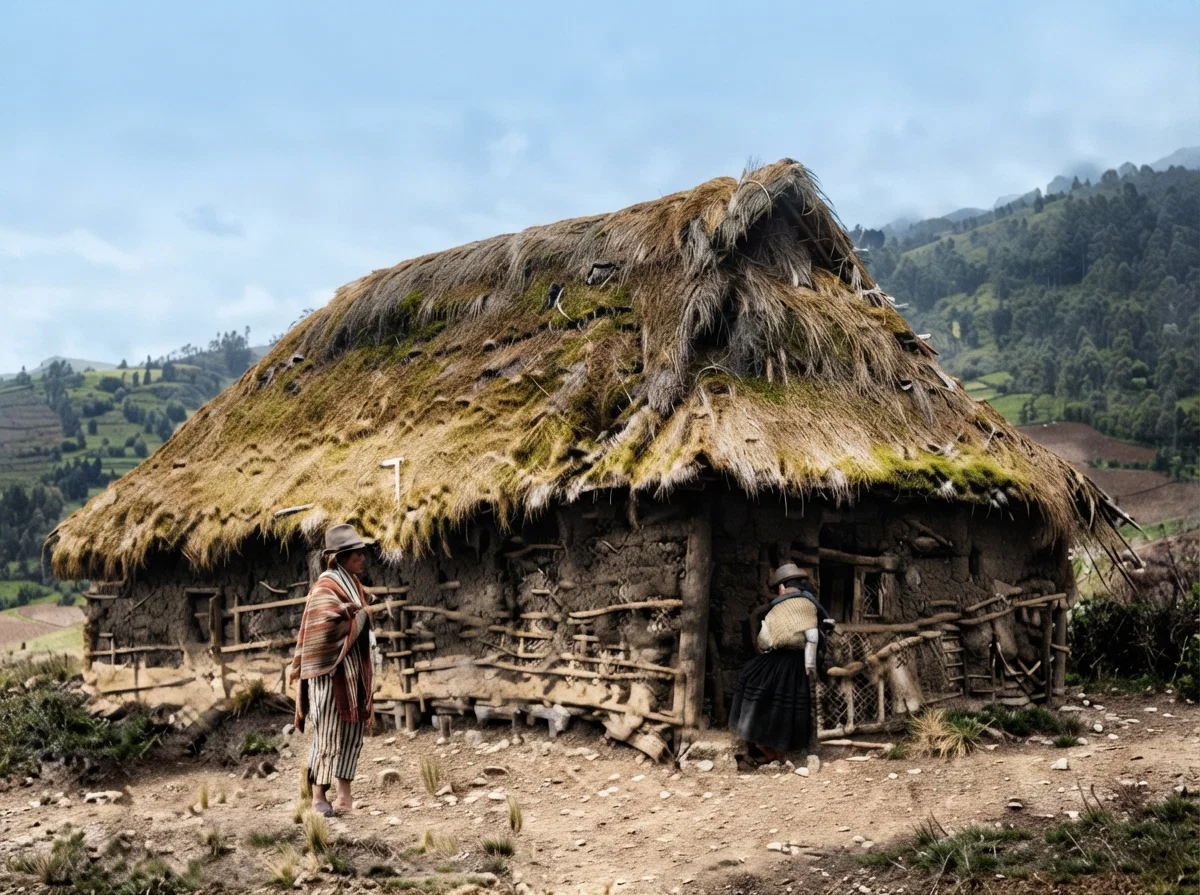
A typical house of Ecuador Indians
Some writers attribute the arrested progress to a tropical climate, while others reason that the country topographically opposes itself. Its high mountains, boundless plains, mighty rivers, and limitless forests baffled the courage of earlier generations, and only twentieth century energy could master such difficulties. But from personal observation and a study of existing conditions, we are persuaded that the real cause of South America's troubles is the system of religion which has kept the people in a state of ignorance and superstition which only finds a parallel in the Middle Ages.
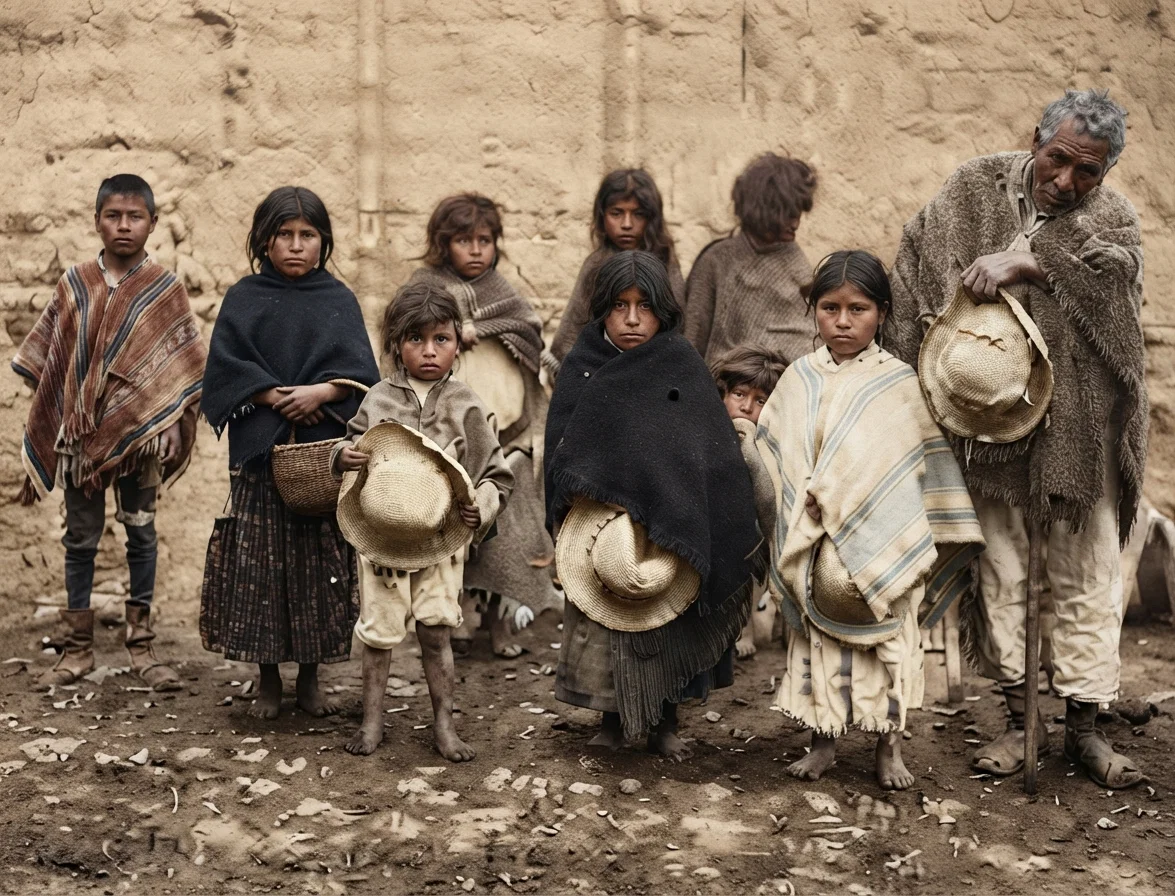
A group of Ecuador Indians
It is well known that since its discovery, the Papacy has had a free hand in South America,—as free as ever Buddha or Confucius had in India or China. We never heard of any attempt to make the climate of these countries responsible for the tyrannies borne by the long-suffering Orientals, for all know that the oppressions germinate in the despotic religion that is behind the government.
When Pope Alexander VI made Spain the overlord of what is now Latin America, he sanctioned a régime which has for centuries enslaved the peoples whom Providence had ordained to be free; and when the church sent an army of monks and friars to propagate the dogmas of the "holy see," there was laid a burden on the necks of the people which neither they nor any nation were able to bear. Spain failed, and lost her vast fiefdom and the fealty of her vassals. But not so with the church; she has guarded too well her charge. During the long centuries, her priesthood have so mixed with the masses, entering into the very warp and woof of society, that a sketch of South American life would be a history of the operations of the Jesuit, Dominican, and Franciscan friars in the southern half of the New World.
During the supremacy of this comprehensive papal scheme in our sister continent, the church has taken cognizance alike of the greatest affairs of the greatest states, and the humblest concerns of the most obscure home. No government could exist without her assistance, no revolution could prosper without her sanction, no industrial enterprise could succeed without her counsel, and not a ship could put out to sea without her blessing. The child began life under the influence of the parish priest, was tutored at his feet, made devotions at his altar and austerities at his confessional. To the average Latin the maxims of the priest were not only a standard of piety, but his ideas of heaven, the Deity, and his hopes for eternal life were all centered in the spiritual efficiency of the santo padre. Thus, in peace or in war, in business or pleasure, at home or abroad, and for life or death,—all was couched in the Roman priest, the alpha and omega of all that appertained to South American life.
Thus in a last analysis, the evidence, beyond a possibility of doubt, compels us to lay the charge of guilt at the feet of the Romish priesthood; for they have not only betrayed the most responsible trust as sponsors of the people, but they have invaded the realm of conscience, robbed men of their most sacred rights, placed the ban on intellectual knowledge, and through the centuries have kept the Book of God under the infamous papal interdict. Robbed thus of the very essence of manhood, the people have been enfeebled, and unfitted to cope with the problems of domestic and public life. While their men have been devoted to war, their fields have been untilled, their forests unexplored, their mines undeveloped, and in their cities have never been heard the hum of the loom, the lathe, or the press.
In the vernacular of the missionary, South America is still the "neglected continent;" but we forgive and forget all causes, and seek to deal only with effects. Nothing but the blessings of the gospel can atone for what these people have suffered and lost. The needs are great and the doors stand open. Many are entering these open doors with the saving message, but more must follow — yes, many more.
May we not fail in doing our whole duty in the little time that remains to us before Jesus comes. B. E. CONNELLY.

Missionary Volunteer Secretaries Recommend "Advance Guard"

Heartily pleased with the new book, "Advance Guard of Missions," Missionary Volunteer secretaries are recommending it to our young people.
The following quotations from letters show how they regard it:
"Our young people need missionary biography, and I hope this is just the book that will inspire them to go and do likewise."
(Miss) Matilda Erickson, Corresponding Secretary General Department.
"I find the book an inspiration even to one who has no zeal in missionary work, and to me who love work of this kind, it is more than an inspiration; it kindles a deep desire in my being to spend every moment in the missionary work, that none may be overlooked in the carrying of the message for this time to blind humanity."
Mrs. V. W. Baxter, Tennessee River Conference.
"It is indeed intensely interesting. I am sure that it will awaken the people's interest in missions, not only the young, but older ones as well."
A. M. Neff, Virginia Conference.
"I like 'Advance Guard' very much. I had it with me on a trip, and Elder Jackson (president of the conference) read a little in it, and I had to let him have it, he liked it so well. He ordered another for me. I think it is the best I have seen in its line. This is the kind of books we need in the young people's work."
W. W. Roble, Northern Union Conference.
"I have been able to read only a part of it, but feel free to say that it is worthy the best recommendation I can give it."
Daisy Terry, Georgia Conference.
"This book is to my mind one of the best books on missions I have read, and I feel, for one, that we will all be pleased to welcome it in our Young People's Missionary Volunteer Reading Course for next fall."
Maggie Ogden, E. Kansas Conference.
"The sketches included in it are put in such form as to be intensely interesting. I consider it a valuable addition to our young people's literature."
Mrs. Carrie R. Moon, Lake Union Conference.
"Am sure it will be an inspiration to the young people of this conference."
W. M. Andress, Western Colorado Conference.
"I am glad to recommend such books to our young people."
Fannie Dickerson Chase, Editor "Youth's Instructor."
"I am well pleased with the book, and it is full of facts which will be well worth the price you ask for it."
Mrs. Emma Wilkinson, Upper Columbia Conference.
"I do not see how it can fail to stir up a missionary spirit in those who read it, whether old or young."
Mrs. M. T. Poston, Arizona Conference.
"I am indeed glad to welcome this book, for I believe emphatically that there is a mission for such a book among our young people. The past two or three years I have urged missionary biographies upon our young people. I am starting tomorrow on a trip through the Central Union, and shall take the book with me to read, and shall then be able intelligently to recommend it."
Meade MacGuire, Central Union.
"From such portions as I have read, I am led to believe that the book is worthy of a place in the library of all of our young people."
Rosamond D. Ginther, California Conference.
"Advance Guard" costs only $1.00 in plain cloth binding; $1.50 cloth, marbled edges.
Address your tract society or Pacific Press Publishing Assn. Mountain View, Cal. Portland, Ore. Calgary, Alberta, Canada. Kansas City, Mo.

Mission Funds

India China
Previously Reported $120.90 $108.65
A Friend .95
A Friend 1.00 1.00
Mrs. Caroline Miller 1.00
O. Gibson (also $25 "Signs" don.) 50.00 25.00
Mrs. Lillian Guthrie 5.00
Mrs. A. E. Flater .15
Mr. and Mrs. C. V. Thayer 6.00 6.00
Mrs. John E. Dolman 1.00
F. A. and Freddy Allen 7.60
F. A., Freddy, and A. Allen 28.50 26.00
S. W. Harris 5.00
Reported through "Our Little Friend" 17.58
Totals $215.95 $195.38

CHINA FAMINE FUND

Previously Reported .................... $72.75 Mrs. L. V., a Friend ................... 5.00 G. R. Pilate .......................... 2.00 Misc. Church Collections ............... 2.01 A Friend .............................. 1.00 S. S. ................................. 10.00 T. S. O'Brien ......................... 1.00 Nebraska Conference ................... 2.00 H. W. Ingham .......................... 2.00 Mrs. E. J. Johnson .................... 4.20 Mary C. White ......................... 1.00 William W. Garrahan ................... 5.00 Eva B. Steunnenberg ................... 5.00 Mr. L. F. Besseger .................... 5.00 Gertrude Holmes ....................... 2.00 A Friend .............................. 1.00 A Friend, "E" ......................... 1.00 Total ................................. $121.96

Attention

Those who have relatives and friends residing in Chicago and vicinity are earnestly requested to urge them to attend a series of gospel meetings which are being conducted in the commodious canvas pavilion located on the corner of Ontario and Laurel streets, Austin, Chicago, Illinois.
The service will be continued every evening, at 7:45, excepting Saturday, until August 20. There will also be a service every Sunday afternoon at three o'clock.
The subjects presented at these meetings are the same as those advocated in this paper.
Please write at once to your friends, that they may obtain the benefit to be derived from these meetings.
The tent can easily be reached by taking the west-bound cars on Lake Avenue, Chicago Avenue, and Madison Street, or the elevated road Oak Park line.
Gospel Tent, Corner Ontario and Laurel Streets, Austin, Chicago, Illinois.
K. C. RUSSELL.

In Our Next Issue

At this writing our California camp-meeting has opened with a most excellent spirit. An earnest seeking of God entered at the very beginning of the meeting, and on the first Sabbath service hundreds came forward, either to seek a new consecration, or to seek God for the first time. Fuller reports will be given in our next.
Quite a number of poems on the Titanic have come to us. We have already published one. While some of these which have been sent in have merit, they are too long, and it does not seem wisdom to publish any more upon the ill-fated ship. It had its lesson; but what is the use of keeping its gruesome, sad picture before the public?
— ★ ★ —

In Our Next Issue

Our next issue among other good things will contain the following:
1. "Man Tested and Lost" (Bible Reading).
2. "The Missionary's Pattern." By Mrs. E. G. White.
3. "The Manner of Christ's Coming." By Prof. G. W. Rine.
4. "Christ as Creator." By G. W. Reaser. This article is the beginning of an excellent series on the character, offices, and work of our blessed Lord.
5. "The Glory of the Stars." By Prof. F. E. Hinkley, astronomer of Harvard University. This article will be illustrated by photographs of objects in the southern heavens.
Besides these are our regular departments, which will be well filled.

Civilization Only a Veneer

Much is said about the refinement of the twentieth century,—its better civilization,—but it needs only a little beer and whisky to show that the civilization is only veneer, and that man at heart is as savage as he ever was. At a recent minute' celebration in Jacksonville, New Jersey, the press despatches give an incident which testifies more strongly than any theory, regarding the human heart. There is a game called "Irish pool," in which a tin can is tied to a rope and made fast to the top of a pole. As the can swings around the pole, forming a circle, it is kept spinning by blows with sticks and clubs. But this was too tame for these celebrants—a live pig was taken, continually struck by those taking part in the game, squealing with every blow, sense of which drew blood. The despatch says, "As the little jets of crimson shot over the heads of men, they howled savagely, and applied their whips and clubs more fiercely. Men sprang in the air to land blows, and when a player succeeded, there was a chorus of screams. The the savagery of the thing was revolting, the participants and spectators took an inhuman delight in the torture that was being inflicted."
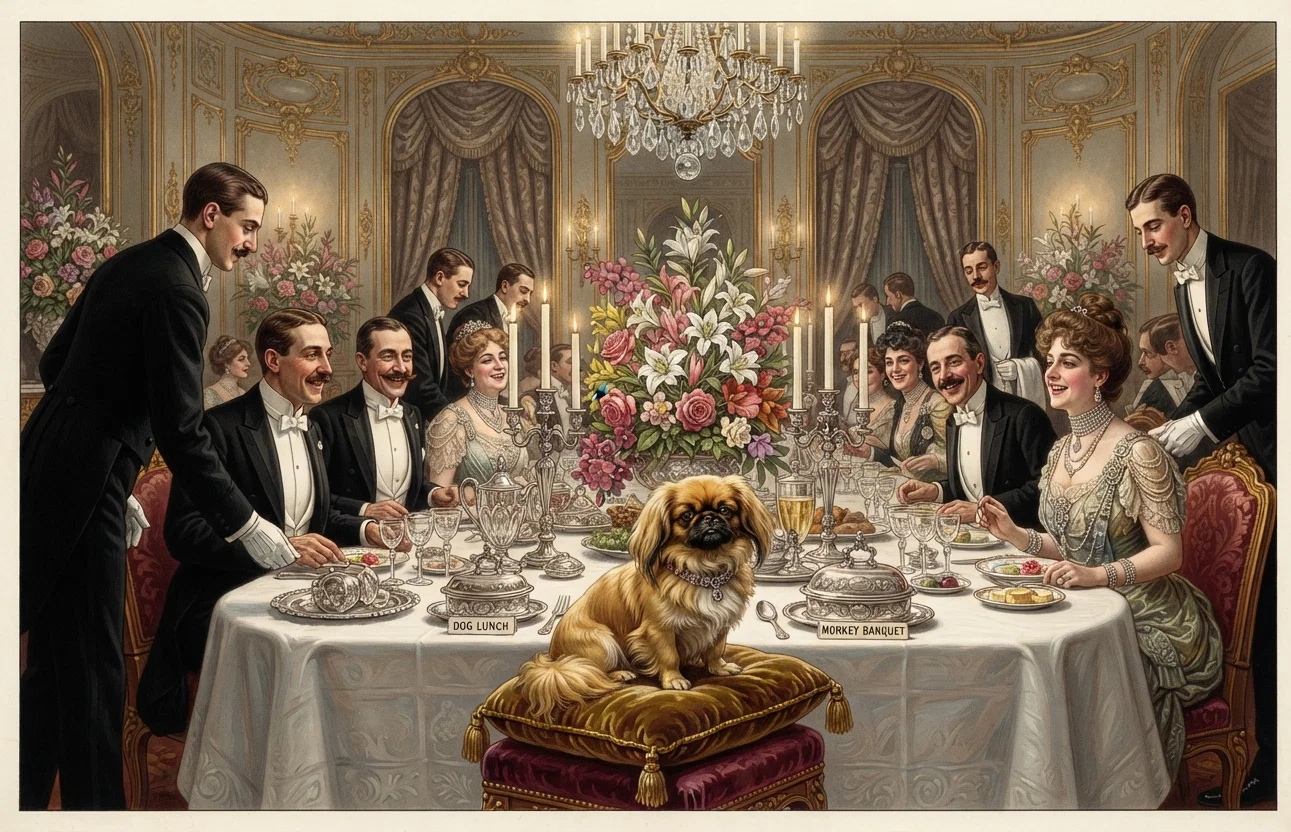
trained waiters, the table adorned with every evidence of luxury,—silver and cut glass and hot-house blooms,—and the reporters of the press notified that they could come and write it up as a function of the first order—an event in society. "Degenerate extravagance" has been applied to the affair; and the words, it seems to us, are not too strong; and it has been truly said that it "flares out against the growing discontent of the time like a torch in darkness." Then, too, the dog itself is a caricature of dogs—a Pekingese spaniel—"a freak of the perverse in nature, helpless to himself and useless to man," as one paper expresses it, "of no purpose save to amuse the emptiness of an idle class, as incapable of rational pleasure as of useful employment."

Bible Authority

Our authority is the Bible, the Holy Scriptures of the Old and New Testaments. When the Common ("King James" or "Authorized") Version or the American Standard Revised Version is used, the version will not generally be designated in reference. Any Bible quotation in this paper, therefore, differing from the Common Version, unless otherwise indicated, will be almost invariably from the American Standard edition of the Revised Bible, copyright 1910, by Thomas Nelson & Sons.
For further particulars, subscription rates, etc., see page 15.

The Coffee Habit in America

The United States and Coffee. — In the international commerce of the world there is two and a half billion pounds of coffee handled yearly. The United States consumes more than one third of it all, more than twice as much as Germany, three times as much as the Netherlands, four times that of France, ten times that of Great Britain, and half as much as all Europe. It is not a hopeful sign. The real hold that coffee has is on account of the poison that it contains in caffein, and the large drinking of coffee must affect the nerves of those who use it. Then, too, it is not needed — utterly useless. Those who do not use it get along even better than those who do. The coffee habit is a mild slavery, but it is slavery nevertheless.

The Italian War

The Italian war drags on. A recent despatch in the Sunday Los Angeles Tribune, from Berlin, declares that the Mohammedan world are concentrating against Italy in their defense of Tripoli, and that the contest has become a "holy war." Mohammedans would do very much to retain Tripoli, but the simple fact is that Turkey is not the center of Mohammedanism. It is quite a serious question whether the great mass of Mohammedanism would not just as soon see Turkey humbled as not, but they do not wish to lose any Mohammedan stronghold or center in Africa. This report comes from one who had spent four months among the Turkish and Arab forces. He was warned in London that his throat would be cut by Arabs, or that the Italians would shoot him at sight; but the Arabs treated him as a friend when they were sure that he was not an Italian, and he said that there was little danger of the Italians' shooting him, because they did not dare come out of their trenches. Italy, he tells us, fails of success because they did not carry the war into the interior with vigor. At the first the Arabs were ready to submit to the invader without striking a blow, but now the attitude of the Arabs is that "we shall go on fighting as long as there is one drop of blood left in our veins."

Memory Text for the Week

John 3:16. A.R.V.

“For God so loved the world, that He gave His only-begotten Son that whosoever believeth on Him should not perish, but have eternal life.”
with us this great question, and increase the circle of our students by enlarging the circulation of the SIGNS OF THE TIMES.

California Camp-Meeting

At this writing our California camp-meeting had opened with a most excellent spirit. An earnest seeking of God entered at the very beginning of the meeting, and on the first Sabbath service hundreds came forward, either to seek a new consecration, or to seek God for the first time. Fuller reports will be given in our next.

The Bible for Today

The conditions in the world politically, socially, religiously, are not matters of surprise to the faithful student of prophecy. Not one dominating condition exists in this world at the present time, but what God has foretold in His Word, clearly, definitely, explicitly; and it shall be the aim of the SIGNS OF THE TIMES to point these things out in all the time to come. We wish our readers to see what is actually true,— that the most up-to-date book that there is in the world is the Bible. It is the living Book for to-day. It pointed out events centuries ago, and in its living testimony points out still the very conditions and troubles of this great old world. Best of all, it has the remedy for its ills; and if the world at large will not accept it, the individual may. We plead with our readers to study

Camp-Meeting Tour Reports

Our associate editor, A. O. T., has just returned from a six weeks' tour of camp-meetings in Washington, Oregon, and Idaho. He reports most excellent meetings, and full work. It has not been in any sense an idle pleasure trip, except as one finds pleasure in doing hard, earnest work for the Master. Many of these meetings were especially blessed of God in souls converted. Eighty-one were baptized at the Portland meeting alone, and fifty-two at the Spokane meeting. He is now back to do still better service for the SIGNS OF THE TIMES.

Editorial Attention

We place our editorial department first in the paper this week. We shall give more editorial attention to the things that are troubling our readers, in the series to come — will endeavor to make the paper more of a help to every one of our great family.

Kin Zoung, the Watchman

We welcome into our growing family another religious paper, bearing God's great everlasting gospel message to the world. Its name is "Kin Zoung," which means, translated into English, "The Watchman." It is published at 60 Lower Kemmendine Road, Rangun, Burma. Typographically, the first number is a creditable looking number, but we can not read a word of it, consequently can not tell our readers its contents. We are sure, however, from those in charge of the work in Burma, that it is filled with the glad gospel message. May it be a faithful watchman, not only in warning souls, but may it bring many to the Lord and Saviour.

Spiritualist Messages From Mr. Stead
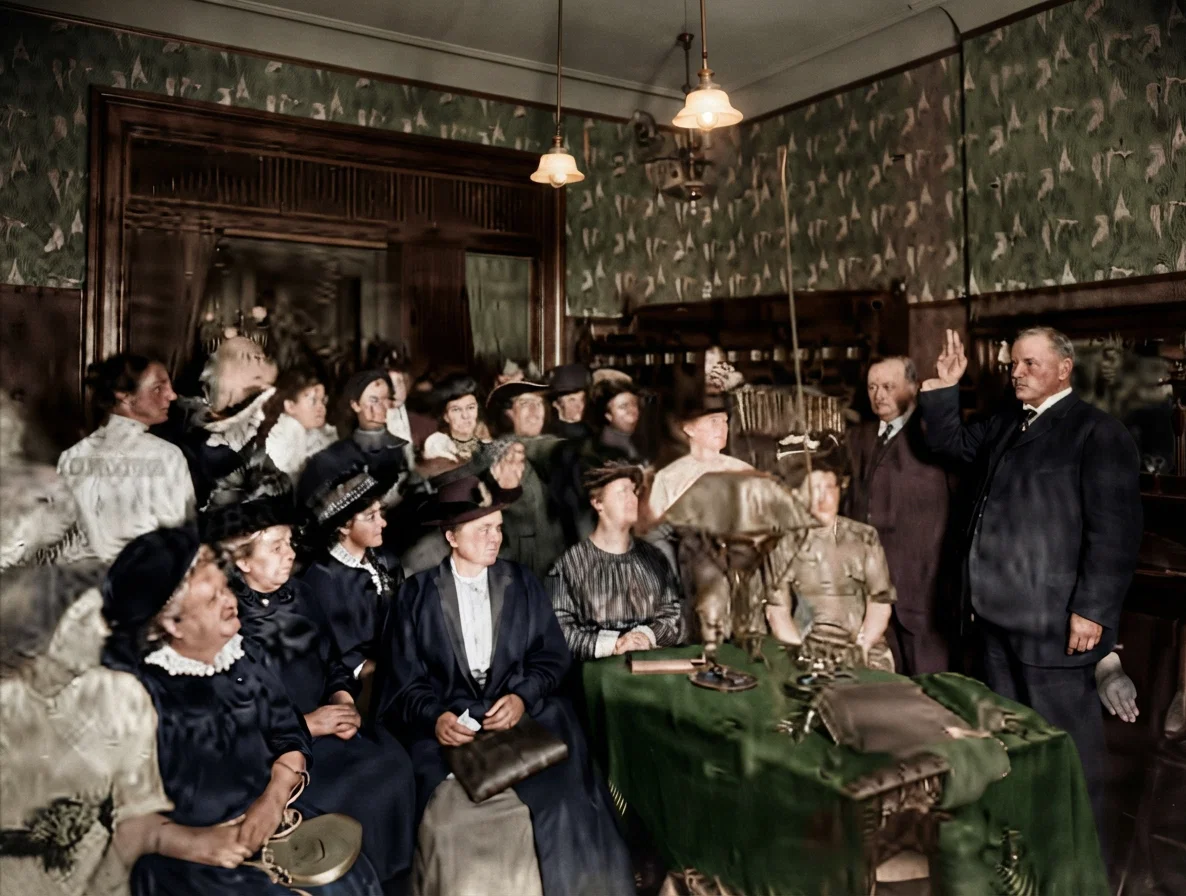
Referring to "Mr. Stead and Spiritualism," an article on page 10, we note also that another person in Washington, D. C., has received a message from Mr. Stead, or rather from a spirit who professes to be the spirit of Mr. Stead. We may safely set down all these real messages, if they are such, to the deceptions of satanic agencies.
Photo by Paul Thompson, N. Y. ELIMINATING THE MIDDLEMAN
Wealth and Its Use.— From a property standpoint, we suppose that those who have money may spend it in any way they please; but from a social standpoint, it is questionable. One of the things which is increasing the discontent in the world at the present time is the lavish expenditure of wealth on the part of those who possess it. Just recently, in one of the most sumptuous hotels of New York City, was given a luncheon party for a dog; a Pekingese spaniel was host, and seven other dogs of like social rank were guests. Each dog had his "chaperon," a lady of wealth. The repast was prepared by the chef of the hotel, served by well-

You have reached the end of this edition.

Signs of the Times · Jul 9, 1912