Your ShelfYour Projects

The Youth’s Instructor, Vol. 64, No. 6.

Huerta's Death and Mexico's Turmoil

The Youth’s Instructor

Feb 8, 1916

Review and Herald Publishing Assn. · Takoma Park Station, Washington, D. C. · Feb 8, 1916

Huerta's Death and Mexico's Turmoil

GENERAL VICTORIANO HUERTA, former dictator and provisional president of Mexico, died at El Paso, Texas, on January 13. He left as his dying testimony that he forgave all his enemies.
SEVENTEEN Americans were murdered by Mexicans on January 12. Within a short time two of General Villa’s officers implicated in the affair were captured by Carranza’s men, and punishment was meted out to them.
TWELVE nations are now involved in the European war; namely, Germany, Austria, Turkey, and Bulgaria on one side; and Great Britain, France, Russia, Belgium, Serbia, Japan, Italy, and Montenegro on the other.
MRS. KATHERINE B. DAVIS has been appointed by Mayor Mitchell of New York head of the Board of Parole, at a salary of $7,500. One of the most important functions of the new Parole Commission will be to make the rules and regulations under which prisoners earn their parole.
THE entire membership of one of our Russian churches, near Riga, has recently been banished. The government edict included the men, women, and children, one hundred persons. This was a church with an unusually well-educated and strong membership. It is to be hoped that their banishment will result in greatly extending the gospel message.
DR. BRAZIL, of Sao Paulo, Brazil, is the head of the largest snake farm in the world, and also the greatest authority on snake bites and their cure. Brazil is infested with venomous snakes, which take a heavy toll of life every year, and on his farm, by inoculating mules and making serum, Dr. Brazil works out a cure for the poison of each variety of snakes in the country.
THE butternut tree has been found to be a weed exterminator. Ten years ago a Vermont valley estimated to contain five thousand acres, was completely covered with shrubby cinquefoil, or five-finger. The roots of the butternut have been found to exert a deadly effect upon this plant; so the best way yet discovered to combat this serious pest is by the planting of butternut trees.
EARLY in January Mr. William Hearst directed all the newspapers controlled by him to reject all whisky advertisements, and all advertisements of medicinal preparations containing alcohol or opiates in habit-forming quantities. This action, it is claimed, will cost Mr. Hearst a million dollars in advertisements. He has directed his editors to espouse the prohibition cause more energetically.
The ruins of the great fire that last year destroyed Mr. Edison’s valuable laboratory led to his latest invention, that of a portable storage-battery searchlight. This effective light is always ready for use, can be handled by one man, and is of great value in rescue work where the regular lighting system has been disabled. It does not deteriorate from lack of use, as in the case of the batteries in electric vehicles. Mr. Edison thinks the light will not only be of use in case of fire, but can be employed in ordinary factory service, excavations, track construction, and mine illumination.
WHEN Samuel Clemens (Mark Twain), at the age of seventeen, left his home in Missouri and went to New York to work in a printing office, his sister asked him in a letter where he spent his evenings. In his reply he said: “You ask where I spend my evenings. Where do you suppose, with a free printers’ library containing more than four thousand volumes within a quarter of a mile of me, and nobody at home to talk to?” Is this the way you would have spent your evenings had you been in this young man’s place? The way you spend your evenings now is the true answer to this question.

Effects of Missions on the Eskimos

WHEN the first Moravian missionaries visited the Labrador coast in 1764, no Eskimo Rajak could be trusted within gunshot. Murderous bands would go for hundreds of miles in summer to the southern part of the coast, where under cover of fog or night they would suddenly approach a lonely fishing schooner. If they found themselves in the majority, they would draw the dagger, secretly concealed in their left sleeve, and do their murderous work. Today we have not only Christian congregations, but practically a Christian Eskimo nation.
A specially striking contrast between the Eskimo of old and of today is seen in the condition of the aged, the infirm, and orphans. In olden times the relatives got rid of such, mostly by abandoning them on some lonely island. Now the old and sick are well cared for; an orphanage is not needed either, as nearly any one is ready to take an orphan into his house, if near relatives are wanting.—The Christian Herald.

HELEN ROSSER

Dependent

THE mistletoe, the mistletoe, A weak and helpless thing. Dependent on the mighty oak, Of vegetation king. Safe 'neath the branches of the oak, From tempest it may hide; Or, when the summer sun grows bold, In shade it may abide.
The human heart, the human heart, A weak and helpless thing. Dependent on the mighty God, Whence all its comforts spring; And to this God we all may fly From rudest storm to hide, And in the drought of summer time Beneath his shade abide.

HELEN ROSSER

Work With a Will

“WHEN you've work to do, boys, Do it with a will; Those who reach the top, boys, First must climb the hill.”

The Call to Service

MABEL ALSBERGE
GREAT and noble tasks are waiting For the touch of some strong hand; Do not disappoint thy Leader, Thou art numbered in his band. Now the time of test and trial, Soon will sound the bugle call; Be not weary nor disheartened, He will never let thee fall. Ever, 'mid the roar of conflict, Follow where his banner leads; Pure in heart, his strength sufficing Shall be given for thy needs.
All around thee foes are lurking, Foes without and foes within. Strong thy arm, and high thy courage, True thy heart, if thou wouldst win. But thy weakness He will strengthen,— Only take him at his word; He will gird thee with his armor, And will buckle on the sword. Go, then, forth into the battle, To the thickest of the fray, And remember he has promised, “I am with you all the way.”
Then, when conflicts all are over, And the victory is won, To the strains of sweetest music, Christ will call his warriors home. Thine will be the victor’s laurels, Thine the crown of shining gold, And before thy raptured vision Wondrous glories will unfold. Robes of white will then be given For thy battle raiment scarred. Hark! the sound of harpers harping Seems to float down through the blue; Soon the pearly gates will open, And the ransomed will pass through.

Builders and Their Houses

HARRY MC WHINNY
A RICH nobleman decided that he would make a visit to a far country. Mark 13:34. He called his servants together, giving them each a special work to do, and told each one that he might build a house for himself on his master’s property. The nobleman, however, made one condition. It was that the servants must follow out specifically his plans in building their houses. Then these houses would belong to the servants, and they would share in the inheritance with their master. Rom. 8:17. But if any of them disregarded the nobleman’s instruction, he would not only lose his house, but become an outcast.
Now these servants entered into their work with much zeal and enthusiasm. Each went to his allotted piece of land, and began to dig for the foundation of his house. The specifications said that the foundation must be built entirely on solid rock, nothing else would do. And so they worked. However, I noticed some were finishing before others. When I drew nearer, I found their houses built on the rocks of reason, and the walls of the house composed of various beautiful stones of common sense.
Upon asking one of the servants why he built his house in this manner, he replied by saying he had lost confidence in his master’s instructions, and decided that he would build his shelter quickly in case of storm. “Besides,” said he, “I can build another later on, and give more time to it.”
Then I thought, “Poor servant, he is building according to his own logic and reasoning. He thinks he knows better than his master.” I found that many had lost confidence in their master’s word. Here and there a foundation was started which was never finished. Luke 14:28-30.
In the course of time most of the houses were finished. I noticed particularly a servant who had been very careful in his work. His name was True Believer. Next to him lived Mr. Good Enough. One day Good Enough paid True Believer a visit. “I have come,” said he, “to compare notes. They say your house is one of the best on our master’s estate.”
“I have tried in every way to follow the plans,” said True Believer. “I have made many mistakes, and have had to do some of my work over again. But I had confidence in my master’s instructions, and feel sure he will be pleased with my home.”
“Well, that’s the way I feel about it,” replied Good Enough. “I’m glad we can agree on this.”
“If you wish,” said True Believer, “we will begin our tour of my house immediately.” So they first inspected the foundation.
“This foundation took considerable time,” said True Believer. “In some places it goes very deep.”
“Indeed,” answered Good Enough, “you have done very well. In my house I found the rock in about four places (the Gospels). But the rest of my foundation will stand, I’m sure.”
“But have you not followed the instructions completely, Mr. Good Enough? You know the whole foundation was to be laid on the solid rock. My foundation is composed of sixty-six parts, some larger than others, but all rest upon the rock, no matter how deep I had to go. 2 Tim. 3:14-17. This gives me confidence in my master’s word, for I have found the rock in each of these parts.”
“I certainly have confidence,” said Good Enough, “but you know our master is kind and merciful, and I believe he overlooks our faults and mistakes.”
From the foundation they walked toward the front of the house.
“This walk is called the ‘Straight and Narrow Way,’” remarked True Believer.
“Is that so? Why, I named my walk ‘Broadway.’ The name is quite significant, you know.”
As they neared the door, Good Enough noticed several steps leading to the porch.
“How strange!” said he. “I have no steps to my porch. Instead, I used the solid plank of ‘Good Morals.’ That’s good enough for me.”
“Oh,” replied True Believer, “you have neglected to study the specifications. You remember there were several steps. The first one is ‘Repentance.’ This one is very essential. The next is ‘Confession,’ and then comes ‘Baptism.’”
“That’s all well enough if you want it that way.” answered Good Enough, “but I don’t see the need of these steps, particularly.”
“The reason you do not see the need of these steps, Mr. Good Enough, is because you have not looked far enough ahead. Do you see those two doors?”
“Yes.”
“Well, if you notice closely, you will find that one door (Love to God) has four panels, and the other door (Love to Man) has six. Each panel is fitted with a mirror. Now, as I walked toward the doors, I found myself very unclean. Isa. 1:5, 6; 64:6. I had tried to get to the doors in one bound, but fell. I found that it was essential that I take the three steps.”
“Your experience is something like mine,” said Good Enough, “for I became tired of seeing myself looking so filthy, and so broke one of the panels. Soon after another was broken. I have never had them replaced.” James 2:10.
“Well, you should have them made right immediately. You remember our master called them his ‘ten words.’ He spoke them and wrote them as well.”
Now as they entered through the doors, a little sign was seen above them which gave them the right to enter after taking the steps. Rev. 22:14. Good Enough noticed the large windows. They represented the great lines of prophecy which gave True Believer much light. As Good Enough looked through the window of Daniel Two, he exclaimed, “I see that my master is due to return sooner than I expected.”
“Very true,” answered True Believer, “and when you look through these glasses of faith (Heb. 11:1, 6), that look will lead you to be very careful in your building.”
Then True Believer took Good Enough through the rest of the house. He showed him the room called “Sanctuary,” which had given him a better understanding of his master’s purposes and plans than any other part of the house. It was here that he found that he and his neighbors each had a personal case to settle. His master, however, was to be his advocate. 1 John 2:1. Good Enough had no such room in his house, and so had little interest in it.
As they went on they came to the telephone room called “Prayer.” True Believer opened the door, and they both walked in.
“I have a room similar to this,” said Good Enough, “but the phone is always out of order.”
“How unfortunate! Why, this room of mine is one that I use quite often. And the phone system gives me complete satisfaction. And do you know,” continued True Believer in a confidential way, “I can talk to our master whenever I want to; and further, he gives me all that I wish. Matt. 7:7; John 14:13, 14. He tells me to ask without wavering. James 1:6. The trouble with your phone, Good Enough, is that you hang it up before the master has a chance to answer.”
After visiting the rest of the house, Good Enough went home. He tried to make a few improvements on his house, but without success.
Not very long afterward a hard storm struck the estate. The houses built on “logic” and “reason” disappeared one after another. Some of the best stood for a while, but finally they fell with the rest. Only a few houses survived the storm, that of True Believer being one of them.
And then the nobleman returned to visit his servants. Matt. 25:19. Most of them he discharged and disinherited. When he found True Believer’s house still standing (Luke 6:46-49), he said to him, “Well done, thou good and faithful servant: thou hast been faithful over a few things, I will make thee ruler over many things: enter thou into the joy of thy lord.” Matt. 25:21. And so True Believer lived forever with his master, and was no longer considered a servant (John 15:15), but became instead a joint heir with his master. Gal. 4:7; Rom. 8:16, 17.

The Man Who Wins

THE man who wins is an average man: Not built on any peculiar plan, Not blessed with any peculiar luck; Just steady and earnest and full of pluck.
When asked a question he does not “guess”— He knows, and answers “no” or “yes;” When set a task that the rest can’t do, He buckles down till he’s put it through.
Three things he’s learned: that the man who tries Finds favor in his employer’s eyes; That it pays to know more than one thing well; That it doesn’t pay all he knows to tell.
So he works and waits; till one fine day There’s a better job with bigger pay, And the men who shirked whenever they could Are bossed by the man whose work made good.
For the man who wins is the man who works, Who neither labor nor trouble shirks, Who uses his hands, his head, his eyes: The man who wins is the man who tries.
— Charles R. Barrett.

The Fatal Grasp

TRAVELERS who visit the falls of Niagara are sometimes directed to a spot on the margin of the precipice over the boiling current, where a gay young woman some years ago lost her life. “She was delighted with the wonders of the unrivaled scene; and ambitious to pluck a flower from a cliff where no human hand had before ventured, as a memorial of her daring, she leaned over the verge and caught a glimpse of the surging waters far down the battlements of the rocks, while fear for a moment held her motionless. But there hung the lovely blossom upon which her heart was fixed, and her arm was outstretched to grasp the beautiful flower. The turf yielded to her pressure, and with a shriek she descended like a fallen star to the rocky gorge, and was borne away gasping in death.”
Every hour life’s sands are sliding from beneath incautious feet; and with sin’s fatal flower in the unconscious hand, the trifler goes to his doom. “Without remedy,” “suddenly shall he be broken.” Prov. 6:15.
ERNEST LLOYD.

Scourging Jesus

DR. ALEXANDER WHYTE tells the story of a man who dreamed that he saw Jesus tied to a whipping post and a soldier was scourging him. He saw the whip in the soldier’s hand, with its thick lashes studded here and there with bits of lead, which were intended to cut into the flesh. As the soldier brought the whip down on the bare shoulders of Jesus, the dreamer shuddered as he saw the marks and bloodstains it left behind. When the soldier raised his hand to strike again, the dreamer rushed forward, intending to stop him. As he did so, the soldier turned around, and the dreamer recognized—himself. We often think how cruel those men must have been who scourged and crucified Jesus. But whenever we do wrong, we, too, cause the heart of Jesus to bleed with sorrow and pain. — Christian Herald.

Driven to My Knees

I HAVE been driven to my knees many times by the realization that I had nowhere else to go.—Lincoln.

The Malaysian Mission Field and the Philippine Islands
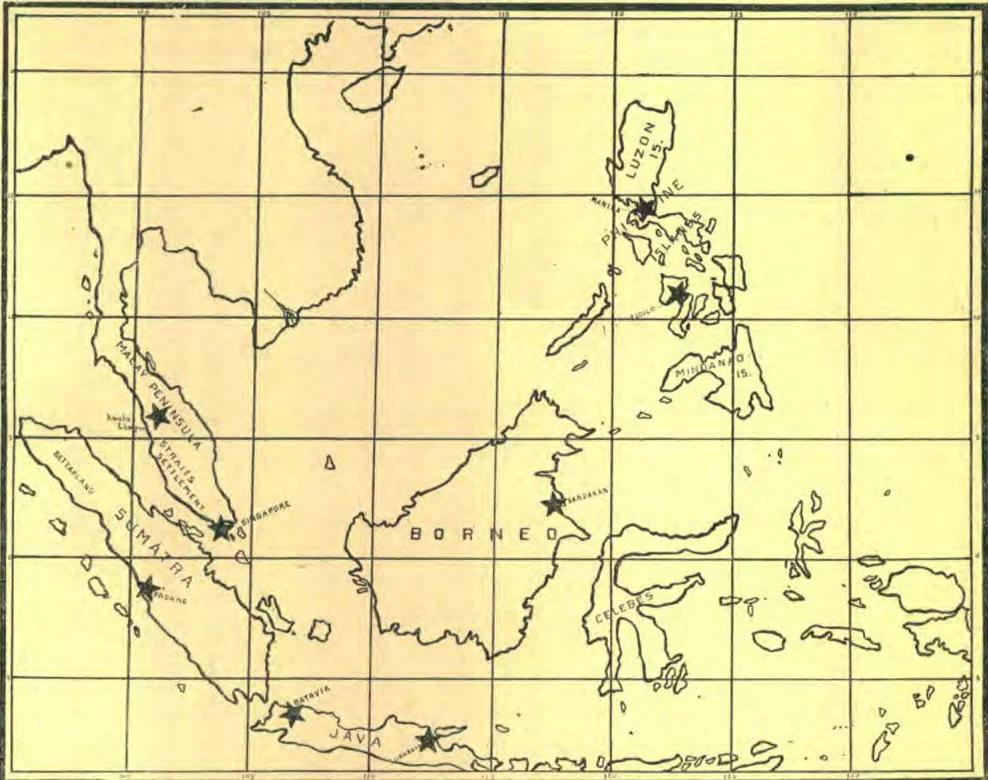
THE Malaysian Mission comprises an area about equal in extent to that of the United States. It includes the Straits Settlements, the Federated Malay States, British North Borneo and Sarawak (under British rule or influence), and the Dutch East Indies (except New Guinea), which are under Dutch control. About fifty million persons, most of whom are Malay Mohammedans, live in this mission field. No fewer than thirty European nationalities are represented, with twenty-two Malay races, ten Indian dialects, and twelve Chinese dialects.
A little further study of this interesting territory will be profitable.
1. The Straits Settlements.— This territory is under British control. It takes its name from the fact that it is “made up of detached blocks of land along the Straits of Malacca.” It includes,—
MAP OF THE MALAYSIAN MISSION FIELD AND THE PHILIPPINE ISLANDS
“a. The island of Singapore, at the extreme south end of the peninsula.
“b. Malacca, a strip of land on the west coast of the peninsula about one hundred miles north of Singapore.
“c. The Dindings, a piece of the mainland and a number of islands 350 miles north of Singapore.
“d. The island of Penang and Province Wellesley, a strip of territory opposite Penang on the mainland, 480 miles north of Singapore.”
2. The Federated Malay States.— “The remaining territory of the Malay peninsula is divided into nine states, all under British protection. Four of these have united under a federation by which they are known as the Federated Malay States. By special arrangement Great Britain administers the governmental affairs of these federated states. The other five states are separate and independent. They have placed themselves under British protection, but each administers its state affairs, under the advice of British counselors.”
3. British North Borneo.— This is a territory comprising 31,106 square miles in the island of Borneo. The capital is Sandakan.
4. Sarawak.— A British protectorate comprising 55,000 square miles in Borneo. The capital city is called by the same name.
5. Dutch East Indies.— This territory includes parts of Java, Sumatra, Borneo, the Celebes, and other islands.
Our work in the Malaysian Mission field is operated in six divisions,— the Straits Settlements, the Federated Malay States, Sumatra, West Java, East Java, and British North Borneo. From the first it has been carried forward under very adverse conditions and often against open opposition. The health of the workers has failed, some have had to leave, and others have struggled on faithfully when they were sorely in need of rest. While the results are comparatively small for the time and effort and money expended, it is good to know that in this distant field there are hearts that thrill with the same joy that a knowledge of this truth brings to us. During the last few years the work has been better established and organized, and advance is being made.
In the fall of 1913 the believers used the Harvest Ingathering Review, and obtained over $400 gold from 1000 papers. The membership has nearly doubled in the past two years. The leaders are seeking to awaken the true missionary spirit among the members, realizing that often the natives can reach their friends where a foreigner would be powerless. In Singapore a Missionary Volunteer Society has been organized, both young and old taking the Reading Course and studying the Standard of Attainment subjects. Some begin to pay tithes before they become members. One man who was baptized at Kuala Lumpur sent Brother Detamore a money order for $16 (Straits money), of which $11 was tithe, the first he had paid, and $5 was an offering for the opening up of the work in the Solomon Islands.

The Philippine Islands

This field was first entered in 1906, by Brother R. A. Caldwell, who came to sell books. Evangelical work was begun in 1907, by Pastor J. L. McElhany, but for only the English-speaking residents. In December, 1908, Pastor and Mrs. L. V. Finster entered the field, and began work for the native people. The blessing of God has attended the efforts made, and the workers are full of courage. The following description of the mission stations under which work is now being carried forward is abridged from the report given by Brother Finster to the delegates at the general meeting of the Asiatic Division, held in Shanghai in the spring of 1915:—
“Until the latter part of 1913, our work had been confined to the Tagalog provinces, in and around Manila, but with the arrival of new missionaries at this time, we were able to open up work in three new languages.

“The Ilocano Mission

“This mission includes the provinces of Ilocos Norte, Ilocos Sur, Abra, and Union. Pastor Roy Hay and family went to Vigan, Ilocos Sur, to study the language and find an opening for our work there. They have been very busy on their language work and in preparing several tracts in the native language. The Lord has also blessed them with three converts, and many others are earnest listeners. The Ilocano people are among the brightest and most stable of the Filipino tribes. Pastor Hay reports many openings for work. In one of his recent letters he reports a man who, having heard that Pastor Hay kept the Sabbath, walked twenty-five miles to his home to study more of the truth.

“The Cebuan Mission

“The islands of Cebu, Bohol, Occidental Negros, Leyte, and Oriental Negros are included in this mission. The languages of the different islands vary but little. Dr. and Mrs. Carlos Fattebert, assisted by Robert Stewart and his wife as colporteurs, are working among the 2,000,000 people of these islands. Dr. Fattebert is located at Argao, and Brother Stewart at Cebu. The doctor's medical work has been well received in Argao, and his dispensary receipts have paid about forty per cent of his salary and expense. His knowledge of Spanish has been a great help to him in his work and in learning the native dialect. He is now able to hold services in the native language. A large number of tracts have been prepared, and our press is now finishing an abridged edition of ‘Thoughts on Daniel.’ There are now eight or nine Sabbath keepers here, and many inquirers.
“Brother Robert Stewart has devoted his time to placing our medical books in the homes of the people. The Lord has richly blessed him in this seed sowing, and he has found interested persons in many parts of the islands.

“The Iloilo Mission

“The people of the islands of Panay and Occidental Negros form this mission. The language is quite similar to the Cebuan. Brother Floyd Ashbaugh first entered this field in 1912 with our literature, and placed many of our books in the homes of the people. These books created many openings, and helped to prepare the field for the arrival of Pastor E. M. Adams and his family in 1914. They have located in Iloilo, in the southern part of Panay. Pastor Adams has had as helpers Fausto Jarnadal and Wenceslao Rodriguez. Just before coming to this meeting, Pastor Adams baptized eleven and organized a church of sixteen members. We are very glad to receive the report of this our first church among the Visayan people. They have prepared several tracts in the native language, and have an abridged edition of ‘Thoughts on Daniel’ about ready for the press. Pastor Adams reports the field more than ripe for the harvest, and many more calls for help than they are able to fill.

“The Tagalog Mission

“This is the oldest mission and the headquarters of our work. The working force consists of Brother and Sister W. E. Lanier, the writer and his wife, four Filipino evangelists, one Bible worker, and two Filipino Bible women. Nurse Blodgett has also been able to render much help to the sick.
GAVAREN PERIAUNAN
GAVAREN PERIAUNAN
“We have started a small printing plant for publishing native tracts, papers, and books, and during the past year have printed the following: 50,800 pages in Ilocano tracts; 51,200 pages in Cebuan tracts; 44,000 pages in Panayan tracts; 240,000 pages in Tagalog tracts; 468,000 pages in monthly papers; 60,660 pages in Sabbath school lessons; and 780,000 pages in Tagalog new book. We have also bound about two thousand books in our bindery. Brother W. E. Lanier has charge of the printing work.
“Our first mission home was completed in July. Our first church was erected in Malolos last January. There have been more than one hundred baptisms during the year, and the present membership is about two hundred eighty-five. Our literature sales will reach $5,000, and the tithes about $1,400, as compared with $557.76 last year.”
A missionary society has been organized, and an active interest in this work is being taken by the church. The believers are faithful in tithe paying, and at present the native tithe pays sixty per cent of the native wages and expenses. The Sabbath school work has been well organized, and the offering increased from $75.57 gold in 1913, to $189 gold in 1914.
The table on page six may lack a few details, but we have used the latest and most accurate information at hand, and believe it will be a help in fixing in mind the points at which work has been done, the location of the workers, and something of results accomplished. It is well to remember, however, that results are not always to be measured or counted or weighed. Eternity alone will show them as they really are.
A. B. E.

TABLE SHOWING WORK AND WORKERS IN THE MALAYSIAN MISSION FIELD

NAME OF STATION YEAR ENTERED WORK WORKERS IN CHARGE OTHER WORKERS RESULTS
SUMATRA
Padang 1898 Evangelical Mr. and Mrs. J. S. Yates Mr. and Mrs. B. Judge Church
Battakland 1912 Schools Immanuel Siregar Brother Shin Schools
STRAITS SETTLEMENTS
Singapore 1904 Mission headquarters Evangelical School F. A. Detamore Roy Mershon K. M. Adams Mrs. F. A. Detamore Mrs. Roy Mershon Lawrence Fox Chan Teck Sung Mr. and Mrs. C. M. Lee R. A. Chinnappah Lo Khi Kwong Mr. and Mrs. Rantoeng Good church, 85 members Church building Training school
JAVA
Surabaya 1907 Evangelical Mr. and Mrs. G. A. Wood Mr. and Mrs. J. Van de Groep Church
Batavia 1909 Evangelical Miss P. Tunheim Richard Sisley Bella Fox Petroes Longgo Emma Brouwer Good church Believers
Soekaboemi Publishing
Semarang School
Bandong
FEDERATED MALAY STATES
Kuala Lumpur 1911 Evangelical G. A. Thompson Mrs. G. A. Thompson A. R. Duckworth Wong On Tong Small church
BRITISH NORTH BORNEO
Sandakan Jesselton 1913 Evangelical Mr. and Mrs. R. P. Montgomery Wong On Tong Tsen Shaw Tsz Chan En Fook Kong Tsun Min Good church Believers

TABLE SHOWING WORK AND WORKERS IN THE PHILIPPINE ISLANDS

TAGALOG MISSION — Manila | 1906 | Mission headquarters; Evangelical; Publishing; School; Nursing | L. V. Finster | Mrs. L. V. Finster; Mr. and Mrs. W. E. Lanier; Native workers | 3 churches; 5 companies; Training school
ILOCANO MISSION — Vigan | 1914 | Evangelical | R. E. Hay | Mrs. R. E. Hay
ILOILO MISSION — Iloilo | 1914 | Evangelical | E. M. Adams | Mrs. E. M. Adams; Fausto Jarnadal; Wenceslao Rodriguez | Church
CEBUAN MISSION — Argao | 1914 | Evangelical; Medical dispensary | Carlos Fattebert, M. D. | Mrs. C. Fattebert
Cebu | Colporteur | Mr. and Mrs. Robert Stewart

A Noble Example

GAVAREN PERIAUNAN, whose photo is shown, was born in Madras, India. As is common among the people of the East, he is not sure of the exact date of his birth, but he thinks he is now about seventeen years of age.
When Gavaren was a small boy, his parents, who were of the Tamil race, left India and came to Africa, landing at the port of Durban. The little boy Gavaren was left in India with his grandmother. Shortly after arriving in Africa, Gavaren's father, who was an idolater, hired himself to a gentleman for a period of five years, which time he served faithfully. At the close of this period he returned to India, and on his return brought to Africa his young son. Then he with his boy entered upon a five-year contract with a faithful Seventh-day Adventist brother living near Ladysmith in Natal.
At this home the parents and the little children of the family, Gavaren with the rest, were brought in contact with the present truth, and came for the first time in close touch with a Christian home. While the father, mother, and other children during this five years of service did not seem to be especially affected by the religion of Christ, it was different with the little boy Gavaren. In his heart the gospel seed took root, and he determined to be a Christian, to serve God, and obey his law. The brother whom he and his parents were serving, bought Gavaren a Tamil Bible, which he delighted to read, and in which he found food for his hungry soul. In this Bible he learned more fully of the way of life; he read of the great sacrifice Christ had made in his behalf, and in it he read for himself that the Seventh-day is the Sabbath and should be kept holy unto the Lord. These truths settled down into the heart of this Indian boy, and he decided to yield himself fully to Christ.
All went along quite well while the family was in service to our Seventh-day Adventist brother, but on the expiration of the five-year contract, the family returned to Durban. Here, in the midst of an idolatrous community, Gavaren was called upon to stand alone for Christ. Now came the great test. His father and mother told him plainly that he could not be a Christian, that in doing so he would not only ruin himself but them as well, and that he must relinquish his foolish notions about Christ and the Christian religion. But Gavaren, though only a young boy, remained true to principle and true to the Saviour.
When his parents saw his determination to be a Christian, they and their relatives were furious, and taking the boy's Tamil Bible from him, they trampled on it, and burned it to ashes. This was a great loss to him, for he loved his Bible, from which he was daily drawing so much to encourage and strengthen his heart; but now it was gone, and he was well-nigh broken-hearted. But Gavaren remained firm, and was not to be moved from his faith in Christ.
In every possible way his parents tried to lead him back to idolatry and to the worship of the temple gods, but the boy steadfastly refused. The supreme test came one evening when his father brought into the house an ax, newly sharpened, and told his son that if he did not go to the temple and worship the gods, he would soon be killed. But in the face of even this severe test Gavaren remained steadfast and true to Jesus. The threat to take his life was not carried out, but scorn, derision, and abuse of every description was heaped upon him by his relatives and the Indian community of Durban.
Boston Photo News Co., Boston, Mass.
Gavaren now planned to obtain the necessary traveling permit from the authorities, and to escape from home and go where he could in peace serve the Saviour whom he loved. This he successfully accomplished, and returned to the home of our Sabbath-keeping brother. Here he found a welcome, and he remained until he entered our Zulu Mission school, where he is at present.
Gavaren's great desire is to get an education so he can read our literature, and thus learn more of the present truth, and then, when older, do something to bring the truth to his people. This seems to be his all-absorbing desire, and to this end we shall give him all the assistance possible.
He was named Gavaren after a god in the temple, but he has now changed his name to Peter, refusing to bear the heathen name longer. Surely there is power in the religion of Christ to change the heart and to transform the life; and there is keeping power with God to hold the soul in times of storm and stress. This transforming power is going on in many hearts here in the Dark Continent, and for this we thank God and take courage in our work. W. B. WHITE.
Continue reading: Clambering Over People