The Youth’s Instructor, Vol. L, No. 2

HOVERING ANGELS

The Youth’s Instructor

January 9, 1902

Review and Herald Publishing Company · Battle Creek, Mich. · January 9, 1902

HOVERING ANGELS

ANGELS round us, angel bands Guarding us with holy hands, Angels near us,— could we see, We would know their ministry; Angels o’er us,— what a world In the silences unfurled! Angels hover everywhere, Guarding all with gentle care.
When the bird the wave has dipped, And our feet have almost slipped, When we stumble in the way, And it seems a weary day, Lo! swift messengers of light Make the changing vision bright; And, to greet our heavy eyes, Glory lights the arching skies.
Read it,— thus the record stands,— Up they bear thee in their hands, Saving thee from danger’s snare, Watching o’er thee everywhere. So God’s ministers of love Guard us for the life above; Yet man knows not that he stands ’Neath the hovering angel bands.
B. F. M. Sours.

THE ROYAL CHINOOKS

THE Prince and Princess of Chinook were born under more auspicious circumstances than their ancestors for many generations back had been. The former princes and princesses had been accustomed to fight and flee for their lives from their earliest infancy, and many of them were destroyed by their enemies before they reached an age at which they were able to protect themselves. But the Chinook family was a prolific one, and despite the great mortality among their youngest children, the family continued to grow larger each year.
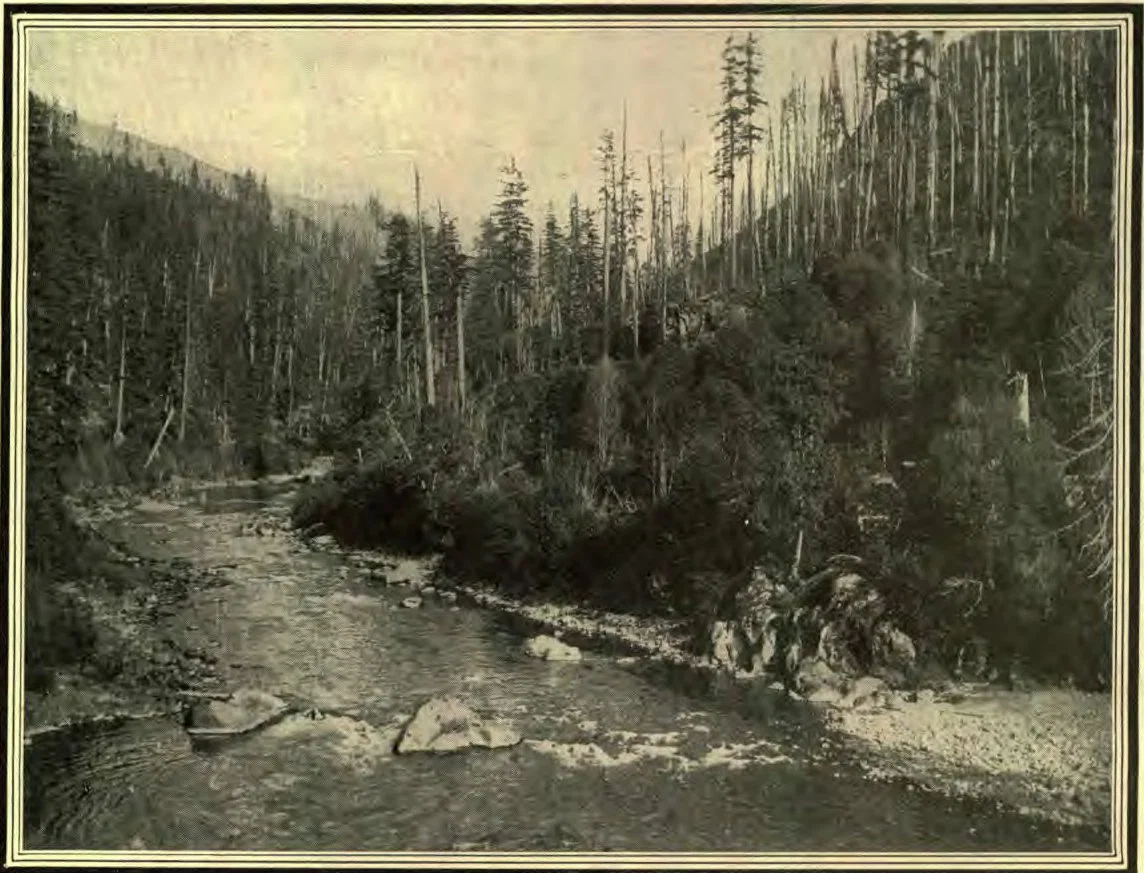
A FAVORITE SPAWNING-GROUND OF THE ROYAL CHINOOKS
The custom of the family was that as soon as the children reached a vigorous youth, they should be sent abroad to remain till they were mated; and each year brought a company of brides and grooms back to their old home. On such occasions, few of their old enemies would molest them; for the full-grown Chinooks, dressed in their bright silver armor, were rather formidable looking. But they had a new enemy, one whom they had never met before, and whose traps and snares were all strange to them. This enemy was strong and cunning, and against him the poor Chinook that he marked for a victim was almost defenseless. He was a cannibal creature, and used the bodies of his victims for food. For ages he was the hereditary enemy of the Chinook family; but for ages he was satisfied when he had secured enough of their bodies for his present wants.
Finally, however, one of these creatures discovered a method by which the bodies of the Chinooks could be kept from decay for an indefinite time. Then they conceived the idea of sending the canned Chinook salmon to their brother cannibals, some of whom lived thousands of miles from the haunts of the Chinook family. That called for a greater supply than could be secured in the old ways; but as soon as the demand existed, men set about to devise new methods of securing the supply.
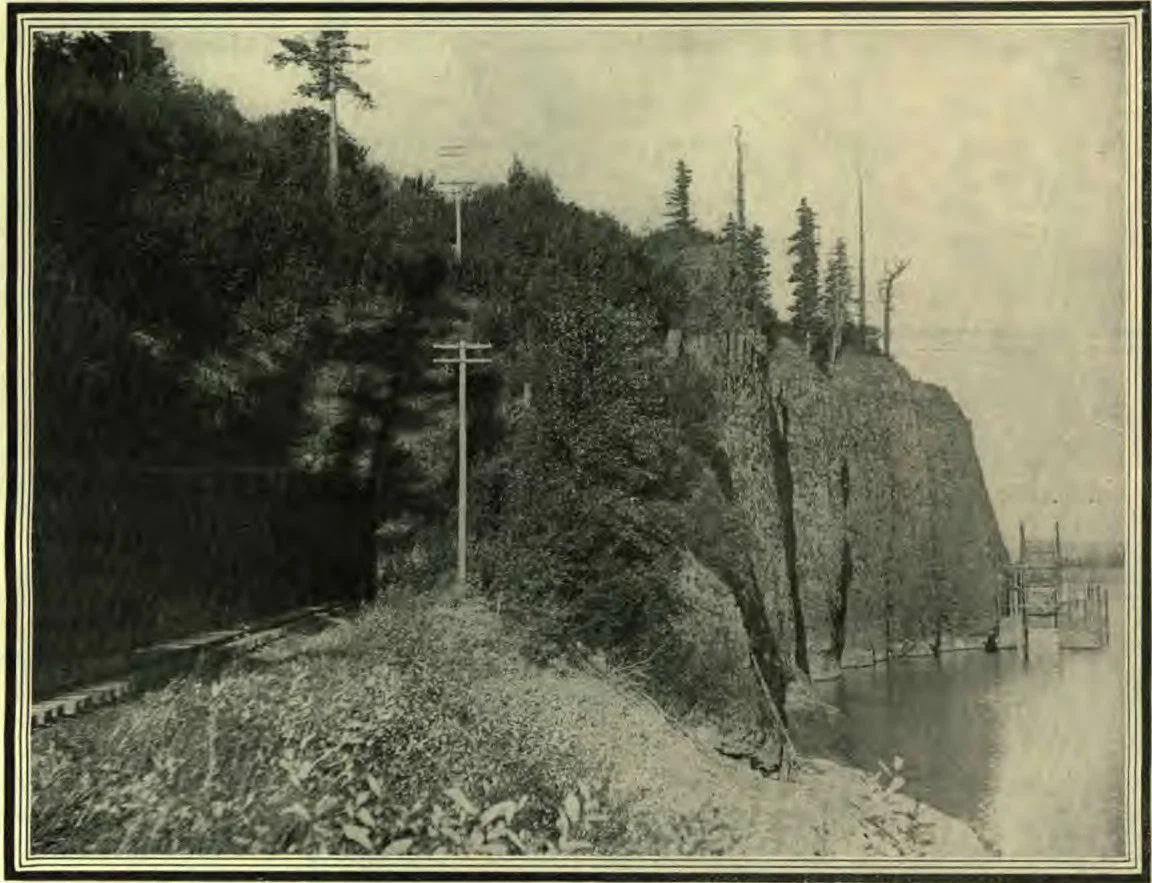
FISH WHEEL (ON EXTREME RIGHT) ON COLUMBIA RIVER.
When the young parties began to arrive from the sea, they found the shallow water near the mouth of the river patrolled by their pitiless enemies, who were constantly stretching out seines in a semicircle, and drawing them to the shore, where the poor Chinooks that they inclosed were left to die upon the sand. Many escaped the seines, only to become entangled in the nets of the fishermen who were stationed above. If these also were passed in safety, and the fish succeeded in reaching the swift water of the upper river, they were met by a new danger,—the fish-wheel. This was a V-shaped inclosure built in shallow water near the shore. The open end was pointed down the stream, and at the other end was anchored a wheel something like the paddle-wheel of a steamboat. This wheel was kept in constant motion by the current of the river, and being armed with dip nets, it scooped up all the fish that came within its reach, and dumped them into a scow behind it. The few that escaped these almost ubiquitous traps were assailed by men who, armed with barbed spears, stood in the rapids, or beside the waterfalls near their spawning-grounds.
Not many, alas! of this royal family were able to run such a terrible gauntlet, and deposit their eggs in a favorable place near the source of some stream. Every couple that did succeed would leave from five thousand to fifteen thousand eggs; and if all these had hatched, and the young grown to maturity, there would probably have been no diminution of the supply. But many fishes, birds, and quadrupeds consider salmon eggs a dainty titbit, and devour them without compunction. After the young are hatched, they are very delicate; and for the first few weeks the slightest injury is fatal, even if they succeed in escaping from their enemies.
Under so many unfavorable conditions, it is no wonder that the “runs” became smaller and smaller every year, and men began to fear that the species would soon become extinct.
“We must build fish hatcheries,” they said, “where we can guard the eggs, and protect the young till they are able to care for themselves.” So they set to work to carry out this plan.
Across a stream where the salmon were wont to run, they built a dam twenty feet high,—higher than the strongest fish could leap. When the royal Chinooks reached this dam, they could go no farther. They would not turn back; for instinct impelled them to strive to continue their course up the stream till they reached a favorable spawning-ground. To them the dam was virtually a prison, from which they could not escape. There they were allowed to remain till they were ready to spawn, when they were seined out, and robbed of their eggs. These eggs were deposited in long troughs, where they were supplied with an abundance of water that was always kept at just the right temperature. In thirty-five days the young salmon began to appear. So successful was this plan, that very often fully ninety per cent of the eggs secured became sturdy little fish, well able to care for themselves, before they left the protecting walls of the hatchery.
It was under such circumstances as these that our Prince and Princess of Chinook were born. They were only about half an inch long, and what they could see of the big world looked so terrible to them that they wanted to dive down under something and hide. But there were thousands of other baby princes and princesses in the same trough, and nothing for any of them to hide under; so they tried to hide under one another. In a few weeks, however, they learned to distinguish between animate and inanimate objects; though they still thought that every moving thing was a foe, from which they must flee to the deepest and darkest place they could find.
In two months they had grown to be handsome little creatures fully an inch long. Their bodies were cigar-shaped, but plump and symmetrical; and their silver sides were crossed by nine dark bars, which seemed to add the finishing touches to their delicate beauty.
About this time a man came to the hatchery with an order for ten thousand of these baby salmon to be planted in a distant stream. The order read Oncorhynchus chavicha; but the man in charge knew that these words meant Chinook salmon, and proceeded forthwith to dip the requisite number from the trough where our prince and princess were playing hide-and-go-seek. They were terribly frightened to be dumped unceremoniously into a big tin can, and they tried their best to find some place to hide. But presently the can was covered up, and when they found themselves in darkness, they were not so frightened.
They had been in the can but a short time when the water began to get foul; and before they were given a fresh supply, the princess was so nearly suffocated that she was floating on the top of the water gasping for breath. After that, however, the man who had charge of them was more prompt about renewing the water, and though they often wished themselves back in the hatchery, they were quite comfortable. They were beginning to wonder if they were always going to be kept there, when the cover was taken from the can, and they were gently turned into a big stream of pure, sweet water. Then the prince and the princess darted away together, and hid in the shadow of a great rock.
It was a pleasant place, with many hiding-places and plenty to eat. They were hungry, so they glided out of the shadow of the rock, where they had taken refuge, and began to eat. But before they were half through, the prince saw something big rushing through the water toward them. “Look out!” he cried. And with a quick flit of their powerful little tails, they were back in the shadow of the friendly rock, where the big fish could not reach them.
The whole winter passed, and the prince and princess had grown to four inches in length, and they began to be dissatisfied with the little stream where they lived. One day while they were resting beside the big rock, the prince said: “I have noticed that the water is always flowing past here in the same direction. It must be a big place where it all goes. I wonder what it is like.”
“I have often thought of that myself,” said the princess; “suppose we go down, and see where it goes.”
“Do, young folks,” said a big king salmon, who, in passing up the stream, overheard the conversation; “by all means go to sea.” Neither of them understood the joke, but they thought that they were encouraged to go. They would have liked to ask some questions of the incoming salmon; but though they were a prince and princess, they felt rather timid about approaching the big kings and queens, and finally concluded to go and see for themselves. On their journey they saw so many strange and beautiful sights that seemed to bid them linger that they were a long time in making their way to the sea,—so long that they had grown to twice the size that they were when they started.
“We are getting so big,” said the prince, as they left the fresh water, and began to swim over a bed of gorgeously colored seaweeds, “that we don’t need to be afraid any more. There are not many things that are big enough to eat us now.”
But just then they looked up, and saw a monstrous creature rushing toward them with its mouth wide open, showing two rows of great white teeth. Quick as a flash they were down among the seaweeds, where the shark could not reach them.
“Oh, wasn’t that a dreadful creature!” gasped the princess, trembling with fear.
“Yes,” answered the prince, not a whit less frightened; “it was ten times as big as the biggest sturgeon I ever saw.”
“Let’s go home,” sobbed the princess.
“All right,” consented the prince, “but we can’t start now; for that big thing is up there waiting for us.”
But presently the “big thing” moved away in search of less agile prey; and with its disappearance their courage came back, and finding an abundance of tempting food scattered about among the seaweeds, they soon concluded to stay in their new home. After that they grew rapidly.
By and by came the time when they were quite grown up, and one spring morning they started on their homeward journey.
How happy they were as they darted through the sweet, cool water of the river, or leaped into the air to describe a graceful curve and disappear beneath the surface again! Perhaps they would not have been so happy had they known that this journey was to end in death. Yet so it was; for even had they escaped the nets and traps with which the river was lined, and reached their spawning-ground in safety, they would have died on the return journey; for salmon spawn but once.
They were in the middle of the stream when they passed the seining-grounds, so that danger was passed. Once the king became entangled in a net; but there was a weak spot in it, and a few vigorous strokes of his powerful tail broke several of the strings, and set him free. Once the queen was struck by a spear; but the spearman was a novice, and she received only a slight wound.
When the journey began, they were careless, happy, and frolicsome; but by the time they were two months in the river, they had sobered down, and were swimming more industriously. They had tasted no food upon the journey; and though they were abundantly supplied with surplus blood and fat when they left the sea, the long fast was beginning to tell upon them. They were now anxious to find some suitable place where the queen could deposit her eggs, and were swimming close to the bank of the river in search of the mouth of a smaller stream, when they suddenly found themselves in a passage that grew narrower as they advanced. But presently they saw an opening ahead, and darted through it—only to be scooped up in one of the nets of a fish-wheel. They lashed the net with their tails in their frantic efforts to escape; but the net was made to withstand just such struggles as theirs, and slowly the pitiless wheel lifted them higher and higher in the air. By the time the net that held them reached the top of the wheel, their strength was exhausted, and they lay gasping for breath, but struggling no longer. Then as they began to descend, they thought that they might be again restored to the water. But in a few moments they were dumped into a scow on the top of a great heap of dead and dying salmon.
Thus ended the lives of two Royal Chinooks.
J. EDGAR ROSS.

TALKS TO OUR BOYS

II
When boys make up their minds to become something, it is a good plan to think how to begin. You know how easy it is to do something we have done many times, and often what a strong desire one has to repeat an act once performed. There seems to be an exception to this rule, however,—when a boy first gets on skates. Any boy can fall down without effort, and even without learning how. The rub comes when he tries to stand up. It usually requires little effort to learn to do something that would be better undone.
But our actions, especially our best actions, depend largely on our habits—what we have done before. The human mind is so constituted that it refuses to go outside of regularly beaten paths unless compelled to do so. What a boy does for a number of times in youth, he is almost sure to do throughout his life. This being true, I wish it could be impressed on the mind of every boy how important is everything he does. Few boys think seriously while they are young. This is one reason so few become truly great men. They form their habits before they have learned to think; and when they become of thinking age, they are bound by these habits. Even if they succeed in breaking away from them, evil habits still strongly influence the future life and thought. A boy who has any desire to become a manly man should learn to think while he is young.
One of the first things a boy should be careful to cultivate is the habit of punctuality. I am sadly too well acquainted with one boy who always would say, “In a moment,” or, “Pretty soon,” or, “By and by,” when asked to do anything,—and, as likely as not, he would never think of it again. Even if he remembered, he would not attend to it till he had waited a few moments. He did not intend to be disagreeable or slack; but the effect of this bad habit can yet be seen in his everyday life, though he has fought against it for years. Many boys are forming the habit of “waiting a while” before doing anything they are told. They mean no harm, but it is so easily done. The sure result will be men who are not punctual, who never attend strictly to business, who accomplish nothing. Be up and doing! Move immediately! Dynamite would be no more valuable than so much sand, were it not that it acts, and acts quickly. When lightning strikes, it makes an impression.
I will mention another thing (some of you may call it a “little thing,” but please wait a moment) that has a great influence on the after-life of a boy,—the habit of cleanliness.
Small boys are apt to fall into the way of not bathing as often as they should. I have even known barefoot boys to go to bed without washing their feet,—provided mama did not know. Such a boy will not make an honest man unless he reforms. Do you wonder why?—Because he does not act from principle. When mama is watching, he always “cleans up;” but if “no one knows,” he doesn’t care.
Did you ever think, boys, that the person whose respect you most need is yourself? Live as long as you may, travel to the ends of the earth if you will, and you will never find any one else who will help you half so much if he thinks you are a man, and are honest; but who, if he knows you are a scoundrel, will not let you succeed if you try.
Another thing: any one who is not particular about keeping clean, who allows himself to become careless, slovenly, and lazy, will carry those characteristics into everything he does, and will finally become wicked and dishonest. Then be clean, boys! Keep the dirt from under your nails, brush your teeth, keep your hair smooth. You will find, as you grow up, that you will have much more influence with people if neatness and cleanliness are a part of your character; better still, you will respect yourself more. Clean boys make clean men. Often a poor boy, friendless and unrecommended, has obtained a favor or even a position, simply because he kept himself tidy, and looked like a gentleman.
Cultivate courtesy. Be polite to one another in your play. It is just as easy, and it shows you so much more a man. But especially be thoughtful, gentle, and respectful to old people. Nothing lifts a boy more in the estimation of any one whose good opinion is worth having, than to see him considerate of the feeble, the unfortunate, and the aged. I always think such a boy has a heart somewhere about him. He may have a ragged coat, a freckled face, and no shoes at all, but he is a gentleman at heart,—and you know, a walnut is all thrown away but the heart. True politeness consists not in forms and bows, but in being considerate of others’ feelings, and never saying or doing things that would wound the most sensitive. FLOYD BRALLIAR.

BIBLE STUDY ON THE SIGNS OF THE SECOND ADVENT

(January 12 - 18)
USING the blackboard or large sheet of paper, fill in the following outline:—
  1. Will any be looking for the second advent? Two references.
  2. How will it overtake the worldly? Three references.
  3. Will there be signs? Two references.
  4. Signs in the heavens. Three references. (Let three members give brief historical testimony on this.)
  5. Signs among the nations. Three references. (Let members be invited to mention facts and information gleaned from books or papers showing how these signs have been and are being fulfilled.)
  6. Signs in the social and religious world. Two references.
Will all our young people set themselves against the current of the world, and make sure of having the life and power of godliness? In view of the evidences and the conditions studied in this lesson, a testimony meeting—a consecration to service—will surely be suggested.
NOTE.—Let us get accustomed to turning through our books for facts and evidences. Our books are not simply to be read once, but are to be used. Many people have books which they do not use, and do not know how to use in study. As we take up these studies, we shall, I hope, learn where to look for information that we need to keep in mind.
NOTE.—A fortnight ago Isa. 52:4 was referred to in the outline of study, and all were invited to look up the historical evidence in the matter; for this scripture states that the Assyrian oppressed God’s people in Egypt. Very likely many have found the explanation, but for the benefit of others I give a paragraph from a writer in the Century Magazine, quoted by Brother A. T. Jones on page 133 of his “Empires of the Bible.” Speaking of Rameses, the Pharaoh who oppressed the Israelites most severely, the writer says:—
“Having thus traced the probable origin of Rameses’s ancestors on his father’s side, by the aid of the Tablet of Four Hundred Years, back to Chaldea; and the lineage of his mother, by the aid of the marriage record of Amenophis, back to Mesopotamia; he might be regarded in respect to race as an Assyrian rather than an Egyptian, might he not? Are we aware that a verse exists in the Bible, reading,— “ ‘For thus saith the Lord God: “ ‘My people went down aforetime into Egypt to sojourn there, “ ‘And the Assyrian oppressed them without cause,’ which has always been an enigma?”
The portraits of Rameses, which many may have seen, show him to have had a face of Asiatic type, quite different from the Egyptian.
W. A. S.

A HELP TO THE CHURCH

ALL who have been following carefully that which has been presented concerning the young people’s work will doubtless remember the two clearly defined points that have been set forth as the object of the whole movement; namely, the spiritual advancement of our young people, and the work which the young people themselves should do. The one thing to be guarded on every hand is the lowering of the standard, the bringing in of that which will hinder the direct accomplishment of the work to which we are pledged.
It is always a source of encouragement to get a report which shows that the young people in any place have caught the real spirit of the movement. The following extract from a letter from Mrs. M. D. McKee, of Grand Rapids, Mich., is one that is full of helpful suggestion to every society:—
“Before receiving your letter, we were organized, and in full running order. We like the plan suggested very much. We have had unusually interesting meetings, and later a real revival. Every young person in the church has taken a stand for the truth. It is a precious flock. We long to see them built up, upon the solid rock of God’s word, so they will stand. Our young people are engaged in six lines of work:—
“1. Gospel workers,—holding Bible readings or meetings.
“2. Visiting workers,—visiting the poor, sick, imprisoned, aged.
“3. House-to-house workers,—distributing papers, tracts, books, etc.
“4. Correspondence workers,—missionary writing and sending literature.
“5. Burden-bearers,—chopping wood, carrying coal, sweeping snow, etc., for helpless poor.
“6. Miscellaneous,—ready for any line of work.
“All are deeply interested, and the Lord is greatly blessing the entire church. Our secretary has spicy reports to read, and we have song service, reports of labor, and Bible study. After the meeting there is a consecration service for any who wish to remain for private counsel or help. We have a fine missionary program for a special service during the week of prayer, to be conducted by the young people. Back of the pulpit we have the two mottoes, ‘The Advent Message to the World in This Generation,’ and ‘Love Teaches the Way,’ for our decorations, and with our map of the world, we are ready for our exercise. We trust that God will greatly bless us all. I long to see many dear young soldiers go out into the field as laborers in the Master’s vineyard.”
Our great need is consecrated leaders for our young people. This report shows the possibilities of the work in every place. Do you notice that this says that “all are deeply interested, and the Lord is greatly blessing the entire church”? That should be true everywhere. If rightly conducted, the young people’s work will be a help to every church. Let this work receive the consideration in each place that its importance demands.
MRS. L. FLORA PLUMMER.

COLLEGE PLACE YOUNG PEOPLE'S SOCIETY

ONE of the best meetings in the history of the young people's work at College Place was held in the college building last Friday evening, December 13. The study was that outlined in the INSTRUCTOR for the missionary service. After the opening exercises an interesting lesson was conducted on “Why the Spirit Is Given.” Then followed short talks by several members on different mission fields. The beginnings of the work in Palestine, and the needs there, were presented in an impressive manner; a plaintive plea for help was made by one of the girls for the women in India; Russia and our work there, and the school and mission efforts in Matabeleland, were dwelt upon by others of the young people. From every quarter the Macedonian cry for help is coming to us. Who will go?
A few minutes was spent in locating on the large missionary map some of the places referred to, and after a song others were given an opportunity to speak. Each one was asked to state his choice of a mission field, and to this invitation a goodly number responded. This was the best part of the program. Should the anticipations of the evening be realized, the most favored people in foreign lands would be our southern Spanish neighbors, a number expressing themselves as being particularly interested in these countries. This is perhaps mainly due to the very interesting Spanish class now being conducted in the college. Other lands were mentioned, among them Germany, Africa, and the Orient. Not a few thought that the home field was their place of labor, and the decided tenor of over half of the testimonies borne was, “Anywhere, dear Saviour, to work for thee.” The first stanza of this song was sung to close.
Another special consecration meeting was held after the morning preaching service on Sabbath. In view of the nearness of the week of prayer, the petitions were directed toward the end of special preparation for that time. A number of short prayers were offered, breathing a spirit of consecration, and then nearly all expressed in brief testimonies their decision to make this as well a week of prayer and heart-searching for themselves. CLAUDE CONARD.

DIVISION I—GEOLOGY

Chapter XVI—The Physical Degeneration of Man

§170. THAT man has rapidly deteriorated, both in size and longevity, is very apparent. Having already learned something of the change that has taken place among the animals and vegetables, it is not surprising that since with man lay the responsibility of this decline in nature, he should also suffer the results of the curse.
§171. Living, as we do, within the confines of that short period known in Scripture as “the time of the end” (Dan. 12:4, 9, 10), when there is to be a marked increase in human knowledge, we are apt to think that this same increase in inventive genius has not been of long duration, and consequently that our forefathers, many generations ago, were densely ignorant; but that is not the case. It is true that during the Dark Ages—this side of Christ—man so far departed from the knowledge of the living God, in pursuit of his own philosophy, that the darkest superstition and densest ignorance reigned. We are now emerging from that darkened period into the dawning light of the soon coming day of our Lord and Saviour Jesus Christ. But go back, as far as we can trace the history of man, aside from the Biblical record, and we find our race possessed of an intelligence, and a knowledge concerning many of the arts and sciences, which equals, and in some cases surpasses, anything we now possess.
§172. Prior to the flood the age of man was measured by centuries, being six, eight, and nine hundred years; but after the flood, accompanying his permission to eat the flesh of animals, his age rapidly dwindled to that of “threescore years and ten.” At the present time the average life of man falls considerably below that mark.
§173. What the stature of man was before the flood we do not know; but Moses, who lived at a time when men of immense proportions were evidently yet common, refers to those who lived at a still earlier period as being giants. Gen. 6:4. And if they seemed as giants to the men of Moses’ day, what would they appear to us? Goliath—one of the descendants of that gigantic race, who, morning and evening for forty days defied the armies of Israel (1 Samuel 17)—was “six cubits and a span” in height, which, taking the cubit as twenty-one inches, would make him ten feet six inches tall. This was about 1063 B. C. About four hundred years before this, Og, king of Bashan, was taken captive by the armies of Israel. We get some idea of his immense size as compared with the men of our time when we learn that his bedstead was of iron, and measured, according to the foregoing standard, fifteen feet nine inches in length, and seven feet in breadth. Deut. 3:11.
§174. To us these proportions seem almost incredible, and yet they are certainly within the bounds of reason. Off the coast of Southern California, on the island of San Nicolas, there are at present found the remains of a race but recently extinct, whose bones are yet well preserved. The height of this people, whoever they were, often reached seven feet three inches. They were an intelligent, well-built race. Their skulls, as found to-day, measure several inches more than the largest skulls of our most intelligent people. Tradition tells us that they were exterminated by the ruthless hand of the Aleutian about the year 1570.
§175. Compared with the animal and vegetable remains, the fossils of the human race are exceedingly rare. In this we learn how completely the Lord carried out his design of destroying from off the face of the whole earth that powerful race, who, though warned, turned from the knowledge of the true and mighty God, only to meet their destruction in the flood of waters.
§176. Skulls and other remains of the human body have been found many feet below the earth’s surface, having evidently been buried there at the time of the deluge. In 1866 a human skull was found in a mine in Calaveras County, California, buried beneath one hundred and fifty feet of rock and earth, having the original ancient gravel still clinging to it. In 1857 the bones of a human being were discovered one hundred and eighty feet below the surface of Table Mountain, California, in connection with the remains of the mastodon and mammoth, showing that they were all buried there at the same time. Bones have been found at different depths in different parts of the earth,—America, England, Italy, Russia, Java, etc.,—showing, as we early suggested in these lessons, that prior to the deluge the earth’s surface was largely land, and quite generally peopled.
§177. Human remains have often been found on the surface, also in caves, and in connection with those of the mammoth, mastodon, cave bear, and other extinct animals. Many of the extinct animals evidently lived this side of the flood; for in the caves of Kentucky, the caverns of Colorado, also in many places in Europe and Eastern Asia, bones of animals have been found that had been carried by the now extinct hyena, cave bear, and other ferocious beasts as common prey to their dens, and eaten at leisure.
§178. The Lord appoints the times, seasons, and boundary-lines of the nations of earth, that “if haply they might feel after him, and find him” (Acts 17:26, 27); and when the time comes that a tribe, colony, or nation no longer returns to him the thanks due his name for all his countless blessings, he withdraws his protecting power, and that people soon pass forever away. So it evidently was with the mound-builders, who once inhabited the territory now known as the United States of America. They so far departed from the living God as to become devout sun-worshipers; then the Lord opened up his treasuries of the North, and moved upon the wild, warlike Indian tribes to cross the then narrow Bering Strait, and march down over the western continent, driving the sin-weakened mound-builders before them into the southland; thence westward into the rocks and caverns of the Sierra Nevada Mountains, where they were known as cliff-dwellers; and thence into Mexico, where they were last known as the Aztecs, who frequently made human sacrifices to the sun.
§179. How long the Indians had been here when Columbus discovered America, we know not; but we do know that they were in the darkness of heathen idolatry, and that they, in turn, have been driven to the West, reaping what they as a nation had sown.
§180. The next great event in this world’s history is the coming of our Lord and Saviour Jesus Christ, to call forth his sleeping saints, and take them, together with the living righteous, to the Father’s home above; and also to lay the land desolate preparatory to its final purifying, not by the waters of a flood, but by the fires of the last great day, when all traces of sin and sinners will be forever wiped out. Satan himself, with all his sympathizers, will become as if he had never been; and then, and not until then, will the saints possess the kingdom for an everlasting inheritance. “Blessed are the meek: for they shall inherit the earth.” “Even so, come, Lord Jesus.” Let us ever pray, “Thy kingdom come. Thy will be done in earth, as it is in heaven.”

QUESTIONS

State the physical effect that sin has had upon the human race. How does it compare with that of the animal and vegetable kingdoms? Why has knowledge increased so rapidly within the last century? Tell all you can about the arts that have been lost. Give all the proofs you can that man is much smaller now than formerly. Why does the Lord remove nations from the earth? Tell all you know about the former inhabitants of this continent. What is the next great event in this world’s history? On which side will you be then? On what side are you now?
DR. O. C. GODSMARK.
2005 Magazine St., Louisville, Ky.

TRY IT THIS WEEK

Let no day pass without personal communion with God.
Begin each day by taking counsel from the word of God, if only one verse while you are dressing.
Put away all bitter feelings and brooding over slights or wrongs, no matter from whom received.
Have on your heart some person or cause for which you are pleading God’s blessings each day.
Let no opportunity pass without owning your Saviour before others, and modestly urging all to accept his service.
Let no opportunity pass to say a kind word, do some kind deed, or at least smile upon those you meet. Do this, not affectedly, but sincerely, as unto the Lord.
Guard well the door of your lips, that no unchaste word, jest, nor story, no slander nor cutting remark, no irreverent nor untruthful statement, shall pass out.—Our Hope.

SELF-SACRIFICE

There was a little stream which had its birth Far from the dusty ways that men have trod, Locked in from all the stains and stress of earth, And sheltered by the silent hills of God.
What summons lured it onward from the sweet, Hushed shelter of the woods that made its home? What called it forth against its banks to beat And fret its heart on cruel rocks to foam?
Set free beyond the pine tree's clasping shade, Swift, hurrying waters o'er the cliff-side sweep, Transfigured in the sunlight, unafraid, Dashed into glory in their wild, glad leap.
Yet had they stayed their feet, nor sped to bring Their gift of health and cleansing forth to light, Slow-creeping death had choked them at their spring, And sodden fens had buried them from sight.
Here, giving all, life's all to them is given; Clear sun and rainbow crown their falling foam, And far off shines beneath the boundless heaven, That boundless ocean which shall be their home.
—Mabel Earle, in Forward.
Continue reading: A GOOD WEEK’S WORK AS TOLD BY BENNY’S SLATE