The Youth’s Instructor, Vol. L, No. 2

HOVERING ANGELS
Earlier text: HOVERING ANGELS

A GOOD WEEK’S WORK AS TOLD BY BENNY’S SLATE.

Sunday Evening:

I was new this morning. Benny is nine years old to-day, and his mama gave me to him for a birthday present. I didn’t know what I was good for, nor how I would be used; but to-night I know all about it,—slates are used to make funny pictures on.
Benny’s mama was not very well, so she went to lie down. Mary said she would wash the dishes, and sweep the kitchen floor; and Benny said he would take care of little Johnny, so mama might have a quiet nap. After Johnny had tired of his blocks, Benny took me down, and drew funny pictures all over both my sides. How Benny and the baby laughed! And before Johnny tired of me, mama came from her room feeling better, and Benny went out to play.

Monday Evening:

Well, well! it seems slates are used for something besides funny pictures. We didn’t laugh so much to-day, but we worked a great deal harder. Mary and Benny have their lessons with their mama, and I help Benny learn his. To-day, in spelling, he missed two words, “lily,” and “valley,” putting two “l’s” in “lily,” and leaving the “e” out of “valley.” But after writing each word ten times on his slate, he is quite sure he knows both.

Tuesday Evening:

I enjoyed my work to-day. We had nature-study, and Benny collected leaves from the lawn, orchard, and garden. He found that the peach and willow leaves are lance-shaped; the apple and pear, oval; the maple, grape, and currant, lobed; the violet, heart-shaped; and the nasturtium, round. He also found that all these are simple leaves, but that the clover, rose, raspberry, and honey-locust are compound. Drawing pictures of all these leaves occupied him most of the afternoon.

Wednesday Evening:

Benny’s reading lesson to-day was about Rain. It told how the sun’s rays warm the water of the sea, so some of it becomes very light, and rises as vapor into the air; how a breeze comes along, and blows the vapor-cloud in over the land; and then how a cold wind meets it, and makes it so heavy that it falls in drops of water to the earth. Benny wrote out all he could remember of this lesson on me, and I found it very interesting, especially when he drew a picture of a little ship on a lake, and another of some ducks waddling along in the rain.

Thursday Evening:

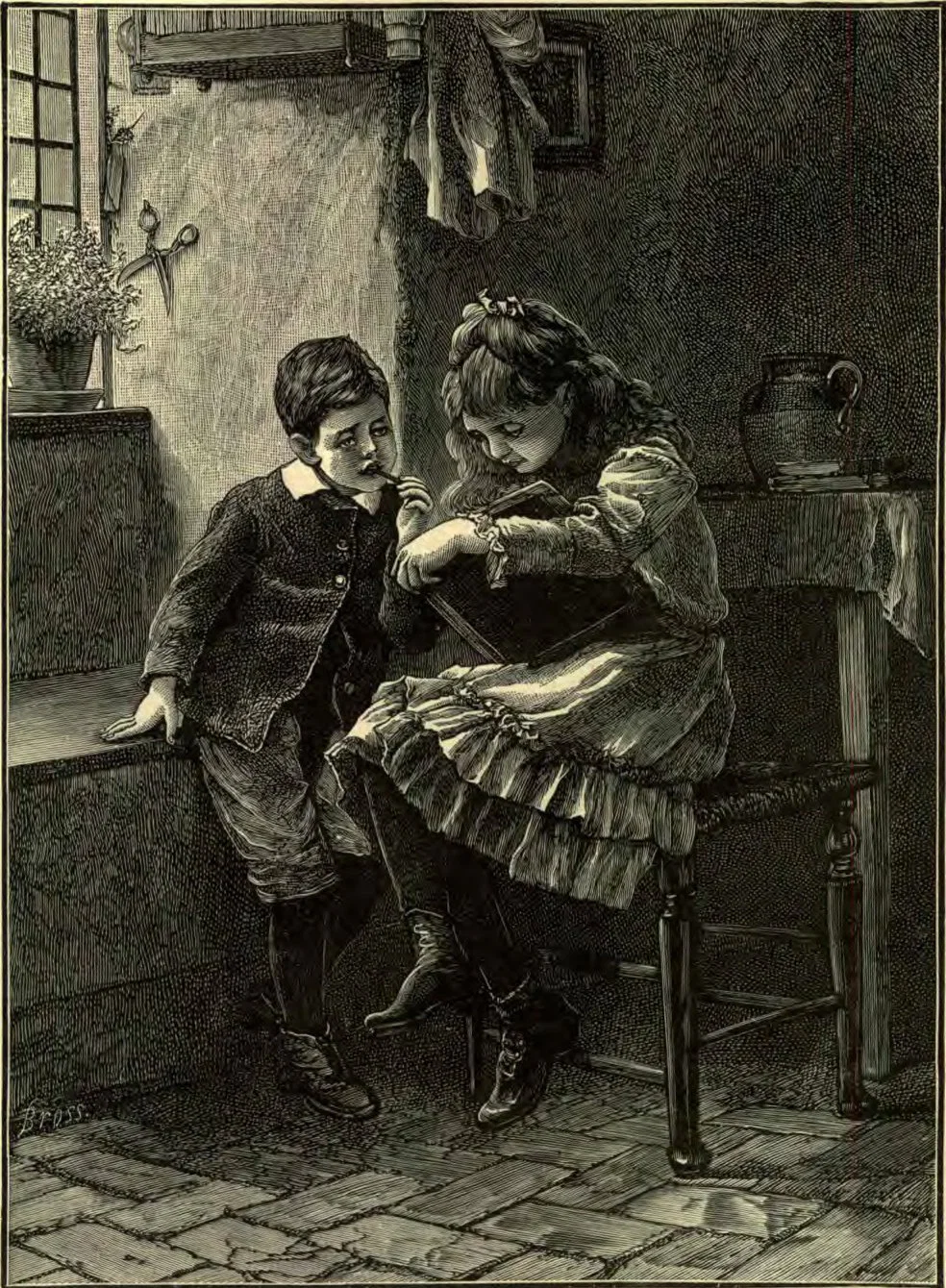
We’ve had a very hard day’s work. Benny is just starting a curious kind of work called Long Division, and we get all mixed up in it. We had to have some help from Mary to-day, and we are both very tired; but I think we understand it fairly well now. Benny’s face was quite puckered up for a while, and it was a relief to have Mary smiling over me. But the clouds soon left Benny’s face, too, as Mary kindly showed him his mistake. She is a good sister.

Friday Evening:

With a nail Benny’s mama ruled one of my sides in half-inch squares. To-day grandma wanted to find a pretty, new pattern for a quilt she is going to piece for Benny’s bed. So he marked off several squares on my ruled side, some two, some two and one-half, and some three inches square; and in these spaces he drew designs, following the lines made by the nail, or drawing obliquely from corner to corner; then he colored them with his red, blue, and yellow pencils. Grandma chose a pretty star-pattern, and Benny will soon have a new quilt.
SHE IS A GOOD SISTER

Saturday Evening:

After he came home from Sabbath-school, and had eaten his dinner, Benny wrote his memory-verse on me. Not just in plain writing,—O, no! On my ruled side he drew a beautiful border, and inside this the verse was written in a variety of ornamental letters, with his colored pencils. I think he will never forget it. On the plain side he set down all he could remember about his Sabbath-school lesson.
It has been a pleasant week, and I hope Benny will make as good use of me next week.
Aunt Betty.

CURIOUS BRUSHES

Willie, flushed and happy, had just come in from the barn, where he had been playing hide-and-seek.
“My little boy needs to find a brush,” said mother, looking up from her work. For bits of side, dry grass and seeds from the mows were clinging to his pretty sailor suit, and some were playing peek-a-boo in his hair.
“O mother! can’t I wait? I’m just too tired now.”
“If flies had been playing hide-and-seek, they wouldn’t allow a speck of dust to stay on their heads; they’d brush it off,” casually remarked Aunt Nan.
“Flies!” exclaimed Willie, incredulously; “where’d they get their brushes, I’d like to know!”
“O, they have them and use them,” laughed Aunt Nan.
“Hair-brushes?” questioned Willie.
“Yes; and with them they always keep themselves very clean. Have you never seen a fly rub his delicate front legs over his head?”
“Lots and lots of times,” replied Willie, quickly.
“Well,” resumed Aunt Nan, “there are a great many hairs on the under side of a fly’s feet and legs, and these form tiny hair-brushes. When any dust gets on a fly’s head, he brushes it off at once, and then he rubs his legs together, as you have probably noticed. This is so that no dust may cling to the little brushes.”
“Hurrah, Mr. Fly!” exclaimed Willie; “I guess you needn’t think you’re the only one who can use a brush, even if a little boy doesn’t carry his brushes round with him on his feet!”
Away he ran; and when he came back, mother said her little boy looked neat enough to be kissed. —Selected.

WORKING TOGETHER

A MILLION little sunbeams Can make a pleasant day; A million little raindrops Can frighten them away. Now if all the little children Should sit down and cry together, What should we do, what could we do, In such a spell of weather? The sun might blaze in bluest skies; ’Twould be a dreary place Until we saw a happy smile On every little face.
— Anna M. Pratt.

IDLE WORDS

VAIN, useless, empty words are idle words. How few there are who realize how many of these words they use. This is said to be an “age of words.” One needs only to pause a moment, and listen to the conversation of people anywhere, to feel the truth of this. Words mean so little. They are so vain, so empty, so frivolous; they carry no conviction with them, except, perchance, a conviction of insincerity. They seem to pour forth from the lips without thought, carelessly, indifferently. Such words have no weight, no power. They are not such as would awaken within the listener a desire to lead a better and nobler life. Still, many professed Christians use them, and are watched by unprofessed Christians, and justly estimated thereby. For all of these empty, careless words we must give an account (a reason, an explanation) in the day of judgment. And when is that day? To those who studied the Sabbath-school lessons on the Judgment I ask: When will your case and mine come up in review?
To be happy, full of life, energy, and enthusiasm (as all should be), a Christian need not be full of words. “Out of the abundance of the heart the mouth speaketh,” and, according to the Scriptures, words are the index of the heart. People will judge our lives, our motives, our sincerity, by what we say. How careful, then, we should be so to choose our words that they will have an influence for good. The old rule, “Think twice before you speak,” would help us to talk less and think more.
There is another text, which declares that “words fitly spoken are like apples of gold in pictures of silver.” Who does not covet such words, or rather, the heart from which such words naturally flow? They will be words of worth, comfort, courage, and life.
Let us consider these texts, and immediately set about revising our vocabularies.
KATHRINA BLOSSOM WILCOX.

THE GREAT SUPPER (Concluded)

(January 18)
LESSON SCRIPTURE: Luke 14:21–24.
LESSON HELP: “Christ’s Object Lessons,” pages 219–237.
21. So that servant came, and showed his lord these things. Then the master of the house, being angry, said to his servant, Go out quickly into the streets and lanes of the city, and bring in hither the poor, and the maimed, and the halt, and the blind.
22. And the servant said, Lord, it is done as thou hast commanded, and yet there is room.
23. And the Lord said unto the servant, Go out into the highway, and hedges, and compel them to come in, that my house may be filled.
24. For I say unto you, That none of those men which were bidden shall taste of my supper.

Questions

1. When the servant found that not one of the bidden guests would come, what did he do?
2. How did his report affect the master?
3. Where did the master then tell him quickly to go?
4. Who were to be brought in from the streets and lanes of the city?
5. How did these people respond to the master’s invitation?
6. What did the servant then say to his lord?
7. Into what places was he therefore commissioned to go?
8. Why was the invitation so urgent in the highways and hedges?
9. Were those who refused the invitation ever to be invited again? Compare Matt. 21:43 with the last verse of our lesson.
10. What can we say concerning the character of the servant who gave the invitations?
11. To whom was the word “Come” merely spoken?
12. Who were “brought” in? Who “compelled”?
13. What is it that will compel men to come? 2 Cor. 5:14.
14. What will enable us to give a compelling invitation to the poor and wretched? Luke 4:17, 18.
15. At the time Christ gave this parable, had the highways and hedges yet been entered? Are they now?

Note

Please recall where Christ was when he gave the parable of the Great Supper. It was the Sabbath, and the Saviour had gone to the house of one of the chief Pharisees to eat bread. Noticing what a selfish spirit was manifested by some of the guests, he rebuked them; and then, turning to the one that bade him, he said: “When thou makest a feast, call the poor, the maimed, the lame, the blind: and thou shalt be blessed.” But this was not a blessing that the Pharisees desired; they expected to share in the blessings of heaven, but refused those offered on earth. When one of them at the table heard Jesus say this, he said to him, with a sanctimonious air, “Blessed is he that shall eat bread in the kingdom of God.” To him personally Christ then spoke the parable of the Great Supper. Jesus would have him know that unless he would accept the blessings of the gospel upon earth, he should never taste them in heaven.

Quotations on the Lesson

1. “The servant who brought in the poor and the blind reported to his master, ‘It is done as thou hast commanded, and yet there is room. And the lord said unto the servant, Go out into the highways and hedges, and compel them to come in, that my house may be filled.’ Here Christ pointed to the work of the gospel outside the pale of Judaism, in the highways and byways of the world.”—“Christ’s Object Lessons,” page 226.
2. “In the command to go into the highways and hedges, Christ sets forth the work of all whom he calls to minister in his name. The whole world is the field for Christ’s ministers. The whole human family is comprised in their congregation. The Lord desires that his word of grace shall be brought home to every soul.”—Id., page 229.
3. “To a great degree this must be accomplished by personal labor. This was Christ’s method. His work was largely made up of personal interviews. He had a faithful regard for the one-soul audience. Through that one soul the message was often extended to thousands.”—Id.
4. “We are not to wait for souls to come to us; we must seek them out where they are. When the word has been preached in the pulpit, the work has but just begun. There are multitudes who will never be reached by the gospel unless it is carried to them.”—Id.
5. “The invitation to the feast was first given to the Jewish people. . . . When they refused the call, it was sent to the poor, the maimed, the halt, and the blind. Publicans and sinners received the invitation. When the gospel call is sent to the Gentiles, there is the same plan of working. The message is first to be given ‘in the highways,’—to men who have an active part in the world’s work, to the teachers and leaders of the people. . . . Men in business life, in high positions of trust, men with large inventive faculties and scientific insight, men of genius, teachers of the gospel who have not been called to the special truths for this time,—these should be the first to hear the call.”—Id., pages 229, 230.
6. “But we are not to think only of great and gifted men, to the neglect of the poorer classes. Christ instructs his messengers to go also to those in the byways and hedges, to the poor and lowly of the earth.”—Id., page 232.

WORD - MEN

One little man was dressed in white, As he left me on a mission bright. He smiled on a sick and lonely lad, He carried the sunshine that made him glad, His voice was musical like the birds,— He belonged to the band of Helpful Words.
One little man forgot to be kind As he hurriedly left “lip-gate” behind; He carried an arrow of woe and pain,— I wish I might call him back again; I wish from his purpose he’d been deterred, For he was a cruel Thoughtless Word.
One little man in a hurry, I s’pose, Forgot to put on his neatest clothes. His dress was shabby, his shoes too tight; He tried to smile, but he looked a sight. His name I’m sure you must have heard, For he was a reckless Slang-dressed Word.
All through the day these little men Leave us, never to come again. They flit about in the outside air Till they make a home in a heart-house near,— Angry word-man making sad, Thoughtful Kind-word making glad.
Keep your word-men pure and true, For they may live long after you. Them and their work on the other shore We’ll greet as we left them long before. Ask the great Sentinel—he’ll hear your call— To watch over heart-gate, word-men, and all. —S. S. Times.

THE COLEOPTERA

A VAST army of insects, almost too numerous to enumerate, are classed under the order Coleoptera, a combination of two Greek words meaning “a sheath” and “wings.” In these insects the upper wings are of a hard structure, so arranged as to form shields for the protection of the under, or true wings of flight. The name was given to the insects by Aristotle.
Because of their many peculiar characteristics, their singular forms and habits, their remarkable coloring, and in some species their large size, and because of their solidity, which renders their preservation comparatively easy, the Coleoptera have always attracted special attention.
The body of the Coleoptera is inclosed in a horny-plated envelope, more or less rigid, and generally oval in form, though diversified according to the habits and place of abode of the insects. Those whose bodies are cubical live in dung; those inhabiting the stems of trees, such as the palm, are flattened; those found under the bark of trees are generally greatly flattened, some being like wafers; those which are wood-borers are always cylindrical, acting like gimlets, fastening their heads in the wood, and whirling their bodies rapidly round and round, creating tiny streams of sawdust, which fall from the hole thus created.
In the larva the eye is simple, as with butterflies; but in the fully developed beetle it is compound, and in many species is divided by a process known as the canthus, as where the eyelids meet in the corner of the eye. In some species this intersection is so complete as to give the appearance of a pair of eyes on each side. In those insects which burrow in earth, the eyes, though fully developed in the young, become more or less atrophied as growth continues.
The eggs of beetles are deposited in various situations, according to the places in which they spend their lives. There is one species, however, that carries the eggs in the abdomen until hatched. These beetles are but one tenth of an inch in length, the abdominal region being enormously distended and turned over upon the back.
In Great Britain over thirty-five hundred indigenous species have been named, and a total of over seventy thousand different kinds are known to exist in the world; but in all probability there are yet hundreds of other species which have never been classified.
Collectors, in order to obtain perfect specimens of insects, rear them from eggs; but beetles are hard to obtain in this way, the larvæ never thriving artificially. Full-grown specimens are easily obtained by using a sheet spread on the grass, or an inverted umbrella under trees, which are then shaken; by dragging a net over grass; and by digging pits in the earth, into which the beetle falls. A little knowledge of the habits of the beetle enables one to obtain specimens with ease. If dropped into a bottle having a small quantity of cyanid of potassium covered with a layer of gypsum, death is instantaneous. If not mounted at once, and the limbs become rigid, they may be moistened by remaining in wet sand over night, covering with a cloth to prevent evaporation. Large beetles must have the abdomen emptied. Beetles containing oil must have it extracted, and be stuffed with cotton. If mites or grease collect, clean the specimens by applying benzine with a brush; if mold appears, expose to strong heat for several hours.
W. S. CHAPMAN.

AN ABSENT BROTHER

Now, gentle breezes, blow, And whisper, sweet and low, Kind words from far away, As with my hair you play; Then take this word to him, Who long from me has been,— That still I love him well, More than my tongue can tell.
O murmur in his ear: “Thy voice I fain would hear Within our childhood home, Where through the woods we'd roam.” And still I see his face, Now filled with manly grace. A sister's love and prayer, O gentle breezes! bear.
PEARL HART.

SHORTHAND BY MAIL.

YOUR spare time can be well improved by studying shorthand, and this can be done at small expense to you by taking a mail course at your home. We are using “The Rogers Compendium of the Graham System of Shorthand,” a method arranged especially for home study, and giving an epitome of a system of shorthand acknowledged to be the best, the briefest, and the most complete. The only presentation of Standard Phonography in which all shorthand outlines are written as first learned, thus greatly abbreviating the work on the part of the student. A complete course in thirty lessons, illustrated by facsimile notes, with key. The correction of all students’ papers given special attention by experts. Reasonable tuition rates. If interested, write for full particulars. Practicing stenographers wishing to prepare for rapid reporting work should secure the last twenty lessons.
FIRESIDE CORRESPONDENCE SCHOOL, Battle Creek, Mich.

GRAND TRUNK R'Y SYSTEM.

Taking Effect June 2, 1901.
Trains leave Battle Creek.

WEST-BOUND.

No. 9, Mail and Express, to Chicago. 12.15 P. M.
No. 7, Limited Express, to Chicago. 7.10 A. M.
No. 3, Lehigh Valley Express, to Chicago. 3.50 P. M.
No. 5, International Express. 2.17 A. M.
No. 75, Mixed, to South Bend. 7.30 A. M.
Nos. 9 and 75, daily, except Sunday.
Nos. 3, 5, and 7, daily.

EAST-BOUND.

No. 10, Mail and Express, East and Detroit. 3.45 P. M.
No. 8, Limited Express, East and Detroit. 4.14 P. M.
No. 4, Lehigh Express, East and Canada. 8.22 P. M.
No. 6, Atlantic Express, East and Detroit. 2.10 A. M.
No. 2, Express, East and Detroit. 7.00 A. M.
No. 74, Mixed (starts from Nichols yard). 7.15 A. M.
Nos. 10 and 74, daily, except Sunday.
Nos. 4, 6, 8, and 2, daily.
W. C. CUNLIFFE, Agent, BATTLE CREEK.

TOO MUCH READING

PRESIDENT GILLMAN, who has just laid down the scepter at Johns Hopkins University, in one of his latest addresses gave the graduates of the Women’s College of Baltimore some advice about reading. “Reading,” he said, “is a kind of craze that has got hold of the people. It is a dangerous habit, like a stimulant.” “Do not read too much,” was his urging, coupled with the advice, “Study the art of thinking,” and, “Use your hands, and enlarge your vision by the use of the microscope.”
I have no doubt that the newspaper report is very fragmentary, and that the wise president introduced many a proviso and explanation; but the substance of his meaning is clear enough. What he objects to is the habit of indiscriminate reading; reading with no plan or purpose; reading accompanied with no reflection, and reading which, therefore, has no effect, or very little effect, indeed, upon the life of the reader.
There is no more virtue in printed paper, nowadays, than in a piece of wall-paper. Many a young lady sits for an hour with her eyes glued to the fascinating pages of “Arabella Armitage,” or whatever is the latest sensation that has reached a sale of one hundred and thirty-five thousand copies, and rises from the exercise with the proud consciousness that she has been reading. Reading! She might just as well have been passing under her eyes so many yards of baby-ribbon. She has enjoyed it, and she might have enjoyed the baby-ribbon; but her mind is in the same condition it was in one hour ago—provided, that is, that “Arabella Armitage” was a well-conducted young lady, and did nothing worse than get duels fought on account of her.
In fact, as books multiply, and especially as fiction extends its sway, it is doubtful whether the true art of reading is not narrowing rather than widening its bounds. For the test of reading is the same as the test of eating. What is read must in some way be built up into the fiber of the mind and the structure of the character.
I want to lay down a principle, and I wish I could know that every reader of this paper would follow it: For every volume of fiction you read, you are to read one volume of some essay like Ruskin’s, or some history like Green’s England or MacMaster’s United States, or some biography like Washington’s, Franklin’s, or William Carey’s; and for every copy of the Monthly Romancer you devour, you will read from cover to cover one number of some standard review.
Come, now; I “stump you.” Will you take the dare?—Caleb Cobweb, in the Christian Endeavor World.

Growing Through Self-Surrender to God

How, then, shall man grow if not by correcting faults? — By self-surrender to God. Not by thinking of wrong, and how to flee it; but much rather of excellence, and how to win it. Not so much by fear of sin, but rather by love of Christ. Not by caution against wrong-doing, but rather by enthusiasm in right-doing. Go out of yourself, and think of others; go out of your own life, and plunge into the service of your Lord. — Frederick Temple.

THE INSTRUCTOR PREMIUM BIBLE.

A Self-Pronouncing Teachers’ Reference Bible, containing the celebrated Teachers’ Helps, and comprising nearly 400 pages. Also a complete series of 15 new maps.
This beautiful book is bound in Imperial Seal Binding, Tuck Edges, known as “Divinity Circuit,” Rounded Corners, Full Red under Gilt Edges.
We offer this Bible, postpaid, for only six new yearly subscriptions at 75 cents; or twelve new six-months’ subscriptions at 40 cents.
We will also send it, postpaid, with the INSTRUCTOR one year for $2.25. For 20 cents extra we will stamp your name in gold upon the cover. Address—
THE YOUTH’S INSTRUCTOR, BATTLE CREEK, — — — MICHIGAN.

THE WEEK OF PRAYER IN BATTLE CREEK

THE week of prayer which has just closed, in Battle Creek was marked by an unusual degree of solemnity and much of God's blessing. Special thought was given to the fact that we, as Seventh-day Adventists, are looking for the return of Christ “in this generation;” and our relation to his work in the earth, our duty to the unwarned peoples, and our personal preparation in view of that event were emphasized. A revival of the true Advent spirit was sought, and, we believe, was found by many. The things of the world—love of money, pleasure, ease, and all else that it has to offer—assume their true value, once the heart really accepts the belief that Jesus is coming, and coming soon.
A number of services were held every day, forenoon and afternoon, that all the members of this large church might have an opportunity to listen to the readings, and the instruction given in connection with them. At least two general meetings were held every evening.
Special attention was given to the needs of the children and young people. The former were divided into two groups, including those under ten years of age in one division, and those of eleven and twelve in another. Those over twelve formed the third group. Meetings were held with these three divisions every afternoon but one, and were well attended. A number gave their hearts to the Lord for the first time, and expressed a desire to serve him, and to prepare to enter his work. That this decision meant something to the children, was plainly evidenced by the behavior of some of the more restless ones during the Sabbath-school hour.
Sabbath afternoon these divisions were greatly enlarged, and so earnest a wish was voiced by the children that these meetings be continued, that it was decided to keep them up, and thus carry forward the work begun during this week. A number of the members of the Battle Creek Young People's Society are interested in this, and expressed a desire to have a part in it.
At the general consecration meeting on Friday evening, about sixty young persons handed in their names, as willing either to go now to some foreign field or to prepare to go soon.
Altogether the week was a good one for this church; and our hearts rejoice to know that while God was blessing us, he was also, and no less truly, blessing you. Now that the week of prayer is in the past, let us not forget that every day brings us, whether we stop to think about it or not, one day nearer that event which is the consummation of all our hopes,—that glad day of days when Jesus will come. May we, dear young Christians, be awake to our duty, alive to our privileges as ambassadors of Christ, faithful to our high calling; and may each day, as it passes, be to each one of us truly one day nearer him.

A GOOD EXPERIENCE

THE fall term of the Battle Creek Church School closed with a good experience for the pupils. During the month of December a special effort was put forth to interest the members of the church in the Missionary Magazine. The children of the primary room led out in the work, and their good success stimulated the others to follow. Nearly every day brought in subscriptions from some source or other. Those who were not successful in getting the people to subscribe would sometimes come in with a discouraged face, but after singing “Onward, Christian Soldiers,” out they would go again with renewed zeal and spirit. Their labors were rewarded. The young people of the school also lent a helping hand, and from the united efforts of every class, eighty-two subscriptions were obtained before Christmas. This included a small number for the Advocate of Christian Education. Besides this a number of copies of the Advocate and the Magazine were sold.
The members of the school decided to make a Christmas offering of the money which they had earned by canvassing, and for this purpose a missionary service was held the last day of the term, Friday morning, December 20. The teachers united with the pupils in giving, and there was taken up a collection of fifty-nine dollars and thirty cents. Nearly every one gave something, and it was indeed a happy lot of children who sang “They Brought Their Gifts to Jesus,” while the offering was being made.
At Thanksgiving the school enjoyed another good time, especially the little people. They brought enough provisions to make up two dozen or more baskets, and then, through the kindness of Mr. S. I. Abbey, carriages were provided, and the children carried their baskets to thirteen different families. Many hearts were touched that day, and the children found that it is more blessed to give than to receive.
The pupils of the fifth and sixth classes raised about four dollars for their Thanksgiving offering. A cord of wood was purchased for one family, and the boys went and split it up. The rest of the school brought their share of clothing and provisions, which were distributed among the poor.
GRACE E. AMADON.

The Burning Log: Yielding Oneself to God's Purpose

THE fireplace might be filled with fuel, but that would neither warm nor brighten the cold room. One might shiver and chill, and indeed even freeze, while sitting close by a grate where all preparations for a fire had been made. In order to be of real use, the log must burn — must yield itself up. Only in thus giving up its store of heat and light is it able to fulfill its beautiful mission. So with human souls. Untouched by the “live coal from the altar,” they are as cold, as dead, as incapable of giving cheer and comfort and life, as the unlighted log in the grate; but when they yield themselves fully to the purpose of God, when they are willing to be as nothing if only they may save some, their lives are a blessing to every one who passes their way.

A USEFUL PLANT

FOR many years the country garden has had its sentinel row of sunflowers, with little thought of anything but their cheerful beauty. Of course the goldfinches flock to the garden in late summer for the seeds, and the domestic fowls enjoy them, too; still for a long time no special attention was paid by the American farmer to the sunflower as an article of utility. According to an exchange, however, it is being raised quite extensively at present for the oil derived from its seeds. This oil is of a pale-yellow color, palatable, and is used to adulterate olive-oil. In its crude state it is also used to some extent as a substitute for linseed oil.
But the usefulness of the sunflower is not exhausted when the oil is extracted from its seeds. The fiber of the stalks, which is fine, strong, and silky, has a value. Already in China it is woven into beautiful fabrics, and it is believed that it may be still further utilized in this way. The seeds, too, from which the oil has been taken, are pressed into cakes and used as fodder. A bushel of seeds will yield a gallon of oil, and about fifty bushels of seeds can be raised to the acre. The oil sells for a dollar a gallon.
“In Russia at the present day the seeds are eaten in immense quantities, raw or roasted, as peanuts are in America, and the oil obtained by pressing the seeds is an important article of diet. The frequent religious fast-days in that country restrict the use of meat, and lead to a large consumption of vegetable oil; and the manufacture of sunflower-oil has consequently grown to considerable dimensions. The best seeds yield an oil which compares favorably with olive-oil for table purposes.
“Even the upper classes in Russia eat the seeds, the larger and finer ones being quite equal to most nuts in respect to palatability and wholesomeness. The stalks and dried leaves are highly prized for fuel, being in some parts of the empire almost the only available substitute for wood. An acre of sunflowers will yield many cords of good fuel.”

PAPERS WANTED

E. M. TRUMMER, of Kingston, Dekalb Co., Ill., wishes us to say that she can use to advantage clean copies of the INSTRUCTOR, Life Boat, and Little Friend.

What a Man Intends to Be

WHAT a man intends to be is what he really is. He may, indeed, realize that he ought not to be that, but to be something better. He may, perhaps, wish, at times, to rise above his chosen course, but this amounts to little while he really, in his heart of hearts, intends to pursue the other path. God knows what we intend to be, and he judges us accordingly. This is the idea of the inspired declaration, “As he thinketh in his heart [as a man purposeth in his inner self], so is he.” —S. S. Times.
Continue reading: FOR EVERY DAY OF THE WEEK