AND now that the conference had shown such self-denial in favor of establishing the peace of the world; now that the tree of arbitration had been firmly planted on the soil of amity, the conference proceeded to devote one day in rejoicing over the work done, by laying the corner-stone of the Palace of Peace.
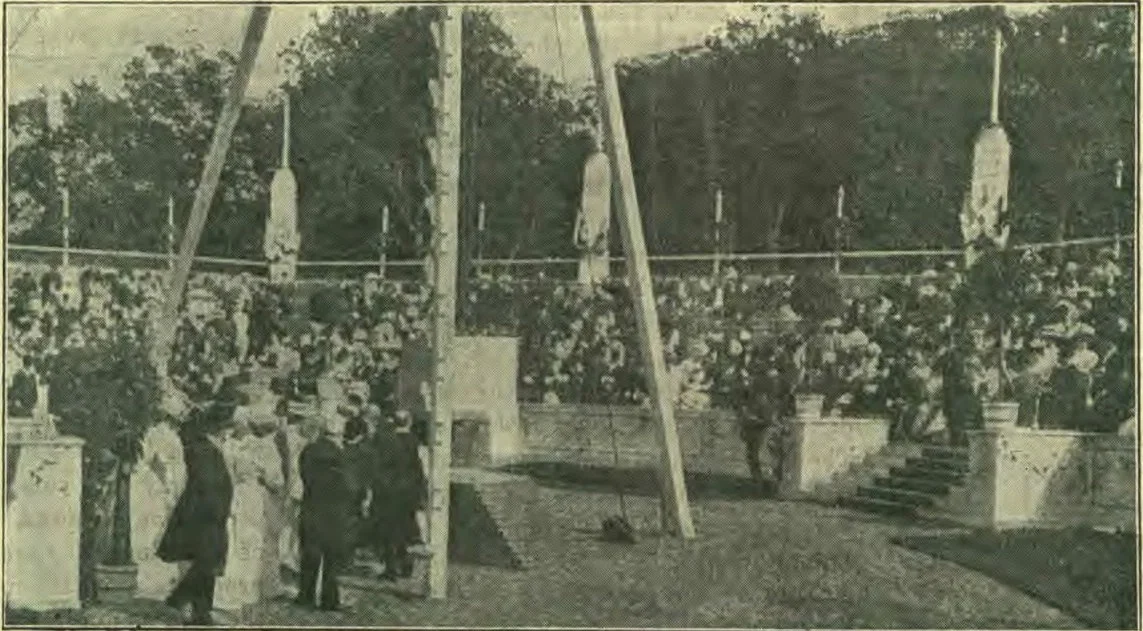
All know that Mr. Carnegie had given a million and a half dollars for the building of this palace. The ceremony took place July 30, in one of the suburbs of The Hague. An amphitheater had been erected on the spot. On both sides of the platform the peace banner, bordered with white, and the Dutch and North American banners were floating in the breeze. At half-past two the orchestra played the “Hallelujah” from Handel’s “Messiah,” followed by Beethoven’s “Benedictus Qui Venit in Nomine Dei”—a solemn mockery!
Laying the Corner-stone of the Palace of Peace.
A speech was then made by Mr. van Karnebeek, chairman of the board of trustees of the Carnegie Fund. Speaking of the conference of 1899, Mr. van Karnebeek called the permanent arbitration court “an organization so elastic that it does not seem to press to any degree upon the self-government of the States and to adapt itself to any kind of cases which might be presented for arbitration. . . . It is possible, it is, perhaps, desirable, to take one step forward from the system of arbitration to the system of judicature proper.” This discourse was followed by the laying of the corner-stone by M. Nelidoff, president of the conference. A lady presented to him a silver trowel with which he laid some cement on the masonry, and the stone was slowly allowed to take its appointed place. On one side, the following inscription was written in gold:
PACI
JUSTITIA FIRMANDAE
HANC AEDEM
ANDREAE CARNEGII
MUNIFICENTIA
DEDICAVIT
M. de Nelidoff then read a paper from which I quote the following: “A new idea, a new principle—peace thru justice and law—is about to see a worthy edifice erected for its abode. From the remotest times, nations have worshiped war. But there has never been in the world an altar erected to peace. It was preached eighteen hundred years ago by the divine Redeemer at the same time as brotherly love, charity, and fraternity. But of all these sublime precepts which sum up the highest aspirations of the human soul, the idea of peace has been until now the most neglected. It has been necessary in order to insure its triumph—and this honor is due to the emperor of Russia—that governments should agree to study in common the means of making the words of peace a reality by seeking the possibility of realizing this boon in order to insure its benefits to the nations.”
If the reader will study the above he will agree with us that it is a model of a meaningless phrase.
After M. de Nelidoff had resumed his seat on the platform, a lady arose and presented Mr. Karnebeek, for Mr. Carnegie absent, a silver medal in the name of the Universal Women’s Alliance. The orchestra and the choir closed the ceremony with Wagner’s “Wach Auf Es Naht den Tag!”
A Magnificent Pageant Planned.
The grounds on which the Peace Palace is to be erected were a portion of a park belonging to the royal family, and have been donated by the Dutch Government. Two hundred sixteen plans were furnished the board of trustees by so many architects. Those made by M. Louis Cardonnier of Lille (France) were accepted, and their author has been selected as builder. They are now on exhibition in The Hague and have already been inspected by thousands of people.
A plan has been formed to arrange a grand allegoric pageant on the occasion of the inauguration of the Palace of Peace, presumably in about three years, and “to symbolize the noble effort to suppress all wars and to remove all differences among the nations.” A long, picturesque crowd will represent in their native costumes all the nations of the earth, past and present, moving in lines toward the temple which is to be the residence of peace. In the front yard of the temple and on the steps and the terraces before the temple, the pageant will take place. First will come Asia, with her ancient Chaldeans, Assyrians, Persians, and Hindus. Next Africa, with her Phenicians, Numidians, Carthaginians, and Arabians. Then Europe, with the old Celts, followed by the Greeks, Romans, Gauls, Franks, and Byzantians. Then again, America, with the Aztecs, Toltecs, Mexicans, and Incas. Next, Australia, represented by the Papuan race and the Maoris.
In the second part of the procession will appear the works of peace: arts, letters, agriculture, cattle-raising, trade, industry, and education, represented by allegorical groups. They will all move toward the Temple of Peace and there, in a grand musical performance, give utterance to their desire to renounce all wars and enmity, praying to Peace (not to the God of heaven) to assume the sovereignty of the earth. The amphitheater to be built will be able to accommodate 25,000 spectators.
The Capital of the World.
But the grand dreams of international “pacifism” do not stop with a palace and a magnificent performance. As Mr. Olsen wrote to the SIGNS in his letters from The Hague, there is an intense pacific movement going on in that city outside of the conference. In fact, the “pacifist” movement all over the world has made The Hague its headquarters. During the time of the conference, it has operated an “International Club” in which lectures have been delivered twice or three times a week by the leading men in the movement from various lands. The influence of this club over the delegates can not be doubted; and if the latter had had only themselves to consult, the peace conference would certainly have had different results. Under the auspices of the “pacifist” movement are issued the “Conference Daily Messenger” and the “Review of Internationalism,” a bimonthly published in four different languages. The “pacifist” movement is responsible for the foundation of the Palace of Peace and for the grand pageant to be held at its inauguration. Yet all this is but a parcel of a “gigantic conception which may yet fascinate the imagination of the world.” There has been organized at The Hague by this same “pacifist” movement a foundation for internationalism which seeks to “unite all the international societies into a unique world association.” It is to be the “gray matter of the brain of humanity so far as organized.” With this in view, and in order to carry out the plan, it is proposed to buy extensive unoccupied lands in the vicinity of The Hague for the erection of a new city, the “international capital of the future United States of the World.” This city is to be the seat and headquarters of the innumerable departments of international life. One of these departments, the highest one, will be, of course, the peace court and the peace conference, which are to become permanent. A Dutch architect, K. P. C. de Bazel, has11designed the plan of the future capital of the world.
The grounds, which are three times larger than greater Amsterdam, are to be bought from the city of The Hague and from the government. It is supposed that they afford space enough for two or three centuries. They begin one kilometer from The Hague city limits and three kilometers from the center of the old city, and extend to the northwest on a parallel with the North Sea coast. The city is to lie two kilometers from the beach. As seen from Mr. Bazel’s plans, it has the shape of five concentric octagons, the fourth one ending in triangles which give the city the appearance of a star. These octagons are cut into triangles and quadrangles by eight avenues radiating from the center, a large square. Four of these avenues form a cross. The body of the cross, longer than the head and arms, ends in a square which is the place selected by the architect for the site of the Peace Palace (Musschenberg Hill). Enlargements outside of the octagons are provided for by symmetric and graceful lines. The head and end of both arms of the cross are to be occupied by various academies, such as academy for pedagogy, hygiene, and political economy, academy of arts, and academy of anthropology. A library, a sanitarium, and practical institutes are planned for. The center of the city has not yet been assigned to any special destination. All buildings, private and public dwellings, will be separated by gardens which will save the city from the objectionable features of modern city life. All streets, avenues, and squares will be so wide as to answer the future requirements of the largest capitals, and will be provided with the most modern of electric means of transit. Appended to the city will be a “garden city” made up of a thousand dwellings with gardens for working people. Finally, the future capital of the world will be connected in the most direct manner—by the Rotterdam-Scheveningen Electric R. R.—with London, Berlin, Paris, New York, and all the other “large cities of the universe.”
Is this the Millennium?
Such are the bewitching plans made by “pacifism” for the establishment of peace on earth. Do they not remind one of the golden city of the Revelation? Might this not, to some minds, seem to be the fulfillment of John’s visions? Is this, perchance, the way in which the Prince of Peace intends to establish on this earth His kingdom of righteousness?
No! “Pacifism” is not the kingdom of Christ—tho it has some features resembling it. Jesus Christ said that His kingdom was not of this world,—this sin-cursed world,—while “pacifism” is content with it as it is. Divine grace and conversion are Christ’s means of bringing about peace, while “pacifism” seeks to bring it about thru man’s own goodness and righteousness. Christ asks of men only faith, while “pacifism” turns to politicians and parliaments. “Pacifism,” then, is condemned in the light of Scripture as well as in the light of all the history of the world. Yea, it is condemned in the very light shed by the present peace conference—the lurid light of battles such as the world has never yet witnessed. Thus, by unconsciously seeking to cover up the appalling realities of a near future and to prevent people from seeking the true and only remedy, the soon and personal coming of Christ as King of Kings, “pacifism” becomes one of the most dangerous movements of the present time.
As says the last number of the “Revue Politique et Littéraire:” “The ‘pacifist’ song is another lullaby. By turning the masses from the present problems, it helps governments in their most crafty maneuvers. . . . Governments are obliged to obtain from the people the money necessary for the incessant increase of war expenses. This task would not be easy, if, near them, did not appear the preacher of peace, the consoler, the man who knows how to turn the attention of the nations from the sadness of the present hour, from the black smoke of the 18,000-ton battleship to the blessed morn of universal fraternity. Conclusion: Whether he wants to or not, the ‘pacifist’ is a most valuable helper to warlike imperialism.”
The Question of Disarmament Decently Buried.
Since writing the above, a new act has been played at The Hague peace theater. The conference has deemed it proper to hold up another peace signal for the relief of the world. At last, the question of armaments was touched upon! A full meeting of the Conference was called together on Saturday, August 17. After an hour had been spent in despatching war matters, Sir Edward Fry, standing on the platform at the right of the president, read a proposition of the highest importance made “by the government of his British majesty.” Mr. Fry mentioned the wish voted in favor of reducing armaments by the first peace conference. He quoted Count Mouravieff’s memoir addressed to Europe in the name of the czar in August, 1898, in which is drawn a frightful picture of the present military condition of the world, which, “should it last, would inevitably lead to the very cataclysm which it is sought to avert, and the horrors of which make every human soul shudder in advance.” He afterward disclosed the fact that between the first and second peace conferences, the annual military expenses in Europe had increased by 1,725 million francs, and exclaimed: “Such is the Christian peace of the civilized world in the twentieth century!” Then, referring to the general desire for peace, he made the proposition in the name of Great Britain to submit annually to any nation who would do the same, her project for the building of new war-ships and the amount to be spent in their construction. Finally, Sir Edward Fry proposed the following resolution to the conference:
“The conference confirms the resolution adopted by the conference of 1899 respecting the limitation of military burdens; and, whereas military burdens have increased considerably in almost every land since the said year, the conference declares that it is highly desirable to see the governments resume the serious study of this question.”
Mr. Fry’s Resolution Discussed.
The president then read a letter from Mr. Choate, supporting the resolution in the name of the United States. M. Bourgeois also supported in the name of France. A letter from the Spanish delegation did the same. The delegations from Chile and Argentine submitted the treaty on disarmament signed by these two countries. Then M. Nelidoff took the floor. He recalled how, at the first conference, when the question of reduction of armaments was submitted, “opinions were so discordant and the discussion soon became such” that the very existence of the conference was threatened. He also recalled how two of the great powers soon after the conference engaged in disastrous wars. He added: “If this question was not ripe in 1899, it is no more so in 1907. It has not been possible to do anything in this direction, and the conference finds itself as little prepared to take up this question as it was then. Any discussion, fruitless in itself, could only harm the object we have in view by making more conspicuous our differences of opinion.” He then proposed that the resolution submitted by England should be voted without any discussion and by unanimous acclamations. And this was done.
Now we have the work of both conferences before us as follows:
In 1899, the peace conference resolved that “the limitation of military burdens . . . was greatly desirable.”
In 1907, the conference confirms that resolution and adds that, considering the fact that these burdens have increased considerably since 1899, “it is highly desirable to see the governments resume the serious study of this question.”
This is what the “Conference Messenger” calls a “hypocritical wish,” “a stone instead of bread given to hungry nations,” “a first-class burial of the reduction of armaments.” This paper even printed on the first page of its number for August 18, the pictures of delegates Fry and Nelidoff framed in black, accompanied by the above epitaph also draped in mourning.
And now that The Hague institute on twentieth century war operations has closed its classes, now that the grandest and most enrapturing dreams of peace have been palmed off upon the world, the arming of nations will go on with greater madness than before. For a few years more, the peoples will keep marching with unconcern toward the “indescribable cataclysm” involved in the coming European war. More than ever can we say now with M. de Blowitz, Paris correspondent of the London “Times,” who wrote thus in 1891:12“The weapons are furbished; the arsenals are full; it is nation rushing against nation.”
The Coming “Cataclysm.
Before we close, may we not cast a timid glance at the awful realities of the coming war so quietly organized by The Hague peace-makers? The writer just quoted had done so in 1891. He said: “I have frequently for two years endeavored to ascertain whether European diplomacy thinks of this event, whether it is weighing the imperative consequences, whether it is preparing for it. I have been stupefied at seeing that among those who ought to scan the future, not one has fixed a steady eye on the mysterious horizon that conceals the thunderclap which must one day awake and startle Europe; and when, seeing them absorbed in their present task, I have pointed out to some of them the eventualities which will then arise, I have seen them shudder and draw back as if terrified by the problem which forced itself on their meditation and which seems to me to have no other issue than war—war from one end of Europe to the other.”
What could be said now, sixteen years later? The horrid picture has been faintly drawn in a recent publication issued by the International Peace Bureau at Berne, Switzerland; it is entitled: “The Consequences of a European War.” We boil it down for the benefit of our readers in the following paragraphs:
“The next war in Europe will undoubtedly involve five nations. But let us take into account only four: France, Germany, Austria, and England. Ten million men will be called to enter the field at the first signal. It will take 630 million francs for the mobilization alone. Every single day of war will cost 125 million, which make 40 billion a year. Moltke estimated that the European war would last two years, and General Von der Goltz declared that it would terminate in the ‘utter destruction of the economic resources of one of the adversaries, or, which is the most probable conclusion, by the complete exhaustion of both.’ The number of the victims would be one million, two hundred thousand. The corpses of the soldiers, putrefying on the battlefield around the cities and villages, for lack of burial, will infect the whole country. Epidemics will be carried from the camps and ambulances into the homes of the people; the hospitals will be crowded and every family in mourning.”
“But the threatening aspect of a future war,” says Vice-Admiral La Reveillere, “is not so much the loss in men, which will be immense, as the suspension of all the functions of national life. The farming class and the aristocracy as well will be compelled to be under arms; all will be torn away from their occupations; no one will be able to work. The fields will remain unplowed; factories and shops will be closed, and with great difficulty will it be possible to furnish the millions of soldiers with their daily food.”
Speaking of the same aspect of the “future war,” M. Jules Roche, a French deputy, says in a recent review that it will be equivalent to “a formidable earthquake, to an immense geological cataclysm. . . . We would see,” he says, “everywhere, a crisis, an economic cyclone such as the world never saw at any time!”
And what will all that be when it does come, but an exact fulfilment of what the Bible predicts for the last days? What will it be but the battle of Armageddon, where all the kings of the earth are to “gather” for the “battle of that great day of God Almighty”? And thus The Hague Peace Conference—perhaps the most important political event of our times—is but another witness to fulfilling prophecy, but another startling sign of the times. JEAN VUILLEUMIER.
HIC JACET
The Question of Limitation of Armaments
Born in St. Petersburg, Aug. 24, 1898
Smothered at The Hague,
Aug. 17, 1907
REQUIESCAT IN BELLO
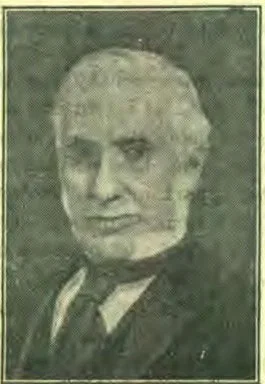
Sir Edward Fry.
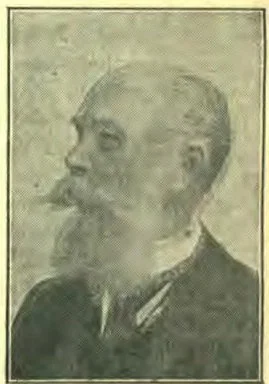
M. de Nelidoff.
A Feast of Good Things
By Editor
Special Notice.
This is the last number of the special Gospel series of the SIGNS OF THE TIMES which we began last May.
From time to time your attention has been called to some of the good things we have in store for you in the numbers to follow; but the half has not been told. Let us briefly recapitulate:
World’s Missions Special.
Our next issue will be the great World’s Missions Special, a double number, fairly bristling with facts and figures and interesting information. Of all the great specials we have ever issued, none equals this in beauty, power, and general information; and it tells truth, wonderful truth, and will interest believers and unbelievers alike. Here is a list of the articles:
“The Open Doors Before God’s People,” by Arthur T. Pierson, D.D., editor “Missionary Review of the World,” a stirring article.
“A Century of Missions,” by I. H. Evans.
“Christianity a Life,” by Geo. B. Thompson.
“A Personal Saviour,” by W. A. Colcord.
“The Power of the Word to Save,” by Abdiel.
“The Great Missionary,” by Mrs. E. G. White.
“Medical Missions,” by A. O. Tait.
“The Evangelization of the World in This Generation,” by A. G. Daniells.
“The Divine Program of Missions,” by W. A. Spicer.
“The Latter Rain,” by M. C. Wilcox.
“A Mighty Factor in Missions,” by J. N. Anderson, China.
“Child Wives and Widows of India,” by Bessie L. Shaw.
It has an excellent song with the missionary spirit running throughout. There are messages and appeals from workers in the great mission fields of Asia, Africa, South America, and the islands of the sea.
Besides these, there are two pages showing God’s great, needy field in picture object-lessons, telling in wonderfully graphic form of the more than one billion of unsaved heathen, and on the other side the millions upon millions that “Christian” America spends in sin and pleasure while giving but seven and one-half millions for foreign missions. It is an awful indictment.
There are two pages of portraits and biographical notes of thirty-two noted pioneer and prominent missionaries, which we have called, “God’s Advance Guard in Mission Fields.” Such an array of portraits can be found in no other publication, or any twenty publications. Books and magazines and libraries have been ransacked to obtain them. This feature is worth more than three times the cost of the paper.
In all our specials the general testimony has been that our performance was better than our promise, but this is far better. No man can read the Missions Number without being stirred.
Bible-Reading Series.
Following the Missions Number we will have a series of twenty-four numbers which will be of great value and peculiar interest to all. One of the most prominent features will be a series of illustrated Bible-readings which will appear under the heading of “Home Bible Studies for Winter Evenings.”
These readings will be in the form of studies covering all the great features of the Gospel. The subjects will be taught by questions, quotations from history, notes from authors, and a marshaling of facts that all ought to know. They will be embellished by diagrams and illustrations that will explain the lessons and make them simple and impressive.
There will also be articles on the books of Daniel and the Revelation.
Articles on the book of Romans, the “therefores” and “wherefores” and the reasons for them.
Articles on the miracles, teaching, and life of Jesus Christ as the great Physician.
A series on the Ten Commandments.
The kingdom and priesthood of Christ.
Conditions in the world. Able correspondents in the Old World and the New. Labor and Capital. Wealth and Poverty. Plenty and Famine. Peace and War. Health and Hygiene.
In the future, as in the past, the SIGNS will keep abreast of the times, and in the Outlook Department will give special attention to current events that have a bearing upon the fulfilment of prophecy. This year we have had one or more special representatives at all important gatherings, such as the Peace Conference in New York, the Peace Conference at The Hague, the Christian Endeavor Convention at Seattle, and the American Federation of Catholic Societies at Indianapolis, Ind. It is our purpose to continue to send representatives to all important gatherings in order that our readers may be kept fully informed as to what is going on in the world and the bearing these movements have upon God’s work.
Home Department.
Beginning November 13, a very interesting and instructive series of articles will appear under the heading of “Home Building.” These articles are from the pen of Mrs. L. D. A. Stuttle, and will be of special interest to every member of the family. Here are the titles:
(1) Home—What It Means.
(2) Honorable Young Manhood.
(3) Beautiful Young Womanhood.
(4) Acquaintance, Friendship, Proprieties.
(5) Honorable and Proper Courtship.
(6) Marriage and Its Meaning.
(7) The Husband in the Home.
(8) The Wife in the Home.
(9) The Family Altar.
(10) The Father.
(11) The Mother.
(12) The Son.
(13) The Daughter.
(14) Reading in the Home.
(15) Order in the Home.
(16) Simplicity in the Home.
(17) Economy in the Home.
(18) Mutual Helpfulness.
(19) Gatherings in the Home—Associations.
(20) The Master in the Home.
(21) The Outshining of the Home.
Besides this list of helpful articles will be another series, entitled “Observations on Home Life,” by Mrs. E. H. Adams, an author of several excellent books and a lady of many years’ experience.
There will also be talks to the youth; talks on health and temperance; interesting information; and occasional helpful stories and sketches. The Home Department alone will be worth the price of the paper for a year.
Bible-Readers’ Band.
A “Bible-Readers’ Band” will be started, and it is hoped that many thousands of subscribers to the SIGNS will join this band and will read the Bible thru in one or two years. A brief outline of each book in the Bible, by whom and when written, and other important data, will be given together with suggestions as to how to take up the study in order to make it the most interesting and profitable. The senior editor will have special charge of this department.
An Appeal.
In looking over our subscription list we find that many subscriptions expire with this number. We are glad to say that renewals are coming in quite rapidly. We do not want to lose a single subscriber, and more than that we hope to add many thousands to the list. Will you not help us in securing new names?
Please see how it is with your own subscription. You can tell this by the label on your paper. If it expires with this number, please renew at once, for we have a feast of good things in store for you.
Here is the subscription-price for both the Missions Special and the Bible-Reading Series:
The Ideal Wife.
By A. J. S. Bourdeau
By A. J. S. Bourdeau.
HAPPY the youth who early paints upon the unspotted canvas of his memory his “ideal woman.” Happier the lover who woos and wins her. But happiest of all, the benedict who, after many years of married life, finds himself still a devoted lover, captivated more and more by the growing charms of his “ideal.”
The term “ideal,” like the word “riches,” is a relative one; that is, what would be “ideal” and “riches” to one, would be inferior and poverty to the other. All depends upon the standard set by the one making the mental picture; and this standard is high or low, according to his environment, education, and moral perfection. Thus there would be great antagonism between the “ideal” of the Hottentot, the Chinese, the Turk, and the “ideal” of Anglo-Saxon civilization.
Even among civilized peoples and individuals, we find numerous standards of the “ideal woman”—standards set by those who view her from the physical, the mental, the moral, or the social standpoint.
The chief needs of her husband, or husband-to-be, also conjure up to him visions of his most-to-be-desired better half, which may, and do, cut directly across the dreams of his fellow mortals who are differently situated.
For instance, the ideal wife of the first settler or pioneer would need to know how to endure physical hardships, how to handle the saw, ax, or rifle even, on occasion, helping to provide fuel, clear the land, or repel an attack of Indians or of wild beasts. How different would be the requirements for the wife of an artist, a clergyman, an editor, or a congressman.
Viewed as to her character, the “ideal” woman must conform to one great standard—the moral law of Ten Commandments. All mankind having “sinned and come short of the glory of God,” she only who attains most nearly to the fulfilment of God’s law may be accounted as one of “the most to be desired” of her sex. And she attains this standard only by becoming the embodiment of love, which is the fulfilling of the law.
All sensible, Christian gentlemen agree as to the love-fruits which the tree of the ideal woman will bear. Let her be loving, cheerful, patient, pure, gentle, brave, and modest. Let her ever be open-hearted, reverential, avoiding small talk and small reading, and gossiping never; let her point out only the good traits of her friends, yes, her enemies; let her be dignified without being stiff; let her be cultured, interested in the salvation of the world thru the salvation of her family, rather than thru her club at the expense of her family.
My ideal woman is she who has “a sound mind in a sound body,” who recognizes that without a sound physical basis—a strong and healthy body—all her other attainments, be they mental or moral, are so much energy wasted. She possesses moral earnestness, avoids frivolity, and remembers that life is more than meat, and the mind more than clothes.
She is welcome not only to her allowance, but, if need be, to my bank-book—to all I possess. Her sunny smiles and winning ways make my home-coming a daily feast and compel me to drop my bundle of worries just outside the door.
She is neat, but not showy, both in her dress and house furnishings. She is not afraid of the house called “they,” but has the courage to live up to her convictions, regardless of Madam Society or Madam Fashion. Glorying in physical culture and the simple life, she is free from the bondage of drugs, headache-powders, cosmetics, from all things superficial and artificial.
So solicitous is she of her husband’s welfare and advancement in his calling, that, with Mrs. Elizabeth Barrett Browning, she well says of him, “Nobody exactly understands him except me, who am in the inside of him, and hear him breathe.”
Finally, with true womanly instinct, she turns from the glare of public life to joyously “fulfil a woman’s highest calling as a wife and mother.”
Not long ago one hundred representative unmarried men were asked to name the qualities best fitting a young woman for an ideal wife. Among the many requisites mentioned, the following eight were named as most to be desired:
Remarkable tho it may seem, “beauty, money, fine attire, position, family, social influence, were comparatively little in demand. Not one asked for money. Only one asked for good clothes; twelve asked for beauty, and not one asked for position, family, or social influence.”
Thousands of ideal women have lived, and are living, ideal wives, who, by their quiet, yet powerful, home influence have helped their husbands to build empires and make history. Margaret, the wife of Henry VI; Mary, the wife of William, Prince of Orange; Martha, the wife of George Washington, and countless other faithful spouses, made their husbands what they were. And of such an ideal wife it was that the Prince Bismarck said: “She it is who has made me what I am;” and of another such Luther said: “I would not exchange my poverty with her for all the riches of Croesus without her.”
There Shall Be No More Night.
By Susan B. Roberts
No night, no night, how blessed the days
With no dark shadows interlaced,
No sunset rays that fade too soon,
Nor yet oppressive, sultry noon,
No threatening clouds by tempest chased.
No night, no night, all tranquil days,
Transcendent light, a sacred chain,
Link after link, each locked in each,
As thru eternity they reach,
’Mid hallelujahs’ glad refrain.
No night, no night of sorrow there,
No midnight cry for dawn of day,
For day shall dawn upon the soul,
Nor ever cease, but onward roll,
Nor lose in night one cheering ray.
No night, no night, with mantle dark
To cover sin—no sin to hide!
Ecstatic thought, no ill to shun,
Eternity of joy begun
With Christ in heaven to abide!
No night, no night, no traveler
Shall grope about to find his way,
For o’er the fields of living green
The radiance of His face is seen,
The glorious One, the Light of day.
SUSAN B. ROBERTS.
Souvenir Earthquake Edition
By Editor
THE Souvenir Earthquake Edition of the SIGNS OF THE TIMES can now be secured.
For more than a year it has been impossible to supply this number, but recently we have been able to get a few hundred copies from one of our agents in the East. These so far as we know are the last in existence which are obtainable.
To those who were privileged to see this number a description is unnecessary. To those who have not, we will say:
That it has the reputation of being the finest thing issued descriptive and illustrative of the California Earthquake and San Francisco Fire.
It contains eye-witness reports from San Francisco, San Jose, Stanford University, Healdsburg, Santa Rosa, and other stricken places.
Forty-two half-tone engravings illustrate these reports.
In the center of the paper there are two great panoramic views, each 5 x 18 inches. One is a photo of San Francisco taken from Twin Peaks (reproduced in two colors), showing the terrific fire making its way toward the heart of the city.
The other a photograph of the ruins after the fire had swept over.
These special features with numerous diagrams, maps, etc., indeed make this a “Souvenir” of the great earthquake, and one which will be more highly prized as April 18, 1906, is left farther behind.
Altho the prices of other earthquake-literature gotten out in the earthquake-district has been advanced, our friends may have these Souvenir SIGNS OF THE TIMES, while our limited supply lasts, at ten cents each. In quantities of one hundred or more, six cents each.
PACIFIC PRESS PUBLISHING CO.
Mountain View - - - - California
Gospel Primer, The.
The object of this little book is to teach reading, and at the same time combine lessons that will instil into the mind of the learner the truth of the Gospel. The first pages are devoted to the alphabet, each letter of which combines some Bible scene. The remaining part of the book is given to Bible stories, made so simple that any child can understand them. Each story is illustrated with a full-page engraving. 128 pages, board covers, cloth back, cover design in gilt and colors, 25c; fine English cloth, embossed cover, lemon edges, 50c. Address this office.
DATE OF EXPIRATION.
The SIGNS wrapper bears date of last issue due on your subscription. Unless renewed in advance, paper stops with expiration date.
If herewith is an order blank, you will know you have overlooked sending renewal. You will not wish to miss a single issue. Back numbers often can not be furnished.