Your ShelfYour Projects

Signs of the Times, Vol. 36, No. 42.

Question Corner

Signs of the Times

Oct 27, 1909

Pacific Press Publishing Association · Mountain View, California · Oct 27, 1909

Question Corner

[To Our Inquirers.—(1) The name and address of all who ask questions must accompany questions, not necessarily for publication, in token of good faith, and that we may reply by letter if thought best. All communications will be considered confidential if so desired, and no name will be published unless requested. But we have no time to give to anonymous or unsigned epistles or articles. (2) Let the questions be to the point. Do not say, “Explain Josh. 7:1-8,” but state the thing upon which help is desired. (3) Questions can not be answered immediately in this department. Sometimes it will mean a month or more of waiting. We can not reply to the same question frequently. Read answers to other questions; you may find reply to yours. (4) Members of the Bible Band will kindly enclose stamp if answer is desired by letter. Others will please enclose ten cents. This does not begin to meet expenses oftentimes. (5) “Foolish . . . questions avoid.”]

2963.—Making Known His Dream

Why did not Satan make known to King Nebuchadnezzar his dream? Can he read thoughts? Do not angels read our thoughts when they take the records of our lives? And was not Satan an angel? N. M. B.
There is no question at all but that Satan had his emissaries around Nebuchadnezzar in the so-called wise men of Babylon, the sorcerers, etc.; but Satan does not know the future. That is the one thing above all others which God has revealed to the children of men, that He alone of all the gods can declare the things which are to come. Satan’s agencies make very wise guesses sometimes. Sometimes one can judge from general principles as to the outcome of a thing or of the events which will occur. These are not what would be called prophetic predictions, however, but are generalizations from known causes. God, however, can foretell the future. He gave Nebuchadnezzar the dream in order that He might teach him a lesson. He taught him that lesson through His own prophet Daniel, but Daniel himself could not interpret the dream, and God revealed to him the dream, and revealed to him what the dream meant. No, we do not believe that Satan can read the thoughts unless we ourselves express them, or are in such harmony with him that he has to a greater or less extent control of our minds. It must be so to some extent with the good angels, altho their discernment must almost infinitely exceed that of the angels who have fallen. Fallen angels, as fallen men, are shrewd, tricky, crafty. Not so with God’s angels who understand the great principles of righteousness, who are able to discern between righteousness and sin, and because of their sinlessness and their union with God, are able to comprehend and understand humanity as fallen angels can not.

2964.—The Electric Storm

Recently an electric storm swept over the country, paralyzing telegraph and cable lines, and was synchronous with the appearance of the aurora borealis. It was also stated that a rain of meteors was witnessed in the Hawaiian Islands in connection with this aurora. F. J. S.
No one, so far as we have seen, is able to give any cause for the recent magnetic or electric storm. Thomas Edison was asked by a newspaper man to what he attributed it, and his only reply was, “I wish I knew, I wish I knew.” It is among the unaccountable things which man at present at least is not able to comprehend. We do not know that these things come regularly. There are some that attribute them to periodical waves or circles, but the evidence seems to be very indefinite indeed. Nor is it true that magnetic storms occur whenever aurora borealis is seen. Take it in the cold countries and in the northern part of this country and the aurora borealis is frequently seen. One year ago the writer witnessed a very beautiful display of it while passing the night in Prescott, Canada, and he has frequently seen much more magnificent displays at times when there was no disturbance of electrical conditions; altho it is generally agreed that this display in the heavens which is called aurora borealis for want of a better name, is electric in its origin.
Science really knows, as Mr. Edison expressed it, very little about electricity. He declared, “We are in the dog’s age of electricity.” That is, we have not come to a human understanding of it yet. And that is true. It is among the wonders of nature: wonders which God Himself controls; wonders many times which show a disturbed and broken earth, and which in a general sense with many other things could indicate in connection with the Scriptures that the time of the end is drawing on; but we can not state positively that these are specific fulfilments of what the prophet Joel has predicted.
There are at times wonderful sights in the heavens; some of these are natural phenomena produced by difference in temperature, meteorological conditions, over which men have no control, and which many times they do not understand. All these things ought to teach us at least this, that we are very small, and that God is very great.

2965.—Two Women Grinding at the Mill

How is it that there are two women grinding at the mill when Jesus comes, and yet the righteous are gathered together according to the prophecy of Zeph. 2:1, 2? N. M. B.
The gathering of Zeph. 2:1, 2 is not a gathering together in one place, but a gathering together to one standard. That is what God’s last Gospel message does. There will come a time when He will gather the saints to Himself, when they will rise to meet their Lord in the air, as stated in 1 Thessalonians 4, but the gathering which the message brings about is the gathering to the one holy standard of God’s righteousness. The coming referred to in Matt. 24:40, 41 refers to the close of probation and not the manifestation of our Lord in heaven. Right up to the time when probation shall close, the wicked and the righteous will be to a greater or less extent together. Separation of characters will then take place. This is more fully explained in the tract “The Manner of His Coming,” in which Christ’s coming to the judgment, His coming in the clouds of heaven, His coming at the end of the thousand years, etc., are more fully developed.

2966.—The Revelation

Did the apostles have the scripture contained in the Revelation in their day? Or were they considered as prophets themselves? F. J. S.
The Revelation was one of the very last books of the New Testament written. Some think that the Gospel of John was perhaps written later, but that is not certain. The Revelation was probably written about the years 96-98. The Spirit of God spoke through the apostles. Some of them wrote for later times, like Matthew, John, Peter, James, and Paul. All of their epistles are of a prophetic character. A prophet is one who speaks for God, and every one of these men spoke by inspiration for God, and was therefore possessor of the prophetic gift.

OUR BIBLE BAND

Schedule for the Week Closing November 6

Day Date Morning Evening
Su. Oct. 31 Jer. 22, 23 Titus 1
Mo. Nov. 1 Jer. 24, 25, 26 Titus 2
Tu. Nov. 2 Jer. 27, 28, 29 Titus 3
We. Nov. 3 Jer. 30, 31 Philemon
Th. Nov. 4 Jer. 32, 33 Heb. 1
Fr. Nov. 5 Jer. 34, 35, 36 Heb. 2
Sa. Nov. 6 Jer. 37, 38, 39 Heb. 3

Suggestive Notes

Our Old Testament readings begin with Jeremiah 22 and close with Jeremiah 39. The attentive reader will notice that Jeremiah’s prophecies are not placed in chronological order. Some of them coming at the very last of his work in Judah precede those that came near the first. This is especially true after we reach the 20th chapter. It is supposed that this displacement came when the manuscript rolls were gathered together in one book. It makes no change whatever in the teaching of Jeremiah, and the chapter itself nearly always indicates clearly its chronology. For the readers who would like to read in chronological order we will note that from the 20th chapter the order ought to be about as follows: Chapters 20, 22, 23, 25, 26, 35, 36, 45, 24, 29, 30, 31, 27, 28, 21, 34, 37, 32, 33, 38, 39:15-18; 39:1-14; chapters 40 to 45, 47, and 46. This is Boothroyd’s arrangement of the chapters; the justice of whose conclusions will be generally seen by the careful reader. In our lesson for this week we have a number of Messianic prophecies in which the prophet is carried forward through the restoration of Babylon to the more glorious restoration under Christ Jesus our Lord.
Our evening readings begin with the book of Titus and close with the third chapter of Hebrews, covering entirely the epistles to Titus and Philemon. Titus was an assistant of the apostle Paul, and accompanied that apostle to the council at Jerusalem as a Gentile Christian. He was afterwards entrusted with an important mission by the apostle. See 2 Cor. 2:13; 2 Cor. 7:6, 13-15, etc. The epistle was probably written about the year 64. From it we learn that the apostle had left Titus in Crete with the instruction that he should set in order the things that were wanting, ordain proper officers of the church, and bestow upon the church the instruction that was needed. While he was to deal kindly, he was to deal firmly, and not be deceived by those who professed to know God, but knew Him not. Splendid instruction is given regarding elders and deacons. A wonderful epitome of Christianity is given in verses 11-14 of the second chapter.
Philemon was a friend of St. Paul, and the epistle to him was sent by a slave Onesimus, who had run away from his master Philemon and had come to Paul. Seemingly he had received a new conversion with the apostle, and was sent back not simply as a slave, but as a brother, and Philemon was exhorted to receive him as such. Note the apostle’s play on the word “Onesimus,” meaning “profitable.” The apostle declares that Onesimus had been converted or begotten in Christ, “who once was unprofitable to thee, but now is profitable to thee and to me.” He had in his character come to his name. The epistle was written probably in the year 63.
The book of Hebrews was probably written in the same year. It is generally said to be written by the apostle Paul, and it is often referred to as one of his epistles; but while there is in every one of the apostle’s epistles mention of his name, so that one finds no trouble whatsoever in knowing certainly that the apostle wrote it, there is nothing of that kind in this epistle. It does not begin as do the other epistles. There is that in the second chapter, the third verse, which seems clearly to indicate that the apostle did not write it. He tells us in Galatians, the first chapter, that the Gospel which he received was not after man, nor did he learn it from men, but by revelation from God; but the writer of the epistle to the Hebrews tells us that the salvation came to him and others with whom he classes himself, as having first been spoken “through the Lord,” and “confirmed unto us by them that heard.” The writer of the epistle was one of those who seemed to have been converted by the apostles of Christ. Some have concluded that it was Barnabas; and some have thought that Apollos wrote it. One of the latest theories of some scholars is that it was written by a woman, namely, Priscilla, and yet it seems to us that the consensus of opinion would make Barnabas the author of the epistle. Whoever the writer may be, the book is filled full of wonderful instruction concerning the person and work of our Lord Jesus Christ.
The first chapter shows how superior was Jesus to angels, because He was the very Son of God, having the Father’s name. The second chapter speaks of His wonderful humiliation in order that He might save His people and become a faithful High Priest; and the third chapter is an appeal to the Hebrew children in the light of past transgressions not to harden their heart in unbelief.

The God Who Knows

A PART OF GOD'S PREDICTIONS CONCERNING BABYLON
ONE of the essential attributes of Deity is omniscience—all knowledge. And this must include not alone a knowledge of the past and present, but a knowledge of the future — the power to foresee and to foretell.
Omniscience has been rarely claimed and never satisfactorily demonstrated among the unbiblical religions. It is one of the great challenges put forth by Jehovah and by Jehovah’s prophets to the devotees of false gods—“Let them bring them forth, and declare unto us what shall happen; declare ye the former things, what they are, that we may consider them, and know the latter end of them; or show us things to come. Declare the things that are to come hereafter, that we may know that ye are gods.” Isa. 41:22, 23.
The gods of the nations have never met this test. Jehovah stands alone in this respect, and bases His reputation, His claim to honor, on His power to foretell: “Behold, the former things are come to pass, and new things do I declare; before they spring forth I tell you of them.” Isa. 42:9.
“Remember the former things of old: for I am God, and there is none else; I am God, and there is none like Me; declaring the end from the beginning, and from ancient times things that are not yet done; saying, My counsel shall stand, and I will do all My pleasure.” Isa. 46:9, 10.
The history of the world is the demonstration of God’s omniscience. Clearly and fully has He predicted events, that when they come to pass men may know that the infinite God has spoken. When all other religions, all other gods, all human foresight, have failed, God has made good His challenge.
Before mighty Babylon reached the height of her glory under Nebuchadnezzar, the prophet of God predicted the ruin of her gilded palaces, the utter destruction of her lofty hanging gardens, the absolute end of her career. Listen:
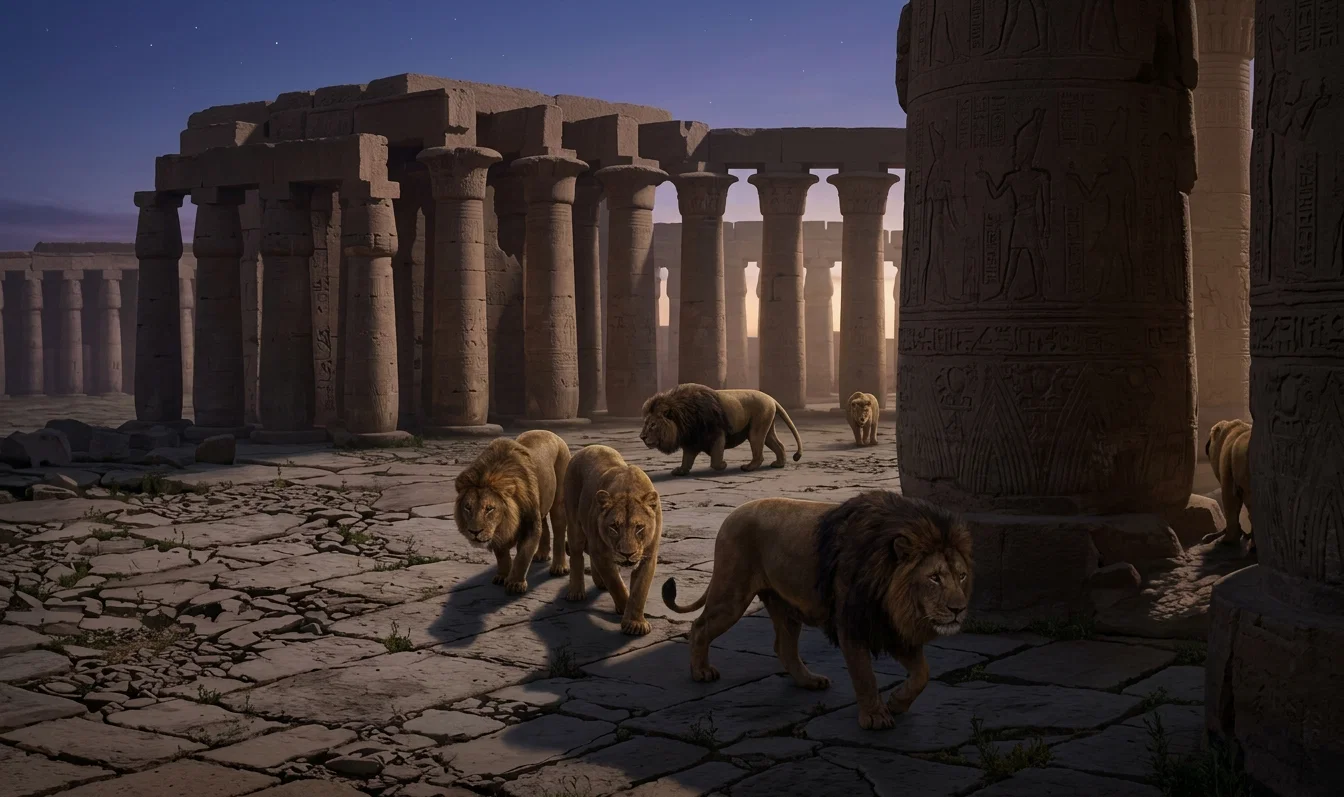
“And Babylon, the glory of kingdoms, the beauty of the Chaldees’ excellency, shall be as when God overthrew Sodom and Gomorrah. It shall never be inhabited, neither shall it be dwelt in from generation to generation: neither shall the Arabian pitch tent there; neither shall the shepherds make their fold there. . . . And the wild beasts of the islands shall cry in their desolate houses, and dragons in their pleasant palaces: and her time is near to come, and her days shall not be prolonged.” Isa. 13:19-22.
How strikingly has all this been fulfilled. An altogether different fate awaited Tyre, the proud, greedy, wealthy merchant city of Phenicia. She too was to be utterly destroyed, but her ruins would be utterly swept away. Listen again:
“And I will make thee like the top of a rock: thou shalt be a place to spread nets upon; thou shalt be built no more; for I the Lord have spoken it, saith the Lord God.” Eze. 26:14.
And we might mention Nineveh and Rabbah and No-Amon and Jerusalem, and predictions concerning various cities and lands. Literally has the Word been fulfilled. All its predictions concerning this world and its nations will be as literally fulfilled.
In the face of all these prophecies men ought to reverence the God of the Bible. In the light of these prophecies men ought to shun the pitfalls of sin and deception. In the assurance of these prophecies men ought to trust Him who knows and who “is able to save to the uttermost.”

The Manner of Christ’s Coming

By Abdiel
The work of Jesus Christ in the great scheme of salvation is made up of different steps and acts. He stepped down from the throne of Deity and gave Himself for the salvation of His creatures. He became an Angel-messenger of God—among the angels. He stoops lower, and is incarnated, a Man among men. He met the climax of His eternal sacrifice by His death upon the cross. He arose again. He ascended on High. He ministers as priest before God. He comes again in glory transcendent, supernal.

Its Importance

Of all the steps or events in that great drama of love and power, there is nothing more important than His second coming; for around it cluster all the hopes of the redeemed; and if it be not consummated, all the work of the past is for naught.
Small wonder, then, it is that the devil has done his best, or worst, to make of no effect the second coming of Christ in the minds of men. He has belittled it by his first falsehood, “Ye shall not surely die.” He has brought upon it reproach by leading men to teach above that which is written. He has connected with it fanatics of every sort, and has made many believe that the doctrine was responsible for the fanaticism. He has thrown round about the doctrine a mysticism, an indefiniteness, that is entirely foreign to the Word of truth. It is made to mean death, and spiritual revival, and Spiritualism, and Christian Science, and New Thought, and “the secret rapture” (whatever that may be), and still other things. The devil is at the bottom of it all with all the various schemes, if by some means he may deceive all. “Be not deceived” is the repeated injunction of the Master.

His First Advent

How will He come the second time? Let us first ask, How did He come the first time?—Literally, personally, visibly. Men saw Him, handled Him, talked to and with Him, ate with Him, walked with Him. He was a literal, personal Being. No believer in the Word questions this as regards His first advent.
He lived here upon this earth thirty-three years. He wrought miracles, preached the Word, saved souls from sin, died on the cross, was raised from the dead,—the same literal Jesus. Forty days after His resurrection He ascended to heaven. Clouds of angels of God met and escorted Him on His way. Two remained behind to instruct and comfort His disciples who sorrowfully watched their ascending Lord. And this is what the angels told them:
“Ye men of Galilee, why stand ye gazing up into heaven? This same Jesus, which is taken up from you into heaven, shall so come in like manner as ye have seen Him go into heaven.” Acts 1:11.
Note the emphasis. It is the “SAME Jesus,” not another, not a representative. The “same Jesus” with whom they had associated for over three years, who died upon the cross, whom they had seen laid in the tomb, who rose again, the same Jesus is coming again.
They had seen Him rise Master over earth’s attraction, and received by a cloud of angels. This same Jesus shall so come in like manner; even as they saw Him ascend, so shall He come again.
And this scripture is confirmed by many others. Listen:
“Behold, He cometh with clouds; and every eye shall see Him.” Rev. 1:7.
“Then shall they see the Son of Man coming in a cloud with power and great glory.” Luke 21:27.
“The Son of Man shall come in the glory of His Father with His angels; and then He shall reward every man according to his works.” Matt. 16:27.
What more testimony can we ask? Yet, notwithstanding this, there are those who teach that when Christ comes the second time for His people, it will be a SECRET coming, known only to His people. That, they tell us, is the parousia (pronounced, par-oo-see-ah), or “presence” of Christ. Some even contend that He is now here gathering out His bride; and that by and by He will come with His bride in visible form.

The Original Terms

But neither the Greek terms nor the Scriptures in general give any such idea as that. There are six different Greek words used of the Master’s coming, as follows: (1) The verb erchomai and its derivatives; it simply means “to come, to go, to pass,” without particular reference to manner. The noun denotes the simple act of coming, going, passing. (2) The verb ephistemi, meaning “to place upon, over, close by,” “to stand by or near,” “to come suddenly upon;” used of the judgments of God, in Luke 21:34; 1 Thess. 5:3. (3) Heko, defined to mean “to be come, have arrived.” It simply means that the coming to which it refers is accomplished. (4) Parousia, meaning “presence, a coming, arrival, a being present, presence, of persons.” It means personal, bodily presence. See 2 Cor. 10:10; 7:6. The word is rendered in our Common Version by “coming” and “presence” only. (5) Apokalupsis, meaning “disclosure, revelation, manifestation, appearance, uncovering, making known;” the Greek title of the book of the Revelation. (6) A word not translated “coming,” but “appearing” and “brightness;” namely, epiphaneia, “glorious display.” These last three words, when used of Christ’s second coming, are erroneously applied to different comings, when they are descriptions of different phases of the same event.

Events Connected with His Coming

There are in connection with Christ’s priesthood, closing events which may be and are spoken of as comings, but not to be confounded with His visible coming for His people. A study of Christ’s priesthood and the sanctuary question will make this clear. Without a knowledge of His priesthood, all is dark and confused. One of those “comings” is when Christ comes in before His Father to receive the kingdom, Dan. 7:13, 14. The other “coming” is when His priestly work ends and He comes to reckon with His servants before He comes in glory. Matt. 25:19. This is not a coming to earth or for His servants. It is a judgment act previous to Christ’s coming, when probation shall close, the beginning of the day of God’s wrath, known only to Him. Rev. 22:11, 12; 2 Peter 3:10; Matt. 24:42-44, 46; 25:10, 19; Mark 13:35; Rev. 3:3, et al. Then Christ is no longer priest, but comes into relationship to His people as judge.

His Personal Coming

But His second personal coming of promise and declaration is revealed under the parousia, the epiphany, the apokalupsis; the first word referring to His PERSONAL PRESENCE, the second to the FORTHSHINING of His glory, the third to His true DISCLOSURE as King of Kings, the glorious Son of God. That the personal presence (parousia) of Christ is not a secret affair, note the following scriptures:
“For this we say unto you by the word of the Lord, that we that are alive, that are left unto the coming [parousia, ‘presence’] of the Lord, shall in no wise precede them that are fallen asleep. For the Lord Himself shall descend from heaven, with a shout, with the voice of the Archangel, and with the trump of God: and the dead in Christ shall rise first.” 1 Thess. 4:15, 16.
“Whom the Lord Jesus shall slay with the breath of His mouth, and bring to naught by the manifestation of His coming [the epiphany of His parousia; literally by the forthshining of His personal presence].” 2 Thess. 2:8.
“For as the lightning cometh forth from the east, and is seen even unto the west; so shall be the coming [parousia, ‘presence’] of the Son of Man.” Matt. 24:27.
Certainly none of these scriptures indicate a secret, quiet, still coming. It is over a quaking earth, with trumpet tones and outbursts of supernal glory, that Christ comes the second time—literal, personal, visible, “this same Jesus” will come. Then men will see Him revealed in all His divine glory, unveiled. “Every eye shall see Him.” Some in the light of that glory will pale and die. Others, with glad hearts, having His glory within, will say, “Lo, this is our God; we have waited for Him, and He will save us.”
“And when He had spoken these things, while they beheld, He was taken up; and a cloud received Him out of their sight. And while they looked steadfastly toward heaven as He went up, behold, two men stood by them in white apparel; which also said, Ye men of Galilee, why stand ye gazing up into heaven? THIS SAME JESUS, which is taken up from you into heaven, SHALL SO COME IN LIKE MANNER as ye have seen Him go into heaven.” Acts 1:9.
Continue reading: What Is Involved in the Coming of Christ