Your ShelfYour Projects

Review and Herald, Vol. 58, No. 2.

Feeling and Conscience as a Guide
Earlier text: NEBRASKA

UPPER COLUMBIA TRACT SOCIETY.

THE first annual session of the Upper Columbia Tract and Missionary Society was called to order by the President, Thursday, June 2, 1881, at 3 P. M. Meeting opened with singing. Prayer by Eld. J. H. Waggoner.
Minutes of the organization session were read and approved. The following committees were appointed: On Nominations, Ambrose Johnson, Wm. McCoy, and Hugh Barkley; on Resolutions, A. T. Jones, Wm. Russell, and M. O. Beck.
The report of labor done the past year was called for, and read as follows:—
Districts No. Members No. Reports Received No. Members Visited No. Families Visited No. Letters Written No. Signs taken in Clubs Subscriptions obtained for Periodicals Pages of Tracts and Pamphlets distributed Periodicals Distributed Annuals sold and given away Cash rec’d on Tract Fund and Periodicals
1 29 52 5 197 152 32 95 16445 1251 28 ............
2 32 65 12 15 101 7 57 22341 730 43 ............
3 40 98 21 11 166 18 111 15642 1268 ............ ............
*1 4 11 4 440 275 ............ 33 6724 349 20 ............
105 226 42 663 694 57 296 61152 3598 91
Eld. Waggoner made interesting remarks in reference to the rise, progress, and importance of the work in general, but more particularly with regard to these items within our own field. He mentioned the fact that at present there is a great immigration to this part of the country, and that it behooves us to make greater efforts to properly meet the increasing demands of the times.
Adjourned to call of chair.
SECOND MEETING, FRIDAY, AT 5 P. M.—The Treasurer read the following report:—

TREASURER’S REPORT.

Received from districts, $371.85
“ on reserve fund, 209.50
“ from agents, 117.82
“ N. P. T. and M. Society, 56.25
“ “ camp-meeting fund, 6.51
Total receipts, $761.93
Paid to Signs Office, $516.70
“ “ REVIEW ” 167.03
“ for library, postage, and freight, 42.28
Total disbursements, $726.86
Cash on hand, 35.07
Financial standing of the Upper Columbia T. and M. Society, March 31, 1881:—
Due REVIEW Office, $17.50
“ “ Signs ” 8.66
Total, $26.16
Due from agents, $70.96
“ “ districts, 51.60
Publications on hand, 263.07
Total, $385.63
Due on pledges to reserve fund, 144.00
Total, including pledges to reserve fund, $529.63
Leaving a balance in favor of our society of 503.47
Report accepted.
This sentiment was considered and accepted: Though the financial condition of our society is somewhat favorable, we should greatly increase our efforts to develop ripe fruits for God.
Eld. Van Horn spoke in regard to the North Pacific T. and M. Society.
Adjourned to call of Chair.
THIRD MEETING, MONDAY, JUNE 9, AT 9 A. M.—The Committee on Nominations reported as follows: For President, G. W. Colcord; Vice-President, A. T. Jones; Secretary and Treasurer, Mrs. G. W. Colcord. Directors: Dist. No. 1, B. T. Winkler; Dist. No. 2, Ambrose Johnson; Dist. No. 3, G. H. Beck. These nominees were elected.
The Committee on Resolutions offered a resolution indorsing the resolutions passed by the Conference at Milton, Oregon, in May, 1880, as expressing all that is necessary to the success of the tract and missionary work in our field.
Adjourned to call of Chair.
FOURTH MEETING.—This meeting was called to order at 4 P. M.
Voted, To divide Idaho Territory on the line of the Lapwai, or Salmon River Mountains, apportioning the northern division to Dist. No. 2, and the southern part to Dist. No. 3.
The session closed with interesting catechisms and instructions.
Adjourned sine die.
G. W. COLCORD, Pres.
MRS. G. W. COLCORD, Sec.

Those Riots.

A recent paper gives the following more specific account of the riots in Marseilles, France, mentioned in our news column last week:—
The hostile feeling between Italy and France, on account of the occupation of Tunis by the latter country, has shown itself in a series of riots at Marseilles, in which city there is a large resident Italian population. The trouble was precipitated by the action of the Italians in hissing the French soldiers returned from Tunis, which brought about a riot in which a number of people were killed, and which was only quelled by the prompt arrival of troops. This initial attack was followed by demonstrations against the Italians in other parts of the city. The French authorities seem to have done their utmost to quell the mob, and promptly punished those who had taken part in it. Italian indignation, however, found vent in threats to mob Frenchmen resident in Italy. France at once retaliated by refusing to permit any portion of a loan, which Italy had advertised to help her resume specie payments, to be negotiated on the Paris bourse until that country formally withdrew her disapproval of the French protectorate for Tunis. This latter step seems to have touched Italy in a tender spot, and the indications are that the excitement will soon blow over. The blame of the whole affair attaches to the Italians, who showed more patriotism than discretion in hissing French soldiers for seizing a country which Italy has for a long time wanted, but was too timid or too slow to take.

Theodore Parker on the Greatness of Jesus

—“None but Jesus can do helpless sinners good.” In spite of his unbelief, Theodore Parker, of Boston, is reported to have said:—
“Measure the religious character of Jesus by that of the time he lived in, or that of any time or any place—yes, by the doctrine of eternal truth. Consider what a work his words and deeds have wrought in the world. Remember that the greatest minds have seen no farther, and have added nothing to the doctrine of religion; that the richest hearts have felt no deeper, and added nothing to the sentiment of religion; have set no loftier aim, no truer method than his, of perfect love to God and man.
“Measure him by the shadow he has cast into the world—no, by the light he has cast upon it. Shall we be told that such a man never lived,—that the whole story is a lie?
“Suppose that Plato and Newton never lived. Who, then, did their works and thought their thoughts? It takes a Newton to forge a Newton. What man could have fabricated a Jesus? None but a Jesus.” —Illustrated Missionary News.

The Mormon Conspiracy.

The report comes from Boston, through the Milwaukee Sentinel, that some months ago a gentleman of that city was sent to Utah, by the President’s direction, as a special agent to make a secret investigation of the sentiment of the Mormons and their intentions toward the government. In a private letter to a friend he intimates very clearly what the character of his report will be; for he corroborates the statements and indorses the predictions made by the The Inter-Ocean commissioner who recently spent some weeks in a similar investigation. This unnamed Bostonian says that the Mormon leaders have a comprehensive and deep-laid scheme, which they are carrying out with as much accuracy and zeal as ever distinguished Jesuitism, to establish an empire or theocracy of their own, independent of the United States, in the West. They have ceased to concentrate their forces in Utah, but by a systematic plan are spreading over the Territories from Wyoming to New Mexico, and the time is not far distant when an army of 100,000 men will be required to enforce the laws of the United States. All the region over which they have spread they are covering with a mesh-like warp of ranches and farms, and are filling this up with the woof of their rapidly-multiplying brood, which increases at an insectivorous rate. Through the fertile valleys of New Mexico and Arizona, along the available water-courses and around good springs, these Mormons are spreading themselves; and the government is giving them weapons with which to strike it back.
The agent says they have made themselves independent of the outside world for the necessities of life. They raise their own crops. They have factories, and in case of war against the Union, they could not be starved out; and, surrounded by their battlements of sky-piercing mountain ranges, they would make a hard fight against the invaders, struggling for their false faith with the fanaticism of a Mohammedan. A Mormon war would be a general Indian war as well. They are untiring in their efforts to poison the minds of the Indians against the national government, and to undermine their faith in its supremacy. They artfully secure Indian favor by never losing an opportunity to show them some consideration and place them under obligations. While it is too true that the average American frontier settler unwisely, and even stupidly, treats every Indian who passes his way with contempt and unaffected dislike, no Indian tribe is too insignificant for them to seek its favor. Their favorite method is to seek to breed a contempt for governmental authority, and a distrust of all its movements. They adapt their proceedings to the conditions of each tribe.
This may be regarded as romance by some people, but it is the same story that is told by every man who has taken trouble to investigate the subject. It is to be hoped that this report will convince the President and Congress of the necessity of immediate and decisive measures to crush out the new conspiracy before it extends beyond the control of law.—Inter-Ocean.

Russian Government Shows No Signs of Reform

—The situation in Russia gives no evidence of improvement. The government seems fully resolved to maintain its autocratic form at all hazards, and to use force if necessary to crush out all opposition. The promise to relieve the peasantry of part of the burden of taxation seems to have been made as a bribe to induce them to remain loyal. No hint is given of any serious intention to introduce radical reforms, or to redress glaring abuses. On the contrary, the recent riots in Southern Russia are cited as a reason why the government should use force to maintain its traditional form and authority. The prisons in all the principal cities are crowded with political prisoners, and the next deportation to Siberia promises to be one of the largest on record.

HOW THE LIQUOR LAWS ARE ADMINISTERED.

A LITTLE of the “backbone” which Spanish officials seem to have, as evinced by their recent energetic raids on gambling saloons, would not be a bad factor in the make-up of the city officials in our own country, judging by the following from the Christian Weekly of July 2:—
Philadelphia and Pittsburg rejoiced for a season over the advent of new city authorities who promised to give the citizens the benefit of quiet Sundays through the execution of the laws against Sunday desecration. They, however, find that, as heretofore, the liquor dealers are superior to the law. When the mayors are remonstrated with for not enforcing the law, they reply with a suspicious accord, that they have no “official” knowledge of a violation of the law, though the papers report what is evident, that bar-rooms are open and crowded. They protest against ordering the police to visit the saloons and report, “as it is not the duty of officers to act as spies and informers.” This new version of police duty is becoming quite fashionable in regard to illegal liquor-selling. When the principle is extended to other forms of crime, as felony, burglary, counterfeiting, etc., our police will become more ornamental than they are now. The fact is, and public officials ought to have the manliness to confess it, rum rules by the votes it controls, and the money it freely gives to political managers to maintain party control. Good citizens must be prepared to meet and overthrow it in this its stronghold.

Notes of News.

—Empress Augusta, of Germany, is seriously ill.
—June 24 was the forty-fourth anniversary of Queen Victoria’s reign.
—The decrease of the national debt for the month of June was $12,500,000.
—The crops in De Witt Co., Ill., were seriously damaged by a storm on the 26th.
—The Yorktown centennial monument is to cost $100,000. Work on it will begin at once.
—Russia purposes to invest 216,000,000 roubles—about $160,000,000—in ships of war.
—A recent fire at the docks in Hull, England, entailed damage to the amount of $150,000.
—It is believed that the entire debt of the country is owned by from 75,000 to 100,000 persons.
—The London Times has sent a special correspondent to Siberia, to describe the condition of the exiles.
—General Ord, who recently visited Mexico, thinks that he saw evidences of substantial growth and prosperity.
—A recent dispatch states that a new and terrible contagion resembling leprosy has appeared at Toulouse, France.
—A strike of the pony-drivers in a colliery in South Yorkshire, England, has thrown 2,000 men out of employment.
—On the 29th inst., tornadoes at Erin, Ont., and Moore’s, Pa., did great damage to farm-houses, trees, and grain fields.
—On Sunday, the 26th inst., the Roman Catholics of Connecticut celebrated at Hartford the centennial of the first mass said in that State.
—A cyclone in Tangier Sound, Chesapeake Bay, June 30, wrecked a number of schooners and fishing-boats, and caused the loss of several lives.
—Italians allege that France is trying to pick a quarrel with them to bring about a war, the object of which is to retrieve the glory she lost in 1870.
—A report from Piedras Negras states that several American engineers have been killed in Mexico in consequence of disputes regarding right of way.
—The mountain region of Colorado is about as large as Switzerland, but it has ten times as many peaks over 14,000 feet high as are in the Alpine range.
—The electoral platform of the National Liberal party in Germany has a plank calling for a reduction of the term of military service from ten to three years.
—A decree has been published dissolving the Spanish Cortes. Aug. 21 has been appointed as the day for holding elections, and the new Cortes is to meet Sept. 20.
—The railroad yardmen of Kansas City, Mo., have struck for an increase in their wages from $1.90 to $2.25. The companies declare they will not employ the strikers again.
—On the 18th inst., a party of fifty-four citizens were attacked by Piute Indians in the Dolores country, Colorado, and five of them were killed. The military are after the Piutes.
—The telegraph-construction steamer Faraday picked up and buoyed the end of the new cable on Land’s End, England, and is now en route to Newfoundland to complete the new line.
—Russia sensibly concludes that if England can protest against the action of Fenians in America, something should be done by European powers to limit the conspiracies of exiled Nihilists.
—The dome of the new observatory at West Point is to be made of paper. It will be thirty feet in diameter, and will weigh about four thousand pounds,—a tenth as much as a copper dome of that size.
—The first prize for declamation at Yale College was awarded to Miss Yew Chung, of Hiang Suan, China, and the topic of her declamation was a defense of the Christian religion. Here is food for a sermon.
—It has been reported by spies that Bon Amana, the rebel chief of Oran, Algeria, murdered the French soldiers captured by him, and spared only thirty-three of the Spaniards whom he took prisoners near Saida.
—A journalist in Pesth, Hungary, has been sentenced to four months’ imprisonment and to pay a fine of 1,000 florins for an article criticising the Austro-Hungarian army. So much for freedom of the press under Austrian rule.
—In sinking a well some seven miles west of Foxburg, Pa., a few days since, the remarkable discovery of a vein of natural coal tar was made, at a depth of 270 feet below the surface. The discovery is the first of the kind on record.
—At Drammen, Norway, some striking workmen made a raid on the town hall with the intention of releasing two of their number who had been arrested. They were fired upon by the military, and one man was killed and several wounded.
—The Commissioner of Railroads has been summarily dismissed by Secretary Kirkwood, for unlawfully reporting to the officers of the Central Pacific Railroad, the debtors of the government, instead of reporting to the Secretary of the Interior.
—A New York agricultural paper, judging from 2,000 crop reports, draws the conclusion that the next harvest will show 20 per cent less wheat than last year, and 15 per cent less corn; an increase in rye and barley, and the largest crop of oats ever produced.
—The British and French holders of Confederate bonds cherish the hope of getting them recognized. They are combining to maintain a representative in New York, who will endeavor to obtain “an equitable settlement” from “the former Confederate States.”
—A land-slide is in progress above Lake Thurn, Canton of Berne, Switzerland. On the land are meadows and houses, and the whole is gradually sliding into the lake. In the Canton of Grisons, 1,300 sheep with their shepherds were overwhelmed by an avalanche.
—A few days ago, a fireworks dealer was fined five shillings in Philadelphia for a breach of the anti-fireworks act passed in 1721 in the time of George the First of England. As the magistrate insisted that the fine should be paid in shillings, the defendant bought them of a broker.
—A manufacturing company at Berwick, Pa., have agreed to pay the three hotels of the place an equivalent for their probable profits for a year from the sale of liquors, if they will not apply for license. They expect to save money through the greater efficiency of sober workmen.
—A Roman Catholic paper says that had the church retained all her children, there should now be in the United States from 20,000,000 to 25,000,000 members of that church, whereas there are now less than 7,000,000. It attributes the great losses to the influence of the public schools.
—Governor Cornell has been giving the district attorneys of New York some much-needed instruction in regard to suppressing lotteries; and in New York city these instructions are obeyed with a promptness that awakens no small trepidation among the culprits, who find that their bribes are useless.
—The rapid emigration from Germany has alarmed the authorities, and they are taking measures to stop it. The public exhibition of placards of emigration agents or of foreign steamship companies has been prohibited, and a bill impeding emigration will be brought before the Reichstag at its next session.
—In the river Mersey, off the city of Liverpool, are hulks containing four hundred tons of gunpowder. The people of Liverpool, in view of the Nihilistic proclivities of the Irish agitators, do not feel secure in so close proximity to these explodent vessels, although the Secretary of the Admiralty assures them that the dangerous hulks are closely watched by a revenue cutter.
—At Prague, the capital of Bohemia, a festival of German students was interrupted by Czechs, and in the course of the riot several Germans were stabbed. Next day the Bohemians again attacked the German students, when more stabbing occurred. Thirty persons have been arrested for participating in the disturbances. The Bohemian authorities are determined to repress the rioting.
—The Constantinople court which tried the persons implicated in the murder of Abdul Aziz, the late Sultan of Turkey, have passed sentence of death upon Midhat, Mahmoud and Nouri Pashas, Fahri Bey, Ali Bey, Nedjib Bey, Hadji Mehmer, Mustapah “the wrestler,” and Mustapah “the gardener.” Izzet Pasha and Zyda Pasha received ten years penal servitude. All the condemned have appealed.
—At Madrid the municipal authorities, engaged in raiding the gambling houses, arrested a young man preparing to lay a petard, who confessed he was the agent of a great conspiracy planned to secure immunity to the gambling fraternity by alarming the citizens. No less than thirty explosions occurred within a few days. The authorities, however, so far from being intimidated, have made a general sweep of the owners and managers of gambling dens, who will probably receive the severest sentences allowed by law. Twenty-seven of his accomplices have been arrested.

France and Turkey Face War Clouds in North Africa

—France has her hands full in Northern Africa. A war-cloud hangs over Tripoli. France is transporting a part of her Tunisian contingent thither for the assumed purpose of restoring order among the native tribes, and Turkey is arming the native police, and is sending four regiments to assist them. The French navy is to have a demonstration in the harbor of Tripoli, in which the Sultan’s war-ships may try to interfere. France has two hundred and fifty-eight ships, of which sixty-six are ironclads. Turkey has one hundred and eighty men-of-war. At Sfax, a sea-port of Tunis, some Arabs fired on a French transport which was conveying part of the contingent to Tripoli. The European residents, fearing attacks from the insurgents, took refuge on board vessels in the harbor. Sfax is in the hands of the insurgents, and French troops have been ordered to the town. A general uprising against the French is imminent in Algeria.

Railway Bridge Collapse in Mexico Kills Soldiers

—Mexico has been having one of those little experiences with railroads to which civilized nations have grown accustomed, but which are not calculated to impress a superstitious people with the superior advantages of new-fangled methods of locomotion. The Moreles railway is a narrow-gauge road, and has only been in operation a week. One of the engineering triumphs of the line was a bridge spanning the San Antonio River near the village of Mailpois. On Friday evening last a train laden with soldiers was thrown into the river by the sudden giving way of the bridge, and the wreck rendered complete by the ignition and explosion of a consignment of alcohol in a freight car. No less than 192 privates and thirteen officers were killed by the fall, or roasted alive in the fire, while fifty others received serious injuries. The engineer and fireman were scalded to death. Fortunately for the popularity of American enterprises in that country, the road was built by native engineers.—Interior.

Prince Alexander of Bulgaria Tightens His Grip on Power

—Prince Alexander, of Bulgaria, who gave his subjects their choice between his abdication or the acceptance of “reforms” which would make him practically dictator, has been swinging around the circle of his principality in order to make personal appeals to its various constituencies. Having first grabbed the power, he now asks his people if it is all right, and is taking such measures as shall make them answer in the affirmative. Several of the most prominent liberal leaders have been arrested and imprisoned on the charge of insulting His Majesty, and for attacking the government in their proclamations. The people are warned against taking part with the agitators or accepting their doctrines. The popular elections were to take place on Sunday, June 26, but the National Assembly which will decide upon the constitutional changes demanded by the Prince, does not meet until the middle of July. It is expected that by that time everything will be so fixed that the “reforms” will pass the Assembly without material opposition. The Russian method of carrying a doubtful point has been apparent throughout the entire movement.—Interior.

Obituary Notices.

“Blessed are the dead which die in the Lord from henceforth.” Rev. 14:13
Bonfoey.—Died of epilepsy, at Almena, Van Buren Co., Mich., June 22, 1881, Webster F. Bonfoey, in the sixteenth year of his age. Webster was a praying boy, and the parents are comforted by the thought that he sleeps in Jesus. Discourse by the writer, from 1 Pet. 2:7, first clause. H. M. Kenyon.
Kenison.—Died in Seward, Neb., June 12, 1881, Otis Kenison, in the sixteenth year of his age. His death was caused by hemorrhage of the nose, resulting from a fracture of the skull occasioned by a fall from a horse more than a year ago. Funeral discourse by the writer, from 1 Cor. 15:22, 23. M. Hackworth.
Pixley.—Died of croupous diphtheria, in Harrison, Mich., June 23, 1881, Ella M., daughter of Byron and Emma Pixley, aged 1 year, 8 months, and 15 days. May the Lord bless this dispensation to the good of the parents, that when the Lifegiver comes, they may again clasp their little one in their arms. Funeral discourse by Eld. Birdsell, United Brethren, from Jer. 31:16, 17. Judson and Eliza Barrett.
Lathrop.—Died of consumption, in Dale, Outagamie Co., Wis., after an illness of six months, our dear brother, Albert Lathrop, aged 23 years, 4 months, and 6 days. He had made no profession of religion up to the time of his illness; but he then sought the Lord, and was found of him. He manifested a desire to know the truth, and talked of the second coming of Christ to ransom his people from the grave, and of his hope in the resurrection. Funeral services by Eld. Reinhart (Methodist). Willard Lathrop.
Chaffee.—Died of consumption, in Greenville, Mich., June 10, Dr. L. A. Chaffee, aged 47 years. Bro. Chaffee embraced the truths of the third angel’s message over five years ago, and since that time has lived a consistent life. During all of this time he has been suffering with consumption, and for over one year he has not spoken aloud. He was confined to the house through the winter, but when spring opened he rode out nearly every day until within two weeks of his death. As a citizen, practitioner, and Christian, he was esteemed by all who knew him. We visited him frequently during his last sickness, and he always rejoiced in the blessed hope of a resurrection when the Lord comes to gather his saints. He leaves a companion and son, and a large circle of friends to mourn his loss. Remarks by the writer from the words, “Prepare to meet thy God, O Israel,” Amos 4:12. J. Fargo.
Olmsted.—Bro. Phineas Olmsted died at Glensdale, Lewis Co., N. Y., April 22, 1881. He came to his death by drowning in the creek running near his house, his body not being found till he had lain in the water nine days. His life was such as to recommend the truth to all with whom he associated. A wife and three children mourn his loss. Sister Olmsted is a woman acquainted with grief. About three years ago, her youngest son died of starvation and fatigue, having lost his way in the woods while assisting a hunting party. His body, too, was found on the ninth day after the accident. Sister O. stands alone in the truth, and is obliged to meet bitter opposition from her own family. May these afflictions work out for her a far more exceeding and eternal weight of glory. The funeral services were held by the writer, June 5. E. M. Plumb.

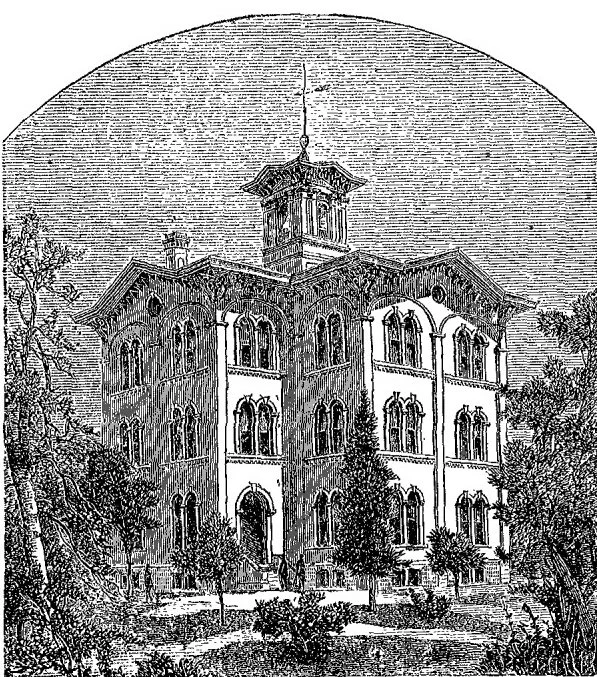
BATTLE CREEK COLLEGE.

A MODEL EDUCATIONAL INSTITUTION, COMPRISING FIVE DEPARTMENTS.

Nearly 500 Students Enrolled Annually, Coming from 32 States and Territories.

DEPARTMENTS.

I. DEPARTMENT OF THE ARTS AND SCIENCES.

This includes a Classical Course of FOUR YEARS and an English Course of three years, each with its Preparatory Course of two years.

II. NORMAL DEPARTMENT.

This includes a Teachers' Course of FOUR YEARS, and a Model School. The course in this department includes all the branches required for a first-class certificate in any State. Professional instruction in Didactics is also given to those in this department who are expecting to teach.

III. COMMERCIAL DEPARTMENT.

This includes instruction in the following topics: Book-keeping, Business Correspondence, Business Forms, Business Penmanship, Commercial Law, Banking, and Telegraphy. The common branches are also pursued in connection with the topics given above; also, French and German.
There are two sessions daily—afternoon and evening.
The courses in this department are of varying length, and the tuition ranges from $5.00 to $30.00.
Superior advantages for those desiring to prepare themselves for Tract and Missionary Secretaries and Librarians. (Send for special circular.)

IV. DEPARTMENT OF THEOLOGY.

This department has a course of three years, which includes, besides the usual common branches, Geology and Greek.

V. DEPARTMENT OF HYGIENE.

This department has a course of one year. It is designed for those who desire to obtain accurate and scientific information on all subjects pertaining to the preservation of health, together with a fundamental knowledge of anatomy and physiology, and a practical acquaintance with the nature and ordinary treatment of common diseases.

THE FACULTY

numbers fourteen members. They are all men and women of experience and critical scholarship.
The majority of the students are young men and women of true moral worth. Their influence over the unstable is highly restrictive and salutary, making it comparatively easy to maintain the most rigid discipline.

EXPENSES.

Probably there is no other College in the United States where a thorough education can be obtained at so small an expense. A system of clubbing, which has become very popular among students, enables them to secure excellent board at $1.10 a week, exclusive of lodging, which costs 50 cents to $1.00 more.
The annual expenses of each student, including all but traveling expenses and clothing, need not exceed $113.00. A full descriptive Catalogue will be sent free, upon application.
Address BATTLE CREEK COLLEGE, Battle Creek, Mich.

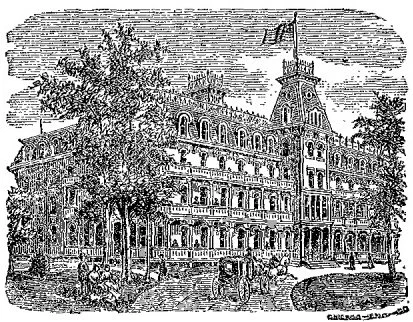
MEDICAL AND SURGICAL SANITARIUM,

Battle Creek, Michigan.
This institution, beautifully located in one of the most healthful cities of Michigan, is everywhere recognized as the

GREAT SANITARIUM OF THE WEST.

More than 4,000 patients successfully treated. The erection of new buildings and the addition of all the most approved remedial appliances known to the profession, have made it The Most Complete Institution of the Kind in America. All modern hotel conveniences furnished. Terms very reasonable.
J. H. KELLOGG, M. D., Medical Superintendent.
Address. SANITARIUM, Battle Creek, Mich.

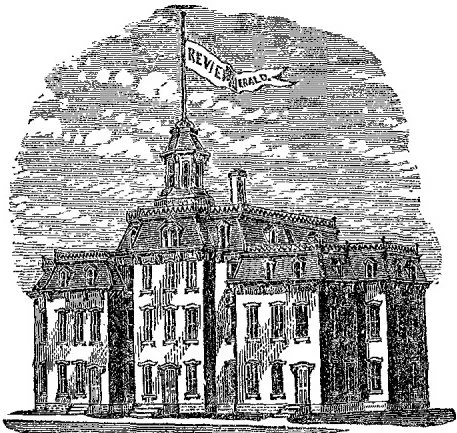
REVIEW AND HERALD PUBLISHING HOUSE.

BOOK AND JOB PRINTING,

BOOK BINDING,
Electrotyping, Stereotyping, Paper Ruling, Blank Book Manufacturing, Etc.
The largest and best-equipped printing office in the State. Orders by mail promptly attended to.
Address REVIEW AND HERALD, Battle Creek, Mich.
TRACTS.—4 cents each. Redemption—The Second Advent—The Sufferings of Christ—The Present Truth—Origin and Progress of S. D. Adventists—Ten Commandments not Abolished—The Two Covenants—Address to the Baptists—The Two Thrones—Spiritualism a Satanic Delusion—Samuel and the Witch of Endor—The Third Message of Rev. 14—Who Changed the Sabbath?—The Spirit of Prophecy—The Millennium—Signs of the Times—Scripture References—Constitution of the T. and M. Society—Tithes and Offerings—Sabbaton.

THE SIGNS OF THE TIMES.

PUBLISHED WEEKLY AT OAKLAND, CAL., FOR THE

MISSIONARY SOCIETY OF SEVENTH-DAY ADVENTISTS.

A live Religious Family Paper, containing, in addition to the great variety of original articles, which make it a desirable prophetic journal, Departments devoted to Temperance, The Home Circle, News, The Missionary Work, and the Sabbath-school. Price per year, $2.00
In clubs of five or more copies to one address, to be used for missionary work, each 1.50
Address SIGNS OF THE TIMES, Oakland, Cal.,
OR—
REVIEW AND HERALD, Battle Creek, Mich.
ELDER J. N. LOUGHBOROUGH, Ravenswood, Shirley Road, Southampton, England.
MISS ELIZA THAYER, Secretary N. E. Tract Society, So. Lancaster, Mass.
WM. LEAVITT, Salem, Oregon.
Continue reading: ADVENT HAROLDEN