ALONG with others who receive the love of the present truth into their hearts, the native African convert is willing to sacrifice for the cause he loves, and give as God prospers him. Of late we have seen some very striking examples of devotion and faithfulness among this people, a few of which we will mention.
About a year ago the writer organized a church over near the Indian Ocean among the Kafirs. This church is wholly a native church, no white people being connected with it. Many of them were, a short time ago, Red Kafirs, who go about with their bodies smeared with red clay, and scantily covered with orange-colored clothing. This church came out of the dense darkness of heathenism when they accepted present truth, and knew but little of God or the plan of salvation. For two or three years their crops have been a failure, their lands have produced but little, so their incomes have been very small indeed; but a short time ago this native church sent to our Union Conference office a check of £55 in tithe which they had been laying aside of their scanty means. In American money this is about $270, and certainly speaks loudly in favor of the faithfulness of these native believers of the Fish River church.
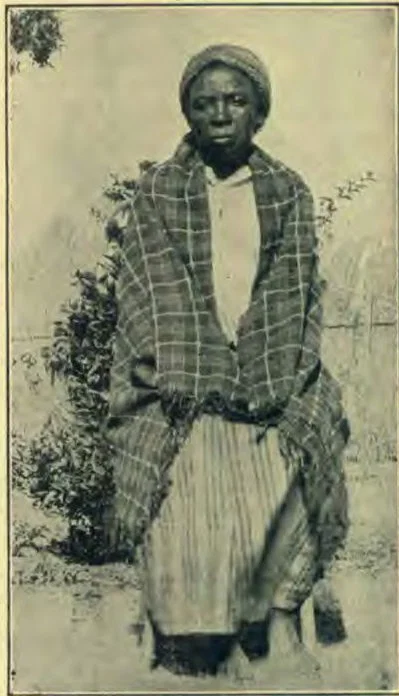
Another instance of faithfulness came to the writer's notice a month or so ago when visiting one of our mission stations in Rhodesia. We were at Somabula, holding a Bible school with our native workers, when one day a native woman came to the mission carrying on her head a basket of grain. This grain was the tithe of all she had raised, as her crop had been terribly cut with the drought, but gladly and willingly she gave God his own, and had brought it six miles on her head. During this Bible school the old lady whose photograph is shown in the next column, walked fifty miles to the school and fifty miles home, that she might be instructed in the things of God, and know more of the truths for this time.
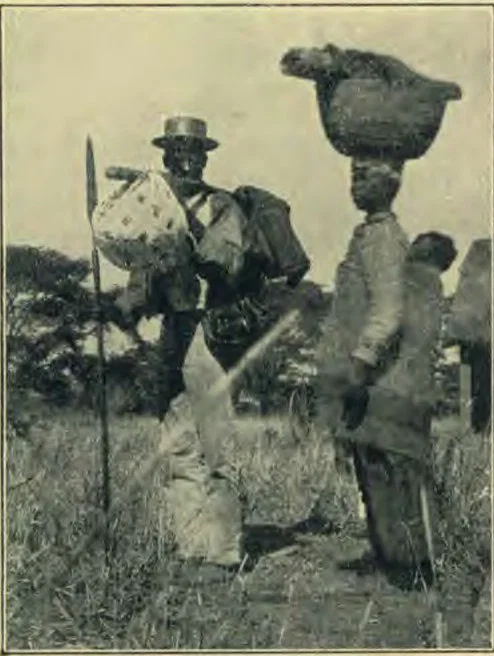
Willie and Mary on their way to the Bible school
To this same Bible school also came Willie with his wife, Mary, from the Shangani Reserve, to meet with those of like faith. Willie is one of our outschool teachers in that wild, dark region. This couple walked one hundred miles to Somabula Mission and back home again, carrying the loads here shown. Willie in one hand carried his spear, as a protection against wild animals, and on his shoulder a pole with two heavy packs tied to the ends, as shown in the photograph. Mary carried on her back a heavy baby, and a basket on her head, weighing, we are sure, forty pounds. With these great loads they trudged through the hot sun and over sandy roads this long distance, that they might meet with us in the Bible school. Surely God, who is no respecter of persons, regards the faithfulness, devotion, and sacrifice of these African children of his, and will reward them according to their works. We believe they love God, and God loves them, and if they continue in the good way, they will finally be permitted to enter the home of the blessed.
Walked fifty miles to attend the
Bible school
To bring this needy people to the love of the truth and see them rejoice in it, is a work that satisfies the soul, and binds the missionaries to their labors with bands of steel. W. B. WHITE.
Who are Earth's Heroes?
“But ah, what folly! see, he stops to raise a fallen child,
To place it out of danger’s way, with kiss and warning
mild.
A fainting comrade claims his care,—once more he
turns aside;
Then stays his strong young steps to be a feeble woman’s guide.
And so wherever duty calls, or sorrow or distress,
He leaves his chosen path to aid, to comfort, or to bless.
“Speak, history! who are life’s heroes?
Unroll thy long annals and say—
Are they those whom the world calls victors,
Who won the success of a day?
The martyrs of Nero? The
Spartans who fell at Thermopylæ’s tryst,
Or the Persians and Xerxes?
His judges or Socrates?
Pilate or Christ?”
First Fruits of the Tabriz Mission
OUR missionaries in Tabriz, Persia, have the joy of seeing the first fruits of their service for God in that trying field. Three young women have accepted the truth, and are now in this country. One of them, a Miss Shalim, who taught for several years in the American Presbyterian school at Tabriz, has entered upon the nurses’ course at the sanitarium in Melrose, Massachusetts, and the other two have secured employment.
Pain Caused by Want of Thought
“PAIN is caused by want of thought
As well as want of feeling.”
For the Finding-Out Club
It was remarked recently that the Finding-Out Club from its variety of subjects would considerably increase the knowledge of one who would become conversant with every subject presented. The club is designed to inspire versatility; but the questions given this week appeal to the heart more than to the intellect. This, however, does not diminish their value.
As the 2,700 students of the University of Kansas registered this year, they were each handed a neat little pamphlet. The title-page was blank except for the words “Character First.” Inside on the next page were the following three simple injunctions:—
“Don’t break the home ties!”
“Write that letter today!”
“Go to church next Sunday!”
The pamphlet contained a brief personal message from the registrar of the university. “You are here for an education,” it said. “Strive to be able to answer the following questions in the affirmative, when your work is done:”—
“Has your education given you sympathy with all good causes and made you espouse them?
“Has it made you public-spirited?
“Has it made you a brother of the weak?
“Have you learned to make friends and keep them?
“Do you know what it is to be a friend yourself?
“Can you look an honest man or a pure woman straight in the eye?
“Do you see anything to love in a little child?
“Will a lonely dog follow you in the street?
“Can you be high-minded and happy in the meaner drudgeries of life?
“Do you think washing dishes and hoeing corn just as compatible with high thinking as piano playing or golf?
“Are you good for anything to yourself? Can you be happy alone?
“Can you look out in the world and see anything except dollars and cents?
“Can you look into a mud puddle by the wayside and see anything in the puddle but mud?
“Can you look into the sky at night and see anything but stars?”
Members of the Finding-Out Club
Stanley R. Altman | Faye F. Felter
Berna Anderson | Gussie Field-Colburn
W. M. Andress | Mrs. Mary Finn
Mrs. C. M. Babcock | Vera M. Fleming
Laechler T. Barnes | Thelma Aletha Fretz
Gladys Bartholomew | Hilda Mae Gilbert
Harold E. Beasley | Mrs. E. M. Glass
Lillian Beatty | Helen M. Gould
Mary F. Beatty | James C. Hannum
William Beck | Engracia Hensen
Helen Dykstra Beguelin | Herbert Hansen
Hazel Brooks | Mrs. Carlyle B. Haynes
Rose M. Brown | Loretta Heacock
Lavina Burkhalter | Perry G. Hills
Lillian Burrows-Parker | Gertrude Hinds
F. E. Cary | Mrs. Grace Hoover
Donald J. Chaney | Modette Hunt
Charles S. Channing | Virgil Jackson
Lois A. Christian | Mrs. L. A. Jacobs
Harold W. Clark | Orie A. Johnson
Katherine Coleman | Evelyn Karr
Myrtle E. Cooper | Mabel Otey Kelso
Reuben Coquillette | H. O. Kaneko
Clora H. Curtis | Almeda Laing
Ross A. Curtis | Mae C. Laing
C. J. Dart | Ruby E. Lea
Milton Dillon, Jr. | Lolita Leadsworth
Milton K. Dymot | Mrs. W. T. Lewis
Mrs. F. D. Emmons | Mary B. Long
David E. Fay | Mrs. H. C. Lyle
Cora Felker | Norman Lee Marsh
Irene MacDonald | Pauline Sanford
J. D. MacGinn | Eva B. Santee
Bernice Mac Lafferty | Mrs. Belle Schrank
Laurence Mac Lafferty | Laura Sharp
Mildred Meleen | Elizabeth Shipley
Edwin Montgomery | Hattie M. Shoals
Mary H. Moore | Stella Teft Shryock
Lulu Morehead | E. Harold Shryock
Inez Mortenson | Alfred Shryock
Athalie Moseley | Lou Smith
Vera Mott | Leeta G. Spicer
Bessie Mount | Mrs. Blanche Spriggs
Mrs. Ruth Mount | Frank Steuenberg
Curtis F. Myers | Grace M. Steves
Hazel Nary | Earle Stiles
Nannie Nelson-Kroehler | R. R. Sweany
John Newton | Eva B. Taylor
Mrs. Minnie Norman | William S. Thomson
Agnes Nystel | Ivy Ruth Thompson
G. Nystel | Elsa Thompson
Oscar Nystel | W. C. Van Gorder
Mrs. Anna Osborn | Mrs. Robert Wallace
Mrs. Josephine Paden | George F. Webb
Pauline Paulson | Harold N. Williams
Louise Quick | May Willhelm
W. S. Reese | Addie Wilson
Mrs. Hattie Robinson | Mrs. Grace C. White
Frances C. Rosenkrans | William E. Whitmore
Adeline Rouleau | Wm. F. Wood
Helen Salisbury | Susan A. Walde
T. D. Sanford | Roland Wright
Something New
If the children come home exhausted from their examinations, it is no wonder. Fancy the mental strain they have undergone to evolve such answers as these, which were selected from those given by New York State pupils in a regents’ examination:—
The chamois is valuable for its feathers; the whale for its kerosene oil.
Climate is caused by the emotions of the earth around the sun.
The purpose of the skeleton: something to hitch meat to.
A blizzard is the inside of a hen.10
George Washington married Martha Curtis and in due time became the father of his country.
The alimentary canal is located in the northern part of Indiana.
The qualifications of a voter at a school meeting are that he must be the father of a child for eight weeks.
Gender shows whether a man is feminine, masculine, or neuter.
Four animals belonging to the cat family are the father cat, the mother cat, and the two little kittens.
“The government of England is a limited mockery,” wrote one school child after patient thought.— Every Week.
Smiles
THE smile is an asset — but there are smiles and smiles. The Southern Merchant (Atlanta) lists some which are to be avoided:—
The pitying smile, when the customer signifies a desire to look at a cheaper article than the one first shown.
The sarcastic smile, when the customer intimates that she is a more competent judge of her own needs than the clerk.
The knowing smile, when the customer says she is buying an electric shaving mug for her “brother.”
The idiotic or meaningless, vacant, perpetual smile of the clerk who considers a smirk his stock in trade.
The bored smile when the customer speaks pridefully of the exceptional cleverness of her sister-in-law’s second cousin’s children.
The “Heaven-help-me” smile, exchanged with a fellow employee, when the customer finds difficulty in deciding between two patterns.
A Traveling Man’s Experience
By James M. Davis
I HAD been traveling all week, with heavy work. Saturday evening found me at a beautiful Illinois town on Rock River.
Finding comfortable quarters, my thoughts turned to services for the next day. Looking back, it seems to me I never in all my life so desired to be in the house of God and to come in touch and communion with his dear children.
Noticing a church near by, I was told it was the First Methodist, and that it had just been dedicated. There, at the first services, I decided to go. At nine o’clock Sunday morning the bell rang, and I was soon ready. I noticed that people were entering the church basement, so I followed the company, and found about eighty in attendance. I learned from an aged, saintly looking Scotchman that it was to be a class meeting. He gave a hearty welcome to all and announced the hymn:—
“A charge to keep I have,
A God to glorify.”
After prayer and another song, the pastor was the first to speak. He said: “I was born in England. My father being a shoemaker, I followed his trade. My father was a Christian, a very quiet, thoughtful man. Often, mornings, he would outline my work for the day, and then not a word would be spoken.
“To our little church there came a great awakening. Many were entering from darkness into light. I was deeply moved, and, at the age of sixteen, after days of prayer I surrendered my heart to God. I felt at once the call to preach the unsearchable riches of Christ. With this conviction I worked quietly for two years, keeping my own counsel. Then the call came so strongly I could stand it no longer. Turning to father, I asked if he could let me go.
“I told him frankly I felt a call to the ministry and wanted to get an education. Father said: ‘Son, you are not of age. I am poor and unable to help you.’ I told him I knew it, and that God, who had called me, would provide; that I wanted to go that day.
“He told me to go, and to take my tools with me, as I might find work somewhere. Then I went home, and told it all to mother, who gave me into God’s hands. I went past the old shop to bid father good-by, and started I knew not whither.
“When far down the road, I turned for a look at the old shop and home, where my childhood and youth had been passed. Father came out, calling loudly to me. When he came up, he held in his hand a fifty-cent piece, which he asked me to take; it was all he had. As he passed it to me, my heart felt breaking.
“I went on and on—far into the country. One day I noticed, far across the fields, a beautiful country home. I went to the door, told my story, and asked for work. The lady, who seemed to be interested, gave me work at doing chores. I kept at this steadily. At nights I worked at my trade. So things remained till fall, when I proposed to go on; but the good lady said they had secured an excellent teacher for the district school, and I must remain.
“There I stayed and worked while I prepared for college. The presiding elder took an interest in me, sent me to college, where with his aid and my own work I was able to pull through, and finally was graduated. And here I am to preach to you my first sermon this morning.” And the sermon followed.
We sang the old hymn: “Leaning on the Everlasting Arms.” Several spoke tenderly of God’s never-failing love. And so in that little country church passed a forenoon that can never be blotted from memory.—
James M. Davis, in the Christian Herald.
Pygmies and Their Wives
The pygmy is a model of domesticity. Although of wandering habits, he cleaves to one wife. As three children are considered an extravagance, he contents himself with two. His worst vice is that he occasionally relieves a neighbor of a fowl or two at night. Perhaps this weakness is some relation to the Southern Negro’s affinity for chicken coops.
So shy are pygmies, and so prone to hide in the tree tops or amid thick foliage, that not every African explorer has been able to see them.
Pygmy men, as described by one traveler, are about four feet high. In spite of their brevity of stature, they are more powerfully built than most African races. They are broad-chested, muscular, with short, thick necks, small bullet heads, and massive legs. Their chests are covered with black curly hair. Most of the men wear thick black beards.
So friendly did one tribe become with an explorer that they even brought their wives to see him. The women are comely, attractive little creatures, with skins much paler than the men’s. They have the usual flat nose, thick lips, and black curly hair of the Negro. Their eyes are singularly beautiful — so bright, so quick, so restless, that they seem never to light for a second on anything. Smaller than the men, the women are not more than three feet and ten inches in height.
Pygmies cannot become farmers, for they never stay in one place long enough to gather a crop. From the trees they get fruits, nuts, and wild honey. For their meat they shoot buffalo, antelope, monkey, wild pig, and occasionally elephant.
“Often,” said A. B. Lloyd, the famous missionary traveler, “they follow a wounded elephant for days, shooting into it hundreds of their little iron-tipped arrows, until the poor creature dies from sheer exhaustion. They then make their little camp all around the carcass, and live upon the flesh as long as it will last, and then away they go again to seek other food.” — Every Week.
Pope on Vice and Habit
Vice is a monster of so frightful mien
As to be hated needs but to be seen;
Yet seen too oft, familiar with her face,
We first endure, then pity, then embrace.
— Pope.
Hope and Courage in the Work of God
By Ellen G. White
“HOPE and courage are essential to perfect service in the work of God. These are the fruit of faith. Despondency is sinful and unreasonable. God is able and willing more abundantly to bestow upon his servants the strength they need for test and trial.”—Mrs. E. G. White.
The Promotion of Clifton Grayson
By Sidney Ralston
“Didn't you get the promotion, Clifton Grayson?” Theodora asked the question in a strained voice. The eagerness that had been in her face as she watched her brother coming up the walk had merged into disappointment and something closely resembling resentment as he came near enough for her to note the expression of his face.
“No, I didn't; Berkeley got it!” the young man answered crisply as he passed the questioner on the steps and entered the house.
The terse negative sounded almost sullen to Theodora; it certainly was not calculated to allay her rising irritation. She followed him into the house, her lips compressed into a straight, unbeautiful line. They had become almost habitually compressed in the last year—those soft, girlish lips which up to that time had known nothing but tender curves.
A little more than a year previous Theodora Grayson had been a care-free student in an Eastern seminary with a reasonable assurance of happy success before her. She had never known a father's love and protection, he having died in the girl's infancy; but in the Central Western manufacturing town where she had lived all her life, she had left her mother and brother to keep the home going and to make study and work and achievement doubly worth while to the young student. Then, very suddenly, had come a summons home, swiftly followed by a last quiet talk with her mother.
“I want you to stay with Clifton, dear, and make a home for him,” the loved voice had whispered in the going-away hour. “I am not forgetting the seminary course, Theo, and I am sorry, but—Clifton needs you. You will see, as time goes on, what I mean, and I know I can trust my girl to do her share.” And Theodora had promised.
Clifton was a little less than two years older than his sister. The two had been graduated from high school in the same class for the boy had not been quite so quick to master the elements of the course as his sister, although his standing was as high. When it was decided that but one of them could continue study beyond the high school, Clifton had generously insisted that it should be Theodora, and had associated himself with one of the largest and most prosperous banks in the home city, while his sister continued her studies in the distant seminary. Then, into the busy, happy lives had come the shadow of parting.
Theodora had no thought or desire to do other than carry out her mother's wish, and immediately set about adjusting herself to the changed conditions, trying to keep the home for her brother just as the mother had done for them both. But as the weeks and months passed, a strange disappointment grew in her heart—disappointment in Clifton. Not that he consciously failed her in any way. He was the same dear, faithful brother he had always been, and his loving pride and confidence in his sister was something beautiful to see; but, for some reason, he did not seem to progress in his work as Theodora thought he ought to. He was faithful and trustworthy, and his employers spoke strongly in his praise, yet it seemed to his sister that opportunities for promotion passed, one after another, while he remained in the background or at least advanced but slowly. This last promotion was one she had been particularly anxious for him to achieve. It had been hanging in the balance for some time, and each evening Clifton had come home with a growing dread of the questioning and disapproval that was sure to meet his acknowledgment that the goal had not yet been gained. It seemed to him that he had done nothing for months but explain, or try to explain, why it was that he was not so high, seemingly, in the scale as some others who had started when he did. As for himself, he could see a consistent reason for it all, and would have worked on courageously but for Theodora's discouraging view; that was making almost a coward of him.
And on this particular evening the limit of Theodora's patience seemed to have been reached. She tried to take this last failure with at least no greater show of impatience than that with which she had met former ones, or, at any rate, to conceal her discouragement as much as possible from her brother, but his keen eyes read her downcast face clearly.
“I'm sorry, Theo,” he said humbly, as they sat down to supper. “I've surely done my best, but sometimes I almost believe luck is against me—”
“Luck!” the girl flashed out impatiently, losing for the moment her self-control. “‘Poor luck’ is the excuse Mrs. Oleson gives for her miserable bread; but no one else calls it that. We all know that she doesn't know how to bake bread.”
Clifton flushed. Theodora had never spoken to him in that way before.
“I'll put my real capability against any of the others in the office,” he flung back spiritedly. “And Mr. Whitney said”—then he subsided suddenly. What was the use of trying to change Theodora's opinion of him when he lacked the proof she demanded? He stared moodily across the supper table, seeing not his sister's flushed face, nor the softly waving shrubbery that looked in at the window beyond, but only the three worth-while promotions that had been passed over his head since he began to work. What was wrong, he wondered miserably? Surely he had tried; he had done his best, as he had told Theodora. He would have done anything to win her approbation. It was the sense of her growing disapproval and disappointment in him that had made his evening homecomings an event to be dreaded for months back. Often, too, the feeling had oppressed and hampered him in his work. He began speaking again, thinking to tell Theodora something of all this, but she only shrugged her shoulders and began clearing away the supper things.12
“Are you going out this evening, Theo?” he asked as she started up the stairs after finishing her work.
“I'm going over to the church,” was the brief answer. “I'm not in a good mood to go anywhere, but I promised to help serve at the banquet tonight.”
“Do—do you want me to come after you?” The question was put hesitatingly.
“No, thank you. It's only three blocks, and there will be others coming my way home.”
The truth was that Theodora did not want her brother to call for her, as was his habit ordinarily on similar occasions. She was so entirely out of patience that she magnified the conditions to an inconsistent degree, and felt that every one must know that her brother of whom she had hoped to be so proud, was not proving capable; he was not even keeping up with boys who were not half so well equipped mentally as she had supposed him to be. “To think of his letting Harry Berkeley win over him in that advancement!” she said to herself bitterly as she dressed for the evening. “Well, I'm just going to quit caring! I've surely done my share in trying to help him on; I've tried to point out every failing so that he could correct it; I have even made a point of looking for faults, just to help him overcome them, and now, if he doesn't take advantage of my help and get to the head it isn't my fault.”
When Theodora came downstairs, Clifton was sitting on the porch railing swinging his long legs mechanically and she passed him without a word. From the house across the street Mr. and Mrs. Burton came, also bound for the church; but Theodora, in her resentful mood, did not wish any company and so held back until they had passed the corner ahead. In fact, she did not want to go to the church at all, but she had promised and felt that she must keep her word, even if she did feel out of harmony with everything.
But when she reached the church, Theodora forced a smile to her lips and greeted the merry company gathered there with her usual winning cordiality; then, as quickly as possible she slipped away from the laughing chatter and busied herself in the arrangement of the tables. She was in no spirit for the light-hearted badinage that usually characterized such occasions. She could not forget the droop of Clifton's broad shoulders, as her swift backward look had shown him to her as she had left him.
It was quite late when the company of young girls, having served their older friends merrily and graciously, themselves surrounded a table spread with appetizing dainties. One place, however, was vacant.
“I wonder why Beth Berkeley went home!” one of the girls said, indicating the empty chair.
“Some company at home, I think she said,” another volunteered. “O girls, isn't it splendid about her brother's promotion at the bank?”
Theodora cringed in her chair, all the bitterness of the early part of the evening, which had been gradually slipping away from her in the generally joyous atmosphere, returning fourfold at mention of that promotion. The next instant she heard the same voice continuing:—
“Father says he's surprised, though, that Harry got it, for his qualifications are no better, and not even so good in some points, as some of the others,—as your brother Cliff for instance, Theodora,—although of course he must be capable of filling the position or they wouldn't have given it to him. Father thinks it is Harry's confident manner that gave him the advantage over the others; it sort of reflected itself in those above him, you see. Harry is very self-reliant, you know.”
“Well, he can thank his sister Beth for that,” Lillian Blake said quietly, and before Theodora had time to answer the allusion to her brother. “Beth thinks there is no one quite like Harry, and she is forever saying and doing things that go to keep up his faith in himself. Of course she can see his faults and weaknesses, too, and isn't backward in talking them over with him and suggesting ways of overcoming them, but Harry told me once that Beth always made him feel, even when they were discussing some particularly glaring mistake or failure, that he could accomplish anything that he really tried for. He said it was through Beth's faith in him that he was valedictorian of his class in high school, and I have no doubt it has been the same in this instance. There is nothing like a feeling that some one believes in you and thinks you can win, to help one to accomplish things worth while.”
“That makes me think of what I heard Mrs. Lester saying at one of the tables tonight,” Elsie Moore interrupted. “She was speaking of Mr. Tracey's being sort of ‘poor doing,’ you know—at least some one else had said something about it and she was trying to excuse him, as she always does when any one is accused in any way. She said she thought perhaps Mrs. Tracey rather expected too much of him, unconsciously of course, and that he had to waste a good deal of his vitality and brain force trying to figure out explanations and excuses to her for his failures, and so had only a half supply to put into his work. According to that theory it is very evident that Harry Berkeley has had every ounce of his brain power to use in his scramble to get to the head, for he has had just the opposite treatment from both his mother and Beth.”
“But they have certainly expected a lot of him, too; and I have always thought that it was a great spur—the feeling that one must live up to somebody's expectations,” said a thoughtful girl who had not spoken before.
“I know, but along with their expectations for Harry, Mrs. Berkeley and Beth take pains to make him feel their faith in his power to eventually reach them; and then, too, they are always patient with his failures, and try to encourage him; I know, for I have been there a good deal.” It was Lillian who again spoke, and no one disputed her, for she was Beth Berkeley's most intimate friend.
Theodora had sat silent while the others were talking, every word of the thoughtless conversation sinking deep into her heart. Her face was white and there was a startled look in her eyes. What had she been doing to Clifton all these months under the mistaken idea that she was helping him? she was asking herself.
She slipped out quietly and went swiftly home through the moonlight. Clifton was sitting by the table in the living-room; his shoulders still held the disconsolate droop. He had lighted the reading lamp, but there was no book in his hands; instead, they were clasped loosely between his knees. His forehead was puckered and his eyes looked tired. It hurt Theodora. It seemed to her that for months his forehead had worn those lines and his eyes had held the anxious look. She stole up softly behind him and laid her hands on his head.
“Don't worry, Cliff,” she said with the old ring of love in her voice. “What if you didn't get the promotion! It will come in time, for I know you are capable of getting to the head.”13
Clifton turned quickly, his face transfigured. “Of course it will come, Theo! Thank you for saying that. I wanted to explain—”
But Theo's hand was placed swiftly on his lips.
“Don't explain, dear,” she said with a little laugh that held a tremor. “I know there can be a dozen good reasons besides incapability to hold you back,” and to herself she added, “and some of the strongest are those I myself placed in his way.”
But Clifton had no knowledge of the thought following her words. His face held a high light—a light his sister had not seen there before.
“I feel as if I could reach any height, Theo, when you express your belief in me like that,” he said earnestly. Then a moment later, “But I must tell you, little girl, because it is your right to know, caring as you always have, that I have not been quite so slow in advancement as it must have seemed to you,—and to me, too, at times,—for Mr. Whitney told me today that I was fully qualified for this advancement, if the one next in line below me had been fitted to take my place. He said it was hardly fair to me, he knew, but they didn't see any other way but that I must hold my present place until young Holt is able to take it; and that won't be long, for Holt has been making good progress since his illness—it was that that put him back, you know.”
How good it was to be sitting there listening to this happy explanation—not in the least like the forced, half-fearful ones she had listened to in the past. Theodora swallowed a little lump in her throat and reached for her brother's hand.
“And I'll help you more than I have, Cliff,” she said, realizing for the first time all her mother had implied in those last words: “I know my girl will do her share.”—Sidney Ralston, in Young People's Weekly.