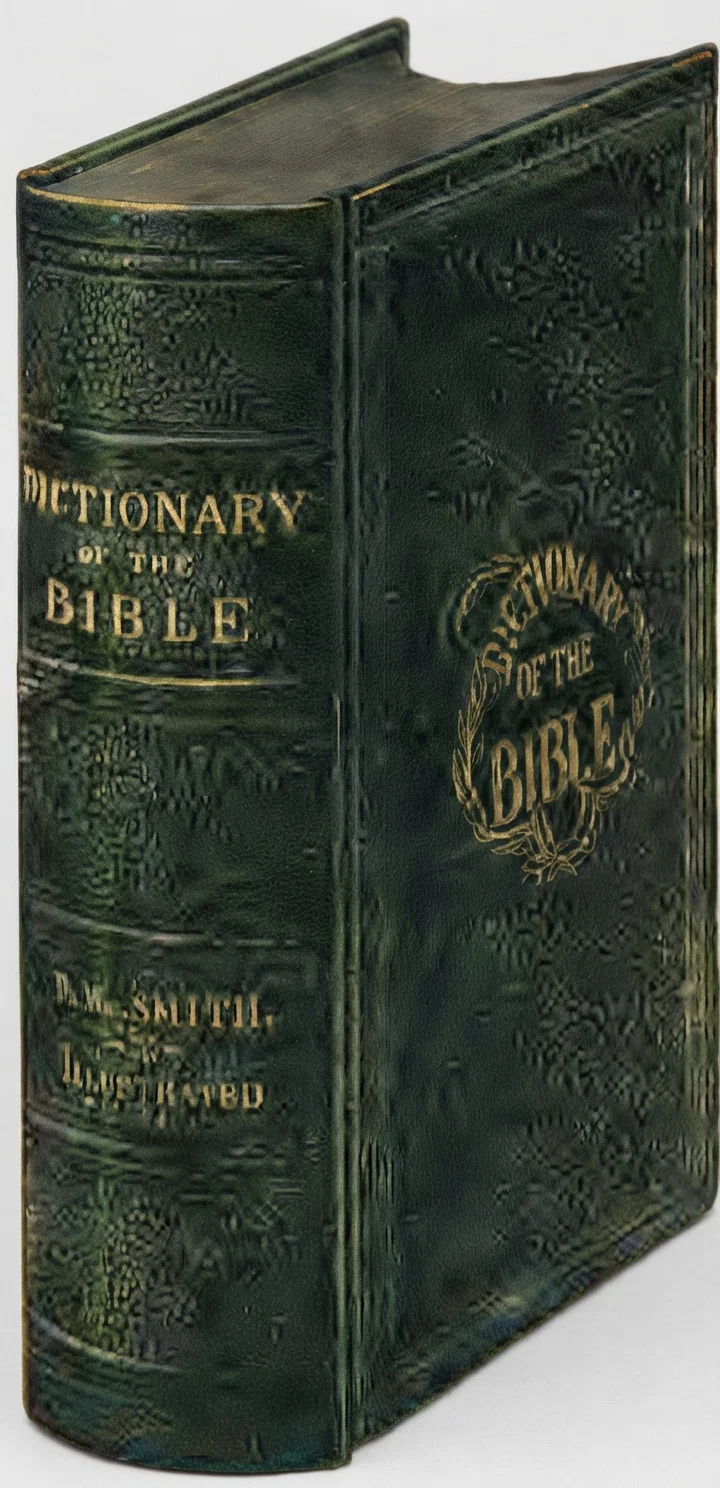
By Dr. Wm. Smith
Size, 6¼ x 9½ x 2½ inches
1017 pages
Illustrated
It contains a full description of every custom, place, plant, mineral, animal, etc., and a biographical sketch of every individual mentioned in the Bible
Publishers’ price, bound in cloth, $4.50
Our price, post-paid, with the SIGNS, one year, $2.25
Book sent free for five new yearly subscriptions and one renewal at $1.00 each
THE “WORLD’S HARVEST” SIGNS.
By Editor
How It Is Received, and How It Sells.
PASTOR W. B. WHITE, president of the Montana Conference, says:—
“The World’s Harvest SIGNS has been received and quite carefully perused, and I have no hesitancy in saying that, from every standpoint, it is the finest paper ever issued by our people. It should have a wide circulation everywhere, and we are trying to do what we can to put it into the homes of the people in our conference.”
Others speak thus:—
“I find no trouble in selling the Harvest issue at the price of ten cents. In my six days of work I sold six hundred and twenty. I enjoy working for the Lord.”
“Harvest SIGNS all gone. Send some more.”
“I am putting them out from twenty to thirty per day. Best day was one just past—thirty-two in four hours. The paper is pleasing the people.”
“I have sold seventy-five copies of the Harvest issue, and received six subscriptions. This is my first experience in canvassing. Have been wonderfully blessed of the Lord.”
“It sells almost at sight. The work grows sweeter to me each day. I entered because of duty, but now it is genuine pleasure.”
Reader, are you missing the blessing which comes to those who present to others the truth as contained in the SIGNS? It is not too late now to redeem the time. Papers always on hand. Order now. Twenty-five for one dollar.
Prophetic Lights
By Editor
If you want a real help in the study of prophecy, you will find it in Dr. E. J. Waggoner’s book,
“Prophetic Lights”
Heavy paper-cover edition - $0 50
SIGNS, one year - - 1 00
Both, post-paid, $1 25
Book free for one new yearly subscriber and one renewal at $1.00 each
WILLIAM.
By Morda Stevens
[By Morda Stevens, in Union Signal.]
HE stood in the doorway looking out on the street, watching the water trickle in little rills across the sidewalk. A dilapidated milk cart cut off his view in front, but that was not much loss, for in the best of sunlight it was only a little, dirty alley that he could see from the door or the front window of the place he called home. And now, with this drizzling rain falling, the prospect was very gloomy indeed.
But William did not notice the dirt or rain. He stood moving his weight from one foot to the other, whistling softly. He was hungry, and was wondering if there would be any dinner to-day.
He was a queer little fellow, thin and small and wiry. His face was never quite clean or his hair quite smooth, tho he was always rather tidy looking. It was hard to say in just what way he was peculiar, but that he was so every one acknowledged. He had always lived right here in this little, dirty alley, with his father and mother. They were regarded as common, uninteresting people, and they were decidedly uninterested in this their only child. There was no one in all the world who cared for him, and he cared for no one. He never had a chum among his schoolmates, tho he was liked well enough by them.
His father drove a dray wagon, and was seldom at home, and his mother spent most of her time at the neighbors,' so William was left to himself. He went to school when he felt like it and stayed at home when he preferred. He had stayed out this morning thinking it would be a good day to fish, but he had soon grown tired of fishing and intended to go to school in the afternoon, provided dinner was on time.
The last bell began to ring. He turned and went into the house. His mother was gone, as usual. He passed out to the kitchen, and found that the fire was out and no dinner started. He looked out of the window, and there was his mother sitting on their neighbor's back porch. She was smoking a pipe, and was apparently unconscious of the hour.
"Guess there'll be no dinner to-day," he said, with a half smile and half frown, and, turning, he passed through the house out to the street, kicking over a chair and stool on his way. At the door he hesitated a moment, then, as the last stroke of the bell died away, he turned into a low grog-shop on the corner, hoping he could get a free lunch.
Miss Adair sat behind her desk in her little recitation room, looking dejectedly out of the window. The water dripped from the casings and trickled dismally down the panes. The young teacher looked tired and discouraged. She had just sent her class into the large study room where the principal presided, and now she was alone. A physiology lay open beside her, but her mind was not on her work.
"What a gloomy day!" she was thinking. "How uninteresting school-teaching is! How thankful I am that William is absent to-day! A rainy day in this school is hard enough at any time, but when he is here it is almost unbearable. What a queer child he is! I never knew, till I came here, that there was anywhere a child so hard to manage."
William was hard to manage. All his teachers had acknowledged that. He was bad in such unusual ways. He was not noisy or openly rebellious or even disobedient. He obeyed everything that was said to him, but the moment he was told to stop one thing he began something else a little worse. No one knew how to control him, and he contrived to keep the school in a perfect ferment all the time.
"I believe it would be easier to love our enemies than some scholars," Miss Adair's thoughts wandered on.
Just then the bell sounded, and she went in to assist in the dismissal of the school for noon.
The afternoon session was half over. The rain was still falling, tho the sun now and then peeped through the clouds for a moment, as if to see how much more water the old earth could hold. Miss Adair was hearing a recitation in history when a shuffling, uneven step was heard in the entry. She went to the door, then passed quickly out, closing it behind her.
There in the entry, leaning against the banister, and facing her, was William. There was a strange, dazed expression upon his face, and his eyes looked glassy. As she approached him he looked up and smiled—such a strange, expressionless smile that she was frightened.
"William," she said, "what has happened? What is the matter?"
He did not answer, but took a step toward her, and reeled as if he were going to fall. She sprang forward and caught him; then she knew. Fumes of liquor told her all too plainly what there was to tell.
"O William"—she began, then stopped, for there was nothing more to say.
In a few moments she had sent her class back into the principal's room, and was leading William home. He spoke but once, telling her, in answer to her question, where he lived. Carefully she guided his unsteady steps, while a hundred thoughts were surging through her brain.
What would she say to his mother? How would she, the mother, endure it? What was she like? Little, and rather weak, she thought. No strong mother would have such a troublesome son. Loving, of course, all mothers were loving. Would she cry and "take on," she wondered, or would the sight of her boy in this condition crush her? In any event, Miss Adair would comfort her, and help her to make this his last fall, as it was, of course, his first.
In the midst of such thoughts as these she reached the house. As she raised her hand to rap, William opened the door and stepped in. A woman sat on the couch reading a yellow-covered, paper-bound book. There was an odor of tobacco in the room. The woman looked up, and, seeing a stranger, rose, closing the book, but keeping her finger carefully in the place. She was tall and angular, and her face was cold and hard. How different from the little mother Miss Adair had been picturing to herself! She hesitated.
"Is this Mrs. Reed?" she asked.
"Yes," answered the woman in an unsympathetic voice. "What has William been doing now? I suppose you are his teacher. O," she said, as she looked at William, "he went to school drunk, did he? I was sure he would some day!" and she came a step nearer.
Miss Adair's fingers instinctively closed more firmly on the little hand she was still holding. "You won't punish him, will you?" she said almost pleadingly.
"O, no!" answered the mother, with a hard laugh. "It wouldn't do no good, or I would. He is on his way to the dogs, all right, tho he's only thirteen years old. And I don't know as I can stop him, if that is where he wants to go. Here, William," and she took hold of his other hand, "lay here and sleep it off."
He shuffled to the couch, and was asleep almost as soon as his head had touched the pillow.
"I'm sorry he made you this trouble, I'm sure," his mother continued, as she turned away and sat down, indicating that the business was finished.
Miss Adair stepped to the door, then hesitated, with her hand on the knob.
"I am so sorry about this," she said, looking down at William's unconscious face. "Couldn't I help you to"—she stopped. Some way it seemed very hard to go on.
Mrs. Reed looked up from her book. She had been hunting for the place where she had left off reading.
"You can do what you want for him," she said impatiently, "if you think it would do any good. I don't care. I don't look at things as some do. A child's a nuisance, I think, especially a boy. They're a dreadful lot of care when they're little, and he makes lots of work yet," and she nodded toward the couch. "But I think when I get his meals and keep his clothes in order I've done my duty. Plenty of mothers don't do that. If a boy of his age wants to go to the bad, it's his own affair."
Her eyes were again on her book, searching rapidly over the page.
Miss Adair's breath came hard. "His father?" she said questioningly.
"Humph! he has no time for children," Mrs. Reed answered, "and, besides, he's drunk too often himself to mind anything like this."
Miss Adair opened the door, but her eyes, full of tears, lingered lovingly on the sleeping boy as she left the room.
Mrs. Reed gave a sigh of relief as the door closed, then settled back in her chair more comfortably. She had now found her place.
Several hours later Miss Adair stood again at the door of that dingy room. She had tried to do her regular work after school, but her mind would go back to that house down the13dark alley, and no matter what she tried to do, she could not shut out the sight of the sleeper on the couch, alone with that grim, unloving woman. Over and over these words repeated themselves in her mind, "Life is hard enough with love; without it, it is unbearable." At last, just before supper time, she had put her books away, and now once again she stood before the wretched dwelling. The rain had ceased. Through the alley she could see Mrs. Reed leaning over a fence talking to a woman on the other side. William must be alone, so she went in. He still lay on the couch where she had left him, but he opened his eyes as she entered, and he half smiled as he saw it was not his mother but Miss Adair. He started to rise, but sank back again, putting his hand to his head. Miss Adair stepped quickly to him, and knelt on the floor by the couch.
"Does your head ache, dear?" she said.
"Yes, it aches dreadfully," William answered in his old swaggering way, "but then I've had 'em before, so I can stand it, I guess."
She did not answer him, but brushed his hair back from his face.
"See these flowers," she said. "Aren't they pretty? I picked them on purpose for you;" and she shook the rain-drops from them on his burning face.
He took the flowers, but said nothing. The way he did not understand her. People are not in the habit of picking flowers on purpose for him. He lay still a moment thinking. Then he looked up, while a red flush kept over his face.
"Wasn't it you who brought me home from school?" he said.
"Yes, it was I."
"And then you picked these flowers on purpose for me?"
"Yes, dear."
He shut his eyes, and after a little while two tears crowded their way from under his tightly-closed lids. He turned his head and wiped them quickly away with his coat sleeve. Miss Adair did not speak. She was praying to that One who is acquainted with grief. There was silence for a few minutes, then William said, "I have been awfully mean in school, but I won't be any more. I"—
She interrupted him. "We did not know each other very well," she said, "that was the trouble. We will be good friends after this," and she smiled brightly down into his eager face.
"If you'd 'a' told me you cared, I'd 'a' been different," he continued, while he tried to keep his lips from twitching. "You know I ain't got any one that likes me very much," and he choked back a sob.
"Yes, William," she answered softly, and there was a world of tenderness in her voice. "I know all about it, dear; but I didn't know until to-day." Then she leaned down and kissed the trembling mouth.
Quickly William's arms were about her neck, while the flowers slipped unnoticed to the floor. "I'll be good after this, Miss Adair, indeed I will," he sobbed.
Neither of them heard the door open or the step on the floor. Mrs. Reed had entered the room, then stopped; and when she backed stealthily out there were tears in her eyes, the first that had been there for years. But they were gone in a moment, and she frowned as she knocked the ashes from her pipe and refilled it.
"His goodness won't last long," she said to herself with a cold, sarcastic smile. But Mrs. Reed did not know.
THE HOME
SPEECH.
By Ella Wheeler Wilcox
TALK happiness. The world is sad enough
Without your woe. No path is wholly rough;
Look for the places that are smooth and clear,
And speak of those, to rest the weary ear
Of earth, so hurt by one continuous strain
Of human discontent and grief and pain.
Talk faith. The world is better off without
Your uttered ignorance and morbid doubt.
If you have faith in God, or man, or self,
Say so; if not, push back upon the shelf
Of silence all your thoughts till faith shall come;
No one will grieve because your lips are dumb.
Talk health. The dreary, never-changing tale
Of mortal maladies is worn and stale.
You can not charm or interest or please
By harping on that minor chord, disease.
Say you are well, or all is well with you,
And God shall hear your words and make them true.
—Ella Wheeler Wilcox.
STARTLING FACTS.
THE well-known American journal Good Health, the editor of which is the veteran hygienist Dr. Kellogg, gives the following significant facts: "It is time to stop a moment for sober thought about where we are and toward what we are drifting. In 1890 a statistician pointed out the fact that in Germany, a pork-eating country of 55,000,000 inhabitants, there were to be found fewer than one hundred persons more than one hundred years old; only seventy-eight, in fact, enjoyed this distinction for longevity. Half a century ago, with a smaller population, the number was six times as great. In Bulgaria, a country of only 4,000,000 people, practically vegetarians, the number of persons more than one hundred years of age was 3,883, or nearly one to the thousand, against one to 700,000 in Germany. In other words, there are in Bulgaria 700 times as many centenarians in proportion to the population as in Germany. In Servia there were 290 persons between the ages of 106 and 115 years, 125 persons between the ages of 115 and 125 years, 18 persons between the ages of 125 and 135 years, and 3 persons more than 135 years old.
"The lesson is that the more civilized a country, and the larger the consumption of flesh food, the shorter the length of life. Why not take a square look at the fact, and think about reforming? It is well known that the longest-lived and the most enduring animals are of vegetarian habits. The dog becomes enduring only by the adoption of a non-flesh diet, a fact well known to hunters, who carefully exclude meat from the diet of their hunting dogs. The study of the habits of centenarians, begun long ago by Hufeland, has always revealed the fact that long-lived men and women are invariably small flesh-eaters, if not exclusively vegetarian in their habits. The Pampas Indians of South America, who subsist almost wholly on flesh food, are perhaps the shortest-lived race in existence. To live long and well one must eat the original meat, described in Gen. 1:29. Fruits, grains, and nuts are man's meat, designed for his sustenance by the Creator, and not to be improved upon. A flesh diet breeds disease and premature decay."—Herald of the Golden Age.
A DROP OF INK.
"I DON'T see why you won't let me play with Robert Scott," pouted Walter Brown. "I know he does not always mind his mother, and smokes cigars, and sometimes swears. But I have been brought up better than that. He won't hurt me, and I should think you would trust me. Perhaps I can do him good."
"Walter," said his mother, "take this glass of pure water, and put just one drop of ink into it."
He did so.
"O mother, would you have thought one drop would blacken a whole glass so?"
"Yes, it has changed the color of the whole, has it not? It is a shame to do that. Just put one drop of clear water in it, and restore its purity," said his mother.
"Why, mother, you are laughing at me. One drop, nor a dozen, nor fifty, won't do that."
"No, my son; and therefore I can not allow one drop of Robert Scott's evil nature to mingle with your careful training, many drops of which will make no impression on him." —Anon.
LIVED A CENTURY.
THE life of Cornero affords a wonderful illustration of the advantages of a fruit and farinaceous diet. In early life Cornero lived riotously, and at 40 years of age found himself a wreck in consequence of his dissipated habits. The serious revelation led him to reflect. He abandoned at once and forever the use of flesh meats, all kinds of condiments, and unwholesome dishes of every description, adopting a simple dietary of fruits, grains, and nuts, with the result that at 80 he was more sprightly than the average youth, and more vigorous than ever before in his life. He was still strong and hearty at 100 years, and lived for many years after, hale and happy, and died without suffering, in consequence of his sober and abstemious life.
The use of cereal foods properly prepared is unquestionably conducive to long and happy life. The free use in childhood of cereal foods properly prepared lays the foundation for a long and vigorous life, building up strong bones and sinews, vigorous brains, nerves, and pure blood. The best of brain-and-blood-making foods is Granola, one of the leading products of Battle Creek, Mich., Sanitarium Health Food Co. It contains three times the food elements of beef, and is ready for immediate use by the addition of fruit juice, or milk, at a cost of one cent a person. The rich, nutty flavor pleases the palates of both the invalid and the robust.
A free sample will be sent to readers of the SIGNS who will send to the Sanitarium Health Food Co., Battle Creek, Mich., the name of a grocer who does not sell Granola.
EMPLOYMENT OFFERED.
Very profitable employment offered to all who are willing to work (male and female) selling patented articles. No competition. Write for particulars to JOHN AP WILLIAMS, 1112 High St., Alameda, Cal.
HAWAII
OCEANIC STEAMSHIP CO.
TO THE WONDERLANDS OF THE PACIFIC
Samoa, New Zealand, Australia
Send for our illustrated pamphlets:
"HAWAII," 10c; "TALOFA, SAMOA," illustrated with colored plates, 20c
J. D. Spreckels & Bros. Co.
114 MONTGOMERY ST. SAN FRANCISCO
Choose Ye This Day
Presents in an impressive manner the fact that it is ours to choose whom we will serve, and represents what will be the result of our choice. A. G. L. No. 14. 50 cents per 100.
PACIFIC PRESS PUBLISHING CO.
New York City Oakland, Cal. Kansas City, Mo.
THE SABBATH SCHOOL
LESSON XIII.—SABBATH, DECEMBER 30, 1899.
JUDAS THE TRAITOR AND THE PREPARATION FOR THE PASSOVER.
1 "And it came to pass, when Jesus had finished all these
2 words, He said unto His disciples, Ye know that after two
days the Passover cometh, and the Son of man is delivered up
3 to be crucified. Then were gathered together the chief
priests, and the elders of the people, unto the court of the high
4 priest, who was called Caiaphas; and they took counsel to-
gether that they might take Jesus by subtlety, and kill Him.
5 But they said, Not during the feast, lest a tumult arise among
the people."
14 "Then one of the twelve, who was called Judas Iscariot;
15 went unto the chief priests, and said, What are ye willing to
give me, and I will deliver Him unto you? And they weighed
16 unto him thirty pieces of silver. And from that time he sought
opportunity to deliver Him unto them."
17 "Now on the first day of unleavened bread the disciples
came to Jesus, saying, Where wilt Thou that we make ready
18 for Thee to eat the Passover? And He said, Go into the city
to such a man, and say unto him, The Master saith, My time
is at hand; I keep the Passover at thy house with My disciples.
19 And the disciples did as Jesus appointed them; and they made
ready the Passover."
8 "And He sent Peter and John, saying, Go and make ready
for us the Passover, that we may eat."
10 "And He said unto them, Behold, when ye are entered into
the city, there shall meet you a man bearing a pitcher of water;
follow him into the house whereunto he goeth."
12 "And he will show you a large upper room furnished; there
make ready."
14 "And when the hour was come, He sat down, and the
15 apostles with Him. And He said unto them, With desire I
have desired to eat this Passover with you before I suffer."
NOTE.—The texts inclosed in marks of parentheses, while not essential to the lesson study, will be found to throw much light upon the lesson, and are suggested for those who wish to study further.
SUGGESTIVE QUESTIONS.
After the solemn admonitions relative to helping the unfortunate, what did Jesus say to His disciples? Matt. 26:1, 2.
As the Passover drew nigh, with whom did the elders and others consult in order to plan for the destruction of Jesus? Verses 3, 4.
Upon making known their plan to kill Jesus secretly, what objection was raised by some? Verse 5. Note 1.
At this juncture what did Judas do? Verses 14, 15. (Luke 22:3-5.)
Having made a compact with the elders, what did Judas from that time seek? Verse 16. Note 2. (Luke 22:6.)
At the time of preparing for the Passover what did the disciples ask concerning the matter? Verse 17. (Ex. 12:3-10, 18.)
In reply what did the Saviour command? Verse 18. Luke 22:11.
Who were selected to perform this service? Verse 8.
How were they to find the house designated? Verse 10.
What did Jesus say they would find in the house pointed out to them? Verse 12.
As Christ sat down that evening in the room provided, how did He express Himself regarding that particular occasion? Verses 14, 15. (Mark 14:17.)
How much time is covered in this quarter's lessons?
What are the principal events of those days?
Side Lights.—"Desire of Ages," chapter 71; "Spirit of Prophecy," vol. 3, chapter 6.
NOTES.
1. EVIDENTLY some thought that the disappearance of Christ from the Passover would raise questions of His whereabouts that could not be satisfactorily answered. Suspicions would then be whispered about that the elders had put Christ to death secretly, which would forever destroy their power over the people, because such an act would be evidence to all that nothing but malicious hate on the part of the authorities had been the cause of His death. Therefore, to save their reputation with the people, it was necessary to trump up some charge by which His death might be compassed with a show of legality, and in a public manner. Thus the odium of His death, if any should exist, would be made to rest on the civil power.
2. HOW GREAT must have been the hardness of Judas' heart in order, afterward, to look the Saviour in the face, and call Him Master, in common with the other disciples. He either never had faith in the Lord's infinite power of discernment, or had permitted himself to be drawn into the darkest condition of mind possible.
THE SABBATH SCHOOL
INTERNATIONAL SERIES THE SUNDAY SCHOOL
LESSON XIV.—SUNDAY, DECEMBER 31, 1899.
REVIEW FOR THE QUARTER.
Golden Text: "Bless the Lord, O my soul, and forget not all His benefits." Ps. 103: 2.
LESSON I.—Joy in God's House. Psalm 122. God meets with His people in the house dedicated to His worship, and the true Christian delights in repairing to this house of meeting—meeting-house. God changes not. He met with His people in the sanctuary of old, and He meets with them to-day—those who realize their need of Him. Golden text: "I was glad when they said unto me, Let us go into the house of the Lord." Ps. 122: 1.
LESSON II.—Haman's Plot against the Jews. Esther 3: 1-11. This is the story of the revengeful plot by which Haman hoped to destroy all the Jews under the jurisdiction of Ahasuerus (Xerxes), because of the refusal of Mordecai to bow to him. For twelve months lots were cast for a favorable opportunity to secure the king's consent to the plan. It was given, and the decree went forth for the destruction of the Jews. Golden text: "If God be for us, who can be against us?" Rom. 8: 31.
LESSON III.—Esther Pleading for Her People. Esther 8: 3-8, 15-17. Through the pleading of Esther for her kindred and her people, the Jews were given the right to defend themselves against any who should attack them. God had a care for His peculiar people, and the wrath of man was made to praise Him. He is able to deliver from any snare the evil one may set. Golden text: "Commit thy way unto the Lord; trust also in Him; and He shall bring it to pass." Ps. 37: 5.
LESSON IV.—Ezra's Journey to Jerusalem. Ezra 8: 21-32. The time of this lesson is the seventh year of Artaxerxes, the son of Ahasuerus (Xerxes). A fast was proclaimed at Ahava River, and the people humbled themselves and sought the Lord for His protection on the journey. Ezra would not ask the king for a company of soldiers, because he had told the king of his trust in God. Golden text: "The hand of our God is upon all them for good that seek Him." Ezra 8: 22.
LESSON V.—Psalms of Deliverance. Psalms 85 and 126. It was doubtless deliverance from captivity that caused these psalms to be written. If written before the captivity, they are prophetic. The Lord is at all times ready to speak peace to His children when they turn from sin and rebellion. Golden text: "They that sow in tears shall reap in joy." Ps. 126: 5.
LESSON VI.—Nehemiah's Prayer. Neh. 1: 1-11. This was in the twentieth year of Artaxerxes, thirteen years after Ezra went to Jerusalem. Nehemiah learns of the affliction of the Jews who had gone up to Jerusalem, and the fact that the walls of the city were broken down and the gates burned with fire. He therefore humbles himself before God, confessing his own sins and the sins of his people, and beseeches the Lord for mercy in their behalf. Golden text: "Prosper, I pray Thee, Thy servant this day." Neh. 1: 11.
LESSON VII.—Rebuilding the Walls of Jerusalem. Neh. 4: 7-18. The enemies of the Jews were stirred to wrath when they learned of the determination to rebuild the walls, and conspired to slay the builders; but the conspiracy was brought to nought; their counsels were known to the Jews, and provisions were made to protect the city; and the building of the walls went on, though under difficulties. When God is working for His people and they are trusting in Him, nothing can prevail against them. Golden text: "Watch and pray." Matt. 26: 41.
LESSON VIII.—Public Reading of the Scriptures. Neh. 8: 1-12. This lesson is a report of a wonderful meeting. The people had come up from Babylon, where they were surrounded by the lowest, basest heathenism. They were now to learn from God's own law what He required of them. The sense, the real meaning, was given so that the people might fully understand God's requirements—and this is the duty of religious teachers now as much as it was then. Golden text: "And he read therein before the street that was before the water-gate from the morning until midday, before the men and the women, and those that could understand; and the ears of all the people were attentive unto the book of the law." Neh. 8: 3.
LESSON IX.—Woe of Intemperance. Prov. 23: 29-35. This lesson is a description of what strong drink does for those who tamper with it, who find pleasure in the drink itself and the associations which it brings with it. Golden text: "Wine is a mocker, strong drink is raging; and whosoever is deceived thereby is not wise." Prov. 20: 1.
LESSON X.—Keeping the Sabbath. Neh. 13: 15-22. Nehemiah tells of the desecration of the Sabbath, and the measures which he took to suppress it. If Israel had kept the Sabbath, Jerusalem would have stood forever. Jer. 17: 25. When the people turned from the Sabbath of the Lord to the sun festivals of Baal, and the sun's day, the Lord allowed the destruction of the city. Nehemiah understands this and wishes to forestall a recurrence. See Jer. 17: 27 and 2 Chron. 36: 19-21. Golden text: "Remember the Sabbath day, to keep it holy." Ex. 20: 8.
LESSON XI.—Lessons in Giving. Mal. 1: 6-11; 3: 8-12. The secret of joyous, bountiful giving is to give, first of all, ourselves. The lesson deals with the principle of tithing and the duty of giving liberally to support the cause of God. Golden text: "God loveth a cheerful giver." 2 Cor. 9: 7.
LESSON XII.—Fruits of Right and Wrong Doing. Mal. 3: 13 to 4: 6. God rebukes those who would do righteousness for profit. He wants men who will do right even if they suffer for it. The lesson scripture declares the coming of that day that shall burn as an oven and try every man's work of what sort it is. Read the scripture and ponder the thoughts contained in those verses. Golden text: "Whatsoever a man soweth, that shall he also reap." Gal. 6: 7.
LESSON XIII.—Christ's Coming Foretold. Isa. 9: 2-7. The lesson scripture refers not only to Christ's coming as a babe in Bethlehem, but to His second coming, when He comes to establish His kingdom on the earth. During His life upon earth He refused to be a judge, or to be made a king; but when He comes again, it will be as the Wonderful Counselor, Mighty God, Everlasting Father, Prince of Peace, having received a kingdom from His Father. Golden text: "Unto you is born this day in the city of David a Saviour, which is Christ the Lord." Luke 2: 11.
VIRGINIA HOMES.
You learn all about Virginia lands, soil, water, climate, resources, products, fruits, berries, modes of cultivation, prices, etc., by reading the Virginia Farmer. Send 10 cents, for three months' subscription, to FARMER CO., Emporia, Va.
SHELLS FOR BUTTONS.
We pay cash for oyster shells or seashells of any kind suitable for making pearl buttons. Those having such for sale, please write us.
PACIFIC PEARL BUTTON CO.,
224½ Washington St.,
Portland, Oregon.