The Youth’s Instructor, Vol. 29, No. 20.

WINDSOR CASTLE

The Youth’s Instructor

May 18, 1881

S. D. A. Publishing Association · Battle Creek, Mich. · May 18, 1881

WINDSOR CASTLE.
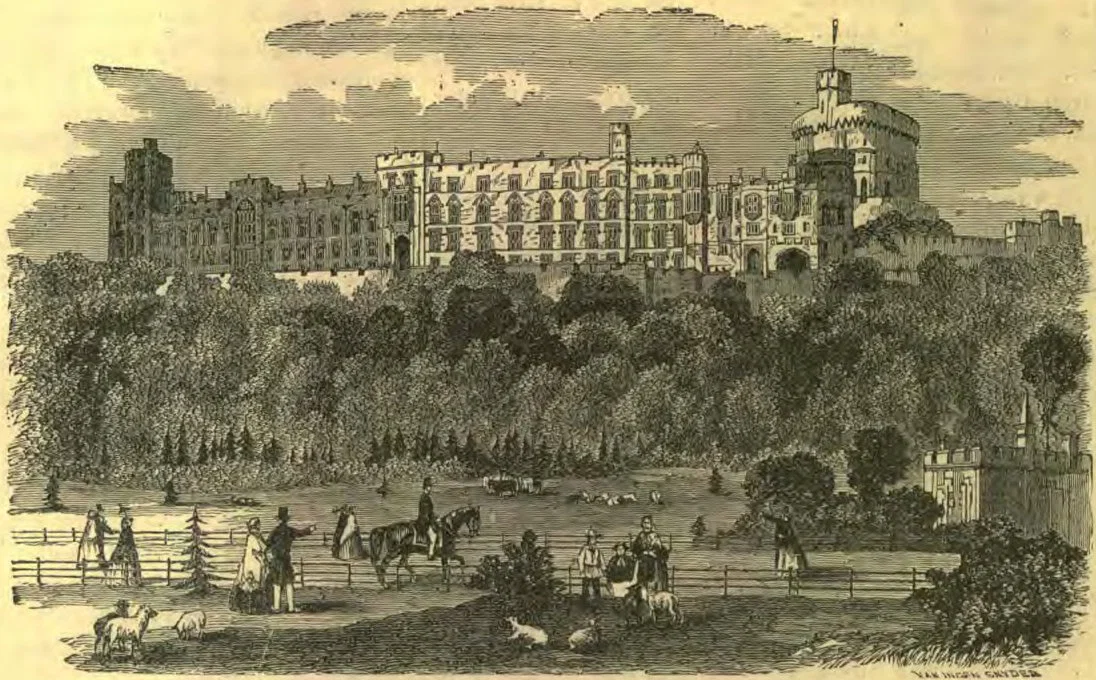
THIS grand old building is the favorite country residence of the British sovereigns. It is built on the top of a hill, overlooking the town of Windsor, and commanding a fine view of the River Thames. On this hill, William the Conqueror built a fortress, which was greatly enlarged by Henry I. King Edward III. entirely rebuilt the castle, except three of the towers at the west end of the lower yard. Such a work as this could not be undertaken in that age without experiencing many difficulties, especially in getting workmen; so that orders were sent to the sheriffs of the different counties, to compel workmen to come to Windsor, there to be employed by the king as long as he needed them. This command was enforced several times, especially in the year 1363, at which time a contagious disease carried off many of the workmen. A noted man, William de Wykeham, superintended the work of building.
Many improvements and alterations were made in the castle by the successors of Edward III. In the reign of Queen Elizabeth, a terrace was made on the north side of the castle; this has since been enlarged. The interior of the castle was greatly improved by Charles II. The buildings alone now cover twelve acres.
Between the two wards of the castle is the keep, or Round Tower, which is about three hundred feet in circumference and is built on the top of a high, artificial mound. It was formerly surrounded by a ditch or moat, but this was filled up long ago. In this tower many royal prisoners have been confined, among others, James I. of Scotland. St. George’s chapel, or the collegiate church of Windsor, is the largest and most elegant of the three royal chapels of England. In the vault connected with this chapel, several kings and queens and other members of the royal family lie buried. The state rooms and corridors of the castle contain many choice paintings, groups of statuary, etc.
The castle is surrounded by the “Little Park,” which is about four miles in circumference, and contains some five hundred acres. It was inclosed by a brick wall in the reign of William III. In this park is situated “Herne’s Oak,” mentioned by Shakespeare in his “Merry Wives of Windsor.” On the south side of the castle, connected with “Little Park” by a long avenue of trees, is the “Great Park,” which is eighteen miles in circumference. It abounds with beautiful forest scenery, and is well stocked with deer. This park is crossed by several roads, the principal of which is the “Long Walk,” with a double row of elms on each side. At the end of this walk is an immense bronze statue of George III. In this park is a beautiful lake, called Virginia Water, on the bank of which is the Royal Fishing Temple. At the end of the lake, the water forms a beautiful cascade, near which is an artificial ruin, formed of marble and other material brought from Greece. West of the “Great Park” lies Windsor Forest, which is fifty-six miles in circumference.
This home of the royal family is indeed a beautiful place, and it might seem that in such a pleasant spot there could be no unhappiness. But all adown the rolling years, many have been the sad and aching hearts shut up in the walls of the old castle, many the weary feet that have walked its halls and corridors. Strange and thrilling stories are related of the secrets of the ancient palace; and could the old walls speak, they might doubtless tell stranger and sadder stories than pen or tongue have revealed. Those of royal birth are sometimes envied; but they have their sorrows as well as other people, and their lives are too often far from happy.
Few of us will ever enter an earthly palace; but we may all, if we will, be heirs of a home more glorious than any royal palace. In the city of God are “many mansions”; no royal grounds can compare with the “garden of the Lord”; and best of all, in that beautiful home will be no sorrow, no pain,—for “God shall wipe away all tears from their eyes, and there shall be no more death, neither sorrow nor crying, neither shall there be any more pain.”

BLESSINGS

Blank indeed is that faithless life which in its imagination can find no means of happiness. Blessings flourish in the soil of appreciation,—he then who appreciates best, enjoys best life's blessings. Though those things be as common as air, food, and drink; as clothing, health, and a humble shelter, he accepts them all as undeserved, and is thankful for them.
Things peculiar to a civilized land,—good papers, and books, and schools; the arts that please the eye and ear, and the sciences which ennoble the mind,—all these are more than we can appreciate ; but we can show thankfulness, in the expression of which the very heart will seem to dilate, and “we’ll work with never a rest until others are equal to ourselves.”
There are blessings, too, which like rough diamonds do not always pass for what they are. They are blessings because in the end they tend to make us happy,—reproof rightly received, mistakes well profited by, disappointments and discouragements leading us to look up, and constant labor keeping us from temptation,—all these, dear young friends, we can turn to a good account in the make-up of a useful life. But true knowledge is of all blessings the greatest, for by it we learn to discern and appreciate all the others. This alone leads to purity, perfection, and life eternal. The fountain is freely open. Our early ancestors had not these blessings. They believed the rocks, the green trees, and the flowing rivers, to be worthy of their worship. Not that they believed these things to possess divine power; “they offered their prayers beneath the shadows of the forest, or on the banks of the rushing torrent as being the places more particularly haunted by the elves, or subordinate deities. . . unseen to mortal eye.” Finally were introduced among these Anglo-Saxons the seeds of truth, teaching of one true God, and recognizing, instead of imaginary elves, real, pure angels ever ready to guard us, not only in worship but in our toil.
The curse, even, we are told was for man's sake. Let us gather every blessing then, though some are found in the path of the curse, and they may become in the hand of Christ a crown of glory to us each.
GEO. R. AVERY.

THE BIRDS.

The robin and the bluebird, piping loud, Filled all the blossoming orchards with their glee; The sparrows chirped as if they still were proud Their race in Holy Writ should mentioned be; And hungry crows assembled in the crowd, Clamored their piteous prayer incessantly, Knowing who hears the ravens cry, and said: “Give us, O Lord, this day, our daily bread!”
Do you ne’er think what wondrous beings these? Do you ne’er think who made them, and who taught The dialect they speak, where melodies Alone are the interpreters of thought! Whose household words are songs in many keys, Sweeter than instrument of man e’er caught! Whose habitations in the tree-tops even Are half-way houses on the road to Heaven!
Think, every morning when the sun peeps through The dim, leaf-latticed windows of the grove, How jubilant the happy birds renew Their old, melodious madrigals of love! And when you think of this, remember too ’Tis always morning somewhere, and above The awakening continents, from shore to shore, Somewhere the birds are singing evermore.
— Longfellow.

LIGHT SWEARING.

“The school will come to order,” said the voice of our superintendent. At once teachers and scholars took their proper seats, and turned their faces toward the desk. Mr. Ford introduced to the children a gentleman whom he said he knew would interest them.
Mr. Watson came forward, and by his bright smile and cheerful voice, won the attention of the children at once.
“I propose to talk this afternoon about swearing,” said Mr. Watson. “You all know what that means; perhaps not a child in this Sabbath-school swears, but you have heard the boys on the street, I know. Generally, when a speaker addresses a school, he directs his words to the boys and neglects the girls; but I am now going to talk to the girls and let the boys listen, and I hope to benefit both.”
“First,” said Mr. Watson, taking a piece of chalk and walking toward the long blackboard; “I will write on the board five words which girls use when they indulge in swearing.”
This last remark made the girls open their eyes in astonishment. As he finished writing the last word, he laid his chalk down and asked, “All good words, are they not, children?”
“Yes, sir,” was the answer.
“And the meaning of each word is good, is it not?”
“Yes, sir,” replied the children.
“No doubt,” said the speaker, “most of the girls here would tell me that boys swear, but they never do. Now,” he continued, again turning to the board, “let me put a little word before each of these good words, and then ask the girls to read together what I have written.”
“Oh, gracious!” How the boys’ eyes sparkled with triumph as the girls went on reading, “My goodness,” “Good conscience.”
Here Addie Norton whispered to the girl next to her, “I never in my life said ‘good conscience;’” but she could not say that about the next sentence; for “oh, mercy” was a favorite expression of hers.
“My heavens!” This last rather startled the girls; but Mr. Watson took not the slightest notice of their surprise, asking in a brisk tone, at the same time pointing to the board, “Boys, what do you call that?”
“Swearing,” was the emphatic answer.
“Yes, it is swearing,” repeated Mr. Watson, looking earnestly at the girls; “but I don’t think that girls wish to swear; and perhaps those who are in the habit of using these expressions, have never stopped to think of their meaning; I am quite sure that if they knew how they sound, coming from the lips of gentle girls, they would not be guilty of using them; for it is swearing, though in a milder way than boys are apt to use.”
“Now, girls,” he added, “although unconscious of it, each one of you is exerting an influence over some one; it may be a brother, or a younger sister, or possibly a school-mate. Every word, every act of yours, has its effect on some one; and may strengthen or injure that one’s character.”
“Boys, you know, have got the idea that they are braver and smarter than girls. So when a boy hears his sister exclaim, ‘Oh, conscience!’ he must prove his superiority by using stronger language, such as girls and all of us call real profanity. Now, my little friends, this light form of swearing is wrong and just as much a habit with you as profanity is with boys. Here let me ask, How many of you would like to hear your father or brother take God’s holy name in vain? Not one,” he said, as he glanced around the room; “then let me intreat you all to be pure and gentle in your speech, to use no word, or expression that may tempt your brother to swear; and by earnest prayer and watchfulness, seek to overcome this sinful habit.”
After Sabbath-school, as Mr. Watson walked around among the children, his kind heart was gladdened to hear from many the resolve to give up using these “ugly expressions,” to use the girls’ term.
“‘He that overcometh will I make a pillar in the temple of my God,’” repeated Mr. Watson; “and, children, if the naughty words escape your lips sometimes, don’t give up trying. A habit once formed is hard to get rid of; but when the temptation to give vent to your feelings in strong language comes, go to Him who ‘was in all points tempted like as we are, yet without sin,’ for he is able to succor, that is,” explained Mr. Watson, “he is able to help those that are tempted, and with the temptation will make a way of escape.”—Advocate and Guardian.

BAD TEMPERS.

Wherever we go, it is pleasant to see the children. They make up a cheerful part of our world. We love to hear their joyous strains of laughter, and to see them skipping about like lambs. As they grow older, we love to see the unfolding of mind, the anxiety to become wiser and to have some strength of character; but the pleasure we take in their continual presence depends much upon their disposition and training. They are not apt to regard others’ “rights” equal with their own; and if this feeling is not restrained, besides making their own life unhappy, they will be be very unpleasant companions. They who have the restraining power of Christian influence in youth are fortunate; for then it is easier to have the rough edges of selfishness and wilfulness smoothed off than in more mature years.
It is good to see natural, unaffected youth, with so much culture that the imitation of what is noble in others will not seem to be put on. We see many pretty and intelligent children, but upon acquaintance, they are so passionate—get so vexed at everything that crosses them,—that their pretty looks and fine dress are forgotten as we witness their continual outbursts of bad temper. What a blessing are those who begin in youth to make all they can of themselves, and who look upon violence of temper as a sin!
The two rules that some children resolved to keep would benefit others, if they would make the same resolution. They are these: “Never get vexed at what you cannot help,” and “Never get vexed at what you can help.” This gives no chance at all to get vexed. Suppose you all try it for a day; don’t you think you would be happier at night?
It is said of Robert Hall, that when he was a little boy, he had a very bad temper. He knew God was not pleased to see him angry, so when he began to feel the anger kindling in his heart, he went into the corner and said, “O Lamb of God, calm my mind!” His prayer was answered, and he became one of the gentlest and kindest of men. Many others have learned self-control in this way.
If we early learn to serve the Lord, he will give us the Christian graces of love, gentleness, and goodness. We find nowhere in the life of Jesus that he was ever selfish or fretful; but he was subject to his parents, and always showed a spirit of love and forbearance toward those who ill-treated him. He loves the children and knows how great is the temptation to give way to anger; he can and will take away the sinful temper from those who ask him, and give them, instead, a meek and quiet spirit.
NETTIE T. HOLT.

ROOM AT THE TOP.

NEVER you mind the crowd, lad, Or fancy your life won't tell; The work is a work for a' that To him that does it well. Fancy the world a hill, lad; Look where the millions stop— You'll find the crowd at the base, lad; There's always room at the top.

Writing Down Thoughts to Preserve Them from Forgetting

THE practice of writing down thoughts and facts for the purpose of holding them fast, and preventing their escape into the dim region of forgetfulness, has been much resorted to by thoughtful and studious men. Lord Bacon left behind him many manuscripts, entitled “Sudden thoughts set down for use.”

“IF YE FAINT NOT.”

FRIEND, the Lord has given to you Some part of his work to do. It may be in hut or hall, Something great or something small, Somewhere there is work to do Which the Master gives to you. Let no dark discouragement Turn you from a fixed intent To accomplish every task Which the Lord of you may ask. Sow the seed, e'en though with tears, Wait, though the waiting be for years; Sometime you will gather sheaves Where you now see withered leaves, For this promise marks the spot: “You shall reap, if you faint not.” —William Norris Burr.

THE BOY WHO DOESN'T CARE.

“My son, you are wasting your time playing with that kitten. You ought to be studying your lessons. You’ll get a black mark if you do not study,” said Mrs. Mason.
“I don’t care,” replied the boy.
“Don’t care, will ruin that child,” said Mrs. Mason to herself. “I will teach him a lesson he will not forget.”
When noon arrived, her idle boy rushed into the house shouting,—
“Mother, I want my dinner!”
“I don’t care,” replied Mrs. Mason.
James was puzzled. His mother had never so treated him before. He was silent awhile; then he spoke again:—
“Mother, I want something to eat.”
“I don’t care,” was the cool reply.
“But recess will be over, mother, and I shall starve if I don’t get some dinner,” urged James.
“I don’t care.”
This was too much for the poor boy to endure. He burst into tears. His mother said:—
“My son, I want to make you feel the folly and sin of the habit you have of saying, ‘I don’t care.’ Suppose I really did not care for you, what would you do for dinner, for clothing, for a nice home, for an education? I hope, therefore, you will cease saying, ‘I don’t care.’”
James had never looked on this evil habit in this light before. He promised to do better, and after receiving a piece of pie, went to school wiser if not better.

When We Devote Our Youth to God

When we devote our youth to God, 'T is pleasing in his eyes; A flower, when offered in the bud, Is no vain sacrifice.

EXERCISE

Exercise is a necessity; it prolongs life, and greatly improves living; it better fits us for our duties; without it we do not more than half live. He only who exercises sufficiently, can know the joy of good health, good appetite, good digestion, refreshing sleep. It causes the blood to circulate quickly, freely, and equally, and will drive away the blues. It increases respiration, thus bringing a larger quantity of the elixir of life, oxygen, to purify and vitalize the blood. It rounds and hardens the muscles, and educates them into ever-ready, faithful, and efficient servants of the will. It limbers the joints and strengthens every part of the body. It invigorates the mind, and renders it active and efficient in all its operations.

Wear Your Learning Like a Watch

WEAR your learning, like your watch, in a private pocket; and don't pull it out to show that you have one; but if you are asked what o'clock it is, tell.

SCENES IN THE LIFE OF CHRIST.

LESSON 17.—VISIT AT SYCHAR.

When Jesus with his disciples came to the well of Jacob, he, being weary, sat down upon the curbing of the well to rest while his disciples went into the town to buy food; for it was now noon. While he was sitting there, a Samaritan woman came to the well to draw water. Jesus asked her to give him a drink, at which she seemed very much surprised; for the Jews were not friendly with the Samaritans. Many years before, when the Jews returned from their captivity in Babylon and began to rebuild the temple at Jerusalem, the Samaritans wanted to join them in the work; but as they were in part idolators, and worshiped false gods, the Jews would let them have no part with them. This caused a bitterness of feeling between the two nations which has never passed away, so “the Jews had no dealings with the Samaritans.”
But Christ came to save all men without respect to birth or nation, so he went on to make himself known as the Saviour of the world. After talking with the woman for some time about the living water he would give those who came to him, he told her to go and call her husband and come back again. “The woman answered and said, I have no husband. Jesus said unto her, Thou hast well said, I have no husband; for thou hast had five husbands; and he whom thou now hast is not thy husband: in that saidst thou truly. The woman said unto him, Sir, I perceive that thou art a prophet.” She then brought up the question as to the proper place to worship,—whether it was at Jerusalem or Mount Gerizim, where the Samaritans had built themselves a temple. By his answer Jesus taught her that it is the spirit with which we call upon him rather than the place where we worship, which God regards. She then said to him, “I know that Messiah cometh, which is called Christ; when he is come, he will tell us all things. Jesus said unto her, I that speak unto thee am he.”
When the disciples returned from the city, they were surprised to see their Master talking with a Samaritan woman; “yet no man said, What seekest thou? or, Why talkest thou with her?” By this time the woman had become so much interested in what Christ had told her that she left her water-pot and went to the city, and said to the people, “Come, see a man that told me all things that ever I did; is not this the Christ?”
While she was gone, the disciples tried to get Jesus to eat of the food they had brought him. But Christ said to them, “I have meat to eat that ye know not of.” They then thought that perhaps some one had brought him food while they were gone to the city; but he said unto them, “My meat is to do the will of Him that sent me, and to finish his work.” Jesus thus teaches that we should be more careful to do the will of God than to seek our own personal comfort.

QUESTIONS.

  1. Where did Jesus sit to rest while his disciples went to the city of Sychar to buy food? John 4:6.
  2. What time of day was it?
  3. Who came to the well to draw water?
  4. What did Jesus ask of her?
  5. Why was she surprised at this request?
  6. Why did the Jews have no dealings with the Samaritans?
  7. After Jesus had talked with the woman for some time, what did he tell her to do? Verse 16.
  8. What did he say to her when she told him that she had no husband?
  1. Why did she think that he must be a prophet?
  2. What disputed question did she then bring up?
  3. What did Jesus teach her by his answer?
  4. How did the woman express faith in a coming Messiah? Verse 25.
  5. In what words did Christ reply to this?
  6. What surprised the disciples when they returned from the city? Verse 27.
  7. What did they say to their Master?
  8. What did the woman say to the people of the city?
  9. What did Christ say when the disciples urged him to eat of the food they had brought him? Verse 32.
  10. What answer did Jesus make when the disciples said one to another, “Hath any man brought him ought to eat?” Verse 34.
  11. What lesson did Christ mean to teach by this?

NEW-TESTAMENT HISTORY.

LESSON 29.—THE HEALING OF THE CENTURION'S SERVANT, AND THE RAISING OF THE WIDOW'S SON.

Now when he had ended all his sayings in the audience of the people, he came down from the mountain, and great multitudes followed him. When he had entered into Capernaum, he was visited by messengers from a centurion whose servant “was sick, and ready to die.” This Roman captain feared that Jesus would not listen to him, so he secured the assistance of certain elders of the Jews, who besought Jesus to come and heal the centurion's servant, saying that the man who had sent them was worthy; for he loved their nation, and had built them a synagogue.
Then Jesus went with them, and when he came near the house, the centurion sent friends, saying, “Lord, trouble not thyself, for I am not worthy that thou shouldest enter under my roof; wherefore neither thought I myself worthy to come unto thee; but say in a word, and my servant shall be healed. For I am a man set under authority, having under me soldiers; and I say unto one, Go, and he goeth; and to another, Come, and he cometh; and to my servant, Do this, and he doeth it.” When Jesus heard these things, he marveled at him, and turned himself about, and said unto the people that followed him, “I say unto you, I have not found so great faith, no, not in Israel.” “And I say unto you, that many shall come from the east and west, and shall sit down with Abraham, and Isaac, and Jacob in the kingdom of Heaven. But the children of the kingdom shall go forth into outer darkness: there shall be weeping and gnashing of teeth.” “And they that were sent, returning to the house, found the servant whole.”
“And it came to pass the day after, that he went into a city called Nain; and many of his disciples went with him, and much people. Now when he came nigh to the gate of the city, behold, there was a dead man carried out, the only son of his mother, and she was a widow: and much people of the city was with her. And when the Lord saw her, he had compassion on her, and said unto her, Weep not. And he came and touched the bier; and they that bare him stood still. And he said, Young man, I say unto thee, Arise! And he that was dead sat up and began to speak. And he delivered him to his mother. And there came a fear on all: and they glorified God, saying, That a great prophet is risen up among us; and, that God has visited his people. And this rumor of him went forth throughout all Judea, and throughout all the region round about.”
“Now when John had heard in the prison the works of Christ, he sent by his disciples, and said unto him, Art thou he that should come, or do we look for another?” “In that hour he cured many of their infirmities and plagues, and of evil spirits; and unto many that were blind he gave sight.” “Then Jesus answering said unto them, Go your way, and tell John what things ye have seen and heard; how that the blind see, the lame walk, the lepers are cleansed, the deaf hear, the dead are raised, to the poor the gospel is preached. And blessed is he, whosoever shall not be offended in me.”

QUESTIONS.

  1. What did Jesus do when he had ended all his sayings in the audience of the people? Matt. 8:1; Luke 7:1.
  2. By whom was he followed?
  3. Into what city did he enter?
  4. By whom was he visited there?
  5. On what errand had these messengers come?
  6. Who had sent them?
  7. What did they say of the man who had made this request?
  8. Did Jesus comply?
  9. When they had come near the house, whom did they meet?
  10. What message did these friends bear from the centurion to our Lord? Luke 7:3, 4.
  11. Why had the centurion sent elders of the Jews to Christ, instead of going himself?
  12. How did the centurion illustrate his confidence in Christ's ability to heal his servant without coming into his presence?
  13. When Jesus had heard these things, what did he say to the people that followed him?
  14. Repeat Matt. 8:11.
  15. Who are supposed to be meant by the children of the kingdom mentioned in verse 12?
  16. What is to be their fate?
  17. When they that were sent had returned to the centurion's house, in what condition did they find the sick man?
  18. Into what city did our Lord go soon after this? Luke 7:11.
  19. Who went with him?
  20. What procession did he meet as he came nigh to the gate of the city?
  21. How was our Lord affected by this scene?
  22. What did he say to the bereaved widow?
  23. What did he do as he came near the bier on which the corpse was borne?
  24. Describe the miracle that was then performed.
  25. How were the people affected by this astonishing evidence of Christ's divinity?
  26. What did they do and say?
  27. How did this miracle spread his fame?
  28. Where was John the Baptist at this time? Matt. 11.:2.
  29. How did he learn of the wonderful works of Christ? Luke 7:18.
  30. What inquiry did John make of his disciples?
  31. While they were tarrying with Christ, waiting for an answer, what miracles did they see performed? Luke 7:21.
  32. After they had witnessed these things, what message did Jesus give them for John?
  33. What benediction was pronounced at the close of this message?

The Bible as a Mine of Wealth

THE Bible is a mine of wealth, but no mine will yield its treasures without labor.

THE WIDOW OF NAIN.

THE dust on their sandals lay heavy and white, Their garments were damp with the tears of the night, Their hot feet aweary, and throbbing with pain, As they entered the gates of the city of Nain.
But lo! on the pathway a sorrowing throng Pressed, mournfully chanting the funeral song, And like a sad monotone, ceaseless and slow, The voice of a woman came laden with woe.
What need, stricken mothers, to tell how she wept? Ye read by the vigils that sorrow hath kept, Ye know by the travail of anguish and pain, The desolate grief of the widow of Nain.
As He who was first of the wayfaring men Advanced, the mute burden was lowered, and then As he touched the white grave-clothes that covered the bier, The bearers shrank back, but the mother drew near.
Her snow-sprinkled tresses had loosened their strands, Great tears fell unchecked on the tightly clasped hands; But hushed the wild sobbing, and stifled her cries, As Jesus of Nazareth lifted his eyes.
Eyes wet with compassion, as slowly they fell,—Eyes potent to soften grief's tremulous swell, As sweetly and tenderly, “Weep not,” he said; And turned to the passionless face of the dead.
White, white gleamed his forehead, loose rippled the hair, Bronze-tinted, o'er temples transparently fair; And a glory stole up from the earth to the skies, As he called to the voiceless one, “Young man, arise!”
The hard, rigid outlines grew fervid with breath, The dull eyes unclosed from the midnight of death; Weep, weep, happy mother, and fall at his feet: Life's dull, blighted promise grown hopeful and sweet.
The morning had passed, and the midday heats burned: Once more to the pathway the wayfarers turned. The conqueror of kings had been conquered again: There was joy in the house of the widow of Nain. —Mary E. Masson.

ARE YOU GROWING?

In body, mind, spirit, Jesus grew. He was fitting to be the Great Teacher. He was a perfect and divine being, yet even he must needs grow. Surely, then, we need to grow. We have not reached the stature of a perfect man in Jesus Christ. He sought help from God and men. The teacher is to be a growing, fruitful plant. Soil and sun give growth. Some teachers take nothing from soil, but trust to sun alone. They pray, but do not study. Others would get all from the soil, but none from the sun. They study, but do not pray. Both are wrong. Christ is the example. He found the teachers' meeting in the temple a necessity. Can we do without it? He wondered that his parents were surprised to find him there. Should we not wonder when the teacher is not there? The teacher who neglects either teachers' meetings or his closet is a marvel. He proclaims that he needs not to grow, or else he declares that he can grow without the aids which his Divine Master needed. Now, teacher, are you growing?—Christian Union.

WICKLIFFE'S BIBLE.

This was the first translation made into the English language. It was first translated by John Wickliffe about 1530, but never printed, though there are manuscript copies of it in several of the public libraries.

NOTE

The children of the kingdom shall be cast out,—the Jews that persist in unbelief, though they were by birth children of the kingdom, yet shall be cast off from being members of the visible church: the kingdom of God, of which they boasted that they were the children, shall be taken from them. . . . In the great day it will not avail men to have been children of the kingdom, either as Jews or Christians; for men will then be judged, not by what they were called, but by what they were. If children indeed, then heirs: but many are children in profession—in the family, but not of it—that will come short of the inheritance."—Matthew Henry.

WHICH WAY DO YOU LEAN.

“If the tree fall toward the south or toward the north, in the place where the tree falleth, there it shall lie.” Eccl. 11 : 3.
The tree will not only lie as it falls, but it will also fall as it leans; that is, we shall go after what we are inclined to—is not that so?—which makes it all in all to us what the bent of our mind is.
Twenty years ago there were two boys in my Sabbath-school class, bright, lively fellows, who interested me very much, only one of them sometimes made me feel anxious. I often found him out evenings in company with young rowdies. When I asked him how it happened, he used to say he was only out on an errand; the boys spoke to him, and he could not help their speaking, he was sure. Perhaps that was so, still it made me uneasy. I once said to his mother: “Is not Willie out nights too much?” “Willie out nights! Oh, no; Willie don’t go out nights.” Was I mistaken then?
The other boy, whose name was Arthur, I never met among the rowdies. His evenings, I am sure, were spent at home. I always found him studying his lessons, or reading with his sisters, or amusing himself at home.
That was twenty years ago. Both boys had begun to show which way they were leaning, and how their tastes inclined them. Twenty years will show it plainer.
The other day I heard of Willie. Somebody met him in Chicago. “What is he?” I asked. “A good-for-nothing, certainly, if not worse,” was the answer; “a shabby, idle, drinking fellow, whom nobody wants to employ.”
“Oh, I am sorry to hear it,—sorry, but not surprised. I wonder where Arthur — is!”
“Arthur? Why didn’t you know he has just been taken into partnership with that old firm he served his time with? They could not spare him, so they had to take him in.”
“Good!” I said, “good! It is just what I should have expected. He leaned right as a boy.”—Sunshine.

THE SOLDIER BOY.

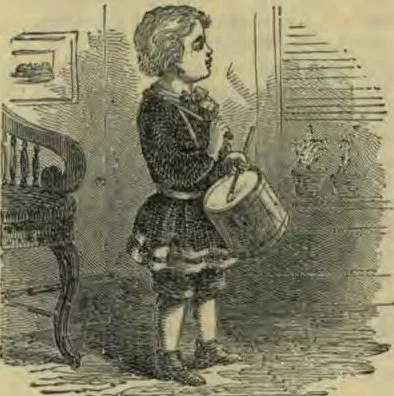
LITTLE Freddy lives in the city; and last Fourth of July, he saw the soldiers go marching by in their bright uniforms, with drums beating, fifes playing, and flags and streamers flying in the breeze. He was wild with excitement at the sight, and since then it has been his ambition to be a soldier. He begged so hard for a drum and fife that for all mamma could say about the noise and so on, what did papa do but come bringing home a drum for Freddy on Christmas Eve! He said he had been a boy, and knew how boys felt. Mamma did feel a little out of patience about it; but it was Christmas, when everything seemed to resound with “Peace on earth, good will to men”; and what could she do but keep still, and let Freddy have his drum!
In the morning, when the little fellow climbed out of bed, there, by his well-filled stocking, hung a drum and a tin fife, the very things he had been wishing for so long. It was quite a question with him how Santa Claus should know just what he most wanted, and just how big a drum to bring him.
Well, there was music in the house that day, and the next, and the next, until mamma heartily wished that drum and fife had never come into the house. Just as sure as baby was nicely asleep, and mamma settled in her rocker for an hour’s quiet reading, “rub-a-dub-dub, rub-a-dub-dub,” would echo along the hall, and in marches our drummer-boy; and ten chances to one, if baby was not waked up crying by the noise.
But now the warm weather has come—for which none of us are sorry—and as Freddy marches bravely up and down the lawn, he certainly feels “every inch a soldier.” He thinks it would be a very fine thing to go away to war and fight, like real soldiers; but, then, he is a little boy, and does not know how much it means to be a soldier. There is a great difference between playing soldier and being a soldier.
Freddy’s mother tells him that soldiers must be brave, and so it will not do for him to cry when he is hurt or vexed. And he does try very hard to be brave when he has his little troubles; so some good has come of his having a drum. His mamma also tells him that all little boys, and girls too, may be soldiers of Jesus; and that is the kind of soldier she would like her little boy to be. Now we wonder how many of the children who read this are going to be soldiers of Jesus!

The Little Brown Seed.

“I'm of no use,” said a little brown seed; “Where shall I go to hide? I'm little and brown, with nobody's love, And ugly beside.”
So she rolled, and she rolled very quickly away, And tumbled on the ground; The rain came in torrents, and fell upon her And all things around.
And she felt herself sinking in darkness beneath, Poor little faithless seed! Where never an eye could see her sad fate, She was hid indeed!
The little brown seed lay still in the earth, To herself still sighing— Till at last with an effort she roused up, and cried, “I'll begin trying; I'll try to stop fretting, for 'tis of no use; And if I've nobody's love, I'll look up in hope, for there is One who will see,— The dear God above.”
Up, up she went, till at last she saw, The lovely, bright blue sky; Oh! the beautiful spirit had found release, The summer was nigh.
Of the brightness and beauty that grew upon her, I cannot begin to speak; Crowned with flowers she stood, beloved by all, So lovely—yet meek.
—The Common People.
Continue reading: Our Linnets