Now it has been the purpose of Satan all these centuries to put something else in the place of Christ, himself if possible,—at all events, to turn away the minds of men from the worship of God as manifested in Jesus Christ. By reading two prophecies, and putting them together, we shall see the force of this working of Satan, through an agency through which his work has been carried on more successfully and for a longer time than through any other agency in the history of the world.
“How art thou fallen from heaven, O Lucifer, son of the morning! how art thou cut down to the ground, which didst weaken the nations! For thou hast said in thine heart, I will ascend into heaven, I will exalt my throne above the stars of God: I will sit also upon the mount of the congregation, in the sides of the north: I will ascend above the heights of the clouds; I will be like the Most High.” Isa. 14:12-14. This scripture evidently speaks of the fall of Satan and the reason for it; for Lucifer, “the light bearer,” by his own course of rebellion became Satan, “the adversary.” “Let no man deceive you by any means; for that day shall not come, except there come a falling away first, and that man of sin be revealed, the son of perdition; who opposeth and exalteth himself above all that is called God, or that is worshiped; so that he as God sitteth in the temple of God, showing himself that he is God.” 2 Thess. 2:3, 4. Every one knows that this prophecy refers to the papacy, and every one who puts those two scriptures together can see that they represent exactly the same spirit,—I will exalt myself above God.
In the papacy we have, in organized form, the greatest manifestation of the working of Satan that this world has ever seen; and the whole principle of the papacy is self-exaltation, the very principle that characterized Satan at the beginning, the very principle which led to his downfall. And this organized power steps forth and claims just what this prophecy says that it should claim,—that it stands in the place of God. The pope, the head of this church, is called the vicar of Christ, or the vicegerent of Christ, that is, he is the one who rules in the place of Christ. Or, in other words, he has put himself in the place of Christ. He poses as the substitute of Christ. That is simply the same old scheme of the devil. He wanted Christ’s place, he wanted the honor and worship that belong to Christ; and this organized manifestation of the spirit and the working of Satan is the same thing over again. It is putting some one else in the place of Christ. And not only that, but the papacy claims to control the saving power of God, that is, his creative power.
THE PAPACY CLAIMS SAVING POWER.
The fact that the papacy claims to exercise the saving power of God, is evident from the following extract from De Harbe’s “Full Catechism of the Catholic Religion,” approved by Catholic authorities, and published in New York by the Catholic Publishing Association, in 1883. The extract is from page 145: “Every one is obliged, under pain of eternal damnation37, to become a member of the Catholic Church, to believe her doctrine, to use her means of grace, and to submit to her authority. Hence the Catholic Church is justly called the only saving church. To despise her is the same as to despise Christ, namely, his doctrine, his means of grace, and his powers. To separate from her is the same as to separate from Christ, and to forfeit eternal salvation. Therefore St. Augustine and the other bishops of Africa pronounced, A. D. 412, at the council of Zirta, this decision: ‘Whosoever is separated from the Catholic Church, however commendable, in his opinion, his life may be, he shall, for this very reason, that he has at some time separated from the unity of Christ, not see life, but the wrath of God abideth on him.’”
The Catholic Church, the papacy,—that organization through which this spirit of Satan has been manifested, in opposing itself against God, in exalting itself above all that is called God, or that is worshiped,—that church claims to have the authority to control the saving grace and power of God. But what is the saving power of God?—It is creative power. We have learned that. What is the sign of God’s creative power, that he is the true God, and that our worship belongs to him because he is the Creator?—It is the true Sabbath.
But here comes another power, the papacy, claiming that it controls saving grace, and that there can be no salvation outside of the authority of the Catholic Church. And one of the charges made against Luther was that he had invented a new means of justification, so that the sinner could come to God and receive pardon without the intervention of church or priest. We have found that God, who is the Creator, and who in Jesus Christ dispenses his saving power freely to all who believe, has established the Sabbath as the sign of that power. Since the Catholic Church, the agency of Satan, claims to have saving power, and to dispense that power, the very logic of the situation demands that she should have a rival sign as a sign of her pretended power, and so she has it in the rival Sabbath. And as she claims that “to separate from her is the same as to separate from Christ and to forfeit eternal salvation,” thus putting herself in the place of Christ, so she demands that the sign of her power should be accepted instead of the true Sabbath, and says: “The keeping holy the Sunday is a thing absolutely necessary to salvation.”—A Sure Way to Find out the True Religion, by Rev. T. Baddeley, p. 95; published by P. J. Kennedy, Catholic Publisher, etc., New York.
WHO CAN SAVE?
Consider now that we have before us two days; one is the sign of the power of God in creation and salvation; the other has been instituted by Christ’s rival, and has been taken up as a Sabbath, or a pretended Sabbath, by that power (the papacy) through which Satan has wrought for a longer time, and in a more marked manner, than in any other power in the earth’s history. One is a sign, or a mark, of the power of God; the other is a sign, or a mark, of the rival power. The question then comes, In whom shall we trust for salvation—in the power of God in Christ, or in a rival power? In whom shall we place our confidence for forgiveness of sins—in God, the Creator of the heaven and the earth, or in that rival power that would exalt itself against God? Who can save—the one of whose power for the creation anew in Christ Jesus the true Sabbath is the sign, or mark, or the one of whose pretended power the false Sabbath is the sign or mark?
The Lord says: “Moreover also I gave them my Sabbaths, to be a sign between me and them, that they might know that I am the Lord that sanctify them. . . . And hallow my Sabbaths; and they shall be a sign between me and you, that ye may know that I am the Lord your God.” Eze. 20:12, 20. But the Catholic Church says: “It is worth while to remember that this observance of the Sabbath, in which, after all, the only Protestant worship consists, not only has no foundation in the Bible, but it is a flagrant contradiction of its letter, which commands rest on the Sabbath, which is Saturday. It was the Catholic Church which, by the authority of Jesus Christ, has transferred this to the Sunday, in remembrance of the resurrection of our Lord. Thus the observance of Sunday by the Protestants is an homage they pay, in spite of themselves, to the authority of the Catholic Church.”—“Plain Talk About the Protestantism of To-day,” p. 213.
What does this mean?—It means this; and the whole question is now clearly before us. The true Sabbath is the sign of the power of God in Jesus Christ, however, wherever, whenever manifested. In the creation of the heaven and the earth, in the deliverance of the children of Israel from Egypt, in the re-creation of the individual,—that is, in conversion, which is but the deliverance of the individual from spiritual bondage,—the Sabbath is the sign of the true God, and of his power manifested through Jesus Christ. The Sunday is but a pretended Sabbath, a rival Sabbath, the sign of the rival power.
[The following dispatches clipped from a single number of a New York daily, are republished by us simply as significant signs of the times.]
OMAHA, Jan. 18.—Roundsman Charles Bloom, one of the best-known and most efficient officers in the city and the recognized head of the anti-Catholic circle in his district, handed in his resignation to-day being charged with writing a letter to Mayor Bemis in which the lives of the mayor, the chief of police and Republican National Committeeman Rosewater were threatened. The letter was signed, “Guiteau-Pendergast,” and the writer declared that he would kill the mayor if certain things were not done.
The matter was kept quiet for a day or two, and then it was referred to the chief of police. The result was that to-day the chief preferred charges against Officer Bloom. He was taken before a meeting of the commissioners and required to write the letter as it was dictated to him by a member of the board. Not only was the handwriting found to be identical, but the same words were misspelled in both letters.
Bloom’s trial was set for to-morrow.
Some time ago the chief of police ordered all of the force to desist from mixing in politics. This was deemed to be necessary in view of the activity of the American Protective Association members on one side and the Catholics on the other. Bloom is said to be a member of the American Protective Association.
MILWAUKEE, Wis., Jan. 18.—W. A. Sims, the American Protective Association lecturer, was stoned by a mob at Kaukauna, Wis., last night. The mob got beyond the control of the police, and Governor Peck was called on for troops. During the lecture stones were thrown through the windows and several persons were hurt. At the close Sims demanded the protection of the police. The crowd at the stairs learned where he was going and followed, arriving at the bridge by a different route almost at the same time that Sims did.
Another demonstration was made, but the officers held the bridge against the mob, and all they could do was to throw stones and other missiles at the lecturer as he ran across the bridge. Governor Peck was not at Madison and did not get the message until this morning. After hiding with friends last night, Sims, escorted by a bodyguard of his American Protective Association friends, armed with rifles, was escorted to the depot this morning and took a train for Ashland.
KANSAS CITY, Mo., Jan. 18.—A subpoena has been issued for J. V. McNamara, the ex-Catholic priest, to whose lecture last Tuesday night the riot at Turner Hall was largely due. The complainant is J. F. Mullin, whose arrest McNamara caused in the hall the night of the lecture because he was said to have called the ex-priest a liar. It is believed that McNamara has left the city.
EMPORIA, Kan., Jan. 18.—The American Protective Association excitement has reached this city. Judge J. F. Culver, who admits he is president of a lodge that numbers nearly eight hundred members in this city, says he has received a letter threatening him and Wm. J. Murray with death. It was decorated with a skull and cross-bones. Lodges are being formed in all the surrounding cities, it is said. Yesterday a man named Bradley went to Burlington and attempted to organize a lodge, but was chased out of town.
“The Observance of the Day.”
[The following chapter from “The Sabbath in Puritan New England,” by Alice Morse Earle, is a sufficient answer to the assertion so frequently made that the so-called Blue Laws of New England never had any existence in fact but were the product of the imagination of a renegade minister who for bad conduct was expelled from the colony of Connecticut. It will be noted that the author whom we quote is entirely friendly not only to the Puritans, but to the day which they mistakenly honored as the Sabbath.]
THE so-called “False Blue Laws” of Connecticut, which were foisted upon the public by the Reverend Samuel Peters, have caused much indignation among all thoughtful descendants and all lovers of New England Puritans. Three of his most bitterly resented false laws which refer to the observance of the Sabbath read thus:—
No one shall travel, cook victuals, make beds, sweep house, cut hair, or shave on the Sabbath day.
No woman shall kiss her child on the Sabbath or fasting day.
No one shall ride on the Sabbath day, or walk in his garden or elsewhere except reverently to and from meeting.
Though these laws were worded by Dr. Peters, and though we are disgusted to hear them so often quoted as historical facts, still we must acknowledge that38though in detail not correct, they are in spirit true records of the old Puritan laws which were enacted to enforce the strict and decorous observance of the Sabbath, and which were valid not only in Connecticut and Massachusetts, but in other New England States. Even a careless glance at the historical record of any old town or church will give plenty of details to prove this.
Thus in New London we find in the latter part of the seventeenth century a wicked fisherman presented before the court and fined for catching eels on Sunday; another “fined twenty shillings for sailing a boat on the Lord’s day;” while in 1670 two lovers, John Lewis and Sarah Chapman, were accused of and tried for “sitting together on the Lord’s day under an apple tree in Goodman Chapman’s Orchard,”—so harmless and so natural an act. In Plymouth a man was “sharply whipped” for shooting fowl on Sunday; another was fined for carrying a grist of corn home on the Lord’s day, and the miller who allowed him to take it was also fined. Elizabeth Eddy of the same town was fined, in 1652, “ten shillings for wringing and hanging out clothes.” A Plymouth man, for attending to his tar-pits on the Sabbath, was set in the stocks. James Watt, in 1658, was publicly reproved “for writing a note about common business on the Lord’s day, at least in the evening somewhat too soon.” A Plymouth man who drove a yoke of oxen was “presented” before the court, as was also another offender, who drove some cows a short distance “without need” on the Sabbath.
In Newbury, in 1646, Aquila Chase and his wife were presented and fined for gathering peas from their garden on the Sabbath, but upon investigation the fines were remitted, and the offenders were only admonished. In Wareham, in 1772, William Estes acknowledged himself “Gilty of Racking Hay on the Lord’s day” and was fined ten shillings; and in 1774 another Wareham citizen, “for a breach of the Sabbath in puling apples,” was fined five shillings. A Dunstable soldier, for “wetting a piece of an old hat to put in his shoe” to protect his foot—for doing this piece of heavy work on the Lord’s day was fined, and paid forty shillings.
Captain Kemble of Boston was, in 1656, set for two hours in the public stocks for his “lewd and unseemly behavior,” which consisted in his kissing his wife “publiquely” on the Sabbath day, upon the doorstep of his house, when he had just returned from a voyage and absence of three years.
Abundant proof can be given that the act of the legislature in 1649 was not a dead letter which ordered that “whosoever shall prophane the Lords daye by doeing any seruill worke or such like abusses shall forfeite for euery such default ten shillings or be whipt.”
The Vermont “Blue Book” contained equally sharp “Sunday laws.” . . . The New Haven code of laws, more severe still, ordered that “Profanation of the Lord’s day shall be punished by fine, imprisonment, or corporeal punishment; and if proudly, and with a high hand against the authority of God—with death.”
Lists of arrests and fines for walking and travelling unnecessarily on the Sabbath might be given in great numbers, and it was specially ordered that none should “ride violently to and from meeting.” . . . One offender explained in excuse of his unnecessary driving on the Sabbath that he had been to visit a sick relative, but his excuse was not accepted. A Maine man who was rebuked and fined for “unseemly walking” on the Lord’s day protested that he ran to save a man from drowning. The court made him pay his fine, but ordered that the money should be returned to him when he could prove by witnesses that he had been on that errand of mercy and duty. As late as the year 1831, in Lebanon, Connecticut, a lady journeying to her father’s home was arrested within sight of her father’s house for unnecessary travelling on the Sabbath.
Sabbath breaking by visiting abounded in staid Worcester town to a most base extent, but was severely punished, as local records show. . . .
Even if they committed no active offense the colonists could not passively neglect the church and its duties. As late as 1774 the First Church of Roxbury fined non-attendance at public worship. . . . Captain Dennison, one of New Haven’s most popular and respected citizens, was fined fifteen shillings for absence from church. William Blagden, who lived in New Haven in 1647, was “brought up” for absence from meeting. He pleaded that he had fallen into the water late on Saturday, could light no fire on Sunday to dry his clothes, and so had lain in bed to keep warm while his only suit of garments was drying. In spite of this seemingly fair excuse, Blagden was found guilty of “sloathefulness” and sentenced to be “publiquely whipped.” Of course the Quakers contributed liberally to the support of the court, and were fined in great numbers for refusing to attend the church which they hated, and which also warmly abhorred them; and they were zealously set in the stocks, and whipped, and caged, and pilloried as well,—whipped if they came and expressed any dissatisfaction, and whipped if they stayed away.
Not content with strict observance of the Sabbath day alone, the Puritans included Saturday evening in their holy day, and in the first colonial years these instructions were given to Governor Endicott by the New England Plantation Company: “And to the end that the Sabeth may be celebrated in a religious manner wee appoint that all may surcease their labor every Satterday throughout the yeare at three of the clock in the afternoone, and that they spend the rest of the day in chatechizing and preparaceon for the Sabeth as the ministers shall direct.”
All the New England clergymen were rigid in the prolonged observance of Sunday. From sunset on Saturday until Sunday night they would not shave, have rooms swept, nor beds made, have food prepared, nor cooking utensils and tableware washed. . . .
It was very generally believed in the early days of New England that special judgments befell those who worked on the eve of the Sabbath. Winthrop gives the case of a man who, having hired help to repair a milldam, worked an hour on Saturday after sunset to finish what he had intended for the day’s labor. The next day his little child, being left alone for some hours, was drowned in an uncovered well in the cellar of his house. “The father freely, in open congregation, did acknowledge it the righteous hand of God for his profaning his holy day.” . . .
Sunday night, being shut out of the Sabbath hours, became in the eighteenth century a time of general cheerfulness and often merry-making. This sudden transition from the religious calm and quiet of the afternoon to the noisy gayety of the evening was very trying to many of the clergymen, especially to Jonathan Edwards, who preached often and sadly against “Sabbath evening dissipations and mirth-making.” In some communities singing-schools were held on Sunday nights, which afforded a comparatively decorous and orderly manner of spending the close of the day.
Sweet to the Pilgrims and to their descendants was the hush of their calm Saturday night, and their still, tranquil Sabbath,—sign and token to them, not only of the weekly rest ordained in the creation, but of the eternal rest to come. The universal quiet and peace of the community showed the primitive instinct of a pure, simple devotion, the sincere religion which knew no compromise in spiritual things, no half-way obedience to God’s Word, but rested absolutely on the Lord’s day—as was commanded. No work, no play, no idle strolling was known; no sign of human life or motion was seen except the necessary care of the patient cattle and other dumb beasts, the orderly and quiet going to and from the meeting, and at the nooning, a visit to the churchyard to stand by the side of the silent dead. This absolute obedience to the letter as well to the spirit of God’s Word was one of most typical traits of the character of the Puritans, and appeared to them to be one of the most vital points of their religion.
Indulgences, Papal and Protestant.
By H. P. Holser
At the entrance to the Catholic village of Oberwyl, near Basel, attached to a crucifix, is the declaration that whoever prays five Ave Marias and Paternosters before this image will be granted forty days' indulgence. The fact that Catholics grant indulgences has ceased to be surprising, but who would believe that Protestants would do the same thing? One of the chief causes that led to the Reformation was the sale of indulgences. This is really what started Luther on his crusade against Rome. This is what led people to protest and thus become Protestants more than anything else.
But prophecy declares that Protestants would yet render homage and honor to Rome. We see this fulfilling to-day. There is a general tendency Romeward among Protestants. They took the first step in this direction when they united the church with the civil powers, and every religious law made by the State is an additional step in the same direction. By making Sunday laws, Protestants render special homage to Rome, for they are thus elevating and enforcing an institution for which there is no Bible authority, but which rests solely on the authority of the Catholic Church. And even more, Sunday is the usurper of the place of the Lord's Sabbath, and thus, in sustaining it, Protestants virtually reject God's institution and accept, in its stead, that of the papacy.
But what about Protestant indulgences? They come in along with the Sunday laws. When we once accept the principles of Rome, we are inevitably led to the same acts, and sooner or later we shall see growing up among Protestants39the same things that made Rome so obnoxious. And it falls to the lot of the far-famed pious Protestant city of Basel to furnish us an illustration of the truthfulness of this statement.
This city has a Sunday law, forbidding work on this day, and punishes with fines or imprisonments the naughty people that do not obey it. But for the last three Sundays of 1893, this law was suspended, and everybody could work to his heart's content, without fear of being disturbed by modern inquisitors. Thus, the whole city was granted a three-weeks' indulgence. We now ask, How much better is this than papal indulgences? The principle is the same. First, it is declared to be wrong to work on Sunday, and at another time it is permitted as all right. The true nature of this transaction is more apparent when we consider that Sunday is a religious institution, taking the place of the Sabbath. Remove the religious element, and there would be no demand for Sunday laws. The religious part is the soul and life of the institution. We are zealously taught that it is wrong to work on this day. This being the case, when the State gives everybody permission to work on it, the State virtually grants an indulgence to do wrong; and is thus doing precisely the same work as the papacy did in granting indulgences in the days of Tetzel.
By taking such a course, the State, or false Protestantism through the State, like the papacy, elevates itself above God. God being righteous, cannot pronounce the transgression of his law sin at one time and not sin at another. It may be argued that God also permits work on the Sabbath. True, but on an entirely different basis. He permits works of mercy, but such works are lawful on every Sabbath. But by punishing people for Sunday work at one time, and at another granting everybody permission to work on Sunday, the State virtually pretends to do what God cannot do. This is a faithful image to the papacy. It not only puts man in the place of God, but elevates him above God. This is why God warns us so solemnly against it. Read Rev. 14:9, 10.
H. P. HOLSER.
Basel, Switzerland, Jan. 10.
Catholic Parishes Organize Against the American Protective Association
“REPRESENTATIVES of twenty-six parishes in Milwaukee,” says the Catholic Review, “have founded an organization to defend their possession of their civic rights against the attacks of the American Protective Association.” The Review significantly adds:—
Our Wisconsin co-religionists show that they value their rights of conscience and of Constitution by promptly combining to prevent these rights from being infringed, abridged or destroyed. They are acting in self-defense, forced to do so by the aggressions of the Know Nothing conspiracy; but in trying to defend themselves they may have to give blows as well as to ward them off. To our intense regret, the American Protective Association has coerced us into this attitude. On that treasonable secret society lies the blame for all the trouble that will ensue.
The signs of the times are ominous. The Christian will watch with interest the gathering clouds, and will warn as many as possible of the coming storm; but he will, at the same time, remember that “the weapons of our warfare are not carnal, but mighty through God to the pulling down of strongholds.” “All they that take the sword shall perish with the sword.”
Among other items under the general heading, “Sabbath Reform,” the Christian Statesman publishes this from Kansas City, Mo.:—
On a recent Sabbath [Sunday the Statesman means] the bar of the Centropolis Hotel bore this inscription, “Bar closed. Bartender gone to church. Go thou and do likewise.”
This reminds us of a statement published some years ago in the California Prohibitionist, namely, “If the saloons will close on Sunday it is about all we can ask.” The Statesman is professedly “devoted to the whole circle of reforms,” but everything else is made secondary to a puritanical Sunday. The Statesman evidently agrees with the California paper that Sunday closing is about all that can be asked of the saloons.
The Sunday Law Is Legal.
MUNICIPAL COURT JUDGE REID rendered a decision in the Krech case yesterday. The decision sustains the legality of the law requiring the closing of all places of business on Sunday and overrules the defendant’s demurrer to the complaint. Henry Krech, the Fife hotel barber, will therefore have to stand his trial upon the charge of shaving customers on Sundays.
Judge Reid’s decision first recites alleged facts in relation to the case and then quotes the Sunday law. It then takes up the defendant’s objection that the law is unconstitutional in that it is discriminating in allowing hotels, livery stables and restaurants, to keep open while forbidding other business establishments to do so, and is thereby class legislation. The decision holds that while the constitutional provision forbids legislation in favor of any particular class of citizens, it does not follow that the act in question affects any particular class, it being directed against certain kinds of business and not in any wise prohibiting all citizens from engaging in the exempted lines if they so desire. The first ground of objection to the validity of the act is therefore decided to be untenable.
The defendant’s second objection asserts that the Sunday law is designed to compel observance of the Christian religion, and therefore illegal; that to be compelled to close his place of business amounts to a molestation and disturbance of both his person and property, and that the religious liberty of the Hebrew would be thus violated by such compulsory observance. The court holds that if he were correct in his claim the law could not stand against his objection, but that he is in error in that the law does not intend to aid or repress any religious sect, but simply to provide a day of rest and to preserve the public health. In support of this the court quotes cases precedent, and disallows the defendant’s contention.
In regard to the claim of the defendant that shaving is not a trade, but a necessity, the court decides that such a question could best be settled by a jury trial. He therefore overrules the demurrer and gives leave to plead.—Sunday Ledger, Tacoma, Wash., Jan. 14.
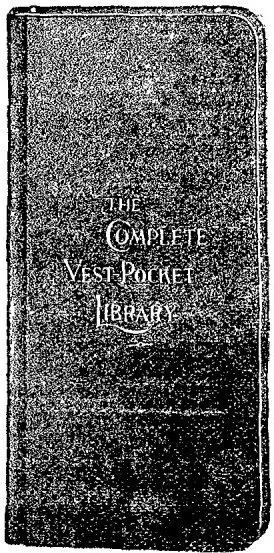
THE COMPLETE VEST-POCKET LIBRARY STANDS PRE-EMINENT,
in that while it is no larger than the average of such books, and of convenient size to carry in the vest-pocket, it gives, besides other useful information, THE CORRECT SPELLING AND PRONUNCIATION OF 45,863 WORDS, OR ABOUT TWICE AS MANY AS ANY SIMILAR WORK.
As its name indicates, it is much more than a dictionary. It contains:—
1. THE COLUMBIAN WORD BUILDER, a very simple and yet exceedingly useful device which more than doubles the capacity of the dictionary.
2. GUIDE TO PRONUNCIATION.
3. A VERY FULL LIST OF ABBREVIATIONS.
4. THE COLUMBIAN PRONOUNCING DICTIONARY AND SPELLER (135 pages).
5. THE COLUMBIAN PRONOUNCING AND STATISTICAL GAZETTEER OF THE WORLD.
6. THE COLUMBIAN DIGEST OF PARLIAMENTARY PRACTICE.
7. THE COLUMBIAN RAPID CALCULATOR, AND COMPEND OF BUSINESS AND SOCIAL FORMS.
8. THE COLUMBIAN PERPETUAL MEMORANDUM, STAMP BOOK AND THREE YEARS' Calendar.
9. TABLES OF WEIGHTS AND MEASURES.
The whole forms a book only 5⅝ by 2¾ inches and only three-eighths of an inch thick.
In Leather, 50c; Cloth, 25c.
Order of PACIFIC PRESS,
43 Bond Street, New York City.
Anglican Synod Denounces Sunday Street Cars
THE Anglican Synod, recently in session in Montreal, adopted resolutions denouncing Sunday street cars, the opening of parks on Sunday, and pauper immigration. The discussion of Sunday cars by the synod brought to light the fact that many of the clergymen were in the habit of patronizing the street railways on that day. One member of the synod defended the cars on the ground of convenience and said that cabs and other carriages made more confusion on Sunday than did the cars. The resolution was, however, finally adopted unanimously.
Chicago in the Grasp of Rome.
CHICAGO, Ill., Jan. 22.—A Washington special to the Inter-Ocean says a delegation of American and German Democrats from Chicago recently had a secret interview with Cleveland, having gone to Washington incog., to protest against the appointment of Martin Russell as collector, and of Frank Lawler as marshal, on the ground that this would put the entire city in Roman Catholic control, and that the effects were already injurious to the party.
The dispatch states that a paper was filed with the President showing that the local Roman Catholics already fill the following offices: mayor, chief of police, chief of the fire department, postmaster, State’s attorney, clerk of Circuit Court, clerk of Probate Court, clerk of Superior Court, a number of judges, forty-five out of sixty-eight aldermen, 90 per cent. of the police force, 80 per cent. of the members of the fire department, and 67 per cent. of the school teachers.
An Unparalleled Offer.
By Editor
FOR $1.25 we will send the AMERICAN SENTINEL to any address for one year and give as a premium one copy of “The Marvel of Nations.” This book is bound in boards; is cloth-covered, embossed in jet and gold, and has always sold for $1.00 per copy. Our offer reduces it to 25 cents with the Sentinel. The book will be sent either to the subscriber or to the one securing the subscription. This will enable old subscribers to obtain the book for themselves for only twenty-five cents by simply obtaining one new subscriber at the regular price and adding twenty-five cents for the book, making $1.25 in all.
WE have received Vol. 1 of the “Religious Liberty Library,” Nos. 1 to 6, 126 pages, neatly bound in cloth, making a volume of convenient size, and costing only 75 cents. This is something that every Seventh-day Adventist, and especially every minister, ought to have. Address all orders to the I. R. L. Association, 271 West Main Street, Battle Creek, Mich.
WE have secured a quantity of the Catholic Mirror pamphlets on the Sabbath question, at such rates as to enable us to offer them to our customers at better terms than formerly. Single copies, ten cents as formerly; three copies to one address, twenty-five cents; ten copies to one address, seventy cents. Pacific Press, 43 Bond St., New York City.
Rome's Claim to Never Change
By Editor
It is the boast of Rome that she “never changes;” therefore be not deceived by her fair professions of love for free institutions.
IN last week’s SENTINEL, fourth line from bottom of first column, on page 26, instead of, “Upon position and decided movements,” etc., read, “Open, positive and decided movements,” etc.
Do you want a SENTINEL index for 1893? If so send a postal card to this office saying so, and one will be sent to you. You ought to have it by all means if you have kept a file of the paper.
THE Examiner (Baptist) notes the fact that the Republic of Nicaragua has passed an act of universal religious toleration, and remarks: “This is a long step forward.” Indeed it is a long step; much longer than has been taken by some of our States, which practically tolerate only Sunday-keepers.
THE bill creating in this country a censor of the press, which was before the last Congress, has been re-introduced in the present Congress by Mr. Hayes of Iowa. The bill empowers the postmaster general to exclude from the mails any publication which in his opinion devotes too much attention to reports of crime or to “stories of immoral deeds.”
An exchange remarks that the clergy of St. Louis are on record as favoring the taxation of Church property; but says that “one minister opposed the reform. He took the ground that as Protestants had more property in Missouri than the Catholics, it would be unwise to tax the churches as Protestants would be the losers.” Pretty Protestantism that! Right is right no matter whom it hurts. If Church property ought to be taxed—and it certainly should—it ought to be taxed no matter to whom it belongs. An infidel paper, the Boston Investigator, makes this comment on the position of the “Protestant” minister who makes the plea for exemption:—
We fear that this is about the size of the morality of Protestants. They oppose a measure that gives somebody else a greater advantage than they themselves enjoy from it. This seems to be the way that a great deal of justice gets into the world. When one party is jealous of another, then the right triumphs.
The Investigator mistakes in supposing that such men are Protestants. It is such morality, masquerading under the name of Protestantism and Christianity, that makes infidels. If all who profess the Christian name and who call themselves Protestants were such indeed, the Investigator would be without occupation, or would soon be preaching the faith it now seeks to destroy.
“ROME never changes,” hence Rome of the Spanish Inquisition and of the massacre of St. Bartholomew, and of Smithfield, is the same Rome which to-day fawns upon and flatters the American Republic while she surely and swiftly casts her chains about its free institutions that she may, erelong, drag it at her chariot wheels.
THE Christian Statesman complains that “the Phipps Conservatory in Schenley Park, Pittsburg, was thrown open to the public, Sabbath, January 7, and four thousand visitors are reported.” The Statesman adds, “This in Sabbath-loving Pittsburg, while in Sabbathless France the Sabbath sentiment is increasing.” This is truly awful! What is the country coming to when people even in Pittsburg will persist in visiting a conservatory on Sunday? Mind you, a conservatory! a wicked place in which flowers actually grow and exhibit their gorgeous tints and exhale their sweet perfumes on Sunday! How long, American Sabbath Union, oh, how long? Cannot the papacy or somebody put a stop to such things ere the “American Sabbath” be—smothered in a bank of winter roses—murdered in an evil resort wherein flowers are permitted to run opposition to the Sunday pulpit?
ACCORDING to the Philadelphia Inquirer of the 20th inst., a movement is on foot in that city to enforce the Sunday law of 1794. A petition to this effect was recently handed to the mayor. It was said to emanate from the Law and Order Society and was to have been presented by Lewis D. Vail, its attorney; but for some reason he did not do so. A clerk in his office said the movement was inspired by Rev. Dr. Fernley, secretary of the Philadelphia Sabbath Association, so-called, and that Mr. Vail declined association with it because he believed it futile. The mayor declines to express an opinion. Cigar and candy stores are, it seems, the principal offenders at present.